- Market Value (2025): USD 1.4 Bn
- Estimated Value (2026): USD 1.5 Bn
- Forecast Value (2036): USD 2.6 Bn
- CAGR (2026-2036): 5.8%
What is the Arterial Blood Sampling Systems Market forecast to be worth by 2036?
USD 1.5 billion in 2026 to USD 2.6 billion by 2036 at a 5.8% CAGR.
- The Arterial Blood Sampling Systems Market was valued at USD 1.4 billion in 2025.
- Demand is projected to increase from USD 1.5 billion in 2026 to USD 2.6 billion by 2036.
- The market is forecast to record 5.8% CAGR from 2026 to 2036 as hospitals and emergency departments standardize blood gas sampling in high-risk respiratory care.
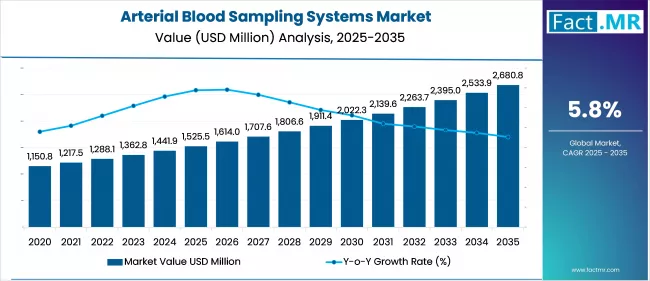
Arterial Blood Sampling Systems Market Value Analysis | Source: Fact.MR
What are the defining numbers behind Arterial Blood Sampling Systems Market growth?
An absolute opportunity of USD 1.1 billion is expected between 2026 and 2036.
- Demand Drivers in the Market
- Respiratory-care teams need arterial samples when oxygenation and carbon dioxide retention must be measured during severe asthma, COPD flare-ups or ventilator adjustment.
- CDC/NCHS reported that 8.6% of U.S. adults had current asthma in 2024, highlighting the substantial prevalence of respiratory disease in the adult population.
- COPD flare-ups and ventilator management keep arterial blood gas testing relevant because clinicians need direct oxygen and carbon dioxide values.
- Critical-care teams need pre-heparinized syringes and arterial-line sampling kits that preserve whole-blood stability before analysis.
- Emergency teams need consistent sampling steps when dyspnea, shock, overdose or severe infection requires quick acid-base assessment.
- Key Segments Analyzed
- By Product: Arterial Blood Sampling Systems are expected to hold 66.50% share in 2026, supported by direct arterial puncture and arterial-line collection.
- By Indication: Respiratory Disorders are projected to account for 56.20% share in 2026, owing to recurring blood gas assessment in asthma and COPD care.
- By End Use: Hospitals are anticipated to represent 45.60% share in 2026, reinforced by ICU and emergency workflows that require validated sample collection.
- Analyst Opinion at Fact.MR
- Shambhu Nath Jha, Principal Consultant at Fact.MR, states, “The commercial test in this market is more than a syringe. It is whether the supplier helps a hospital protect sample quality from the bedside to the analyzer. Demand is expected to favor portfolios that combine arterial puncture devices with line-draw options. Heparin balance, clear labeling and training support are expected to strengthen supplier selection.”
- Strategic Implications
- Device makers should keep arterial puncture and arterial-line collection options together so hospitals have one route for acute-care sampling.
- Hospital distributors should prioritize sterile availability, lot traceability and staff education material because sample errors often begin before analysis.
- Blood gas analyzer vendors should pair instruments with compatible sampling devices to reduce manual transfer steps and patient-sample mismatch risk.
- Regional sales teams should match product messages to ICU, emergency and respiratory departments instead of treating blood collection as one broad category.
The USA is projected to record 6.3% CAGR through 2036, supported by respiratory disease burden and CLIA-regulated testing scale. Germany is forecast to advance at 6.0% CAGR due to hospital and emergency-care intensity. South Korea is estimated to reach 5.4% CAGR as bed density sustains bedside testing. France is anticipated to post 4.8% CAGR through emergency and critical-care use. Italy is expected to register 4.2% CAGR as hospital activity supports measured replacement cycles.
How does the Arterial Blood Sampling Systems Market break down by segment?
Arterial Blood Sampling Systems are projected to lead Product at 66.5%; Respiratory Disorders lead Indication at 56.2%.
Which Product dominates?
Arterial Blood Sampling Systems are expected to hold 66.5% share in 2026.
Arterial blood sampling systems lead because they create the specimen used for blood gas analysis. The product group covers arterial syringes, arterial-line draw devices and related kits used before analyzer testing begins.
Direct arterial products remain favored when clinicians need a controlled specimen for blood gas analysis. Vented syringes, balanced heparin coating and secure caps help protect sample quality before analyzer testing begins.
What leads the Indication segment?
Respiratory Disorders are projected to account for 56.2% share in 2026.
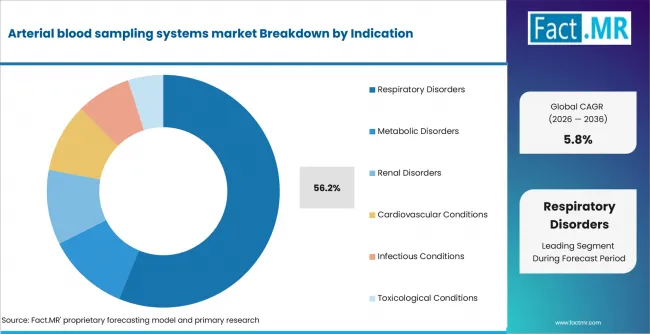
Arterial Blood Sampling Systems Market Analysis By Indication | Source: Fact.MR
Respiratory disorders lead because arterial blood gases measure oxygen and carbon dioxide directly. The specimen is valuable when oxygen saturation, ventilation status or acid-base balance must be checked quickly.
WHO reported in April 2026 that asthma affected an estimated 363 million people in 2023. In severe or deteriorating respiratory episodes, arterial blood gas testing can provide direct assessment of oxygenation and ventilation through PaO₂ and PaCO₂ measurements.
How does End Use shape demand?
Hospitals are anticipated to represent 45.6% share in 2026.
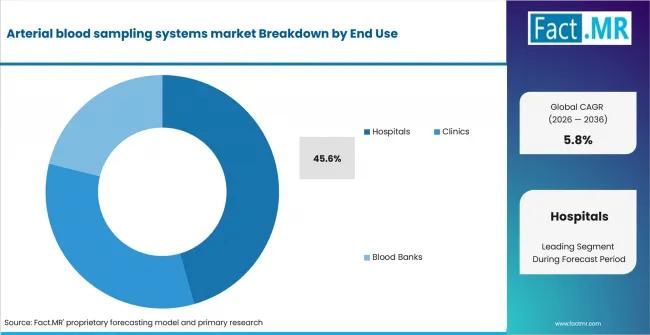
Arterial Blood Sampling Systems Market Analysis By End Use | Source: Fact.MR
Hospitals lead because arterial sampling is tied to emergency rooms, intensive care units and recovery settings. These areas have trained staff, analyzer access and repeat testing needs for unstable patients.
Hospital-based acute care remains central to sampling-device use because arterial blood gas testing is concentrated where trained staff and analyzers operate together. ICU and emergency teams also repeat specimens when a patient’s respiratory or metabolic status changes quickly.
What is accelerating Arterial Blood Sampling Systems Market adoption, and what is holding it back?
Demand is expected to rise through respiratory testing, ICU use and sample-quality controls. Market pace is moderated by training burden, price pressure and use of alternate sample routes.
Drivers Impact Analysis
| DRIVER | (~) % IMPACT ON CAGR | GEOGRAPHIC RELEVANCE | IMPACT TIMELINE |
|---|---|---|---|
| Respiratory blood gas assessment in acute care | +1.5% | Global | Short term (<= 2 years) |
| ICU and arterial-line sampling standardization | +1.2% | North America, Europe, East Asia | Medium term (2-4 years) |
| Emergency department diagnostic workflows | +0.9% | USA, Germany, France | Medium term (2-4 years) |
| Sample identification and preanalytical controls | +0.7% | Global | Long term (>= 4 years) |
Source: Fact.MR analysis. Updated Sep 16, 2026
Opportunity Impact Analysis
| OPPORTUNITY | (~) % IMPACT ON CAGR | GEOGRAPHIC RELEVANCE | IMPACT TIMELINE |
|---|---|---|---|
| Closed arterial-line sampling kits | +1.0% | North America, Europe | Medium term (2-4 years) |
| Training-led conversion from basic syringes | +0.8% | Global | Short term (<= 2 years) |
| Analyzer-linked sample identification | +0.6% | North America, Europe, South Korea | Long term (>= 4 years) |
Source: Fact.MR analysis. Updated Sep 16, 2026
Restraints Impact Analysis
| RESTRAINT | (~) % IMPACT ON CAGR | GEOGRAPHIC RELEVANCE | IMPACT TIMELINE |
|---|---|---|---|
| Operator skill requirements for arterial puncture | -0.6% | Global | Short term (<= 2 years) |
| Hospital budget control on disposable devices | -0.5% | Europe, Asia Pacific | Medium term (2-4 years) |
| Use of alternate sample routes where clinically acceptable | -0.4% | Global | Long term (>= 4 years) |
Source: Fact.MR analysis. Updated Sep 16, 2026
Which countries are scaling the Arterial Blood Sampling Systems Market through 2036?
- The country comparison spans 2.1 percentage points between the USA and Italy across the forecast period.
- The USA remains 0.3 percentage point above Germany through respiratory disease burden and regulated laboratory testing scale.
- Germany remains 0.6 percentage point above South Korea as hospital emergency activity sustains acute-care sampling intensity.
- South Korea remains 0.6 percentage point above France, supported by high hospital bed density and broad medical access.
- France remains 0.6 percentage point above Italy as emergency passages keep hospital sampling demand steady.
Comparable CAGRs create different entry conditions due to respiratory disease burden, emergency-care flow, hospital bed density and laboratory governance. Full report coverage includes North America, Latin America, Western Europe, Eastern Europe, East Asia, South Asia and Pacific, Middle East and Africa.
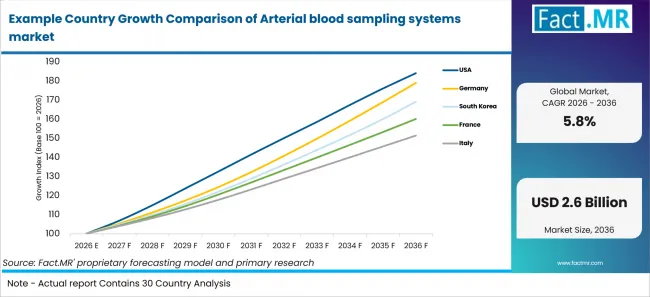
Example Country Growth Comparison Of Arterial Blood Sampling Systems Market | Source: Fact.MR
| Country | CAGR (2026-2036) |
|---|---|
| USA | 6.3% |
| Germany | 6.0% |
| South Korea | 5.4% |
| France | 4.8% |
| Italy | 4.2% |
Source: Fact.MR analysis. Updated Sep 16, 2026
What supports USA adoption?
6.3% CAGR, supported by respiratory disease burden and CLIA-regulated testing scale.
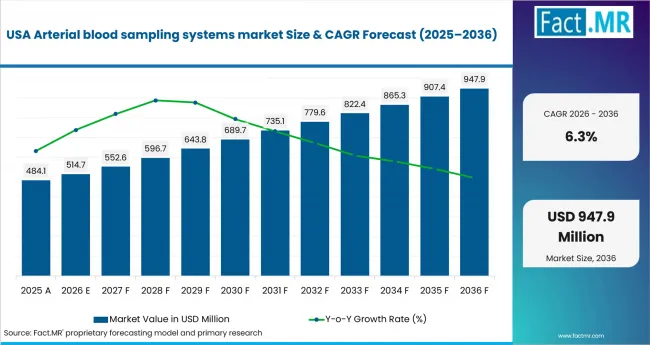
Arterial Blood Sampling Systems Market Country Value Analysis | Source: Fact.MR
CMS reported 302.3 thousand active or certified clinical laboratory providers in Q1 2026, highlighting the scale of the U.S. CLIA-regulated diagnostic testing infrastructure. Hospitals and other appropriately certified laboratories form part of the clinical settings in which blood-gas testing may be performed.
What is supporting Germany’s growth?
6.0% CAGR, reinforced by hospital intensity and emergency treatment volume.
Germany is projected to benefit from high emergency-care activity inside hospitals. Destatis reported 13.0 million ambulatory emergency treatments in German hospitals in 2024. This substantial acute-care volume provides context for diagnostic activity in emergency settings, where blood-gas analysis can support rapid assessment of respiratory, acid-base and metabolic status.
How is South Korea developing demand?
5.4% CAGR, driven by hospital capacity and broad medical access.
South Korea is anticipated to see steady use because hospital capacity remains deep by OECD standards. OECD Health at a Glance 2025 reported 12.6 hospital beds per 1,000 population in Korea, substantially above the OECD average of 4.2 and highlighting the country’s comparatively high inpatient-care capacity.
What supports France adoption?
4.8% CAGR, shaped by emergency passages and critical-care capacity.
France is forecast to advance through emergency and critical-care activity. DREES reported 21.3 million emergency department visits in France in 2024. This emergency-care volume provides context for the scale of acute-care diagnostic activity.
How does Italy perform?
4.2% CAGR, led by hospital admission recovery and measured replacement cycles.
Italy is expected to close the displayed range because hospital admission activity supports stable sampling use. Italy’s Ministry of Health reported that 8,045,050 SDO hospital-discharge records, including records relating to healthy newborns, were transmitted by the regions in 2024. Arterial blood sampling demand remains tied to acute respiratory care, cardiovascular monitoring and hospital-based blood gas testing.
Who leads the Arterial Blood Sampling Systems Market?
Becton Dickinson has a direct fit through BD Preset and BD A-Line arterial blood collection syringes used for blood-gas testing. Radiometer and SARSTEDT add direct depth through dedicated blood-gas syringes and arterial or venous blood-gas collection products.
Competitive differentiation is likely to center on specimen integrity, heparinization, operator safety, sample identification and compatibility with blood-gas analysis workflows. Greiner Bio-One broadens the direct sampling set through its Blood Gas Sampling System, while SANLI Medical offers arterial blood collection syringes intended for clinical blood-gas analysis. These portfolios reinforce the importance of safe collection and consistent preanalytical sample quality.
Which companies are the key providers?
Key companies include Becton, Dickinson and Company (BD); Radiometer Medical ApS; SARSTEDT AG & Co. KG; Greiner Bio-One; and Liuyang SANLI Medical Technology Development Co., Ltd.
- Becton, Dickinson and Company (BD)
- Radiometer Medical ApS
- SARSTEDT AG & Co. KG
- Liuyang SANLI Medical Technology Development Co., Ltd.
- Greiner Bio-One
Bibliography
- Centers for Medicare & Medicaid Services. (2026, April 15). Provider of Services File - Clinical Laboratories [Data set].
- Direction de la recherche, des études, de l’évaluation et des statistiques. (2026, May 20). Les établissements de santé en 2024 - Édition 2026.
- Ministero della Salute. (2026, June 24). Rapporti annuali sui ricoveri ospedalieri.
- National Center for Health Statistics. (2026, April 16). Asthma. Centers for Disease Control and Prevention.
- Organisation for Economic Co-operation and Development. (2025, November 13). Health at a Glance 2025: Korea.
- SARSTEDT AG & Co. KG. (2026, February 17). Blood Gas Monovette® [Product specification].
- Statistisches Bundesamt. (2025, December 3). 13 Millionen Behandlungen in Notfallambulanzen im Jahr 2024 [13 million treatments in emergency departments in 2024].
- U.S. Food and Drug Administration. (2026, April 15). 510(k) premarket notification (K260128: BD Preset™ and BD A-Line™ Arterial Blood Collection Syringes) [Database record].
- World Health Organization. (2026, April 28). Asthma.
This Report Answers
- The report explains where arterial blood sampling systems are used across product, indication and end-use settings.
- Segment analysis identifies why arterial blood sampling systems, respiratory disorders and hospitals form the main demand centers.
- Country analysis examines the USA, Germany, South Korea, France and Italy through respiratory burden, hospital activity and care pathways.
- Competitive analysis reviews providers across arterial syringes, blood-gas samplers, arterial-line systems and related collection accessories.
- Application analysis assesses how sample quality, staff safety, identification and analyzer compatibility influence buying decisions.
What does the Arterial Blood Sampling Systems Market cover?
The Arterial Blood Sampling Systems Market covers sterile devices used to collect arterial whole-blood specimens for testing. It links directly with blood gas analyzers when specimens support pH, oxygenation and electrolyte assessment.
The assessment connects with point-of-care diagnostics where bedside results guide immediate care. It also overlaps with critical care diagnostics in ICU and emergency settings.
What is included in the scope?
The scope includes arterial puncture syringes, arterial-line sampling products, heparinized arterial blood-gas syringes, arterial sampling needles and related accessories. It reviews medical sharps when they are used within arterial collection kits.
Included consumables cover transfer and identification steps that preserve whole-blood stability. The analysis refers to hospital supplies where disposable products shape acute-care availability.
What is excluded from the scope?
The scope leaves out blood gas analyzers sold separately from sampling products and broad molecular testing platforms. It leaves out capillary blood collection devices when the collection route replaces arterial sampling.
Routine venous collection is outside the core boundary. The report discusses venipuncture procedure where clinical substitution affects arterial draw frequency. Broad blood-use programs are outside the product boundary. Connections with patient blood management appear where arterial sampling informs acute care decisions.
How Was the Analysis Built?
The analysis draws on 120+ references, 35+ company portfolios, 25+ countries and more than 20 industry interviews.
- Primary Research: Primary research includes discussions with device manufacturers, distributors, respiratory clinicians, ICU teams and laboratory managers. These conversations examine buying priorities, product selection, sample quality, training needs and price sensitivity.
- Desk Research: Desk research covers government statistics, hospital activity data, regulatory publications, company pages, investor releases and standards. The bibliography documents every public reference used in the analysis.
- Market Sizing and Forecasting: Market estimates combine respiratory burden indicators, hospital procedure intensity, device mix, country growth, company participation and barriers to wider use.
- Data Validation and Update Cycle: Findings are validated by comparing interviews with public data, company activity and regulatory changes. Updates review product training, launches and approvals.
Segmentation
What is the report’s scope and coverage?
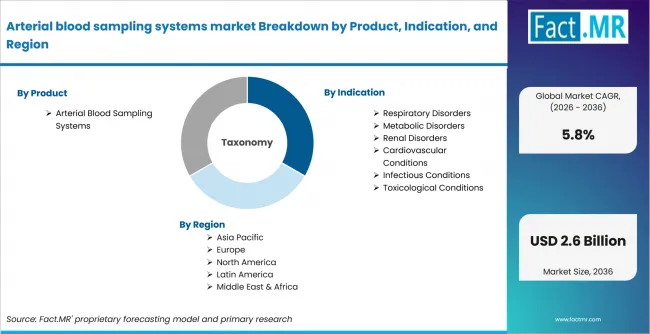
Arterial Blood Sampling Systems Market Breakdown By Product, Indication, And Region | Source: Fact.MR
| Attribute | Details |
|---|---|
| Quantitative Units | USD billion |
| Market Definition | Products used to collect arterial whole-blood specimens for blood gas, acid-base, respiratory, circulatory, metabolic and critical-care testing. |
| Product | Arterial Blood Sampling Systems |
| Indication | Respiratory Disorders; Metabolic Disorders; Renal Disorders; Cardiovascular Conditions; Infectious Conditions; Toxicological Conditions |
| End Use | Hospitals; Clinics; Specialty Clinics; Blood Banks |
| Regions Covered | North America; Latin America; Western Europe; Eastern Europe; East Asia; South Asia and Pacific; Middle East and Africa |
| Countries Covered | USA; Germany; South Korea; France; Italy |
| Key Companies Profiled | Becton, Dickinson and Company (BD); Radiometer Medical ApS; SARSTEDT AG & Co. KG; Greiner Bio-One; Liuyang SANLI Medical Technology Development Co., Ltd. |
| Forecast Period | 2026 to 2036 |
| Approach | Hybrid top-down and bottom-up approach using respiratory disease burden, hospital activity, ICU use, emergency care intensity, product portfolio review and country-level adoption factors. |
Source: Fact.MR analysis. Updated Sep 16, 2026
How is the market segmented?
-
By Product:
- Arterial Blood Sampling Systems
- Vacuum Blood Collection Systems
- Microfluidic Blood Sampling Systems
- Blood Collection Tubes
- Lancets
- Needles
- Accessories and Consumables
- Arterial Blood Sampling Systems
-
By Indication:
- Respiratory Disorders
- Asthma
- Chronic Obstructive Pulmonary Disease
- Cystic Fibrosis
- Metabolic Disorders
- Diabetes Complications
- Renal Disorders
- Kidney Failure
- Cardiovascular Conditions
- Heart Failure
- Haemorrhage
- Shock
- Infectious Conditions
- Severe Infections
- Toxicological Conditions
- Drug Overdose
- Poisoning
- Respiratory Disorders
-
By End Use:
- Hospitals
- Emergency Departments
- Intensive Care Units
- Clinics
- Specialty Clinics
- Diagnostic Clinics
- Blood Banks
- Hospital Based Blood Banks
- Independent Blood Banks
- Hospitals
-
By Region:
- North America
- Latin America
- Western Europe
- Eastern Europe
- East Asia
- South Asia and Pacific
- Middle East and Africa
Frequently Asked Questions
How big is the arterial blood sampling systems market in 2026?
What is the CAGR of the arterial blood sampling systems market from 2026 to 2036?
Which product leads the arterial blood sampling systems market?
Which indication leads the arterial blood sampling systems market?
Who are the main companies in the arterial blood sampling systems market?
Who worked on this report


Preview the report firsthand - request a free sample
Free SampleGet the brochure for pricing and purchase details
Download PDF