Cutting Balloon Catheter Market Size, Share, Growth and Forecast (2026 - 2036)
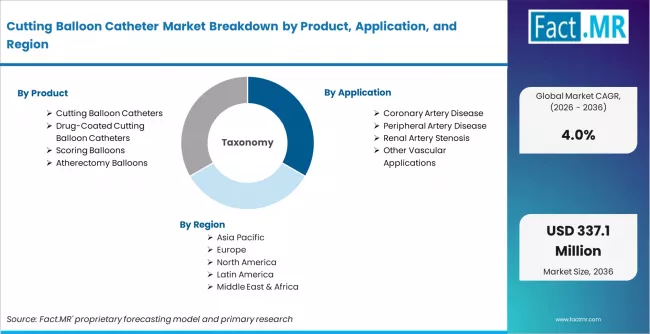
Cutting Balloon Catheter Market is segmented by Product (Cutting Balloon Catheters, Drug-Coated Cutting Balloon Catheters, Scoring Balloons, Atherectomy Balloons), Application (Coronary Artery Disease, Peripheral Artery Disease, Renal Artery Stenosis, Other Vascular Applications), End Use (Hospitals, Ambulatory Surgical Centers, Specialty Clinics, Research & Academic Institutes), and Region, with forecasts covering the period from 2026 to 2036.
According to Fact.MR estimates, the global cutting balloon catheter market market was valued at USD 219.0 million in 2025. The market is projected to reach USD 227.8 million in 2026 and is expected to grow to USD 337.1 million by 2036, expanding at a CAGR of 4.0%. Cutting Balloon Catheters is anticipated to account for 55.0% of the product segment in 2026, while Coronary Artery Disease is expected to remain the leading application with around 52.0% share.
Cutting Balloon Catheter Market Analysis and Forecast by Fact.MR
The global market for cutting balloon catheter is estimated to be around USD 227.8 million in 2026 and has been forecast to expand at a CAGR of 4.0% to end up at USD 337.1 million by 2036. The Cutting Balloon Catheter segment is led by Cutting Balloon Catheters, which is anticipated to account for 55.0% of the product segment in 2026, while Coronary Artery Disease is expected to remain the leading application with around 52.0% share. The market was valued at USD 219.0 million in 2025 and is poised for steady growth driven by evolving industry dynamics and regional demand patterns.
Summary of Cutting Balloon Catheter Market
- Market Snapshot
- In 2025, the global Cutting Balloon Catheter Market was valued at approximately USD 219.0 million.
- The market is estimated to reach USD 227.8 million in 2026 and is projected to attain USD 337.1 million by 2036
- The cutting balloon catheter market is likely to expand at a CAGR of 4.0% during the forecast period.
- The market is anticipated to create an absolute dollar opportunity of USD 109.3 million between 2026 and 2036.
- Cutting Balloon Catheters account for 55.0% of market share in 2026.
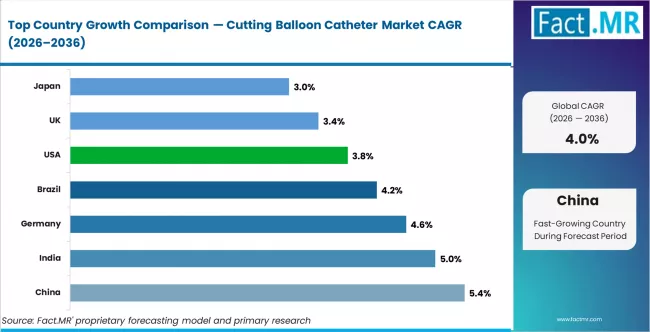
- China (5.4%) and India (5.0%) are the key growth markets during the forecast period
- Demand and Growth Drivers
- Rising prevalence of coronary and peripheral artery disease is increasing interventional cardiology procedure volumes, expanding demand for specialty balloon catheters.
- Growing clinical adoption of cutting balloon technology for in-stent restenosis and calcified lesion treatment is increasing procedural usage beyond conventional balloon angioplasty.
- Expansion of catheterization laboratory infrastructure in Asia Pacific and Latin America is broadening access to advanced interventional cardiology devices.
- Product and Segment View
- Cutting balloon catheters account for 55% of the product segment in 2026, reflecting established clinical positioning for controlled plaque modification in stenotic lesions.
- Coronary artery disease applications represent 52% in 2026, with percutaneous coronary intervention procedures driving the largest device utilization volumes.
- Hospitals hold 63% of end-use demand in 2026, with catheterization laboratories in tertiary care hospitals as the primary procedure setting.
- Geography and Competitive Outlook
- China leads at 5.4% CAGR, driven by expanding interventional cardiology infrastructure and rising cardiovascular disease prevalence.
- North America and Europe remain the largest markets by value, with established procedure volumes and premium device pricing.
- Boston Scientific holds 35% market share, maintaining leadership through its Flextome cutting balloon platform and broad interventional cardiology portfolio.
- Analyst Opinion
- The cutting balloon catheter market occupies a specialized niche within the broader interventional cardiology device landscape. Growth is constrained by the limited clinical indication set, primarily in-stent restenosis and calcified lesion modification, and competition from drug-coated balloons that offer both mechanical dilation and anti-restenotic drug delivery. The market opportunity lies in expanding procedural adoption in Asia Pacific where catheterization infrastructure is scaling rapidly and cardiovascular disease burden is increasing. Boston Scientific's dominant position reflects first-mover advantage and clinical evidence depth, but emerging competitors from China and India are introducing lower-cost alternatives that could reshape pricing dynamics in high-growth markets.
Why is the Cutting Balloon Catheter Market Growing?
- Cardiovascular disease prevalence is increasing globally, driving growth in interventional cardiology procedure volumes across both developed and emerging markets.
- Clinical evidence supporting cutting balloon use for in-stent restenosis and calcified lesions is increasing procedural adoption among interventional cardiologists.
- Catheterization laboratory expansion in China, India, and Southeast Asia is broadening access to advanced interventional devices beyond established Western markets.
The cutting balloon catheter market grows as a function of interventional cardiology procedure volume expansion and clinical adoption within the specialty balloon catheter sub-category. Unlike commodity balloon catheters, cutting balloons serve specific lesion morphologies where controlled plaque incision improves procedural outcomes compared to conventional dilation.
The geographic growth opportunity is concentrated in Asia Pacific, where rapid catheterization lab construction and growing cardiovascular disease burden are creating the fastest procedural volume growth. In mature markets, growth is driven by clinical evidence-based protocol adoption and the introduction of next-generation device designs with improved deliverability.
Segment-wise Analysis of the Cutting Balloon Catheter Market
- Cutting balloon catheters lead at 55% share in 2026, supported by established clinical evidence and physician familiarity.
- Coronary artery disease accounts for 52% of applications in 2026, with PCI procedures driving the largest device utilization.
- Sterile single-use packaging holds 68% in 2026, reflecting regulatory requirements for interventional device sterilization and traceability.
The market is segmented by product type (cutting balloon, drug-coated cutting balloon, scoring balloon, atherectomy balloon), application (coronary artery disease, peripheral artery disease, renal artery stenosis, other vascular), end use (hospitals, ambulatory surgical centers, specialty clinics, research institutes), and technology (balloon angioplasty, drug delivery, atherectomy-based systems).
Which Product Segment Leads?
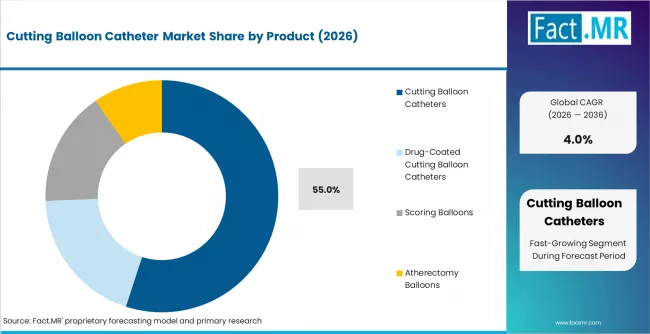
Cutting balloon catheters hold 55% of the product segment in 2026. Their leadership reflects decades of clinical evidence supporting controlled plaque modification for in-stent restenosis and fibrotic lesions. Drug-coated cutting balloons represent the fastest-growing sub-segment, combining mechanical plaque modification with localized drug delivery to reduce restenosis rates.
Which Application Drives Largest Demand?
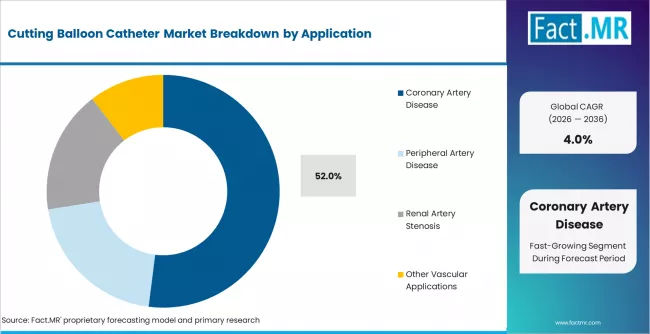
Coronary artery disease accounts for 52% of applications in 2026. Percutaneous coronary intervention procedures for in-stent restenosis and de novo calcified lesions represent the primary clinical use case. Peripheral artery disease applications account for the second-largest share, with femoropopliteal and below-the-knee interventions driving growing procedural volumes.
Key Growth Drivers, Constraints, and Market Scope
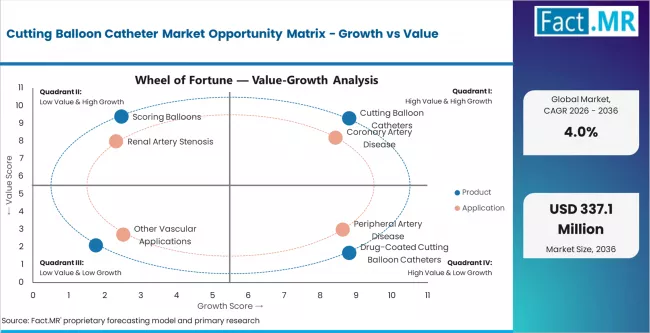
- Cardiovascular disease prevalence growth drives interventional procedure volume expansion.
- Clinical evidence for cutting balloon use in specific lesion types supports procedural adoption.
- Competition from drug-coated balloons and atherectomy devices limits market share expansion within the specialty balloon category.
The cutting balloon catheter market is shaped by cardiovascular disease epidemiology, interventional cardiology procedure trends, clinical evidence development, and competitive positioning against alternative lesion preparation technologies.
Growth Drivers
Demand is shaped by cardiovascular disease burden increase, catheterization infrastructure expansion in emerging markets, and clinical protocol adoption for cutting balloon use in calcified and restenotic lesions.
Constraints
Competition from drug-coated balloons offering combined mechanical and pharmacological therapy limits cutting balloon growth. Limited indication set constrains addressable procedure volume. Premium pricing relative to conventional balloons limits adoption in price-sensitive markets.
Opportunities
Drug-coated cutting balloon development combines mechanical and pharmacological efficacy. Catheterization laboratory expansion in Asia Pacific creates new procedural volume growth. Next-generation designs with improved crossing profiles and deliverability address physician usability concerns.
Regional Outlook Across Key Markets
.webp)
- China leads at 5.4% CAGR, driven by catheterization lab expansion and rising cardiovascular disease prevalence.
- India follows at 5.0% CAGR, reflecting growing interventional cardiology capacity and disease burden.
- Germany records 4.6% CAGR, supported by established interventional procedure volumes.
- USA grows at 3.8% CAGR, reflecting mature market dynamics and competition from alternative technologies.
Country CAGR Table
| Country | CAGR (%) |
|---|---|
| China | 5.4% |
| India | 5.0% |
| Germany | 4.6% |
| Brazil | 4.2% |
| USA | 3.8% |
| UK | 3.4% |
| Japan | 3.0% |

Regional demand reflects cardiovascular disease prevalence, catheterization infrastructure maturity, reimbursement frameworks, and clinical adoption of specialty balloon technologies.
Market Outlook in China
The China cutting balloon catheter market is projected to grow at a CAGR of 5.4% through 2036. Demand is driven by rapid catheterization lab construction, increasing coronary intervention volumes, and growing adoption of advanced lesion preparation techniques.
- Catheterization lab expansion broadens access to interventional procedures.
- Rising cardiovascular disease prevalence increases procedure volumes.
- Local device manufacturers are introducing cost-competitive alternatives.
Demand Trends in India
The India cutting balloon catheter market is projected to grow at a CAGR of 5.0% through 2036. Growth reflects expanding interventional cardiology capacity, increasing cardiovascular disease burden, and growing tertiary hospital infrastructure.
- Interventional cardiology capacity growth drives procedure volume expansion.
- Cardiovascular disease burden increases demand for coronary interventions.
- Tertiary hospital infrastructure development broadens device access.
USA Market Outlook
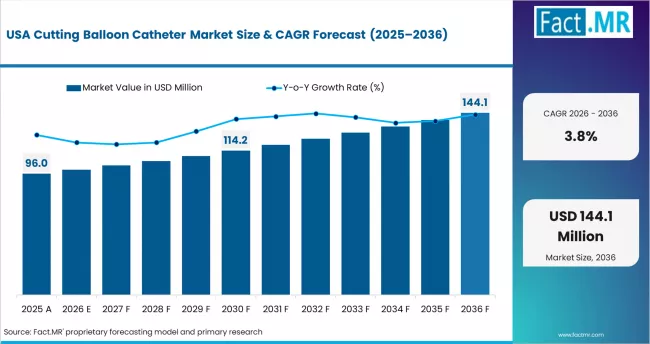
The USA cutting balloon catheter market is projected to grow at a CAGR of 3.8% through 2036. Demand is shaped by mature procedure volumes, clinical evidence-based protocol adoption, and competition from drug-coated balloons and atherectomy devices.
- Established procedure volumes sustain baseline device procurement.
- Clinical protocols drive selective adoption for specific lesion types.
- Competition from alternative technologies moderates growth.
Germany Market Assessment
The Germany cutting balloon catheter market is projected to grow at a CAGR of 4.6% through 2036. Demand reflects established interventional cardiology capacity, strong clinical adoption patterns, and reimbursement support for specialty device use.
- Established interventional capacity supports consistent procedure volumes.
- Reimbursement frameworks support specialty balloon catheter procurement.
- Clinical evidence adoption drives guideline-based device selection.
Competitive Benchmarking and Company Positioning
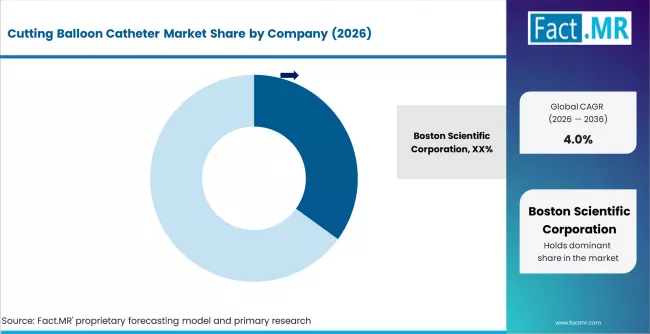
- Boston Scientific holds 35% market share through its Flextome cutting balloon platform and integrated interventional cardiology portfolio.
- Abbott and Terumo compete through broad catheter portfolios and established physician relationships in interventional cardiology.
- Competition is shaped by device deliverability, clinical evidence depth, physician training programs, and integration with broader interventional device portfolios.
The competitive landscape is concentrated around Boston Scientific's first-mover position with the Flextome cutting balloon. Abbott, Terumo, and Medtronic compete through broader interventional cardiology portfolios that include cutting balloons alongside stents, guide wires, and diagnostic devices.
Strategic priorities include developing drug-coated cutting balloon variants, improving device crossing profiles for complex lesion access, building clinical evidence through randomized trials, and expanding distribution in Asia Pacific markets.
Competitive Benchmarking
| Company | Market Position | Product Platform | Clinical Evidence | Geographic Reach |
|---|---|---|---|---|
| Boston Scientific | Leader | Flextome | Extensive | Global |
| Abbott | Strong | Broad portfolio | Strong | Global |
| Terumo | Established | Catheter focused | Moderate | Global |
| Medtronic | Established | Broad portfolio | Moderate | Global |
| MicroPort | Growing | Regional focus | Developing | Asia Pacific |
Recent Industry Developments
- Boston Scientific received regulatory approval for an updated Flextome cutting balloon design in 2025, featuring improved crossing profile for complex coronary lesion access.
- Meril Life Sciences expanded distribution of its cutting balloon catheter in emerging markets in early 2026, targeting cost-sensitive hospital procurement in Asia Pacific.
- Medtronic announced clinical trial enrollment for a drug-coated cutting balloon in 2025, targeting combined mechanical and pharmacological therapy for in-stent restenosis.
Leading Companies Shaping the Cutting Balloon Catheter Market
-
Major Players
- Boston Scientific Corporation
- Abbott Laboratories
- Terumo Corporation
- Medtronic Plc.
- B. Braun Melsungen AG
-
Emerging Players
- BIOTRONIK SE & Co. KG
- Cook Medical Inc.
- MicroPort Scientific Corporation
- Cardionovum GmbH
- Meril Life Sciences Pvt Ltd
- Hexacath
Analysis by Product Type, Application, End Use, Technology, Source, Packaging, and Region
-
Cutting Balloon Catheter Market Market Segmented by Product:
- Cutting Balloon Catheters
- Conventional Cutting Balloon Catheters
- Standard Angioplasty Cutting Balloons
- Conventional Cutting Balloon Catheters
- Drug-Coated Cutting Balloon Catheters
- Drug-Eluting Cutting Balloons
- Anti-Restenosis Balloon Systems
- Drug-Eluting Cutting Balloons
- Scoring Balloons
- Modified Cutting & Scoring Devices
- Advanced Lesion Modification Catheters
- Modified Cutting & Scoring Devices
- Atherectomy Balloons
- Hybrid Plaque Modification Systems
- High Precision Vascular Devices
- Hybrid Plaque Modification Systems
- Cutting Balloon Catheters
-
Cutting Balloon Catheter Market Market Segmented by Application:
- Coronary Artery Disease
- Complex Coronary Lesions
- In-Stent Restenosis Treatment
- Complex Coronary Lesions
- Peripheral Artery Disease
- Lower Limb Arterial Disease
- Critical Limb Ischemia Treatment
- Lower Limb Arterial Disease
- Renal Artery Stenosis
- Kidney Vessel Interventions
- Hypertension Related Procedures
- Kidney Vessel Interventions
- Other Vascular Applications
- Emerging Interventional Uses
- Specialty Cardiovascular Procedures
- Emerging Interventional Uses
- Coronary Artery Disease
-
Cutting Balloon Catheter Market Market Segmented by End Use:
- Hospitals
- Cardiology Departments
- Advanced Cath Labs
- Cardiology Departments
- Ambulatory Surgical Centers
- Day Care Cardiac Units
- Minimally Invasive Procedure Centers
- Day Care Cardiac Units
- Specialty Clinics
- Cardiology Clinics
- Outpatient Vascular Care Centers
- Cardiology Clinics
- Research & Academic Institutes
- Clinical Research Hospitals
- Medical Training Institutions
- Clinical Research Hospitals
- Hospitals
-
Cutting Balloon Catheter Market Market Segmented by Technology:
- Balloon Angioplasty Technology
- Controlled Vessel Dilation Systems
- Mechanical Plaque Modification
- Controlled Vessel Dilation Systems
- Drug Delivery Technology
- Localized Drug Coating Systems
- Anti-Restenosis Technology
- Localized Drug Coating Systems
- Atherectomy-Based Systems
- Plaque Removal Devices
- Advanced Lesion Crossing Technology
- Plaque Removal Devices
- Balloon Angioplasty Technology
-
Cutting Balloon Catheter Market Market Segmented by Source:
- Medical Grade Polymer Materials
- Nylon Based Materials
- Polyurethane Components
- Specialty Biocompatible Polymers
- Nylon Based Materials
- Medical Grade Polymer Materials
-
Cutting Balloon Catheter Market Market Segmented by Packaging:
- Sterile Single-Use Packaging
- Medical Blister Packs
- Sterile Catheter Kits
- Medical Blister Packs
- Pouch Packaging
- Medical Grade Sealed Pouches
- Procedure Ready Kits
- Medical Grade Sealed Pouches
- Boxed Hospital Supply Packs
- Bulk Clinical Packaging
- Cath Lab Supply Boxes
- Bulk Clinical Packaging
- Sterile Single-Use Packaging
-
Cutting Balloon Catheter Market Market by Region:
- North America
- USA
- Canada
- Mexico
- Latin America
- Brazil
- Chile
- Rest of Latin America
- Western Europe
- Germany
- UK
- Italy
- Spain
- France
- Nordic
- BENELUX
- Rest of Western Europe
- Eastern Europe
- Russia
- Poland
- Hungary
- Balkan & Baltic
- Rest of Eastern Europe
- East Asia
- China
- Japan
- South Korea
- South Asia and Pacific
- India
- ASEAN
- Australia & New Zealand
- Rest of South Asia and Pacific
- Middle East & Africa
- Kingdom of Saudi Arabia
- Other GCC Countries
- Turkiye
- South Africa
- Other African Union
- Rest of Middle East & Africa
- North America
Sources and Research References
- World Health Organization (WHO). Cardiovascular disease epidemiology data.
- American Heart Association (AHA). Interventional cardiology procedure statistics.
- Boston Scientific Corporation. Annual reports and interventional portfolio disclosures.
- European Society of Cardiology (ESC). Clinical practice guidelines for coronary intervention.
- United States Food and Drug Administration (FDA). Medical device regulatory databases.
- Primary interviews with interventional cardiologists, hospital procurement managers, and device distributors.
This bibliography is provided for reader reference. The full report contains the complete reference list.
Key Questions This Report Addresses
- What is the current and projected size of the cutting balloon catheter market?
- What CAGR is expected between 2026 and 2036?
- Which product type holds the largest share?
- Which application accounts for highest demand?
- What factors shape demand?
- Which countries show fastest growth?
- How is the competitive landscape structured?
- How does Fact.MR validate the forecast?
Cutting Balloon Catheter Market Definition
The cutting balloon catheter market covers specialized angioplasty devices that incorporate microsurgical blades or atherotomes on the balloon surface to create controlled incisions in plaque during vessel dilation. The market spans device manufacturing and distribution for use in coronary, peripheral, and renal artery interventional procedures.
Cutting Balloon Catheter Market Inclusions
The scope covers global and regional market size and forecasts for 2026 to 2036 across product type, application, end use, technology, packaging, and region. It includes demand analysis based on cardiovascular disease prevalence, interventional procedure volumes, and catheterization laboratory infrastructure development.
Cutting Balloon Catheter Market Exclusions
The scope excludes conventional plain balloon catheters, drug-eluting stents, guide catheters, diagnostic catheters, and non-vascular balloon devices used in gastroenterology or urology.
Cutting Balloon Catheter Market Research Methodology
- Primary research includes interviews with interventional cardiologists, hospital procurement managers, medical device distributors, and regulatory affairs specialists.
- Desk research draws on cardiovascular disease epidemiology data, procedure volume statistics, device regulatory databases, and company financial disclosures.
- Market sizing uses a demand-side model validated through procedure volume cross-checks, device per-procedure utilization rates, and pricing benchmarks.
- Data validation involves reconciliation with medical device registry data and expert panel review.
Scope of Analysis

| Parameter | Details |
|---|---|
| Quantitative Units | USD 227.8 million to USD 337.1 million, at a CAGR of 4.0% |
| Market Definition | Covers specialty angioplasty devices with microsurgical blades for controlled plaque modification in coronary, peripheral, and renal artery interventions. |
| Regions Covered | North America, Latin America, Europe, East Asia, South Asia and Pacific, Middle East and Africa |
| Countries Covered | USA, China, India, Germany, Brazil, UK, Japan, and 30+ countries |
| Key Companies | Boston Scientific, Abbott, Terumo, Medtronic, B. Braun, BIOTRONIK, Cook Medical, MicroPort, Cardionovum, Meril, Hexacath |
| Forecast Period | 2026 to 2036 |
| Approach | Hybrid demand-side methodology built on procedure volume data, disease epidemiology, device utilization rates, and primary interviews across cardiologists, hospitals, and device distributors. |
Table of Content
- Executive Summary
- Global Market Outlook
- Demand to side Trends
- Supply to side Trends
- Technology Roadmap Analysis
- Analysis and Recommendations
- Market Overview
- Market Coverage / Taxonomy
- Market Definition / Scope / Limitations
- Research Methodology
- Chapter Orientation
- Analytical Lens and Working Hypotheses
- Market Structure, Signals, and Trend Drivers
- Benchmarking and Cross-market Comparability
- Market Sizing, Forecasting, and Opportunity Mapping
- Research Design and Evidence Framework
- Desk Research Programme (Secondary Evidence)
- Company Annual and Sustainability Reports
- Peer-reviewed Journals and Academic Literature
- Corporate Websites, Product Literature, and Technical Notes
- Earnings Decks and Investor Briefings
- Statutory Filings and Regulatory Disclosures
- Technical White Papers and Standards Notes
- Trade Journals, Industry Magazines, and Analyst Briefs
- Conference Proceedings, Webinars, and Seminar Materials
- Government Statistics Portals and Public Data Releases
- Press Releases and Reputable Media Coverage
- Specialist Newsletters and Curated Briefings
- Sector Databases and Reference Repositories
- Fact.MR Internal Proprietary Databases and Historical Market Datasets
- Subscription Datasets and Paid Sources
- Social Channels, Communities, and Digital Listening Inputs
- Additional Desk Sources
- Expert Input and Fieldwork (Primary Evidence)
- Primary Modes
- Qualitative Interviews and Expert Elicitation
- Quantitative Surveys and Structured Data Capture
- Blended Approach
- Why Primary Evidence is Used
- Field Techniques
- Interviews
- Surveys
- Focus Groups
- Observational and In-context Research
- Social and Community Interactions
- Stakeholder Universe Engaged
- C-suite Leaders
- Board Members
- Presidents and Vice Presidents
- R&D and Innovation Heads
- Technical Specialists
- Domain Subject-matter Experts
- Scientists
- Physicians and Other Healthcare Professionals
- Governance, Ethics, and Data Stewardship
- Research Ethics
- Data Integrity and Handling
- Primary Modes
- Tooling, Models, and Reference Databases
- Desk Research Programme (Secondary Evidence)
- Data Engineering and Model Build
- Data Acquisition and Ingestion
- Cleaning, Normalisation, and Verification
- Synthesis, Triangulation, and Analysis
- Quality Assurance and Audit Trail
- Market Background
- Market Dynamics
- Drivers
- Restraints
- Opportunity
- Trends
- Scenario Forecast
- Demand in Optimistic Scenario
- Demand in Likely Scenario
- Demand in Conservative Scenario
- Opportunity Map Analysis
- Product Life Cycle Analysis
- Supply Chain Analysis
- Investment Feasibility Matrix
- Value Chain Analysis
- PESTLE and Porter’s Analysis
- Regulatory Landscape
- Regional Parent Market Outlook
- Production and Consumption Statistics
- Import and Export Statistics
- Market Dynamics
- Global Market Analysis 2021 to 2025 and Forecast, 2026 to 2036
- Historical Market Size Value (USD Million) Analysis, 2021 to 2025
- Current and Future Market Size Value (USD Million) Projections, 2026 to 2036
- Y to o to Y Growth Trend Analysis
- Absolute $ Opportunity Analysis
- Global Market Pricing Analysis 2021 to 2025 and Forecast 2026 to 2036
- Global Market Analysis 2021 to 2025 and Forecast 2026 to 2036, By Product
- Introduction / Key Findings
- Historical Market Size Value (USD Million) Analysis By Product , 2021 to 2025
- Current and Future Market Size Value (USD Million) Analysis and Forecast By Product , 2026 to 2036
- Cutting Balloon Catheters
- Conventional Cutting Balloon Catheters
- _Standard Angioplasty Cutting Balloons
- Drug-Coated Cutting Balloon Catheters
- Drug-Eluting Cutting Balloons
- _Anti-Restenosis Balloon Systems
- Scoring Balloons
- Modified Cutting & Scoring Devices
- _Advanced Lesion Modification Catheters
- Atherectomy Balloons
- Hybrid Plaque Modification Systems
- _High Precision Vascular Devices
- Cutting Balloon Catheters
- Y to o to Y Growth Trend Analysis By Product , 2021 to 2025
- Absolute $ Opportunity Analysis By Product , 2026 to 2036
- Global Market Analysis 2021 to 2025 and Forecast 2026 to 2036, By Application
- Introduction / Key Findings
- Historical Market Size Value (USD Million) Analysis By Application, 2021 to 2025
- Current and Future Market Size Value (USD Million) Analysis and Forecast By Application, 2026 to 2036
- Coronary Artery Disease
- Complex Coronary Lesions
- _In-Stent Restenosis Treatment
- Peripheral Artery Disease
- Lower Limb Arterial Disease
- _Critical Limb Ischemia Treatment
- Renal Artery Stenosis
- Kidney Vessel Interventions
- _Hypertension Related Procedures
- Other Vascular Applications
- Emerging Interventional Uses
- _Specialty Cardiovascular Procedures
- Coronary Artery Disease
- Y to o to Y Growth Trend Analysis By Application, 2021 to 2025
- Absolute $ Opportunity Analysis By Application, 2026 to 2036
- Global Market Analysis 2021 to 2025 and Forecast 2026 to 2036, By End Use
- Introduction / Key Findings
- Historical Market Size Value (USD Million) Analysis By End Use, 2021 to 2025
- Current and Future Market Size Value (USD Million) Analysis and Forecast By End Use, 2026 to 2036
- Hospitals
- Cardiology Departments
- _Advanced Cath Labs
- Ambulatory Surgical Centers
- Day Care Cardiac Value (USD Million)s
- _Minimally Invasive Procedure Centers
- Specialty Clinics
- Cardiology Clinics
- _Outpatient Vascular Care Centers
- Research & Academic Institutes
- Clinical Research Hospitals
- _Medical Training Institutions
- Hospitals
- Y to o to Y Growth Trend Analysis By End Use, 2021 to 2025
- Absolute $ Opportunity Analysis By End Use, 2026 to 2036
- Global Market Analysis 2021 to 2025 and Forecast 2026 to 2036, By Technology
- Introduction / Key Findings
- Historical Market Size Value (USD Million) Analysis By Technology, 2021 to 2025
- Current and Future Market Size Value (USD Million) Analysis and Forecast By Technology, 2026 to 2036
- Balloon Angioplasty Technology
- Controlled Vessel Dilation Systems
- _Mechanical Plaque Modification
- Drug Delivery Technology
- Localized Drug Coating Systems
- _Anti-Restenosis Technology
- Atherectomy-Based Systems
- Plaque Removal Devices
- _Advanced Lesion Crossing Technology
- Balloon Angioplasty Technology
- Y to o to Y Growth Trend Analysis By Technology, 2021 to 2025
- Absolute $ Opportunity Analysis By Technology, 2026 to 2036
- Global Market Analysis 2021 to 2025 and Forecast 2026 to 2036, By Source
- Introduction / Key Findings
- Historical Market Size Value (USD Million) Analysis By Source, 2021 to 2025
- Current and Future Market Size Value (USD Million) Analysis and Forecast By Source, 2026 to 2036
- Medical Grade Polymer Materials
- Nylon Based Materials
- _Polyurethane Components
- _Specialty Biocompatible Polymers
- Medical Grade Polymer Materials
- Y to o to Y Growth Trend Analysis By Source, 2021 to 2025
- Absolute $ Opportunity Analysis By Source, 2026 to 2036
- Global Market Analysis 2021 to 2025 and Forecast 2026 to 2036, By Packaging
- Introduction / Key Findings
- Historical Market Size Value (USD Million) Analysis By Packaging, 2021 to 2025
- Current and Future Market Size Value (USD Million) Analysis and Forecast By Packaging, 2026 to 2036
- Sterile Single-Use Packaging
- Medical Blister Packs
- _Sterile Catheter Kits
- Pouch Packaging
- Medical Grade Sealed Pouches
- _Procedure Ready Kits
- Boxed Hospital Supply Packs
- Bulk Clinical Packaging
- _Cath Lab Supply Boxes
- Sterile Single-Use Packaging
- Y to o to Y Growth Trend Analysis By Packaging, 2021 to 2025
- Absolute $ Opportunity Analysis By Packaging, 2026 to 2036
- Global Market Analysis 2021 to 2025 and Forecast 2026 to 2036, By Region
- Introduction
- Historical Market Size Value (USD Million) Analysis By Region, 2021 to 2025
- Current Market Size Value (USD Million) Analysis and Forecast By Region, 2026 to 2036
- North America
- Latin America
- Western Europe
- Eastern Europe
- East Asia
- South Asia and Pacific
- Middle East & Africa
- Market Attractiveness Analysis By Region
- North America Market Analysis 2021 to 2025 and Forecast 2026 to 2036, By Country
- Historical Market Size Value (USD Million) Trend Analysis By Market Taxonomy, 2021 to 2025
- Market Size Value (USD Million) Forecast By Market Taxonomy, 2026 to 2036
- By Country
- USA
- Canada
- Mexico
- By Product
- By Application
- By End Use
- By Technology
- By Source
- By Packaging
- By Country
- Market Attractiveness Analysis
- By Country
- By Product
- By Application
- By End Use
- By Technology
- By Source
- By Packaging
- Key Takeaways
- Latin America Market Analysis 2021 to 2025 and Forecast 2026 to 2036, By Country
- Historical Market Size Value (USD Million) Trend Analysis By Market Taxonomy, 2021 to 2025
- Market Size Value (USD Million) Forecast By Market Taxonomy, 2026 to 2036
- By Country
- Brazil
- Chile
- Rest of Latin America
- By Product
- By Application
- By End Use
- By Technology
- By Source
- By Packaging
- By Country
- Market Attractiveness Analysis
- By Country
- By Product
- By Application
- By End Use
- By Technology
- By Source
- By Packaging
- Key Takeaways
- Western Europe Market Analysis 2021 to 2025 and Forecast 2026 to 2036, By Country
- Historical Market Size Value (USD Million) Trend Analysis By Market Taxonomy, 2021 to 2025
- Market Size Value (USD Million) Forecast By Market Taxonomy, 2026 to 2036
- By Country
- Germany
- UK
- Italy
- Spain
- France
- Nordic
- BENELUX
- Rest of Western Europe
- By Product
- By Application
- By End Use
- By Technology
- By Source
- By Packaging
- By Country
- Market Attractiveness Analysis
- By Country
- By Product
- By Application
- By End Use
- By Technology
- By Source
- By Packaging
- Key Takeaways
- Eastern Europe Market Analysis 2021 to 2025 and Forecast 2026 to 2036, By Country
- Historical Market Size Value (USD Million) Trend Analysis By Market Taxonomy, 2021 to 2025
- Market Size Value (USD Million) Forecast By Market Taxonomy, 2026 to 2036
- By Country
- Russia
- Poland
- Hungary
- Balkan & Baltic
- Rest of Eastern Europe
- By Product
- By Application
- By End Use
- By Technology
- By Source
- By Packaging
- By Country
- Market Attractiveness Analysis
- By Country
- By Product
- By Application
- By End Use
- By Technology
- By Source
- By Packaging
- Key Takeaways
- East Asia Market Analysis 2021 to 2025 and Forecast 2026 to 2036, By Country
- Historical Market Size Value (USD Million) Trend Analysis By Market Taxonomy, 2021 to 2025
- Market Size Value (USD Million) Forecast By Market Taxonomy, 2026 to 2036
- By Country
- China
- Japan
- South Korea
- By Product
- By Application
- By End Use
- By Technology
- By Source
- By Packaging
- By Country
- Market Attractiveness Analysis
- By Country
- By Product
- By Application
- By End Use
- By Technology
- By Source
- By Packaging
- Key Takeaways
- South Asia and Pacific Market Analysis 2021 to 2025 and Forecast 2026 to 2036, By Country
- Historical Market Size Value (USD Million) Trend Analysis By Market Taxonomy, 2021 to 2025
- Market Size Value (USD Million) Forecast By Market Taxonomy, 2026 to 2036
- By Country
- India
- ASEAN
- Australia & New Zealand
- Rest of South Asia and Pacific
- By Product
- By Application
- By End Use
- By Technology
- By Source
- By Packaging
- By Country
- Market Attractiveness Analysis
- By Country
- By Product
- By Application
- By End Use
- By Technology
- By Source
- By Packaging
- Key Takeaways
- Middle East & Africa Market Analysis 2021 to 2025 and Forecast 2026 to 2036, By Country
- Historical Market Size Value (USD Million) Trend Analysis By Market Taxonomy, 2021 to 2025
- Market Size Value (USD Million) Forecast By Market Taxonomy, 2026 to 2036
- By Country
- Kingdom of Saudi Arabia
- Other GCC Countries
- Turkiye
- South Africa
- Other African Union
- Rest of Middle East & Africa
- By Product
- By Application
- By End Use
- By Technology
- By Source
- By Packaging
- By Country
- Market Attractiveness Analysis
- By Country
- By Product
- By Application
- By End Use
- By Technology
- By Source
- By Packaging
- Key Takeaways
- Key Countries Market Analysis
- USA
- Pricing Analysis
- Market Share Analysis, 2025
- By Product
- By Application
- By End Use
- By Technology
- By Source
- By Packaging
- Canada
- Pricing Analysis
- Market Share Analysis, 2025
- By Product
- By Application
- By End Use
- By Technology
- By Source
- By Packaging
- Mexico
- Pricing Analysis
- Market Share Analysis, 2025
- By Product
- By Application
- By End Use
- By Technology
- By Source
- By Packaging
- Brazil
- Pricing Analysis
- Market Share Analysis, 2025
- By Product
- By Application
- By End Use
- By Technology
- By Source
- By Packaging
- Chile
- Pricing Analysis
- Market Share Analysis, 2025
- By Product
- By Application
- By End Use
- By Technology
- By Source
- By Packaging
- Germany
- Pricing Analysis
- Market Share Analysis, 2025
- By Product
- By Application
- By End Use
- By Technology
- By Source
- By Packaging
- UK
- Pricing Analysis
- Market Share Analysis, 2025
- By Product
- By Application
- By End Use
- By Technology
- By Source
- By Packaging
- Italy
- Pricing Analysis
- Market Share Analysis, 2025
- By Product
- By Application
- By End Use
- By Technology
- By Source
- By Packaging
- Spain
- Pricing Analysis
- Market Share Analysis, 2025
- By Product
- By Application
- By End Use
- By Technology
- By Source
- By Packaging
- France
- Pricing Analysis
- Market Share Analysis, 2025
- By Product
- By Application
- By End Use
- By Technology
- By Source
- By Packaging
- India
- Pricing Analysis
- Market Share Analysis, 2025
- By Product
- By Application
- By End Use
- By Technology
- By Source
- By Packaging
- ASEAN
- Pricing Analysis
- Market Share Analysis, 2025
- By Product
- By Application
- By End Use
- By Technology
- By Source
- By Packaging
- Australia & New Zealand
- Pricing Analysis
- Market Share Analysis, 2025
- By Product
- By Application
- By End Use
- By Technology
- By Source
- By Packaging
- China
- Pricing Analysis
- Market Share Analysis, 2025
- By Product
- By Application
- By End Use
- By Technology
- By Source
- By Packaging
- Japan
- Pricing Analysis
- Market Share Analysis, 2025
- By Product
- By Application
- By End Use
- By Technology
- By Source
- By Packaging
- South Korea
- Pricing Analysis
- Market Share Analysis, 2025
- By Product
- By Application
- By End Use
- By Technology
- By Source
- By Packaging
- Russia
- Pricing Analysis
- Market Share Analysis, 2025
- By Product
- By Application
- By End Use
- By Technology
- By Source
- By Packaging
- Poland
- Pricing Analysis
- Market Share Analysis, 2025
- By Product
- By Application
- By End Use
- By Technology
- By Source
- By Packaging
- Hungary
- Pricing Analysis
- Market Share Analysis, 2025
- By Product
- By Application
- By End Use
- By Technology
- By Source
- By Packaging
- Kingdom of Saudi Arabia
- Pricing Analysis
- Market Share Analysis, 2025
- By Product
- By Application
- By End Use
- By Technology
- By Source
- By Packaging
- Turkiye
- Pricing Analysis
- Market Share Analysis, 2025
- By Product
- By Application
- By End Use
- By Technology
- By Source
- By Packaging
- South Africa
- Pricing Analysis
- Market Share Analysis, 2025
- By Product
- By Application
- By End Use
- By Technology
- By Source
- By Packaging
- USA
- Market Structure Analysis
- Competition Dashboard
- Competition Benchmarking
- Market Share Analysis of Top Players
- By Regional
- By Product
- By Application
- By End Use
- By Technology
- By Source
- By Packaging
- Competition Analysis
- Competition Deep Dive
- Boston Scientific Corporation
- Overview
- Product Portfolio
- Profitability by Market Segments (Product/Age /Sales Channel/Region)
- Sales Footprint
- Strategy Overview
- Marketing Strategy
- Product Strategy
- Channel Strategy
- Abbott Laboratories
- Terumo Corporation
- Medtronic Plc.
- B. Braun Melsungen AG
- BIOTRONIK SE & Co. KG
- Cordis Corporation
- Cook Medical Inc.
- MicroPort Scientific Corporation
- Cardionovum GmbH
- Meril Life Sciences Pvt Ltd
- Hexacath
- Boston Scientific Corporation
- Competition Deep Dive
- Assumptions & Acronyms Used
List Of Table
- Table 1: Global Market Value (USD Million) Forecast by Region, 2021 to 2036
- Table 2: Global Market Value (USD Million) Forecast by Product, 2021 to 2036
- Table 3: Global Market Value (USD Million) Forecast by Application, 2021 to 2036
- Table 4: Global Market Value (USD Million) Forecast by End Use, 2021 to 2036
- Table 5: Global Market Value (USD Million) Forecast by Technology, 2021 to 2036
- Table 6: Global Market Value (USD Million) Forecast by Source, 2021 to 2036
- Table 7: Global Market Value (USD Million) Forecast by Packaging, 2021 to 2036
- Table 8: North America Market Value (USD Million) Forecast by Country, 2021 to 2036
- Table 9: North America Market Value (USD Million) Forecast by Product, 2021 to 2036
- Table 10: North America Market Value (USD Million) Forecast by Application, 2021 to 2036
- Table 11: North America Market Value (USD Million) Forecast by End Use, 2021 to 2036
- Table 12: North America Market Value (USD Million) Forecast by Technology, 2021 to 2036
- Table 13: North America Market Value (USD Million) Forecast by Source, 2021 to 2036
- Table 14: North America Market Value (USD Million) Forecast by Packaging, 2021 to 2036
- Table 15: Latin America Market Value (USD Million) Forecast by Country, 2021 to 2036
- Table 16: Latin America Market Value (USD Million) Forecast by Product, 2021 to 2036
- Table 17: Latin America Market Value (USD Million) Forecast by Application, 2021 to 2036
- Table 18: Latin America Market Value (USD Million) Forecast by End Use, 2021 to 2036
- Table 19: Latin America Market Value (USD Million) Forecast by Technology, 2021 to 2036
- Table 20: Latin America Market Value (USD Million) Forecast by Source, 2021 to 2036
- Table 21: Latin America Market Value (USD Million) Forecast by Packaging, 2021 to 2036
- Table 22: Western Europe Market Value (USD Million) Forecast by Country, 2021 to 2036
- Table 23: Western Europe Market Value (USD Million) Forecast by Product, 2021 to 2036
- Table 24: Western Europe Market Value (USD Million) Forecast by Application, 2021 to 2036
- Table 25: Western Europe Market Value (USD Million) Forecast by End Use, 2021 to 2036
- Table 26: Western Europe Market Value (USD Million) Forecast by Technology, 2021 to 2036
- Table 27: Western Europe Market Value (USD Million) Forecast by Source, 2021 to 2036
- Table 28: Western Europe Market Value (USD Million) Forecast by Packaging, 2021 to 2036
- Table 29: Eastern Europe Market Value (USD Million) Forecast by Country, 2021 to 2036
- Table 30: Eastern Europe Market Value (USD Million) Forecast by Product, 2021 to 2036
- Table 31: Eastern Europe Market Value (USD Million) Forecast by Application, 2021 to 2036
- Table 32: Eastern Europe Market Value (USD Million) Forecast by End Use, 2021 to 2036
- Table 33: Eastern Europe Market Value (USD Million) Forecast by Technology, 2021 to 2036
- Table 34: Eastern Europe Market Value (USD Million) Forecast by Source, 2021 to 2036
- Table 35: Eastern Europe Market Value (USD Million) Forecast by Packaging, 2021 to 2036
- Table 36: East Asia Market Value (USD Million) Forecast by Country, 2021 to 2036
- Table 37: East Asia Market Value (USD Million) Forecast by Product, 2021 to 2036
- Table 38: East Asia Market Value (USD Million) Forecast by Application, 2021 to 2036
- Table 39: East Asia Market Value (USD Million) Forecast by End Use, 2021 to 2036
- Table 40: East Asia Market Value (USD Million) Forecast by Technology, 2021 to 2036
- Table 41: East Asia Market Value (USD Million) Forecast by Source, 2021 to 2036
- Table 42: East Asia Market Value (USD Million) Forecast by Packaging, 2021 to 2036
- Table 43: South Asia and Pacific Market Value (USD Million) Forecast by Country, 2021 to 2036
- Table 44: South Asia and Pacific Market Value (USD Million) Forecast by Product, 2021 to 2036
- Table 45: South Asia and Pacific Market Value (USD Million) Forecast by Application, 2021 to 2036
- Table 46: South Asia and Pacific Market Value (USD Million) Forecast by End Use, 2021 to 2036
- Table 47: South Asia and Pacific Market Value (USD Million) Forecast by Technology, 2021 to 2036
- Table 48: South Asia and Pacific Market Value (USD Million) Forecast by Source, 2021 to 2036
- Table 49: South Asia and Pacific Market Value (USD Million) Forecast by Packaging, 2021 to 2036
- Table 50: Middle East & Africa Market Value (USD Million) Forecast by Country, 2021 to 2036
- Table 51: Middle East & Africa Market Value (USD Million) Forecast by Product, 2021 to 2036
- Table 52: Middle East & Africa Market Value (USD Million) Forecast by Application, 2021 to 2036
- Table 53: Middle East & Africa Market Value (USD Million) Forecast by End Use, 2021 to 2036
- Table 54: Middle East & Africa Market Value (USD Million) Forecast by Technology, 2021 to 2036
- Table 55: Middle East & Africa Market Value (USD Million) Forecast by Source, 2021 to 2036
- Table 56: Middle East & Africa Market Value (USD Million) Forecast by Packaging, 2021 to 2036
List Of Figures
- Figure 1: Global Market Pricing Analysis
- Figure 2: Global Market Value (USD Million) Forecast 2021-2036
- Figure 3: Global Market Value Share and BPS Analysis by Product, 2026 and 2036
- Figure 4: Global Market Y-o-Y Growth Comparison by Product, 2026 to 2036
- Figure 5: Global Market Attractiveness Analysis by Product
- Figure 6: Global Market Value Share and BPS Analysis by Application, 2026 and 2036
- Figure 7: Global Market Y-o-Y Growth Comparison by Application, 2026 to 2036
- Figure 8: Global Market Attractiveness Analysis by Application
- Figure 9: Global Market Value Share and BPS Analysis by End Use, 2026 and 2036
- Figure 10: Global Market Y-o-Y Growth Comparison by End Use, 2026 to 2036
- Figure 11: Global Market Attractiveness Analysis by End Use
- Figure 12: Global Market Value Share and BPS Analysis by Technology, 2026 and 2036
- Figure 13: Global Market Y-o-Y Growth Comparison by Technology, 2026 to 2036
- Figure 14: Global Market Attractiveness Analysis by Technology
- Figure 15: Global Market Value Share and BPS Analysis by Source, 2026 and 2036
- Figure 16: Global Market Y-o-Y Growth Comparison by Source, 2026 to 2036
- Figure 17: Global Market Attractiveness Analysis by Source
- Figure 18: Global Market Value Share and BPS Analysis by Packaging, 2026 and 2036
- Figure 19: Global Market Y-o-Y Growth Comparison by Packaging, 2026 to 2036
- Figure 20: Global Market Attractiveness Analysis by Packaging
- Figure 21: Global Market Value (USD Million) Share and BPS Analysis by Region, 2026 and 2036
- Figure 22: Global Market Y-o-Y Growth Comparison by Region, 2026 to 2036
- Figure 23: Global Market Attractiveness Analysis by Region
- Figure 24: North America Market Incremental Dollar Opportunity, 2026 to 2036
- Figure 25: Latin America Market Incremental Dollar Opportunity, 2026 to 2036
- Figure 26: Western Europe Market Incremental Dollar Opportunity, 2026 to 2036
- Figure 27: Eastern Europe Market Incremental Dollar Opportunity, 2026 to 2036
- Figure 28: East Asia Market Incremental Dollar Opportunity, 2026 to 2036
- Figure 29: South Asia and Pacific Market Incremental Dollar Opportunity, 2026 to 2036
- Figure 30: Middle East & Africa Market Incremental Dollar Opportunity, 2026 to 2036
- Figure 31: North America Market Value Share and BPS Analysis by Country, 2026 and 2036
- Figure 32: North America Market Value Share and BPS Analysis by Product, 2026 and 2036
- Figure 33: North America Market Y-o-Y Growth Comparison by Product, 2026 to 2036
- Figure 34: North America Market Attractiveness Analysis by Product
- Figure 35: North America Market Value Share and BPS Analysis by Application, 2026 and 2036
- Figure 36: North America Market Y-o-Y Growth Comparison by Application, 2026 to 2036
- Figure 37: North America Market Attractiveness Analysis by Application
- Figure 38: North America Market Value Share and BPS Analysis by End Use, 2026 and 2036
- Figure 39: North America Market Y-o-Y Growth Comparison by End Use, 2026 to 2036
- Figure 40: North America Market Attractiveness Analysis by End Use
- Figure 41: North America Market Value Share and BPS Analysis by Technology, 2026 and 2036
- Figure 42: North America Market Y-o-Y Growth Comparison by Technology, 2026 to 2036
- Figure 43: North America Market Attractiveness Analysis by Technology
- Figure 44: North America Market Value Share and BPS Analysis by Source, 2026 and 2036
- Figure 45: North America Market Y-o-Y Growth Comparison by Source, 2026 to 2036
- Figure 46: North America Market Attractiveness Analysis by Source
- Figure 47: North America Market Value Share and BPS Analysis by Packaging, 2026 and 2036
- Figure 48: North America Market Y-o-Y Growth Comparison by Packaging, 2026 to 2036
- Figure 49: North America Market Attractiveness Analysis by Packaging
- Figure 50: Latin America Market Value Share and BPS Analysis by Country, 2026 and 2036
- Figure 51: Latin America Market Value Share and BPS Analysis by Product, 2026 and 2036
- Figure 52: Latin America Market Y-o-Y Growth Comparison by Product, 2026 to 2036
- Figure 53: Latin America Market Attractiveness Analysis by Product
- Figure 54: Latin America Market Value Share and BPS Analysis by Application, 2026 and 2036
- Figure 55: Latin America Market Y-o-Y Growth Comparison by Application, 2026 to 2036
- Figure 56: Latin America Market Attractiveness Analysis by Application
- Figure 57: Latin America Market Value Share and BPS Analysis by End Use, 2026 and 2036
- Figure 58: Latin America Market Y-o-Y Growth Comparison by End Use, 2026 to 2036
- Figure 59: Latin America Market Attractiveness Analysis by End Use
- Figure 60: Latin America Market Value Share and BPS Analysis by Technology, 2026 and 2036
- Figure 61: Latin America Market Y-o-Y Growth Comparison by Technology, 2026 to 2036
- Figure 62: Latin America Market Attractiveness Analysis by Technology
- Figure 63: Latin America Market Value Share and BPS Analysis by Source, 2026 and 2036
- Figure 64: Latin America Market Y-o-Y Growth Comparison by Source, 2026 to 2036
- Figure 65: Latin America Market Attractiveness Analysis by Source
- Figure 66: Latin America Market Value Share and BPS Analysis by Packaging, 2026 and 2036
- Figure 67: Latin America Market Y-o-Y Growth Comparison by Packaging, 2026 to 2036
- Figure 68: Latin America Market Attractiveness Analysis by Packaging
- Figure 69: Western Europe Market Value Share and BPS Analysis by Country, 2026 and 2036
- Figure 70: Western Europe Market Value Share and BPS Analysis by Product, 2026 and 2036
- Figure 71: Western Europe Market Y-o-Y Growth Comparison by Product, 2026 to 2036
- Figure 72: Western Europe Market Attractiveness Analysis by Product
- Figure 73: Western Europe Market Value Share and BPS Analysis by Application, 2026 and 2036
- Figure 74: Western Europe Market Y-o-Y Growth Comparison by Application, 2026 to 2036
- Figure 75: Western Europe Market Attractiveness Analysis by Application
- Figure 76: Western Europe Market Value Share and BPS Analysis by End Use, 2026 and 2036
- Figure 77: Western Europe Market Y-o-Y Growth Comparison by End Use, 2026 to 2036
- Figure 78: Western Europe Market Attractiveness Analysis by End Use
- Figure 79: Western Europe Market Value Share and BPS Analysis by Technology, 2026 and 2036
- Figure 80: Western Europe Market Y-o-Y Growth Comparison by Technology, 2026 to 2036
- Figure 81: Western Europe Market Attractiveness Analysis by Technology
- Figure 82: Western Europe Market Value Share and BPS Analysis by Source, 2026 and 2036
- Figure 83: Western Europe Market Y-o-Y Growth Comparison by Source, 2026 to 2036
- Figure 84: Western Europe Market Attractiveness Analysis by Source
- Figure 85: Western Europe Market Value Share and BPS Analysis by Packaging, 2026 and 2036
- Figure 86: Western Europe Market Y-o-Y Growth Comparison by Packaging, 2026 to 2036
- Figure 87: Western Europe Market Attractiveness Analysis by Packaging
- Figure 88: Eastern Europe Market Value Share and BPS Analysis by Country, 2026 and 2036
- Figure 89: Eastern Europe Market Value Share and BPS Analysis by Product, 2026 and 2036
- Figure 90: Eastern Europe Market Y-o-Y Growth Comparison by Product, 2026 to 2036
- Figure 91: Eastern Europe Market Attractiveness Analysis by Product
- Figure 92: Eastern Europe Market Value Share and BPS Analysis by Application, 2026 and 2036
- Figure 93: Eastern Europe Market Y-o-Y Growth Comparison by Application, 2026 to 2036
- Figure 94: Eastern Europe Market Attractiveness Analysis by Application
- Figure 95: Eastern Europe Market Value Share and BPS Analysis by End Use, 2026 and 2036
- Figure 96: Eastern Europe Market Y-o-Y Growth Comparison by End Use, 2026 to 2036
- Figure 97: Eastern Europe Market Attractiveness Analysis by End Use
- Figure 98: Eastern Europe Market Value Share and BPS Analysis by Technology, 2026 and 2036
- Figure 99: Eastern Europe Market Y-o-Y Growth Comparison by Technology, 2026 to 2036
- Figure 100: Eastern Europe Market Attractiveness Analysis by Technology
- Figure 101: Eastern Europe Market Value Share and BPS Analysis by Source, 2026 and 2036
- Figure 102: Eastern Europe Market Y-o-Y Growth Comparison by Source, 2026 to 2036
- Figure 103: Eastern Europe Market Attractiveness Analysis by Source
- Figure 104: Eastern Europe Market Value Share and BPS Analysis by Packaging, 2026 and 2036
- Figure 105: Eastern Europe Market Y-o-Y Growth Comparison by Packaging, 2026 to 2036
- Figure 106: Eastern Europe Market Attractiveness Analysis by Packaging
- Figure 107: East Asia Market Value Share and BPS Analysis by Country, 2026 and 2036
- Figure 108: East Asia Market Value Share and BPS Analysis by Product, 2026 and 2036
- Figure 109: East Asia Market Y-o-Y Growth Comparison by Product, 2026 to 2036
- Figure 110: East Asia Market Attractiveness Analysis by Product
- Figure 111: East Asia Market Value Share and BPS Analysis by Application, 2026 and 2036
- Figure 112: East Asia Market Y-o-Y Growth Comparison by Application, 2026 to 2036
- Figure 113: East Asia Market Attractiveness Analysis by Application
- Figure 114: East Asia Market Value Share and BPS Analysis by End Use, 2026 and 2036
- Figure 115: East Asia Market Y-o-Y Growth Comparison by End Use, 2026 to 2036
- Figure 116: East Asia Market Attractiveness Analysis by End Use
- Figure 117: East Asia Market Value Share and BPS Analysis by Technology, 2026 and 2036
- Figure 118: East Asia Market Y-o-Y Growth Comparison by Technology, 2026 to 2036
- Figure 119: East Asia Market Attractiveness Analysis by Technology
- Figure 120: East Asia Market Value Share and BPS Analysis by Source, 2026 and 2036
- Figure 121: East Asia Market Y-o-Y Growth Comparison by Source, 2026 to 2036
- Figure 122: East Asia Market Attractiveness Analysis by Source
- Figure 123: East Asia Market Value Share and BPS Analysis by Packaging, 2026 and 2036
- Figure 124: East Asia Market Y-o-Y Growth Comparison by Packaging, 2026 to 2036
- Figure 125: East Asia Market Attractiveness Analysis by Packaging
- Figure 126: South Asia and Pacific Market Value Share and BPS Analysis by Country, 2026 and 2036
- Figure 127: South Asia and Pacific Market Value Share and BPS Analysis by Product, 2026 and 2036
- Figure 128: South Asia and Pacific Market Y-o-Y Growth Comparison by Product, 2026 to 2036
- Figure 129: South Asia and Pacific Market Attractiveness Analysis by Product
- Figure 130: South Asia and Pacific Market Value Share and BPS Analysis by Application, 2026 and 2036
- Figure 131: South Asia and Pacific Market Y-o-Y Growth Comparison by Application, 2026 to 2036
- Figure 132: South Asia and Pacific Market Attractiveness Analysis by Application
- Figure 133: South Asia and Pacific Market Value Share and BPS Analysis by End Use, 2026 and 2036
- Figure 134: South Asia and Pacific Market Y-o-Y Growth Comparison by End Use, 2026 to 2036
- Figure 135: South Asia and Pacific Market Attractiveness Analysis by End Use
- Figure 136: South Asia and Pacific Market Value Share and BPS Analysis by Technology, 2026 and 2036
- Figure 137: South Asia and Pacific Market Y-o-Y Growth Comparison by Technology, 2026 to 2036
- Figure 138: South Asia and Pacific Market Attractiveness Analysis by Technology
- Figure 139: South Asia and Pacific Market Value Share and BPS Analysis by Source, 2026 and 2036
- Figure 140: South Asia and Pacific Market Y-o-Y Growth Comparison by Source, 2026 to 2036
- Figure 141: South Asia and Pacific Market Attractiveness Analysis by Source
- Figure 142: South Asia and Pacific Market Value Share and BPS Analysis by Packaging, 2026 and 2036
- Figure 143: South Asia and Pacific Market Y-o-Y Growth Comparison by Packaging, 2026 to 2036
- Figure 144: South Asia and Pacific Market Attractiveness Analysis by Packaging
- Figure 145: Middle East & Africa Market Value Share and BPS Analysis by Country, 2026 and 2036
- Figure 146: Middle East & Africa Market Value Share and BPS Analysis by Product, 2026 and 2036
- Figure 147: Middle East & Africa Market Y-o-Y Growth Comparison by Product, 2026 to 2036
- Figure 148: Middle East & Africa Market Attractiveness Analysis by Product
- Figure 149: Middle East & Africa Market Value Share and BPS Analysis by Application, 2026 and 2036
- Figure 150: Middle East & Africa Market Y-o-Y Growth Comparison by Application, 2026 to 2036
- Figure 151: Middle East & Africa Market Attractiveness Analysis by Application
- Figure 152: Middle East & Africa Market Value Share and BPS Analysis by End Use, 2026 and 2036
- Figure 153: Middle East & Africa Market Y-o-Y Growth Comparison by End Use, 2026 to 2036
- Figure 154: Middle East & Africa Market Attractiveness Analysis by End Use
- Figure 155: Middle East & Africa Market Value Share and BPS Analysis by Technology, 2026 and 2036
- Figure 156: Middle East & Africa Market Y-o-Y Growth Comparison by Technology, 2026 to 2036
- Figure 157: Middle East & Africa Market Attractiveness Analysis by Technology
- Figure 158: Middle East & Africa Market Value Share and BPS Analysis by Source, 2026 and 2036
- Figure 159: Middle East & Africa Market Y-o-Y Growth Comparison by Source, 2026 to 2036
- Figure 160: Middle East & Africa Market Attractiveness Analysis by Source
- Figure 161: Middle East & Africa Market Value Share and BPS Analysis by Packaging, 2026 and 2036
- Figure 162: Middle East & Africa Market Y-o-Y Growth Comparison by Packaging, 2026 to 2036
- Figure 163: Middle East & Africa Market Attractiveness Analysis by Packaging
- Figure 164: Global Market - Tier Structure Analysis
- Figure 165: Global Market - Company Share Analysis
- Frequently Asked Questions -
What is the market size in 2026?
The global cutting balloon catheter market is estimated at USD 227.8 million in 2026.
What will be the market size in 2036?
The market is projected to reach USD 337.1 million by 2036.
What is the expected CAGR?
The market is expected to grow at a 4.0% CAGR between 2026 and 2036.
Which product type leads?
Cutting balloon catheters hold 55% of the product segment in 2026.
Which application accounts for highest demand?
Coronary artery disease accounts for 52% of applications in 2026.
Which country is fastest growing?
China is the fastest growing market at 5.4% CAGR through 2036.
What does the market cover?
Specialty angioplasty devices with microsurgical blades for controlled plaque modification in coronary, peripheral, and renal artery interventions.
How does Fact.MR validate the forecast?
Fact.MR uses a hybrid demand-side methodology validated through procedure data, epidemiology statistics, and primary interviews across 30+ countries.