- Market Value (2025): USD 219.6 Mn
- Estimated Value (2026): USD 242.4 Mn
- Forecast Value (2036): USD 651.4 Mn
- CAGR (2026-2036): 10.4%
What is the Medical-Grade Barrier Coating Systems Market forecast to be worth by 2036?
USD 242.4 million in 2026 to USD 651.4 million by 2036 at a 10.4% CAGR.
- The 2025 value of medical-grade barrier coating systems was USD 219.6 million in 2025, with hydrophilic and protective device coatings carrying most of that base.
- Revenue will expand from USD 242.4 million in 2026 to USD 651.4 million by 2036, as more device programs specify coated surfaces at the design stage.
- A 10.4% CAGR reflects steady qualification of new coating platforms in interventional devices and coated nutrition formats.
| Year | Basis | Market Value (USD million) |
|---|---|---|
| 2025 | Actual | 219.6 |
| 2026 | Estimate | 242.4 |
| 2036 | Forecast | 651.4 |
| CAGR 2026 to 2036 | Forecast period | 10.4% |
Source: Fact.MR analysis. Updated Nov 12, 2026
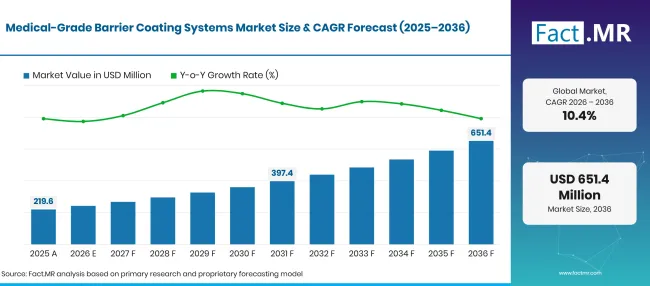
Medical Grade Barrier Coating Systems Forecast Global | Source: Fact.MR
What are the defining numbers behind Medical-Grade Barrier Coating Systems Market growth?
The 2026 to 2036 period adds USD 409.0 million in new value, led by coated interventional devices and protected nutrient delivery formats.
- Demand Drivers in the Market
- Faster curing processes are lowering the cost of putting a barrier layer on high-volume devices. Hydromer described its HydrUV coatings in January 2026 as UV-curable layers that cure in minutes and resist autoclave, ethylene oxide and plasma sterilization. Shorter cure cycles let contract manufacturers add coating lines without large ovens.
- Coating capacity is moving closer to device assembly hubs. Harland Medical Systems announced that its hydrophilic coating site in the Green Park Free Zone in Alajuela, Costa Rica, would start operations in July 2025. Local capacity shortens validation loops for catheter and guidewire makers in the region.
- Regulatory clarity is keeping fluoropolymers in the barrier toolkit. The U.S. FDA states that it has found no reason to restrict the use of fluoropolymers such as PTFE in medical devices. Designers can therefore keep PTFE liners while adding hydrophilic or silicone topcoats where lubricity is needed.
- Device makers want one supplier for coating, testing and documentation. Biocompatibility files now require lubricity, particulate and durability data that small in-house teams struggle to produce. Coating partners that run these tests alongside production win longer supply agreements.
- Key Segments Analyzed
- By Medical Barrier Coating Material: Silicone will hold 31.4% share in 2026, as flexible silicone layers bond well to elastomeric tubing, wound contact layers and skin adhesives.
- By Product Delivery Form: Capsule / tablet will account for 26.3% of 2026 value, since solid oral forms need enteric and moisture barrier films to protect sensitive actives.
- By Health Application: Clinical nutrition will capture 23.7% in 2026, given that hospital and care home formulas demand stable, low-odor nutrient delivery.
- By Customer Channel: Medical nutrition OEM will command 23.6% of 2026 revenue, because these producers buy coated ingredients under formal quality agreements.
- Analyst Opinion at Fact.MR
- Shambhu Nath Jha, Principal Consultant at Fact.MR, states, “Barrier coatings are now judged on test data as much as on chemistry, and suppliers who arrive with sterilization, particulate and aging results will shorten customer approvals. Silicone and hydrophilic platforms will keep gaining device programs as interventional procedures spread into new care settings. On the nutrition side, coated capsules and microencapsulated beads will win where they protect sensitive actives without adding taste or volume.”
- Strategic Implications
- Coating manufacturers should publish sterilization resistance, particulate and aging data for each platform so device teams can file faster.
- Contract coaters should place capacity near catheter and guidewire assembly clusters in Ireland, Costa Rica and Asia.
- Device OEMs should qualify a second coating source early to protect launch timelines against supplier disruption.
- Nutrition formulators should test barrier films against odor, moisture pickup and dose volume before scaling a new format.
Country growth spreads across 3.6 percentage points. India leads at 13.6%, helped by a domestic device push that is still filling basic capacity. China follows at 12.3%, where new quality rules are lifting coating specifications across a large production base. The United Kingdom, at 10.4%, edges the United States at 10.2% because its smaller medtech base is adding coated device lines from a lower start. Germany closes at 10.0%, as an export-heavy industry already runs mature coating programs and grows mainly through upgrades.
How does the Medical-Grade Barrier Coating Systems Market break down by segment?
Silicone will lead Medical Barrier Coating Material at 31.4%; Capsule / tablet will head Product Delivery Form at 26.3%; Clinical nutrition will lead Health Application at 23.7%; Medical nutrition OEM will hold Customer Channel at 23.6% in 2026.
Which Medical Barrier Coating Material leads?
Silicone holds 31.4% of 2026 sales.
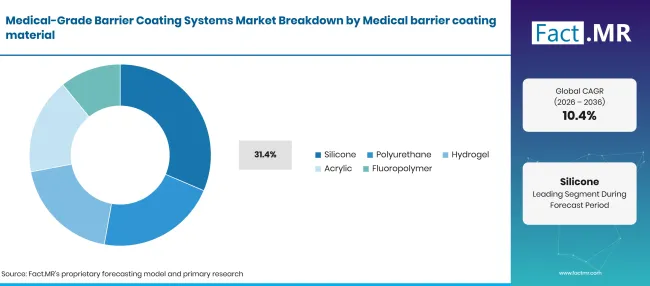
Medical Grade Barrier Coating Systems Breakdown Medical Barrier Coating Material | Source: Fact.MR
| Medical Barrier Coating Material | Share (2026) |
|---|---|
| Silicone (Leading segment) | 31.4% |
| Other segments combined | 68.6%* |
| Total | 100.0% |
Source: Fact.MR analysis. Updated Nov 12, 2026
Flexible tubing, wound dressings and skin-contact adhesives need a barrier that stretches with the substrate. Silicone layers meet that need while keeping low surface tension and good skin tolerance. Suppliers often pair silicone with performance silicones know-how, since cure control and adhesion promoters decide coating life. Covalon, for example, tailors its CovaCoat platform as a permanent coating for a range of devices. Polyurethane serves catheter shafts that need abrasion resistance, while hydrogel layers give the wet lubricity used on guidewires. Acrylic coatings protect sensors and wearables, and fluoropolymers line lumens where low friction is required. Parylene vapor coatings also protect implants and electronics, and Specialty Coating Systems reported that Parylene N reaches 5% mass loss only at 327°C in air. Readers can compare these chemistries with medical device coating demand across device classes.
What supports Capsule / tablet within Product Delivery Form?
Capsule / tablet takes 26.3% of 2026 revenue.
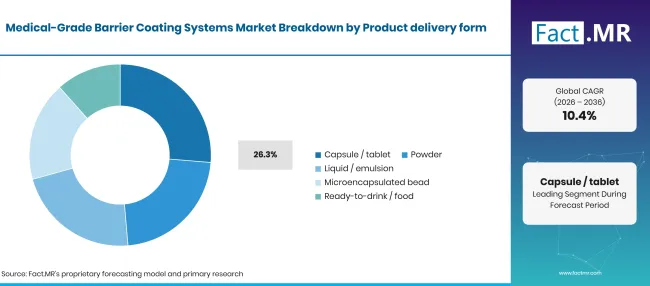
Medical Grade Barrier Coating Systems Breakdown Product Delivery Form | Source: Fact.MR
| Product Delivery Form | Share (2026) |
|---|---|
| Capsule / tablet (Leading segment) | 26.3% |
| Other segments combined | 73.7%* |
| Total | 100.0% |
Source: Fact.MR analysis. Updated Nov 12, 2026
Solid oral doses carry probiotics, vitamins and drugs that degrade with moisture or stomach acid. Barrier films on these doses rely on film formers that set water vapor transmission and release timing. Coating lines for tablets are well established, so new barrier polymers can enter with limited capital outlay. Powder and liquid / emulsion formats need encapsulated particles that survive mixing and heat treatment. Microencapsulated beads serve higher-value actives such as omega-3 oils and sensitive peptides. Ready-to-drink and food formats broaden the base but demand barrier systems that leave taste and texture untouched.
How does Health Application shape demand?
Clinical nutrition accounts for 23.7% of 2026 value.
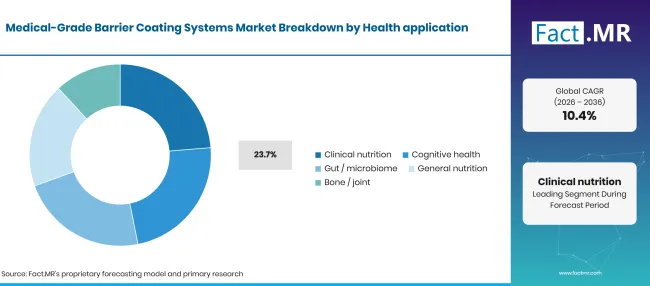
Medical Grade Barrier Coating Systems Breakdown Health Application | Source: Fact.MR
| Health Application | Share (2026) |
|---|---|
| Clinical nutrition (Leading segment) | 23.7% |
| Other segments combined | 76.3%* |
| Total | 100.0% |
Source: Fact.MR analysis. Updated Nov 12, 2026
Hospital and care home patients often stop taking oral supplements because of taste, smell or volume. dsm-firmenich reported in December 2025 that adherence to oral nutritional supplements can be as low as 37%. Barrier layers that mask odors and allow smaller, denser doses address that problem directly. Cognitive health products use coated fatty acids and botanicals that oxidize quickly. Gut / microbiome products need acid-resistant coatings so live cultures reach the intestine. General nutrition and bone / joint products are price sensitive and use simpler moisture barriers.
What leads the Customer Channel segment?
Medical nutrition OEM represents 23.6% of 2026 sales.
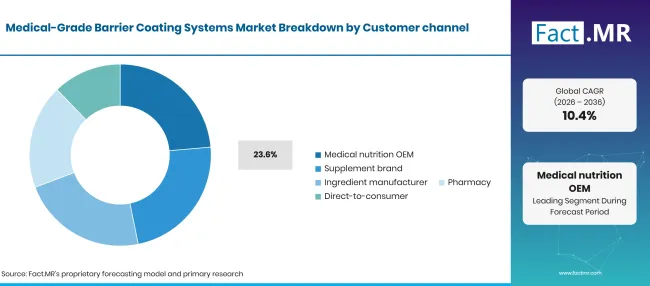
Medical Grade Barrier Coating Systems Breakdown Customer Channel | Source: Fact.MR
| Customer Channel | Share (2026) |
|---|---|
| Medical nutrition OEM (Leading segment) | 23.6% |
| Other segments combined | 76.4%* |
| Total | 100.0% |
Source: Fact.MR analysis. Updated Nov 12, 2026
Producers of enteral and oral clinical formulas buy coated ingredients under strict specifications and audit rights. These buyers prefer multi-year supply terms, which gives coating suppliers stable volume. Their audits also push suppliers toward pharmaceutical-grade documentation. Supplement brands look for coatings that support label claims and shelf life. Ingredient manufacturers apply barrier layers upstream and resell protected actives. Pharmacies and direct-to-consumer sellers drive demand for convenient formats, though they rarely specify the coating itself.
What is accelerating Medical-Grade Barrier Coating Systems Market adoption, and what is holding it back?
Faster UV curing, new regional coating sites and steady interventional device launches are widening use of barrier coatings. Device teams also value suppliers that bundle testing with production. Long biocompatibility programs, coating delamination risk and qualification costs slow adoption, especially for smaller device developers with limited test budgets.
Drivers Impact Analysis
| DRIVER | (~) % IMPACT ON CAGR | GEOGRAPHIC RELEVANCE | IMPACT TIMELINE |
|---|---|---|---|
| Growth in coated interventional and vascular devices | +1.2% | Global | Medium term (2-4 years) |
| Faster UV-cure coating processes for volume lines | +0.9% | North America, Western Europe | Short term (<=2 years) |
| Regional coating capacity near device assembly hubs | +0.7% | Latin America, Western Europe | Medium term (2-4 years) |
| Protected nutrient delivery in clinical nutrition | +0.6% | Global | Long term (>=4 years) |
Source: Fact.MR analysis. Updated Nov 12, 2026
Opportunity Impact Analysis
| OPPORTUNITY | (~) % IMPACT ON CAGR | GEOGRAPHIC RELEVANCE | IMPACT TIMELINE |
|---|---|---|---|
| Bundled coating, testing and documentation services | +0.7% | Global | Medium term (2-4 years) |
| Coating supply for domestic device makers in India | +0.6% | South Asia & Pacific | Long term (>=4 years) |
| Antimicrobial and hemocompatible topcoats | +0.5% | North America, Western Europe | Medium term (2-4 years) |
| Odor-masking barriers for oral nutrition formats | +0.3% | East Asia, Western Europe | Long term (>=4 years) |
Source: Fact.MR analysis. Updated Nov 12, 2026
Restraints Impact Analysis
| RESTRAINT | (~) % IMPACT ON CAGR | GEOGRAPHIC RELEVANCE | IMPACT TIMELINE |
|---|---|---|---|
| Long biocompatibility and validation programs | -0.6% | Global | Short term (<=2 years) |
| Qualification cost for new coating platforms | -0.4% | Global | Medium term (2-4 years) |
| Delamination and particulate risk on complex geometries | -0.3% | Global | Medium term (2-4 years) |
| Substrate limits for some coating chemistries | -0.2% | Emerging markets | Long term (>=4 years) |
Source: Fact.MR analysis. Updated Nov 12, 2026
Which countries are scaling the Medical-Grade Barrier Coating Systems Market through 2036?
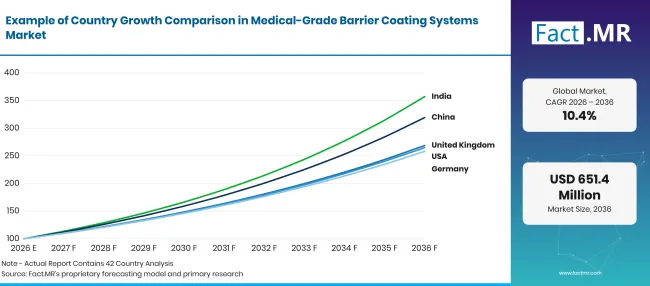
Medical Grade Barrier Coating Systems Growth Index | Source: Fact.MR
| Country | CAGR (2026 to 2036) |
|---|---|
| India | 13.6% |
| China | 12.3% |
| United Kingdom | 10.4% |
| United States | 10.2% |
| Germany | 10.0% |
Source: Fact.MR analysis. Updated Nov 12, 2026
How is India expanding barrier coating adoption?
13.6% CAGR, driven by domestic device manufacturing support and growing export volumes.
India is building device capacity from a base that still relies on imports. The Department of Pharmaceuticals reported medical device exports of USD 4,014 million in FY 2024-25 against imports of USD 8,822 million. Consumables and disposables formed the top export category, and these are the products that most often carry coated surfaces. A Rs 500 crore scheme for common facilities and testing will help local makers source and validate coatings at home.
What is driving China’s demand?
12.3% CAGR, helped by tighter manufacturing rules and support for novel biomaterial devices.
China’s regulator is pushing device makers toward higher-end products and stricter quality control. NMPA measures issued in June 2025 name novel biomaterial-based devices as a priority and call for standard work on new medical materials. A revised Good Manufacturing Practice for medical devices, announced in November 2025, takes effect on November 1, 2026. Coating process records will face closer inspection under these rules.
How is the United Kingdom developing demand?
10.4% CAGR, backed by a broad medtech base and steady device innovation.
The United Kingdom has a large medical technology industry for its size. Government statistics published in September 2026 estimate 2024/25 medtech turnover at £44.2 billion, with 158,500 employees across about 4,500 companies. Many of these firms make catheters, wound care and diagnostic devices that use barrier layers. Domestic coating suppliers and Irish coating hubs both serve this customer base.
What is supporting United States adoption?
10.2% CAGR, reflecting a high volume of device submissions and novel device clearances.
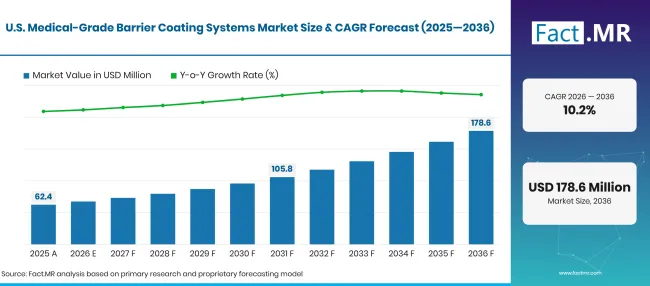
Medical Grade Barrier Coating Systems Forecast Usa | Source: Fact.MR
The United States remains the reference market for coated device approvals. The FDA’s CDRH reported 124 novel device authorizations and 21,780 device submissions in its 2025 annual report. Each submission with a coated surface needs biocompatibility evidence for that coating. Hydrophilic, antimicrobial and Parylene suppliers in Minnesota and the Northeast serve much of this pipeline.
How is Germany sustaining growth?
10.0% CAGR, as export-focused device makers upgrade existing coating programs.
Germany’s device industry sells heavily abroad, which ties coating demand to export orders. Destatis reported total German exports of EUR 1,569.6 billion in 2025, while exports to the United States fell 9.3% to EUR 146.9 billion. Softer transatlantic trade will keep device makers focused on cost and yield. Coating upgrades that cut scrap and cure time fit that priority.
Who leads the Medical-Grade Barrier Coating Systems Market?
The field splits into three groups. Hydrophilic and functional coating specialists, including Surmodics, Hydromer and Harland Medical Systems, compete on lubricity, durability and the speed of coating trials. Surmodics opened cleanroom coating and analytical testing capability in Ballinasloe, Ireland, in September 2026 to serve European device makers.
Hydromer is pushing UV-cure chemistry for volume lines, while Harland added a coating site in Costa Rica in 2025. A second group covers protective and silicone-based coatings. Specialty Coating Systems applies Parylene to implants and electronics, and Covalon tailors its CovaCoat platform for individual devices. These suppliers win on barrier integrity across sterilization and aging. dsm-firmenich forms the third group, bringing encapsulation know-how to clinical and general nutrition formats. Through the forecast period, the winners will be the suppliers that pair coating chemistry with test data, regional capacity and fast technical support for each customer.
Which companies are the key providers?
Key companies in the Medical-Grade Barrier Coating Systems Market include Surmodics, Hydromer, Harland Medical Systems, Specialty Coating Systems, Covalon Technologies and dsm-firmenich.
- Surmodics
- Hydromer
- Harland Medical Systems
- Specialty Coating Systems
- Covalon Technologies
- dsm-firmenich
Bibliography
- Department for Science, Innovation and Technology and Office for Life Sciences. (2026, September 17). Bioscience and health technology sector statistics 2024 to 2025.
- Department of Pharmaceuticals, Government of India. (2026). Annual Report 2025-26.
- dsm-firmenich. (2025, December 3). Medical nutrition product innovation starts with people: proprietary insights to real-world needs in nutritional care.
- Federal Statistical Office of Germany (Destatis). (2026, February 6). Exports in December 2025: +4.0% on November 2025.
- Harland Medical Systems. (2025, January 24). Harland Medical Systems To Begin Operations in Costa Rica.
- Hydromer. (2026, January 16). Future-Proof Medical Devices With Durable UV-Cure Coatings.
- National Medical Products Administration. (2025, June 27). Announcement of the National Medical Products Administration on Issuing Measures to Optimize Whole Life-Cycle Regulation in Support of the Innovative Development of High-End Medical Devices ([2025] No. 63).
- National Medical Products Administration. (2025, November 4). Announcement of the NMPA on the Release of the Good Manufacturing Practice for Medical Devices ([2025] No. 107).
- Specialty Coating Systems. (2025, March 14). Thermal Characterization of Parylene for Medical Applications.
- Surmodics. (2026, September 10). Surmodics Opens Medical Device Coating Capabilities in Ireland.
- U.S. Food and Drug Administration. (2026, January 28). 2025 CDRH Annual Report.
- U.S. Food and Drug Administration. (2026, September 1). PFAS in Medical Devices: What You Need to Know
This Report Answers
- How much value will medical-grade barrier coatings add between 2026 and 2036?
- Why does silicone hold the top position among coating materials?
- Which delivery formats rely most on barrier films and encapsulation?
- How do clinical nutrition buyers and medical nutrition OEMs shape specifications?
- Where will India, China and the United Kingdom outpace mature markets?
- What separates hydrophilic specialists from protective coating and encapsulation suppliers?
What does the Medical-Grade Barrier Coating Systems Market cover?
This study tracks coating materials and coating services whose main job is to block moisture, fluids, gases or chemicals on a medical or health product. Device coatings include hydrophilic, silicone, polyurethane, acrylic, fluoropolymer and Parylene layers applied to catheters, guidewires, implants, wearables and device electronics. Related device adhesives are discussed through medical adhesives where they share a barrier role.
Value is counted at the coating level. It covers sale of the coating material or the fee for a coating service, not the price of the finished device or supplement.
What is included in the scope?
Coating chemistries sold to device OEMs and contract manufacturers for body-contact and implant use.
Contract coating, cure and analytical testing services billed by coating specialists. Barrier films and encapsulation systems on capsules, tablets, powders, beads and liquid nutrition formats. Antimicrobial and hemocompatible topcoats tracked under surface active coatings when they also serve a barrier function.
What is excluded from the scope?
General industrial and architectural coatings with no healthcare use.
Electronics-only protection covered in conformal coatings outside medical devices. Standard packaging films and blister materials without a direct product coating. Finished devices, drugs and nutrition products, apart from the coating value inside them.
How Was the Analysis Built?
The analysis draws on 120+ sources, 35+ company portfolios, 25+ countries, and more than 20 industry interviews.
- Primary Research: Primary research includes discussions with manufacturers, service providers, technology developers, distributors, end users, and subject-matter experts. These conversations examine purchasing priorities, product adoption, operational challenges, approval requirements, competitive positioning, and the factors that influence wider market acceptance.
- Desk Research: Desk research covers government statistics, regulatory publications, company filings, trade data, technical studies, industry associations, standards, public policy, and other authoritative sources. Every source used in the analysis is documented in the bibliography.
- Market Sizing and Forecasting: Market estimates combine historical performance, demand indicators, pricing and volume trends, segment shares, company participation, country-level growth, adoption patterns, investment activity, and barriers to market expansion.
- Data Validation and Update Cycle: Findings are validated by comparing primary interviews with public data, company activity, regulatory changes, trade patterns, and industry developments. Regular updates review new product launches, capacity changes, partnerships, approvals, and shifts in commercial adoption.
Segmentation
What is the report’s scope and coverage?
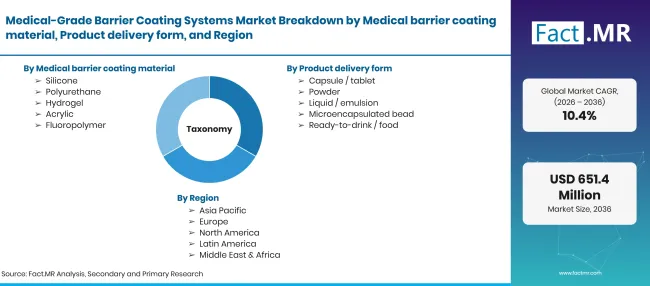
Medical Grade Barrier Coating Systems Taxonomy | Source: Fact.MR
| Attribute | Details |
|---|---|
| Quantitative Units | USD million |
| Market Definition | Coating materials, formulations and coating services that form a protective barrier on medical devices, device components and coated nutrition or health delivery formats. |
| Medical Barrier Coating Material | Silicone; Polyurethane; Hydrogel; Acrylic; Fluoropolymer |
| Product Delivery Form | Capsule / tablet; Powder; Liquid / emulsion; Microencapsulated bead; Ready-to-drink / food |
| Health Application | Clinical nutrition; Cognitive health; Gut / microbiome; General nutrition; Bone / joint |
| Customer Channel | Medical nutrition OEM; Supplement brand; Ingredient manufacturer; Pharmacy; Direct-to-consumer |
| Regions Covered | North America; Latin America; Western Europe; Eastern Europe; East Asia; South Asia & Pacific; Middle East & Africa |
| Countries Covered | India; China; United Kingdom; United States; Germany |
| Companies Profiled | Surmodics; Hydromer; Harland Medical Systems; Specialty Coating Systems; Covalon Technologies; dsm-firmenich |
| Forecast Period | 2026 to 2036 |
| Approach | Coating revenue built up by chemistry and delivery format, then checked against device approval, trade and manufacturing statistics in each country. |
Source: Fact.MR analysis. Updated Nov 12, 2026
How is the market segmented?
-
By Medical Barrier Coating Material
- Silicone
- Polyurethane
- Hydrogel
- Acrylic
- Fluoropolymer
-
By Product Delivery Form
- Capsule / tablet
- Powder
- Liquid / emulsion
- Microencapsulated bead
- Ready-to-drink / food
-
By Health Application
- Clinical nutrition
- Cognitive health
- Gut / microbiome
- General nutrition
- Bone / joint
-
By Customer Channel
- Medical nutrition OEM
- Supplement brand
- Ingredient manufacturer
- Pharmacy
- Direct-to-consumer
-
By Region
- North America
- Latin America
- Western Europe
- Eastern Europe
- East Asia
- South Asia & Pacific
- Middle East & Africa
Frequently Asked Questions
How large is the medical-grade barrier coating systems market in 2026?
What growth rate will the medical-grade barrier coating systems market record?
Which coating material leads?
Which product delivery form leads?
Which health application leads?
Which customer channel leads?
Which country will grow quickest?
Who are the main companies?
What holds the market back?
Who worked on this report


Preview the report firsthand - request a free sample
Free SampleGet the brochure for pricing and purchase details
Download PDF