- Base Value(2025): 2.4 Bn
- Forecast Value (2035): 4.1 Bn
- CAGR (2035): 5.6%
Catamaran Market Outlook 2025 to 2035
The global catamaran market is projected to increase from USD 2.4 billion in 2025 to USD 4.1 billion by 2035, with a CAGR of 5.6% during the forecast period. Growth is driven by demand for recreational boating due to rising disposable income. A major trend is eco-friendly hybrid and electric propulsion. Consumers seek stable, spacious, and fuel-efficient vessels for leisure and transport, creating coastal tourism and charter opportunities.
Facts about Catamaran Market
- Industry Value (2025): USD 2.4 Billion
- Projected Value (2035): USD 4.1 Billion
- Forecast CAGR (2025 to 2035): 5.6%
- Leading Segment (2025): Sailing (42% Market Share)
- Country Growth Rate (2025 to 2035): China (7.1% CAGR)
- Top Key Players: Alumarine Shipyard, Seawind, Grup Aresa Internaciona, Voyage, Lagoon, and Fountaine Pajot
2025-to-2035.webp "Us Catamaran Market Market Value(usd Billion)2025 To 2035")
Us Catamaran Market Market Value(usd Billion)2025 To 2035 | Source: Fact.MR
What are the Drivers of Catamaran Market?
The growing popularity of cruising is driving growth in the catamaran market. Cruising, which involves leisurely travel by boat with stops at various ports, aligns well with the appeal of catamarans. These vessels offer a unique blend of sailing freedom and the comfort and amenities found on cruise ships, making them an attractive choice for vacationers. In July 2023, the UK Department for Transport reported that 2022 cruise passenger numbers rose to 2.0 million from 181,000 in 2021.
Water sports are a key factor driving growth in the catamaran market, encompassing a wide range of activities involving varying levels of immersion in water. Catamarans provide an ideal platform for both thrilling and relaxing experiences, offering spaciousness, stability, and easy access to water. Popular activities such as sunbathing, swimming, snorkeling, kayaking, and stand-up paddleboarding (SUP) are commonly enjoyed from catamarans, making them highly favored for recreational water sports and contributing to increasing market demand. In May 2023, the Royal Yachting Association's Watersports Participation Survey found that 13.2 million U.K. adults boated in 2022 and over 10 million people annualy. Stand-up paddleboarding gained 536,000 participants.
Technological advances in marine engineering and materials have resulted in the creation of more fuel-efficient, lightweight, and comfortable catamarans. This makes them more appealing to buyers who value both performance and luxury.
Environmental concerns are also influencing the market, with a growing interest in hybrid and electric-powered catamarans. These sustainable alternatives support global emission reduction efforts and appeal to environmentally conscious consumers, particularly in regulated markets such as Europe and Australia.
What are the Regional Trends of Catamaran Market?
North America is seeing an increase in demand for recreational boating and marine transportation services. The growing popularity of environmentally friendly vessels, advances in fuel-efficient and hybrid propulsion technologies, and increased interest in private yachting are major factors driving market growth. The U.S. and Canada are key markets, with MarineMax, Sunreef Yachts, and Leopard Catamarans leading the way. The strong consumer base and preference for stable, high-performance vessels help to drive steady market growth in North America.
Europe, with countries like France, Italy, and Greece known for their coastal attractions and popularity of boating holidays. The region draws buyers looking for luxurious cruising experiences and charter opportunities.
Catamarans are gaining popularity in the Asia Pacific region, with countries such as Australia and Thailand leading the charge. The region's large coastal line, thriving tourism industry, and emerging affluent class all contribute to increased demand for leisure catamarans and charter services. Furthermore, the Caribbean and Mediterranean regions are well-known for their sailing and yachting attractions, attracting both buyers and catamaran charter operators.
What are the Challenges and Restraining Factors of Catamaran Market?
One of the primary challenges facing the catamaran market is the high initial purchase and maintenance costs. Catamarans are more expensive than traditional monohull boats because they require more materials, dual engines, and specialized components. This makes them less accessible to middle-class consumers, limiting adoption to affluent buyers or commercial operators.
Alack of adequate docking and marina infrastructure, especially in developing countries. Catamarans require larger berths and specialized handling facilities because of their wide beam. Accommodating these vessels in congested or outdated marinas is often difficult or costly, limiting their usability and operational flexibility.
Weather conditions also have an impact on catamaran operations. While they perform well in calm waters, rough offshore conditions can be challenging, especially for lighter recreational models. This reduces their popularity in areas with harsh marine environments or limited seasonal access.
Complexity of handling and maneuverability can also be a barrier for first-time boat owners. While catamarans provide excellent stability, their twin-engine systems and wide turning radius can be problematic in confined waters or docking situations. This often necessitates additional training or reliance on crew, raising operational costs.
Country-Wise Outlook
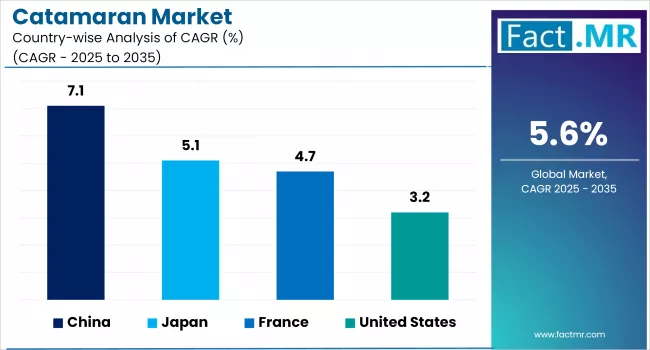
Catamaran Market By Country | Source: Fact.MR
U.S. Catamaran Market Expands with Rising Demand for Recreation, Cruising, and Charter Tourism
In the U.S., the catamaran market is being driven by increased interest in recreational boating, coastal cruising, and charter tourism. With one of the world's largest marine recreation markets, the U.S. sees high demand for both sailing and power catamarans, especially in Florida, California, and the Great Lakes. Catamarans are becoming increasingly popular due to their stability, space, and comfort, particularly for family and group travel.
The rise of luxury charter services is a major trend in the U.S. market. The Florida Keys and the U.S. Virgin Islands have become popular destinations for catamaran charters. This demand is driving manufacturers and charter companies to expand their fleets with mid-size and large catamarans, which are frequently outfitted with premium interiors and hybrid propulsion systems.
2025-to-2035.webp "Us Catamaran Market Country Value(usd Billion)2025 To 2035")
Us Catamaran Market Country Value(usd Billion)2025 To 2035 | Source: Fact.MR
The U.S. is also seeing an increase in demand for environmentally friendly boating solutions. Stricter marine emissions standards set by the Environmental Protection Agency (EPA) and regional air quality mandates, particularly in California, are driving growth in electric and hybrid catamaran models. Builders are responding by incorporating solar panels, battery storage systems, and lightweight materials into new designs.
The U.S. Coast Guard and other regulatory bodies enforce compliance with maritime safety standards, resulting in a well-regulated environment for both manufacturers and operators. These include flotation device requirements, hull identification numbers, and charter operators' commercial licenses.
China Catamaran Market Grows with Rising Marine Leisure Demand and Coastal Tourism Expansion
The catamaran market in China is growing, owing in large part to the rapid development of the domestic recreational boating industry. Catamarans are becoming more desirable for private ownership, tourism, and event hosting as disposable incomes rise and interest in marine leisure grows among the urban middle and upper classes. Coastal provinces like Guangdong, Hainan, and Zhejiang are popular destinations for marine activity and catamaran demand.
The Chinese government's promotion of marine tourism through initiatives such as the "Blue Economy" and Hainan Free Trade Port development, which encourages yacht tourism and leisure boating, is a significant driver. Hainan, in particular, is positioning itself as a major recreational boating destination, with relaxed yacht entry regulations and infrastructure development opening up new opportunities for catamaran sales and charter services.
China's regulatory oversight is changing, with agencies like the China Maritime Safety Administration (MSA) establishing safety and operational standards. Import tariffs and certification requirements continue to be barriers to entry for foreign manufacturers, but trade policy reforms, particularly in designated pilot free trade zones, are improving access.
France Emerges as Global Hub for Catamaran Production and Marine Innovation
France is the world's leading catamaran manufacturer, with a large domestic consumer base. The country is home to some of the world's most renowned catamaran brands, and French shipyards, particularly along the Atlantic coast in regions such as La Rochelle and Les Sables-d'Olonne, play an important role in global manufacturing and innovation.
A major motivator is France's deep-rooted sailing culture, which is supported by a large community of recreational and competitive sailors. Catamarans are particularly popular for leisure cruising and offshore sailing, with the French market preferring both sailing and power catamarans due to their stability, safety, and versatility in coastal waters and the Mediterranean.
France is also a leader in offshore racing, with multihull catamarans competing in global events such as the Route du Rhum and the Transat Jacques Vabre. This racing pedigree drives innovation in lightweight materials, hydrodynamic design, and hybrid propulsion, much of which is applied to commercial and recreational catamarans.
The French Maritime Authority is responsible for regulatory oversight, which must comply with EU directives on vessel safety, emissions, and construction standards. France also receives significant state support for marine innovation through initiatives such as Pôle Mer Bretagne Atlantique, which funds R&D in advanced marine technologies.
Category-wise Analysis
Sailing to Exhibit Leading by Type
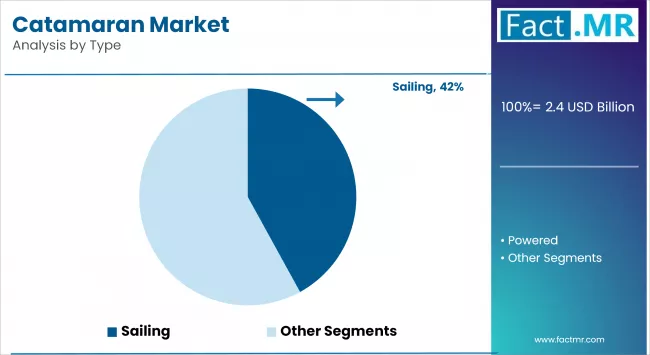
Catamaran Market By Type | Source: Fact.MR
Sailing catamarans dominate the catamaran market, driven by advances in materials, design, and performance. Lightweight, long-lasting composites and more efficient hull designs have increased speed, stability, and fuel economy. Their market dominance stems from their versatility, which provides excellent stability and space for leisure, racing, and commercial applications. Furthermore, their higher fuel efficiency and lower environmental impact make them appealing to environmentally conscious consumers and businesses alike.
Power catamarans are the fastest-growing segment in the catamaran market due to their versatility, increased stability, and rising demand for high-performance, fuel-efficient vessels. Their dual-hull design provides excellent comfort while reducing drag, allowing them to achieve higher speeds and better fuel efficiency than monohulls. With growing consumer interest in recreational boating, tourism, and commercial applications, power catamarans are gaining significant appeal due to their spacious design, smooth ride quality, and ability to navigate shallow waters with ease. Hybrid and electric propulsion systems are consistent with growing sustainability trends.
Medium-Sized (30 to 50 m) to Exhibit Leading by Size
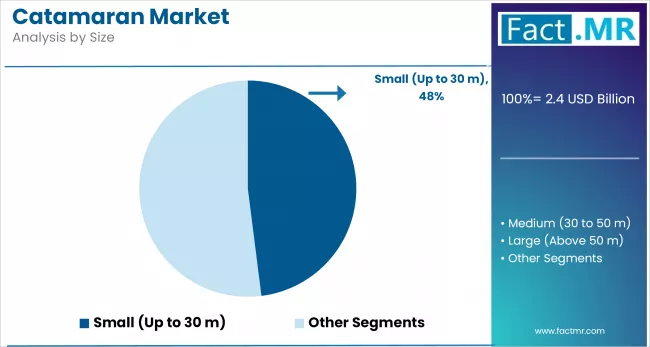
Catamaran Market By Size | Source: Fact.MR
Medium-sized (30 to 50 m) catamarans dominate the catamaran market as these offer an ideal balance of performance, space, and affordability. They have made advances in lightweight materials, as well as optimized hull shapes and designs for improved propulsion. They do boast speed, which saves fuel while also providing durability to cats, which have space for luxury, but it takes up less real estate than large vessels.
Because of these three factors, it is cost-effective and provides access to a variety of waterways, as well as efficiency in both individual ownership and chartering. As there is a growing demand for boats that combine efficiency and functionality, medium-sized catamarans are taking the lead.
Large-sized (Above 50 m) catamarans are the fastest-growing segment in the global catamaran market, driven by increased demand for luxury and high-performance vessels. The unparalleled stability, ample living space, and increased comfort make them ideal for long-distance cruising, luxury tourism, or private ownership. With advancements in hybrid propulsion and smarter navigation technology, the giant catamaran is expected to be more fuel efficient and environmentally friendly. Large catamarans would become more popular in the coming years as private yacht purchases increase and there is a growing preference for luxury sustainability travel.
Sports to Exhibit Leading by Passenger Type
The sports segment dominates the catamaran market, due to high-performance sailing and racing enthusiasts, which include both recreational and competitive sailors. These catamarans were designed with speed, agility, and lightweight construction in mind, making them ideal for regattas, offshore races, and performance cruising. To reduce drag and maximize velocity, sports catamarans typically feature sleek hulls, advanced sail rigs, and high-strength composite materials such as carbon fiber. Unlike luxury cruising models, these ships prioritize maneuverability and aerodynamic efficiency over onboard comfort. Their twin-hull design provides a natural advantage in terms of stability and reduced water resistance, resulting in superior speed performance, a critical factor in competitive sailing.
The passenger transport segment is the fastest-growing in the catamaran market, due to its superior stability, speed, and fuel efficiency. The twin-hull design allows for smooth navigation in rough waters, ensuring passenger comfort. These vessels provide faster travel times and lower operating costs. Their spacious decks allow for plenty of passenger space, making powered catamarans a popular choice for efficient, environmentally friendly maritime transportation in coastal and island regions.
Competitive Analysis
The catamaran market is becoming increasingly competitive, driven by changing consumer preferences, advances in marine technology, and the growing popularity of leisure marine activities. Catamarans, known for their stability, speed, and spacious layouts, are gaining popularity as recreational and commercial vessels. Sailing and power catamarans are both available on the market, with the latter gaining popularity due to improved fuel efficiency and maneuverability.
Design innovation, material selection, and propulsion technology all contribute to market competition. To improve speed and fuel economy, manufacturers focus on lightweight composites like carbon fiber and fiberglass. Customization, luxury interiors, and sustainable features such as solar panels and hybrid engines are now important differentiators. Companies with advanced design capabilities and production flexibility are better positioned to serve both wealthy private owners and commercial operators.
Sustainable development and innovation are becoming increasingly important in competitive positioning. To remain competitive, manufacturers are investing in electric propulsion, energy-efficient hull designs, and green building practices as regulations surrounding marine emissions tighten, particularly in Europe. Players who can strike a balance between performance and environmental sensitivity are increasingly popular with environmentally conscious consumers.
Key players in the market include Incat Crowther, Alumarine Shipyard, Seawind, Grup Aresa Internaciona, Voyage, Lagoon, Fountaine Pajot, Robertson & Caine, Matrix Yachts, LOMOcean Design, African Cats; Bavaria, Catana Group, LeisureCat, Outremer Yachting, and other players.
Recent Development
- In October 2024, Sunreef Yachts unveiled the Sunreef 80 Power Eco at the Monaco Yacht Show, showcasing a cutting-edge solar-powered luxury catamaran. This vessel represents Sunreef's commitment to sustainability and luxury, combining cutting-edge green technologies with refined design and performance. Its silent propulsion provides an environmentally friendly and noise-free cruising experience, which is ideal for marine conservation and guest comfort.
- In October 2024, Rossinavi unveiled its first catamaran, the Seawolf X, which incorporates solar panels and emphasizes eco-sustainability alongside performance. The Seawolf X combines high-performance engineering with luxurious amenities to provide a comfortable and eco-friendly yachting experience. With an array of solar panels, the catamaran uses renewable energy to power onboard systems and propulsion, significantly lowering its carbon footprint.
Segmentation
Segmentation of Catamaran Market
-
By Type :
- Sailing
- Powered
-
By Size :
- Small (Up to 30 m)
- Medium (30 to 50 m )
- Large (Above 50 m)
-
By Passenger Type :
- Sports
- Passenger Transport
- Cruising
- Others (Military, Survey Vessels, etc.)
-
By Region :
- North America
- Latin America
- Western Europe
- Eastern Europe
- East Asia
- South Asia & Pacific
- Middle East & Africa
Frequently Asked Questions
What is the Global Catamaran Market size in 2025?
Who are the Major Players Operating in the Catamaran Market?
What is the Estimated Valuation of the Catamaran Market by 2035?
What Value CAGR Did the Catamaran Market Exhibit over the Last Five Years?
Who worked on this report


Preview the report firsthand - request a free sample
Free SampleGet the brochure for pricing and purchase details
Download PDF