- Base Value(2025): 6.3 Bn
- Forecast Value (2035): 10.9 Bn
- CAGR (2035): 5.6%
Dozer Market Outlook (2025 to 2035)
The global dozer market is projected to increase from USD 6.3 billion in 2025 to USD 10.9 billion by 2035, with a CAGR of 5.6% during the forecast period. Growth is driven by a global infrastructure investment boom, particularly in the areas of energy, transportation, and urban development.
Dozers are ideal for their powerful earthmoving capabilities, efficiency in large-scale construction and infrastructure projects, and versatility in grading, excavation, and land clearing tasks across energy, transportation, and urban development sectors.
2025-to-2035.webp "Us Dozer Market Market Value(usd Billion)2025 To 2035")
Us Dozer Market Market Value(usd Billion)2025 To 2035 | Source: Fact.MR
What are the Drivers of Dozer Market?
The market is experiencing substantial development as a result of the growing demand for heavy machinery to support large-scale construction and earthmoving activities. Furthermore, the adoption of dozers is being further intensified by the expansion of the mining sector, which is being driven by high commodity prices and new mining developments in regions such as Africa, Australia, and Latin America.
The market adoption is being accelerated by technological advancements, such as the integration of GPS, telematics, and autonomous systems, which are improving operational efficiency, safety, and fleet management. Particularly in public sector developments and eco-sensitive zones, the adoption of electric and hybrid dozers presents substantial opportunities due to the transition to green construction and low-emission projects.
Nevertheless, the high initial costs of sophisticated dozers that are equipped with telematics and automation continue to be a significant obstacle, restricting the availability of these machines to smaller contractors. Countries worldwide are prioritizing large-scale development projects in the energy, urbanization, and transportation sectors, which is substantially driving the growth of the dozer market as a result of increasing infrastructure investments.
Significant foreign investments are being attracted to India as a result of the government's strong emphasis on infrastructure development. Foreign Direct Investment (FDI) in construction development, which encompasses townships, housing, built-up infrastructure, and related projects, was approximately USD 26.76 billion, according to the India Brand Equity Foundation (IBEF).
FDI in infrastructure activity peaked at USD 35.24 billion between April 2000 and September 2024. This constant inflow of capital facilitates the country's ongoing expansion in the construction sector, thereby increasing the demand for heavy machinery, including dozers.
The Bipartisan Infrastructure Law (BIL), also known as the Infrastructure Investment and Jobs Act (IIJA), in the U.S., authorizes USD 1.2 trillion for infrastructure and transportation improvements. This legislation is facilitating the extensive development of roads, bridges, and energy systems, necessitating heavy-duty equipment, such as dozers, with USD 550 billion allocated to new projects.
Equipment manufacturers and end users are exploring greener alternatives to traditional diesel-powered machinery in response to the global shift toward sustainability and the increasing regulatory pressure to reduce carbon emissions.
For example, in September 2024, Fortescue and Liebherr executed a USD 2.8 billion agreement to implement 475 zero-emission mining machines, including battery-powered PR 776 dozers, to facilitate fossil-free, autonomous operations in large-scale mining projects.
The sustained demand for dozers and the critical role they play in sustaining long-term construction and industrial growth are being reinforced by these massive infrastructure developments in major global economies.
| Metric | Value |
|---|---|
| Industry Size (2025E) | USD 6.3 billion |
| Industry Size (2035F) | USD 10.9 billion |
| CAGR (2025-2035) | 5.6% |
Source: Fact.MR analysis. Updated Aug 12, 2025
What are the Regional Trends of Dozer Market?
Regional trends in the dozer market for 2025 indicate that Asia Pacific held the largest share globally, propelled by rapid infrastructure growth, expanding mining activities, accelerated urbanization, and increasing government investments in transportation, energy, and industrial projects across major economies, including China, India, Australia, and Southeast Asia. This robust development in the region drives substantial demand for dozers in construction and earthmoving applications vital to ongoing industrialization and urban expansion efforts..
The region's dominance is additionally bolstered by the increasing demand for advanced construction and earthmoving equipment to serve the requirements of large-scale projects, such as transportation networks, renewable energy, and smart cities.
India, Australia, and South Korea are among the countries that are placing a greater emphasis on industrial growth and infrastructure modernization. This is reflected in the increased investments in transport corridors, renewable energy, and urban redevelopment, which are all contributing to the demand for construction and earthmoving equipment, including dozers.
In particular, the rapid expansion of infrastructure in India is generating substantial growth opportunities for equipment manufacturers. The mining and construction equipment (MCE) sector in India is expected to expand at a compound annual growth rate (CAGR) of 19.0%, with a projected value of USD 45 billion (INR 3,83,850 crore) by 2030, as per the Confederation of Indian Industry (CII) and Kearney.
India's rise as the world's fastest-growing MCE market is demonstrated by this surge, substantially bolstering Asia Pacific's leadership in the global dozer market.
In 2025, the market was recognized as a profitable region. The European dozer market is undergoing a substantial transformation, which is being driven by the region's strong emphasis on sustainable construction practices, the growing demand for eco-friendly and low-emission construction equipment, and the growth of urban redevelopment projects.
There is a rise in investments in infrastructure modernization. The market is also benefiting from the adoption of greener, more efficient machinery, such as hybrid and electric dozers, by contractors in response to stringent environmental regulations.
Additionally, the consistent demand for equipment is being bolstered by the revival of large-scale civil engineering projects, renewable energy installations, and transportation corridor enhancements in various countries, such as the U.K., Germany, and France.
In 2025, the European dozer market was recognized as a profitable region. The European dozer market is undergoing a substantial transformation, which is being driven by the region's strong emphasis on sustainable construction practices, the growing demand for eco-friendly and low-emission construction equipment, and the growth of urban redevelopment projects.
There is a rise in investments in infrastructure modernization. The market is also benefiting from the adoption of greener, more efficient machinery, such as hybrid and electric dozers, by contractors in response to stringent environmental regulations.
Additionally, the consistent demand for equipment is being bolstered by the revival of large-scale civil engineering projects, renewable energy installations, and transportation corridor enhancements in various countries, such as the U.K., Germany, and France.
In 2025, the North American dozer market was recognized as a lucrative region due to the increasing demand from the mining and energy sectors, the rise in demand from the commercial and residential construction sector, the expansion of large-scale infrastructure projects, and the increasing adoption of advanced and efficient machinery.
The steady demand for dozers across multiple applications is being driven by the region's strong emphasis on upgrading aging transportation networks, expanding renewable energy infrastructure, and bolstering industrial capacity.
What are the Challenges and Restraining Factors of the Dozer Market?
The substantial upfront investment required to purchase dozers, often ranging from USD 30,000 to USD 900,000 for traditional and advanced models, acts as a major constraint, particularly for small and medium-sized enterprises (SMEs). This financial barrier pushes many companies toward rental services or second-hand equipment instead of purchasing new machines, thus slowing market expansion.
Economic slowdowns, reduced construction activity, and delays or cancellations of infrastructure projects directly decrease demand for new dozers. When financing becomes tighter, companies prefer to delay or avoid large capital expenditures on heavy machinery.
The increasing availability of other heavy equipment, such as multi-functional compact loaders or excavators that can perform similar tasks, reduces direct demand for dozers. This intensifies competition and challenges dozer suppliers to differentiate their products.
Variability in the price of steel and other raw materials affects manufacturing costs and pricing strategies. Additionally, higher interest rates and stricter financing conditions make it more difficult for buyers to afford heavy equipment.
Country-Wise Outlook
| Country | CAGR (2025-35) |
|---|---|
| United States | 5.1% |
| China | 5.7% |
| Japan | 4.9% |
Source: Fact.MR analysis. Updated Aug 12, 2025
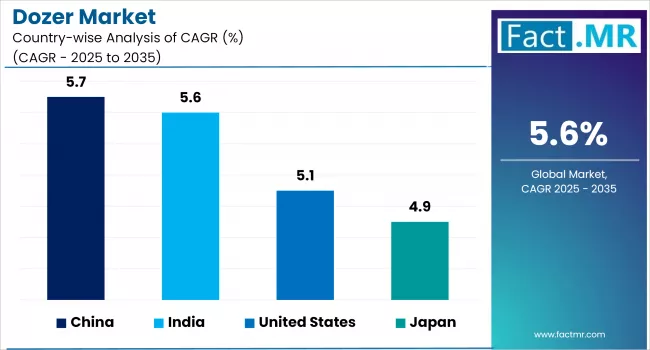
Dozer Market By Country | Source: Fact.MR
U.S. Dozer Market sees Growth Driven by Increasing Investments in Infrastructure Revitalization
The U.S. market maintained a dominant position in 20255, fueled by the steady demand from the mining, construction, and energy sectors, the increasing adoption of advanced machine control technologies, and a growing shift toward low-emission and hybrid machinery.
Furthermore, investments in infrastructure revitalization have played a crucial role. The U.S. market is undergoing a significant transformation as fleet owners and contractors increasingly focus on sustainability, fuel efficiency, and enhanced productivity.
The demand for technologically advanced earthmoving equipment is being further accelerated by the drive to modernize transportation networks, upgrade utilities, and expand renewable energy projects. For example, in March 2025, John Deere introduced the 850 X-Tier Dozer, which is equipped with E-Drive technology. Additionally, the company upgraded its 700, 750, and 850 P-Tier models, which were designed to improve operator comfort, fuel efficiency, and productivity by utilizing sophisticated SmartGrade systems.
These advancements are indicative of the U.S. market's continuous transition to more efficient, environmentally friendly, and intelligent dozer solutions, which further solidifies its position as a global leader in equipment innovation.
China Witnesses Rapid Market Growth Backed by its Construction and Mining Sectors is Creating Strong Demand for Advanced Earthmoving Equipment
2025-to-2035.webp "Us Dozer Market Country Value(usd Billion)2025 To 2035")
Us Dozer Market Country Value(usd Billion)2025 To 2035 | Source: Fact.MR
In 2025, the China dozer market maintained a significant revenue share. The demand for sophisticated earthmoving equipment is on the rise as a result of China's emphasis on the integration of green technologies, automation, and digitalization into its construction and mining sectors.
The adoption of innovative machinery is being further accelerated by the country's strategic initiatives to enhance infrastructure resilience and project efficiency. For example, in September 2022, Shantui and Huazhong University of Science and Technology jointly introduced the world's first autonomous unmanned bulldozer, which represented a significant advancement in the automation of construction equipment and established a new standard for intelligent heavy machinery in China.
The dozer market in China is undergoing rapid growth, which is being driven by the country's ongoing urbanization and industrial upgrading efforts, the expansion of high-speed rail, and the increasing investments in smart construction technologies. Similarly, the country is also investing in renewable energy projects.
Japan Market sees Rising Demand for Compact and Technologically advanced dozers
In 2025, the Japanese dozer market maintained a substantial revenue share. In Japan's space-constrained urban environments and mountainous construction zones, the demand for compact and technologically advanced dozers is on the rise, as precision, efficiency, and reduced emissions are essential.
The government's active support of infrastructure investments, both domestically and internationally, also benefits Japan's construction sector. For example, in December 2024, the Japan Overseas Infrastructure Investment Corporation (JOIN) announced an investment of approximately USD 3.15 million (JPY 500 million) in India's brownfield annuity state road projects.
This investment is indicative of Japan's dedication to infrastructure development through global partnerships. Japan's outward infrastructure drive is underscored by this investment, which also reinforces the country's domestic emphasis on high-quality, technologically sophisticated construction machinery. This ensures that there will be a continuing demand for advanced dozers in both domestic and international markets.
Category-wise Analysis
Crawler to Exhibit Leading by Product Type
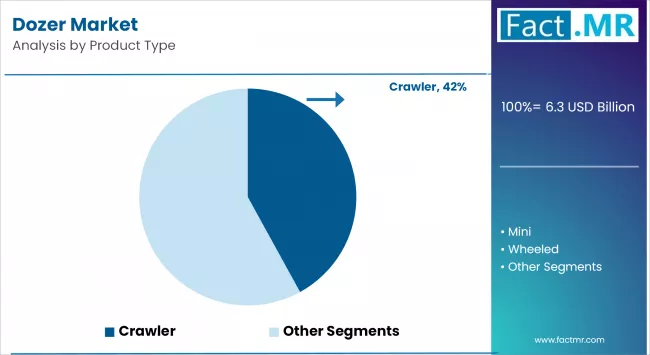
Dozer Market By Product Type | Source: Fact.MR
The crawler bulldozers segment dominates the dozer market, due to increasing demand for heavy-duty equipment in mining and construction, the growing adoption of automation and telematics, and the necessity for improved operational efficiency and productivity. They are extensively used in large-scale construction, mining, and infrastructure development projects, where high power and efficiency are essential. Their capability to handle heavy loads and operate in challenging conditions has led to sustained demand across both developed and developing markets.
Mini excavators are the fastest-growing segment, propelled by urbanization and demand for compact, agile machinery. Their small footprint makes them ideal for residential projects, landscaping, and utility maintenance in tight urban spaces. Additionally, their ease of transport, lower operating costs, and increasing availability in electric variants are contributing to their rapid adoption, especially in Asia-Pacific and North America.
20,000 to 60,000 lb to Exhibit Leading by Operating Weight
The 20,000 to 60,000 lb segment dominates the dozer market, offering a versatile range suitable for medium to large-scale construction and industrial tasks. These excavators deliver the power needed for foundational work, trenching, and material handling while maintaining flexibility and transportability. Their wide use across public infrastructure and commercial real estate sectors supports sustained demand.
The under 20,000 lb segment is the fastest-growing segment, due to rising usage in compact, urban construction projects. As city infrastructure grows vertically and underground utilities expand, smaller machines are favored for their ability to maneuver in restricted areas. Cost-effectiveness, low emissions, and improved mobility make them ideal for city-based contractors and public utilities.
126 to 250 HP to Exhibit leading by Flywheel Power
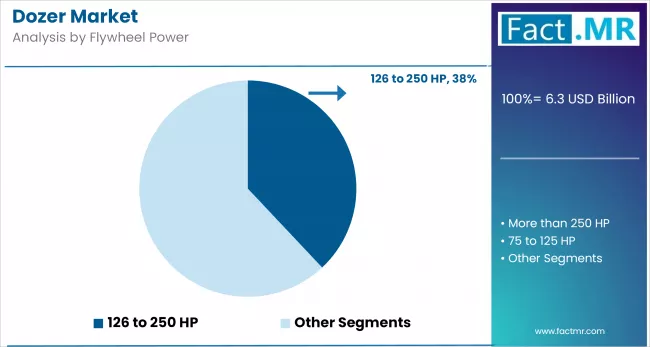
Dozer Market By Flywheel Power | Source: Fact.MR
126 to 250 HP excavators dominate the dozer market, serving as workhorses across heavy-duty construction, mining, and road-building applications. These machines strike an optimal balance between power, fuel efficiency, and operational cost, making them a preferred choice for contractors undertaking large-scale earthmoving or infrastructure work.
More than 250 HP is the fastest-growing segment, fueled by increasing demand in mega infrastructure and open-pit mining operations. These machines offer high torque and capacity, critical for deep excavation, rock breaking, and bulk material movement. As emerging economies scale up industrial activities, the need for high-powered excavators is rapidly increasing.
Construction to Exhibit Leading by End-Use Vertical
Construction dominates the end-use segment in the dozer market, owing to continual global infrastructure upgrades, urban redevelopment, and smart city projects. Excavators are integral to activities such as foundation digging, road construction, and trenching, making them indispensable for both public and private sector developments worldwide.
Mining is the fastest-growing segment as demand for minerals, especially those needed in renewable energy and electronics, continues to rise. Excavators are essential for overburden removal, ore extraction, and site preparation. With increasing mining activity in South America, Africa, and Asia, the requirement for large, durable machines is accelerating rapidly
2,251 to 4,500 to Exhibit Leading by Wattage
2,251 to 4,500 Watts systems dominate the dozer market, aligning with mid-size electric excavators and auxiliary construction tools. This wattage range supports efficient operation while balancing power and energy consumption. These systems are increasingly used in medium-duty applications across construction and urban infrastructure development.
Above 6,000 Watts is the fastest-growing wattage category, driven by electrification trends and technological innovation in heavy-duty machinery. As sustainability goals push for low-emission equipment, high-powered electric excavators are gaining popularity in mining and large-scale urban projects. Enhanced battery technologies and government incentives are further driving the adoption of high-wattage models.
Competitive Analysis
The global dozer market is becoming increasingly competitive, with the presence of several large multinational manufacturers and a number of regional players. The dozer market will remain intensely competitive, with technological advancement, cost leadership, and regional expansion as the central strategies shaping market share and long-term profitability.
Caterpillar Inc. is a renowned manufacturer of mining and construction equipment, which includes a diverse selection of dozers. The organization provides a comprehensive array of earthmoving solutions, such as wheeled bulldozers, crawler bulldozers, and value-added services, to industries such as industrial construction, oil & gas, mining, and infrastructure development.
Caterpillar utilizes sophisticated technologies, including grade control systems, telematics, and hybrid powertrains, to improve the efficiency, sustainability, and productivity of its equipment through a global network of manufacturing, parts distribution, and service facilities.
Key players in the dozer industry include Caterpillar, Zoomlion, CNH Industries, Deere & Company, Guangxi Liugong Machinery Co., Ltd, Bell Equipment Co., SA, Komatsu, SHANDONG SHANTUI CONSTRUCTION MACHINERY IMP&EXP CO., Liebherr, and other players.
Recent Development
- In April 2025, Liebherr-Canada launched four new PR 776 dozers, including the latest Generation 8 model, to Taseko’s Gibraltar mine. These machines feature enhanced fuel efficiency, reduced emissions, and an advanced operator assistance system.
- In April 2025, Leica Geosystems and Shantui jointly launched new aftermarket machine control kits for the DH20M dozer. These kits enable the seamless integration of Leica’s 3D guidance systems, helping contractors boost jobsite precision, productivity, and overall operational efficiency through advanced machine control technology.
Segmentation
Segmentation of Dozer Market
-
By Product Type :
- Crawler
- Wheeled
- Mini
-
By Operating Weight :
- Under 20,000 Lb
- 20,000 to 60,000 Lb
- 60,001 to 150,000 Lb
- Over 150,000 Lb
-
By Flywheel Power :
- 75 to 125 HP
- 126 to 250 HP
- More than 250 HP
-
By End-use Vertical :
- Construction
- Mining
- Forestry & Agriculture
- Others
-
By Wattage :
- 1,000 to 1,250 Watts
- 1251 to 1500 Watts
- 1,501 to 1,750 Watts
- 1,751 to 2,000 Watts
- 2,001 to 2,250 Watts
- 2,251 to 4,500 Watts
- 4,501 to 6,000 Watts
- Above 6,000 Watts
-
By Region :
- North America
- Latin America
- Western Europe
- Eastern Europe
- East Asia
- South Asia & Pacific
- Middle East & Africa
Frequently Asked Questions
What is the Global Dozer Market size in 2025?
Who are the Major Players Operating in the Dozer Market?
What is the Estimated Valuation of the Dozer Market by 2035?
What Value CAGR Did the Dozer Market Exhibit over the Last Five Years?
Who worked on this report


Preview the report firsthand - request a free sample
Free SampleGet the brochure for pricing and purchase details
Download PDF