- Base Value(2025): 6.00 Bn
- Estimated Value(2026): 6.20 Bn
- Forecast Value (2036): 8.58 Bn
- CAGR (2026 - 2036): 3.3%
Body Mist Market Size, Market Forecast and Outlook By FACT.MR
The body mist market was valued at USD 6.00 billion in 2025, projected to reach USD 6.20 billion in 2026, and is forecast to expand to USD 8.58 billion by 2036 at a 3.3% CAGR. The absolute dollar opportunity of approximately USD 2.38 billion added over the forecast decade reflects moderate but sustained consumer interest in affordable fragrance layering products positioned between deodorants and premium perfumes. Based on FACT.MR's analysis, social media-driven fragrance discovery and seasonal collection launches by mass-market brands sustain repurchase cycles.
Body mist occupies a distinct positioning tier in the personal fragrance hierarchy, priced below eau de toilette and eau de parfum but marketed with similar lifestyle and scent identity narratives. Product development cycles are shortening as brands release seasonal and limited-edition collections to capitalize on social media trend velocity. Ingredient transparency requirements are reshaping formulation strategies, with consumers increasingly checking for paraben-free, alcohol-free, and vegan-certified labels before purchase. FACT.MR analysts note that celebrity and influencer-backed fragrance lines have materially accelerated market entry frequency, compressing brand life cycles and intensifying competition for retail shelf space.
The United States represents the largest single-country market for body mists, where Bath & Body Works operates a dominant specialty retail network. India's body mist consumption is accelerating as young urban consumers adopt fragrance layering routines promoted through social media platforms. China's prestige and mass fragrance markets converge in the body mist segment, where domestic brands compete with international entrants. The United Kingdom maintains consistent demand through seasonal gifting and travel-retail channels. Japan's fragrance culture emphasizes subtle, layered scenting, creating demand for lighter body mist formulations. FACT.MR opines that Brazil's large personal care market and cultural affinity for fragrance make it a high-potential growth market.
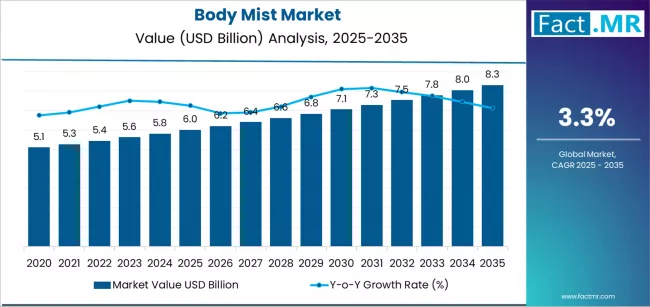
Body Mist Market Market Value Analysis | Source: Fact.MR
Body Mist Market Key Takeaways
| Metric | Details |
|---|---|
| Industry Size (2026) | USD 6.20 billion |
| Industry Value (2036) | USD 8.58 billion |
| CAGR (2026 to 2036) | 3.3% |
Source: Fact.MR analysis. Updated Mar 18, 2026
Body Mist Market Definition
Body mist is a lightly scented liquid fragrance product applied directly to the skin, typically containing a lower concentration of fragrance oils than eau de toilette or perfume. It is used for personal scenting, post-shower freshening, and fragrance layering. Products are sold through specialty retail, mass-market, online, and travel-retail channels.
Body Mist Market Inclusions
Market scope covers global and regional sales volumes and values for body mists, forecast period from 2026 to 2036, segment breakdowns by consumer demographic, distribution channel, and fragrance family. Brand positioning analysis and ingredient trend assessments are included.
Body Mist Market Exclusions
The scope excludes eau de toilette, eau de parfum, and perfume concentrate products above body mist fragrance oil concentration thresholds. Deodorants, antiperspirants, and body sprays marketed primarily for odor neutralization rather than scenting are excluded.
Body Mist Market Research Methodology
Primary Research: Analysts conducted interviews with fragrance brand managers, specialty retail buyers, and beauty e-commerce category leads across 30 countries.
Desk Research: Data collection aggregated cosmetic regulatory filings, retail sales tracking data, and consumer survey results from national statistical agencies.
Market-Sizing and Forecasting: Baseline values derive from a bottom-up aggregation of retail and e-commerce sales data, applying demographic adoption curves and per-capita spending trends.
Data Validation and Update Cycle: Projections are cross-validated against publicly reported revenue data from major personal care and fragrance companies.
Summary of Body Mist Market
- Body Mist Market Definition
- Body mist encompasses lightly scented liquid fragrance products applied to the skin, positioned as an affordable personal scenting and fragrance layering option sold across specialty, mass-market, online, and travel-retail channels.
- Demand Drivers in the Market
- Social media-driven fragrance discovery and influencer-backed product launches accelerate consumer trial and seasonal repurchase cycles across younger demographics.
- Affordable pricing relative to premium perfume allows consumers to maintain multiple scent options for different occasions, supporting higher unit purchase frequency.
- Clean-beauty and ingredient transparency trends compel brands to reformulate with paraben-free, alcohol-free, and vegan-certified ingredients to meet retail listing requirements.
- Key Segments Analyzed in the FACT.MR Report
- Women account for 62.0% of consumer demand in 2026, reflecting the category's strong positioning within female personal care and gifting routines.
- Specialty/Brand Stores command 45.0% of channel share, led by dedicated fragrance retail networks that drive impulse purchases through in-store scent testing.
- Floral fragrance family holds 38.0% of scent-category demand, reflecting broad consumer preference for classic rose, jasmine, and peony-based compositions.
- Analyst Opinion at FACT.MR
- As per FACT.MR, the body mist market is characterized by rapid product turnover, compressed brand life cycles, and intensifying competition from celebrity and influencer-backed fragrance launches. Brands that rely on annual reformulation cycles without investing in digital-first marketing and limited-edition scarcity strategies risk losing relevance to faster-moving competitors. The convergence of clean-beauty certification requirements and social media-driven discovery creates a market where product authenticity and ingredient story matter as much as scent composition itself.
- Strategic Implications / Executive Takeaways
- Brands must shorten seasonal collection development timelines to capitalize on social media scent trends and maintain consumer engagement between major launches.
- Retailers should invest in experiential in-store scent discovery formats to differentiate body mist purchasing from purely price-driven online transactions.
- Manufacturers targeting South Asian and Latin American markets need affordable multi-pack and travel-size formats to build trial and repurchase frequency among price-sensitive young consumers.
- Methodology
- Primary Research: FACT.MR conducted interviews with fragrance brand managers, specialty retail buyers, and beauty e-commerce leads across 30 countries.
- Desk Research: Analysts aggregated cosmetic regulatory filings, retail sales data, and consumer survey results from national agencies.
- Market-Sizing and Forecasting: Models apply a bottom-up methodology from retail and e-commerce sales data, integrating demographic adoption curves.
Why is the Body Mist Market Growing?
Market expansion is being supported by the increasing global beauty consciousness and the corresponding need for affordable fragrance products that can maintain scent quality and personal expression while supporting diverse lifestyle applications across various consumer demographics. Modern consumers and beauty enthusiasts are increasingly focused on implementing fragrance solutions that can provide lasting scent, minimize costs, and deliver consistent performance in daily personal care routines. Body mist products' proven ability to deliver enhanced fragrance accessibility, reliable scent performance, and versatile personal care applications make them essential products for contemporary beauty operations and personal expression solutions.
The growing focus on personal care modernization and beauty accessibility is driving demand for body mist products that can support daily fragrance needs, provide affordable luxury, and enable efficient personal styling across varying lifestyle preferences. Consumer preference for products that combine quality with affordability and convenience is creating opportunities for innovative formulation implementations. The rising influence of social media marketing and celebrity endorsements is also contributing to increased adoption of body mist products that can provide trendy fragrance options without compromising performance or budget considerations.
Opportunity Pathways - Body Mist Market
The body mist market is poised for robust growth and transformation. As consumers and beauty enthusiasts across both developed and emerging markets seek fragrance products that are affordable, trendy, diverse, and accessible, body mist systems are gaining prominence not just as personal care products but as strategic solutions for beauty expression, lifestyle enhancement, personal identity, and social positioning.
Rising beauty consciousness and lifestyle modernization in North America, Europe, and Asia Pacific amplify demand, while manufacturers are picking up on innovations in fragrance technologies and celebrity collaborations.
Pathways like celebrity partnerships, premium formulations, and digital marketing promise strong margin uplift, especially in developed markets. Geographic expansion and product diversification will capture volume, particularly where beauty awareness is growing or personal care infrastructure requires modernization. Social media pressures around personal branding, lifestyle expression, beauty accessibility, and trend adoption give structural support.
- Pathway A - Celebrity & Influencer Collaborations. Consumers increasingly seek products endorsed by celebrities and social media influencers. Product manufacturers who specialize in celebrity partnerships or enhance influencer marketing capabilities can command a premium. Expected revenue pool: USD 0.6-0.8 billion
- Pathway B - Premium & Niche Fragrance Innovation. Advanced scent systems -- long-lasting formulations, unique fragrance combinations, luxury positioning -- improve product appeal and consumer loyalty. Opportunity: USD 0.5-0.7 billion
- Pathway C - Digital Marketing Integration. Social media campaigns, online exclusives, and e-commerce optimization enhance brand visibility and consumer engagement. Systems with stronger digital presence and automated marketing capabilities will allow premium positioning. Revenue lift: USD 0.4-0.6 billion
- Pathway D - Specialized Consumer Applications. Extending reach into men's grooming, teen markets, and unisex products. Demographics will look for product suppliers who provide relevant, appealing fragrance solutions. Pool: USD 0.4-0.6 billion
- Pathway E - Emerging Market Expansion. Strong growth in developing beauty markets, urbanization trends, and disposable income growth. Local partnerships and customized fragrances help penetration. Expected upside: USD 0.3-0.5 billion
- Pathway F - Multi-Scent Collections. Product lines offering various fragrances help consumers build fragrance wardrobes and seasonal collections. Collection approaches benefit from consumer variety preferences. USD 0.3-0.5 billion
- Pathway G - Eco-Friendly & Clean Beauty Solutions. Natural ingredients, recyclable packaging, and clean formulations create differentiation and environmental compliance advantages. Pool: USD 0.2-0.4 billion
Segmental Analysis
The market is segmented by consumer, channel, and fragrance family. By consumer, the market is divided into women, men, and unisex/teens. By channel, it covers specialty/brand stores, online, and mass/drug. By fragrance family, it is segmented into floral, fresh/citrus, and gourmand/woody. Regionally, the market is divided into North America, Europe, Asia Pacific, Latin America, and Middle East & Africa.
By Consumer, the Women Segment Accounts for 62.0% Market Share
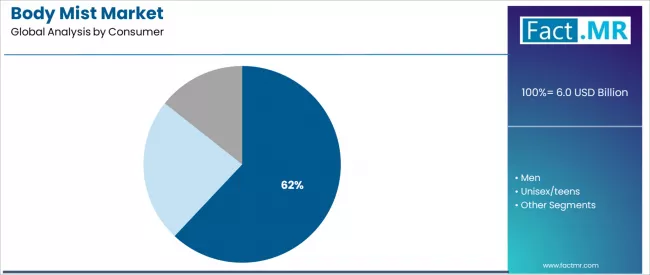
Body Mist Market Analysis By Consumer | Source: Fact.MR
The women segment is projected to account for 62.0% of the body mist market in 2025, reaffirming its position as the leading consumer category. Female consumers increasingly utilize body mist products for their proven affordability, established fragrance variety, and convenience in daily beauty routines across personal care, social occasions, and lifestyle enhancement applications. Women's fragrance technology's established usage procedures and consistent scent output directly address the beauty requirements for accessible luxury and personal expression in diverse social environments.
This consumer segment forms the foundation of current personal care operations, as it represents the demographic with the greatest fragrance engagement and established beauty infrastructure across multiple applications and lifestyle scenarios. Consumer investments in enhanced fragrance collections and beauty optimization continue to strengthen adoption among women consumers. With female consumers prioritizing beauty accessibility and product variety, women-focused products align with both personal expression objectives and budget management requirements, making them the central component of comprehensive beauty strategies.
By Channel, the Specialty/Brand Stores Segment Accounts for 45.0% Market Share
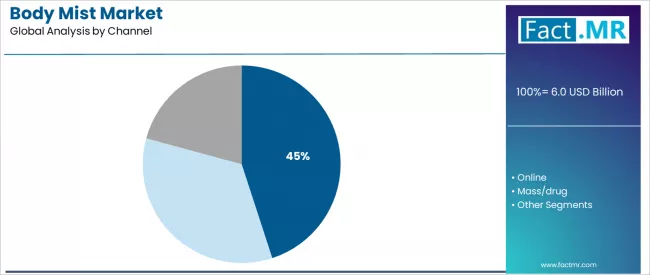
Body Mist Market Analysis By Channel | Source: Fact.MR
Specialty/brand stores are projected to represent 45.0% of body mist distribution in 2025, underscoring their critical role as the primary retail channel for beauty consumers and fragrance enthusiasts. Specialty retailers prefer body mist products for their brand positioning, established customer engagement, and ability to provide personalized service while supporting consumer experience and product discovery requirements. Positioned as premium retail infrastructure for modern beauty markets, specialty/brand stores offer both experiential advantages and customer benefits.
The segment is supported by continuous innovation in retail experience and the growing availability of exclusive product configurations that enable immersive shopping with enhanced customer interaction. The specialty retailers are investing in brand partnerships to support premium positioning and customer service delivery. As experiential retail becomes more prevalent and customer engagement requirements increase, specialty/brand stores will continue to dominate the distribution market while supporting advanced product presentation and consumer education strategies.
By Fragrance Family, the Floral Segment Accounts for 38.0% Market Share
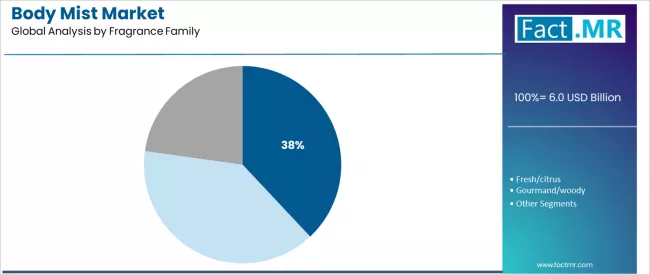
Body Mist Market Analysis By Fragrance Family | Source: Fact.MR
Floral fragrances are projected to represent 38.0% of body mist demand in 2025, underscoring their critical role as the primary fragrance preference for beauty enhancement and feminine expression. Consumers prefer body mist products with floral fragrances for their timeless appeal, romantic associations, and versatile performance in various social settings while supporting personal style and confidence requirements. Positioned as classic fragrance choice for modern consumers, floral products offer both aesthetic advantages and emotional benefits.
The segment is supported by continuous innovation in floral formulations and the growing availability of specialized scent combinations that enable unique fragrance experiences with enhanced longevity performance. Consumers are investing in fragrance diversification to support personal collection building and occasion-specific choices. As fragrance sophistication becomes more prevalent and personal expression requirements increase, floral fragrances will continue to dominate the fragrance family market while supporting advanced scent experiences and consumer satisfaction strategies.
What are the Drivers, Restraints, and Key Trends of the Body Mist Market?
The body mist market is advancing steadily due to increasing beauty consciousness and growing adoption of affordable luxury infrastructure that provides enhanced personal care and fragrance accessibility across diverse consumer applications. The market faces challenges, including fragrance ingredient costs, seasonal demand fluctuations, and varying consumer preferences across different demographic environments. Innovation in scent technologies and packaging innovations continues to influence product development and market expansion patterns.
Rising Global Beauty Consciousness and Personal Care Modernization
The growing expansion of beauty awareness and personal care infrastructure development is enabling product manufacturers to develop body mist systems that provide superior fragrance quality, enhanced accessibility, and reliable performance in daily beauty environments. Advanced fragrance systems provide improved scent capacity while allowing more effective personal expression and consistent beauty delivery across various applications and lifestyle requirements. Manufacturers are increasingly recognizing the competitive advantages of modern fragrance capabilities for beauty enhancement and consumer satisfaction positioning.
Celebrity Influence and Social Media Drive Product Innovation
Modern body mist manufacturers are incorporating celebrity partnerships and social media marketing to enhance brand visibility, increase consumer engagement, and ensure consistent performance delivery to beauty consumers. These strategies improve market positioning while enabling new applications, including limited edition collections and influencer collaborations. Advanced marketing integration also allows manufacturers to support premium product positioning and trend optimization beyond traditional fragrance product supply.
Analysis of the Body Mist Market by Key Countries
.webp "Top Country Growth Comparison Body Mist Market Cagr (2026 2036)")
Top Country Growth Comparison Body Mist Market Cagr (2026 2036) | Source: Fact.MR
| Country | CAGR (2026-2036) |
|---|---|
| USA | 3.6% |
| Mexico | 3.4% |
| Germany | 3.0% |
| South Korea | 3.0% |
| France | 2.9% |
| United Kingdom | 2.8% |
| Japan | 2.7% |
Source: Fact.MR analysis. Updated Mar 18, 2026
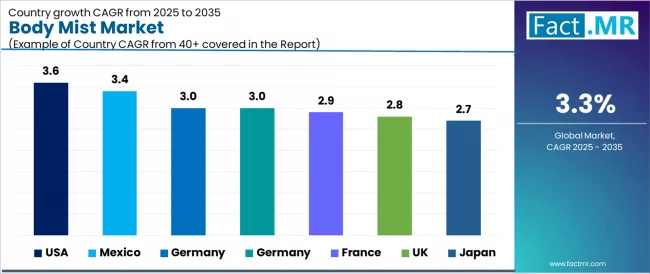
Body Mist Market Cagr Analysis By Country | Source: Fact.MR
The market is experiencing steady growth globally, with the USA leading at a 3.6% CAGR through 2036, driven by extensive beauty culture development, advanced retail infrastructure investments, and significant adoption of celebrity-endorsed fragrance solutions. Mexico follows at 3.4%, supported by growing beauty consciousness, rapid urbanization trends, and growing adoption of affordable luxury products. Germany and South Korea show growth at 3.0%, emphasizing premium positioning and advanced consumer preferences. France records 2.9%, focusing on fragrance innovation and luxury market development. United Kingdom demonstrates 2.8% growth, supported by beauty modernization and retail optimization. Japan demonstrates 2.7% growth, supported by quality enhancement but constrained by market maturity.
The report covers an in-depth analysis of 40+ countries, top-performing countries are highlighted below.
USA Leads Global Market Growth with Beauty Culture Infrastructure
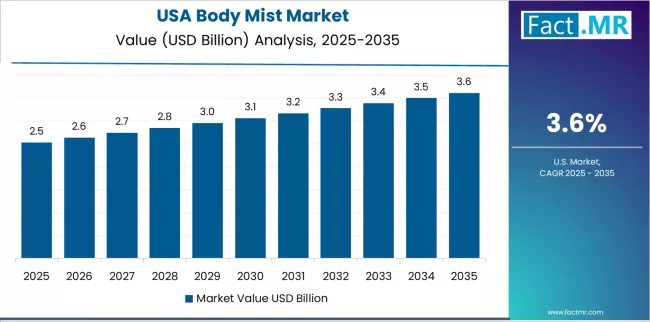
Body Mist Market Country Value Analysis | Source: Fact.MR
The USA is projected to exhibit exceptional growth with a CAGR of 3.6% through 2036, driven by extensive beauty culture development and rapidly growing adoption of celebrity-endorsed fragrance solutions supported by social media influence and consumer lifestyle initiatives. The country's comprehensive retail infrastructure and increasing investment in beauty innovation technologies are creating substantial demand for advanced body mist product solutions. Major retailers and beauty brands are establishing comprehensive product lines to serve both domestic operations and trend-setting requirements.
- Strong celebrity endorsement culture and social media influence is driving demand for trendy fragrance technologies throughout major retail chains and beauty enthusiasts.
- Robust consumer spending power and expanding network of specialty stores are supporting the rapid adoption of premium fragrance technologies among consumers seeking enhanced personal expression and beauty accessibility.
Mexico Demonstrates Strong Market Potential with Beauty Infrastructure Expansion
Mexico is expanding at a CAGR of 3.4%, supported by the country's growing beauty consciousness, extensive urbanization development, and increasing adoption of affordable luxury systems. The country's comprehensive economic growth and growing middle class income levels are driving sophisticated fragrance capabilities. Urban consumers and retail chains are establishing extensive product availability to address the growing demand for accessible beauty products and personal care reliability.
- Rising disposable income levels and expanding urban beauty culture are creating opportunities for product adoption across consumers, retailers, and beauty service companies in major metropolitan corridors.
- Growing youth demographic focus and beauty modernization is driving adoption of trendy fragrance technologies among consumers seeking enhanced personal style and social positioning.
Europe Market Split by Countries
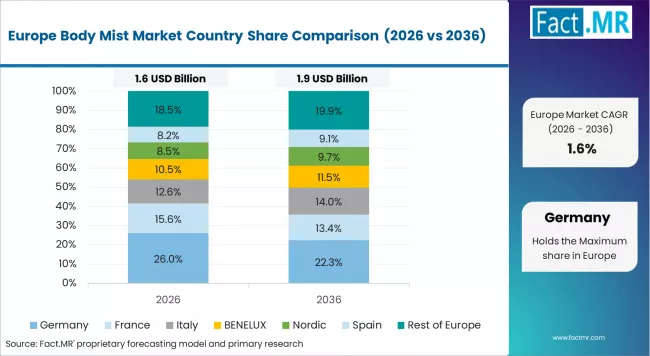
Body Mist Market Europe Country Market Share Analysis, 2026 & 2036 | Source: Fact.MR
The body mist market in Europe is projected to grow from USD 1.6 billion in 2026 to USD 2.1 billion by 2036, registering a CAGR of 2.9% over the forecast period. Germany is expected to maintain its leadership position with a 26.2% market share in 2026, increasing to 26.8% by 2036, supported by its advanced beauty retail infrastructure, comprehensive consumer preferences, and major fragrance markets serving European and international customers.
France follows with a 21.5% share in 2026, projected to ease to 21.0% by 2036, driven by luxury fragrance heritage, beauty innovation programs, and established consumer market capabilities, but facing challenges from competitive pressures and market maturation constraints. United Kingdom holds a 18.9% share in 2026, expected to decline to 18.5% by 2036, supported by beauty retail modernization requirements and consumer lifestyle optimization but facing challenges from economic uncertainties and market competition. Italy commands a 13.4% share in 2026, projected to reach 13.6% by 2036, while Spain accounts for 11.2% in 2026, expected to reach 11.4% by 2036. The Rest of Europe region, including Nordic countries, Eastern European markets, Belgium, Netherlands, and other European countries, is anticipated to gain momentum, expanding its collective share from 8.8% to 8.7% by 2036, attributed to increasing beauty development across Nordic countries and growing consumer modernization across various European markets implementing fragrance accessibility programs.
Competitive Landscape of the Body Mist Market
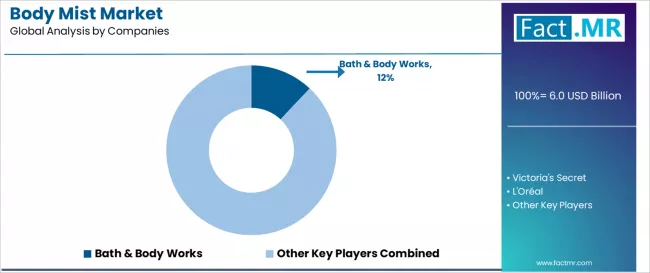
Body Mist Market Analysis By Company | Source: Fact.MR
The market is characterized by competition among established beauty brands, specialized fragrance companies, and integrated personal care manufacturers. Companies are investing in advanced fragrance research, celebrity partnership development, packaging innovation, and comprehensive product portfolios to deliver appealing, accessible, and trend-focused body mist solutions. Innovation in scent technologies, brand collaborations, and digital marketing capabilities is central to strengthening market position and competitive advantage.
Bath & Body Works leads the market with a 12.0% market share, offering specialized body mist collections with a focus on seasonal fragrances and affordable luxury positioning for beauty consumers. Victoria's Secret provides comprehensive beauty product portfolios with an focus on sensual positioning, brand recognition, and retail experience services. L'Oréal delivers diverse beauty products with a focus on innovation and global market capabilities. Coty specializes in fragrance solutions with focus on celebrity partnerships and mass market positioning. Unilever focuses on personal care products with global distribution leadership and large-scale production capabilities. Estée Lauder offers premium beauty solutions with luxury positioning and brand management expertise. Shiseido provides beauty products with focus on Asian market leadership and technological advancement.
Key Players in the Body Mist Market
- Bath & Body Works
- Victoria's Secret
- L'Oréal
- Coty
- Unilever
- Estée Lauder
- Shiseido
- Natura &Co
- Puig
- Kylie/Celebrity Brands
Bibliography
- European Commission. (2024). Cosmetic Products Regulation (EC) No 1223/2009: Implementation update. EC.
- United States Food and Drug Administration. (2024). Cosmetics safety and labeling guidance. FDA.
- Organisation for Economic Co-operation and Development. (2024). Consumer product safety: Cosmetics and personal care. OECD.
- Government of India, Bureau of Indian Standards. (2024). IS 6608: Toilet preparations, perfumery, and cosmetics. BIS.
- Euromonitor International. (2024). Personal care: Fragrances and body care global industry overview. Euromonitor.
- Japan Cosmetic Industry Association. (2024). Japanese cosmetic market statistics 2024. JCIA.
This bibliography is provided for reader reference. The full FACT.MR report contains the complete reference list with primary research documentation.
This Report Addresses
- Market sizing and quantitative forecast metrics detailing global body mist sales volumes and values through 2036.
- Segmentation analysis mapping consumption patterns across consumer demographics, distribution channels, and fragrance family preferences.
- Regional deployment intelligence comparing North American specialty retail dominance against emerging market mass-channel growth.
- Regulatory compliance assessment analyzing cosmetic safety labeling requirements and ingredient transparency standards across jurisdictions.
- Competitive landscape evaluation tracking the market positioning of heritage brands, celebrity-backed launches, and private-label entrants.
- Strategic marketing guidance defining social media content, limited-edition strategy, and in-store experiential investment priorities.
- Supply chain and ingredient analysis identifying fragrance oil sourcing trends and clean-beauty reformulation cost impacts.
- Custom data delivery formats encompassing interactive dashboards, raw Excel datasets, and comprehensive PDF narrative reports.
Segmentation
Scope of the Report
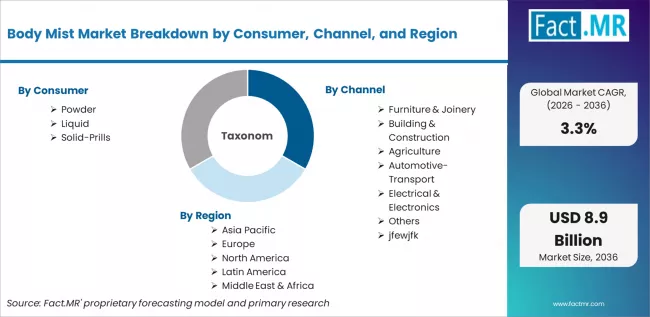
Body Mist Market Breakdown By Consumer, Channel, And Region | Source: Fact.MR
| Metric | Value |
|---|---|
| Quantitative Units | USD 6.20 billion to USD 8.58 billion, at a CAGR of 3.3% |
| Market Definition | Body mist encompasses lightly scented liquid fragrance products applied to the skin, positioned as an affordable personal scenting and fragrance layering option sold across specialty, mass-market, online, and travel-retail channels. |
| Consumer Segmentation | Women, Men, Unisex/Teens |
| Channel Segmentation | Specialty/Brand Stores, Online, Mass/Drug |
| Fragrance Family Segmentation | Floral, Fresh/Citrus, Gourmand/Woody |
| Regions Covered | North America, Latin America, Europe, East Asia, South Asia, Oceania, Middle East & Africa |
| Countries Covered | India, China, USA, Canada, UK, Germany, Japan, and 40 plus countries |
| Key Companies Profiled | Bath & Body Works Inc., Victoria's Secret & Co., L'Oreal S.A., Coty Inc., Unilever plc, The Estee Lauder Companies Inc., Shiseido Company Ltd., Natura & Co. Holding S.A., Puig S.L., Kylie Cosmetics LLC |
| Forecast Period | 2026 to 2036 |
| Approach | Forecasting models apply a bottom-up methodology starting with retail and e-commerce sales data, integrating demographic adoption curves, per-capita fragrance spending trends, and channel-specific growth assumptions. |
Source: Fact.MR analysis. Updated Mar 18, 2026
Body Mist Market by Segments
-
Consumer :
- Women
- Men
- Unisex/teens
-
Channel :
- Specialty/brand stores
- Online
- Mass/drug
-
Fragrance Family :
- Floral
- Fresh/citrus
- Gourmand/woody
-
Region :
-
North America
- United States
- Canada
- Mexico
-
Europe
- Germany
- United Kingdom
- France
- Italy
- Spain
- Nordic
- BENELUX
- Rest of Europe
-
Asia Pacific
- China
- Japan
- India
- South Korea
- ASEAN
- Australia & New Zealand
- Rest of Asia Pacific
-
Latin America
- Brazil
- Chile
- Rest of Latin America
-
Middle East & Africa
- Kingdom of Saudi Arabia
- Other GCC Countries
- Turkey
- South Africa
- Other African Union
- Rest of Middle East & Africa
-
Frequently Asked Questions
How large is the demand for body mist in the global market in 2026?
What will be the market size of body mist by 2036?
What is the expected demand growth between 2026 and 2036?
Which consumer segment is poised to lead by 2026?
How significant is the role of Specialty/Brand Stores in distribution?
Which fragrance family leads the market?
What is driving demand growth?
What is body mist and what is it mainly used for?
What is included in the scope of this report?
What is excluded from the scope of this report?
How does FACT.MR build and validate the body mist forecast?
Does the report cover USA in its regional analysis?
Does the report cover India in its regional analysis?
Who worked on this report


Preview the report firsthand - request a free sample
Free SampleGet the brochure for pricing and purchase details
Download PDF