- Base Value(2025): 128.2 Bn
- Forecast Value (2025): 128.2 Bn
- CAGR (2025): 6.3%
Parking Services Market Size and Share Forecast Outlook 2025 to 2035
The global parking services market is forecast to reach USD 236.2 billion by 2035, up from USD 128.2 billion in 2025. During the forecast period, the industry is projected to register at a CAGR of 6.3%.
Rising urban congestion and increasing demand for vehicle ownership are driving the need for efficient parking solutions, fueling the growth of the parking services market. Smart parking and cashless payment systems improve convenience. EV infrastructure integration and smart city initiatives offer scalable, tech-driven, and sustainable parking innovations.
Quick Stats on Parking Services Market
- Parking Services Market Size (2025): USD 128.2 billion.
- Projected Parking Services Market Size (2035): USD 236.2 billion
- Forecast CAGR of Parking Services Market (2025 to 2035): 6.3%
- Leading Type Segment of Parking Services Market: Off-Street
- Key Growth Regions of Parking Services Market: United States, Germany, Japan
- Prominent Players in the Parking Services Market: ABM Industries Inc., Ace Parking Management Inc., Diamond Parking, Get My Parking, Impark, Others.
2025-to-2035.webp "Us Parking Services Market Value(usd Million)2025 To 2035")
Us Parking Services Market Value(usd Million)2025 To 2035 | Source: Fact.MR
| Metric | Value |
|---|---|
| Industry Size (2025E) | USD 128.2 billion |
| Industry Size (2035F) | USD 236.2 billion |
| CAGR (2025-2035) | 6.3% |
Source: Fact.MR analysis. Updated Aug 19, 2025
Between 2025 and 2035, the parking services industry is projected to expand from USD 128.2 billion to USD 236.2 billion, registering a CAGR of 6.3%. Year-on-year growth is expected to remain steady, with early years experiencing slightly slower expansion due to the initial capital investment cycle, and later years benefiting from compound growth, smart infrastructure rollouts, and increased EV integration.
From 2025 to 2026, growth is likely to hover around 5.8%–6.0%, driven by new municipal projects and private operator expansions. Post-2028, annual gains are anticipated to exceed 6.5% as large-scale smart city programs mature, and airport, retail, and healthcare parking systems integrate advanced automation and cashless operations.
Regulatory frameworks will play a pivotal role, particularly in Europe, where environmental zones and EV mandates are stimulating the need for electrified and structured parking solutions. In North America, dynamic pricing models and zoning reforms will create new revenue structures, while in Asia-Pacific, government-backed smart city developments will accelerate capacity expansions.
Demand-supply dynamics are expected to be influenced by urban land scarcity, prompting greater adoption of vertical and automated parking systems. On the supply side, private sector participation, public–private partnerships, and peer-to-peer parking platforms will expand service diversity.
Technological advancements, particularly IoT-based occupancy monitoring, app-based reservations, and dynamic pricing algorithms, will improve operational efficiency and customer experience. These innovations will also help operators optimize revenue through real-time data analytics.
Top Parking Services Market Dynamics
The parking services sector is evolving in response to a combination of urban mobility trends, technological adoption, and regulatory pressures. Growth is being fueled by the need to optimize limited parking space, rising global vehicle production, and the acceleration of smart city programs.
High infrastructure costs, integration barriers, and shifting consumer behaviors present hurdles to sustained expansion. The interplay of these drivers and challenges shapes the pace and nature of market development, influencing investment patterns, technology priorities, and service models across regions and categories.
Need for Optimal Space Utilization to Enhance Parking Services Demand
Urban centers face mounting pressure to manage parking more efficiently as vehicle ownership continues to grow while land availability remains constrained. This has prompted parking authorities and private operators to adopt advanced space management tools, including IoT-enabled sensors, automated guidance systems, and dynamic pricing. These solutions allow for higher turnover rates, better traffic flow, and maximized revenue per space.
In addition to operational efficiency, optimized space utilization contributes to reduced congestion and lower emissions from vehicles searching for parking. The integration of real-time occupancy data with navigation apps further enhances user convenience, making such systems a preferred choice for municipalities and commercial facility managers.
Increasing Automotive Production to Provide Impetus to Parking Services Demand
Rising vehicle output is directly increasing the need for parking solutions that can handle expanding fleets without consuming excessive land. This is particularly relevant in urban and suburban hubs where transit nodes such as train stations and airports require structured facilities to handle peak demand.
Partnerships between public agencies and private parking operators are enabling the deployment of multi-functional parking complexes, often integrated with retail and transit infrastructure. Such projects ensure accessibility while generating multiple revenue streams from both commuters and commercial tenants.
Increasing Smart City Project Implementation
Global investments in smart cities have created a favorable environment for parking innovations. Integrated systems combining occupancy sensors, automated payments, and mobile app navigation are becoming standard in new developments.
These projects often receive government backing, ensuring rapid deployment and long-term operational support. Benefits extend beyond parking efficiency to include reduced congestion, improved urban air quality, and enhanced user satisfaction, factors that strengthen the case for widespread adoption.
High Development and Maintenance Costs May Deter Adoption of Parking Services
Urban land acquisition and the construction of advanced parking facilities require substantial capital investment. This restricts expansion in the most demand-intensive zones.
Innovative financing models, such as public-private partnerships and pay-as-you-use systems, are increasingly being explored to bridge funding gaps and ensure project viability.
Technological Integration Barriers May Hinder Deployment of Parking Services
Smaller municipalities and operators often face challenges in adopting advanced parking technologies due to high setup costs and technical complexities. Streamlined integration platforms and modular IoT systems may offer a path forward, enabling gradual adoption without large upfront expenditure.
Regulatory and Zoning Restrictions
Strict building codes and environmental regulations delay project approvals and increase costs. These issues are especially prevalent in developed urban centers with stringent land-use laws.
Proactive engagement with regulatory authorities and early incorporation of compliance measures can mitigate these risks, ensuring smoother project execution.
Rising Preference for Ride-Sharing and Public Transit Options May Stymie Growth
The rise of ride-sharing and public transit adoption in urban areas could reduce demand for long-term parking services. Operators are adapting by diversifying into short-term and flexible-use parking, targeting last-mile delivery fleets and micro-mobility solutions.
Top Regions in the Global Parking Services Market
The parking services industry exhibits distinct growth trajectories across major regions, shaped by varying stages of urban infrastructure maturity, policy environments, and adoption of smart technologies. North America continues to lead in early deployment of dynamic pricing models, cashless payment platforms, and sensor-enabled occupancy tracking. Its market benefits from strong private sector participation and public-private partnerships, particularly in high-demand nodes such as airports, healthcare complexes, and sports arenas.
Europe’s market expansion is influenced by environmental regulations, EV infrastructure mandates, and pedestrian-focused urban planning, pushing operators toward structured and electrified facilities. Asia-Pacific is the fastest-growing region, fueled by government-led smart city programs, rapid motorization, and large-scale commercial development. Here, technology adoption is increasingly paired with public investments in connectivity and integrated transport hubs.
Country-Wise Outlook
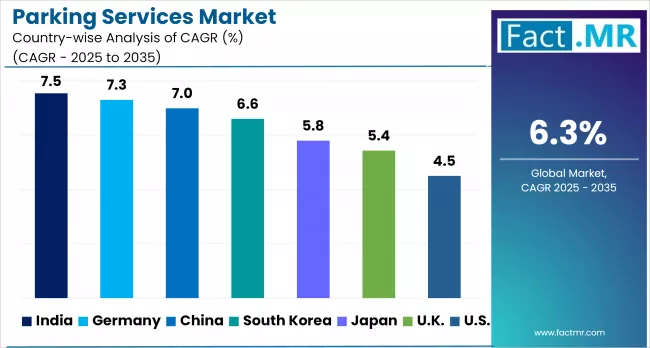
Parking Services Market By Country | Source: Fact.MR
| Countries | CAGR (2025-2035) |
|---|---|
| United States | 4.5% |
| Germany | 7.3% |
| Japan | 5.8% |
Source: Fact.MR analysis. Updated Aug 19, 2025
United States Deploying Adaptive Parking Strategies for Urban and Commercial Use
2025-to-2035.webp "Us Parking Services Market Country Value(usd Million)2025 To 2035")
Us Parking Services Market Country Value(usd Million)2025 To 2035 | Source: Fact.MR
The United States has seen a steady shift in parking management strategies to address the growing complexities of urban mobility and the rapid expansion of e-commerce logistics. Many cities have introduced designated loading and parking zones for delivery fleets, aiming to reduce congestion from double parking and enhance traffic flow.
Smart parking solutions, including sensor-enabled spaces, dynamic pricing models, and mobile payment integration, have become common in metropolitan areas such as San Francisco and Seattle.
Programs like SFpark demonstrate how demand-responsive pricing can maximize availability while cutting down on cruising times. While zoning reforms in some municipalities reduce minimum parking requirements to encourage shared mobility, high-demand environments like airports, hospitals, and sports arenas continue to provide lucrative opportunities for operators offering automated, cashless, and valet services.
- Growing adoption of real-time parking management in major urban centers
- Increased allocation of dedicated spaces for commercial delivery vehicles
- Diverse revenue streams from high-traffic institutional and event venues
EV Oriented Parking Services Determining Significant Demand in Germany
Germany’s parking landscape is being reshaped by a combination of stringent environmental regulations and the country’s Smart City Charter. Cities are implementing intelligent parking guidance systems, dynamic signage, and mobile navigation tools to reduce search traffic and improve urban air quality. Environmental zones, where only low-emission vehicles can operate, are increasing the demand for facilities with EV charging stations.
Subsidies and mandates are encouraging both public and private operators to invest in these upgrades. Street parking is being reduced in many cities, replaced with pedestrian spaces and green areas, creating opportunities for multi-level and underground parking facilities. At the same time, the growth of mixed-use developments is driving demand for short-term commercial parking to support last-mile delivery operations.
- Implementation of intelligent parking guidance and navigation systems
- Expansion of EV charging infrastructure across public and private facilities
- Reduced street parking fostering structured facility growth
Maximizing Space with Automation amid Land Constraints a Key Driver for Growth in Japan
Japan’s parking sector has evolved to address the severe space constraints in urban centers such as Tokyo, Osaka, and Yokohama. Automated and mechanical solutions, including tower-style and underground parking systems, are a defining feature of the market. Operators like Park24 and Times24 have pioneered systems with touchless payment, real-time availability tracking, and license plate recognition.
Mobile apps such as Times Club allow users to reserve, navigate to, and pay for spaces with ease, aligning with Japan’s emphasis on convenience and precision. Government incentives for EV adoption are encouraging the addition of charging points in both urban and suburban lots. The combination of automation, customer-focused service, and integration of EV infrastructure positions Japan as a global leader in advanced parking technologies.
- High adoption of mechanical and tower-style parking facilities
- Integration of mobile platforms for booking and payment
- Rising installation of EV chargers in urban and suburban locations
Parking Services Market Analysis by Key Categories
Parking services demand across key categories is determined by a combination of vehicle flow intensity, location-specific requirements, and technological integration levels. Off-street parking commands the largest share due to its scalability, better traffic management potential, and alignment with long-term urban development blueprints.
These facilities, ranging from multi-level garages to underground complexes, are increasingly integrated into smart city frameworks with automated payment systems and IoT-enabled monitoring. On-street parking remains an important segment, especially in retail districts, mixed-use urban zones, and central business areas, where short-term accessibility is essential.
Off-Street Parking Preferred for Efficiency and Integration
Off-street parking continues to dominate due to its ability to accommodate large vehicle volumes without contributing to street-level congestion. These facilities often benefit from pre-existing infrastructure and are easier to integrate with advanced management systems such as automated gates, license plate recognition, and mobile payment apps.
Their role within smart city projects is growing, as they help optimize traffic flow and free up street space for pedestrians and public transport. Operators are also exploring modular designs that allow for future scalability without major reconstruction, making them a strategic choice for urban planners.
- Strong alignment with municipal smart city programs
- Enhanced safety and reduced street congestion
- Low maintenance and scalable infrastructure options
Commercially Owned Parking Offers Structured Urban Mobility
Commercial operators have established a strong foothold in urban markets by offering a mix of convenience, scale, and technological sophistication. These facilities, often located at airports, malls, hotels, and business districts, are equipped with digital payment solutions, real-time occupancy tracking, and automated entry/exit systems.
Their larger capacity allows them to serve both short-term visitors and long-term contract users, creating diversified revenue streams. The integration of loyalty programs and premium services such as valet parking enhances customer retention and strengthens competitive positioning in high-demand zones.
- Widespread adoption in high-traffic commercial hubs
- Use of automation to maximize throughput and efficiency
- Ability to serve both long- and short-term parking needs
Airport Parking Services to be Highest in Demand
Airports remain one of the most profitable segments due to consistent passenger traffic and longer parking durations. Facilities are increasingly adopting digital reservation systems, tiered pricing models, and real-time availability updates to enhance convenience.
Public-private partnerships often oversee these operations, ensuring a balance between service quality and operational profitability. With the rebound in air travel, many airports are investing in infrastructure upgrades, including premium zones, EV charging, and automated ticketing, to cater to a diverse traveler base.
- Steady revenue from long-duration parking demand
- Digital systems improving booking and payment processes
- Infrastructure upgrades targeting premium service offerings
Competitive Analysis
Growing urbanization, increased vehicle ownership, and technological advancements are all driving the rapid evolution of the parking services market. The need to provide efficient, secure, and convenient parking solutions that align with changing consumer expectations and smart city initiatives drives competition. Providers compete on the basis of service quality, accessibility, automation, and integration with mobile and digital platforms.
Service diversity is a key differentiator. Companies that provide a combination of short-term, long-term, valet, and automated parking have a competitive advantage. Airport parking, commercial complexes, municipal facilities, hospitals, and retail stores all require customized service models. Providers that can address multiple segments while maintaining operational efficiency tend to outperform in competitive environments.
Digital transformation is a major battleground. Real-time availability updates, digital payments, contactless entry/exit, and app-based reservations have all become necessary. Companies that invest in IoT-enabled sensors, cloud-based management platforms, and data analytics stand out by providing a consistent user experience and operational optimization. To maximize revenue, service providers are increasingly implementing dynamic pricing based on demand.
Key players in the market include ABM Industries Inc., Ace Parking Management Inc., Diamond Parking, Get My Parking, Impark, Indigo, Lanier Parking, LAZ Parking Ltd. LLC, Park+, Park24, Parkwel Parking Services LLP, SP Plus Corporation, TPS Parking, Wilson Parking, Your Parking Space, and Zenpark. and other players.
Recent Developments
- In April 2025, the city of Zilina implemented a novel intelligent parking monitoring system on Anton Bernoláka Street with nearly €64,000 in funding from the Horizon Europe SPINE project, to enhance traffic flow and support sustainable urban transportation.
- In February 2024,SP Plus Corporation has implemented its Sphere™ technology platform to manage five parking facilities at Miami Valley Hospital in Dayton, Ohio. Miami Valley Hospital's implementation of Sphere Commerce Digital Ticket technology includes gated entry and exits, as well as a completely digital experience with QR code capability and a digital ticket, which eliminates the need for paper tickets.
- In January 2025, Park+, an auto-tech super app, has launched the first smart parking management system in Prayagraj, allowing devotees to easily park during the upcoming Maha Kumbh 2025.
Segmentation
Segmentation of Parking Services Market
-
By Type :
- On-Street Parking
- Off-Street Parking
-
By Ownership :
- Commercially Owned
- Privately owned
-
By Location :
- Government/Municipal
- Airport
- Retail
- Corporate
- Educational Institute
- Hospital/Healthcare
- Others
-
By Region :
- North America
- Latin America
- Western Europe
- Eastern Europe
- East Asia
- South Asia & Pacific
- Middle East & Africa
Frequently Asked Questions
What is the Global Parking Services Market size in 2025?
Who are the Major Players Operating in the Parking Services Market?
What is the Estimated Valuation of the Parking Services Market by 2035?
At what CAGR is the Parking Services Market slated to grow during the study period?
Who worked on this report


Preview the report firsthand - request a free sample
Free SampleGet the brochure for pricing and purchase details
Download PDF