- Base Value(2025): 48.1 Bn
- Estimated Value(2026): 50.8 Bn
- Forecast Value (2036): 77.8 Bn
- CAGR (2026 - 2036): 5.6%
Perfume Market Forecast By Fact.Mr
In 2025, the perfume market was valued at USD 48.1 billion. Based on Fact MR analysis, demand for perfumes is estimated to grow to USD 50.8 billion in 2026 and USD 77.8 billion by 2036. FMR projects a CAGR of 5.6% during the forecast period.
The absolute dollar growth from 2026 to 2036 is USD 27 billion. This growth is driven by rising consumer preference for premium and personalized fragrances, increasing disposable incomes, and growing demand in emerging markets. Expansion of retail channels, including online and specialty stores, is further supporting market growth. However, high product costs and competition from natural or niche fragrance alternatives may limit adoption in certain regions.
China leads with a CAGR of 7%, driven by growing luxury goods demand and rising middle-class consumers. India follows with 6.7%, supported by expanding retail penetration and rising fragrance awareness. The USA grows at 5.2%, reflecting steady demand in premium and mass-market segments. Germany shows a CAGR of 5.5%, driven by strong consumer preference for high-quality perfumes. The UK grows at 4.8%, supported by stable demand in both niche and mainstream fragrance markets.
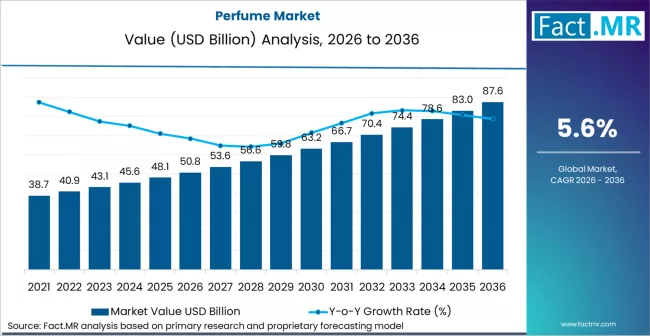
Perfume Market Market Value Analysis | Source: Fact.MR
Perfume Market
| Metric | Value |
|---|---|
| Estimated Value in (2026E) | USD 50.8 billion |
| Forecast Value in (2036F) | USD 77.8 billion |
| Forecast CAGR (2025 to 2036) | 5.6% |
Source: Fact.MR analysis. Updated Mar 12, 2026
Perfume Market Definition
The perfume market involves the creation, production, and sale of fragranced products formulated to provide specific scents for personal use, including fine fragrances, eau de toilettes, and eau de parfums sold to individual consumers.
Market Inclusions
This report covers global and regional market sizes for perfumes over a defined forecast period, including product types (premium, mass, niche), distribution channels (specialty retail, department stores, online), and consumer segments (gender, age group).
Market Exclusions
The scope excludes unrelated fragranced products not marketed as personal perfumes (such as home fragrances and industrial scents), and raw fragrance ingredients not sold as finished consumer perfume products.
Research Methodology
- Primary Research: Interviews were conducted with perfumers, brand managers, and retail buyers.
- Desk Research: Data was sourced from industry reports, consumer trend publications, and trade association statistics.
- Market‑Sizing and Forecasting: A hybrid model combining top‑down consumer demand forecasts with bottom‑up sales and shipment data was used.
- Data Validation and Update Cycle: Findings were validated through expert review and aligned with recent production, adoption, and trade figures.
Summary of the Perfume Market
- Market Definition
- The perfume market includes global production, trade, and sale of fragranced products designed for personal use. It covers Eau de Parfum, Eau de Toilette, Eau de Cologne, and Eau Fraiche. The market serves diverse consumer segments across genders, age groups, and price tiers, including mass, premium, and niche products. Distribution channels include offline retail stores, mono-brand outlets, department stores, and e-commerce platforms.
- Demand Drivers
- Rising consumer preference for premium and personalized fragrances.
- Increasing disposable incomes and luxury goods consumption in emerging markets.
- Expansion of retail channels, including online platforms and specialty stores.
- Synthetic perfumes dominate due to affordability, longevity, and variety in scent formulation.
- Growth in gifting and lifestyle-oriented fragrance consumption.
- Key Segments
- Nature: Synthetic perfumes hold 70% market share in 2026, driven by cost efficiency and stability.
- Product Type: Eau de Parfum accounts for 35% market share in 2026, preferred for high fragrance concentration and premium positioning.
- Perfume Type: Includes Citrus, Fruity, Spicy, Floral, Green, Woody, Mossy, and Amber fragrances.
- Customer Orientation: Male, Female, Unisex, and Kids fragrances.
- Sales Channels: Online (brand websites, e-commerce platforms) and Offline (department stores, supermarkets, mono-brand stores, pharmacies).
- Regional Dynamics
- China: CAGR of 7%, driven by luxury consumption and rising middle-class demand.
- India: CAGR of 6.7%, supported by retail expansion and fragrance awareness.
- USA: CAGR of 5.2%, fueled by mass-market and premium segments along with e-commerce adoption.
- Germany: CAGR of 5.5%, reflecting consumer preference for branded fragrances.
- UK: CAGR of 4.8%, supported by continued premium fragrance uptake and retail access.
- Market Insights
- Fact MR notes that the perfume market is mature, growth-driven by brand heritage, consumer lifestyle, and premiumization trends. While mass-market fragrances remain significant in volume, growth is concentrated in premium and niche lines emphasizing unique scents, experiential branding, and compliance with regulatory standards. Market expansion is supported by rising global retail penetration, online sales growth, and increasing awareness of personal grooming.
- Strategic Implications
- Focus on synthetic perfumes for broad consumer appeal while expanding niche and luxury offerings.
- Leverage online retail and e-commerce to enhance accessibility and reach emerging markets.
- Develop unique fragrance profiles and experiential marketing to strengthen brand differentiation.
- Target high-growth regions such as China and India for premium and mass-market growth.
- Methodology
- Primary Research: Interviews with perfumers, brand managers, and retail buyers.
- Desk Research: Industry reports, trade association data, and consumer trend publications.
- Market Sizing: Hybrid top-down and bottom-up model combining sales, shipment data, and regional forecasting.
Segmental Analysis
Perfume Market Analysis by Nature
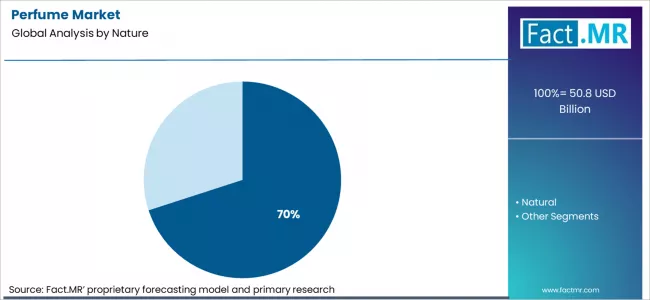
Perfume Market Analysis By Nature | Source: Fact.MR
Market Overview: Synthetic perfumes are expected to capture 70% of the market share by 2026. Synthetic fragrances dominate the market due to their affordability, long-lasting scent, and the ability to replicate complex aroma profiles that are difficult or expensive to extract from natural sources.
Demand Drivers:
- Cost-Effectiveness: Synthetic perfumes are more affordable than natural alternatives, making them accessible to a broader consumer base.
- Variety of Scents: Synthetic ingredients allow perfumers to create unique and consistent fragrance profiles, driving their widespread adoption.
- Longevity and Stability: Synthetic perfumes offer longer-lasting scents and greater shelf stability, increasing consumer preference and market demand.
Perfume Market Analysis by Product Type
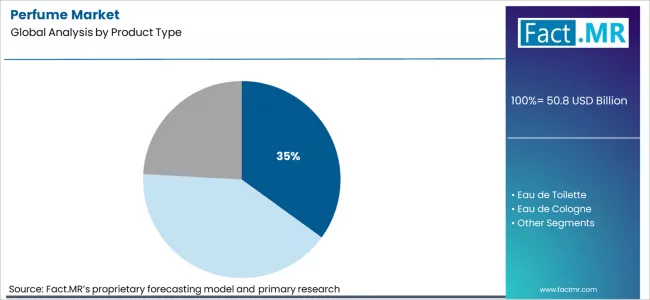
Perfume Market Analysis By Product Type | Source: Fact.MR
Market Overview: Eau de Parfum is projected to hold 35% of the market share by 2026. Eau de Parfum offers a higher concentration of fragrance oils compared to other formats, providing a longer-lasting and more intense scent, making it popular among consumers seeking premium perfume experiences.
Demand Drivers:
- High Fragrance Concentration: Eau de Parfum provides a strong and lasting aroma, preferred by consumers seeking long-lasting scents for personal use.
- Premium Positioning: This product type is often positioned as a luxury option, appealing to consumers willing to invest in high-quality perfumes.
- Broad Consumer Acceptance: Its balance between fragrance intensity and price makes Eau de Parfum a versatile choice across demographics and markets globally.
Perfume Market Drivers, Restraints, and Opportunities
FMR analysts observe that the perfume market is a mature, consumer‑driven segment rooted in longstanding cultural and personal expression norms, and shaped by evolving preferences for fragrance as part of self‑care and lifestyle. Historically, traditional eau de parfum and cologne dominated; as consumers have valued personalization, sustainability, and premium sensory experiences, structural demand has shifted toward niche, designer, and bespoke fragrances that command higher price points. The 2026 valuation reflects steady growth tied to beauty and personal care spending, brand innovation, and expanded global retail access rather than one‑off novelty.
While mass‑market fragrances remain large in volume, growth is concentrated in premium and artisanal lines that emphasize unique scent profiles, sustainable sourcing, and experiential branding. These higher‑value products contribute to net market value growth even as unit volumes grow moderately with consumer spending trends. The market exists because fragrance remains an emblem of identity and lifestyle, and regulatory labeling and ingredient standards shape formulation and consumer confidence.
- Premiumization & Personalization Demand: Consumers increasingly choose niche and bespoke fragrances over basic scents, driving higher average selling prices.
- Regulatory & Safety Standards: Cosmetic ingredient and labeling regulations push adoption of certified, compliant formulations that meet defined safety and transparency criteria.
- Regional Consumption Trends: In Europe and North America, heritage fragrance markets and luxury spending drive premium uptake, while Asia‑Pacific shows rapid growth with rising disposable income and beauty adoption.
Regional Analysis
The market analysis covers key global regions, including East Asia, South Asia, North America, and Western Europe. It is segmented geographically, with specific market dynamics for each region. The full report provides a detailed market attractiveness analysis.
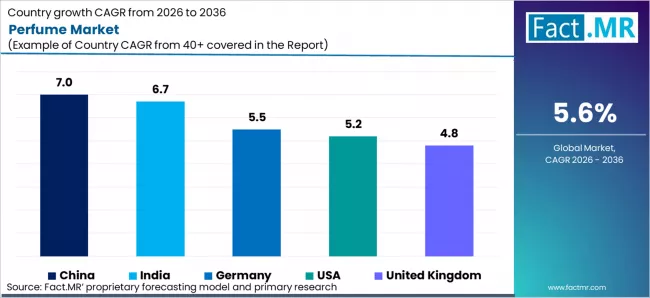
Perfume Market Cagr Analysis By Country | Source: Fact.MR
| Country | CAGR (2026-2036) |
|---|---|
| China | 7.0% |
| India | 6.7% |
| USA | 5.2% |
| United Kingdom | 4.8% |
| Germany | 5.5% |
Source: Fact.MR analysis. Updated Mar 12, 2026
Source: Fact MR (FMR) analysis, based on proprietary forecasting model and primary research
East Asia
China is a major market, driven by rising personal care consumption, increasing retail penetration, and growing demand for luxury fragrances. Key players include L’Oréal China, Procter & Gamble, and Coty Inc.
- China: Demand for perfume in China is projected to rise at 7.0% CAGR through 2036. Growth is supported by expansion of luxury retail stores (03-2025) and L’Oréal China’s regional distribution increase (08-2025).
South Asia
India is a significant market, supported by increasing consumer awareness, urbanization, and adoption of premium and mid-range fragrances.
- India: Demand for perfume in India is projected to rise at 6.7% CAGR through 2036. Growth is driven by retail expansion and Procter & Gamble’s regional product launches (05-2025).
North America
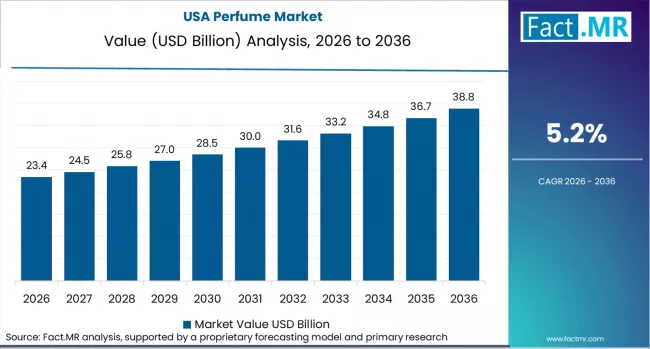
Perfume Market Country Value Analysis | Source: Fact.MR
The USA is a key market, driven by consumer demand for personal care, premium fragrances, and increasing e-commerce adoption.
- USA: Demand for perfume in the U.S. is projected to rise at 5.2% CAGR through 2036. Growth is influenced by Coty Inc.’s product distribution expansion (06-2025) and department store fragrance programs (09-2025).
Western Europe
The United Kingdom and Germany are major markets, supported by retail penetration, personal care trends, and increasing demand for designer and branded fragrances.
- United Kingdom: Demand for perfume in the UK is projected to rise at 4.8% CAGR through 2036. Growth is supported by expansion of luxury retail chains (04-2025) and L’Oréal UK’s product launches (08-2025).
- Germany: Demand for perfume in Germany is projected to rise at 5.5% CAGR through 2036. Growth is influenced by increasing consumer adoption of personal care products (03-2025) and Procter & Gamble’s regional expansions (07-2025).
Fact MR's analysis of the perfume market in East Asia, South Asia, North America, and Western Europe consists of country-wise assessments that include China, India, the USA, the United Kingdom, and Germany. Readers can find detailed trends, regulatory updates, and company-specific investments shaping market growth in these countries.
What is the Competitive Structure and Buyer Behavior in the Perfume Market?
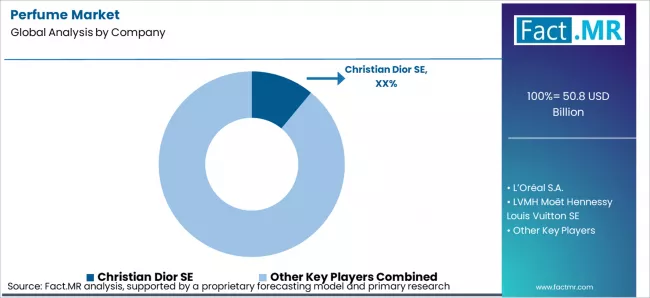
Perfume Market Analysis By Company | Source: Fact.MR
The perfume market is moderately concentrated, with major luxury and personal care conglomerates such as LVMH Moët Hennessy Louis Vuitton SE, Christian Dior SE, Chanel Limited, The Estée Lauder Companies Inc., and L’Oréal S.A. accounting for a substantial share alongside established brands including Coty Inc., Shiseido Company, Limited, Puig S.L., Capri Holdings Limited, Hermès International S.A., and Giorgio Armani S.p.A., as well as accessible fragrance producers like Revlon, Inc., Avon Products, Inc., and Natura & Co Holding S.A. The primary competitive variables are brand equity, fragrance formulation quality, packaging design, distribution reach, and marketing presence, which heavily influence consumer preference and retail placement. Companies with strong brand heritage, broad global distribution networks, and integrated marketing capabilities hold structural advantages because they can command premium positioning, secure high‑visibility retail space, and sustain consumer loyalty across markets.
Large retailers, luxury boutiques, and e‑commerce platforms exert notable buyer leverage by selecting assortments, negotiating promotional support, and requiring performance metrics tied to category turnover. To manage supplier dependency, these buyers qualify multiple brands, emphasize exclusivity arrangements or co‑branded initiatives, and standardize shelf presentation criteria, which limits individual suppliers’ pricing power. As a result, competition focuses on brand differentiation, consumer experience, and marketing impact rather than on price alone.
Key Players of the Perfume Market
- Christian Dior SE
- L’Oréal S.A.
- LVMH Moët Hennessy Louis Vuitton SE
- Coty Inc.
- Chanel Limited
- The Estée Lauder Companies Inc.
- Puig S.L.
- Capri Holdings Limited
- Shiseido Company, Limited
- Natura & Co Holding S.A.
- Givaudan SA
- Revlon, Inc.
- Avon Products, Inc.
- Hermès International S.A.
- Giorgio Armani S.p.A.
Report Scope
| Metric | Value |
|---|---|
| Quantitative Units | USD 50.8 billion (2026) to USD 77.8 billion (2036), at a CAGR of 5.6% |
| Market Definition | The perfume market includes global production, trade, and sale of fragrances in various forms, catering to diverse consumer segments and price points across multiple distribution channels. |
| Product Type | Eau de Parfum, Eau de Toilette, Eau de Cologne, Eau Fraiche |
| Customer Orientation | Perfumes for Males, Perfumes for Females, Unisex Perfumes, Perfumes for Kids |
| Nature | Synthetic Perfumes, Natural Perfumes |
| Price Range | Mass Perfumes, Premium Perfumes |
| Perfume Type | Citrus Perfumes, Fruity Perfumes, Spicy Perfumes, Floral Perfumes, Green Perfumes, Woody Perfumes, Mossy Perfumes, Amber Perfumes |
| Sales Channel | Online Sales / E-tailing, Offline Sales |
| Key Companies Profiled | Christian Dior SE, L’Oréal S.A., LVMH Moët Hennessy Louis Vuitton SE, Coty Inc., Chanel Limited, The Estée Lauder Companies Inc., Puig S.L., Capri Holdings Limited, Shiseido Company, Limited, Natura & Co Holding S.A., Givaudan SA, Revlon, Inc., Avon Products, Inc., Hermès International S.A., Giorgio Armani S.p.A. |
| Forecast Period | 2026 to 2036 |
| Approach | Hybrid top-down and bottom-up market modeling validated through interviews with perfume manufacturers and distributors, supported by trade data benchmarking and plant-level capacity verification |
Source: Fact.MR analysis. Updated Mar 12, 2026
Bibliographies
- Financial Times. (2024, August). Perfume offers a new “lipstick effect” in the luxury slowdown. Financial Times.
- The Guardian. (2025, August 23). Eau de courgette: Rise in foodie perfumes may be linked to weight-loss drugs. The Guardian.
- Reuters. (2025, October 21). L’Oréal’s $4.7 billion Kering beauty buy offers decades of potential. Reuters.
- Le Monde. (2025, December 27). Six thousand new perfumes in 2025: Why manufacturers are flooding the market. Le Monde.
- Vogue Business. (2024, December). Swarovski relaunches its fragrance division with Coty. Vogue Business.
This report addresses
- Market intelligence enabling a detailed assessment of leading countries, product types, fragrance orientations, and price segments in the global Perfume Market.
- Market volume (revenue) estimates and 10-year revenue forecasts from 2026 to 2036, validated through sales channel data, brand performance, and consumer adoption trends.
- Growth opportunity mapping across product types (Eau de Parfum, Eau de Toilette, Eau de Cologne, Eau Fraiche), customer orientations (Male, Female, Unisex, Kids), perfume nature (Synthetic, Natural), price segments (Mass, Premium), perfume types (Citrus, Fruity, Spicy, Floral, Green, Woody, Mossy, Amber), and sales channels (Online/E-tailing, Offline).
- Segment and regional revenue forecasts by product, customer orientation, perfume nature, price segment, and geography, covering 40+ countries.
- Competition strategy analysis focusing on brand equity, fragrance formulation, packaging, distribution reach, marketing presence, and consumer loyalty, including major players LVMH Moët Hennessy Louis Vuitton SE, Christian Dior SE, Chanel Limited, The Estée Lauder Companies Inc., L’Oréal S.A., Coty Inc., Puig S.L., Capri Holdings Limited, Shiseido Company Limited, Natura & Co Holding S.A., Givaudan SA, Revlon, Inc., Avon Products, Inc., Hermès International S.A., and Giorgio Armani S.p.A.
- Product, regulatory, and quality tracking aligned with global cosmetic standards, ingredient labeling, and safety compliance for synthetic and natural perfumes.
- Adoption dynamics emphasizing premium and synthetic perfumes, online and offline sales expansion, fragrance personalization, and emerging market consumption.
- Report delivery in PDF, Excel, PowerPoint, and interactive dashboard formats for executive, operational, and strategic planning use.
Segmentation
Perfume Market Key Segments
-
Product Type:
- Eau de Parfum
- Eau de Toilette
- Eau de Cologne
- Eau Fraiche
-
Customer Orientation:
- Perfumes for Males
- Perfumes for Females
- Unisex Perfumes
- Perfumes for Kids
-
Nature:
- Synthetic Perfumes
- Natural Perfumes
-
Price Range:
- Mass Perfumes
- Premium Perfumes
-
Perfume Type:
- Citrus Perfumes
- Bergamot
- Lemon
- Lime
- Orange
- Fruity Perfumes
- Apple
- Melon
- Peach
- Strawberry
- Spicy Perfumes
- Cinnamon
- Cloves
- Nutmeg
- Floral Perfumes
- Jasmine
- Carnation
- Rose
- Violet
- Green Perfumes
- Woody Perfumes
- Mossy Perfumes
- Amber Perfumes
- Citrus Perfumes
-
Sales Channel:
- Online Sales/E-tailing of Perfumes
- Company/Brand Websites
- E-Commerce Platform
- Offline Sales of Perfumes
- Supermarkets/Hypermarkets
- Franchise Outlets
- Departmental Stores
- Mono Brand Stores
- Convenience Stores
- Drug Store and Pharmacies
- Multi-Brand Outlets
- Other Sales Channels
- Online Sales/E-tailing of Perfumes
-
Region
- North America
- USA
- Canada
- Mexico
- Europe
- Germany
- UK
- France
- Italy
- Spain
- Nordic Countries
- BENELUX
- Rest of Europe
- Asia Pacific
- China
- Japan
- South Korea
- India
- Australia
- Rest of Asia Pacific
- Latin America
- Brazil
- Argentina
- Rest of Latin America
- Middle East and Africa
- Kingdom of Saudi Arabia
- United Arab Emirates
- South Africa
- Rest of Middle East and Africa
- Other Regions
- Oceania
- Central Asia
- Other Markets
- North America
Frequently Asked Questions
How large is the demand for Perfumes in the global market in 2026?
What will be the market size of Perfumes in the global market by 2036?
What is the expected demand growth for Perfumes in the global market between 2026 and 2036?
Which nature type is expected to dominate the market?
Which region is expected to show the highest growth rate for Perfumes?
How significant is the growth outlook for India in this market?
What is the growth outlook for the United States in the Perfume market?
What is the growth forecast for the United Kingdom in the Perfume market?
What is the growth forecast for Germany in the Perfume market?
Which company is identified as a leading player in the Perfume market?
What are Perfumes used for?
What does the Perfume market include in this report?
How is the market forecast developed in this report?
What is meant by the Perfume market in this report?
Who worked on this report


Preview the report firsthand - request a free sample
Free SampleGet the brochure for pricing and purchase details
Download PDF