- Market Value (2025): USD 255.4 Mn
- Estimated Value (2026): 270.0 Mn
- Forecast Value (2036): USD 470.0 Mn
- CAGR (2026-2036): 5.7%
What is the Acid-Free Rust Removers Market forecast to be worth by 2036?
USD 270.0 million in 2026 to USD 470.0 million by 2036, at a 5.7% CAGR.
- The market surpassed USD 255.4 million in 2025, helped by wider use of rust removers and metal cleaning chemicals in maintenance work.
- Demand is projected to increase from USD 270.0 million in 2026 to USD 470.0 million by 2036.
- The market is forecast to record a 5.7% CAGR. Companies are giving more attention to products that remove rust effectively and leave metal parts ready for painting, coating, or assembly.
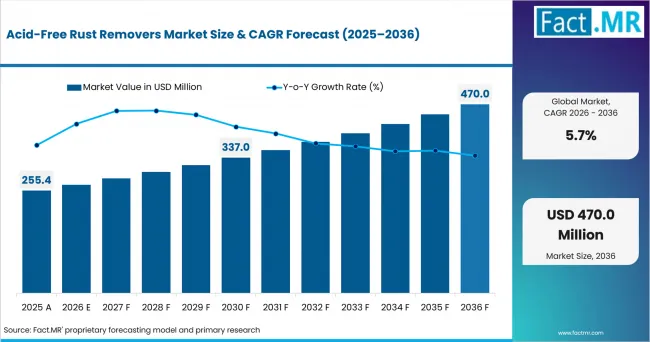
Acid Free Rust Removers Market Value Analysis | Source: Fact.MR
What are the defining numbers behind Acid-Free Rust Removers Market growth?
USD 200.0 million absolute opportunity through 2036.
- Demand Drivers in the Market
- Companies continue testing chelating agents to see how well they remove rust without damaging the metal underneath. They also check how quickly the product works, whether it reaches narrow areas, and how much residue it leaves.
- Metal treatment shops prefer products that are safer and easier to use during regular work. A new product must also fit the current cleaning area, containers, rinsing process, and part-handling steps.
- Liquid products gain interest when they reduce cleaning time and lower rework. Companies look for fewer repeat cleaning steps, easier rinsing, and fewer parts being rejected before coating or assembly.
- Maintenance staff use rust removal products when corrosion begins to affect later production steps. They check rust in pits, joints, and other hard-to-reach areas, along with any residue that may affect coating, fastening, fitting, or assembly.
- Retail customers prefer products that use less rinse water and require less cleanup. They also want the treated surface to stay clean for longer without needing another round of treatment.
- Key Segments Analyzed
- By Chemistry: Chelating agents are expected to hold 31% share in 2026, helped by controlled rust removal and lower risk of damage to the metal underneath.
- By Application: Tool restoration is projected to account for 28% share in 2026 due to regular use on edges, joints, narrow spaces, and uneven tool surfaces.
- By Format: Liquid is anticipated to capture 35% share in 2026 because it spreads across the full surface and reaches areas that are difficult to clean with spot treatments.
- By End User: MRO is estimated to represent 35% share in 2026, with maintenance staff using these products to return rusted parts and equipment to service.
- By Sales Channel: Retail is forecast to account for 35% share in 2026, offering customers an easy way to purchase rust removers for tools and other metal items.
- Analyst Opinion at Fact.MR
- Shambhu Nath Jha, Senior Analyst at Fact.MR, states, “Rust removers are more likely to be accepted when they make maintenance work easier and give a clean, usable surface. Companies want products that reach difficult areas, remove rust without harming the metal, and leave the part ready for the next step. The time needed for cleaning also matters, especially when equipment must return to service without delay.”
- Strategic Implications
- Companies should test chelating agents on real rusted parts before using them more widely. The test should show how long the product takes to work, how much rinsing is needed, whether any residue remains, and whether the metal stays in good condition after drying.
- Metal treatment shops should compare products on similar parts and follow the same cleaning steps for each test. This makes it easier to see which product works better without differences in rust level, brushing, drying, or operator method affecting the result.
- Distributors should provide clear safety and use information. This should cover storage, protective equipment, spill cleanup, disposal of used liquid, and safe handling during regular maintenance.
- Maintenance staff should consider how long the equipment will stay out of use. A long soak may suit a removable tool, but it is less practical for fixed machines, quick repairs, or parts needed back in production.
Worker safety is becoming a bigger part of product selection. Companies prefer rust removers that reduce the need for strong acids, but the product must still clean the metal well, avoid surface damage, leave little residue, and be easy to rinse and dispose of.
China is projected to record a 7.7% CAGR by 2036. India is expected to grow at a 7.1% CAGR during the forecast period. Germany is anticipated to expand at a 6.6% CAGR through 2036. Brazil is forecast to register a 6.0% CAGR over the same period. The United States is expected to post a 5.4% CAGR through 2036.
How does the Acid-Free Rust Removers Market break down by segment?
Chelating agents lead Chemistry with 31% share in 2026, while Tool restoration leads Application at 28%.
How does Chemistry shape demand?
Chelating agents hold 31% share in 2026.
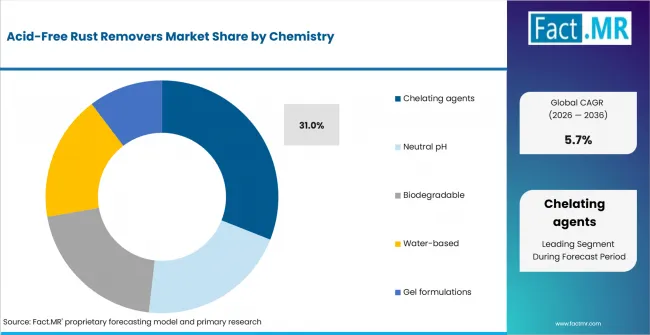
Acid Free Rust Removers Market Analysis By Chemistry | Source: Fact.MR
Companies choose these products when they remove rust without damaging the metal underneath. Working time also matters, especially when rust is trapped in pits, threads, narrow spaces, or closed parts.
Neutral pH, biodegradable, water-based, and gel products offer different choices for handling, cleanup, residue, and waste. After cleaning, the part may still need proper rinsing and drying before painting or assembly. Repeat orders are more likely when workers get the same result each time and can clearly see when the cleaning is complete.
Where is Application demand strongest?
Tool restoration accounts for 28% share in 2026.
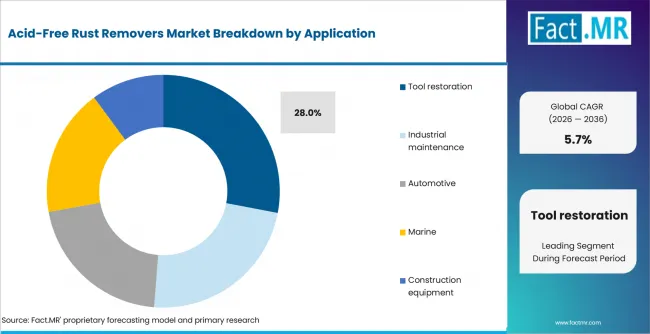
Acid Free Rust Removers Market Analysis By Application | Source: Fact.MR
Tool restoration gives users a clear way to check how well a rust remover works. After treatment, they can inspect edges, joints, handles, and working surfaces to see whether the rust has been removed. Tools often have narrow gaps and moving parts, so any residue left behind can affect fit or movement.
The cleaning method also depends on the size and type of equipment. Small tools can be soaked in a bath, while fixed or larger equipment may need the product applied only to the rusted area. Before the tool goes back into use, workers need to make sure it is fully rinsed, dried, and working properly. The process should remove rust without changing the shape, movement, coating, or fit of the part.
What supports Format adoption?
Liquid holds 35% share in 2026.
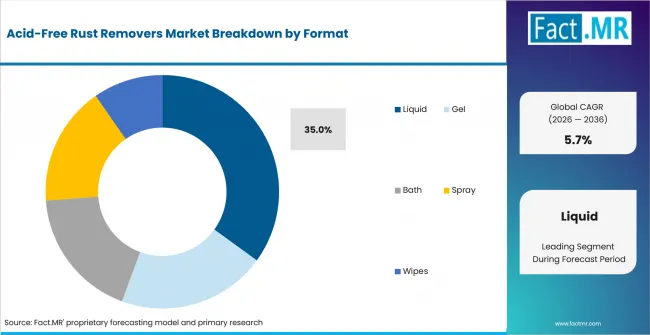
Acid Free Rust Removers Market Analysis By Format | Source: Fact.MR
Liquid rust removers cover large surfaces and reach narrow or uneven areas. Small parts can be soaked, while larger parts can be fully covered with the liquid. Users also need to manage the container, draining, and disposal of the used product.
Gels, sprays, baths, and wipes suit different cleaning jobs. Gels stay on one area, wipes work well on small spots, and sprays help reach wider surfaces. The best choice depends on the size and shape of the part, the area that needs cleaning, and how easy the product is to rinse away.
Which End User dominates?
MRO leads with 35% share in 2026.
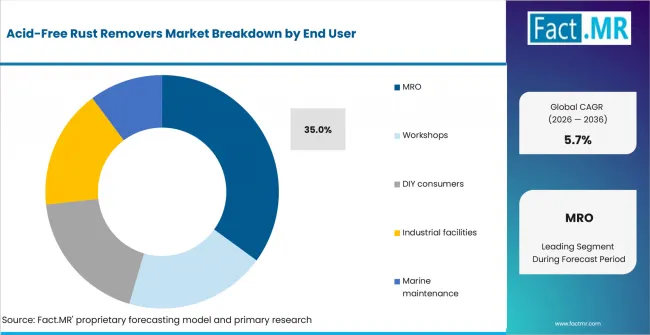
Acid Free Rust Removers Market Analysis By End User | Source: Fact.MR
Maintenance workers use rust removers on many types of tools, parts, and machines. Some items can be removed and soaked, while others must be cleaned where they are. The product should remove rust, be easy to clean up, and leave the metal ready for repair, painting, coating, or reuse.
Workshops, factories, marine service providers, and home users have different needs. Products are more likely to be used again when they save time, give steady results, and do not damage the metal.
What leads the Sales Channel segment?
Retail holds 35% share in 2026.
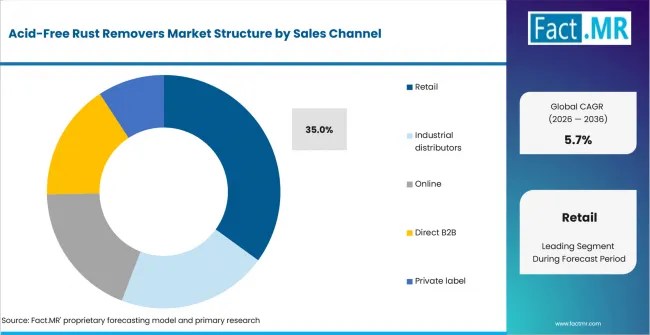
Acid Free Rust Removers Market Analysis By Sales Channel | Source: Fact.MR
Retail stores let customers try a rust remover on a tool or small metal part before buying more. The product label should clearly explain how to use it, how long to leave it on, whether scrubbing is needed, and how to clean the part afterward.
Online stores, industrial sellers, direct sales, and private-label products are also used by customers who need larger amounts or regular supply. Simple rust removal jobs often start with retail products, while harder jobs may need more guidance.
What is accelerating Acid-Free Rust Removers Market adoption, and what is holding it back?
Safer handling is anticipated to drive market growth, while testing costs and poor fit with existing cleaning work restrain it.
Drivers Impact Analysis
| DRIVER | (~) % IMPACT ON CAGR | GEOGRAPHIC RELEVANCE | IMPACT TIMELINE |
|---|---|---|---|
| Worker exposure control in Chelating agents | +0.8% | China and export suppliers | Medium term (2-4 years) |
| Corrosion control testing | +0.6% | Europe and North America | Short term (<= 2 years) |
| Industrial MRO approval programs | +0.5% | Asia Pacific | Medium term (2-4 years) |
| Local support near maintenance teams | +0.4% | Global | Long term (>= 4 years) |
Source: Fact.MR analysis. Updated Jul 15, 2026
- Worker safety with chelating agents: Companies are more likely to review chelating agents when they want to reduce the use of strong acids. The product still needs to remove rust well, be easy to use, and leave the metal clean after rinsing and drying.
- Rust removal testing: A quick look at the surface is not enough. Companies should test the product on real parts, check narrow areas, rinse and dry the part, and make sure it is ready for painting, coating, or assembly.
- MRO approval programs: A clear testing process helps maintenance workers use the product in the same way each time. It also sets simple rules for working time, cleaning results, downtime, and when the part is ready to go back into use.
- Local support for maintenance workers: Nearby support helps solve problems faster during product trials. A company representative can check the rust level, how the product was applied, how well it was rinsed, and whether any residue remains.
Opportunity Impact Analysis
| OPPORTUNITY | (~) % IMPACT ON CAGR | GEOGRAPHIC RELEVANCE | IMPACT TIMELINE |
|---|---|---|---|
| Grades tuned for Industrial MRO | +0.5% | Global | Medium term (2-4 years) |
| Application labs for Tool restoration | +0.4% | Asia Pacific and Europe | Short term (<= 2 years) |
| Rule-ready documentation | +0.4% | Europe and United Kingdom | Medium term (2-4 years) |
| Local trials with plant safety leads | +0.3% | India and Brazil | Long term (>= 4 years) |
Source: Fact.MR analysis. Updated Jul 15, 2026
- Rust removers for industrial maintenance: Companies need products that work across many types of parts. Workers should be able to follow the same basic steps, clean the part easily, and know when it is ready to use again.
- Tool restoration testing: Early testing helps compare soaking time, light scrubbing, rinsing, and drying before the product is used in the workshop. The cleaned tool should still move properly, fit correctly, and keep its markings and edges.
- Simple product documents: Clear instructions help companies check storage, handling, cleanup, and disposal before approval. The paperwork should also explain how the product should be used during normal maintenance work.
- On-site trials with safety staff: Safety and maintenance staff can test the product together on real parts. This helps them check worker safety, cleaning steps, rinsing, waste, and the final condition of the metal in one trial.
Restraints Impact Analysis
| RESTRAINT | (~) % IMPACT ON CAGR | GEOGRAPHIC RELEVANCE | IMPACT TIMELINE |
|---|---|---|---|
| Qualification cost | -0.4% | Global processors | Medium term (2-4 years) |
| Fit limits in Tool restoration | -0.3% | Global | Short term (<= 2 years) |
| Documentation burden | -0.3% | Europe and North America | Medium term (2-4 years) |
| Scale-up risk | -0.2% | High-volume plants | Long term (>= 4 years) |
Source: Fact.MR analysis. Updated Jul 15, 2026
- Cost of testing: Trying a new rust remover takes time and money. Companies need to stop work, test the product, rinse the parts, inspect them, and make sure they are ready to use again. Many keep using acid products until the new option clearly saves time or is easier to handle.
- Problems with tool cleaning: Tools often have joints, springs, small gaps, and hidden areas. Rust or product residue can remain in these places. This may affect how the tool moves, fits, looks, or works.
- Too much paperwork: Approval takes longer when safety details, cleaning steps, disposal rules, and final checks are kept in separate documents. One clear record makes the work easier to follow.
Problems during larger use: A product may work well in a small test but give different results on larger jobs. Bigger containers, more parts, and longer use can make cleaning harder to control. Companies usually increase use only after the product gives the same result each time and the used liquid can be disposed of safely.
Which countries are scaling Acid-Free Rust Removers Market fastest?
Germany 6.6%, Brazil 6.0%, United States 5.4%.
.webp "Top Country Growth Comparison Acid Free Rust Removers Market Cagr (2026 2036)")
Top Country Growth Comparison Acid Free Rust Removers Market Cagr (2026 2036) | Source: Fact.MR
Regional analysis covers North America, Europe, Asia Pacific, Latin America, and the Middle East & Africa.
| COUNTRY | CAGR |
|---|---|
| Germany | 6.6% |
| Brazil | 6.0% |
| United States | 5.4% |
Source: Fact.MR analysis. Updated Jul 15, 2026
What underpins Germany's growth?
6.6% CAGR, supported by strict testing and metal repair needs.
German manufacturers often check rust removers on parts that must be painted, fitted, or assembled after cleaning. The surface must come out clean without damage to the metal underneath. Rinsing and drying also need to be simple and reliable.
Older acid-based products are more likely to be replaced when a new option gives the same result every time and is safer to use during daily work.
What is driving Brazil's growth through 2036?
6.0% CAGR, driven by equipment upkeep and local product trials.
In Brazil, rust removers are often tested close to the workshop or equipment being cleaned. This helps companies see how the product works on small tools, large parts, and machines that cannot be soaked.
They also check whether the liquid runs off too quickly, whether the part is easy to rinse and dry, and how the used product should be removed. Repeat orders are more likely when the rust comes off in one cleaning and the item can return to use without extra work.
How is United States scaling demand?
5.4% CAGR, backed by safer cleaning needs and on-site testing.
In the United States, companies often test rust removers with the people who use them during repair work. These trials show whether the product is safer to handle, removes rust properly, and leaves the part ready for painting or assembly.
Wider use depends on clear instructions for different rust levels and part shapes. Workers also need simple limits for cleaning time, surface checks, used liquid, and waste disposal.
Who leads the Acid-Free Rust Removers Market?
B’laster Holdings Corporation, CRC Industries, WD-40 Company, and Henkel AG & Co. KGaA are included in the company list.
Companies compare these providers based on product quality, clear instructions, easy rinsing, and help with difficult cleaning jobs. A product must remove rust well and work on parts with different shapes and surface conditions.
Clear instructions make the product easier to use. They should show how to apply it, how long to wait, whether scrubbing is needed, and how to rinse and dry the part. After cleaning, the part should be ready for painting, coating, or assembly. Simple safety details can also make approval easier.
Which companies are the key providers?
B’laster Holdings Corporation and CRC Industries are key providers. WD-40 Company and Henkel AG & Co. KGaA complete the company set.
- B’laster Holdings Corporation
- CRC Industries
- WD-40 Company
- Henkel AG & Co. KGaA
Bibliography
- Liu, J., Wang, W., Mao, Z., Cao, L., Yu, M., & Chen, S. (2025). Eco-friendly and highly efficient rust removal for Q235 steel via UV-induced copolymerization of acrylic monomers into adsorptive gel. Surfaces and Interfaces, 67, 106417.
- Zhang, L., Song, Y., Jia, Y., Zhou, Y., Tian, M., & Li, Y. (2025). PVA composite hydrogel film for rust removal of an ancient bronze mirror. Langmuir, 41(8).
- Jungbunzlauer Suisse AG. (2025). Citric acid: An eco-friendly and safe rust-removal agent.
- Department of Chemicals and Petrochemicals. (2026, February 6). Annual report 2025–26. Ministry of Chemicals and Fertilizers, Government of India.
- National Bureau of Statistics of China. (2026, February 28). Statistical communiqué of the People's Republic of China on the 2025 national economic and social development.
This Report Addresses
- The report provides clear information on the market across chemistry and application choices.
- The regional outlook reviews China and India along with Germany, Brazil, and the United States.
- The competitive analysis profiles B’laster Holdings Corporation and CRC Industries, followed by WD-40 Company and Henkel AG & Co. KGaA.
- The use-case review covers industrial maintenance and related rust-removal and metal-cleaning work.
- The market outlook examines cleaning needs, country growth, product testing, working time, rinsing, waste handling, and whether treated parts are ready for painting, coating, or reuse.
What does the Acid-Free Rust Removers Market cover?
The market covers chelating agents, tool restoration, and industrial maintenance uses.
It includes rust removers used on tools, machine parts, equipment, and other metal surfaces. Products are available as liquids, gels, baths, sprays, and wipes. Demand depends on how well the product removes rust, how easy it is to use, and whether the cleaned part is ready for repair, painting, coating, or reuse.
The scope excludes products that do not remove rust or are not sold for the uses covered in this study.
What is included in the scope?
The scope includes acid-free and low-acid products used to remove rust from metal parts, tools, and equipment. Coverage includes chelating agents, tool restoration, industrial maintenance, and all other listed segments.
The market also includes products sold for home repair, workshop use, and factory maintenance. Only products bought for rust removal and used in regular cleaning work are included.
What is excluded from the scope?
Basic chemicals are excluded when they are not sold as rust removers. Tanks, brushes, spray tools, and other cleaning equipment sold on their own are also outside the market.
General maintenance work is not included unless an acid-free rust remover is purchased and used. Products meant only for cleaning dirt, grease, paint, or other marks also fall outside the scope.
How was the analysis built?
120+ sources, 40+ company portfolios, 25+ countries, 20+ interviews.
- Primary Research: Primary research reflects discussions with companies, distributors, product makers, maintenance workers, and technical staff using rust removers and metal cleaning products.
- Desk Research: Desk research reviews government data, safety rules, technical information, industry standards, waste guidance, and public information related to rust removal and metal care.
- Market-Sizing and Forecasting: Forecasting combines market value, growth rate, segment shares, company presence, country demand, product use, pricing, and factors that may slow adoption.
- Data Validation and Update Cycle: Forecast checks compare company activity, factory demand, product testing, safety needs, and country-level trends. The update cycle reviews whether products are moving from trial use to regular use.
Segmentation
What is the report's scope and coverage?
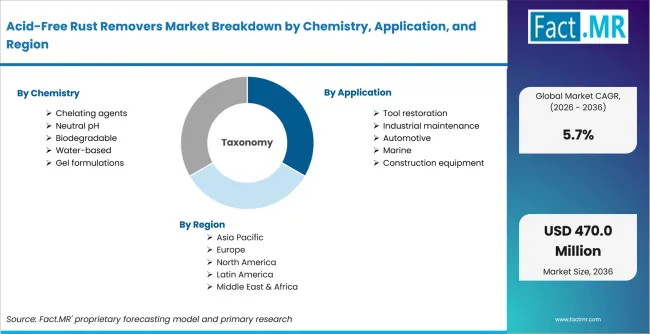
Acid Free Rust Removers Market Breakdown By Chemistry, Application, And Region | Source: Fact.MR
| Attribute | Details |
|---|---|
| Quantitative Units | USD Million in 2026 to USD Million by 2036 at CAGR |
| Market Definition | Neutral or low-acid rust removal formulations for safer industrial, DIY, and maintenance applications. |
| Chemistry | Chelating agents, Neutral pH, Biodegradable, Water-based, Gel formulations |
| Application | Tool restoration, Industrial maintenance, Automotive, Marine, Construction equipment |
| Format | Liquid, Gel, Bath, Spray, Wipes |
| End User | MRO, Workshops, DIY consumers, Industrial facilities, Marine maintenance |
| Sales Channel | Retail, Industrial distributors, Online, Direct B2B, Private label |
| Regions Covered | North America, Europe, Asia Pacific, Central and South America, Middle East and Africa |
| Countries Covered | Germany, Brazil, United States |
| Key Companies Profiled | B’laster Holdings Corporation, CRC Industries, WD-40 Company, Henkel AG & Co. KGaA |
| Forecast Period | 2026 to 2036 |
| Approach | Hybrid top-down and bottom-up approach using Rust Removers / Metal Cleaning Chemicals, segment shares, country growth, and technical validation |
Source: Fact.MR analysis. Updated Jul 15, 2026
How is the market segmented?
-
By Chemistry
- Chelating agents
- Neutral pH
- Biodegradable
- Water-based
- Gel formulations
-
By Application
- Tool restoration
- Industrial maintenance
- Automotive
- Marine
- Construction equipment
-
By Format
- Liquid
- Gel
- Bath
- Spray
- Wipes
-
By End User
- MRO
- Workshops
- DIY consumers
- Industrial facilities
- Marine maintenance
-
By Sales Channel
- Retail
- Industrial distributors
- Online
- Direct B2B
- Private label
-
By Region
- North America
- United States
- Canada
- Europe
- Germany
- United Kingdom
- France
- Italy
- Spain
- Asia Pacific
- Japan
- South Korea
- Australia
- Central & South America
- Brazil
- Argentina
- Mexico
- Chile
- Middle East & Africa
- UAE
- Saudi Arabia
- South Africa
- North America
Frequently Asked Questions
Which Chemistry leads the Acid-Free Rust Removers Market?
Which Application leads the Acid-Free Rust Removers Market?
Which Format leads the Acid-Free Rust Removers Market?
Which End User leads the Acid-Free Rust Removers Market?
Which Sales Channel leads the Acid-Free Rust Removers Market?
Which country records the highest CAGR in the Acid-Free Rust Removers Market?
What is the primary driver in the Acid-Free Rust Removers Market?
What is the main restraint in the Acid-Free Rust Removers Market?
Why are Chelating agents important?
Why do companies continue testing acid-free rust removers?
Who worked on this report


Preview the report firsthand - request a free sample
Free SampleGet the brochure for pricing and purchase details
Download PDF