- Base Value(2026): 9.7 Bn
- Estimated Value(2026): 9.7 Bn
- Forecast Value (2036): 23.0 Bn
- CAGR (2026 - 2036): 9.0%
Ice Skating Equipment Analysis and Forecast by Fact.MR
- The Ice Skating Equipment Market is expected to grow from USD 9.7 billion in 2026 to USD 23.0 billion by 2036, at a 9.0% CAGR.
- Driven by recreational participation growth supported by indoor rink expansion, competitive figure skating and hockey enrollment driving performance demand.
- Indoor rink investment in emerging markets is widening year-round access. Ice Skates account for 58.9% product share, while Recreational Skating contributes 36.4% application share as participants prioritize comfort, safety, performance, and accessibility.
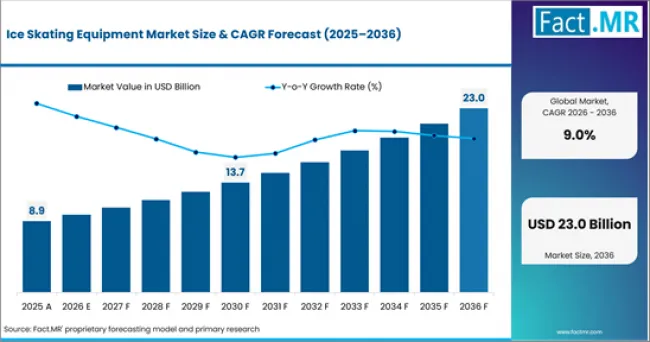
Ice Skating Equipment Market Value Analysis | Source: Fact.MR
Summary of Ice Skating Equipment Market
- Market Snapshot
- In 2025, the global Ice Skating Equipment Market was valued at approximately USD 8.9 billion.
- The market is estimated to reach USD 9.7 billion in 2026 and is projected to attain USD 23.0 billion by 2036.
- The market is likely to expand at a CAGR of 9.0% during the forecast period.
- The market is anticipated to create an absolute dollar opportunity of USD 13.3 billion between 2026 and 2036.
- Ice Skates account for 58.9% of product share in 2026.
- United States (16.0%) and China (11.0%) are the key growth markets during the forecast period.
- Demand and Growth Drivers
- Recreational ice skating participation growth, supported by indoor rink expansion and winter sports tourism, sustains the broadest demand pool for ice skates and protective equipment.
- Competitive figure skating and ice hockey program enrollment drive demand for performance-grade equipment where blade technology and boot precision shape specification.
- Indoor ice rink facility investment across emerging markets widens year-round skating access and equipment demand beyond traditional winter-sport geographies.
- Indoor rink expansion in non-traditional markets creates year-round equipment demand beyond cold-climate geographies.
- Heat-moldable boot technology and advanced blade systems create premium, performance-differentiated products.
- Product and Segment View
- Ice Skates accounts for 58.9% of the product segment in 2026, emerging as the leading category.
- Recreational Skating accounts for 36.4% of the application segment in 2026, making it the dominant use setting.
- Key segmentation includes:
- Product: Ice Skates, Protective Gear, Ice Skating Apparel, Accessories
- Application: Recreational Skating, Professional Sports, Training & Coaching, Fitness & Lifestyle
- End Use: Sports Clubs & Academies, Individual Consumers, Educational Institutions, Entertainment Venues
- Technology: Blade Engineering Technology, Thermal Control Technology, Impact Protection Technology, Performance Optimization Tech
- Formulation: Composite Material Systems, Foam-based Systems, Metal Alloy Systems, and Hybrid Material Systems
- Distribution Channel: Sporting Goods Retailers, Online Retail Platforms, Sports Equipment Distributors, Institutional Sales Channels
- These systems enable:
- Performance blade and boot skating systems
- Competitive figure skating and hockey protection
- Recreational and entry-level skating access
- Geography and Competitive Outlook
- North America leads on ice hockey participation, rink infrastructure, and the presence of major equipment brands.
- Europe demand reflects figure skating and recreational skating culture across northern and central European markets.
- Asia Pacific posts the steepest growth, as indoor rink investment in China and urban centers in Japan and South Korea widen skating access.
- the United States (16.0%) and China (11.0%) lead country growth, with other major markets showing steady demand.
- Key companies include Bauer Hockey (Peak Achievement Athletics), CCM Hockey (SIG), Jackson Ultima Skates, Riedell Shoes, Inc., Edea S.r.l., Rollerblade (Tecnica Group).
- Analyst Opinion
- Shambhu Nath Jha, Principal Consultant at Fact.MR, says "Ice skating equipment demand splits between high-volume recreational and specification-driven competitive segments. Ice skates lead at nearly 59% share. The structural growth driver is indoor rink expansion that creates year-round demand beyond cold-climate markets, with China showing the steepest post-Winter Olympics participation growth. Bauer and CCM hold strong positions in hockey equipment, while Jackson Ultima, Riedell, and Edea are established figure skating equipment brands. Suppliers combining competitive credibility with accessible recreational products and strong retail distribution are positioned across both volume and premium segments."
Key Growth Drivers, Constraints, and Opportunities
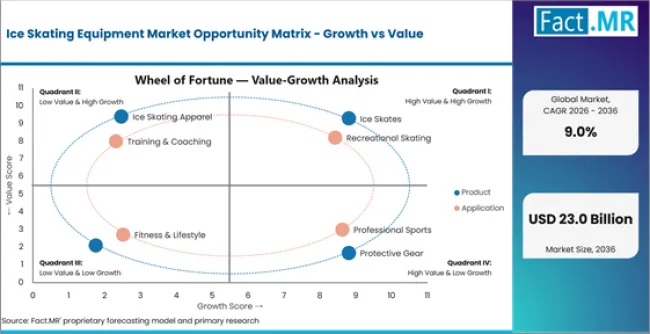
Ice Skating Equipment Market Opportunity Matrix Growth Vs Value | Source: Fact.MR
Key Factors Driving Growth
- Recreational ice skating participation growth, supported by indoor rink expansion and winter sports tourism, sustains the broadest demand pool for ice skates and protective equipment.
- Competitive figure skating and ice hockey program enrollment drive demand for performance-grade equipment where blade technology and boot precision shape specification.
- Indoor ice rink facility investment across emerging markets widens year-round skating access and equipment demand beyond traditional winter-sport geographies.
Key Market Constraints
- Seasonal demand patterns in outdoor skating markets create uneven equipment procurement cycles.
- High cost of competition-grade figure skating and hockey equipment limits adoption among casual participants.
- Climate change reducing natural ice availability affects outdoor skating participation in some regions.
Key Opportunity Areas
- Indoor rink expansion in non-traditional markets creates year-round equipment demand beyond cold-climate geographies.
- Heat-moldable boot technology and advanced blade systems create premium, performance-differentiated products.
- Winter sports tourism and experience-economy trends support recreational equipment rental and purchase.
Segment-wise Analysis of the Ice Skating Equipment Market
- Ice Skates holds 58.9% of the product segment in 2026, supported by clinical preference and procurement scale.
- Recreational Skating represents 36.4% of the application segment in 2026, anchored by its dominant care setting.
The Ice Skating Equipment Market is segmented by product, application, end use, technology, formulation, distribution channel. Demand is shaped by clinical pathway choices, reimbursement exposure, and procurement structure, with leading segments anchored in higher-volume care settings while faster-growing categories capture incremental demand as adoption broadens.
Which Product Segment Dominates the Ice Skating Equipment Market?
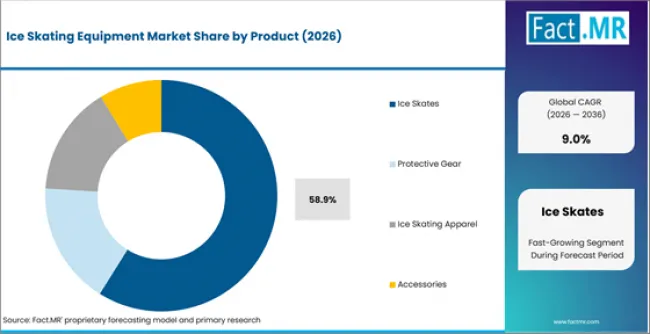
Ice Skating Equipment Market Analysis By Product | Source: Fact.MR
Ice Skates lead the product segment with 58.9% share in 2026, reflecting the foundational role of skates as the essential equipment piece for recreational, competitive, and hockey skating participation.
The segment is expected to retain leadership as skating participation sustains skate procurement. Protective gear, accessories, and rink equipment grow alongside, but ice skates anchor the largest share through their essential-equipment role.
Which Application Segment Dominates the Ice Skating Equipment Market?
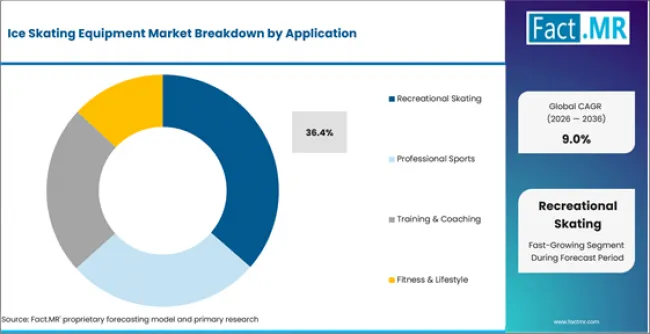
Ice Skating Equipment Market Analysis By Application | Source: Fact.MR
Recreational Skating leads the application segment with 36.4% share in 2026, reflecting the broadest participation base where casual skaters, families, and tourism-driven participants drive equipment purchase and rental volumes.
The application is likely to hold its lead as indoor rink expansion widens recreational access. Figure skating, hockey, and speed skating grow through competitive program enrollment, but recreational skating anchors the largest participation-driven demand channel.
Which Product Trend is Shaping the Next Phase of Growth in the Ice Skating Equipment?
Ice Skates lead the product segment at 58.9%, and the defining dynamic is the split between recreational volume demand for affordable entry-level skates and performance-grade demand from competitive figure skating and hockey where boot and blade technology drive specification. Recreational skating anchors the largest application share, where indoor rink access and winter tourism sustain participation.
Indoor rink expansion is the most consequential structural growth driver. By extending skating access beyond seasonal outdoor conditions and traditional cold-climate markets, indoor facilities create year-round demand in geographies previously outside the ice skating equipment base. Heat-moldable boot technology and advanced blade materials support premium pricing in competitive segments.
Regional Outlook Across Key Markets
- North America leads on ice hockey participation, rink infrastructure, and the presence of major equipment brands.
- Europe demand reflects figure skating and recreational skating culture across northern and central European markets.
- Asia Pacific posts the steepest growth, as indoor rink investment in China and urban centers in Japan and South Korea widen skating access.
- Canada shows the highest per-capita equipment demand driven by hockey culture.
.webp "Top Country Growth Comparison Ice Skating Equipment Market Cagr (2026 2036)")
Top Country Growth Comparison Ice Skating Equipment Market Cagr (2026 2036) | Source: Fact.MR
CAGR Table
| Country | CAGR (%) |
|---|---|
| U.S. | 16.0% |
| China | 11.0% |
| Canada | 10.3% |
| Japan | 8.0% |
| UK | 7.6% |
Source: Fact.MR analysis. Updated Jun 12, 2026
Source: Fact.MR analysis, based on proprietary forecasting model and primary research.
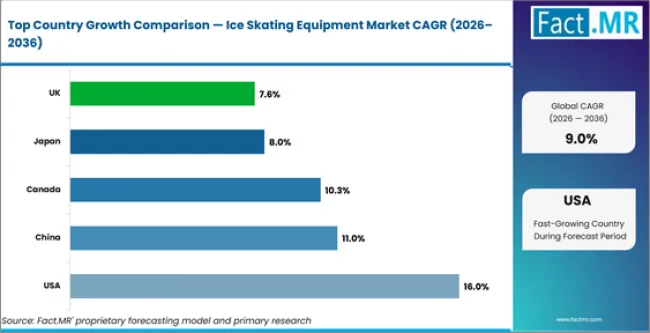
Ice Skating Equipment Market Cagr Analysis By Country | Source: Fact.MR
Market Outlook for Ice Skating Equipment in China
The China Ice Skating Equipment market is projected to grow at a CAGR of 11.0% through 2036. Indoor ice rink investment and growing recreational skating participation, accelerated by post-Winter Olympics interest, are widening equipment demand. Domestic manufacturing provides entry-level skate supply, while urban indoor rink expansion creates year-round market access beyond traditional winter-sport regions.
- Indoor rink investment widens year-round skating equipment demand.
- Post-Winter Olympics interest sustains recreational skating participation growth.
India Ice Skating Equipment Demand Trends
Demand is shaped by emerging indoor rink facilities in metropolitan areas that introduce ice skating to a new consumer base. Cost-effectiveness favors entry-level recreational skates, while ice hockey and figure skating program establishment create incremental performance equipment demand.
- Indoor rink facilities introduce ice skating to metropolitan consumers.
- Ice hockey and figure skating programs create performance equipment demand.
Ice Skating Equipment Growth Assessment in Germany
EU product safety standards and German quality expectations govern skating equipment specification. Figure skating and recreational skating culture sustain demand for mid-range and performance-grade equipment, while indoor rink infrastructure supports year-round participation.
- EU product safety standards govern skating equipment specification.
- Figure skating culture sustains performance-grade equipment demand.
United States Ice Skating Equipment Market Opportunity Outlook
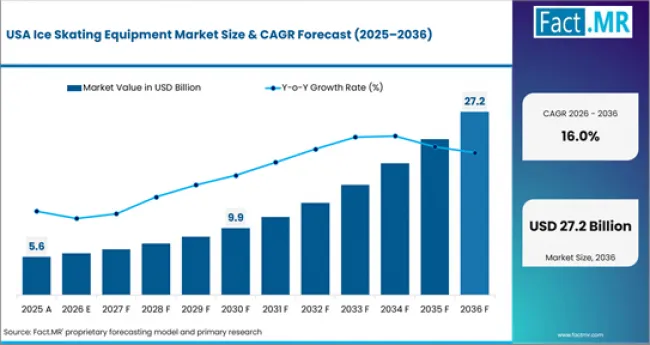
Ice Skating Equipment Market Country Value Analysis | Source: Fact.MR
The United States Ice Skating Equipment market is projected to grow at a CAGR of 16.0% through 2036. The largest ice hockey equipment market and established figure skating culture anchor the broadest skating equipment demand base. Youth hockey participation and recreational skating sustain volume, while competition-grade boot and blade technology support premium pricing in performance segments.
- Youth hockey participation sustains the broadest equipment demand base.
- Competition-grade technology supports premium skating equipment pricing.
Ice Skating Equipment Demand Analysis in Japan
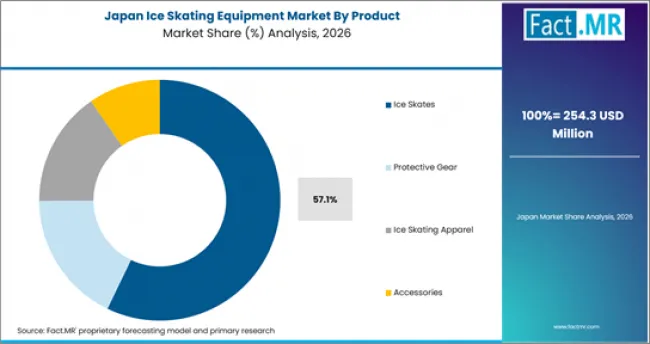
Ice Skating Equipment Market Japan Market Share Analysis By Product | Source: Fact.MR
The Japan Ice Skating Equipment market is projected to grow at a CAGR of 8.0% through 2036. Domestic sporting goods heritage and competitive figure skating culture sustain demand for quality skating equipment. Indoor rink infrastructure supports year-round participation, while consumer preference for performance and quality shapes equipment specification.
- Competitive figure skating culture sustains quality equipment demand.
- Indoor rink infrastructure supports year-round skating participation.
Competitive Benchmarking and Company Positioning
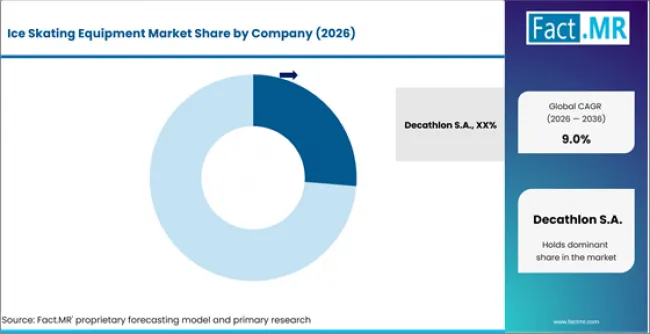
Ice Skating Equipment Market Analysis By Company | Source: Fact.MR
Ice Skating Equipment Analysis By Company
- Bauer and CCM hold leading positions in ice hockey equipment through comprehensive skate, protective gear, and stick portfolios, supported by professional athlete endorsements and established retail and team channel access.
- Jackson Ultima, Riedell, and Edea compete through dedicated figure skating boot and blade portfolios where boot fit precision, blade quality, and competitive skating credibility shape specification preference.
- Heat-moldable boot technology and advanced blade materials increasingly differentiate suppliers as performance customization drives premium purchase decisions.
The competitive landscape splits between ice hockey and figure skating specialists, with Bauer and CCM dominating hockey equipment through brand strength, professional endorsements, and comprehensive product ranges. Jackson Ultima, Riedell, and Edea lead in figure skating through boot precision and competitive credibility.
Below the primary specialists, Graf, Risport, K2, and other brands maintain positions through specific price points, regional distribution, and recreational market access. Competition turns on boot fit, blade quality, and brand credibility rather than price alone.
Performance customization is the competitive frontier. Heat-moldable boots, advanced blade alloys, and anatomical fit systems create premium specification demand among competitive skaters. Brands that combine validated competitive performance with accessible recreational products and strong retail distribution are positioned across both volume and margin segments.
Key Companies in the Ice Skating Equipment
- Leading companies in the ice skating equipment market include Bauer Hockey (Peak Achievement Athletics), CCM Hockey (SIG), Jackson Ultima Skates, Riedell Shoes, Inc., which hold strong positions through portfolio breadth, clinical evidence, and broad distribution.
- Edea S.r.l., Rollerblade (Tecnica Group), Graf Skates AG, Risport Skates maintain established positions across specific segments and channels, competing on assay or product performance, service, and regional reach.
- K2 Sports and other specialists compete through focused offerings and niche strength, reinforcing relevance in a competitive but evolving market.
Recent Industry Developments
- Bauer, Vapor FlyLite Skate Range Launch
- Bauer expanded its 2025 hockey skate range with the Vapor FlyLite line. The skates are positioned for players seeking faster movement, better fit, and stronger on-ice response.
- CCM Hockey, World Para Ice Hockey Equipment Supplier Partnership
- CCM Hockey became the official equipment supplier for World Para Ice Hockey for the 2026 calendar year. Under the partnership, CCM will provide uniforms and equipment for officiating crews at major Para ice hockey events.
- Warrior, Alpha Pro Hockey Skate Market Entry
- Warrior entered the hockey skate category with the Alpha Pro Skate. The product marks Warrior’s move beyond sticks, gloves, and protective gear into player skates.
Leading Companies Shaping the Ice Skating Equipment
- Bauer Hockey (Peak Achievement Athletics)
- CCM Hockey (SIG)
- Jackson Ultima Skates
- Riedell Shoes, Inc.
- Edea S.r.l.
- Rollerblade (Tecnica Group)
- Graf Skates AG
- Risport Skates
- K2 Sports
Sources and Research References
- Bauer Hockey. (2026). BAUER Vapor FlyLite skate senior.
- GearGeek. (2026, April 27). The countdown is on for the Warrior Alpha Pro skates.
- Warrior Sports. (2026). Alpha Pro Skate.
- Willies. (2025, June 25). Bauer’s 2025 ice hockey player skate range.
- World Para Ice Hockey. (2025, November 27). World Para Ice Hockey announces CCM Hockey as its official equipment supplier.
This bibliography is provided for reader reference and is not exhaustive. The full report contains the complete reference list and detailed citations.
Key Questions This Report Addresses
- What is the current and future size of the Ice Skating Equipment Market?
- How fast is the Ice Skating Equipment Market expected to grow between 2026 and 2036?
- Which product segment is likely to lead the market by 2026?
- Which application segment is expected to account for the highest demand by 2026?
- What factors are driving demand in the ice skating equipment market globally?
- Which countries are projected to show the fastest growth through 2036?
- What is driving market expansion in USA and China?
- Who are the key companies active in the ice skating equipment market?
- How is indoor rink expansion widening ice skating equipment demand beyond cold-climate markets?
- What role does competition-grade technology play in premium equipment pricing?
- How does Fact.MR estimate and validate the ice skating equipment market forecast?
Ice Skating Equipment Market Definition
The ice skating equipment market covers ice skates, protective gear, skating accessories, and rink equipment used in recreational skating, figure skating, ice hockey, and speed skating applications. It spans boot construction, blade technology, protective padding, and rink maintenance technologies across recreational skaters, competitive athletes, ice rinks, and sporting goods retailers.
Ice Skating Equipment Market Inclusions
- The scope covers global and regional market size and forecasts for 2026 to 2036 across product type, application, end use, technology, formulation, and distribution channel.
- It includes demand tied to recreational ice skating participation, competitive figure skating and hockey programs, ice rink operations, and winter sports tourism.
- Pricing analysis spans entry-level to competition-grade equipment across specialty retail, sporting goods, and e-commerce channels.
- Coverage includes advanced blade technology, heat-moldable boot systems, and protective equipment innovation.
Ice Skating Equipment Market Exclusions
- The scope excludes inline and roller skating equipment.
- It excludes ice rink construction and building infrastructure.
- General winter apparel without a skating-specific function is excluded.
- Artificial ice and synthetic rink surfaces are excluded.
Ice Skating Equipment Market Research Methodology
- The methodology combines secondary research, primary interviews, and demand-side modeling.
- It draws on 90 plus secondary sources and benchmarks 35 plus brand and equipment portfolios.
- Market sizing covers 30 plus countries through a participation and rink-infrastructure model with top-down validation.
- Key inputs include ice skating participation rates, rink facility counts, competitive program enrollment, and winter sports tourism.
- The model cross-checks demand with equipment shipments, retail sell-through, and brand revenue data.
- Primary validation includes 15 plus interviews across equipment manufacturers, rink operators, retailers, and skating federations.
- Final estimates pass through participation-trend review and sensitivity testing.
Segmentation
Scope of Analysis
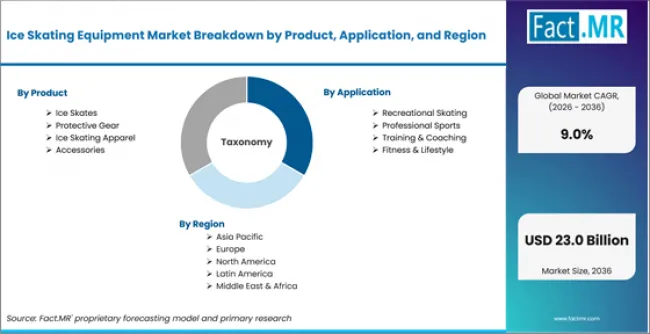
Ice Skating Equipment Market Breakdown By Product, Application, And Region | Source: Fact.MR
| Parameter | Details |
|---|---|
| Quantitative Units | USD 9.7 billion to USD 23.0 billion, at a CAGR of 9.0% |
| Market Definition | The ice skating equipment market covers ice skates, protective gear, ice skating apparel, and accessories. |
| Regions Covered | North America, Latin America, Europe, East Asia, South Asia and Pacific, Middle East and Africa |
| Countries Covered | U.S., China, Canada, Japan, UK, 30 plus countries |
| Key Companies | Bauer Hockey (Peak Achievement Athletics), CCM Hockey (SIG), Jackson Ultima Skates, Riedell Shoes, Inc., Edea S.r.l., Rollerblade (Tecnica Group), Graf Skates AG, Risport Skates, K2 Sports |
| Forecast Period | 2026 to 2036 |
| Approach | Hybrid demand-side and top-down methodology built on country-level demand, product and assay benchmarking, pricing analysis, shipment validation, and primary interviews across providers, laboratories, distributors, and end users |
Source: Fact.MR analysis. Updated Jun 12, 2026
Ice Skating Equipment Segmentation
-
Ice Skating Equipment Market Segmented by Product:
- Ice Skates
- Figure Skates
- Recreational Figure Skates
- Professional Figure Skates
- Hockey Skates
- Competitive Hockey Skates
- Recreational Hockey Skates
- Figure Skates
- Protective Gear
- Helmets
- Ventilated Ice Helmets
- Impact Resistant Helmets
- Pads
- Knee Protection Pads
- Elbow Protection Pads
- Helmets
- Ice Skating Apparel
- Thermal Clothing
- Insulated Jackets
- Thermal Leggings
- Performance Wear
- Aerodynamic Suits
- Stretchable Training Wear
- Thermal Clothing
- Accessories
- Blade Maintenance Tools
- Sharpening Kits
- Blade Covers
- Training Aids
- Balance Trainers
- Practice Supports
- Blade Maintenance Tools
- Ice Skates
-
Ice Skating Equipment Market Segmented by Application:
- Recreational Skating
- Indoor Rinks
- Mall Ice Rinks
- City Recreational Rinks
- Outdoor Skating
- Frozen Lakes Skating
- Seasonal Ice Parks
- Indoor Rinks
- Professional Sports
- Ice Hockey Leagues
- Junior Hockey Leagues
- Professional Hockey Leagues
- Figure Skating Competitions
- National Championships
- International Championships
- Ice Hockey Leagues
- Training & Coaching
- Skating Academies
- Beginner Training Centers
- Elite Training Institutes
- Sports Coaching Programs
- Private Coaching Sessions
- Group Training Programs
- Skating Academies
- Fitness & Lifestyle
- Fitness Skating Programs
- Cardio Skating Sessions
- Weight Management Skating
- Recreational Fitness Centers
- Community Fitness Rinks
- Indoor Fitness Studios
- Fitness Skating Programs
- Recreational Skating
-
Ice Skating Equipment Market Segmented by End Use:
- Sports Clubs & Academies
- Ice Skating Clubs
- Amateur Skating Clubs
- Professional Skating Clubs
- Sports Training Academies
- Youth Training Academies
- Elite Performance Academies
- Ice Skating Clubs
- Individual Consumers
- Recreational Users
- Casual Skaters
- Hobby Enthusiasts
- Professional Athletes
- Competitive Skaters
- Sponsored Athletes
- Recreational Users
- Educational Institutions
- Schools & Colleges
- Sports Education Programs
- Physical Education Departments
- Sports Universities
- Athletic Training Institutes
- Research Sports Programs
- Schools & Colleges
- Entertainment Venues
- Ice Shows & Events
- Live Ice Performances
- Touring Ice Shows
- Amusement Parks
- Winter Theme Parks
- Indoor Entertainment Rinks
- Ice Shows & Events
- Sports Clubs & Academies
-
Ice Skating Equipment Market Segmented by Technology:
- Blade Engineering Technology
- Precision Blade Design
- Carbon Steel Blade Systems
- Stainless Steel Blade Systems
- Edge Enhancement Technology
- Micro Groove Blades
- High Grip Edge Systems
- Precision Blade Design
- Thermal Control Technology
- Cold Resistance Materials
- Insulated Boot Technology
- Thermal Retention Liners
- Heat Adaptive Materials
- Temperature Responsive Linings
- Moisture Control Systems
- Cold Resistance Materials
- Impact Protection Technology
- Shock Absorption Systems
- Foam Based Impact Layers
- Gel Cushioning Systems
- Structural Reinforcement
- Carbon Fiber Reinforcement
- Composite Shell Technology
- Shock Absorption Systems
- Performance Optimization Tech
- Motion Efficiency Systems
- Low Friction Blade Coatings
- Energy Transfer Optimization
- Balance Control Systems
- Stability Enhancement Frames
- Posture Correction Designs
- Motion Efficiency Systems
- Blade Engineering Technology
-
Ice Skating Equipment Market Segmented by Formulation:
- Composite Material Systems
- Fiber Reinforced Composites
- Carbon Fiber Blends
- Glass Fiber Blends
- Polymer Composite Systems
- Thermoplastic Composites
- Thermoset Composites
- Fiber Reinforced Composites
- Foam Based Systems
- High Density Foams
- Shock Absorbing Foam Layers
- Thermal Insulation Foams
- Lightweight Foam Systems
- Flexible Cushion Foams
- Elastic Support Foams
- High Density Foams
- Metal Alloy Systems
- Stainless Steel Alloys
- Corrosion Resistant Alloys
- High Strength Alloys
- Carbon Steel Alloys
- Hardened Steel Structures
- Precision Cut Steel Components
- Stainless Steel Alloys
- Hybrid Material Systems
- Multi Layer Structures
- Composite Hybrid Skates
- Reinforced Apparel Systems
- Adaptive Material Systems
- Temperature Adaptive Layers
- Performance Responsive Materials
- Multi Layer Structures
- Composite Material Systems
-
Ice Skating Equipment Market Segmented by Distribution Channel:
- Sporting Goods Retailers
- Specialty Sports Stores
- Ice Sports Equipment Stores
- Professional Skating Stores
- General Sports Retail Chains
- Multi Brand Sports Outlets
- Urban Sports Stores
- Specialty Sports Stores
- Online Retail Platforms
- E Commerce Marketplaces
- Global Sports E Commerce Sites
- Regional Online Sports Stores
- Brand Owned Online Stores
- Direct Manufacturer Websites
- Exclusive Brand Portals
- E Commerce Marketplaces
- Sports Equipment Distributors
- Regional Distributors
- Local Sporting Goods Distributors
- Ice Equipment Supply Networks
- National Distributors
- Large Scale Equipment Suppliers
- Multi State Distribution Networks
- Regional Distributors
- Institutional Sales Channels
- Sports Academies Procurement
- Training Institute Contracts
- Club Level Bulk Purchases
- Government Sports Procurement
- Public Sports Facility Tenders
- Educational Institution Supply Contracts
- Sports Academies Procurement
- Sporting Goods Retailers
-
Ice Skating Equipment Market by Region:
- North America
- USA
- Canada
- Mexico
- Latin America
- Brazil
- Chile
- Rest of Latin America
- Western Europe
- Germany
- UK
- Italy
- Spain
- France
- Nordic
- BENELUX
- Rest of Western Europe
- Eastern Europe
- Russia
- Poland
- Hungary
- Balkan & Baltic
- Rest of Eastern Europe
- East Asia
- China
- Japan
- South Korea
- South Asia and Pacific
- India
- ASEAN
- Australia & New Zealand
- Rest of South Asia and Pacific
- Middle East & Africa
- Kingdom of Saudi Arabia
- Other GCC Countries
- Turkiye
- South Africa
- Other African Union
- Rest of Middle East & Africa
- North America
Frequently Asked Questions
How big is the ice skating equipment market in 2026?
What will be the size of ice skating equipment market in 2036?
How much will be the ice skating equipment market growth between 2026 and 2036?
What are the key product in the ice skating equipment market?
Which application segment is expected to contribute significant share in the ice skating equipment market in 2026?
Who worked on this report


Preview the report firsthand - request a free sample
Free SampleGet the brochure for pricing and purchase details
Download PDF