- Base Value(2025): 10.5 Bn
- Forecast Value (2036): 15.1 Bn
- CAGR (2036): 3.3%
Yoga Equipment Market Forecast and Outlook by FACT.MR
- The yoga equipment market was valued at USD 10.5 billion in 2025.
- Based on Fact.MR analysis, revenue is estimated at USD 10.9 billion in 2026 and projected to reach USD 15.1 billion by 2036.
- Fact.MR projects a 3.3% CAGR during the forecast period.
- The market is set to create an incremental revenue opportunity of USD 4.2 billion between 2026 and 2036.
- Sales growth is steady as yoga equipment remains part of health routines and low-cost home fitness.
- Higher rubber and cork prices can slow demand in price-sensitive retail.
- Manufacturers that improve mat texture and odor control can gain repeat sales during replacement cycles.
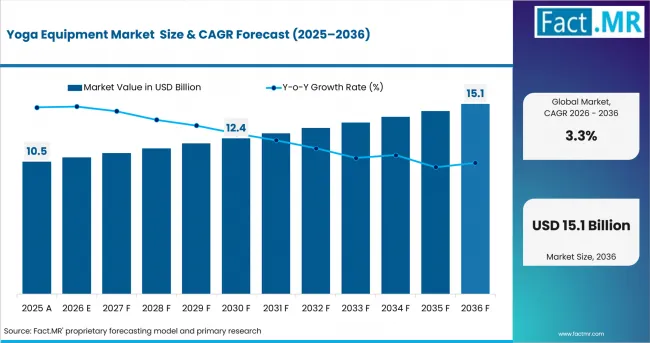
Yoga Equipment Market Value Analysis | Source: Fact.MR
Summary of yoga equipment market
- Demand Drivers
- Home practice is increasing repeat purchases for mats and simple props. Consumers often start with a mat and add blocks or belts as routines become more structured.
- Studio and fitness center classes support replacement cycles for mats and bolsters. Shared-use products wear faster and need better grip.
- Material labeling is shaping consumer choice in specialty stores. Retailers use PVC and rubber options to separate basic mats from higher-priced ranges.
- Key Segments Analyzed
- By Product Type: Yoga mats hold 42.6% share in 2026 as nearly every yoga routine requires a personal surface for grip and comfort.
- By Material: PVC products account for 39.2% share in 2026 because low pricing and wide retail supply support first-time consumer purchases.
- By End User: Household users hold 62.7% share in 2026 as home practice keeps equipment purchases tied to daily wellness routines.
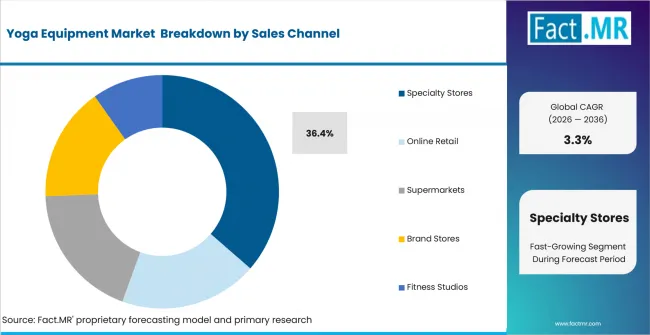
- By Sales Channel: Specialty stores capture 36.4% share in 2026 since consumers compare grip and mat thickness before purchase.
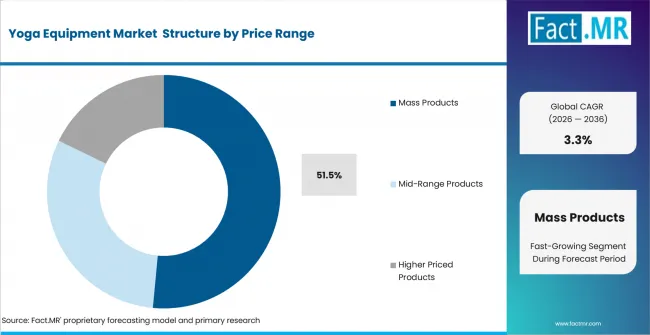
- By Price Range: Mass products account for 51.5% share in 2026 as entry-level mats and belts suit first-time consumers.
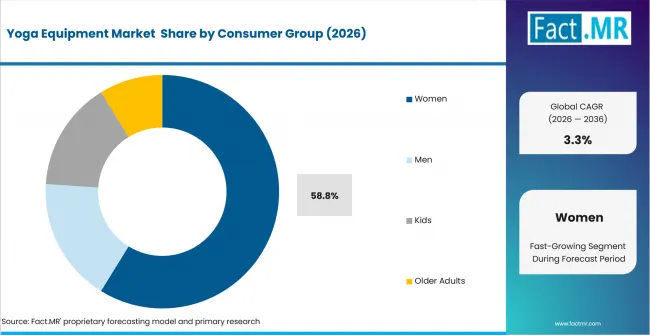
- By Consumer Group: Women hold 58.8% share in 2026 as class-based practice and guided home routines support repeat accessory purchases.
- Analyst Opinion at Fact.MR
- Shambhu Nath Jha, Principal Consultant at Fact.MR, opines, “Yoga equipment revenue will move toward home practice kits and material-graded mats. Higher-margin demand will come from products with better grip and simple retail claims.”
- Strategic Implications
- Manufacturers should improve mat grip and odor control. These factors affect repeat purchases more than design alone.
- Retailers should separate basic mats from material-graded mats in stores and online pages. Clear tiers help reduce price comparison across similar foam products.
- Suppliers should offer bundles with mats and belts. This can raise order value among first-time yoga users.
| Metric | Value |
|---|---|
| Estimated Value in 2026 | USD 10.9 billion |
| Forecast Value in 2036 | USD 15.1 billion |
| Forecast CAGR (2026 to 2036) | 3.3% |
Source: Fact.MR analysis. Updated Jun 9, 2026
India leads at 5.6% CAGR through 2036 as public yoga programs and studio expansion support entry-level product demand. China follows at 4.6% with fitness retail growth and local sports goods output. The United States records 3.5% as retail channels and class-based fitness routines support repeat purchases. The United Kingdom advances at 3.2% as active adult participation supports studio and home use. Germany expands at 3.0% through club-based training and material-aware consumers. Canada records 2.9% as activity programs support steady wellness spending. Japan grows at 2.7% as older consumers favor low-impact exercise routines.
Segmental Analysis
Yoga Equipment Market Analysis by Product Type
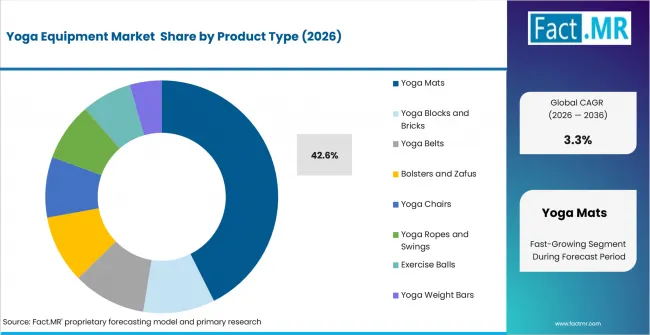
Yoga Equipment Market Analysis By Product Type | Source: Fact.MR
Yoga mats are expected to account for 42.6% of product type revenue in 2026 as regular practice needs grip and comfort. The share reflects steady mat replacement in home practice and studio classes. Personal exercise mats offer a useful benchmark for foam thickness and surface texture choices. Belts and blocks follow as add-on products once users move beyond basic routines.
- Yoga Mat Replacement: Mat replacement comes from surface wear and odor issues. Manufacturers gain repeat sales from mats that keep grip during daily use.
- Support Prop Bundling: Blocks and belts increase first-order value. Beginner kits turn one mat purchase into a full home practice set.
- Studio Product Rotation: Studios buy mats and bolsters in batches because shared products wear faster during classes and cleaning.
Yoga Equipment Market Analysis by Material
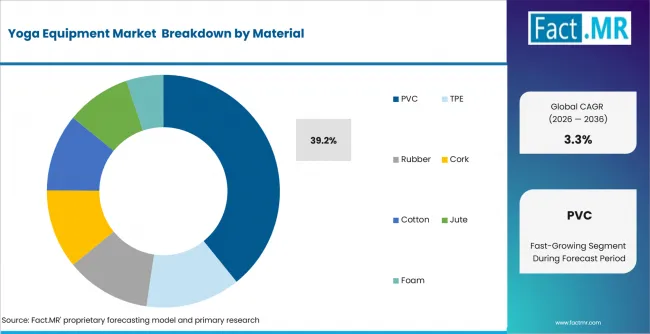
Yoga Equipment Market Analysis By Material | Source: Fact.MR
PVC products are expected to account for 39.2% of material revenue in 2026 as low price and wide supply suit first-time consumers. The share reflects high demand for budget products in supermarkets and online stores. Rubber and cork products attract users who want better grip and surface feel. Material claims need proof through texture and odor control during repeated practice.
- PVC Volume Strength: PVC mats keep high unit sales as entry prices let retailers stock many colors and thickness levels.
- Rubber Upgrade Demand: Rubber mats appeal to regular users who want better grip and floor stability after basic foam mats wear out.
- Cork and Cotton Positioning: Cork and cotton products create higher ticket options for users who prefer a natural feel over low-cost foam.
Yoga Equipment Market Analysis by End User
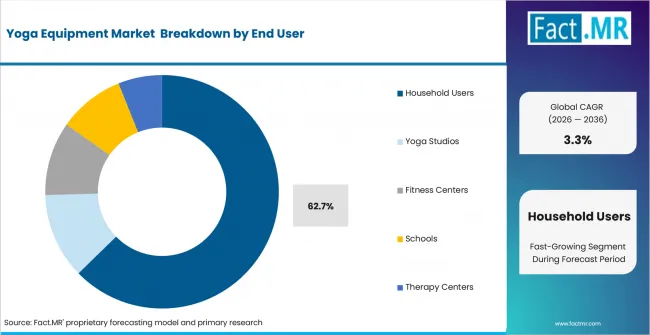
Yoga Equipment Market Analysis By End User | Source: Fact.MR
Household users are expected to account for 62.7% of end user revenue in 2026 as home practice keeps equipment within personal wellness budgets. The share reflects low setup cost and practice without studio fees. Functional fitness equipment shows a similar shift toward home workout accessories. Studios and fitness centers continue to support bulk purchases for shared use.
- Home Routine Pull: Households buy mats and simple props as starter products. Worn mats are replaced as daily practice increases surface wear.
- Studio Batch Orders: Yoga studios buy bolsters and straps in sets. This supports steady replacement across class schedules and instructor-led sessions.
- Fitness Center Cross-Use: Fitness centers use yoga props for stretching areas and recovery classes. This connects yoga products with general training floors.
Yoga Equipment Market Analysis by Sales Channel
Yoga Equipment Market Analysis By Sales Channel | Source: Fact.MR
Specialty stores are expected to account for 36.4% of sales channel revenue in 2026 as consumers prefer to check grip and thickness before purchase. The share reflects the need to feel mat texture and test prop density. Sports equipment sales show that specialist outlets still matter for products that need touch-based selection. Online retail gains share after consumers know their preferred brand and size.
- Specialty Store Role: Specialty stores work well for higher priced mats as staff explain thickness and care needs in simple terms.
- Online Repeat Flow: Online retail supports repeat mat purchases once consumers know the preferred brand and size.
- Studio Direct Sales: Studios sell mats and belts to new members through class enrollment and instructor advice.
Yoga Equipment Market Analysis by Price Range
Yoga Equipment Market Analysis By Price Range | Source: Fact.MR
Mass products are expected to account for 51.5% of price range revenue in 2026 as entry mats and belts keep yoga affordable. The share reflects high unit sales in basic foam products and starter kits. Higher priced products use rubber and cork materials to attract repeat users. Low-impact studio routines create overlap in demand for mats, support props, and balance-focused accessories.
- Entry Price Pull: Mass products sell quickly through stores and online channels as consumers test yoga at a low cost.
- Mid-Tier Upgrade: Mid-priced mats benefit as users replace thin starter mats after grip loss and surface cracking.
- Higher Priced Range: Higher priced products need clear material claims and longer use life to justify the price gap over PVC mats.
Yoga Equipment Market Analysis by Consumer Group
Yoga Equipment Market Analysis By Consumer Group | Source: Fact.MR
Women are expected to account for 58.8% of consumer group revenue in 2026 as class-based practice and guided home routines support higher accessory use. The share reflects stronger use of yoga classes and posture support products. Pilates equipment shows a close consumer overlap in low-impact studio routines. Men and older adults add sales through mobility and stretching products.
- Women’s Practice Frequency: Women support repeat purchases in mats and support props as studio classes and online instruction build regular routines.
- Men’s Mobility Use: Men add demand through stretching and recovery routines that use mats with blocks and straps after strength training.
- Older Adult Comfort Need: Older adults prefer thicker mats and posture props as low-impact movement supports balance and flexibility.
Drivers, Restraints, and Opportunities
Yoga Equipment Market Opportunity Matrix Growth Vs Value | Source: Fact.MR
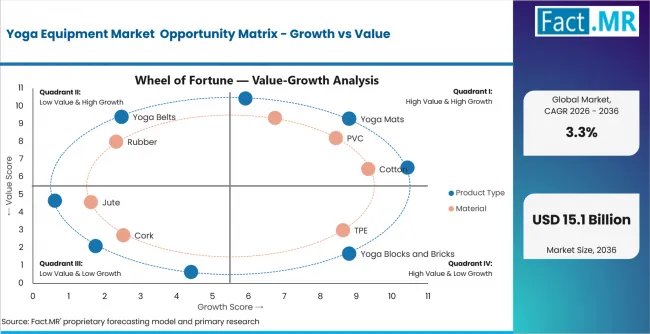
The yoga equipment market grows steadily as personal wellness spending moves toward low-entry home products. World Health Organization data released in June 2024 reported that 31% of adults did not meet recommended physical activity levels [1]. This keeps light fitness products within public health and household wellness discussions. Yoga mats and belts benefit as they need little space and no heavy equipment.
Demand is supported by mat replacement and studio replenishment. The gym equipment field has a heavier capital cycle, but yoga equipment depends on lower priced repeat units. Suppliers use online fitness services to guide home routines and support product bundles. The main restraint is low product difference in basic foam mats.
- Driver: Home practice kits raise order value as retailers combine mats with blocks and towels for structured routines.
- Restraint: Low-cost foam mats create price pressure as consumers compare similar products online and choose lower prices.
- Opportunity: Material-graded mats and posture props help manufacturers serve repeat users who need grip and support.
Regional Analysis
The yoga equipment market is assessed across North America, Europe, Asia Pacific, Latin America and the Middle East and Africa. The study covers 40+ country-level demand by product type, material, end user, sales channel, price range and consumer group. The full report includes market attractiveness analysis by region and country.
.webp "Top Country Growth Comparison Yoga Equipment Market Cagr (2026 2036)")
Top Country Growth Comparison Yoga Equipment Market Cagr (2026 2036) | Source: Fact.MR
| Country | CAGR (2026 to 2036) |
|---|---|
| India | 5.6% |
| China | 4.6% |
| United States | 3.5% |
| United Kingdom | 3.2% |
| Germany | 3.0% |
| Canada | 2.9% |
| Japan | 2.7% |
Source: Fact.MR analysis. Updated Jun 9, 2026
Source: Fact.MR analysis, based on proprietary forecasting model and primary research
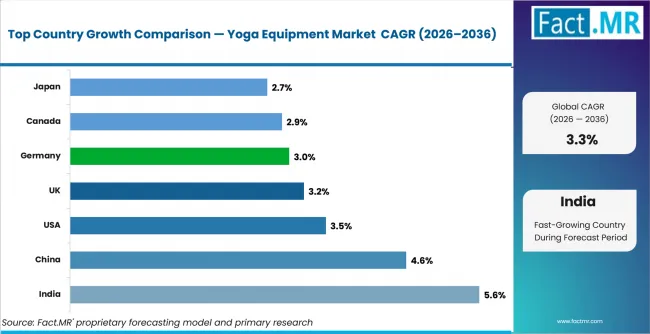
Yoga Equipment Market Cagr Analysis By Country | Source: Fact.MR
Asia Pacific Yoga Equipment Market Analysis
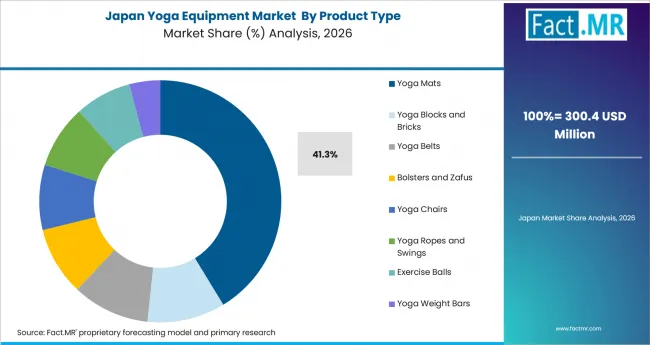
Yoga Equipment Market Japan Market Share Analysis By Product Type | Source: Fact.MR
Asia Pacific records the fastest regional expansion for yoga equipment. Public yoga programs and local sports goods production support access to low-priced mats. Fitness retail in China and India creates a large channel for starter kits and material-graded mats.
- India: India is projected to record 5.6% CAGR through 2036 as national yoga promotion and studio activity keep starter product purchases active. A Government of India feature in June 2025 stated that 24.53 crore people joined International Day of Yoga celebrations in 2024 [3]. This scale supports mass-market mat and belt sales through stores and wellness centers.
- China: China is expected to expand at 4.6% CAGR by 2036 as local sports goods output supports low-priced mats and accessories. The National Bureau of Statistics of China and the General Administration of Sport of China reported sports goods manufacturing value added of CNY 424.5 billion in 2024 [4]. Local production helps suppliers serve domestic retail and export orders.
- Japan: Japan is forecast to rise at 2.7% CAGR from 2026 to 2036 as low-impact exercise suits older consumers and compact homes. The Sasakawa Sports Foundation reported 4.19 million estimated yoga participants in Japan in December 2024 [5]. This user base supports demand for thicker mats and balance-support props.
North America Yoga Equipment Market Analysis
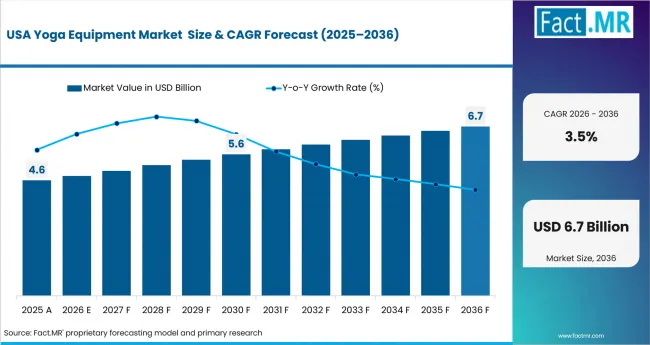
Yoga Equipment Market Country Value Analysis | Source: Fact.MR
North America is a large replacement market for yoga mats and support accessories. Specialty fitness stores and online channels serve repeat users who already know their preferred thickness and material. Home practice and paid classes both support accessory sales.
- United States: The United States is projected to record 3.5% CAGR by 2036 as sports participation keeps wellness products in mainstream retail. The Sports & Fitness Industry Association reported in March 2026 that 250 million Americans took part in at least one sport, fitness, or leisure activity in 2025 [2]. This supports replacement sales for mats and low-cost props.
- Canada: Canada is expected to advance at 2.9% CAGR through 2036 as adult activity programs support steady wellness spending. Statistics Canada reported in October 2025 that 46% of adults met recommended physical activity levels during 2022 to 2024 [6]. Retailers can use this active adult base to sell mat upgrades and home practice bundles.
Europe Yoga Equipment Market Analysis
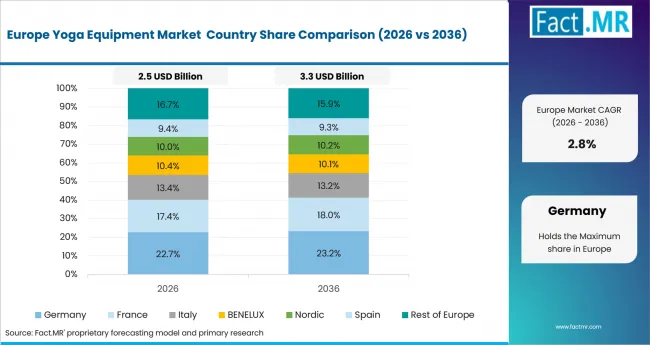
Yoga Equipment Market Europe Country Market Share Analysis, 2026 & 2036 | Source: Fact.MR
Europe shows steady yoga equipment demand through fitness clubs and specialty retail. Material claims and product durability matter in Germany and the United Kingdom. Consumers often compare mat grip and texture before moving from basic foam products to better-grade mats.
- United Kingdom: The United Kingdom is forecast to rise at 3.2% CAGR from 2026 to 2036 as active adults support paid classes and home practice. Sport England reported in April 2025 that 30 million adults in England met weekly activity guidance during November 2023 to November 2024 [7]. This participation base supports yoga mats and props through specialty fitness retail.
- Germany: Germany is expected to rise at 3.0% CAGR by 2036 as fitness club activity and material-aware consumers support higher-grade mats. European Commission sport research in September 2024 found improved health at 54% and fitness at 47% as leading reasons for physical activity [8]. These reasons support yoga as a low-impact fitness routine.
Competitive Aligners for Market Players
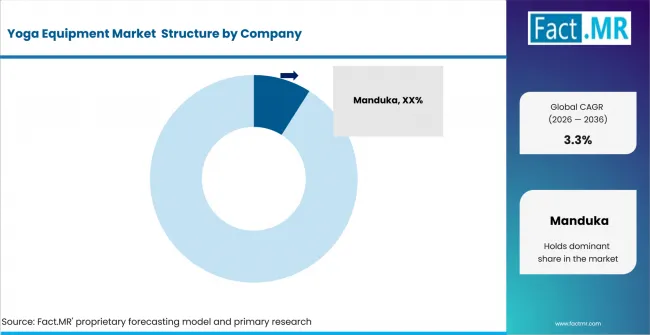
Yoga Equipment Market Analysis By Company | Source: Fact.MR
Yoga equipment manufacturers need clear material claims and repeat purchase trust. Products with steady grip and better odor control stand out in specialty stores. Brands gain value by explaining thickness and surface feel in simple retail language. Mat suppliers perform better if they prove wear performance without making entry prices too high.
Home practice creates a different sales path from studio demand. Home users often buy starter kits online. Studios need durable mats and bolsters that can handle cleaning and daily class use. Companies with bundles and steady stock availability have an advantage in both channels.
Other fitness formats influence product design and retail placement. Connected sports gear shows rising interest in guided activity tools. Aqua gym equipment shows how low-impact products can reach older users. Yoga suppliers can use the same comfort-led message for thicker mats and aided posture props.
Regional expansion in India and China is practical for mid-priced products. Local suppliers can reduce delivery time and support large retail programs. Global brands need clear material claims and consistent quality control to defend higher prices. The best competitive position comes from product proof and easy product choice.
Key Players
- Manduka
- Lululemon Athletica
- Alo Yoga
- JadeYoga
- Gaiam
- Decathlon
- Nike
- Adidas AG
Bibliography
- [1] World Health Organization. (2024, June 26). Physical activity.
- [2] Sports & Fitness Industry Association. (2026, March 12). Participation hits new high, but majority of Americans not yet meeting recommended guidelines of weekly activity, SFIA’s 2026 Topline Report finds.
- [3] Press Information Bureau. (2025, June 19). International Day of Yoga 2025. Government of India.
- [4] National Bureau of Statistics of China, & General Administration of Sport of China. (2025, December 31). Announcement on total scale and value-added data of the national sports industry in 2024.
- [5] Sasakawa Sports Foundation. (2024, December 31). The 2024 SSF National Sports-Life Survey: Executive summary.
- [6] Statistics Canada. (2025, October 17). Directly measured physical activity and sedentary time in Canada: New results from the Canadian Health Measures Survey, 2022 to 2024.
- [7] Sport England. (2025, April 24). Record numbers playing sport and taking part in physical activity.
- [8] European Commission. (2024, September 20). New Eurobarometer on sport and physical activity.
This Report Addresses
- Strategic demand analysis for yoga equipment across household users, yoga studios and fitness centers globally.
- Market forecast from USD 10.9 billion in 2026 to USD 15.1 billion by 2036 at 3.3% CAGR.
- Opportunity mapping across India, China, the United States, the United Kingdom, Germany, Canada and Japan.
- Segment analysis by product type, material, end user, sales channel, price range and consumer group through 2036.
- Competitive analysis of Manduka, Lululemon Athletica, Alo Yoga, JadeYoga, Gaiam, Decathlon, Nike and Adidas AG.
- Consumer behavior analysis covering home practice kits, studio replacement cycles and material graded mat demand.
- Report delivery in PDF, Excel and presentation formats supported by brand catalogs, retail checks and fitness industry interviews.
Yoga Equipment Market Definition
The yoga equipment market covers physical products used for yoga practice across homes, studios and fitness spaces. Product scope includes yoga mats, blocks and bricks. It also includes yoga belts, bolsters and zafus, yoga chairs, yoga ropes and swings, exercise balls, and Yoga Weight Bars. These products support grip and comfort during regular practice. They also support posture assistance and aided movement for therapy or low-impact routines.
Yoga Equipment Market Market Inclusions
Covers global and regional market forecasts from 2026 to 2036 by product type, material, end user, sales channel, price range, consumer group, and region. Includes yoga mats and support props across PVC, TPE, rubber, cork, cotton, jute, and foam materials. Covers household users, yoga studios, fitness centers, schools and therapy centers. Includes sales through specialty stores, online retail, supermarkets, brand stores and fitness studios.
Yoga Equipment Market Exclusions
Excludes general gym equipment not directly used for yoga practice. Omits apparel, footwear, digital subscriptions and wellness services unless sold as part of a yoga equipment bundle. Excludes medical rehabilitation devices where yoga is not the direct product application. Excludes furniture or home décor items that do not support yoga practice, posture support or aided movement.
Yoga Equipment Market Research Methodology
- Primary Research
- Interviews with yoga studio operators, fitness center managers, specialty retail buyers, online channel sellers and yoga equipment brand managers across the United States, Germany, India, China, Japan and Canada.
- Desk Research
- Analysis of Manduka, Lululemon Athletica, Alo Yoga, JadeYoga, Gaiam, Decathlon, Nike and Adidas AG product ranges. Supplemented by physical activity data, sports participation reports, yoga participation studies and fitness retail indicators from public agencies and industry bodies.
- Market-Sizing and Forecasting
- Hybrid model combining top-down fitness equipment spending estimates with bottom-up product demand projections by end user and sales channel. Average selling prices by product type, material and price range are modeled independently and aggregated across all regions.
- Data Validation and Update Cycle
- Validated through brand catalogs, retail price checks, distributor interviews, fitness participation datasets and studio replacement cycle inputs. Updated annually with changes in yoga participation, material pricing, product launches and channel-level sales patterns.
Segmentation
Scope of the Report
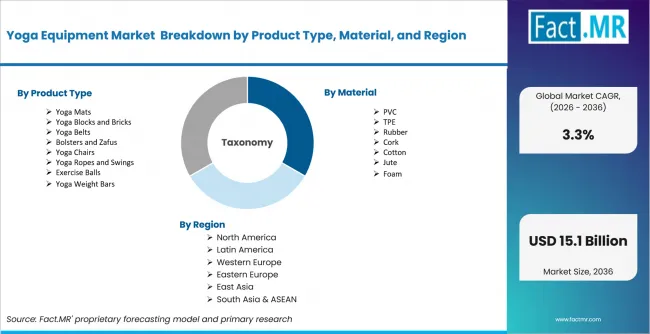
Yoga Equipment Market Breakdown By Product Type, Material, And Region | Source: Fact.MR
| Attribute | Details |
|---|---|
| Quantitative Units | USD 10.9 billion in 2026 to USD 15.1 billion by 2036 at 3.3% CAGR |
| Market Definition | Physical products used for yoga practice at home and in paid instruction spaces. Product scope includes yoga mats, blocks, belts, bolsters, chairs, ropes, swings, exercise balls, and yoga weight bars. |
| Product Type Segmentation | Yoga Mats, Yoga Blocks and Bricks, Yoga Belts, Bolsters and Zafus, Yoga Chairs, Yoga Ropes and Swings, Exercise Balls, Yoga Weight Bars |
| Material Segmentation | PVC, TPE, Rubber, Cork, Cotton, Jute, Foam |
| End User Segmentation | Household Users, Yoga Studios, Fitness Centers, Schools, Therapy Centers |
| Sales Channel Segmentation | Specialty Stores, Online Retail, Supermarkets, Brand Stores, Fitness Studios |
| Price Range Segmentation | Mass Products, Mid-Range Products, Higher Priced Products |
| Consumer Group Segmentation | Women, Men, Kids, Older Adults |
| Regions Covered | North America, Europe, Asia Pacific, Latin America, Middle East and Africa |
| Countries Covered | United States, Canada, Mexico, Germany, United Kingdom, France, Italy, Spain, Netherlands, China, Japan, South Korea, India, ASEAN, Australia and New Zealand, Brazil, Saudi Arabia, GCC, Turkey, South Africa |
| Key Companies Profiled | Manduka, Lululemon Athletica, Alo Yoga, JadeYoga, Gaiam, Decathlon, Nike, Adidas AG |
| Forecast Period | 2026 to 2036 |
| Approach | Hybrid top-down and bottom-up model using fitness equipment spending and yoga participation signals. Retail pricing checks and distributor interviews support validation. |
Source: Fact.MR analysis. Updated Jun 9, 2026
Yoga Equipment Market by Segment
-
By Product Type
- Yoga Mats
- Yoga Blocks and Bricks
- Yoga Belts
- Bolsters and Zafus
- Yoga Chairs
- Yoga Ropes and Swings
- Exercise Balls
- Yoga Weight Bars
-
By Material
- PVC
- TPE
- Rubber
- Cork
- Cotton
- Jute
- Foam
-
By End User
- Household Users
- Yoga Studios
- Fitness Centers
- Schools
- Therapy Centers
-
By Sales Channel
- Specialty Stores
- Online Retail
- Supermarkets
- Brand Stores
- Fitness Studios
-
By Price Range
- Mass Products
- Mid-Range Products
- Higher Priced Products
-
By Consumer Group
- Women
- Men
- Kids
- Older Adults
-
By Region
- North America
- United States
- Canada
- Mexico
- Western Europe
- Germany
- United Kingdom
- France
- Italy
- Spain
- Netherlands
- East Asia
- China
- Japan
- South Korea
- South Asia and Pacific
- India
- ASEAN
- Australia and New Zealand
- Middle East and Africa
- Saudi Arabia
- Other GCC Countries
- Turkey
- South Africa
- North America
Frequently Asked Questions
What is the present outlook for the yoga equipment market?
What is the evaluated growth forecast for yoga equipment sales?
What is the approximate growth rate in the forecast duration?
Which region is evaluated to dominate in sales of yoga equipment?
Who are the key players in the global market?
Who worked on this report


Preview the report firsthand - request a free sample
Free SampleGet the brochure for pricing and purchase details
Download PDF