- Base Value(2025): 416.3 Mn
- Estimated Value(2025): 416.3 Mn
- Forecast Value (2035): 726.9 Mn
- CAGR (2025 - 2035): 5.7%
Propylene Carbonate Market Forecast and Outlook 2025 to 2035
The global propylene carbonate market is projected to grow from USD 416.3 million in 2025 to approximately USD 726.9 million by 2035, recording an absolute increase of USD 310.6 million over the assessment period. This expansion represents total growth of 74.6% and a compound annual growth rate of 5.7%.
The market size is expected to reach nearly 1.7 times its 2025 level, supported by increasing demand for environmentally responsible solvent systems, wider adoption of lithium-ion battery technologies, and continued emphasis on sustainable chemical production practices across global industrial operations. Broader utilisation of propylene carbonate is influenced by its favourable solvency characteristics, low toxicity profile, and compatibility with a wide range of chemical processes.
Quick Stats for Propylene Carbonate Market
- Propylene Carbonate Market Value (2025): USD 416.3 million
- Propylene Carbonate Market Forecast Value (2035): USD 726.9 million
- Propylene Carbonate Market Forecast CAGR: 5.7%
- Leading Application in Propylene Carbonate Market: Solvent (37.5%)
- Key Growth Regions in Propylene Carbonate Market: Asia Pacific, Europe, and North America
- Key Players in Propylene Carbonate Market: BASF SE (14.5%), LyondellBasell Industries (11.2%), Shandong Depu Chemical (10.8%), Empower Materials (9.0%), Huntsman International LLC. (8.5%), Dhalop Chemicals (7.6%), Tokyo Chemical Industry Co., Ltd. (6.8%), Linyi Evergreen Chemical Co., Ltd. (5.7%), Central Drug House (5.1%), Carl Roth (3.9%)
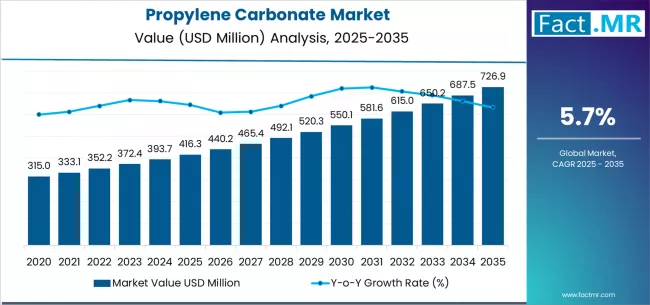
Propylene Carbonate Market Market Value Analysis | Source: Fact.MR
Solvent applications account for 37.5% of the market, reflecting the importance of propylene carbonate in paints, coatings, and related formulations requiring strong solvency power and controlled evaporation behaviour. Its properties as a polar aprotic solvent make it suitable for systems requiring high dissolving capability and stable performance across varied operating conditions. These characteristics support its integration into applications where low vapour pressure, reduced environmental impact, and performance reliability are essential.
Adoption across other segments remains substantial, influenced by specialised needs in pharmaceutical synthesis, polymer processing, and electrochemical applications where specific reactivity and compatibility requirements guide material selection. Advances in production efficiency, purification techniques, and sustainable processing methods contribute to improved product quality and cost stability across supply chains.
The end-use trends show paints and coatings holding 27.2% of market demand, shaped by ongoing formulation development and the need to comply with volatile organic compound reduction guidelines. Propylene carbonate remains important in systems designed to minimise emissions while maintaining coating uniformity, adhesion properties, and curing performance.
Its dissolving capacity, thermal stability, and biodegradability align with regulatory expectations in regions emphasising reduced environmental impact within industrial and consumer-facing products. Other end-use sectors exhibit distinct chemical performance requirements, reflecting the broad utilisation of propylene carbonate across manufacturing and processing industries.
Regional growth patterns are influenced by industrial development trajectories and regulatory frameworks. Asia Pacific continues to expand manufacturing capacity in chemicals, electronics, and energy storage sectors, supporting strong demand for propylene carbonate in both volume-driven and specialised applications.
North America and Europe maintain stringent environmental standards that encourage adoption of greener solvent alternatives and improved process efficiency across industrial facilities. The global shift toward sustainable chemistry, combined with rapid industrialisation in developing economies, creates balanced growth prospects that support expansion of both commodity-grade and high-purity propylene carbonate products through the forecast period.
Between 2025 and 2030, the propylene carbonate market is projected to expand from USD 416.3 million to USD 550.2 million, resulting in a value increase of USD 133.9 million, which represents 43.1% of the total forecast growth for the decade. This phase of development will be shaped by rising demand for sustainable solvent solutions, increasing applications in lithium-ion battery electrolytes, and growing penetration in pharmaceutical and cosmetic formulations. Industrial manufacturers are expanding their propylene carbonate utilization to address the growing demand for environmentally compliant and performance-optimized chemical intermediates in various industrial applications and production categories.
From 2030 to 2035, the market is forecast to grow from USD 550.2 million to USD 726.9 million, adding another USD 176.7 million, which constitutes 56.9% of the overall ten-year expansion. This period is expected to be characterized by the expansion of battery-grade propylene carbonate applications, the integration of innovative purification technologies, and the development of specialized grades for specific industrial segments. The growing adoption of environmental sustainability standards and green chemistry mandates will drive demand for ultra-high purity propylene carbonate systems with enhanced performance specifications and consistent quality characteristics.
Propylene Carbonate Market Key Takeaways
| Metric | Value |
|---|---|
| Estimated Value in (2025E) | USD 416.3 million |
| Forecast Value in (2035F) | USD 726.9 million |
| Forecast CAGR (2025 to 2035) | 5.7% |
Source: Fact.MR analysis. Updated Nov 25, 2025
Why is the Propylene Carbonate Market Growing?
Market expansion is being supported by the increasing demand for green solvent solutions and the corresponding need for high-quality propylene carbonate in industrial applications across global manufacturing operations.
Modern chemical manufacturers are increasingly focused on advanced solvent systems that can improve process efficiency, reduce environmental impact, and enhance product performance while meeting stringent sustainability requirements.
The proven efficacy of propylene carbonate in various industrial applications makes it an essential component of comprehensive green chemistry strategies and emission reduction programs.
The growing emphasis on environmental compliance and sustainable manufacturing optimization is driving demand for ultra-pure propylene carbonate that meets stringent quality specifications and operational requirements for industrial applications.
Chemical manufacturers' preference for reliable, high-performance solvents that can ensure consistent processing outcomes is creating opportunities for innovative production methodologies and customized grade solutions.
The rising influence of environmental regulations and green chemistry protocols is also contributing to increased adoption of premium-grade propylene carbonate across different industrial applications and chemical processes requiring advanced solvent technology.
Opportunity Pathways - Propylene Carbonate Market
The propylene carbonate market represents a specialized growth opportunity, expanding from USD 416.3 million in 2025 to USD 726.9 million by 2035 at a 5.7% CAGR. As industrial manufacturers prioritize environmental compliance, process optimization, and product performance in complex chemical processes, propylene carbonate systems have evolved from a niche specialty chemical to an essential component enabling solvent replacement, emission reduction, and multi-stage industrial operations across manufacturing networks and specialized chemical applications.
The convergence of green chemistry expansion, increasing environmental regulation requirements, lithium-ion battery market development, and sustainability mandates creates momentum in demand. High-quality formulations offering superior solvent performance, cost-effective chemical systems balancing functionality with economics, and specialized grades for critical applications will capture market premiums, while geographic expansion into high-growth Asian manufacturing markets and emerging industrial sector penetration will drive volume leadership. Industrial manufacturer emphasis on environmental compliance and process efficiency provides structural support.
Segmental Analysis
The market is segmented by application, end use, and region. By application, the market is divided into solvent and other applications. Based on end use, the market is categorized into paints and coatings, pharmaceuticals, cosmetics and personal care, lithium-ion batteries, and others. Regionally, the market is divided into North America, Europe, Asia Pacific, Latin America, and Middle East & Africa.
By Application, Which Segment Drives Market Leadership?
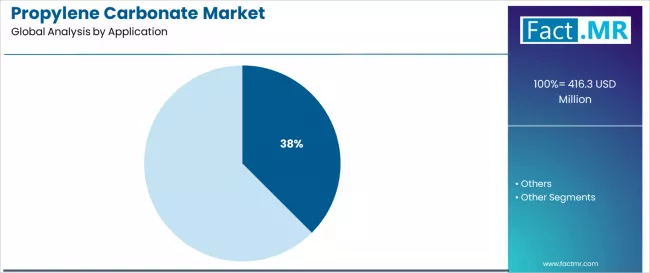
Propylene Carbonate Market Analysis By Application | Source: Fact.MR
Solvents are projected to account for 37.5% of the propylene carbonate market in 2025, reaffirming its position as the category's dominant application. Industrial manufacturers increasingly recognize the optimal balance of solvency power and environmental compatibility offered by propylene carbonate for most chemical processing applications, particularly in paints and coatings formulations.
Solvents address both performance requirements and sustainability considerations while providing reliable functionality across diverse industrial processes. This application forms the foundation of most formulation protocols for industrial chemicals, as it represents the most widely accepted and commercially viable solvent technology in the specialty chemicals industry.
Performance validation standards and extensive application testing continue to strengthen confidence in propylene carbonate solvent systems among formulators and process engineers. With increasing recognition of the environmental compliance and worker safety requirements in industrial operations, propylene carbonate solvent systems align with both process modernization and sustainability goals, making them the central growth driver of comprehensive green chemistry strategies.
By End Use, Which Segment Commands the Majority Market Share?
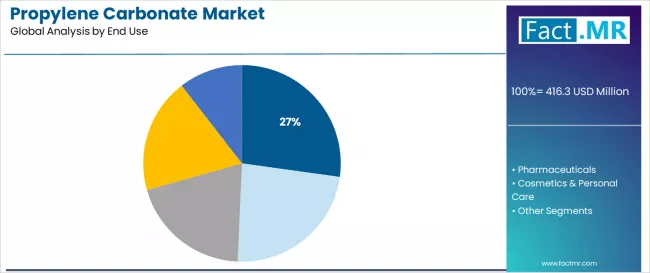
Propylene Carbonate Market Analysis By End Use | Source: Fact.MR
Paints and coatings applications are projected to represent 27.2% of propylene carbonate demand in 2025, underscoring its role as the primary end-use segment driving market adoption and growth.
Formulation chemists recognize that coating requirements, including VOC reduction mandates, performance consistency, and application versatility, often require specialized solvent solutions that conventional organic solvents cannot adequately provide while meeting environmental standards. Propylene carbonate offers enhanced formulation flexibility and environmental compliance in paints and coatings applications.
The segment is supported by the stringent nature of environmental regulations, requiring low-emission solvent systems, and the increasing recognition that specialized green solvents can improve coating performance and regulatory compliance outcomes. Manufacturers are increasingly adopting evidence-based formulation guidelines that recommend specific sustainable solvents for optimal application outcomes.
As understanding of solvent impact on coating properties advances and environmental requirements become more stringent, propylene carbonate will continue to play a crucial role in comprehensive formulation strategies within the paints and coatings market.
What are the Drivers, Restraints, and Key Trends of the Propylene Carbonate Market?
The propylene carbonate market is advancing steadily due to increasing recognition of green chemistry's importance and growing demand for sustainable solvent systems across the specialty chemicals sector. However, the market faces challenges, including production cost considerations, potential for price volatility in raw material supply chains, and concerns about specialized grade availability for demanding industrial applications. Innovation in manufacturing processes and customized purification protocols continues to influence product development and market expansion patterns.
Expansion of Green Chemistry Programs and Sustainable Solvent Technologies
The growing adoption of environmental sustainability initiatives is enabling the development of more sophisticated propylene carbonate applications and formulation systems that can meet stringent regulatory requirements.
Industrial chemical manufacturers offer comprehensive demand for propylene carbonate, including high-purity and specialized-grade formulations that are particularly important for achieving performance requirements in chemical processing applications.
Advanced production technologies provide access to high-quality propylene carbonate that can optimize process performance and reduce environmental concerns while maintaining cost-effectiveness for large-scale industrial operations.
Integration of Lithium-Ion Battery Standards and Electrolyte Systems
Modern battery manufacturers are incorporating advanced chemical technologies such as high-purity electrolyte solvents, performance optimization additives, and quality monitoring integration to enhance propylene carbonate deployment and operational efficiency.
These systems improve battery performance, enable consistent electrochemical characteristics, and provide better coordination between electrolyte systems and cell design requirements throughout the production cycle.
Advanced quality control capabilities also enable customized purity specifications and early identification of contamination issues or performance degradation, supporting reliable manufacturing efficiency.
Analysis of the Propylene Carbonate Market by Key Countries
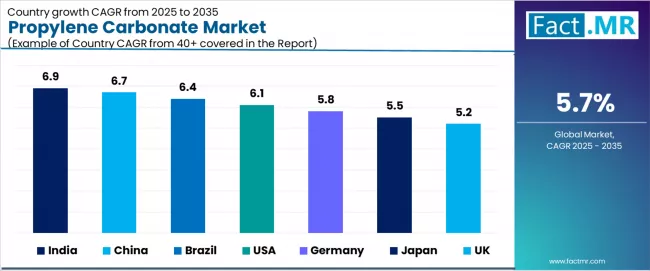
Propylene Carbonate Market Cagr Analysis By Country | Source: Fact.MR
| Country | CAGR (2025 to 2035) |
|---|---|
| India | 6.9% |
| China | 6.7% |
| Brazil | 6.4% |
| USA | 6.1% |
| Germany | 5.8% |
| Japan | 5.5% |
| UK | 5.2% |
Source: Fact.MR analysis. Updated Nov 25, 2025
The propylene carbonate market is experiencing steady growth globally, with India leading at a 6.9% CAGR through 2035, driven by expanding manufacturing sector, growing lithium-ion battery production, and comprehensive chemical industry development across major industrial regions.
China follows at 6.7%, supported by massive battery manufacturing expansion, coating industry growth, and domestic chemical production capability enhancement. The USA records 6.1% growth, benefiting from pharmaceutical manufacturing presence and specialty chemical demand. Brazil demonstrates 6.4% growth, emphasizing industrial coatings expansion and automotive sector development.
Germany shows 5.8% growth, representing advanced coating formulations and pharmaceutical manufacturing excellence. Japan records 5.5% growth with electronics industry applications and precision chemical manufacturing capabilities, while the UK shows 5.2% growth, representing specialty chemical markets and pharmaceutical industry presence.
How Does India Demonstrate Exceptional Market Potential with Manufacturing Expansion?
Revenue from propylene carbonate in India is projected to exhibit exceptional growth with a CAGR of 6.9% through 2035, driven by rapidly expanding manufacturing sector and increasing recognition of sustainable solvents as essential for coating formulations and battery production advancement. The country's growing industrial base and expanding lithium-ion battery manufacturing capabilities are creating significant opportunities for propylene carbonate deployment across both coating formulation operations and emerging energy storage production facilities. International chemical suppliers and domestic manufacturers are establishing comprehensive distribution and production capabilities to serve the expanding population of coating manufacturers and battery producers requiring high-quality solvents across automotive coatings, industrial applications, and energy storage manufacturing throughout India's major industrial clusters.
The Indian government's strategic emphasis on manufacturing development and clean energy initiatives is driving substantial investments in battery production capabilities and coating technology advancement. This policy support, combined with the country's enormous growth potential and cost-competitive manufacturing advantages, creates a favorable environment for propylene carbonate market development. Indian manufacturers are increasingly focusing on sustainable solvent adoption to meet environmental standards, with propylene carbonate representing a preferred low-VOC alternative in coating and pharmaceutical applications.
- Government initiatives supporting manufacturing growth and battery production development are driving demand for specialty chemical solvents and formulation materials
- Industrial expansion programs and environmental regulations are supporting appropriate utilization of low-VOC solvents among coating manufacturers and chemical processors nationwide
- Battery manufacturers and coating formulators are increasingly integrating propylene carbonate into formulations, creating new application opportunities
- Rising sustainability awareness and growing regulatory compliance requirements are accelerating propylene carbonate adoption across industrial segments
What Makes China Demonstrate Market Leadership with Battery Production Dominance?
Revenue from propylene carbonate in China is expanding at a CAGR of 6.7%, supported by massive lithium-ion battery manufacturing scale, expanding coating industry operations, and advancing chemical production infrastructure across the country's industrial regions. The country's dominant position in global battery production and substantial coating manufacturing capacity are driving demand for propylene carbonate solutions in both electrolyte applications and coating formulation uses. International chemical companies and domestic producers are expanding production capacity to serve the growing demand for specialty solvents while supporting the country's position as the world's largest chemical manufacturing center.
China's chemical sector continues to benefit from substantial industrial investment, expanding electric vehicle production driving battery demand, and coating industry modernization driving formulation advancement. The country's focus on battery technology leadership and environmental compliance is driving investments in high-purity chemical production including propylene carbonate manufacturing and application development. This development is particularly important for propylene carbonate applications, as manufacturers seek reliable domestic sources for battery-grade and coating-grade materials to enhance supply chain security and reduce dependence on imported specialty chemicals.
- Rising battery production volumes and improving chemical manufacturing capabilities are creating opportunities for specialized propylene carbonate applications
- Growing electric vehicle manufacturing and coating industry expansion are supporting increased propylene carbonate consumption across end-use categories
- Expanding environmental regulations and quality standards are driving adoption of compliant solvents in coating and pharmaceutical applications
- Manufacturing capability advancement is enabling production of high-purity propylene carbonate grades, supporting market growth and domestic supply development
Why Does Brazil Maintain Industrial Coatings Growth?
Revenue from propylene carbonate in Brazil is projected to exhibit solid growth with a CAGR of 6.4% through 2035, driven by expanding industrial coatings sector and automotive manufacturing development. The country's significant coating industry and growing industrial base are creating opportunities for propylene carbonate integration across both architectural coating and industrial finishing applications. Brazilian chemical distributors and coating manufacturers are leveraging regional production capabilities to serve growing demand for sustainable solvents while supporting the country's position as a major Latin American industrial center.
The Brazilian market benefits from established coating industry infrastructure, enabling optimized propylene carbonate deployment in water-based and industrial coating formulations. This development is particularly important for propylene carbonate applications, as formulators seek environmentally-compliant solvents that support coating performance while ensuring regulatory compliance in industrial and architectural applications.
Strategic Market Considerations:
- Industrial coatings and automotive finishing segments leading growth with focus on VOC compliance and formulation performance applications
- Environmental regulations are driving sustainable solvent portfolios from traditional organic solvents to low-VOC propylene carbonate systems
- Coating industry expertise and automotive manufacturing supporting competitive positioning in Latin American chemical markets
- Government environmental standards and industrial development policies beginning to influence solvent selection decisions and propylene carbonate adoption timelines
How Does the USA Maintain Pharmaceutical Manufacturing Leadership?
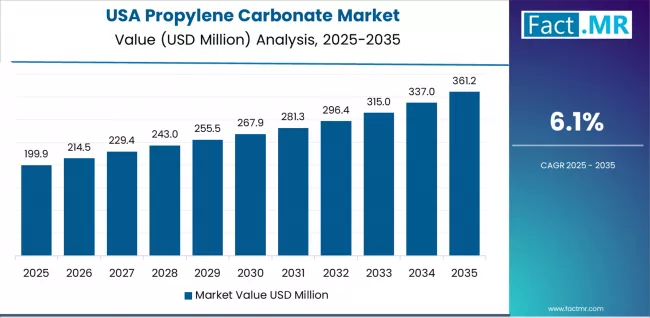
Propylene Carbonate Market Country Value Analysis | Source: Fact.MR
The USA' advanced chemical market demonstrates sophisticated propylene carbonate utilization with documented applications in pharmaceutical synthesis and specialty coating formulations through integration with comprehensive quality control systems and regulatory frameworks. The country leverages pharmaceutical manufacturing expertise and specialty chemical infrastructure to maintain a 6.1% CAGR through 2035. Manufacturing facilities, including pharmaceutical production sites and specialty coating operations throughout major industrial regions, showcase diverse propylene carbonate applications where high-purity grades integrate with regulated manufacturing processes and specialty formulation requirements to optimize product performance and regulatory compliance.
American chemical users prioritize quality assurance and regulatory compliance in solvent selection, creating demand for validated propylene carbonate grades with comprehensive documentation, including certificates of analysis and regulatory support aligned with FDA and EPA standards. The market benefits from established specialty chemical distribution infrastructure and willingness to adopt performance-enhancing formulation technologies.
Strategic Market Considerations:
- Pharmaceutical and specialty coatings segments leading consumption with focus on high-purity grades and regulatory compliance applications
- Quality requirements are driving premium product portfolios from commodity-grade solvents to pharmaceutical-grade specialty chemicals
- Regulatory compliance challenges offset by strong pharmaceutical industry presence and established specialty chemical infrastructure
- Environmental regulations and pharmaceutical manufacturing standards beginning to accelerate high-purity propylene carbonate procurement requirements
What Drives Germany Market Growth with Coating Formulation Excellence?
Germany's advanced chemical market demonstrates sophisticated propylene carbonate adoption with a 5.8% CAGR through 2035, driven by coating formulation expertise, pharmaceutical manufacturing presence, and comprehensive environmental regulations supporting sustainable solvent use. The country's leadership in coating technology development is creating substantial demand for performance solvents including propylene carbonate across industrial coating and specialty formulation applications. German coating manufacturers and pharmaceutical producers are increasingly prioritizing sustainable solvents that balance performance with environmental responsibility.
Market dynamics focus on high-quality propylene carbonate that addresses both formulation performance requirements and environmental compliance considerations important to German industrial standards and regulatory frameworks. Growing sustainability emphasis creates opportunities for bio-based propylene carbonate development and circular economy integration.
Strategic Market Considerations:
- Industrial coatings and pharmaceutical applications demonstrating focused growth with emphasis on environmental compliance and formulation performance
- Stringent environmental requirements driving innovative solvent portfolios from conventional organic solvents to sustainable propylene carbonate systems
- Coating expertise supported by comprehensive formulation research infrastructure and pharmaceutical manufacturing excellence
- EU environmental regulations and sustainability mandates emphasizing low-VOC solvent adoption in industrial applications
How Does Japan Demonstrate Electronics Industry Integration?
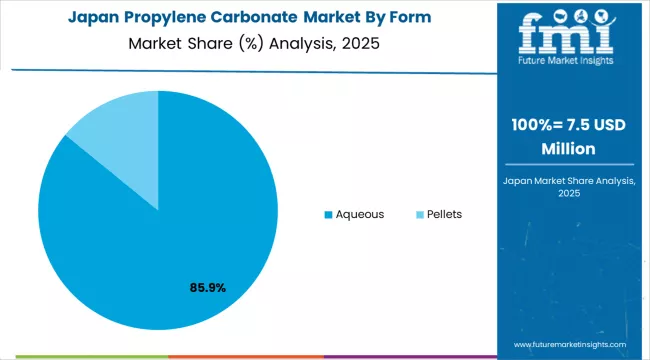
Propylene Carbonate Market Japan Market Share Analysis By Form | Source: Fact.MR
Japan's sophisticated chemical market demonstrates consistent propylene carbonate utilization with a 5.5% CAGR through 2035, driven by electronics manufacturing applications, precision coating requirements, and established chemical industry infrastructure. The country's electronics manufacturing expertise creates demand for high-purity propylene carbonate supporting semiconductor processing and specialty coating applications. Japanese chemical companies and electronics manufacturers emphasize quality consistency and technical performance that reflect industry expectations for specialty chemical specifications.
Market dynamics focus on high-purity propylene carbonate grades that balance electronics-grade requirements with cost considerations important to Japanese manufacturing standards and quality protocols. Established chemical industry infrastructure creates foundation for specialized grade development and application optimization.
Strategic Market Considerations:
- Electronics and specialty coating applications demonstrating steady growth with focus on high-purity requirements and precision formulation
- Quality standards driving premium specifications with stringent purity characteristics and comprehensive testing protocols
- Electronics manufacturing expertise supporting specialized propylene carbonate grade adoption as application requirements advance
- Industry preferences emphasizing proven reliability and comprehensive quality documentation in chemical procurement
Why does the UK Show Pharmaceutical Specialization?
Revenue from propylene carbonate in the UK is projected to grow at a CAGR of 5.2% through 2035, driven by pharmaceutical industry presence and specialty chemical market development. The country's established pharmaceutical manufacturing sector creates opportunities for propylene carbonate deployment across pharmaceutical synthesis and specialty formulation applications. The chemical distributors are maintaining consistent supply capabilities to serve pharmaceutical manufacturing requirements while establishing technical service programs to support specialty applications.
The UK market benefits from pharmaceutical manufacturing excellence supporting high-purity chemical demand and established specialty chemical distribution networks. This development creates foundation demand for propylene carbonate as pharmaceutical companies prioritize quality-assured solvents and specialty chemical suppliers emphasize technical support capabilities.
Strategic Market Considerations:
- Pharmaceutical and specialty applications demonstrating focused growth with emphasis on regulatory compliance and quality assurance
- Pharmaceutical industry requirements driving premium propylene carbonate specifications with comprehensive regulatory documentation
- Specialty chemical infrastructure supporting steady propylene carbonate adoption in pharmaceutical manufacturing operations
- Regulatory standards and pharmaceutical industry preferences influencing quality specifications and supplier selection criteria
Europe Market Split by Country
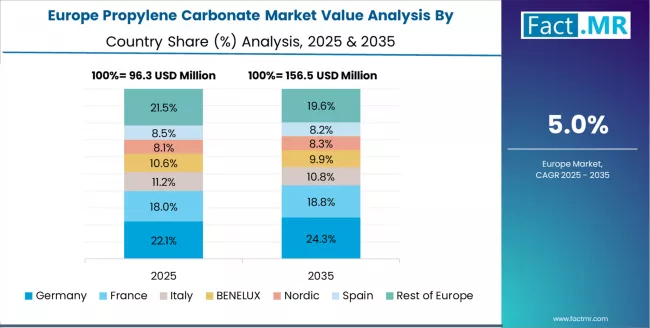
Propylene Carbonate Market Europe Country Market Share Analysis, 2025 & 2035 | Source: Fact.MR
The propylene carbonate market in Europe is projected to grow from USD 108.2 million in 2025 to USD 189.0 million by 2035, registering a CAGR of 5.7% over the forecast period. Germany is expected to maintain its leadership position with a 41.8% market share in 2025, rising to 42.5% by 2035, supported by its advanced coating industry, comprehensive pharmaceutical manufacturing sector, and established chemical production infrastructure throughout major industrial regions.
France follows with a 19.2% share in 2025, projected to reach 19.7% by 2035, driven by coating industry presence, pharmaceutical manufacturing capabilities, and specialty chemical distribution networks serving both domestic and European markets. The UK holds a 15.6% share in 2025, expected to increase to 16.1% by 2035, supported by pharmaceutical industry concentration and specialty chemical market development.
Italy commands a 11.9% share in 2025, projected to reach 11.4% by 2035, while Spain accounts for 8.3% in 2025, expected to reach 7.8% by 2035. The Rest of Europe region, including Nordic countries with coating industry presence, Eastern European emerging chemical markets, and smaller Western European industrial centers, is anticipated to hold 3.2% in 2025, declining slightly to 2.5% by 2035, attributed to market consolidation toward larger core markets with established chemical distribution infrastructure and comprehensive propylene carbonate application capabilities.
Competitive Landscape of the Propylene Carbonate Market
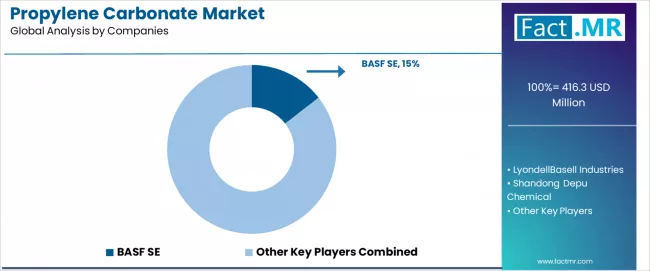
Propylene Carbonate Market Analysis By Company | Source: Fact.MR
The propylene carbonate market is characterized by competition among established chemical manufacturers, specialty solvent producers, and regional chemical suppliers focused on delivering high-quality, reliable, and application-optimized propylene carbonate.
Companies are investing in production technology advancement, quality assurance enhancement, strategic customer partnerships, and technical support services to deliver effective, efficient, and sustainable chemical solutions that meet stringent industrial and environmental requirements. Process standardization, purity validation protocols, and supply chain optimization strategies are central to strengthening product portfolios and market presence.
BASF SE leads the market with a 14.5% market share, offering comprehensive high-quality propylene carbonate solutions with a focus on product reliability and application versatility for industrial customers. LyondellBasell Industries provides specialized chemical products with emphasis on large-scale manufacturing applications and comprehensive technical support services.
Shandong Depu Chemical focuses on cost-competitive production technologies and regional market development for chemical systems serving Asian markets. Empower Materials delivers innovative specialty chemicals with strong application development capabilities and customer-focused expertise.
Huntsman International LLC. operates with a focus on bringing advanced purification technologies to specialized industrial applications and high-purity product markets. Dhalop Chemicals provides comprehensive chemical portfolios, including premium propylene carbonate grades, across multiple industrial applications and regional requirements. Tokyo Chemical Industry Co., Ltd. specializes in high-purity laboratory and specialty chemicals for research applications with emphasis on quality consistency.
Linyi Evergreen Chemical Co., Ltd. provides competitive manufacturing capabilities and regional distribution expertise to enhance market accessibility and customer access to essential propylene carbonate. Central Drug House and Carl Roth focus on specialized laboratory-grade solutions and premium product offerings for research and analytical applications, emphasizing quality differentiation and technical innovation through advanced production strategies.
Key Players in the Propylene Carbonate Market
- BASF SE
- LyondellBasell Industries
- Shandong Depu Chemical
- Empower Materials
- Huntsman International LLC
- Dhalop Chemicals
- Tokyo Chemical Industry Co., Ltd.
- Linyi Evergreen Chemical Co., Ltd.
- Central Drug House
- Carl Roth
Segmentation
Scope of the Report
| Items | Values |
|---|---|
| Quantitative Units (2025) | USD 416.3 Million |
| Application | Solvent, Others |
| End Use | Paints & Coatings, Pharmaceuticals, Cosmetics & Personal Care, Lithium-Ion Batteries, Others |
| Regions Covered | North America, Europe, Asia Pacific, Latin America, Middle East & Africa |
| Countries Covered | USA, Germany, UK, Japan, India, China, Brazil and 40+ countries |
| Key Companies Profiled | BASF SE, LyondellBasell Industries, Shandong Depu Chemical, Empower Materials, Huntsman International LLC., Dhalop Chemicals, Tokyo Chemical Industry Co., Ltd., Linyi Evergreen Chemical Co., Ltd., Central Drug House, Carl Roth |
| Additional Attributes | Dollar sales by application and end use, regional demand trends, competitive landscape, industrial preferences for specific propylene carbonate grades, integration with formulation systems, innovations in production technologies, quality control monitoring, and application optimization |
Source: Fact.MR analysis. Updated Nov 25, 2025
Propylene Carbonate Market by Segments
-
Application :
- Solvent
- Others
-
End Use :
- Paints & Coatings
- Pharmaceuticals
- Cosmetics & Personal Care
- Lithium-Ion Batteries
- Others
-
Region :
- North America
- USA
- Canada
- Mexico
- Europe
- Germany
- France
- UK
- Italy
- Spain
- Nordic
- BENELUX
- Rest of Europe
- Asia Pacific
- China
- India
- Japan
- South Korea
- ASEAN
- Australia & New Zealand
- Rest of Asia Pacific
- Latin America
- Brazil
- Argentina
- Chile
- Rest of Latin America
- Middle East & Africa
- Kingdom of Saudi Arabia
- Other GCC Countries
- Turkey
- South Africa
- Other African Countries
- Rest of Middle East & Africa
- North America
Frequently Asked Questions
How big is the propylene carbonate market in 2025?
What will be the size of propylene carbonate market in 2035?
How much will be the propylene carbonate market growth between 2025 and 2035?
What are the key product types in the propylene carbonate market?
Which end use segment to contribute significant share in the propylene carbonate market in 2025?
Who worked on this report


Preview the report firsthand - request a free sample
Free SampleGet the brochure for pricing and purchase details
Download PDF