- Base Value(2025): 5.10 Bn
- Estimated Value(2025): 5.1 Bn
- Forecast Value (2035): 8.9 Bn
- CAGR (2025 - 2035): 5.7%
Ethylene Propylene Diene Monomer Market Forecast and Outlook 2025 to 2035
The global ethylene propylene diene monomer market is projected to reach USD 8.88 billion by 2035, recording an absolute increase of USD 3.78 billion over the forecast period. The market is valued at USD 5.10 billion in 2025 and is set to rise at a CAGR of 5.7% during the assessment period.
The market is expected to grow by approximately 1.7 times during the same period, supported by increasing demand for durable elastomers in automotive sealing systems and weather-resistant applications worldwide, driving investments in advanced compounding technologies and rising adoption of sustainable rubber formulations with enhanced heat and ozone resistance across construction, automotive, and industrial applications globally.
Quick Stats for Ethylene Propylene Diene Monomer Market
- Ethylene Propylene Diene Monomer Market Value (2025): USD 5.10 billion
- Ethylene Propylene Diene Monomer Market Forecast Value (2035): USD 8.88 billion
- Ethylene Propylene Diene Monomer Market Forecast CAGR: 5.7%
- Leading Product Type in Ethylene Propylene Diene Monomer market: Seals & O-Rings (18.5%)
- Key Growth Regions in Ethylene Propylene Diene Monomer market: Asia Pacific, North America, and Europe
- Top Players in Ethylene Propylene Diene Monomer market: Dow, Exxon Mobil Corporation, ARLANXEO, Sumitomo Chemical Co. Ltd., Lion Elastomers, Mitsui Chemicals, PetroChina, Kumho Polychem, SK Geo Centric, Versalis (Eni)
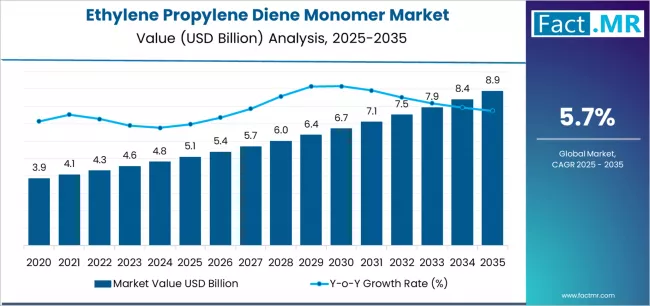
Ethylene Propylene Diene Monomer Market Market Value Analysis | Source: Fact.MR
Manufacturers face mounting pressure to deliver high-performance sealing solutions while addressing environmental regulations for recyclability and production efficiency requirements, with modern EPDM rubber providing documented benefits including superior weathering resistance, excellent electrical insulation properties, and extended service life compared to conventional rubber materials alone.
Growing awareness about energy-efficient building practices and expanding electric vehicle production enabling widespread EPDM adoption create substantial opportunities for polymer producers and compounding specialists. However, volatile raw material costs for ethylene and propylene feedstocks and competition from thermoplastic elastomer alternatives may pose obstacles to consistent margin maintenance and universal application dominance.
The seals & O-rings segment dominates market activity, driven by extensive use in automotive door sealing systems and industrial machinery applications requiring reliable fluid containment and environmental protection across diverse operating conditions worldwide. Manufacturers increasingly recognize the performance advantages of EPDM seals, with typical product offerings providing excellent compression set resistance and temperature stability at competitive price points through established automotive and industrial supply networks.
Hoses demonstrate robust market presence, supported by demanding hydraulic and industrial applications requiring flexible yet durable fluid transfer solutions. Automotive applications emerge as the dominant end-use category, reflecting widespread EPDM adoption across gaskets, seals, and weather stripping supporting vehicle manufacturing operations. Seals & O-rings represent the leading product type, driven by critical sealing requirements across automotive, construction, and industrial equipment applications.
Regional dynamics show Asia Pacific demonstrating the fastest growth trajectory, supported by massive automotive production capacity and expanding construction activities driving EPDM consumption across emerging economies. North America maintains significant market presence through advanced automotive manufacturing and stringent building code requirements favoring EPDM roofing membranes, while Europe emphasizes sustainable rubber compounds and circular economy initiatives.
India leads country-level growth through rapid automotive sector expansion and infrastructure development programs, followed by China supported by dominant EPDM production capabilities and electric vehicle manufacturing acceleration.
The competitive landscape features moderate concentration with Dow maintaining market leadership position with a 17.5% market share, while established players including Exxon Mobil, ARLANXEO, and Sumitomo Chemical compete through comprehensive polymer portfolios and specialized compounding expertise across diverse rubber applications.
Ethylene Propylene Diene Monomer Market Year-over-Year Forecast 2025 to 2035
Between 2025 and 2029, the ethylene propylene diene monomer market is projected to expand from USD 5.10 billion to USD 6.36 billion, resulting in a value increase of USD 1.26 billion, which represents 33.3% of the total forecast growth for the period. This phase of development will be shaped by rising demand for automotive sealing systems addressing electric vehicle battery thermal management requirements, product innovation in bio-based EPDM formulations incorporating renewable feedstocks, as well as expanding applications in sustainable roofing membranes and energy-efficient building envelope components. Companies are establishing competitive positions through investment in advanced polymerization technologies, enhanced compounding capabilities, and strategic market expansion across automotive tier suppliers, construction material distributors, and industrial rubber fabricators.
From 2029 to 2035, the market is forecast to grow from USD 6.36 billion to USD 8.88 billion, adding another USD 2.52 billion, which constitutes 66.7% of the overall expansion. This period is expected to be characterized by the expansion of specialty EPDM grades, including electrically conductive compounds for electromagnetic shielding and flame-retardant formulations for transportation applications offering enhanced safety performance, strategic collaborations between polymer producers and automotive OEMs implementing lightweighting initiatives, and an enhanced focus on circular economy principles and devulcanization technologies. The growing emphasis on hydrogen fuel cell vehicle sealing solutions and rising demand for high-performance gaskets supporting electrification infrastructure will drive innovation across diverse application segments from roofing systems to industrial machinery components globally.
Ethylene Propylene Diene Monomer Market Key Takeaways
| Metric | Value |
|---|---|
| Market Value (2025) | USD 5.10 billion |
| Market Forecast Value (2035) | USD 8.88 billion |
| Forecast CAGR (2025-2035) | 5.7% |
Source: Fact.MR analysis. Updated Dec 1, 2025
Why is the Ethylene Propylene Diene Monomer Market Growing?
The ethylene propylene diene monomer market grows by enabling manufacturers to achieve superior weather resistance and long-term durability while addressing demanding sealing requirements and environmental exposure conditions that conventional rubber materials cannot withstand across automotive, construction, and industrial applications.
Manufacturers face mounting pressure to reduce warranty claims and improve product longevity while meeting stringent temperature cycling and ozone resistance specifications, with modern EPDM rubber typically providing excellent aging characteristics, superior moisture resistance, and outstanding electrical insulation compared to natural rubber or styrene-butadiene alternatives alone, making synthetic elastomer solutions essential for critical sealing and insulation applications.
The automotive and construction industries' need for reliable and cost-effective sealing materials creates demand for specialized EPDM solutions that can provide compression set resistance, maintain flexibility across extreme temperatures, and deliver consistent performance without compromising safety standards or aesthetic requirements.
Automotive specification approvals and proven field performance drive adoption across vehicle assembly plants, roofing contractors, and industrial equipment manufacturers, where sealing integrity has direct impact on product quality and customer satisfaction ratings. The expanding electric vehicle production globally, requiring specialized battery sealing and thermal management systems, creates growing opportunities for advanced EPDM formulations.
Rising construction activities in emerging markets and building renovation projects in developed economies enable widespread roofing membrane adoption for waterproofing applications. However, feedstock price volatility for ethylene and propylene monomers and processing complexity for achieving optimal vulcanization may limit universal EPDM adoption and create challenges for cost-sensitive applications among diverse manufacturing operations with varying quality requirements.
Segmental Analysis
The market is segmented by product, application, and region. By product, the market is divided into seals & O-rings, hoses, gaskets, rubber compounds, roofing membranes, connectors & insulators, weather stripping, and others.
Based on application, the market is categorized into automotive, building & construction, electrical & electronics, lubricant additives, plastic modifications, tires & tubes, and others. Regionally, the market is divided into Asia Pacific, Europe, North America, Latin America, and Middle East & Africa.
By Product, Which Segment Accounts for the Dominant Market Share?
The seals & O-rings segment represents the dominant force in the ethylene propylene diene monomer market, capturing approximately 18.5% of total market share in 2025. This established product category encompasses solutions featuring precision-molded sealing components and compression-resistant designs, including advanced cross-linked formulations combining peroxide and sulfur vulcanization systems that enable superior sealing performance and extended service life across automotive door seals, industrial machinery shaft seals, and motor vehicle body sealing applications worldwide.
The seals & O-rings segment's market leadership stems from its critical functional importance and stringent performance requirements, with solutions capable of maintaining sealing integrity across wide temperature ranges and aggressive environmental conditions while providing excellent compression set resistance and dimensional stability across diverse industrial applications.
Within the seals & O-rings segment, shaft seals represent a critical application area, driven by demanding requirements in automotive transmissions, industrial pumps, and rotating equipment requiring dynamic sealing performance. This sub-segment benefits from continuous innovation in lip seal geometry and compound formulations improving friction characteristics and extending maintenance intervals.
The hoses segment maintains a substantial market share in the 16.0% range, serving fluid transfer applications and pressure containment requirements where flexible yet robust rubber tubing including hydraulic hoses, industrial chemical transfer lines, and pressure washer hoses remain essential infrastructure components. These solutions offer superior flexibility for manufacturers managing complex piping layouts while providing sufficient pressure resistance to accommodate hydraulic systems and high-pressure cleaning operations. The hoses segment demonstrates steady demand patterns, driven by ongoing industrial equipment maintenance and automotive coolant system requirements.
Within the product category, gaskets including metallic, semi-metallic, and non-metallic variants demonstrate important adoption across engine components and industrial flanges. Rubber compounds address automotive exterior applications including car bumpers and fender extensions, while roofing membranes represent specialized construction waterproofing solutions.
Key performance advantages driving the seals & O-rings segment include:
- Advanced compression set resistance enabling long-term sealing effectiveness and reduced maintenance requirements across automotive and industrial applications
- Established temperature stability providing reliable performance from -40°C to +150°C across diverse climate conditions and operating environments
- Enhanced ozone resistance characteristics preventing premature cracking and degradation while maintaining seal integrity throughout extended service life
- Superior moldability delivering precise dimensional control and complex geometry fabrication supporting custom sealing solutions
By Product, What Drives the Hoses Segment Growth?
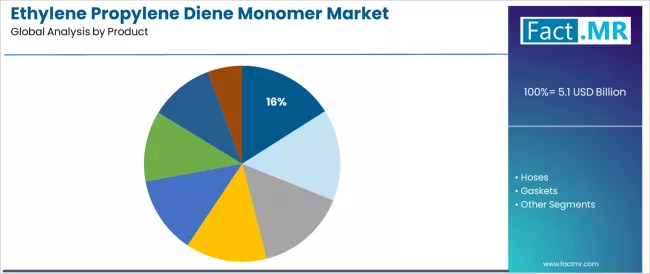
Ethylene Propylene Diene Monomer Market Analysis By Product | Source: Fact.MR
Hoses represent a significant product segment in the ethylene propylene diene monomer market with a 16.0% market share in 2025, reflecting the fundamental role of flexible rubber tubing in fluid transfer systems and pressure containment applications across automotive, industrial, and agricultural equipment categories.
The hoses segment demonstrates consistent demand driven by replacement market requirements and continuous equipment operation necessitating reliable hydraulic power transmission, coolant circulation, and chemical transfer capabilities. Within hose applications, hydraulic and pressure washer hoses represent demanding categories, driven by high-pressure operating conditions in construction equipment, agricultural machinery, and cleaning systems requiring burst-resistant construction. The segment benefits from reinforcement technologies combining textile and wire braiding with EPDM compounds optimizing flexibility and pressure ratings.
The industrial hoses segment emerges as an important category with diverse application requirements, driven by chemical processing facilities, mining operations, and manufacturing plants requiring chemical-resistant and abrasion-resistant tubing solutions. Users seeking long service life drive adoption of specialized EPDM compounds offering superior resistance to acids, alkalis, and cleaning chemicals.
Within product types, automotive cooling system hoses demonstrate critical functional requirements through radiator connections and heater circuits requiring antifreeze compatibility. HVAC system hoses address refrigerant lines and air conditioning applications, while general-purpose industrial hoses represent versatile solutions for compressed air distribution and water transfer.
Key product dynamics include:
- Hydraulic hose requirements accelerating across construction equipment and agricultural machinery with emphasis on high-pressure performance and temperature resistance
- Industrial applications driving demand for chemical-resistant formulations and abrasion-resistant covers supporting harsh operating environments
- Automotive cooling system evolution requiring specialized compounds compatible with extended-life coolants and electric vehicle thermal management
- Pressure washer growth creating opportunities for burst-resistant small-bore hoses supporting consumer and commercial cleaning equipment
By Application, Which Segment Accounts for a Significant Market Share?
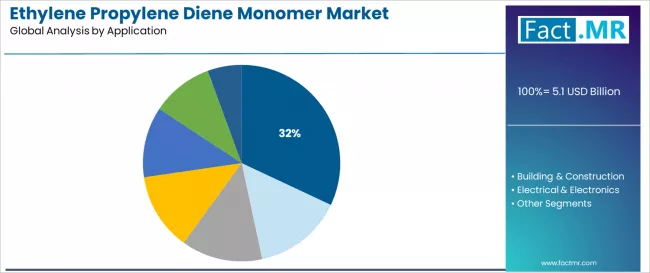
Ethylene Propylene Diene Monomer Market Analysis By Application | Source: Fact.MR
Automotive represents the leading application segment in the ethylene propylene diene monomer market with a 32.0% market share in 2025, reflecting the fundamental role of EPDM rubber in vehicle sealing systems, cooling circuits, and weather protection applications supporting passenger car and commercial vehicle manufacturing operations. The automotive segment demonstrates consistent demand driven by global vehicle production volumes and stringent OEM specifications requiring reliable sealing performance throughout vehicle warranty periods and extended service life.
Within automotive applications, gaskets represent critical components, driven by engine sealing requirements in cylinder head gaskets, intake manifold gaskets, and oil pan gaskets requiring high-temperature resistance. The segment benefits from continuous innovation in multi-layer steel gaskets incorporating EPDM coatings optimizing sealing effectiveness.
The seals & O-rings category emerges as an important automotive application with widespread deployment patterns, driven by door sealing systems, window channels, trunk seals, and hood seals requiring weather protection and noise isolation. Vehicle occupants expecting quiet cabin environments drive adoption of precision-extruded EPDM profiles offering superior compression characteristics and water resistance.
Within application types, hoses demonstrate specialized requirements through coolant circulation systems connecting radiators, heaters, and engine blocks requiring thermal cycling resistance. Weather stripping addresses vehicle body sealing for door frames and window surrounds, while under-hood components represent demanding environments requiring heat and chemical resistance.
Key application dynamics include:
- Automotive sealing requirements accelerating across electric vehicle platforms with emphasis on battery pack sealing and thermal management system hoses
- Engine gasket applications driving demand for high-temperature EPDM compounds and multi-material composite structures
- Door seal innovations prioritizing acoustic insulation and aerodynamic sealing supporting fuel efficiency and passenger comfort
- Coolant system evolution creating opportunities for extended-life hoses compatible with organic acid technology coolants and electric powertrains
By Application, What Drives the Lubricant Additives Segment Growth?
Lubricant additives represent an important application segment demonstrating fastest growth potential with a 14.0% market share in 2025, driven by EPDM's role as viscosity index improvers and thermal stability enhancers in automotive and industrial lubricants requiring performance consistency across temperature extremes. The lubricant additives segment benefits from expanding synthetic lubricant formulations and extended drain interval requirements demanding advanced polymer solutions.
Within lubricant applications, viscosity index improvers represent the core technology, driven by requirements for maintaining oil viscosity across wide temperature ranges in automotive engine oils and hydraulic fluids. The segment benefits from EPDM copolymers offering excellent shear stability and thermal resistance supporting extended oil change intervals.
The thermal stability additives category emerges with specialized requirements, driven by high-temperature industrial applications including turbine oils and heat transfer fluids requiring oxidation resistance. Users demanding equipment protection drive adoption of specialized EPDM derivatives offering antioxidant properties and sludge prevention.
Within application types, building & construction demonstrates significant market presence through roofing membrane waterproofing and window gasket sealing. Electrical & electronics addresses cable insulation and connector sealing, while plastic modifications represent impact resistance enhancement for thermoplastic compounds.
Key application dynamics include:
- Lubricant additive requirements growing across synthetic motor oils with emphasis on fuel economy improvement and emission system compatibility
- Building & construction applications driving demand for single-ply roofing membranes and window sealing gaskets supporting energy-efficient building envelope systems
- Electrical & electronics segment prioritizing insulation resistance and flame retardancy for wire and cable jacketing applications
- Plastic modification opportunities expanding through impact modifier applications enhancing polypropylene and polyethylene performance characteristics
What are the Drivers, Restraints, and Key Trends of the Ethylene Propylene Diene Monomer market?
The market is driven by three concrete demand factors tied to automotive production and construction activities. First, rising electric vehicle manufacturing creates expanding opportunities for EPDM sealing solutions across battery pack enclosures and thermal management systems, with specialized rubber compounds representing a critical enabler for protecting sensitive electrical components from moisture ingress and thermal stress, requiring comprehensive material testing validation.
Second, growing infrastructure investment and commercial construction drive roofing membrane demand, with single-ply EPDM systems demonstrating significant adoption supporting energy-efficient building envelope designs and sustainable waterproofing solutions by 2030. Third, increasing automotive emission regulations enable more demanding under-hood sealing requirements that improve engine compartment environmental control while supporting powertrain efficiency through reduced air leakage and improved thermal management.
Market restraints include volatile ethylene and propylene feedstock pricing related to crude oil fluctuations and petrochemical supply-demand dynamics that can challenge cost predictability and margin management, particularly during periods of tight monomer availability affecting polymer production economics and forcing frequent price negotiations. Competition from thermoplastic elastomers and silicone rubber alternatives poses another significant obstacle, as emerging material technologies offer processing advantages including injection moldability and higher temperature resistance, potentially limiting EPDM adoption in premium applications requiring superior performance characteristics. Processing complexity for achieving optimal vulcanization and compound mixing creates additional challenges, demanding specialized equipment investments and technical expertise for maintaining consistent quality standards.
Key trends indicate accelerated bio-based EPDM development in developed markets, particularly Europe and North America, where polymer producers demonstrate commitment to renewable feedstock integration and reduced carbon footprint objectives supporting sustainability reporting requirements. Recycling technology adoption trends toward devulcanization processes and circular economy initiatives enable recovered EPDM reintegration that optimizes material utilization and reduces landfill disposal throughout end-of-life vehicle processing. However, the market thesis could face disruption if significant breakthroughs in thermoplastic vulcanizate technologies or major automotive design shifts toward sealed cabin pressurization systems reduce reliance on traditional EPDM weather sealing solutions.
Analysis of the Ethylene Propylene Diene Monomer market by Key Countries
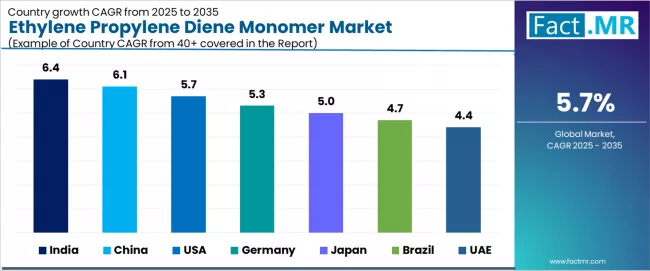
Ethylene Propylene Diene Monomer Market Cagr Analysis By Country | Source: Fact.MR
| Country | CAGR (2025 to 2035) |
|---|---|
| India | 6.4% |
| China | 6.1% |
| USA | 5.7% |
| Germany | 5.3% |
| Japan | 5.0% |
| Brazil | 4.7% |
| UAE | 4.4% |
Source: Fact.MR analysis. Updated Dec 1, 2025
The global ethylene propylene diene monomer market is expanding steadily, with India leading at a 6.4% CAGR through 2035, driven by rapid automotive manufacturing expansion and massive infrastructure construction programs requiring comprehensive rubber sealing solutions. China follows at 6.1%, supported by dominant EPDM production capacity and accelerating electric vehicle adoption.
The USA records 5.7%, reflecting automotive manufacturing resilience and expanding hydrogen fueling infrastructure. Germany advances at 5.3%, leveraging advanced automotive gasket manufacturing and precision sealing system expertise. Japan posts 5.0%, focusing on high-tech electronics applications and automotive component quality excellence, while Brazil grows steadily at 4.7%, emphasizing construction sector expansion and industrial machinery manufacturing. UAE demonstrates 4.4% growth, anchored by infrastructure development and petrochemical industry investments.
How is India Leading Global Market Expansion?
India demonstrates the strongest growth potential in the ethylene propylene diene monomer market with a CAGR of 6.4% through 2035. The country's leadership position stems from rapidly expanding automotive manufacturing capacity, massive infrastructure development programs including smart cities initiatives, and growing industrial equipment production supporting comprehensive EPDM consumption across sealing, roofing, and automotive applications.
Growth is concentrated in major automotive clusters and industrial regions, including Maharashtra, Tamil Nadu, Gujarat, and Haryana, where vehicle manufacturers and component suppliers increasingly specify EPDM rubber for critical sealing and weather protection applications.
Distribution channels through automotive tier suppliers, industrial rubber distributors, and construction material dealers expand accessibility across small and medium enterprises. The country's expanding middle-class vehicle ownership patterns provide strong momentum for automotive production growth, including comprehensive adoption across passenger car and commercial vehicle segments requiring reliable EPDM sealing systems.
Key market factors:
- Automotive manufacturing clusters concentrated in southern and western states with growing production volumes across all vehicle segments
- Infrastructure construction programs through government initiatives including housing development and transportation projects requiring roofing membranes
- Comprehensive industrial equipment manufacturing ecosystem supporting EPDM gasket and seal requirements across machinery production
- Local compounding capabilities developing through domestic rubber processors offering cost-competitive formulations and technical support
Why is China Emerging as a High-Growth Market?
In major manufacturing provinces including Jiangsu, Zhejiang, Guangdong, and Shandong, the adoption of ethylene propylene diene monomer solutions is accelerating across automotive assembly plants, construction projects, and industrial equipment manufacturing facilities, driven by massive vehicle production capacity and extensive infrastructure modernization programs.
The market demonstrates strong growth momentum with a CAGR of 6.1% through 2035, linked to dominant global EPDM production capabilities and increasing emphasis on electric vehicle manufacturing requiring specialized battery sealing solutions. Chinese manufacturers are implementing advanced compounding technologies and quality control systems to enhance product performance while meeting growing domestic automotive OEM specifications and international export requirements.
The country's leadership in electric vehicle production creates ongoing demand for specialized EPDM compounds supporting battery pack sealing, thermal management systems, and high-voltage cable insulation applications.
Key development areas:
- Electric vehicle manufacturing clusters leading EPDM adoption with emphasis on battery enclosure sealing and cooling system hoses
- Distribution expansion through automotive tier supplier networks and industrial rubber distributors providing comprehensive market coverage
- Construction modernization initiatives implementing waterproofing membrane systems and building envelope sealing solutions
- Growing preference for specialty EPDM grades offering enhanced thermal conductivity and flame retardancy supporting electronics applications
What drives USA’s Market Resilience?
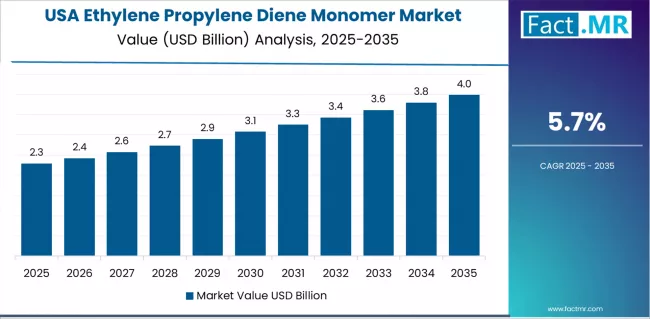
Ethylene Propylene Diene Monomer Market Country Value Analysis | Source: Fact.MR
The USA’s market expansion is driven by diverse application requirements, including automotive sealing system innovation for electric vehicles and sustainable roofing membrane adoption for commercial construction projects across sophisticated industrial segments.
The country demonstrates steady growth potential with a CAGR of 5.7% through 2035, supported by continuous research investment from established polymer producers and automotive tier suppliers. Manufacturers face implementation challenges related to domestic EPDM production capacity limitations and import dependency for certain specialty grades, requiring strategic supplier relationships and inventory management optimization.
Established automotive manufacturing operations and extensive commercial roofing markets create stable baseline demand for EPDM rubber, particularly among vehicle manufacturers pursuing electrification strategies where specialized sealing solutions drive primary material selection decisions.
Market characteristics:
- Automotive OEMs and tier-one suppliers showing robust demand with substantial annual EPDM consumption across vehicle sealing systems
- Regional preferences varying between Midwest automotive application focus and Sun Belt emphasis on roofing membrane waterproofing systems
- Future projections indicate continued premiumization with emphasis on bio-based EPDM content and carbon footprint reduction initiatives
- Growing emphasis on hydrogen fuel cell vehicle sealing applications and extreme low-temperature performance supporting cold climate requirements
How does Germany Demonstrate Advanced Manufacturing Leadership?
The German market leads in automotive gasket innovation based on comprehensive engineering expertise and precision manufacturing capabilities supporting high-performance sealing applications across premium vehicle segments and industrial machinery categories. The country shows strong potential with a CAGR of 5.3% through 2035, driven by continuous technology development and quality excellence in major manufacturing regions, including Baden-Württemberg, Bavaria, North Rhine-Westphalia, and Lower Saxony.
Manufacturers are adopting advanced EPDM formulations for demanding engine gasket applications, particularly in turbocharged powertrains and electric vehicle battery systems requiring rigorous sealing specifications and comprehensive validation testing. Distribution channels through automotive tier suppliers and specialized industrial rubber fabricators expand coverage across precision engineering operations and quality-focused production facilities.
Leading market segments:
- Automotive gasket manufacturing in major vehicle production centers implementing multi-material sealing systems and advanced compression molding
- Industrial machinery partnerships with equipment builders achieving high specification compliance rates across hydraulic and pneumatic systems
- Strategic collaborations between EPDM compounders and automotive OEMs expanding battery pack sealing applications for electric vehicles
- Focus on sustainability initiatives and recycled rubber integration addressing circular economy requirements and environmental impact reduction
What Positions Japan for Quality Excellence Leadership?
In Tokyo, Aichi, Osaka, and other major manufacturing prefectures, companies are implementing ethylene propylene diene monomers through precision molding processes and comprehensive quality assurance systems, with documented production capabilities showing substantial dimensional tolerance achievements across automotive weather sealing and electronics insulation applications.
The market shows steady growth potential with a CAGR of 5.0% through 2035, linked to ongoing manufacturing excellence initiatives, rigorous testing protocols, and emerging specialty compound development programs in major regions. Manufacturers are adopting pharmaceutical-grade quality control standards and advanced analytical testing technologies to ensure compound consistency while maintaining quality leadership demanded by automotive and electronics positioning. The country's established automotive supply chain expertise creates ongoing opportunities for premium EPDM sealing systems that differentiate through comprehensive performance validation and long-term reliability demonstration.
Market development factors:
- Quality-focused automotive suppliers leading EPDM adoption with emphasis on precision molding and dimensional stability
- Technology partnerships enabling advanced compound development with comprehensive aging resistance testing protocols
- Strategic emphasis on specialty grades offering enhanced electrical properties for electromagnetic shielding applications
- Focus on miniaturization support and precision sealing solutions addressing automotive sensor protection and electronics encapsulation
How does Brazil Show Infrastructure Development Leadership?
In São Paulo, Minas Gerais, Rio de Janeiro, and other major states, construction contractors are implementing ethylene propylene diene monomers through roofing membrane installations and building envelope sealing projects, with documented performance in tropical climate conditions showing substantial weathering resistance improvements across commercial and residential construction applications.
The market shows steady growth potential with a CAGR of 4.7% through 2035, linked to ongoing infrastructure investment programs, expanding industrial manufacturing capacity, and increasing emphasis on sustainable construction practices in major urban regions.
Builders are adopting single-ply EPDM roofing systems with comprehensive waterproofing performance to enhance building durability while maintaining cost-effectiveness demanded by commercial construction project economics. The country's growing industrial machinery sector creates ongoing opportunities for hydraulic hoses and industrial gaskets that differentiate through chemical resistance and pressure containment capabilities.
Market development factors:
- Construction professionals leading EPDM roofing adoption across commercial building projects throughout Brazil
- Infrastructure development providing growth opportunities in transportation projects and industrial facility construction
- Strategic partnerships between EPDM suppliers and roofing contractors expanding waterproofing membrane applications
- Emphasis on tropical climate performance and UV resistance addressing harsh environmental exposure conditions
What Characterizes UAE's Market Development?
In major emirates including Dubai, Abu Dhabi, Sharjah, and Ajman, the adoption of ethylene propylene diene monomers is expanding across infrastructure construction projects, petrochemical facilities, and automotive service operations, driven by extensive building development programs and industrial diversification initiatives. The market demonstrates solid growth potential with a CAGR of 4.4% through 2035, linked to comprehensive construction sector activity and increasing emphasis on durable building materials suitable for extreme climate conditions.
Contractors are implementing EPDM roofing membranes and weather sealing systems to enhance building longevity while meeting growing expectations for performance reliability in high-temperature desert environments. The country's petrochemical industry presence creates ongoing demand for industrial hoses and chemical-resistant gaskets, while increasing automotive aftermarket activity drives adoption of replacement sealing components.
Key development areas:
- Construction contractors leading EPDM membrane adoption with emphasis on heat resistance and long-term weathering performance
- Distribution expansion through specialized building material suppliers and industrial rubber distributors
- Petrochemical facilities requiring chemical-resistant hoses and high-temperature gaskets supporting process equipment operations
- Integration of international quality standards and comprehensive testing requirements supporting premium material positioning
Europe Market Split by Country
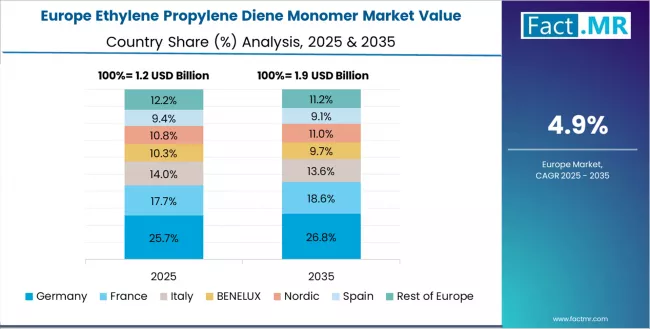
Ethylene Propylene Diene Monomer Market Europe Country Market Share Analysis, 2025 & 2035 | Source: Fact.MR
The ethylene propylene diene monomer market in Europe is projected to grow from USD 1.31 billion in 2025 to USD 2.33 billion by 2035, registering a CAGR of 5.9% over the forecast period. Germany is expected to maintain its leadership position with a 28.0% market share in 2025, adjusting to 27.5% by 2035, supported by its extensive automotive manufacturing concentration, comprehensive chemical industry expertise, and advanced rubber compounding capabilities serving major European markets.
France follows with a 20.5% share in 2025, projected to reach 20.8% by 2035, driven by comprehensive automotive production including electric vehicle manufacturing and construction roofing membrane adoption concentrating in major urban development regions implementing sustainable building practices. The UK holds a 17.0% share in 2025, expected to maintain 17.2% by 2035 through ongoing automotive component manufacturing and industrial sealing applications.
Italy commands a 15.5% share, while Spain accounts for 13.0% in 2025. The Rest of Europe region is anticipated to gain momentum, expanding its collective share from 6.0% to 6.2% by 2035, attributed to increasing EPDM adoption in Nordic countries and emerging Eastern European automotive component manufacturing facilities implementing modern sealing technologies.
How does Quality Define Ethylene Propylene Diene Monomer Adoption in Japan?
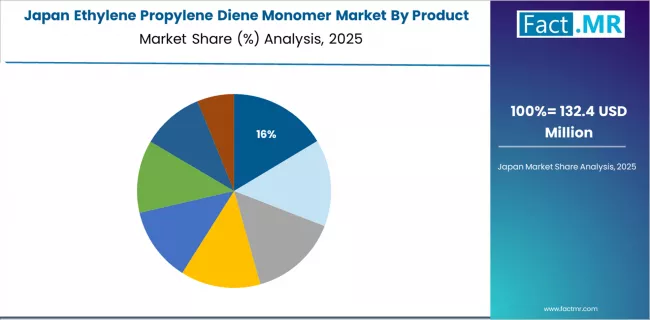
Ethylene Propylene Diene Monomer Market Japan Market Share Analysis By Product | Source: Fact.MR
The ethylene propylene diene monomer market in Japan demonstrates a mature and precision-focused landscape, characterized by sophisticated integration of advanced molding technologies with comprehensive quality validation systems across automotive, electronics, and industrial equipment applications, supported by rigorous specification compliance and continuous improvement programs. Japan's emphasis on manufacturing excellence and zero-defect production drives demand for premium EPDM compounds that support exacting dimensional tolerances and long-term sealing reliability in mission-critical applications.
The market benefits from strong partnerships between international polymer producers and domestic automotive suppliers, including established tier-one component manufacturers and precision molding specialists, creating comprehensive technical ecosystems that prioritize consistent quality and collaborative innovation. Manufacturing centers showcase advanced EPDM implementations where automated inspection systems achieve performance improvements through integrated statistical process control approaches and comprehensive accelerated aging validation programs.
What drives Premium Positioning in South Korea's Market?
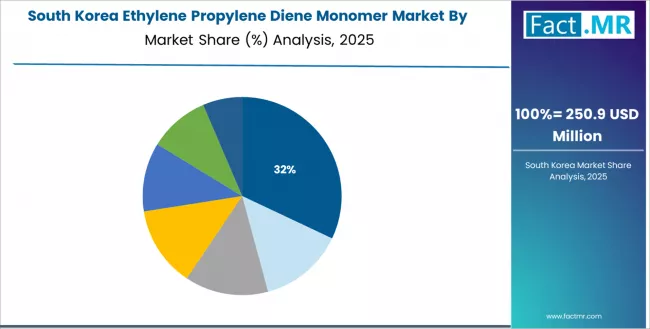
Ethylene Propylene Diene Monomer Market South Korea Market Share Analysis By Application | Source: Fact.MR
The South Korean ethylene propylene diene monomer market is characterized by strong automotive-driven presence, with companies like local component manufacturers and international polymer suppliers maintaining significant positions through comprehensive technical portfolios and advanced formulations for vehicle sealing and electronics insulation applications.
The market is demonstrating a growing emphasis on electric vehicle sealing solutions and specialized high-performance compounds, as South Korean automotive manufacturers increasingly demand premium EPDM formulations that combine superior compression set resistance with excellent thermal management properties and precise moldability deployed across battery electric vehicle platforms and advanced driver assistance system components.
Local innovations and specialty compound launches are gaining market share through strategic emphasis on conductive EPDM grades, offering specialized formulations including electromagnetic shielding compounds and flame-retardant variants for comprehensive vehicle electrification support. The competitive landscape shows increasing collaboration between EPDM compounders and automotive OEMs, creating integrated development models that combine material science expertise with application engineering insights and rapid prototype validation capabilities.
Competitive Landscape of the Ethylene Propylene Diene Monomer market
The ethylene propylene diene monomer market features approximately 15-20 meaningful players with moderate concentration, where the top three companies control roughly 35-45% of global market share through established production capacity, comprehensive polymer expertise, and extensive customer relationships across automotive and industrial rubber sectors. Competition centers on polymer quality consistency, technical application support, and sustainable production capabilities rather than commodity pricing alone.
Market leaders include Dow maintaining a 17.5% market share, Exxon Mobil, and ARLANXEO, which maintain competitive advantages through vertically integrated petrochemical operations, advanced polymerization technologies, and deep expertise in synthetic rubber chemistry, creating high customer retention among automotive OEMs and tire manufacturers seeking reliable material supply. These companies leverage continuous innovation in catalyst systems and strategic sustainability initiatives to defend market positions while expanding into adjacent categories including specialty elastomers and thermoplastic compounds.
Challengers encompass established chemical companies including Sumitomo Chemical, Lion Elastomers, and Mitsui Chemicals, which compete through regional production footprints and specialized grade portfolios. Asian producers, including PetroChina, Kumho Polychem, and SK Geo Centric, focus on cost-competitive offerings and domestic market penetration, offering differentiated capabilities in rapid delivery, flexible order quantities, and responsive technical service approaches.
Emerging specialty compounders and regional rubber processors create competitive pressure through customized formulation development and niche application focus, particularly in high-growth markets including India and China, where local compounding capabilities provide advantages in rapid prototype development and cost-effective solutions. Market dynamics favor companies that combine polymer production expertise with comprehensive compounding knowledge and technical support that addresses the complete value chain from monomer synthesis through finished part fabrication. Strategic emphasis on bio-based feedstock integration, carbon-neutral production facilities, and circular economy partnerships enables differentiation in increasingly sustainability-focused automotive and construction industries across developed and emerging markets.
Global Ethylene Propylene Diene Monomer market - Stakeholder Contribution Framework
Ethylene propylene diene monomer represents a critical synthetic elastomer that enables manufacturers to achieve superior weather resistance and long-term durability while addressing demanding sealing requirements and environmental exposure conditions that conventional rubber materials cannot withstand across automotive, construction, and industrial applications, typically delivering excellent aging characteristics, superior moisture resistance, and outstanding electrical insulation compared to natural rubber alternatives alone while ensuring structural integrity and comprehensive performance reliability. With the market projected to grow from USD 5.10 billion in 2025 to USD 8.88 billion by 2035 at a 5.7% CAGR, these solutions offer compelling advantages for automotive sealing systems, roofing membranes, and diverse industrial applications requiring long-term environmental resistance. Scaling market penetration and sustainable production achievement requires coordinated action across petrochemical policy, technical standards development, polymer producers, rubber fabricators, and recycling infrastructure initiatives.
How Could Governments Spur Local Development and Adoption?
- Automotive Manufacturing Support: Include advanced sealing technologies in vehicle lightweighting programs, providing targeted support for EPDM compound testing facilities and supporting research institutions through polymer science development grants and material characterization investments.
- Tax Policy & Investment Support: Implement reduced tax rates for bio-based EPDM production, provide tax incentives for companies investing in sustainable polymerization technologies and renewable feedstock procurement, and establish favorable import duties that encourage domestic polymer manufacturing over commodity imports.
- Regulatory Framework Development: Create streamlined approval processes for new EPDM grades across automotive and construction applications, establish clear performance standards and testing protocols for sealing components, and develop international harmonization efforts that facilitate cross-border material qualifications.
- Circular Economy & Recycling Support: Fund research into EPDM devulcanization technologies, invest in rubber recycling infrastructure development that supports material recovery from end-of-life tires and vehicles, and explore extended producer responsibility frameworks for vulcanized rubber products.
- Research & Innovation Support: Establish public-private partnerships for advanced elastomer research, support academic-industry collaborations investigating bio-based monomers and sustainable vulcanization systems, and create regulatory environments that encourage innovation in recyclable rubber compounds.
How Could Industry Bodies Support Market Development?
- Technical Standards & Testing Protocols: Define standardized performance testing methodologies for EPDM seal compression set assessment across automotive applications, establish universal quality specifications and compound classification systems, and create material property databases that engineers and designers can rely on for material selection.
- Market Education & Application Guidelines: Lead messaging that demonstrates EPDM advantages over alternative elastomers, emphasizing weathering resistance, cost-effectiveness, and processing versatility compared to silicone or fluoroelastomer alternatives through coordinated industry awareness campaigns.
- Sustainability Standards Development: Develop guidelines for bio-based content verification, recyclability enhancement, carbon footprint assessment, and responsible sourcing, ensuring environmental stewardship across polymerization and compounding operations.
- Professional Development: Run certification programs for rubber compounders, quality control technicians, and application engineers on optimizing EPDM formulations, vulcanization system selection, and troubleshooting processing challenges across diverse manufacturing environments.
How Could Manufacturers and Technology Players Strengthen the Ecosystem?
- Advanced Product Development: Develop next-generation EPDM grades with enhanced sustainability profiles, optimized vulcanization characteristics, and application-specific performance that improves sealing reliability while reducing environmental impact through bio-based monomer integration.
- Technical Application Support: Provide comprehensive compound selection guidance, processing parameter recommendations, and mold design consultation that helps fabricators successfully implement EPDM components into production operations.
- Sustainability Innovation Programs: Offer comprehensive renewable feedstock integration, carbon-neutral polymerization facilities, and end-of-life recyclability solutions that support circular economy objectives and transparent environmental impact reporting.
- Research & Development Networks: Build comprehensive R&D capabilities, collaborative testing programs, and application development laboratories that ensure EPDM compounds maintain superior performance standards and continuous innovation across diverse sealing applications.
How Could End-User Industries and Fabricators Navigate the Market?
- Advanced Material Integration: Incorporate high-performance EPDM compounds into comprehensive vehicle sealing strategies, with particular focus on electric vehicle battery enclosures, thermal management systems, and acoustic insulation requirements.
- Process Optimization Excellence: Establish comprehensive vulcanization control protocols, compound handling best practices, and quality assurance systems through optimized molding operations and operator training programs.
- Supply Chain Partnership: Implement collaborative relationships with polymer producers and compounders ensuring reliable material supply, technical support access, and joint development opportunities throughout product lifecycle.
- Innovation Collaboration: Develop co-creation programs with EPDM suppliers exploring new sealing applications, specialty compounds, and performance enhancements that differentiate products and enhance manufacturing efficiency.
How Could Investors and Financial Enablers Unlock Value?
- Production Capacity Financing: Provide growth capital for established companies like Dow, Exxon Mobil, and regional producers to expand polymerization facilities and compounding capabilities supporting market demand growth.
- Innovation Investment: Back startups developing bio-based EPDM technologies, devulcanization systems, and specialty compound platforms that enhance sustainability credentials and functional capabilities.
- Market Expansion Funding: Finance distribution network expansion for EPDM producers establishing operations in high-growth regions including India and China, supporting localization initiatives that address regional automotive requirements.
- Technology Integration Investment: Support companies developing AI-driven compound formulation tools, predictive performance modeling platforms, and digital quality control systems that enhance development efficiency through technology-enabled solutions.
Key Players in the Ethylene Propylene Diene Monomer Market
- Dow Inc.
- Exxon Mobil Corporation
- ARLANXEO
- Sumitomo Chemical Co., Ltd.
- Lion Elastomers
- Mitsui Chemicals, Inc.
- PetroChina Company Limited
- Kumho Polychem Co., Ltd.
- SK Geo Centric Co., Ltd.
- Versalis S.p.A. (an Eni company)
Segmentation
Scope of the Report
| Items | Values |
|---|---|
| Quantitative Units | USD 5.10 Billion |
| Product | Seals & O-Rings, Hoses, Gaskets, Rubber Compounds, Roofing Membranes, Connectors & Insulators, Weather Stripping, Others |
| Application | Automotive, Building & Construction, Electrical & Electronics, Lubricant Additives, Plastic Modifications, Tires & Tubes, Others |
| Regions Covered | Asia Pacific, Europe, North America, Latin America, Middle East & Africa |
| Country Covered | India, China, USA, Germany, Japan, Brazil, UAE, and 40+ countries |
| Key Companies Profiled | Dow, Exxon Mobil Corporation, ARLANXEO, Sumitomo Chemical Co. Ltd., Lion Elastomers, Mitsui Chemicals, PetroChina, Kumho Polychem, SK Geo Centric, Versalis (Eni) |
| Additional Attributes | Dollar sales by product and application categories, regional adoption trends across Asia Pacific, Europe, and North America, competitive landscape with polymer producers and rubber compounding companies, product specifications and vulcanization system requirements, integration with automotive sealing technologies and sustainable manufacturing practices, innovations in bio-based monomers and devulcanization processes, and development of specialized applications with compression set resistance and weathering durability capabilities. |
Source: Fact.MR analysis. Updated Dec 1, 2025
Ethylene Propylene Diene Monomer market by Segments
-
Product:
- Seals & O-Rings
- Hoses
- Gaskets
- Rubber Compounds
- Roofing Membranes
- Connectors & Insulators
- Weather Stripping
- Others
-
Application:
- Automotive
- Building & Construction
- Electrical & Electronics
- Lubricant Additives
- Plastic Modifications
- Tires & Tubes
- Others
-
Region:
- Asia Pacific
- China
- Japan
- South Korea
- India
- Australia
- Thailand
- Rest of Asia Pacific
- Europe
- Germany
- UK
- France
- Italy
- Spain
- Denmark
- Sweden
- Norway
- Rest of Europe
- North America
- USA
- Canada
- Mexico
- Latin America
- Brazil
- Argentina
- Rest of Latin America
- Middle East & Africa
- South Africa
- Saudi Arabia
- UAE
- Kuwait
- Rest of Middle East & Africa
- Asia Pacific
Frequently Asked Questions
How big is the ethylene propylene diene monomer market in 2025?
What will be the size of ethylene propylene diene monomer market in 2035?
How much will be the ethylene propylene diene monomer market growth between 2025 and 2035?
What are the key product types in the ethylene propylene diene monomer market?
Which application segment to contribute significant share in the ethylene propylene diene monomer market in 2025?
Who worked on this report


Preview the report firsthand - request a free sample
Free SampleGet the brochure for pricing and purchase details
Download PDF