- Market Value (2025): USD 4.4 Bn
- Estimated Value (2026): USD 4.6 Bn
- Forecast Value (2036): USD 7.3 Bn
- CAGR (2026-2036): 4.7%
What is the Food Emulsifier Market forecast to be worth by 2036?
USD 4.6 billion in 2026 to USD 7.3 billion by 2036 at 4.7% CAGR.
- The food emulsifier market reached USD 4.4 billion in 2025 as bakery, dairy and packaged food processors relied on repeatable texture systems.
- Demand is projected to increase from USD 4.6 billion in 2026 to USD 7.3 billion by 2036.
- The market is forecast to record 4.7% CAGR from 2026 to 2036 as manufacturers use emulsifiers to control texture and stability.
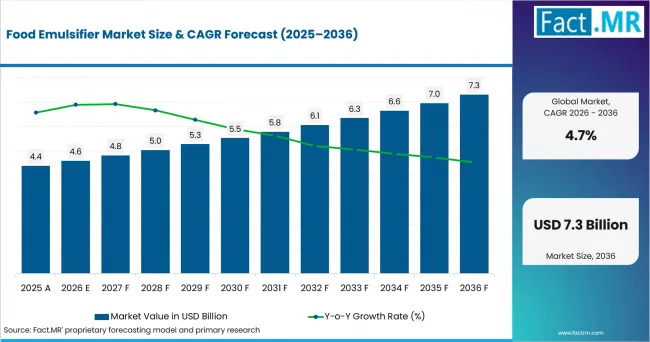
Food Emulsifier Market Value Analysis | Source: Fact.MR
What are the defining numbers behind Food Emulsifier Market growth?
USD 2.7 billion absolute opportunity by 2036, led by Lecithin Based Emulsifiers, Bakery Products and Food Manufacturing Companies.
- Demand Drivers in the Market
- Bakery manufacturers need emulsifiers that keep batter aeration stable so bread, buns and cakes hold texture after scale-up.
- Dairy processors use emulsifier systems to limit phase separation in milk-based beverages and frozen dairy products.
- Packaged food producers require lot-to-lot functionality since shelf-life claims depend on consistent dispersion and mouthfeel.
- Ingredient procurement teams favor direct industrial sales when technical dosing support reduces plant trial failures.
- Key Segments Analyzed
- By Product: Lecithin Based Emulsifiers are anticipated to hold 63.80% share in 2026 because natural lipid functionality suits bakery and beverage formulations.
- By Application: Bakery Products are projected to account for 41.60% share in 2026 as bread, buns and cake premixes require stable aeration during processing.
- By End Use: Food Manufacturing Companies are expected to capture 58.90% share in 2026 due to repeat production contracts in large plants.
- By Technology: Lipid Based Emulsification Technology is estimated to represent 52.40% share in 2026 owing to practical oil-water dispersion needs.
- By Formulation: Powdered Emulsifier Systems are forecast to hold 44.30% share in 2026 as dry blends suit premixes and storage in industrial bakeries.
- By Distribution Channel: Direct Industrial Sales are projected to account for 61.70% share in 2026 since manufacturers need technical support during recipe transfer.
- Analyst Opinion at Fact.MR
- Shambhu Nath Jha, Principal Consultant at Fact.MR, states, "Food emulsifier selection is becoming a plant-level decision, not only a formulation choice. The market is expected to reward suppliers that can prove texture stability across bakery, dairy and beverage lines. Winning portfolios combine lecithin expertise, dry-system know-how and practical application support."
- Strategic Implications
- Food manufacturers should test emulsifier performance under actual mixing, baking or cooling conditions.
- Ingredient suppliers should document allergen, additive and origin data before qualification.
- Bakery brands should separate texture performance from label claims during emulsifier comparison.
- Distributors should support smaller processors with dosing guidance because misuse can create avoidable texture defects.
Germany is expected to record 5.4% CAGR through 2036 owing to bakery depth. Brazil is projected to advance at 4.9% CAGR as dairy and bakery processing expands. The USA is anticipated to post 4.5% CAGR due to packaged-food spending. The UK is estimated to hold 4.0% CAGR, while Japan is forecast to reach 3.5% CAGR.
How does the Food Emulsifier Market break down by segment?
Lecithin Based Emulsifiers lead at 63.8%; Bakery Products lead at 41.6%.
Which product dominates?
Lecithin Based Emulsifiers hold 63.8% share in 2026.
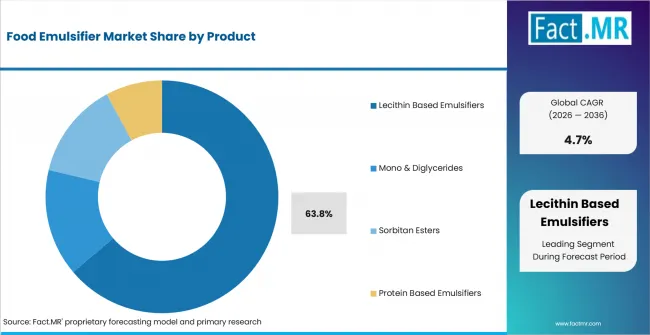
Food Emulsifier Market Analysis By Product | Source: Fact.MR
Lecithin Based Emulsifiers are expected to hold 63.8% share in 2026 because soy and sunflower systems support clean dispersion in fat-water blends. Mono and diglycerides remain useful where batter softness and anti-staling performance carry more weight, while sorbitan esters serve confectionery recipes that need fat stability.
What leads the Application segment?
Bakery Products lead with 41.6% share in 2026.
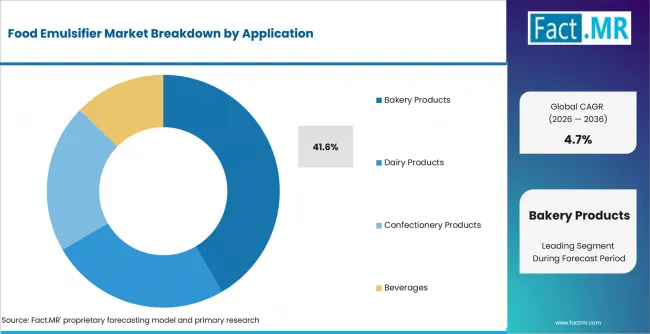
Food Emulsifier Market Analysis By Application | Source: Fact.MR
Bakery Products are projected to account for 41.6% share in 2026 due to regular use in bread, buns and cakes. Dairy products follow where beverages and frozen products need phase stability. Palsgaard linked its 2025 Brazil Emulpals production to cake mix whipping agents and regional bakery premix demand. BLS counted 81,880 bakers in U.S. food manufacturing in 2025.
How does End Use shape demand?
Food Manufacturing Companies capture 58.9% share in 2026.
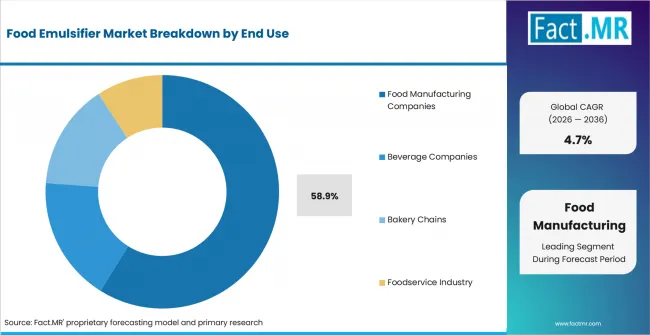
Food Emulsifier Market Analysis By End Use | Source: Fact.MR
Food Manufacturing Companies are anticipated to capture 58.9% share in 2026 as large processors qualify emulsifier lots for repeated batch output. Dairy processors require similar control in high-volume beverage and frozen dairy lines. USDA ERS reported a 88.2-cent marketing share in each U.S. food dollar in 2024, covering processing and other post-farm activities. BLS counted 43,328 private U.S. food-manufacturing establishments in Q4 2025.
What supports Technology demand?
Lipid Based Emulsification Technology represents 52.4% share in 2026.
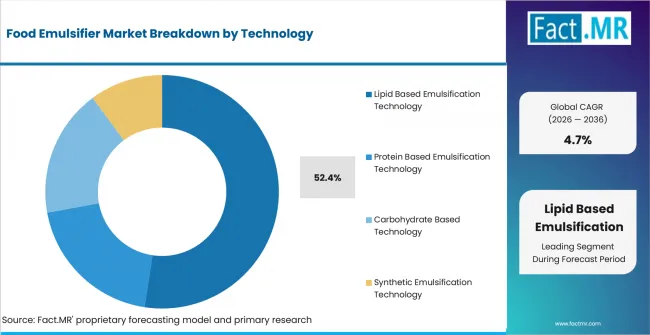
Food Emulsifier Market Analysis By Technology | Source: Fact.MR
Lipid Based Emulsification Technology is estimated to represent 52.4% share in 2026 owing to the wide use of lecithins and mono-glycerides. Modified lipid systems remain relevant where processors need stronger aeration or anti-staling performance.
Which Formulation leads?
Powdered Emulsifier Systems hold 44.3% share in 2026.
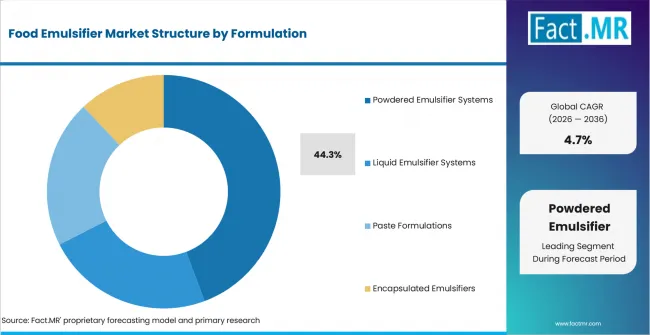
Food Emulsifier Market Analysis By Formulation | Source: Fact.MR
Powdered Emulsifier Systems are forecast to hold 44.3% share in 2026 as bakeries and premix makers value easy dosing. Dry blend systems simplify flour-based mixing and reduce handling variability. Paste and encapsulated formats serve recipes that need controlled release or thicker texture.
How does Distribution Channel affect procurement?
Direct Industrial Sales account for 61.7% share in 2026.
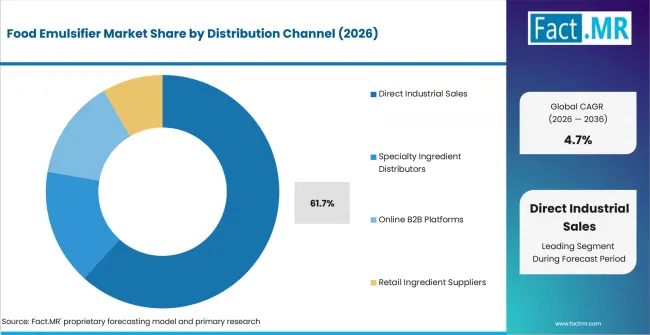
Food Emulsifier Market Analysis By Distribution Channel | Source: Fact.MR
Direct Industrial Sales are projected to account for 61.7% share in 2026 since food manufacturers need formulation support before approval. Contracts give suppliers access to plant trials and repeat orders. Specialty distributors remain useful for smaller plants and regional brands.
What is accelerating Food Emulsifier Market adoption, and what is holding it back?
Bakery and prepared-food processing drive it; additive documentation and formulation cost restrain it.
| Driver | (~) % Impact on CAGR | Geographic Relevance | Impact Timeline |
|---|---|---|---|
| Bakery and premix stabilization | +1.4% | Germany, Brazil, USA | Short term (<= 2 years) |
| Lecithin-based reformulation | +1.1% | Europe, USA, Japan | Short term (<= 2 years) |
| Dairy and beverage texture control | +0.9% | Brazil, UK, Japan | Medium term (2-4 years) |
| Industrial shelf-life management | +0.8% | USA, Germany, UK | Medium term (2-4 years) |
| Direct technical sales | +0.5% | Global | Long term (>= 4 years) |
- Bakery and premix stabilization: Bread and cake mixes need emulsifiers that protect structure during mixing and baking. Bakery plants qualify these systems directly inside production recipes.
- Lecithin-based reformulation: Lecithin systems benefit from broad familiarity among food formulators. Soy lecithin balances cost and function, while sunflower lecithin supports non-soy positioning.
- Industrial shelf-life management: Packaged food producers use emulsifiers to limit texture drift across shelf life. Suppliers gain when dosage support links to shelf-life testing.
- Direct technical sales: Emulsifier approval often requires plant trials, so direct contracts carry more value than catalog sales. Technical teams adjust dosage and mixing order.
Opportunity Impact Analysis
| Opportunity | (~) % Impact on CAGR | Geographic Relevance | Impact Timeline |
|---|---|---|---|
| Powdered functional systems | +0.9% | Brazil and Germany | Medium term (2-4 years) |
| Plant-based lecithin sourcing | +0.8% | USA, UK, Japan | Medium term (2-4 years) |
| Application-center support | +0.7% | Brazil and Latin America | Short term (<= 2 years) |
| Beverage-emulsion stability | +0.5% | Japan and USA | Long term (>= 4 years) |
- Powdered functional systems: Powdered emulsifiers create opportunity where processors want simpler storage and controlled addition to dry mixes. The format fits bakery premixes.
- Plant-based lecithin sourcing: Sunflower and soy lecithin systems create room for suppliers with origin documentation. Brands use these options when label strategy changes.
- Application-center support: Technical centers help customers translate laboratory formulas into plant recipes. This support reduces failed trials when cake mixes, beverage bases or dairy systems move from bench work into production.
- Beverage-emulsion stability: Functional beverages and non-alcoholic drinks create a longer-term route for emulsifiers. Suppliers must prove heat and storage stability.
Restraints Impact Analysis
| Restraint | (~) % Impact on CAGR | Geographic Relevance | Impact Timeline |
|---|---|---|---|
| Palm and oilseed feedstock cost | -0.8% | Global | Short term (<= 2 years) |
| Additive documentation scrutiny | -0.6% | EU, UK, USA | Short term (<= 2 years) |
| Application-specific dosage trials | -0.5% | Bakery and dairy plants | Medium term (2-4 years) |
| Small processor price sensitivity | -0.4% | Brazil, Japan, UK | Medium term (2-4 years) |
- Palm and oilseed feedstock cost: Lecithins and mono-glyceride systems depend on agricultural oils and fats. Cost swings affect contract pricing and reformulation timing.
- Application-specific dosage trials: An emulsifier that works in one recipe may fail in another. Plant teams therefore need trials before switching systems.
- Small processor price sensitivity: Regional bakeries and smaller dairy plants often buy on narrower margins. They may keep incumbent ingredients when testing costs rise.
Which countries are scaling Food Emulsifier Market fastest?
- The country comparison spans 1.9 percentage points and forms distinct growth bands across the forecast period.
- Germany remains 0.5 percentage point above Brazil through bakery depth, prepared-food manufacturing and demand for documented emulsifier systems.
- Brazil remains 0.4 percentage point above the USA as dairy scale, bakery premix localization and domestic oilseed availability support emulsifier demand.
- The USA remains 0.5 percentage point above the UK through packaged-food scale, processing depth and technical support for large manufacturing plants.
- The UK remains 0.5 percentage point above Japan as agri-food manufacturing and bakery channel demand sustain food-grade emulsifier use.
- Japan closes the displayed range through premium food exports, beverage formulation needs and demand for predictable sensory performance.
Comparable CAGRs can create different entry conditions due to bakery and dairy processing scale, formulation requirements, ingredient qualification and local technical-support needs. Full report coverage includes North America, Latin America, Europe, East Asia, South Asia and Pacific, Middle East and Africa.
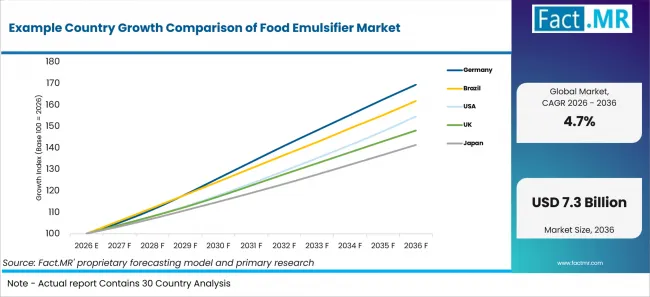
Example Country Growth Comparison Of Food Emulsifier Market | Source: Fact.MR
| Country | CAGR (2026-2036) |
|---|---|
| Germany | 5.4% |
| Brazil | 4.9% |
| USA | 4.5% |
| UK | 4.0% |
| Japan | 3.5% |
What supports Germany adoption?
5.4% CAGR through 2036, driven by bakery depth and prepared-food manufacturing.
Germany’s growth reflects strong bakery and prepared-food production, where emulsifiers support texture, aeration and shelf stability. Industrial bakeries continue to use lecithin and powdered systems, while EU-compliant documentation, oilseed costs and fresh label reviews can slow supplier changes.
How is Brazil scaling demand?
4.9% CAGR through 2036, supported by dairy scale and bakery premix localization.
Brazil’s growth is supported by dairy processing and localized bakery premix production. IBGE reported 27.51 billion liters of raw milk acquisition in 2025, up 8.5% from 2024. Food manufacturers also benefit from direct technical support, while freight costs, unfamiliar dosing routines and repeated shelf-life testing can slow adoption of new emulsifier systems.
What is driving USA growth from 2026 to 2036?
4.5% CAGR through 2036, backed by packaged-food scale and processing depth.
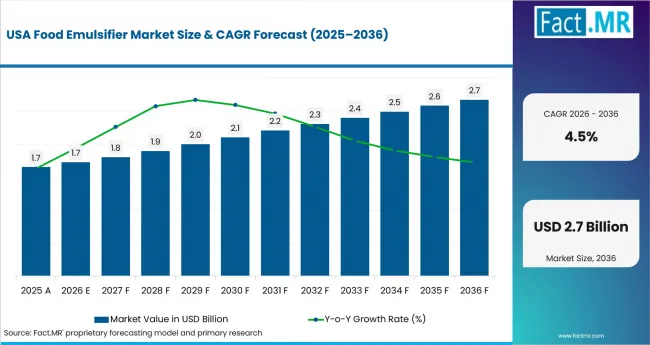
Food Emulsifier Market Country Value Analysis | Source: Fact.MR
The USA’s growth reflects its large packaged-food and processing base, where emulsifiers help protect texture during national distribution. Large plants pair supply contracts with technical support, while label review, testing costs and commodity oil and fat price swings can delay switching from incumbent systems.
What supports the UK outlook?
4.0% CAGR through 2036, led by agri-food manufacturing and bakery channel demand.
The UK’s growth is supported by active food, drink and catering channels and continued use of emulsifiers in bakery and dairy products. Retailer label scrutiny, stable approved ingredient lists and imported ingredient exposure can still limit faster reformulation.
How does Japan perform?
3.5% CAGR through 2036, shaped by premium food exports and beverage formulation needs.
Japan’s growth reflects demand from premium food producers and beverage manufacturers that require predictable texture and dispersion. Japan MAFF reported agricultural, forestry, fishery and food exports of JPY 1,700.5 billion in 2025, up 12.8% from the previous year. High quality expectations, cautious ingredient changes and import-sensitive lipid costs can extend validation and adoption cycles.
Who leads the Food Emulsifier Market?
Kerry Group and Palsgaard A/S lead direct food emulsifier coverage, while IFF and LDC strengthen application depth.
Kerry Group and Palsgaard A/S hold clear relevance across bakery, beverage and prepared-food formulation systems. IFF participates through food ingredients and Danisco heritage. Palsgaard opened an advanced Application Centre in Navi Mumbai in June 2025 and announced it in July 2025; the facility includes industrial-scale pilot plants for bakery, dairy, ice cream, chocolate and confectionery applications.
Louis Dreyfus Company is included through the former BASF Food and Health Performance Ingredients portfolio. That portfolio covers emulsifiers and related performance ingredients. Puratos, Lasenor, Oleon, Riken Vitamin and Zhengzhou Honest complete the profiled set.
Which companies are the key providers?
Kerry Group and Palsgaard A/S are key providers. IFF and LDC are also profiled. Puratos, Lasenor, Oleon, Riken Vitamin and Zhengzhou Honest complete the company set.
- Kerry Group
- Palsgaard A/S
- Louis Dreyfus Company, including BASF Food and Health Performance Ingredients
- International Flavors & Fragrances Inc.
- Puratos
- Lasenor Emul, S.L.
- Oleon NV
- Riken Vitamin Co., Ltd.
Bibliography
- BASF SE, & Louis Dreyfus Company. (2025, September 30). BASF and Louis Dreyfus Company complete sale and purchase transaction for BASF’s Food and Health Performance Ingredients Business.
- Department for Environment, Food & Rural Affairs. (2026, July 29). Agriculture in the United Kingdom 2025: Chapter 14—The food chain.
- European Commission. (2025, April 2). Commission Regulation (EU) 2025/651 of 2 April 2025 amending Regulation (EC) No 1333/2008 as regards the use of mono- and diglycerides of fatty acids (E 471) and carnauba wax (E 903) as glazing agents on certain fresh fruit and cassavas and of lecithins (E 322) and fatty acids (E 570) as carriers in glazing agents on cassavas.
- Instituto Brasileiro de Geografia e Estatística. (2026, March 18). In 2025, Brazil registers the highest production of milk, leather and eggs in history; slaughter of cattle, chickens and pigs also hits record.
- Palsgaard A/S. (2025, October 8). Palsgaard Brazil begins producing Emulpals® cake mix emulsifiers.
- U.S. Department of Agriculture, Economic Research Service. (2026, March 10). Food Dollar—Summary findings.
- Eurostat. (2026, March 26). EU trade in goods surplus down to €128 billion in 2025.
This Report Answers
- The report provides strategic intelligence on Product and Application choices that shape food formulation decisions.
- Segment analysis covers Lecithin Based Emulsifiers and Bakery Products as 2026 share leaders.
- Country outlook evaluates Germany, Brazil, the USA, the UK and Japan.
- Competitive analysis profiles Kerry Group, Palsgaard A/S, IFF and Louis Dreyfus Company. Puratos, Lasenor, Oleon, Riken Vitamin and Zhengzhou Honest complete the provider view.
- Formulation assessment covers powdered, liquid, paste and encapsulated emulsifier systems.
What does the Food Emulsifier Market cover?
Food emulsifiers stabilize oil and water phases where texture and mouthfeel need consistent control.
Core food emulsifier market coverage includes lecithin based emulsifiers, mono and diglycerides, sorbitan systems and protein based emulsifiers. Coverage connects with adjacent emulsifiers and co-emulsifiers where bakery, dairy and beverage manufacturers use similar functionality. Clean-label emulsifier demand is included when the ingredient performs an emulsifier role.
What is included in the scope?
The scope includes food-grade emulsifiers used in bakery products, dairy products, confectionery and beverages. It includes direct industrial sales and distributor channels when those routes support food manufacturer purchases.
Lecithin systems are included where soy, sunflower or specialty formats support dispersion and texture. Related lecithin systems and egg yolk lecithin applications are considered when the use case remains food formulation. Bakery-related coverage connects with functional bakery ingredients.
What is excluded from the scope?
Non-food emulsifiers used in cosmetics, paints, pharmaceuticals or agrochemicals are excluded. Equipment is excluded unless revenue is tied to food emulsifier ingredients.
The scope excludes stabilizers when they do not perform an emulsifier function. Nearby food stabilizers and Polysorbate-80 surfactants are included only in food-grade emulsion stability systems. Adjacent emulsifier category outlook and organic emulsifiers and stabilizers remain outside the core count unless the food-emulsifier role is clear.
How Was the Analysis Built?
The analysis draws on 120+ sources, 35+ company portfolios, 25+ countries, and 20+ interviews.
- Primary Research: Primary research includes discussions with ingredient manufacturers, distributors, bakery producers, dairy processors and procurement teams.
- Desk Research: Desk research covers government statistics, regulatory publications, company filings, food-additive rules and standards.
- Market Sizing and Forecasting: Market estimates combine historical performance, application demand, segment shares, company participation and country growth.
- Data Validation and Update Cycle: Findings are validated by comparing interviews with public data, company activity and regulatory changes.
What is the report's scope and coverage?
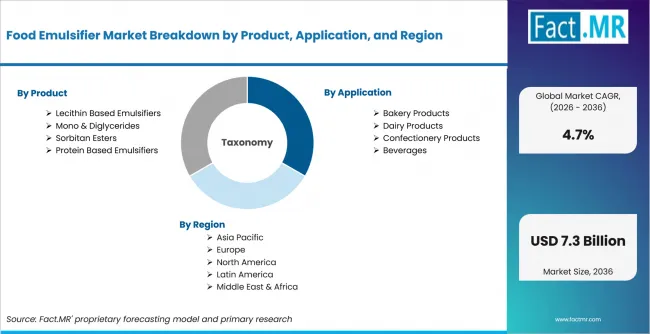
Food Emulsifier Market Breakdown By Product, Application, And Region | Source: Fact.MR
| Attribute | Details |
|---|---|
| Quantitative Units | USD billion |
| Market Definition | Food-grade emulsifier systems used to stabilize oil-water mixtures, improve aeration, protect mouthfeel and support texture control in processed food production |
| Product | Lecithin Based Emulsifiers; Mono & Diglycerides; Sorbitan Esters; Protein Based Emulsifiers |
| Application | Bakery Products; Dairy Products; Confectionery Products; Beverages |
| End Use | Food Manufacturing Companies; Beverage Companies; Bakery Chains; Foodservice Industry |
| Technology | Lipid Based Emulsification Technology; Protein Based Emulsification Technology; Carbohydrate Based Technology; Synthetic Emulsification Technology |
| Formulation | Powdered Emulsifier Systems; Liquid Emulsifier Systems; Paste Formulations; Encapsulated Emulsifiers |
| Distribution Channel | Direct Industrial Sales; Specialty Ingredient Distributors; Online B2B Platforms; Retail Ingredient Suppliers |
| Regions Covered | North America; Latin America; Europe; East Asia; South Asia and Pacific; Middle East and Africa |
| Countries Covered | Germany; Brazil; USA; UK; Japan |
| Key Companies Profiled | Kerry Group; Palsgaard A/S; Louis Dreyfus Company, including BASF Food and Health Performance Ingredients; International Flavors & Fragrances Inc.; Puratos; Lasenor Emul, S.L.; Oleon NV; Riken Vitamin Co., Ltd. |
| Forecast Period | 2026 to 2036 |
| Approach | Hybrid top-down and bottom-up approach using food processing indicators, bakery and dairy application needs, emulsifier functionality, regional production trends, company portfolio review and country adoption patterns |
How is the market segmented?
-
By Product
- Lecithin Based Emulsifiers
- Soy Lecithin Systems
- Sunflower Lecithin Systems
- Mono & Diglycerides
- Distilled Monoglycerides
- Diglyceride Blends
- Sorbitan Esters
- Sorbitan Monostearate Systems
- Polysorbate Systems
- Protein Based Emulsifiers
- Milk Protein Emulsifiers
- Plant Protein Emulsifiers
- Lecithin Based Emulsifiers
-
By Application
- Bakery Products
- Bread & Buns
- Cakes & Pastries
- Dairy Products
- Milk Based Beverages
- Frozen Dairy Products
- Confectionery Products
- Chocolate Products
- Candy Products
- Beverages
- Non Alcoholic Beverages
- Functional Beverages
- Bakery Products
-
By End Use
- Food Manufacturing Companies
- Packaged Food Producers
- Dairy Processing Companies
- Beverage Companies
- Soft Drink Manufacturers
- Functional Beverage Companies
- Bakery Chains
- Industrial Bakeries
- Retail Bakery Chains
- Foodservice Industry
- Quick Service Restaurants
- Catering Services
- Food Manufacturing Companies
-
By Technology
- Lipid Based Emulsification Technology
- Natural Lipid Systems
- Modified Lipid Systems
- Protein Based Emulsification Technology
- Milk Protein Systems
- Plant Protein Systems
- Carbohydrate Based Technology
- Starch Derivatives
- Gum Based Systems
- Synthetic Emulsification Technology
- Non Ionic Surfactants
- Ionic Surfactants
- Lipid Based Emulsification Technology
-
By Formulation
- Powdered Emulsifier Systems
- Dry Blend Systems
- Instant Mix Formulations
- Liquid Emulsifier Systems
- Oil Based Liquids
- Water Based Liquids
- Paste Formulations
- Semi Solid Systems
- Thickened Emulsion Systems
- Encapsulated Emulsifiers
- Micro Encapsulation Systems
- Stability Enhanced Systems
- Powdered Emulsifier Systems
-
By Distribution Channel
- Direct Industrial Sales
- Food Manufacturer Contracts
- Beverage Industry Contracts
- Specialty Ingredient Distributors
- Regional Food Ingredient Distributors
- Global Ingredient Suppliers
- Online B2B Platforms
- Digital Ingredient Marketplaces
- Manufacturer Direct Platforms
- Retail Ingredient Suppliers
- Food Service Retail Channels
- Direct Industrial Sales
-
By Region
- North America
- Latin America
- Western Europe
- Eastern Europe
- East Asia
- South Asia and Pacific
- Middle East & Africa