- Base Value(2025): 425.4 Mn
- Estimated Value(2026): 453.5 Mn
- Forecast Value (2036): 859.3 Mn
- CAGR (2026 - 2036): 6.6%
Polysorbate-80 Market Forecast and Outlook By Fact.MR
In 2025, the Polysorbate-80 market was valued at USD 425.4 million. Based on Fact MR analysis, demand for Polysorbate-80 is estimated to grow to USD 453.5 million in 2026 and USD 859.3 million by 2036. FMR projects a CAGR of 6.6% during the forecast period.
The absolute dollar growth from 2026 to 2036 is USD 405.8 million. Expansion reflects steady growth in pharmaceutical and food emulsifier applications rather than a structural shift in specialty chemical markets. Polysorbate-80 is widely used as a solubilizing and emulsifying agent in injectable drugs, vaccines, processed foods, and cosmetic formulations. Pharmaceutical manufacturers continue incorporating it to stabilize protein based formulations and improve ingredient dispersion. Growth pace remains moderated by regulatory scrutiny over excipient safety, fluctuations in oleochemical feedstock costs, and formulation substitution with alternative surfactants in certain applications.
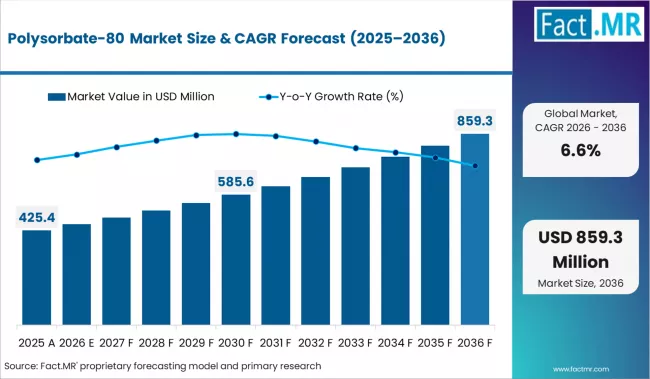
Polysorbate 80 Market Market Value Analysis | Source: Fact.MR
Polysorbate-80 Market Key Takeaways
| Metric | Details |
|---|---|
| Industry Size (2026E) | USD 453.5 million |
| Industry Value (2036F) | USD 859.3 million |
| CAGR (2026 to 2036) | 6.6% |
Source: Fact.MR analysis. Updated Mar 25, 2026
Brazil leads with a projected CAGR of 7.0%, supported by expanding pharmaceutical production and rising demand for food emulsifiers in processed foods. India follows with a CAGR of 6.7%, reflecting growth in domestic drug manufacturing and increasing use of excipients in pharmaceutical formulations. Germany records a CAGR of 6.3%, driven by established pharmaceutical manufacturing and specialty chemical production. China shows a CAGR of 6.0%, supported by expanding pharmaceutical ingredient manufacturing capacity. The United States records the slowest growth at 5.7%, reflecting a mature pharmaceutical excipient market where demand is increasingly linked to replacement and reformulation cycles.
Summary of Polysorbate-80 Market
- Market Definition
- The market comprises production and commercial supply of polysorbate-80, a nonionic surfactant and emulsifying agent used in food, pharmaceutical, cosmetic, and industrial formulations. The compound is produced from sorbitol derivatives and fatty acids and is widely used to stabilize mixtures of oil and water. Polysorbate-80 supports ingredient dispersion, improves formulation stability, and maintains uniform texture during manufacturing and storage across multiple product categories.
- Demand Drivers
- Increasing use of polysorbate-80 as an emulsifier and stabilizing agent in pharmaceutical formulations including vaccines and injectable medicines.
- Rising demand from processed food manufacturers requiring emulsifiers to maintain product texture and ingredient dispersion.
- Growing application in cosmetic and personal care formulations where surfactants improve stability of creams, lotions, and topical products.
- Expansion of pharmaceutical manufacturing and biologic drug production requiring reliable excipients for formulation stability.
- Key Segments Analyzed
- Source: Synthetic polysorbate-80 accounts for about 60% share due to controlled chemical production and consistent quality standards.
- Application: Pharmaceutical applications represent roughly 35% share supported by widespread use in injectable drugs and vaccine formulations.
- Functionality: Emulsifier, dispersant, solubilizer, surfactant, and stabilizer functions support use across multiple industrial formulations.
- Geography: Brazil records the fastest expansion supported by growing pharmaceutical production and increasing demand for food emulsifiers.
- Analyst Opinion at Fact MR
- Shambhu Nath Jha, Principal Consultant, Fact MR, opines, "In this updated edition of the Polysorbate-80 Market report, industry participants will observe that pharmaceutical manufacturing remains a key driver of demand for polysorbate-80. The compound functions as a stabilizing excipient used to improve dispersion and maintain formulation stability in injectable drugs and biologic products. Companies maintaining high purity production standards and regulatory compliance frameworks will sustain stronger positions in the specialty ingredient supply market."
- Strategic Implications or Executive Takeaways
- Expand production capabilities for pharmaceutical grade polysorbate-80 used in vaccine and injectable drug formulations.
- Maintain regulatory compliance with global food and pharmaceutical ingredient standards governing emulsifier usage.
- Strengthen supply chain integration with pharmaceutical manufacturers, food ingredient processors, and cosmetic product developers.
- Invest in purification technologies that support high quality surfactant production for regulated industrial applications.
- Methodology
- Primary interviews conducted with chemical manufacturers, pharmaceutical formulation specialists, food ingredient suppliers, and cosmetic product developers.
- Desk research based on chemical industry publications, company financial reports, regulatory databases, and international trade statistics.
- Market sizing developed through a hybrid approach combining bottom up production analysis and top down demand assessment across food, pharmaceutical, and personal care industries.
- Findings validated through multiple chemical industry sources and expert consultations following Fact MR internal modeling standards.
Segmental Analysis
Polysorbate-80 Market Analysis by Source
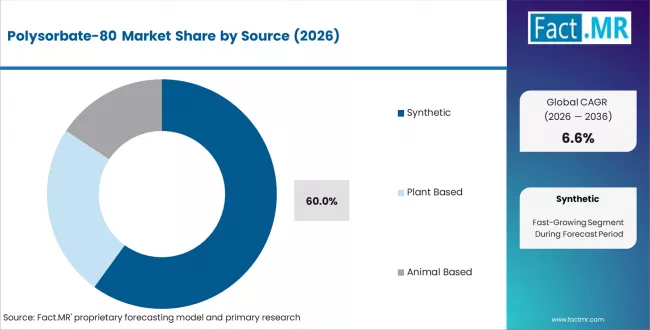
Polysorbate 80 Market Analysis By Source | Source: Fact.MR
- Market Overview: Synthetic polysorbate 80 is projected to account for around 60% share of the polysorbate 80 market by 2026. Synthetic production methods allow manufacturers to maintain consistent quality and large scale supply for industrial applications. The compound is produced through controlled chemical processes that combine sorbitol derivatives with fatty acids and ethylene oxide. This manufacturing approach enables standardized purity levels required for pharmaceutical, food processing, and cosmetic formulations. Industrial users rely on synthetic polysorbate 80 due to its stable emulsification properties and compatibility with large scale formulation processes.
- Demand Drivers:
- Controlled Manufacturing Processes: Synthetic production enables consistent purity and quality standards required in regulated industries.
- Industrial Scale Supply: Chemical synthesis supports large volume production needed for pharmaceutical, food, and personal care product manufacturing.
- Stable Emulsifying Properties: Synthetic polysorbate 80 functions as a reliable emulsifier in formulations that require stable mixtures of oil and water phases.
Polysorbate-80 Market Analysis by Application
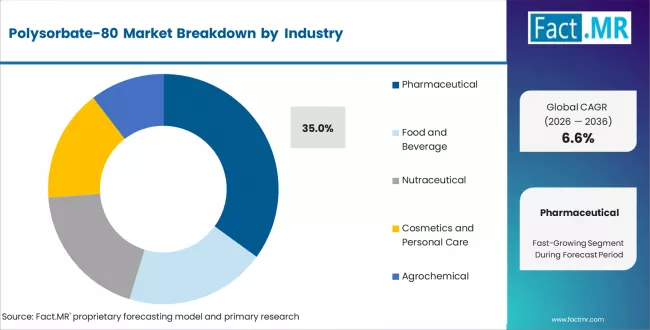
Polysorbate 80 Market Analysis By Application | Source: Fact.MR
- Market Overview: Pharmaceutical applications are expected to represent approximately 35% share of the polysorbate 80 market in 2026. The compound is widely used in pharmaceutical formulations as an emulsifier and solubilizing agent to improve the stability of drug preparations. Polysorbate 80 is incorporated in injectable medicines, vaccines, and oral drug formulations to maintain uniform distribution of active ingredients. Pharmaceutical manufacturers utilize the compound to enhance solubility and maintain formulation stability during storage and transportation.
- Demand Drivers:
- Drug Formulation Stability: Polysorbate 80 helps maintain stable emulsions and suspensions in pharmaceutical preparations.
- Vaccine and Injectable Products: The compound is used in vaccine formulations and injectable drugs to stabilize active ingredients.
- Solubilizing Agent in Medicines: Pharmaceutical manufacturers incorporate polysorbate 80 to improve the solubility of hydrophobic drug compounds in medicinal formulations.
Key Dynamics
Polysorbate-80 Market Drivers, Restraints, and Opportunities
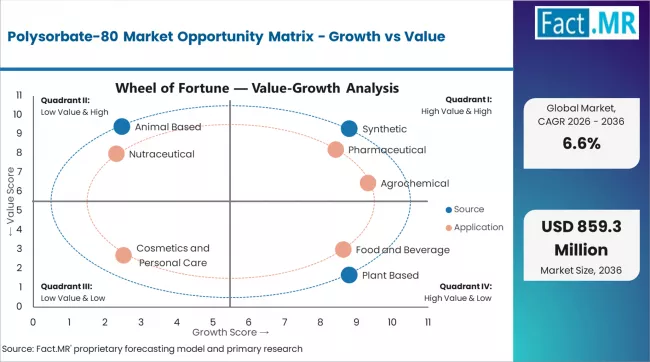
Polysorbate 80 Market Opportunity Matrix Growth Vs Value | Source: Fact.MR
Fact MR analysis indicates that the polysorbate 80 market developed from industrial emulsifier production used in pharmaceutical, food, and cosmetic formulations. Polysorbate 80 functions as a nonionic surfactant that stabilizes emulsions and improves solubility of oil-based ingredients in aqueous solutions. The current market valuation reflects widespread use across injectable pharmaceutical formulations, processed foods, and cosmetic products where emulsification and ingredient dispersion remain essential for product stability. Demand persists because polysorbate 80 supports uniform ingredient distribution during large-scale manufacturing and improves shelf stability of formulated products.
A structural shift is occurring as conventional synthetic emulsifiers face scrutiny related to formulation transparency and ingredient sourcing in consumer products. Polysorbate 80 remains widely used in pharmaceutical manufacturing due to its proven safety profile and compatibility with injectable drug formulations. Food and cosmetic manufacturers increasingly evaluate alternative emulsifiers derived from plant-based or naturally sourced ingredients for certain product categories. Even as these alternatives emerge, pharmaceutical and biotechnology applications maintain steady demand for polysorbate 80 due to strict formulation requirements. Higher purification standards required for pharmaceutical-grade polysorbate support stable market value growth.
- Pharmaceutical Formulation Demand: Drug manufacturers use polysorbate 80 to stabilize biologics, vaccines, and injectable medications where uniform dispersion of active compounds is required.
- Food and Drug Regulation: Regulatory frameworks such as U.S. Food and Drug Administration food additive regulations and European Food Safety Authority approval for E433 polysorbate 80 govern its use in pharmaceutical and food applications.
- Europe Pharmaceutical Manufacturing: Germany, Switzerland, and France maintain strong pharmaceutical production industries that utilize polysorbate 80 in drug formulation and vaccine manufacturing.
Regional Analysis
The market analysis covers key global regions, including North America, East Asia, Europe, South Asia, and Latin America. It is segmented geographically, with specific market dynamics for each region. The full report provides a detailed market attractiveness analysis.
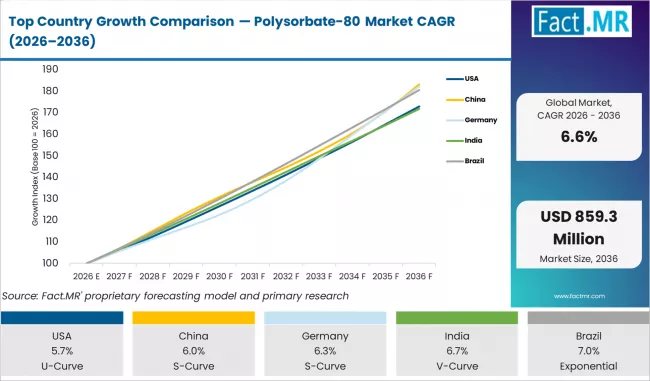
Top Country Growth Comparison Polysorbate 80 Market Cagr 2026 To 2036 | Source: Fact.MR
Polysorbate-80 Market CAGR Table
| Country | CAGR (2026-2036) |
|---|---|
| USA | 5.7% |
| China | 6.0% |
| Germany | 6.3% |
| India | 6.7% |
| Brazil | 7.0% |
Source: Fact.MR analysis. Updated Mar 25, 2026
Source: Fact MR (FMR) analysis, based on proprietary forecasting model and primary research
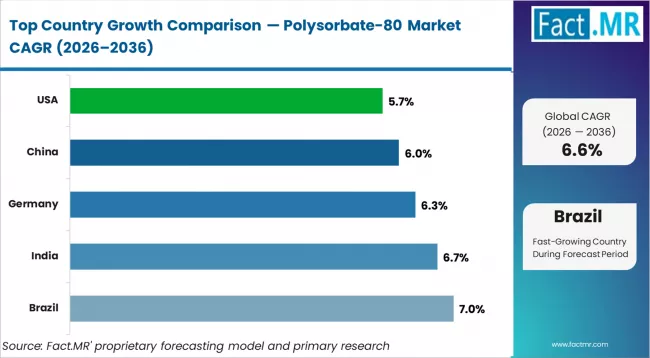
Polysorbate 80 Market Cagr Analysis By Country | Source: Fact.MR
North America:
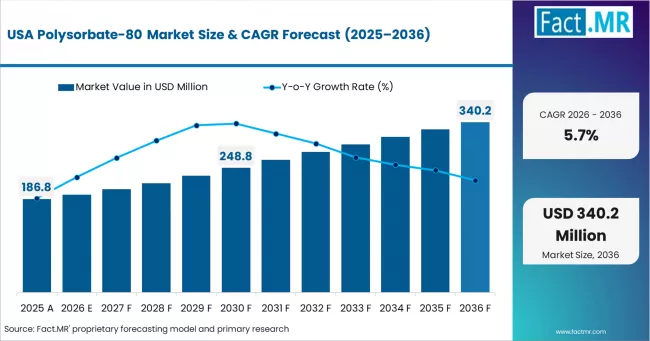
Polysorbate 80 Market Country Value Analysis | Source: Fact.MR
The USA represents a major market supported by pharmaceutical manufacturing, food ingredient processing, and cosmetic formulation applications. Key companies include Croda International Plc, Evonik Industries, and BASF SE.
- USA: Demand for polysorbate-80 in the U.S. is projected to rise at 5.7% CAGR through 2036. Growth is supported by pharmaceutical ingredient manufacturing programs promoted by the Food and Drug Administration (04-2025) and expansion of surfactant production by BASF SE (08-2025).
East Asia:
China represents a key market supported by pharmaceutical ingredient production, food additive manufacturing, and personal care product formulation.
- China: Demand for polysorbate-80 in China is projected to rise at 6.0% CAGR through 2036. Growth is supported by pharmaceutical manufacturing initiatives promoted by the National Medical Products Administration (03-2025) and expansion of ingredient production by Evonik Industries (07-2025).
Europe:
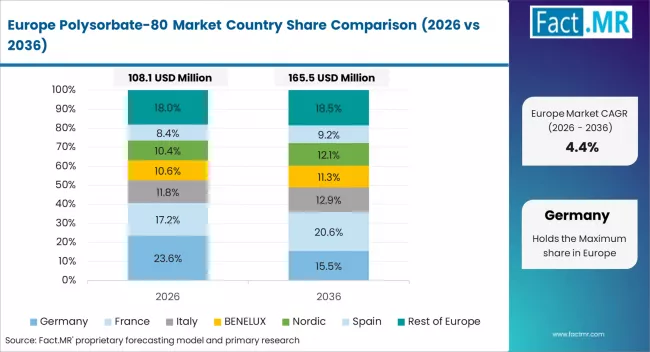
Polysorbate 80 Market Europe Country Market Share Analysis, 2026 & 2036 | Source: Fact.MR
Germany represents an important market supported by pharmaceutical production, specialty chemical manufacturing, and food ingredient innovation.
- Germany: Demand for polysorbate-80 in Germany is projected to rise at 6.3% CAGR through 2036. Growth is supported by pharmaceutical research initiatives promoted by the Federal Institute for Drugs and Medical Devices (03-2025) and ingredient technology development by BASF SE (07-2025).
South Asia:
India represents a growing market supported by pharmaceutical manufacturing expansion, food processing industries, and personal care product production.
- India: Demand for polysorbate-80 in India is projected to rise at 6.7% CAGR through 2036. Growth is supported by pharmaceutical manufacturing initiatives promoted by the Ministry of Chemicals and Fertilizers (05-2025) and expansion of surfactant ingredient production by Croda International Plc (09-2025).
Latin America:
Brazil represents a key market supported by pharmaceutical production, food ingredient manufacturing, and personal care product demand.
- Brazil: Demand for polysorbate-80 in Brazil is projected to rise at 7.0% CAGR through 2036. Growth is supported by pharmaceutical industry development initiatives promoted by the Ministry of Health (04-2025) and expansion of surfactant production by Evonik Industries (08-2025).
Fact MR's analysis of the polysorbate-80 market in North America, East Asia, Europe, South Asia, and Latin America consists of country-wise assessments that include the USA, China, Germany, India, and Brazil. Readers can find detailed trends, regulatory updates, and company-specific investments shaping market growth in these countries.
Competitive Landscape
Competitive Structure and Buyer Dynamics in the Polysorbate-80 Market
Polysorbate 80 Market Analysis By Company | Source: Fact.MR
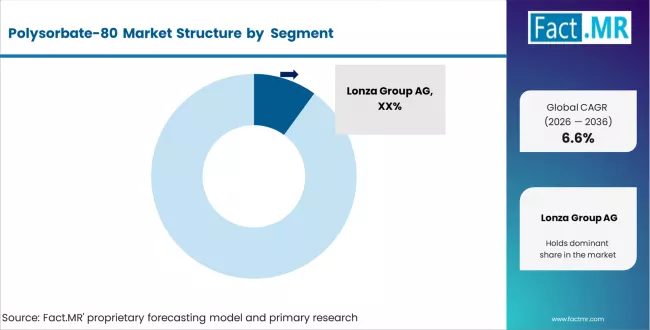
The competitive structure of the Polysorbate-80 Market is moderately fragmented, with global specialty chemical companies and regional ingredient manufacturers participating in supply. Major firms including BASF SE, Croda International Plc, Lonza Group AG, Solenis LLC, and Avril SCA maintain strong positions through established chemical manufacturing capabilities and global distribution networks. These companies supply polysorbate-80 for applications across pharmaceuticals, food processing, cosmetics, and personal care formulations. Regional producers such as Hangzhou Reachin Chemical Co., Ltd., Guangzhou Runhua Food Additive Co., Ltd., and Mohini Organics Pvt. Ltd. contribute through large scale production and cost competitive supply in ingredient markets. Additional suppliers including Lotioncrafter LLC and Camden-Grey Essential Oils, Inc. operate in smaller batch distribution and specialty ingredient segments. Competition in the market is primarily influenced by product purity, regulatory compliance, and formulation compatibility across end use industries.
Several companies maintain structural advantages through integrated chemical production and established supply relationships with pharmaceutical and cosmetic manufacturers. BASF SE, Croda International Plc, and Lonza Group AG benefit from advanced chemical processing infrastructure and strong regulatory compliance capabilities required in pharmaceutical ingredient markets. Large buyers in pharmaceutical manufacturing, cosmetics production, and food processing typically maintain multi supplier procurement strategies to reduce dependence on a single ingredient provider. Procurement teams evaluate suppliers based on quality consistency, certification standards, and supply reliability. This purchasing behavior moderates supplier pricing leverage across the market. Manufacturers with pharmaceutical grade production capability and established regulatory compliance frameworks retain stronger negotiating influence in long term ingredient supply agreements.
Key Players of the Polysorbate-80 Market
- Lonza Group AG
- Avril SCA
- BASF SE
- Solenis LLC
- Hangzhou Reachin Chemical Co., Ltd.
- Croda International Plc
- Lotioncrafter LLC
- Mohini Organics Pvt. Ltd.
- Camden-Grey Essential Oils, Inc.
- Guangzhou Runhua Food Additive Co., Ltd.
Report Scope
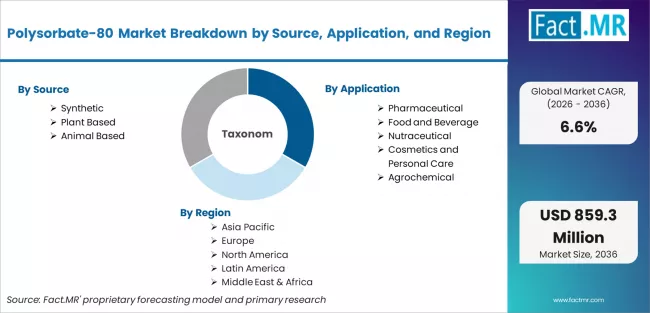
Polysorbate 80 Market Breakdown By Source, Application, And Region | Source: Fact.MR
| Metric | Value |
|---|---|
| Quantitative Units | USD 453.5 million (2026) to USD 859.3 million (2036), at a CAGR of 6.6% |
| Market Definition | The polysorbate-80 market includes the global production and trade of a nonionic surfactant derived from sorbitol and oleic acid, widely used as an emulsifying and solubilizing agent in food products, pharmaceutical formulations, nutraceutical preparations, cosmetics, and agrochemical formulations to improve ingredient dispersion and stability. |
| Source Segmentation | Plant Based, Animal Based, Synthetic |
| Functionality Segmentation | Emulsifier, Dispersant, Solubilizer, Surfactant, Stabilizer |
| Application Segmentation | Food and Beverage, Pharmaceutical, Nutraceutical, Cosmetics and Personal Care, Agrochemical |
| Regions Covered | North America, Latin America, Europe, East Asia, South Asia, Oceania, Middle East and Africa |
| Countries Covered | United States, Canada, Mexico, Brazil, Argentina, Germany, France, United Kingdom, Italy, Spain, China, India, Japan, South Korea, Indonesia, Australia, and 40+ countries |
| Key Companies Profiled | Lonza Group AG, Avril SCA, BASF SE, Solenis LLC, Hangzhou Reachin Chemical Co., Ltd., Croda International Plc, Lotioncrafter LLC, Mohini Organics Pvt. Ltd., Camden-Grey Essential Oils, Inc., Guangzhou Runhua Food Additive Co., Ltd. |
| Forecast Period | 2026 to 2036 |
| Approach | Hybrid top-down and bottom-up market estimation supported by ingredient supply chain analysis, production capacity benchmarking, trade flow assessment, and validation through interviews with emulsifier manufacturers, ingredient distributors, and formulation specialists across food, pharmaceutical, and personal care industries. |
Source: Fact.MR analysis. Updated Mar 25, 2026
Bibliographies
- [1] Food and Drug Administration, USA. (2025). Pharmaceutical ingredient manufacturing programs.
- [2] National Medical Products Administration, China. (2025). Pharmaceutical manufacturing initiatives.
- [3] Federal Institute for Drugs and Medical Devices, Germany. (2025). Pharmaceutical research initiatives.
- [4] Ministry of Chemicals and Fertilizers, India. (2025). Pharmaceutical manufacturing initiatives.
- [5] Ministry of Health, Brazil. (2025). Pharmaceutical industry development initiatives.
- [6] BASF SE. (2025). Surfactant production expansion.
- [7] Evonik Industries. (2025). Ingredient production expansion.
- [8] Croda International Plc. (2025). Surfactant ingredient production expansion.
This Report Addresses
- Market size estimation and revenue forecasts for the Polysorbate-80 Market from 2026 to 2036, supported by specialty chemical production benchmarks and pharmaceutical excipient consumption indicators.
- Growth opportunity analysis across plant based, animal based, and synthetic polysorbate-80 sources used in industrial emulsification, stabilization, and solubilization processes.
- Segment and regional revenue forecasts covering food and beverage, pharmaceutical, nutraceutical, cosmetics and personal care, and agrochemical applications using polysorbate-80 as an emulsifier, dispersant, surfactant, and stabilizer.
- Competitive strategy assessment including specialty chemical manufacturing capability, pharmaceutical grade ingredient production standards, and global distribution network benchmarking among ingredient suppliers and chemical producers.
- Regulatory and compliance evaluation covering frameworks such as United States Food and Drug Administration excipient regulations and European Food Safety Authority approval for E433 polysorbate-80 governing its use in pharmaceutical and food formulations.
- Market report delivery in PDF, Excel, PPT, and interactive dashboard formats designed for specialty chemical procurement planning, pharmaceutical formulation analysis, and food ingredient market evaluation.
- Supply chain and operational risk analysis identifying oleochemical feedstock cost exposure, pharmaceutical grade purification requirements, and regulatory scrutiny over excipient safety affecting production and supply of polysorbate-80.
Polysorbate-80 Market Definition
The Polysorbate-80 Market covers the production and commercial trade of polysorbate-80, a nonionic surfactant and emulsifying agent widely used in food, pharmaceutical, and cosmetic formulations. Polysorbate-80 is derived from sorbitol and oleic acid and is commonly used to stabilize mixtures of oil and water. It helps maintain uniform texture, improve ingredient dispersion, and extend product stability during processing and storage. The compound is used in products such as ice cream, sauces, injectable medicines, vaccines, and personal care formulations. Its primary function is to act as an emulsifier and stabilizer in industrial and consumer product formulations.
Polysorbate-80 Market Inclusions
This report covers global and regional market sizes for polysorbate-80 with forecast analysis for the study period. The market is segmented by application including food processing, pharmaceutical formulations, and personal care products. End users include food manufacturers, pharmaceutical companies, and cosmetic product producers. The study evaluates production patterns, pricing structures, and distribution channels across major manufacturing regions. It also examines supply chain structures and selected trade flow analysis across key chemical and ingredient markets.
Polysorbate-80 Market Exclusions
The report excludes other emulsifiers such as lecithin, mono and diglycerides, and polysorbate-20 that belong to separate ingredient categories. Finished food, pharmaceutical, and cosmetic products that contain polysorbate-80 as a minor ingredient are not included. The scope also excludes industrial surfactants used in detergents, lubricants, and chemical processing. Raw materials used in the synthesis of polysorbate compounds are outside the defined market scope.
Polysorbate-80 Market Research Methodology
- Primary Research: Interviews were conducted with chemical manufacturers, pharmaceutical formulation specialists, food ingredient suppliers, and cosmetic product developers.
- Desk Research: Public information was collected from chemical industry publications, company reports, regulatory databases, and international trade statistics.
- Market-Sizing and Forecasting: A hybrid model combining bottom up production analysis with top down demand assessment across food, pharmaceutical, and personal care industries was applied.
- Data Validation and Update Cycle: Findings were cross verified using multiple chemical industry data sources and expert inputs, with periodic updates conducted as new production and trade data becomes available.
Segmentation
Polysorbate 80 Market Key Segments
-
Source:
- Plant Based
- Animal Based
- Synthetic
-
Functionality:
- Emulsifier
- Dispersant
- Solubilizer
- Surfactant
- Stabilizer
-
Application:
- Food and Beverage
- Pharmaceutical
- Nutraceutical
- Cosmetics and Personal Care
- Agrochemical
-
Region:
- North America
- USA
- Canada
- Mexico
- Europe
- Germany
- UK
- France
- Italy
- Spain
- Nordic Countries
- BENELUX
- Rest of Europe
- Asia Pacific
- China
- Japan
- South Korea
- India
- Australia
- Rest of Asia Pacific
- Latin America
- Brazil
- Argentina
- Rest of Latin America
- Middle East and Africa
- Kingdom of Saudi Arabia
- United Arab Emirates
- South Africa
- Rest of Middle East and Africa
- Other Regions
- Oceania
- Central Asia
- Other Markets
- North America
Frequently Asked Questions
How large is the demand for Polysorbate-80 in the global market in 2026?
What will be the market size of Polysorbate-80 in the global market by 2036?
What is the expected demand growth for Polysorbate-80 in the global market between 2026 and 2036?
Which Source Segment is poised to lead global demand by 2026?
Which Company is Identified as a Leading Participant in the Polysorbate-80 Market?
What is Driving Polysorbate-80 Demand in the United States?
What is the United States Growth Outlook in this Report?
Why is China an Important Market for Polysorbate-80?
What is the China Growth Outlook in this Report?
Why is Germany Considered an Important Market for Polysorbate-80 in Europe?
What is the Germany Growth Outlook in this Report?
What Factors Support Polysorbate-80 Demand in India?
What is the India Growth Outlook in this Report?
Why is Brazil Considered an Important Market for Polysorbate-80?
What is the Brazil Growth Outlook in this Report?
What is Polysorbate-80 and What is It Mainly Used For?
What does Polysorbate-80 Market Mean in this Report?
What is Included in the Scope of this Polysorbate-80 Market Report?
What is Excluded from the Scope of this Report?
What does Market Forecast Mean on this Page?
How is the Polysorbate-80 Market Forecast Developed in this Report?
Who worked on this report


Preview the report firsthand - request a free sample
Free SampleGet the brochure for pricing and purchase details
Download PDF