- Base Value(2025): 39.1 Bn
- Estimated Value(2026): 41.4 Bn
- Forecast Value (2036): 72.1 Bn
- CAGR (2026 - 2036): 5.7%
Soft Drinks Concentrates Market Forecast and Outlook By Fact.MR
In 2025, the soft drinks concentrates market was valued at USD 39.1 billion. Based on Fact.MR analysis, demand for soft drinks concentrates is estimated to grow to USD 41.4 billion in 2026 and USD 72.1 billion by 2036. FACT.MR projects a CAGR of 5.7% during the forecast period.
Between 2026 to 2036, the market is expected to generate USD 33.0 billion in new revenue opportunities. Growth is driven by expanding packaged beverage consumption in emerging markets, retailer private-label concentrate adoption, and functional drink formulation growth. Constraints include sugar tax legislation in over 40 countries, rising raw material costs for natural sweeteners, and distribution infrastructure gaps in rural emerging markets limiting concentrate penetration.
Country growth reflects sugar tax policy, packaged beverage market maturity, and functional drink adoption. The United States leads at 6.8% CAGR driven by strong demand for natural and functional concentrate formats in convenience and e-commerce channels. China follows at 6.5% supported by expanding domestic beverage manufacturing and premiumisation of concentrate-based ready-to-drink products. India records 6.0% growth through rising organised retail penetration and affordable concentrate distribution models targeting tier-2 and tier-3 cities. Germany posts 5.3% as a mature European market with structural constraints from EU sugar reduction targets and premium concentrate reformulation costs limiting volume growth.
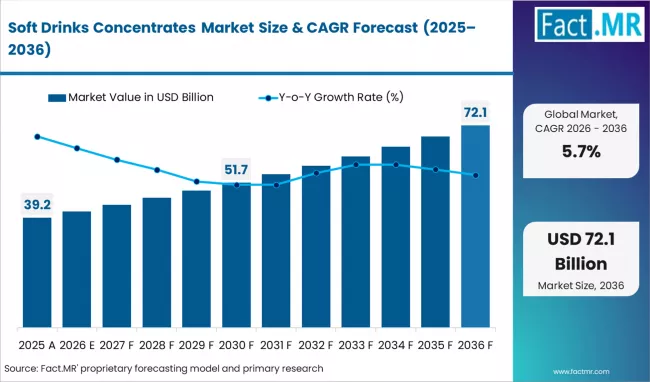
Soft Drinks Concentrates Market Market Value Analysis | Source: Fact.MR
| Metric | Value |
|---|---|
| Estimated Value in 2026 | USD 41.4 billion |
| Forecast Value in 2036 | USD 72.1 billion |
| Forecast CAGR (2026 to 2036) | 5.7% |
Source: Fact.MR analysis. Updated Mar 18, 2026
Soft Drinks Concentrates Market Definition
The soft drinks concentrates market covers liquid and powder flavour concentrates used by manufacturers, foodservice operators, and consumers to prepare carbonated and non-carbonated beverages.
Market Inclusions
Covers global and regional market sizes from 2026 to 2036 by product type, packaging, and distribution channel. Includes carbonated and non-carbonated concentrate formats for both commercial bottler supply and consumer retail use, across all major beverage application categories.
Market Exclusions
Excludes finished ready-to-drink soft drinks, alcoholic beverage concentrates, energy drink finished goods, and plain fruit juice without added flavouring or functional ingredients. Does not cover carbonation equipment or beverage dispensing hardware sold separately from concentrate supply.
Research Methodology
- Primary Research: Interviews with concentrate buyers at beverage manufacturers, retail category managers, foodservice procurement directors, and independent bottler operations managers across North America, Europe, and Asia Pacific.
- Desk Research: Sources include WHO sugar consumption data, national sugar tax legislation registers, company annual reports, FMCG retail sales databases, and food regulation authority publications from 2024 to 2025.
- Market Sizing and Forecasting: Hybrid top-down and bottom-up model using concentrate volume shipments, average selling prices by product type and channel, bottler procurement data, and country-level packaged beverage market output.
- Data Validation and Update Cycle: Forecasts validated against beverage company revenue disclosures, retail scanner data, sugar tax revenue reports from national finance ministries, and primary interviews with procurement and innovation managers.
Summary of Soft Drinks Concentrates
- Market Definition
- The soft drinks concentrates market encompasses flavoured liquid and powder bases used by bottlers, foodservice operators, and consumers to prepare carbonated and non-carbonated beverages for retail and on-premise consumption.
- Demand Drivers
- Sugar tax legislation in over 40 countries is compelling concentrate manufacturers to reformulate with stevia, monk fruit, and other natural sweetener alternatives, driving volume growth in reduced-sugar concentrate formats.
- Expanding organised retail in India, Southeast Asia, and Sub-Saharan Africa is increasing concentrate distribution reach, enabling affordable packaged beverage consumption in markets previously served only by loose beverage formats.
- Functional concentrate formats incorporating vitamins, electrolytes, and botanical extracts are driving premiumisation in North American and European convenience and e-commerce channels, increasing revenue per litre sold.
- Key Segments Analyzed
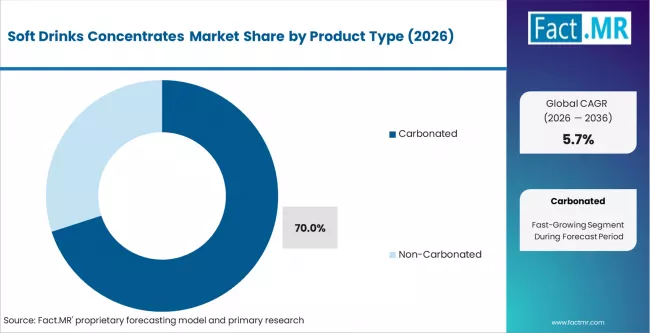
- By Product Type: Carbonated concentrates lead with approximately 70% share in 2026, anchored by dominant branded cola and flavoured soda applications in bottler supply chains globally.
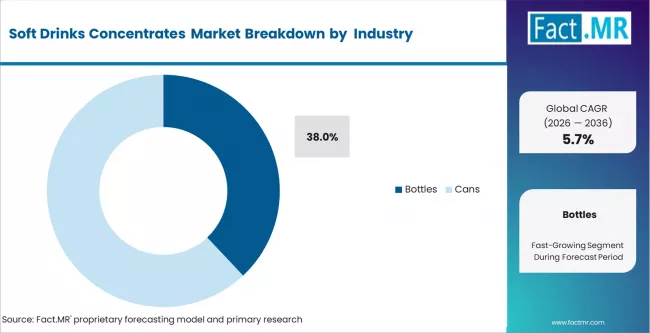
- By Packaging: Bottles account for approximately 38% share in 2026, preferred for retail and foodservice concentrate applications requiring portion-controlled dispensing and consumer accessibility.
- By Distribution Channel: Supermarkets lead concentrate retail distribution with the largest volume share in 2026 due to established category shelf space and promotional infrastructure for concentrate SKUs.
- Analyst Opinion at FACT.MR
- Shambhu Nath Jha, Principal Consultant at Fact.MR, opines that CXOs will find this report essential for identifying growth opportunities in reduced-sugar concentrate reformulation, functional beverage concentrate formats, and emerging market distribution channel strategies for both branded and private-label concentrate portfolios.
- Strategic Implications
- Concentrate manufacturers should accelerate natural sweetener reformulation investment to maintain retailer listings in sugar tax jurisdictions and meet brand sustainability commitments on sugar reduction.
- Branded concentrate companies should develop tiered product lines offering premium functional concentrates alongside affordable standard formats to capture both health-conscious urban consumers and price-sensitive emerging market buyers.
- Distributors entering India and Southeast Asia should partner with local bottlers and convenience chains to build cold-chain and ambient concentrate logistics capability targeting rapid tier-2 city retail penetration.
- Methodology
- Market sizing based on concentrate volume shipments and average selling prices validated against major beverage company revenue disclosures and bottler procurement data.
- Sugar tax legislation registers, WHO sugar consumption statistics, and national food regulatory authority publications supported demand and restraint analysis.
- Forecasts integrated functional beverage growth trajectories, retail channel expansion timelines, reformulation investment data, and primary interviews with concentrate buyers and category managers.
Segmental Analysis
Soft Drinks Concentrates Market Analysis by Product Type
Soft Drinks Concentrates Market Analysis By Product Type | Source: Fact.MR
Based on FACT.MR's soft drinks concentrates market report, carbonated concentrates are estimated to hold approximately 70% share in 2026. Carbonated formats dominate due to their central role in Coca-Cola and PepsiCo bottler franchise systems and their entrenched position in foodservice fountain dispense channels globally.
- Coca-Cola Franchise Investment: The Coca-Cola Company reported in its Q4 2024 earnings that its concentrate sales to global bottlers grew 4% in volume, with reduced-sugar Coca-Cola Zero Sugar concentrate contributing disproportionately to growth across European and Asian bottler markets. [5]
- Dohler Group Carbonated Technology: Dohler Group launched a new carbonated beverage concentrate platform in October 2024 incorporating natural flavour systems and stevia-based sweeteners, targeting European bottlers and private-label beverage manufacturers seeking HFSS-compliant reformulations. [6]
- Non-Carbonated Concentrate Growth Trend: Innova Market Insights reported in its 2025 Beverage Trends Report that non-carbonated concentrate new product launches grew 22% year-on-year in 2024 globally, with dilutable squash and functional water concentrate formats leading growth in the UK, Germany, and India. [7]
Soft Drinks Concentrates Market Analysis by Packaging
Soft Drinks Concentrates Market Analysis By Packaging | Source: Fact.MR
Based on FACT.MR's soft drinks concentrates market report, bottles account for approximately 38% of packaging share in 2026. Bottled concentrate formats dominate retail and foodservice channels due to their convenience for portion dispensing, extended shelf life, and compatibility with consumer dilution-at-home behaviour.
- Cott Corporation Bottle Format Investment: Cott Corporation disclosed in its February 2025 investor update that it expanded bottled concentrate private-label capacity at its Toronto facility, targeting Canadian and US supermarket retailers seeking own-label squash and dilutable formats as alternatives to branded concentrates. [8]
- Can Format Technology Development: Ball Corporation introduced lightweight concentrate-compatible aluminium can formats in September 2024, reducing material costs by approximately 8% for concentrate manufacturers packaging single-serve dilutable formats for convenience and vending applications. [9]
- Sustainable Packaging Trend: Kraft Foods and Dohler Group both adopted rPET bottle formats for concentrate packaging lines in 2024 in response to EU Packaging and Packaging Waste Regulation requirements, with rPET now accounting for over 30% of new European concentrate bottle production. [10]
Drivers, Restraints, and Opportunities
FACT.MR analysts observe that the soft drinks concentrates market is sustained by deep structural integration of concentrate supply into global bottler and foodservice beverage systems. The market's scale reflects decades of branded concentrate franchise dominance anchored by Coca-Cola and PepsiCo's global bottler networks, which continue to represent the largest single source of volume demand despite growing competition from private-label and functional concentrate alternatives.
The market is undergoing a significant reformulation shift driven by sugar reduction policy. High-sugar concentrate formats face volume pressure in Europe and North America as sugar taxes increase end-product pricing for bottlers, reducing consumer off-take for full-sugar soft drinks.
- Sugar Tax Legislation Expansion: The UK Soft Drinks Industry Levy, updated in April 2025 to raise the lower band threshold to 4g per 100ml, has accelerated reformulation timelines for British bottlers purchasing concentrate from Cott Corporation and Dohler Group. Similar levy structures in Ireland, France, and South Africa are expanding the tax-driven reformulation mandate across key concentrate markets. [2]
- India Retail Infrastructure Growth: India's Ministry of Food Processing Industries allocated INR 2,100 crore in the Union Budget 2025-26 for packaged food and beverage retail infrastructure development, supporting expanded cold-chain and ambient distribution for concentrate-based beverage products in tier-2 and tier-3 cities. [3]
- Functional Concentrate Innovation: PepsiCo launched its Gatorade Fit and Propel functional concentrate formats in January 2025 across US convenience and e-commerce channels, demonstrating how established concentrate brands are repositioning standard flavour concentrates toward electrolyte and vitamin-fortified premiums that command 25-40% price increases over traditional formats. [4]
Regional Analysis
The soft drinks concentrates market is analysed across Asia Pacific, Europe, North America, Latin America, and Middle East and Africa, covering over 40 countries with distinct demand profiles shaped by sugar tax policy, retail channel maturity, packaged beverage consumption growth, and branded concentrate franchise penetration. The full report offers market attractiveness analysis based on sugar reduction policy timelines, retail infrastructure development, and functional concentrate adoption benchmarks.
.webp "Top Country Growth Comparison Soft Drinks Concentrates Market Cagr (2026 2036)")
Top Country Growth Comparison Soft Drinks Concentrates Market Cagr (2026 2036) | Source: Fact.MR
| Country | CAGR (2026 to 2036) |
|---|---|
| United States | 6.8% |
| China | 6.5% |
| India | 6.0% |
| Germany | 5.3% |
Source: Fact.MR analysis. Updated Mar 18, 2026
Source: Fact.MR (FACT.MR) analysis, based on proprietary forecasting model and primary research
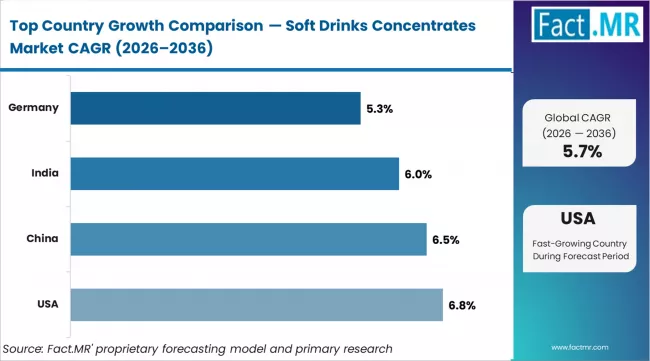
Soft Drinks Concentrates Market Cagr Analysis By Country | Source: Fact.MR
North America Soft Drinks Concentrates Market Analysis
North America is the largest revenue market for premium and functional concentrate formats, driven by strong branded concentrate franchise systems and accelerating consumer demand for reduced-sugar and health-positioned beverage options.
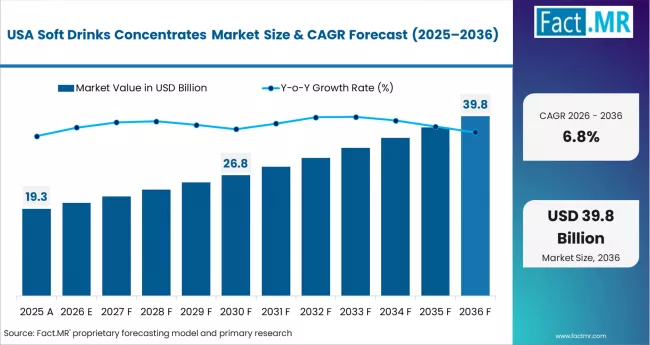
Soft Drinks Concentrates Market Country Value Analysis | Source: Fact.MR
- United States: Demand for soft drinks concentrates in the United States is projected to rise at 6.8% CAGR through 2036. PepsiCo launched Gatorade Fit and Propel functional concentrate formats in January 2025 across US convenience and e-commerce channels, expanding the functional concentrate category beyond traditional sports drink formats. The FDA's updated dietary supplement and beverage labelling guidance issued in September 2024 provided clearer pathways for functional ingredient claims on concentrate-based beverage products, accelerating vitamin and electrolyte concentrate commercialization.
FACT.MR's analysis of the soft drinks concentrates market in North America consists of country-wise assessment that includes the United States, Canada, and Mexico. Readers can find FDA labelling guidance data, functional concentrate adoption benchmarks, private-label growth trends, and country-level CAGR forecasts by product type and distribution channel.
Asia Pacific Soft Drinks Concentrates Market Analysis
Asia Pacific is the fastest-growing regional market for soft drinks concentrates, driven by India's expanding organised retail and China's premiumisation of domestic beverage manufacturing. Nongfu Spring and Genki Forest lead Chinese market development, while Parle Agro and PepsiCo India drive concentrate adoption across organised and traditional retail channels in India.
- China: Soft drinks concentrate demand in China is projected to grow at 6.5% CAGR through 2036. China's domestic functional beverage manufacturing sector expanded approximately 16% in 2024 according to China Beverage Industry Association data, with domestic brands adopting concentrate supply models to support rapid SKU diversification across online and convenience channels. The National Health Commission updated food additive standards GB 2760 in December 2024 to restrict certain synthetic sweeteners in beverage concentrates, accelerating natural sweetener adoption among Chinese concentrate manufacturers.
- India: Demand for soft drinks concentrates in India is projected to rise at 6.0% CAGR through 2036. India's Ministry of Food Processing Industries allocated INR 2,100 crore in the Union Budget 2025-26 for packaged food and beverage retail infrastructure development, supporting expanded concentrate distribution into tier-2 and tier-3 cities. FSSAI updated food safety standards for soft drink concentrates in August 2024 to align with revised sugar content labelling requirements, encouraging reformulation by Parle Agro, Coca-Cola India, and regional manufacturers.
FACT.MR's analysis of the soft drinks concentrates market in Asia Pacific consists of country-wise assessment that includes China, India, Japan, South Korea, ASEAN, and Australia and New Zealand. Readers can find functional concentrate adoption data, retail infrastructure growth benchmarks, and country-level CAGR forecasts by product type and packaging.
Europe Soft Drinks Concentrates Market Analysis
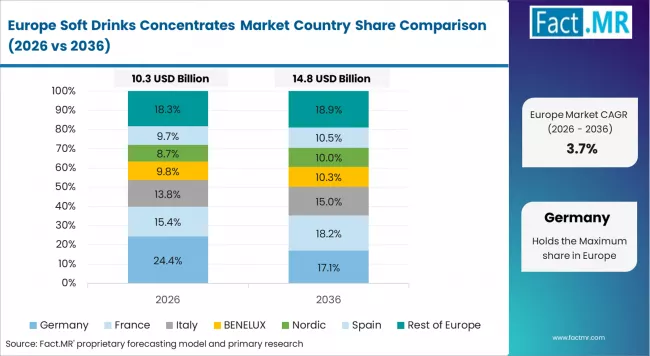
Soft Drinks Concentrates Market Europe Country Market Share Analysis, 2026 & 2036 | Source: Fact.MR
Europe is the global regulatory laboratory for concentrate sugar reduction, with sugar levy frameworks in the UK, Ireland, France, and Portugal compelling manufacturers to accelerate reduced-sugar concentrate reformulation. Cott Corporation and Dohler Group are key European private-label and flavour concentrate suppliers operating across multiple reformulation mandates simultaneously.
- Germany: Soft drinks concentrate demand in Germany is projected to rise at 5.3% CAGR through 2036. The EU's revised Regulation (EU) 2024/1441 on food contact materials issued in June 2024 introduced updated standards for packaging used in concentrate bottling, requiring compliance investment by German concentrate manufacturers including regional private-label producers. Rewe Group and Edeka expanded their private-label soft drinks concentrate ranges in H2 2024 with reduced-sugar squash and functional water concentrate formats, responding to consumer demand shifts toward lower-calorie home dilutable drinks.
FACT.MR's analysis of the soft drinks concentrates market in Europe consists of country-wise assessment that includes Germany, France, the United Kingdom, Italy, Spain, and Rest of Western Europe. Readers can find sugar levy compliance data, private-label reformulation benchmarks, EU packaging regulation impacts, and country-level CAGR forecasts.
Competitive Aligners for Market Players
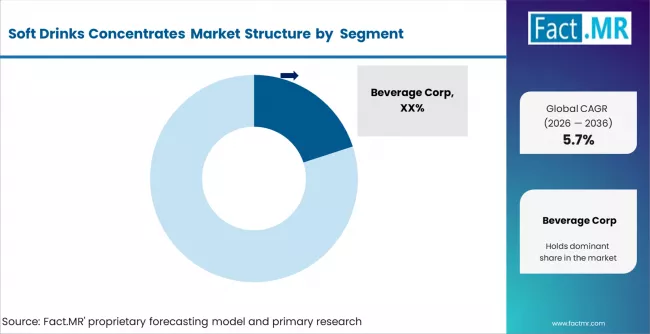
Soft Drinks Concentrates Market Analysis By Company | Source: Fact.MR
The global soft drinks concentrates market is moderately concentrated at the branded level and highly fragmented in private-label and regional segments. The Coca-Cola Company and PepsiCo Inc. together account for an estimated 45-50% of global branded concentrate revenue through their bottler franchise systems, while Cott Corporation and Dohler Group lead the private-label and flavour system segments. The primary competitive variable at the branded level is flavour system innovation and bottler relationship depth; at the private-label level it is cost efficiency and reformulation speed.
Coca-Cola and PepsiCo hold structural advantages through exclusive concentrate supply agreements with their global bottler networks, creating captive demand bases that independent competitors cannot directly access. Dohler Group and Kraft Foods compete effectively in the flavour systems and private-label segment by offering full formulation services including natural sweetener integration and regulatory compliance support, enabling food manufacturers and retailers to launch own-label concentrates without internal R&D infrastructure. Large retail buyers manage concentrate supplier dependency by dual-sourcing branded and private-label formats, using private-label growth as a pricing lever against branded suppliers during contract negotiations.
This dynamic limits branded concentrate pricing power in mature European and North American markets while creating volume opportunities for private-label specialists such as Cott Corporation and Dohler Group as retailers expand own-label concentrate category penetration.
Key Players
- Beverage Corp
- The Coca-Cola Company
- PepsiCo Inc.
- Cott Corporation
- Kraft Foods
- Dohler Group
- Dr. Pepper Snapple Group
Bibliography
- [1] UK Government, HM Treasury. (2025). Soft Drinks Industry Levy Rate Review 2025: Lower Band Sugar Threshold Adjustment to 4g per 100ml and Impact Assessment for Beverage Concentrate Reformulation. April 2025. gov.uk/government/collections/soft-drinks-industry-levy
- [2] Ministry of Food Processing Industries, Government of India. (2025). Union Budget 2025-26: Packaged Food and Beverage Retail Infrastructure Development Allocation INR 2,100 Crore for Cold-Chain and Ambient Distribution Expansion. February 2025. mofpi.gov.in
- [3] PepsiCo Inc. (2025). Product Launch Press Release: Gatorade Fit and Propel Electrolyte Functional Concentrate Formats in US Convenience and E-Commerce Channels with Reduced-Sugar Positioning. January 2025. pepsico.com/news
- [4] The Coca-Cola Company. (2025). Q4 2024 Full-Year Results Press Release: Coca-Cola Zero Sugar Concentrate Volume Growth with Global Bottler Network and European and Asian Market Performance. February 2025. investors.coca-colacompany.com
- [5] Dohler Group. (2024). Product Launch Announcement: Carbonated Beverage Concentrate Platform with Natural Flavour Systems and Stevia-Based Sweeteners for European Bottlers and Private-Label Manufacturers HFSS Compliance. October 2024. doehler.com/news
- [6] Innova Market Insights. (2025). Global Beverage Trends Report 2025: Non-Carbonated Concentrate New Product Launch Growth Rate, Dilutable Squash and Functional Water Concentrate Format Share by Region. January 2025. innovamarketinsights.com
- [7] Cott Corporation. (2025). Q4 2024 Investor Update: Private-Label Bottled Concentrate Capacity Expansion at Toronto Facility for Canadian and US Supermarket Retailer Own-Label Squash and Dilutable Format Supply. February 2025. cott.com/investors
- [8] Ball Corporation. (2024). Product Innovation Announcement: Lightweight Aluminium Can Format for Single-Serve Concentrate Applications with Approximately 8% Material Cost Reduction for Convenience and Vending Manufacturers. September 2024. ball.com/news
- [9] European Commission. (2024). EU Packaging and Packaging Waste Regulation Update: Recycled Content Requirements for PET Beverage Packaging Including Concentrate Bottles and Industry Compliance Timeline. June 2024. ec. europa.eu/environment
This Report Addresses
- Strategic intelligence on UK Soft Drinks Industry Levy updates, EU sugar reduction mandates, India FSSAI concentrate standards, China GB 2760 sweetener restrictions, and US FDA beverage labelling guidance shaping global soft drinks concentrate demand through 2036.
- Market forecast from USD 41.4 billion in 2026 to USD 72.1 billion by 2036 at 5.7% CAGR, segmented by product type, packaging, and distribution channel.
- Growth opportunity mapping across US functional concentrate innovation, China domestic beverage manufacturing expansion, India retail infrastructure development, and Germany private-label reduced-sugar reformulation.
- Country CAGR outlook for United States 6.8%, China 6.5%, India 6.0%, and Germany 5.3%, with sugar tax policy, retail channel maturity, and functional concentrate adoption benchmarks per country.
- Competitive analysis of The Coca-Cola Company, PepsiCo Inc., Cott Corporation, Dohler Group, Kraft Foods, and Dr. Pepper Snapple Group covering bottler franchise systems, private-label strategies, and reformulation investment.
- Technology tracking covering natural sweetener stevia and monk fruit integration, rPET sustainable concentrate packaging, functional electrolyte and vitamin concentrate formats, and cold-water dispersibility improvements.
- Regulatory analysis covering UK SDIL levy band updates, EU Packaging Regulation rPET mandates, India FSSAI sugar labelling requirements, China GB 2760 sweetener restrictions, and US FDA dietary supplement beverage claim pathways.
- Report delivered in PDF, Excel datasets, PowerPoint summary, and dashboard formats supported by company earnings disclosures, retail scanner data, sugar tax revenue reports, and primary research interviews.
Segmentation
Scope of Report
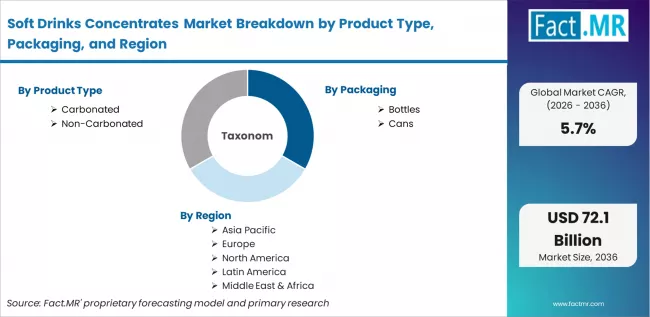
Soft Drinks Concentrates Market Breakdown By Product Type, Packaging, And Region | Source: Fact.MR
| Attribute | Details |
|---|---|
| Quantitative Units | USD 41.4 billion (2026) to USD 72.1 billion (2036), at a CAGR of 5.7% |
| Market Definition | Liquid and powder flavour concentrates for carbonated and non-carbonated beverage preparation sold to bottlers, foodservice operators, and consumers through retail channels globally. |
| Product Type Segmentation | Carbonated, Non-Carbonated |
| Packaging Segmentation | Bottles, Cans |
| Distribution Channel Segmentation | Supermarkets, Convenience Stores, Online Retail Stores |
| Application Coverage | Bottler franchise supply, foodservice fountain dispensing, retail consumer dilutable formats, private-label supermarket concentrates, and functional beverage manufacturing. |
| Regions Covered | Asia Pacific, Europe, North America, Latin America, Middle East and Africa |
| Countries Covered | China, India, Japan, South Korea, ASEAN, Australia and New Zealand, Germany, UK, France, Italy, Spain, Nordic, BENELUX, USA, Canada, Mexico, Brazil, Chile, Ecuador, Saudi Arabia, GCC, Turkey, South Africa, Rest of MEA |
| Key Companies Profiled | Beverage Corp, The Coca-Cola Company, PepsiCo Inc., Cott Corporation, Kraft Foods, Dohler Group, Dr. Pepper Snapple Group |
| Forecast Period | 2026 to 2036 |
| Approach | Hybrid top-down and bottom-up model using concentrate volume shipments, average selling prices by product type and channel, bottler procurement data, and primary interviews. |
Source: Fact.MR analysis. Updated Mar 18, 2026
Soft Drinks Concentrates Market by Segments
-
By Product Type:
- Carbonated
- Non-Carbonated
-
By Packaging:
- Bottles
- Cans
-
By Distribution Channel:
- Supermarkets
- Convenience Stores
- Online Retail Stores
-
By Region:
- North America
- United States
- Canada
- Mexico
- Latin America
- Brazil
- Chile
- Ecuador
- Rest of Latin America
- Western Europe
- Germany
- United Kingdom
- France
- Italy
- Spain
- Nordic Countries
- BENELUX
- Rest of Western Europe
- Eastern Europe
- Russia
- Poland
- Hungary
- Balkan and Baltic
- Rest of Eastern Europe
- East Asia
- China
- Japan
- South Korea
- South Asia and Pacific
- India
- ASEAN
- Australia and New Zealand
- Rest of South Asia and Pacific
- Middle East and Africa
- Kingdom of Saudi Arabia
- Other GCC Countries
- Turkey
- South Africa
- Other African Union
- Rest of Middle East and Africa
- North America
Frequently Asked Questions
How large is the soft drinks concentrates market in 2025?
What will the market size be in 2026?
What is the projected market size by 2036?
What is the expected CAGR?
Which product type leads the soft drinks concentrates market?
Which packaging format holds the largest share?
Which country shows the fastest growth?
What is driving reformulation in the soft drinks concentrates market?
Why are reduced-sugar soft drink concentrates gaining popularity?
How are companies responding to sugar reduction regulations?
What role do natural sweeteners play in this market?
Who worked on this report


Preview the report firsthand - request a free sample
Free SampleGet the brochure for pricing and purchase details
Download PDF