2D Bar Code Marketing Market (2026 - 2036)

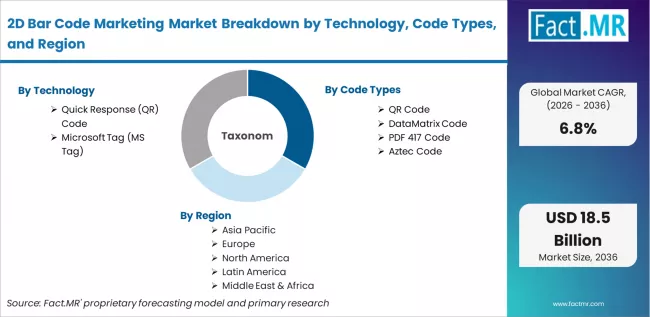
2D Bar Code Marketing Market is segmented by Technology (Quick Response (QR) Code and Microsoft Tag (MS Tag)), Code Types (QR Code, DATAMATRIX Code, PDF 417 Code, and AZTEC Code), Applications (Retailing, Entertainment, Advertising, Government, Logistics, Health Care, and Transportation), and Region. Forecast for 2026 to 2036.

Core Findings

    2D Bar Code Marketing Market Forecast By Fact.MR

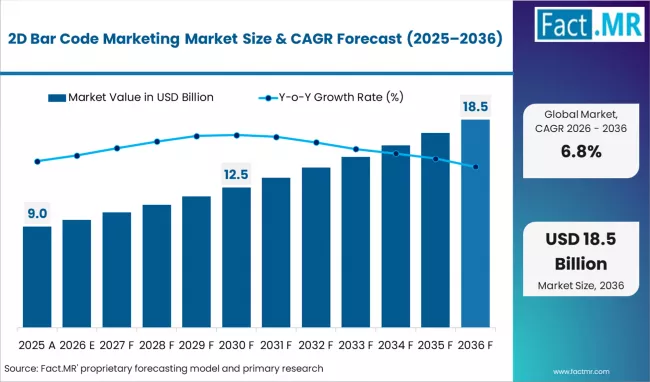
    In 2025, the 2D bar code marketing market was valued at USD 9.0 billion. Based on Fact MR analysis, demand for 2D bar code marketing is estimated to grow to USD 9.6 billion in 2026 and USD 19.3 billion by 2036. FMR projects a CAGR of 6.8% during the forecast period.

    The absolute dollar growth from 2026 to 2036 is USD 9.7 billion. This expansion reflects steady adoption of digital engagement tools rather than a structural shift in marketing technology systems. 2D bar codes such as QR codes are widely used to connect physical products and media with digital content, enabling customer interaction, product tracking, and promotional campaigns. Demand continues to grow across retail, packaging, advertising, and logistics applications. Growth remains influenced by user engagement variability, dependence on smartphone penetration, and substitution by alternative digital marketing channels.

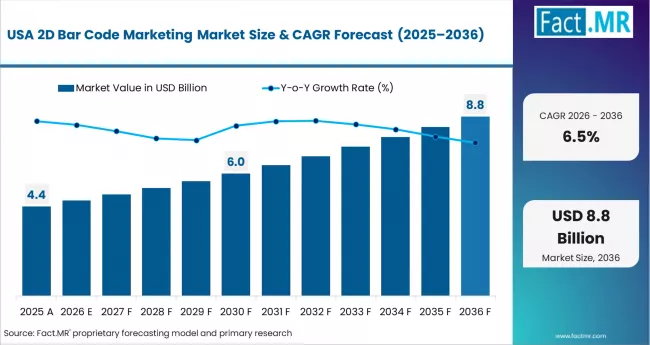
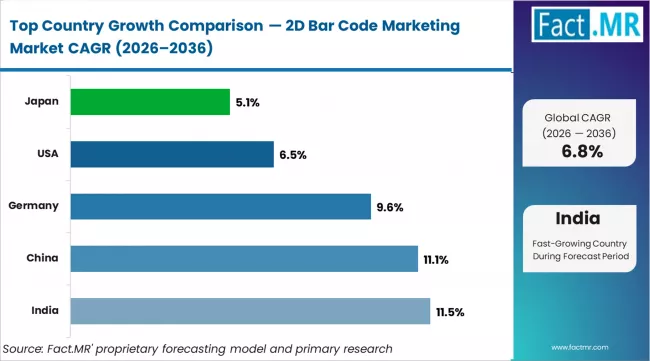
    India leads with a projected CAGR of 11.5%, supported by rapid growth in mobile internet usage and increasing adoption of QR code based payment and marketing systems. China follows with a CAGR of 11.1%, driven by widespread use of QR codes across digital payments, retail, and online to offline services. Germany records a CAGR of 9.6%, reflecting steady adoption of digital labeling and customer engagement tools. The United States shows a CAGR of 6.5%, supported by continued use in packaging and promotional campaigns. Japan records the slowest growth at 5.1%, reflecting a mature market where demand is largely tied to replacement and incremental usage. Mature markets generate a significant share of replacement demand as businesses update marketing systems and integrate digital engagement tools.
    2d Bar Code Marketing Market Market Value Analysis

    2D Bar Code Marketing Market

    Metric Details
    Industry Size (2026E) USD 9.6 billion
    Industry Value (2036F) USD 19.3 billion
    CAGR (2026 to 2036) 6.8%

    2D Bar Code Marketing Market Definition

    The 2D Bar Code Marketing Market includes the use of two dimensional barcodes such as QR codes and Data Matrix codes for marketing and customer engagement purposes. These codes store information in a compact format and can be scanned using smartphones or dedicated scanners to access digital content. Businesses use 2D barcodes to link physical products, advertisements, and packaging to online platforms such as websites, promotions, or product information pages. The primary function of 2D barcode marketing is to connect offline media with digital interactions and enable measurable customer engagement.

    2D Bar Code Marketing Market Inclusions

    This report covers global and regional market sizes for 2D barcode marketing solutions with forecast analysis for the study period. The market is segmented by code type including QR codes, Data Matrix codes, and other 2D barcode formats. Application segments include retail marketing, product packaging, advertising campaigns, and event promotions. End users include retail companies, brand owners, advertising agencies, and digital marketing service providers. The report also evaluates pricing models, campaign deployment trends, and selected trade flow analysis across major marketing technology markets.

    2D Bar Code Marketing Market Exclusions

    The report excludes traditional one dimensional barcodes used for inventory tracking and logistics operations. Barcode scanning hardware such as handheld scanners and point of sale devices are not included. The scope also excludes general digital marketing tools that do not involve barcode integration. Inventory management systems and supply chain tracking solutions are outside the defined market scope, as the analysis focuses strictly on marketing applications of 2D barcode technology.

    2D Bar Code Marketing Market Research Methodology

    • Primary Research: Interviews were conducted with marketing technology providers, advertising agencies, retail brand managers, and digital campaign specialists.
    • Desk Research: Public information was collected from marketing industry publications, company reports, trade statistics, and digital media data sources.
    • Market-Sizing and Forecasting: A hybrid model combining bottom up campaign spending analysis with top down demand assessment across marketing and advertising sectors was applied.
    • Data Validation and Update Cycle: Findings were cross verified using multiple industry data sources and expert inputs, with periodic updates conducted as new market information becomes available.

    Summary of the 2D Bar Code Marketing Market

    • Market Definition
      • The market includes technologies and platforms that use two dimensional barcodes such as QR codes and Data Matrix codes to enable marketing and customer engagement. These codes store data in a compact format and can be scanned using mobile devices to access digital content, promotions, and product information. The primary function is to connect physical media with digital platforms and enable measurable interaction.
    • Demand Drivers
      • Increasing use of smartphones enabling widespread adoption of QR code based interactions
      • Rising demand for contactless engagement solutions across retail, payments, and service environments
      • Expansion of digital marketing campaigns integrating physical and online customer touchpoints
      • Growing use of 2D barcodes in packaging, advertising, and product information access
    • Key Segments Analyzed
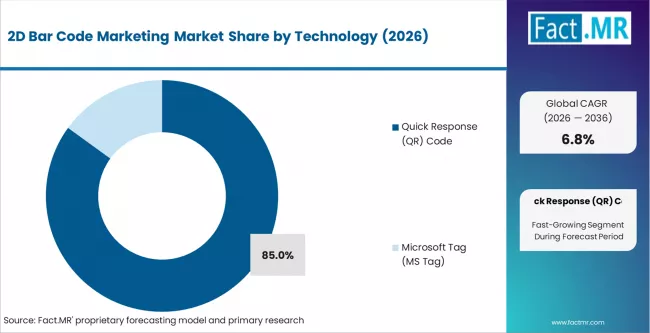
      • Technology: QR code technology leads with around 85% share in 2026 supported by ease of use and accessibility
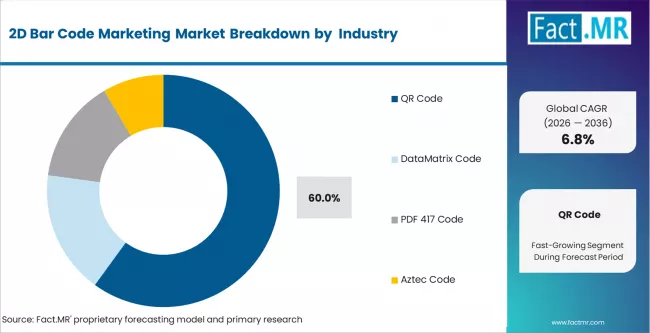
      • Code Type: QR codes dominate with about 60% share due to higher data capacity and versatility
      • Application: Retailing and advertising segments show strong adoption driven by customer engagement use cases
      • Geography: Asia Pacific leads in growth, while North America and Europe maintain steady adoption in marketing and retail applications
    • Analyst Opinion at Fact MR
      • Shambhu Nath Jha, Principal Consultant, Fact MR, opines, "In this updated edition of the 2D Bar Code Marketing Market report, industry participants will observe that demand remains aligned with digital engagement trends and mobile connectivity expansion. 2D barcode technologies continue to support integration between physical and digital marketing channels. Providers that enhance data tracking, campaign analytics, and seamless user interaction will maintain competitive positioning as marketing strategies evolve through 2036."
    • Strategic Implications/Executive Takeaways
      • Invest in QR code based platforms that support scalable marketing and customer engagement campaigns
      • Strengthen integration with mobile applications, payment systems, and digital marketing tools
      • Enhance data analytics capabilities to track user interaction and campaign performance
      • Focus on ease of deployment and user accessibility to support widespread adoption across industries
    • Methodology
      • Primary interviews conducted with marketing technology providers, advertising agencies, and retail stakeholders
      • Desk research based on marketing publications, company reports, trade statistics, and digital media data
      • Market sizing derived using a hybrid approach combining bottom up campaign spending analysis with top down demand assessment
      • Data validation performed through cross verification with industry datasets and internal peer review aligned with Fact MR standards

    Segmental Analysis

    2D Bar Code Marketing Market Analysis by Technology
    2d Bar Code Marketing Market Analysis By Technology

    • Market Overview: Quick response code technology is projected to account for around 85% share of the 2D bar code marketing market by 2026. QR codes enable rapid access to digital content through smartphone scanning, allowing users to connect with websites, applications, payment platforms, and promotional campaigns. Businesses deploy QR code technology in advertising, product packaging, retail displays, and event marketing to provide interactive consumer engagement. The widespread availability of smartphones with built in scanning capabilities supports the adoption of QR code based marketing solutions across industries.
    • Demand Drivers:
      • Smartphone Based Interaction: QR codes can be scanned using mobile devices, enabling direct access to digital content and services.
      • Contactless Engagement Solutions: Businesses use QR codes to provide touch free access to menus, payments, and promotional information.
      • Marketing Campaign Integration: QR code technology is integrated into advertising campaigns to connect physical media with digital platforms.

    2D Bar Code Marketing Market Analysis by Code Types
    2d Bar Code Marketing Market Analysis By Code Types

    • Market Overview: QR codes are expected to represent approximately 60% share of the 2D bar code marketing market in 2026. QR codes are widely used due to their ability to store larger amounts of data compared with traditional barcodes. These codes support various applications including website links, product information, authentication, and digital payments. Businesses incorporate QR codes into packaging, advertisements, and point of sale systems to enhance customer interaction and information access. The versatility and ease of implementation of QR codes continue to support their dominance within code type segments.
    • Demand Drivers:
      • High Data Storage Capacity: QR codes can store more information compared with conventional barcodes, supporting diverse marketing applications.
      • Ease of Implementation: Businesses can generate and deploy QR codes easily across different marketing channels.
      • Consumer Accessibility: QR codes provide a simple interface for users to access product information, promotions, and digital services through mobile devices.

    2D Bar Code Marketing Market Drivers, Restraints, and Opportunities
    2d Bar Code Marketing Market Opportunity Matrix Growth Vs Value

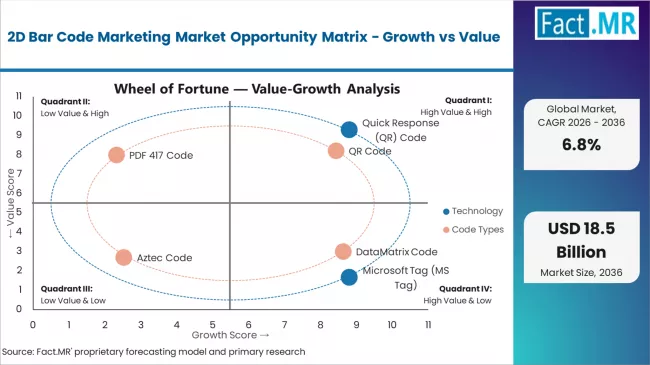
    Fact MR analysis indicates that the 2D bar code marketing market developed from product identification systems where barcodes were used for inventory tracking and point-of-sale operations. Early barcode formats enabled basic data encoding for product identification across retail and logistics systems. The current market valuation reflects the expansion of 2D codes such as QR codes and Data Matrix that support marketing engagement, digital content access, and mobile-based interactions. Demand persists because businesses use 2D barcodes to connect physical products and print media with digital platforms through smartphone scanning.

    A structural shift is occurring as traditional linear barcodes transition toward multifunctional 2D codes that support data-rich interactions and consumer engagement. Conventional barcodes remain widely used in retail operations where simple product identification remains sufficient. 2D barcodes enable dynamic content linking, promotional campaigns, payment integration, and customer engagement tracking. These capabilities increase the value of barcode deployment beyond inventory management. Even with stable usage volumes in logistics and retail, higher value derived from marketing applications supports steady market expansion.

    • Mobile Engagement Tools: Brands deploy QR codes and similar formats to enable consumers to access product information, promotional content, and digital services through smartphones.
    • Barcode Standardization: Standards such as GS1 QR Code specifications and ISO IEC 16022 Data Matrix standards define encoding formats and interoperability across industries.
    • Asia Retail Adoption: China, Japan, and South Korea maintain strong adoption of QR code-based marketing and payment systems integrated with mobile commerce platforms.

    Regional Analysis

    The 2D bar code marketing market is assessed across North America, Europe, Asia Pacific, Latin America, and Middle East & Africa, segmented by country-level adoption of QR code campaigns, mobile engagement, and retail digitization. Regional demand reflects smartphone penetration, digital payment integration, and marketing automation systems. The full report offers market attractiveness analysis.

    Top Country Growth Comparison 2d Bar Code Marketing Market Cagr (2026 2036)

    Country CAGR (2026-2036)
    USA 6.5%
    China 11.1%
    Germany 9.6%
    Japan 5.1%
    India 11.5%

    Source: Fact MR analysis, based on proprietary forecasting model and primary research
    2d Bar Code Marketing Market Cagr Analysis By Country

    North America

    2d Bar Code Marketing Market Country Value Analysis

    North America functions as the omnichannel marketing and digital engagement hub, supported by strong retail digitization and mobile-first campaigns. Google LLC supports QR-based mobile interactions. Adobe Inc. strengthens marketing automation platforms. Zebra Technologies Corporation expands barcode solutions for enterprises.

    • USA: Demand for 2D bar code marketing in USA is projected to rise at 6.5% CAGR through 2036. Growth is supported by FCC digital communication frameworks (updated 2021), enabling mobile engagement technologies. Zebra Technologies Corporation expanded enterprise barcode and QR solutions (March 2023), supporting adoption.

    Europe
    2d Bar Code Marketing Market Europe Country Market Share Analysis, 2026 & 2036

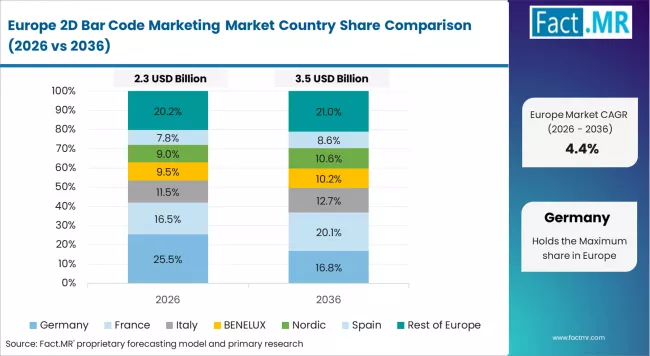
    Europe operates as the regulated digital commerce and data protection base, shaped by privacy frameworks and retail digitization standards. SAP SE supports retail and marketing integration platforms. Siemens AG expands industrial and retail digital solutions. Datalogic S.p.A. strengthens scanning and barcode systems.

    • Germany: Demand for 2D bar code marketing in Germany is projected to rise at 9.6% CAGR through 2036. The EU Digital Services Act (European Commission, October 2022) supports digital commerce frameworks. Datalogic S.p.A. expanded barcode scanning and marketing solutions (February 2023), supporting adoption.

    Asia Pacific
    2d Bar Code Marketing Market Japan Market Share Analysis By Technology

    Asia Pacific serves as the high-growth mobile engagement and QR-based commerce market, supported by digital payments and smartphone adoption. Alibaba Group Holding Limited integrates QR codes into digital ecosystems. Denso Wave Incorporated pioneered QR code technology. Paytm expands QR-based transactions and marketing.

    • China: Demand for 2D bar code marketing in China is projected to rise at 11.1% CAGR through 2036. The Digital Economy Development Plan (State Council, January 2022) supports QR-based commerce systems. Alibaba Group Holding Limited expanded QR-enabled retail and payment ecosystems (April 2023), supporting adoption.
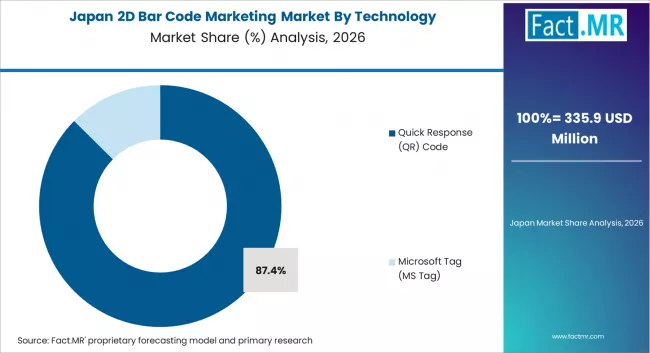
    • Japan: Demand for 2D bar code marketing in Japan is projected to rise at 5.1% CAGR through 2036. Cashless payment promotion policies (Ministry of Economy, Trade and Industry, ongoing) support QR code usage. Denso Wave Incorporated expanded QR code applications (January 2023), supporting market presence.
    • India: Demand for 2D bar code marketing in India is projected to rise at 11.5% CAGR through 2036. The Digital India programme (MeitY, ongoing) supports QR-based payments and services. Paytm expanded QR-based merchant solutions (May 2023), supporting market growth.

    Fact MR's analysis of 2D bar code marketing market in global regions consists of country-wise assessment that includes USA, China, Germany, Japan, and India. Readers can find mobile engagement trends, digital payment integration, retail digitization patterns, and competitive positioning across key markets.

    Competitive Structure and Buyer Dynamics in the 2D Bar Code Marketing Market
    2d Bar Code Marketing Market Analysis By Company

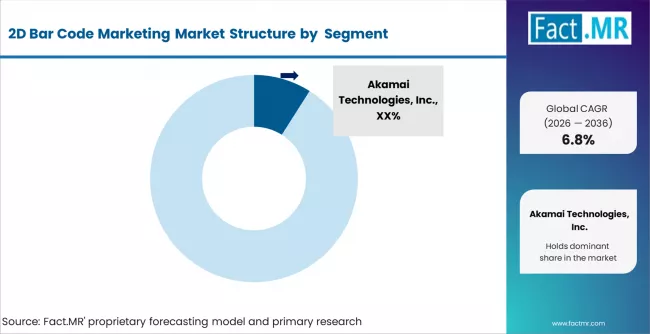
    The competitive structure of the 2D Bar Code Marketing Market is moderately fragmented, with a mix of hardware manufacturers, software platform providers, and mobile engagement solution companies participating across the value chain. Companies such as Zebra Technologies Corporation, Honeywell International Inc., DENSO WAVE INCORPORATED, and Avery Dennison Corporation maintain strong positions through barcode scanning devices, labeling solutions, and enterprise data capture systems. Software and marketing solution providers including Scandit AG, Blue Bite LLC, Scanbuy, Inc., NeoMedia Technologies, Inc., and Akamai Technologies, Inc. contribute through mobile scanning platforms, QR code engagement tools, and cloud based campaign management systems. Additional participants such as Opticon Sensors Europe B.V., Code Corporation, and Barcodes, Inc. support the market through scanning hardware and distribution services. Competition is primarily influenced by scanning accuracy, mobile compatibility, data analytics capability, and integration with marketing and retail systems.

    Several companies maintain structural advantages through established hardware ecosystems and proprietary software platforms. Firms such as Zebra Technologies Corporation and Honeywell International Inc. benefit from extensive barcode scanning hardware portfolios and long standing enterprise relationships. DENSO WAVE INCORPORATED maintains influence through its role in QR code development and standardization. Scandit AG and Blue Bite LLC maintain advantages through advanced mobile scanning software and consumer engagement analytics. Retailers and brand owners often adopt multi vendor solutions to reduce dependence on a single provider and ensure flexibility across marketing campaigns. Procurement decisions evaluate vendors based on system compatibility, data tracking capability, and ease of integration. This purchasing behavior moderates supplier pricing leverage, while vendors with integrated hardware and software solutions retain stronger negotiating influence.

    Key Players of the 2D Bar Code Marketing Market

    • Akamai Technologies, Inc.
    • Zebra Technologies Corporation
    • Honeywell International Inc.
    • DENSO WAVE INCORPORATED
    • Avery Dennison Corporation
    • Blue Bite LLC
    • Scanbuy, Inc.
    • NeoMedia Technologies, Inc.
    • Opticon Sensors Europe B.V. (Opticon Sensors group entity)
    • Code Corporation (operates as Brady Corporation subsidiary)
    • Barcodes, Inc.
    • Scandit AG

    Report Scope

    2d Bar Code Marketing Market Breakdown By Technology, Code Types, And Region

    Metric Value
    Quantitative Units USD 9.6 billion (2026) to USD 19.3 billion (2036), at a CAGR of 6.8%
    Market Definition The 2D bar code marketing market includes technologies and platforms that use two dimensional codes such as QR and other matrix codes to enable digital engagement, product tracking, mobile marketing, and information sharing across consumer and enterprise applications through scannable interfaces.
    Technology Segmentation Quick Response (QR) Code, Microsoft Tag (MS Tag)
    Code Types Segmentation QR Code, DataMatrix Code, PDF417 Code, Aztec Code
    Application Segmentation Retailing, Entertainment, Advertising, Government, Logistics, Healthcare, Transportation
    Regions Covered North America, Latin America, Europe, East Asia, South Asia, Oceania, Middle East and Africa
    Countries Covered United States, Canada, Mexico, Brazil, Germany, United Kingdom, France, Italy, Spain, China, India, Japan, South Korea, Australia, and 40+ countries
    Key Companies Profiled Akamai Technologies, Inc., Zebra Technologies Corporation, Honeywell International Inc., DENSO WAVE INCORPORATED, Avery Dennison Corporation, Blue Bite LLC, Scanbuy, Inc., NeoMedia Technologies, Inc., Opticon Sensors Europe B.V., Code Corporation, Barcodes, Inc., Scandit AG
    Forecast Period 2026 to 2036
    Approach Hybrid top-down and bottom-up market modeling supported by mobile scanning adoption trends, digital marketing integration analysis, barcode technology usage data, and validation through interviews with technology providers, retailers, and marketing solution vendors.

    2D Bar Code Marketing Market Key Segments

    • Technology :

      • Quick Response (QR) Code
      • Microsoft Tag (MS Tag)
    • Code Types :

      • QR Code
      • DataMatrix Code
      • PDF 417 Code
      • Aztec Code
    • Applications :

      • Retailing
      • Entertainment
      • Advertising
      • Government
      • Logistics
      • Health Care
      • Transportation
    • Region :

      • North America
        • USA
        • Canada
        • Mexico
      • Europe
        • Germany
        • UK
        • France
        • Italy
        • Spain
        • Nordic Countries
        • BENELUX
        • Rest of Europe
      • Asia Pacific
        • China
        • Japan
        • South Korea
        • India
        • Australia
        • Rest of Asia Pacific
      • Latin America
        • Brazil
        • Argentina
        • Rest of Latin America
      • Middle East and Africa
        • Kingdom of Saudi Arabia
        • United Arab Emirates
        • South Africa
        • Rest of Middle East and Africa
      • Other Regions
        • Oceania
        • Central Asia
        • Other Markets

    Bibliographies

    • [1] Reserve Bank of India. (2025, May). UPI QR codes record 91.5% surge to 657.9 million.
    • [2] Alipay+. (2023, January). Alipay+ promotes QR code connectivity for cash-free travel in Chinese mainland.
    • [3] BizNext. (2025, November). How QR code payments are driving India’s digital retail revolution.
    • [4] JiMi. (2025, December). China's offline payment battle enters a new phase.
    • [5] Uniqode. (2025, May). India just touched 100B digital payments-Could it work in the US?.
    • [6] Shivangi Khanna (via LinkedIn). (2026, January). India's cashless revolution: From QR beeps to digital payments.

    This Report Addresses

    • Market size estimation and revenue forecasts for the 2D Bar Code Marketing Market from 2026 to 2036, supported by mobile engagement trends and digital campaign deployment benchmarks.
    • Growth opportunity mapping across QR code and MS tag technologies, reflecting demand for smartphone-based interaction and contactless engagement systems.
    • Segment and regional revenue forecasts covering code types, applications, and key markets including India, China, United States, Germany, and Japan.
    • Competition strategy assessment of leading companies such as Zebra Technologies Corporation, Honeywell International Inc., DENSO WAVE INCORPORATED, Avery Dennison Corporation, and Scandit AG, including platform integration and data analytics benchmarking.
    • Regulatory impact analysis covering barcode standardization frameworks, data privacy regulations, and digital communication policies influencing deployment and usage.
    • Market report delivery in PDF, Excel, PPT, and interactive dashboard formats designed for marketing strategy, campaign performance analysis, and operational planning.
    • Supply chain vulnerability assessments examining dependence on smartphone penetration, variability in user engagement, and competition from alternative digital marketing channels impacting adoption.

    Table of Content

    • Demand to side Trends
    • Supply to side Trends
    • Analysis and Recommendations
    • Market Overview
      • Market Coverage / Taxonomy
      • Market Definition / Scope / Limitations
    • Research Methodology
      • Chapter Orientation
      • Analytical Lens and Working Hypotheses
        • Market Structure, Signals, and Trend Drivers
        • Benchmarking and Cross-market Comparability
        • Market Sizing, Forecasting, and Opportunity Mapping
      • Research Design and Evidence Framework
        • Desk Research Programme (Secondary Evidence)
          • Company Annual and Sustainability Reports
          • Peer-reviewed Journals and Academic Literature
          • Corporate Websites, Product Literature, and Technical Notes
          • Earnings Decks and Investor Briefings
          • Statutory Filings and Regulatory Disclosures
          • Technical White Papers and Standards Notes
          • Expert Input and Fieldwork (Primary Evidence)
            • Primary Modes
              • Qualitative Interviews and Expert Elicitation
              • Quantitative Surveys and Structured Data Capture
              • Blended Approach
            • Why Primary Evidence is Used
            • Field Techniques
              • Interviews
              • Surveys
              • Focus Groups
              • Observational and In-context Research
              • Social and Community Interactions
            • Stakeholder Universe Engaged
              • C-suite Leaders
              • Board Members
              • Presidents and Vice Presidents
              • R&D and Innovation Heads
              • Technical Specialists
              • Domain Subject-matter Experts
              • Scientists
              • Physicians and Other Healthcare Professionals
            • Governance, Ethics, and Data Stewardship
              • Research Ethics
              • Data Integrity and Handling
          • Tooling, Models, and Reference Databases
        • Data Engineering and Model Build
          • Data Acquisition and Ingestion
          • Cleaning, Normalisation, and Verification
          • Synthesis, Triangulation, and Analysis
        • Quality Assurance and Audit Trail
      • Market Background
        • Market Dynamics
          • Drivers
          • Restraints
          • Opportunity
          • Trends
        • Scenario Forecast
          • Demand in Optimistic Scenario
          • Demand in Likely Scenario
          • Demand in Conservative Scenario
        • Opportunity Map Analysis
        • Product Life Cycle Analysis
        • Supply Chain Analysis
        • Investment Feasibility Matrix
        • Value Chain Analysis
        • PESTLE and Porter’s Analysis
        • Regulatory Landscape
        • Regional Parent Market Outlook
        • Production and Consumption Statistics
        • Import and Export Statistics
      • Global Market Analysis 2021 to 2025 and Forecast, 2026 to 2036
        • Historical Market Size Value (USD Million) Analysis, 2021 to 2025
        • Current and Future Market Size Value (USD Million) Projections, 2026 to 2036
          • Y to o to Y Growth Trend Analysis
          • Absolute $ Opportunity Analysis
      • Global Market Pricing Analysis 2021 to 2025 and Forecast 2026 to 2036
      • Global Market Analysis 2021 to 2025 and Forecast 2026 to 2036, By Technology
        • Introduction / Key Findings
        • Historical Market Size Value (USD Million) Analysis By Technology, 2021 to 2025
        • Current and Future Market Size Value (USD Million) Analysis and Forecast By Technology, 2026 to 2036
          • Quick Response (QR) Code
          • Microsoft Tag (MS Tag)
        • Y to o to Y Growth Trend Analysis By Technology, 2021 to 2025
        • Absolute $ Opportunity Analysis By Technology, 2026 to 2036
      • Global Market Analysis 2021 to 2025 and Forecast 2026 to 2036, By Code Types
        • Introduction / Key Findings
        • Historical Market Size Value (USD Million) Analysis By Code Types, 2021 to 2025
        • Current and Future Market Size Value (USD Million) Analysis and Forecast By Code Types, 2026 to 2036
          • QR Code
          • DataMatrix Code
          • PDF 417 Code
          • Aztec Code
        • Y to o to Y Growth Trend Analysis By Code Types, 2021 to 2025
        • Absolute $ Opportunity Analysis By Code Types, 2026 to 2036
      • Global Market Analysis 2021 to 2025 and Forecast 2026 to 2036, By Region
        • Introduction
        • Historical Market Size Value (USD Million) Analysis By Region, 2021 to 2025
        • Current Market Size Value (USD Million) Analysis and Forecast By Region, 2026 to 2036
          • North America
          • Latin America
          • Western Europe
          • Eastern Europe
          • East Asia
          • South Asia and Pacific
          • Middle East & Africa
        • Market Attractiveness Analysis By Region
      • North America Market Analysis 2021 to 2025 and Forecast 2026 to 2036, By Country
        • Historical Market Size Value (USD Million) Trend Analysis By Market Taxonomy, 2021 to 2025
        • Market Size Value (USD Million) Forecast By Market Taxonomy, 2026 to 2036
          • By Country
            • USA
            • Canada
            • Mexico
          • By Technology
          • By Code Types
        • Market Attractiveness Analysis
          • By Country
          • By Technology
          • By Code Types
        • Key Takeaways
      • Latin America Market Analysis 2021 to 2025 and Forecast 2026 to 2036, By Country
        • Historical Market Size Value (USD Million) Trend Analysis By Market Taxonomy, 2021 to 2025
        • Market Size Value (USD Million) Forecast By Market Taxonomy, 2026 to 2036
          • By Country
            • Brazil
            • Chile
            • Rest of Latin America
          • By Technology
          • By Code Types
        • Market Attractiveness Analysis
          • By Country
          • By Technology
          • By Code Types
        • Key Takeaways
      • Western Europe Market Analysis 2021 to 2025 and Forecast 2026 to 2036, By Country
        • Historical Market Size Value (USD Million) Trend Analysis By Market Taxonomy, 2021 to 2025
        • Market Size Value (USD Million) Forecast By Market Taxonomy, 2026 to 2036
          • By Country
            • Germany
            • UK
            • Italy
            • Spain
            • France
            • Nordic
            • BENELUX
            • Rest of Western Europe
          • By Technology
          • By Code Types
        • Market Attractiveness Analysis
          • By Country
          • By Technology
          • By Code Types
        • Key Takeaways
      • Eastern Europe Market Analysis 2021 to 2025 and Forecast 2026 to 2036, By Country
        • Historical Market Size Value (USD Million) Trend Analysis By Market Taxonomy, 2021 to 2025
        • Market Size Value (USD Million) Forecast By Market Taxonomy, 2026 to 2036
          • By Country
            • Russia
            • Poland
            • Hungary
            • Balkan & Baltic
            • Rest of Eastern Europe
          • By Technology
          • By Code Types
        • Market Attractiveness Analysis
          • By Country
          • By Technology
          • By Code Types
        • Key Takeaways
      • East Asia Market Analysis 2021 to 2025 and Forecast 2026 to 2036, By Country
        • Historical Market Size Value (USD Million) Trend Analysis By Market Taxonomy, 2021 to 2025
        • Market Size Value (USD Million) Forecast By Market Taxonomy, 2026 to 2036
          • By Country
            • China
            • Japan
            • South Korea
          • By Technology
          • By Code Types
        • Market Attractiveness Analysis
          • By Country
          • By Technology
          • By Code Types
        • Key Takeaways
      • South Asia and Pacific Market Analysis 2021 to 2025 and Forecast 2026 to 2036, By Country
        • Historical Market Size Value (USD Million) Trend Analysis By Market Taxonomy, 2021 to 2025
        • Market Size Value (USD Million) Forecast By Market Taxonomy, 2026 to 2036
          • By Country
            • India
            • ASEAN
            • Australia & New Zealand
            • Rest of South Asia and Pacific
          • By Technology
          • By Code Types
        • Market Attractiveness Analysis
          • By Country
          • By Technology
          • By Code Types
        • Key Takeaways
      • Middle East & Africa Market Analysis 2021 to 2025 and Forecast 2026 to 2036, By Country
        • Historical Market Size Value (USD Million) Trend Analysis By Market Taxonomy, 2021 to 2025
        • Market Size Value (USD Million) Forecast By Market Taxonomy, 2026 to 2036
          • By Country
            • Kingdom of Saudi Arabia
            • Other GCC Countries
            • Turkiye
            • South Africa
            • Other African Union
            • Rest of Middle East & Africa
          • By Technology
          • By Code Types
        • Market Attractiveness Analysis
          • By Country
          • By Technology
          • By Code Types
        • Key Takeaways
      • Key Countries Market Analysis
        • USA
          • Pricing Analysis
          • Market Share Analysis, 2025
            • By Technology
            • By Code Types
        • Canada
          • Pricing Analysis
          • Market Share Analysis, 2025
            • By Technology
            • By Code Types
        • Mexico
          • Pricing Analysis
          • Market Share Analysis, 2025
            • By Technology
            • By Code Types
        • Brazil
          • Pricing Analysis
          • Market Share Analysis, 2025
            • By Technology
            • By Code Types
        • Chile
          • Pricing Analysis
          • Market Share Analysis, 2025
            • By Technology
            • By Code Types
        • Germany
          • Pricing Analysis
          • Market Share Analysis, 2025
            • By Technology
            • By Code Types
        • UK
          • Pricing Analysis
          • Market Share Analysis, 2025
            • By Technology
            • By Code Types
        • Italy
          • Pricing Analysis
          • Market Share Analysis, 2025
            • By Technology
            • By Code Types
        • Spain
          • Pricing Analysis
          • Market Share Analysis, 2025
            • By Technology
            • By Code Types
        • France
          • Pricing Analysis
          • Market Share Analysis, 2025
            • By Technology
            • By Code Types
        • India
          • Pricing Analysis
          • Market Share Analysis, 2025
            • By Technology
            • By Code Types
        • ASEAN
          • Pricing Analysis
          • Market Share Analysis, 2025
            • By Technology
            • By Code Types
        • Australia & New Zealand
          • Pricing Analysis
          • Market Share Analysis, 2025
            • By Technology
            • By Code Types
        • China
          • Pricing Analysis
          • Market Share Analysis, 2025
            • By Technology
            • By Code Types
        • Japan
          • Pricing Analysis
          • Market Share Analysis, 2025
            • By Technology
            • By Code Types
        • South Korea
          • Pricing Analysis
          • Market Share Analysis, 2025
            • By Technology
            • By Code Types
        • Russia
          • Pricing Analysis
          • Market Share Analysis, 2025
            • By Technology
            • By Code Types
        • Poland
          • Pricing Analysis
          • Market Share Analysis, 2025
            • By Technology
            • By Code Types
        • Hungary
          • Pricing Analysis
          • Market Share Analysis, 2025
            • By Technology
            • By Code Types
        • Kingdom of Saudi Arabia
          • Pricing Analysis
          • Market Share Analysis, 2025
            • By Technology
            • By Code Types
        • Turkiye
          • Pricing Analysis
          • Market Share Analysis, 2025
            • By Technology
            • By Code Types
        • South Africa
          • Pricing Analysis
          • Market Share Analysis, 2025
            • By Technology
            • By Code Types
      • Market Structure Analysis
        • Competition Dashboard
        • Competition Benchmarking
        • Market Share Analysis of Top Players
          • By Regional
          • By Technology
          • By Code Types
      • Competition Analysis
        • Competition Deep Dive
          • Akamai Technologies, Inc.
            • Overview
            • Product Portfolio
            • Profitability by Market Segments (Product/Age /Sales Channel/Region)
            • Sales Footprint
            • Strategy Overview
              • Marketing Strategy
              • Product Strategy
              • Channel Strategy
          • Zebra Technologies Corporation
          • Honeywell International Inc.
          • DENSO WAVE INCORPORATED
          • Avery Dennison Corporation
          • Blue Bite LLC
          • Scanbuy, Inc.
          • NeoMedia Technologies, Inc.
          • Opticon Sensors Europe B.V. (Opticon Sensors group entity)
          • Code Corporation (operates as Brady Corporation subsidiary)
          • Barcodes, Inc.
          • Scandit AG
    • Assumptions & Acronyms Used

    List Of Table

    • Table 1: Global Market Value (USD Million) Forecast by Region, 2021 to 2036
    • Table 2: Global Market Value (USD Million) Forecast by Technology, 2021 to 2036
    • Table 3: Global Market Value (USD Million) Forecast by Code Types, 2021 to 2036
    • Table 4: North America Market Value (USD Million) Forecast by Country, 2021 to 2036
    • Table 5: North America Market Value (USD Million) Forecast by Technology, 2021 to 2036
    • Table 6: North America Market Value (USD Million) Forecast by Code Types, 2021 to 2036
    • Table 7: Latin America Market Value (USD Million) Forecast by Country, 2021 to 2036
    • Table 8: Latin America Market Value (USD Million) Forecast by Technology, 2021 to 2036
    • Table 9: Latin America Market Value (USD Million) Forecast by Code Types, 2021 to 2036
    • Table 10: Western Europe Market Value (USD Million) Forecast by Country, 2021 to 2036
    • Table 11: Western Europe Market Value (USD Million) Forecast by Technology, 2021 to 2036
    • Table 12: Western Europe Market Value (USD Million) Forecast by Code Types, 2021 to 2036
    • Table 13: Eastern Europe Market Value (USD Million) Forecast by Country, 2021 to 2036
    • Table 14: Eastern Europe Market Value (USD Million) Forecast by Technology, 2021 to 2036
    • Table 15: Eastern Europe Market Value (USD Million) Forecast by Code Types, 2021 to 2036
    • Table 16: East Asia Market Value (USD Million) Forecast by Country, 2021 to 2036
    • Table 17: East Asia Market Value (USD Million) Forecast by Technology, 2021 to 2036
    • Table 18: East Asia Market Value (USD Million) Forecast by Code Types, 2021 to 2036
    • Table 19: South Asia and Pacific Market Value (USD Million) Forecast by Country, 2021 to 2036
    • Table 20: South Asia and Pacific Market Value (USD Million) Forecast by Technology, 2021 to 2036
    • Table 21: South Asia and Pacific Market Value (USD Million) Forecast by Code Types, 2021 to 2036
    • Table 22: Middle East & Africa Market Value (USD Million) Forecast by Country, 2021 to 2036
    • Table 23: Middle East & Africa Market Value (USD Million) Forecast by Technology, 2021 to 2036
    • Table 24: Middle East & Africa Market Value (USD Million) Forecast by Code Types, 2021 to 2036

    List Of Figures

    • Figure 1: Global Market Pricing Analysis
    • Figure 2: Global Market Value (USD Million) Forecast 2021 to 2036
    • Figure 3: Global Market Value Share and BPS Analysis by Technology, 2026 and 2036
    • Figure 4: Global Market Y-o-Y Growth Comparison by Technology, 2026 to 2036
    • Figure 5: Global Market Attractiveness Analysis by Technology
    • Figure 6: Global Market Value Share and BPS Analysis by Code Types, 2026 and 2036
    • Figure 7: Global Market Y-o-Y Growth Comparison by Code Types, 2026 to 2036
    • Figure 8: Global Market Attractiveness Analysis by Code Types
    • Figure 9: Global Market Value (USD Million) Share and BPS Analysis by Region, 2026 and 2036
    • Figure 10: Global Market Y-o-Y Growth Comparison by Region, 2026 to 2036
    • Figure 11: Global Market Attractiveness Analysis by Region
    • Figure 12: North America Market Incremental Dollar Opportunity, 2026 to 2036
    • Figure 13: Latin America Market Incremental Dollar Opportunity, 2026 to 2036
    • Figure 14: Western Europe Market Incremental Dollar Opportunity, 2026 to 2036
    • Figure 15: Eastern Europe Market Incremental Dollar Opportunity, 2026 to 2036
    • Figure 16: East Asia Market Incremental Dollar Opportunity, 2026 to 2036
    • Figure 17: South Asia and Pacific Market Incremental Dollar Opportunity, 2026 to 2036
    • Figure 18: Middle East & Africa Market Incremental Dollar Opportunity, 2026 to 2036
    • Figure 19: North America Market Value Share and BPS Analysis by Country, 2026 and 2036
    • Figure 20: North America Market Value Share and BPS Analysis by Technology, 2026 and 2036
    • Figure 21: North America Market Y-o-Y Growth Comparison by Technology, 2026 to 2036
    • Figure 22: North America Market Attractiveness Analysis by Technology
    • Figure 23: North America Market Value Share and BPS Analysis by Code Types, 2026 and 2036
    • Figure 24: North America Market Y-o-Y Growth Comparison by Code Types, 2026 to 2036
    • Figure 25: North America Market Attractiveness Analysis by Code Types
    • Figure 26: Latin America Market Value Share and BPS Analysis by Country, 2026 and 2036
    • Figure 27: Latin America Market Value Share and BPS Analysis by Technology, 2026 and 2036
    • Figure 28: Latin America Market Y-o-Y Growth Comparison by Technology, 2026 to 2036
    • Figure 29: Latin America Market Attractiveness Analysis by Technology
    • Figure 30: Latin America Market Value Share and BPS Analysis by Code Types, 2026 and 2036
    • Figure 31: Latin America Market Y-o-Y Growth Comparison by Code Types, 2026 to 2036
    • Figure 32: Latin America Market Attractiveness Analysis by Code Types
    • Figure 33: Western Europe Market Value Share and BPS Analysis by Country, 2026 and 2036
    • Figure 34: Western Europe Market Value Share and BPS Analysis by Technology, 2026 and 2036
    • Figure 35: Western Europe Market Y-o-Y Growth Comparison by Technology, 2026 to 2036
    • Figure 36: Western Europe Market Attractiveness Analysis by Technology
    • Figure 37: Western Europe Market Value Share and BPS Analysis by Code Types, 2026 and 2036
    • Figure 38: Western Europe Market Y-o-Y Growth Comparison by Code Types, 2026 to 2036
    • Figure 39: Western Europe Market Attractiveness Analysis by Code Types
    • Figure 40: Eastern Europe Market Value Share and BPS Analysis by Country, 2026 and 2036
    • Figure 41: Eastern Europe Market Value Share and BPS Analysis by Technology, 2026 and 2036
    • Figure 42: Eastern Europe Market Y-o-Y Growth Comparison by Technology, 2026 to 2036
    • Figure 43: Eastern Europe Market Attractiveness Analysis by Technology
    • Figure 44: Eastern Europe Market Value Share and BPS Analysis by Code Types, 2026 and 2036
    • Figure 45: Eastern Europe Market Y-o-Y Growth Comparison by Code Types, 2026 to 2036
    • Figure 46: Eastern Europe Market Attractiveness Analysis by Code Types
    • Figure 47: East Asia Market Value Share and BPS Analysis by Country, 2026 and 2036
    • Figure 48: East Asia Market Value Share and BPS Analysis by Technology, 2026 and 2036
    • Figure 49: East Asia Market Y-o-Y Growth Comparison by Technology, 2026 to 2036
    • Figure 50: East Asia Market Attractiveness Analysis by Technology
    • Figure 51: East Asia Market Value Share and BPS Analysis by Code Types, 2026 and 2036
    • Figure 52: East Asia Market Y-o-Y Growth Comparison by Code Types, 2026 to 2036
    • Figure 53: East Asia Market Attractiveness Analysis by Code Types
    • Figure 54: South Asia and Pacific Market Value Share and BPS Analysis by Country, 2026 and 2036
    • Figure 55: South Asia and Pacific Market Value Share and BPS Analysis by Technology, 2026 and 2036
    • Figure 56: South Asia and Pacific Market Y-o-Y Growth Comparison by Technology, 2026 to 2036
    • Figure 57: South Asia and Pacific Market Attractiveness Analysis by Technology
    • Figure 58: South Asia and Pacific Market Value Share and BPS Analysis by Code Types, 2026 and 2036
    • Figure 59: South Asia and Pacific Market Y-o-Y Growth Comparison by Code Types, 2026 to 2036
    • Figure 60: South Asia and Pacific Market Attractiveness Analysis by Code Types
    • Figure 61: Middle East & Africa Market Value Share and BPS Analysis by Country, 2026 and 2036
    • Figure 62: Middle East & Africa Market Value Share and BPS Analysis by Technology, 2026 and 2036
    • Figure 63: Middle East & Africa Market Y-o-Y Growth Comparison by Technology, 2026 to 2036
    • Figure 64: Middle East & Africa Market Attractiveness Analysis by Technology
    • Figure 65: Middle East & Africa Market Value Share and BPS Analysis by Code Types, 2026 and 2036
    • Figure 66: Middle East & Africa Market Y-o-Y Growth Comparison by Code Types, 2026 to 2036
    • Figure 67: Middle East & Africa Market Attractiveness Analysis by Code Types
    • Figure 68: Global Market - Tier Structure Analysis
    • Figure 69: Global Market - Company Share Analysis

    - Frequently Asked Questions -

    How large is the demand for 2D Bar Code Marketing in the global market in 2026?

    Demand for 2D Bar Code Marketing in the global market is estimated to be valued at USD 9.6 billion in 2026.

    What will be the market size of 2D Bar Code Marketing in the global market by 2036?

    Market size for 2D Bar Code Marketing is projected to reach USD 19.3 billion by 2036.

    What is the expected demand growth for 2D Bar Code Marketing in the global market between 2026 and 2036?

    Demand for 2D Bar Code Marketing in the global market is expected to grow at a CAGR of 6.8% during 2026 to 2036.

    Which Technology Segment is poised to lead global demand by 2026?

    Quick response (QR) codes are expected to remain the dominant technology segment, accounting for approximately 85% of the global market share in 2026.

    Which Company is Identified as a Leading Participant in the 2D Bar Code Marketing Market?

    Zebra Technologies Corporation is identified as a leading participant in the 2D bar code marketing market due to its strong portfolio of barcode and data capture solutions.

    What is Driving 2D Bar Code Marketing Demand in the United States?

    Demand growth in the United States is supported by increasing use of QR codes in retail marketing, payments, and customer engagement applications.

    What is the United States Growth Outlook in this Report?

    The United States 2D bar code marketing market is projected to expand at a CAGR of 6.5% during 2026 to 2036.

    Why is China an Important Market for 2D Bar Code Marketing?

    China represents a significant market due to widespread adoption of QR codes in digital payments and mobile commerce platforms.

    What is the China Growth Outlook in this Report?

    The China 2D bar code marketing market is projected to expand at a CAGR of 11.1% during 2026 to 2036.

    Why is Germany Considered an Important Market for 2D Bar Code Marketing in Europe?

    Germany represents a key European market due to increasing use of barcode technologies in retail and industrial applications.

    What is the Germany Growth Outlook in this Report?

    The Germany 2D bar code marketing market is projected to expand at a CAGR of 9.6% during 2026 to 2036.

    Why is Japan an Important Market for 2D Bar Code Marketing?

    Japan represents an important market due to early adoption of QR code technologies and continued use in consumer and industrial applications.

    What is the Japan Growth Outlook in this Report?

    The Japan 2D bar code marketing market is projected to expand at a CAGR of 5.1% during 2026 to 2036.

    What Factors Support 2D Bar Code Marketing Demand in India?

    India demand growth is associated with increasing use of QR codes in digital payments and retail engagement strategies.

    What is the India Growth Outlook in this Report?

    The India 2D bar code marketing market is projected to expand at a CAGR of 11.5% during 2026 to 2036.

    What is 2D Bar Code Marketing and What is It Mainly Used For?

    2D bar code marketing refers to the use of two dimensional codes such as QR codes for advertising, customer engagement, and information sharing.

    What does 2D Bar Code Marketing Market Mean in this Report?

    2D bar code marketing market refers to global development, deployment, and use of barcode based technologies for marketing and communication purposes.

    What is Included in the Scope of this 2D Bar Code Marketing Market Report?

    The scope includes barcode marketing technologies categorized by type and their use across retail, advertising, and digital engagement applications.

    What is Excluded from the Scope of this Report?

    One dimensional barcodes and unrelated identification technologies are excluded unless integrated with 2D barcode systems.

    What does Market Forecast Mean on this Page?

    Market forecast represents a projection of future demand based on adoption of digital marketing tools and mobile engagement technologies.

    How is the 2D Bar Code Marketing Market Forecast Developed in this Report?

    Forecast analysis is developed using digital payment adoption data, retail technology trends, and usage statistics of barcode based engagement platforms.

    2D Bar Code Marketing Market