- Market Value (2025): USD 483.5 Mn
- Estimated Value (2026): USD 531.4 Mn
- Forecast Value (2036): USD 1365.8 Mn
- CAGR (2026-2036): 9.9%
Self-Healing Protective Coatings Market Forecast and Outlook 2026 to 2036
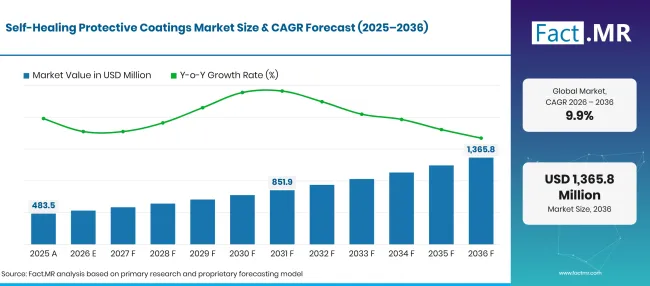
The self-healing protective coatings market is projected to grow from USD 531.4 million in 2026 to USD 1,365.8 million by 2036. Demand for self-healing protective coatings is likely to grow at a CAGR of 9.9% over the forecast period.
Demand for self-healing protective coatings is rising as automotive manufacturers and industrial asset owners seek surfaces that recover from minor scratches and reduce repair frequency. For example, in April 2026, Natoco introduced a self-healing clear coat for in-mold coating that forms the protective layer during plastic injection molding. Manufacturers of self-healing coatings are extending damage-responsive chemistries from paint protection films into spray-applied and in-mold systems. Similar process-integrated products are projected to drive sales of self-healing protective coatings in automotive and electronics manufacturing.
Key Takeaways from the Self-Healing Protective Coatings Market
- Sales of self-healing protective coatings stood at USD 483.5 million in 2025
- Self-Healing Protective Coatings Market Value (2026): USD 531.4 million
- Self-Healing Protective Coatings Market Forecast Value (2036): USD 1,365.8 million
- Self-Healing Protective Coatings Market Forecast CAGR (2026-2036): 9.9%
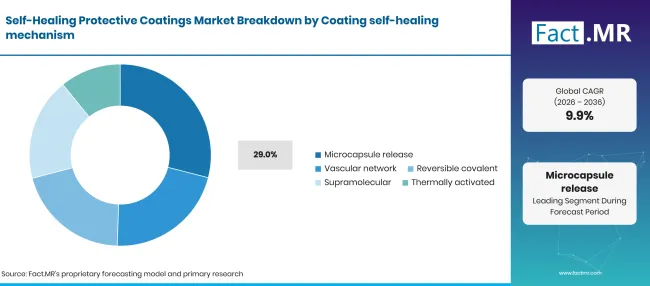
- Leading Coating Self-Healing Mechanism: Microcapsule Release (29.0%)
- Key Market Participants: NEI Corporation, Autonomic Materials, Inc., FEYNLAB Inc., 3M Company, Nippon Paint Holdings Co., Ltd., AkzoNobel N.V.
- Key Growth Regions: India, China, United States, Japan, Germany
Demand for longer-lasting surface protection is strongest in automotive and electronics, which together account for 42.7% of 2026 revenue. For example, in September 2026, IRISTEK launched an upgraded paint protection film with faster self-healing and improved gloss retention. Similar performance upgrades are projected to drive sales of self-healing protective coatings among professional installers and vehicle manufacturers. Manufacturers of self-healing coatings are competing on healing speed, gloss retention and the ability to repair the same defect repeatedly.
Self-Healing Protective Coatings Market
| Metric | Value |
|---|---|
| Estimated Value in (2026) | USD 531.4 million |
| Forecast Value in (2036) | USD 1,365.8 million |
| Forecast CAGR (2026 to 2036) | 9.9% |
Source: Fact.MR analysis. Updated Nov 16, 2026
Source: Fact.MR analysis. Updated 14 Nov 2026
Self Healing Protective Coatings Forecast Global | Source: Fact.MR
Category
| Category | Segments |
|---|---|
| Coating Self-Healing Mechanism | Microcapsule Release, Vascular Network, Reversible Covalent, Supramolecular, Thermally Activated |
| Supply / Product Format | Paste / Gel, Powder / Pellets, Liquid / Dispersion, Film / Sheet, Two-Component / Custom |
| Manufacturing / Cure Process | Moisture / Ambient, UV / Radiation, Thermal, Melt Processing, Hybrid / Specialty |
| Industrial End Use | Automotive, Electronics, Construction, Industrial Equipment, Packaging / Infrastructure |
| Region | India; China; United States; Japan; Germany |
Source: Fact.MR analysis. Updated Nov 16, 2026
Segmental Analysis
Why does microcapsule release lead the Self-Healing Protective Coatings Market by mechanism?
Self Healing Protective Coatings Breakdown Coating Self Healing Mechanism | Source: Fact.MR
Demand for microcapsule-release coatings accounts for 29.0% of the market in 2026, about USD 154.1 million, as embedded capsules release a healing agent that seals scratches on surfaces exposed to abrasion and handling. For example, in September 2026, the University of Queensland announced a nanotechnology-based rust-prevention coating whose particles release corrosion-inhibiting molecules at damaged areas. Similar encapsulation research is projected to drive sales of microcapsule-based self-healing coatings for steel structures and industrial equipment. Manufacturers of self-healing coatings are developing microencapsulated systems that keep adhesion and corrosion resistance after damage.
How is supramolecular chemistry reshaping repair performance in the Self-Healing Protective Coatings Market?
Self Healing Protective Coatings Breakdown Supply Product Format | Source: Fact.MR
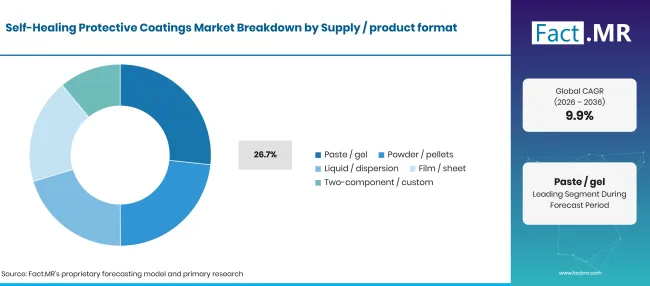
In April 2026, Onyx Coating launched two paint protection film grades with heat-activated self-healing performance. Demand for supramolecular self-healing coatings accounts for 26.7% of revenue in 2026, about USD 141.9 million, as reversible molecular interactions restore coating integrity without consuming a stored healing agent. Similar reversible-repair products are projected to drive sales of self-healing protective coatings where repeated healing at the same location is required. Manufacturers of self-healing coatings are applying these chemistries to automotive clear coats and paint protection films that recover with heat.
Why does automotive lead end-use demand in the Self-Healing Protective Coatings Market?
Self Healing Protective Coatings Breakdown Industrial End Use | Source: Fact.MR
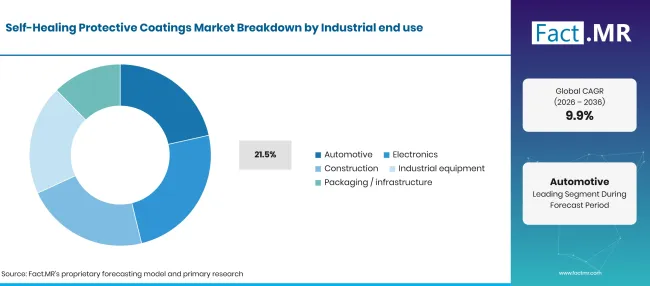
Demand from automotive manufacturers and aftermarket users accounts for 21.5% of the market in 2026, about USD 114.3 million, as vehicle finishes are expected to retain appearance through years of handling and washing. Manufacturers of self-healing coatings are moving beyond adhesive films into spray-applied vehicle protection. For example, in February 2026, Nippon Paint Malaysia soft-launched a self-healing spray-applied paint protection system based on polyurethane chemistry. Similar application formats are projected to drive sales of self-healing protective coatings through vehicle dealers and detailing networks.
Self-Healing Protective Coatings Market-Drivers, Restraints & Trends
- Drivers: In February 2026, India's Ministry of Heavy Industries reported passenger-vehicle production of 5.38 million units and commercial-vehicle production of 1.11 million units for 2025. Demand for self-healing protective coatings is rising as vehicle production grows and manufacturers look to extend surface life. Similar growth in the vehicle parc is projected to drive sales of self-healing protective coatings in automotive applications. Manufacturers of self-healing coatings are supplying heat-responsive films and clear coats to vehicle makers and installers.
- Restraints: Demand for self-healing protective coatings is constrained by the technical work needed to balance repair performance with adhesion, corrosion resistance and long-term stability. Manufacturers of microcapsule coatings must keep capsules intact through storage and application while releasing the healing agent only when damage occurs. For example, NASA's NASA-STD-5008B qualification framework for protective coatings includes extended corrosion exposure with performance evaluated over periods of up to five years. Similar validation requirements are projected to slow adoption of self-healing protective coatings in high-reliability infrastructure and defense applications.
- Trend: Flexible Films for Complex Vehicle Surfaces In May 2026, CARBINS introduced a self-healing paint protection film with a soft coating designed to stretch around complex vehicle surfaces without cracking. Demand for paint protection films that stretch around complex body panels is rising as installers seek fewer cracks and matte patches. Manufacturers of self-healing films are reformulating top coats for elasticity. Similar installation-focused improvements are projected to drive sales of self-healing protective coatings among professional detailers.
- Trend: Nanocontainer Anticorrosion Systems Demand for self-healing anticorrosion coatings is rising as asset owners seek longer maintenance intervals for steel. For example, in October 2026, researchers reported a pH-responsive self-healing anticorrosion coating that achieved 99.97% anticorrosion efficiency on Q235 steel after 36 days of salt-solution immersion. Manufacturers and research groups are embedding corrosion inhibitors in nanocontainers within waterborne epoxy matrices. Similar laboratory results are projected to drive sales of self-healing protective coatings into bridges, buildings and industrial steel structures once commercialized.
Self-Healing Protective Coatings Market by Analysis by Key Country
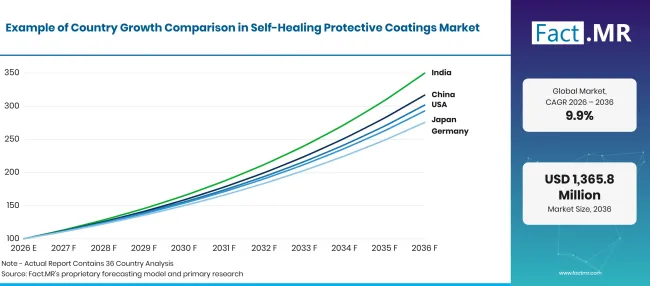
Self Healing Protective Coatings Growth Index | Source: Fact.MR
| Country | CAGR (2026-2036) |
|---|---|
| India | 13.3% |
| China | 12.2% |
| United States | 11.7% |
| Japan | 11.3% |
| Germany | 10.7% |
Source: Fact.MR analysis. Updated Nov 16, 2026
Source: Fact.MR analysis. Updated 14 Nov 2026
What is driving self-healing coating demand in India?
In October 2026, the Reserve Bank of India reported that manufacturing output grew 9.0% year on year in August 2026, with infrastructure and construction goods up 6.4%.
Sales of self-healing protective coatings in India are projected to grow at a 13.3% CAGR, the fastest among the five key countries, as vehicle production expands and manufacturers seek durable surface protection. Manufacturers of self-healing coatings are supplying paint protection films and advanced formulations to Indian vehicle makers and aftermarket channels. Similar industrial growth is projected to drive sales of self-healing protective coatings across India.
How is China's manufacturing base supporting self-healing coating sales?
Demand for self-healing protective coatings in China is projected to grow at a 12.2% CAGR as the country's automotive and electronics manufacturers protect finished surfaces and components.
For example, in November 2026, China's Ministry of Industry and Information Technology reported that automobile production reached 26.318 million units in January to October 2026. Manufacturers of self-healing coatings are extending supply into construction and industrial equipment in China. Similar breadth in manufacturing is projected to drive sales of self-healing protective coatings in China through 2036.
What is sustaining self-healing coating demand in the United States?
Demand for self-healing protective coatings in the United States is projected to grow at an 11.7% CAGR as automotive paint protection and advanced-materials interest expand.
For example, in October 2026, the Federal Reserve's Industrial Production report recorded motor vehicle assemblies at an annualized rate of 10.21 million units for September 2026. Similar industrial activity is projected to drive sales of self-healing protective coatings in the United States, which adds the largest dollar increment of the five countries. Manufacturers of self-healing coatings are offering specialist microencapsulated systems and repeat-healing formulations to U.S. industrial users.
How is clear-coat technology supporting self-healing coating demand in Japan?
In June 2026, Japan's Ministry of Economy, Trade and Industry reported an industrial production index of 103.0 for May 2026, and Nippon Paint continues to market a re-flow self-healing clear-coat technology for automotive finishes.
Sales of self-healing protective coatings in Japan are projected to grow at an 11.3% CAGR as automotive and electronics manufacturers combine scratch resistance with durable finishes. Similar factory-applied systems are projected to drive sales of self-healing protective coatings to Japanese vehicle makers. Manufacturers of self-healing coatings are applying re-flow resin technologies to automotive clear coats.
What manufacturing requirements are shaping self-healing coating demand in Germany?
Demand for self-healing protective coatings in Germany is projected to grow at a 10.7% CAGR as vehicle and industrial manufacturers seek lifecycle performance from finished components.
Manufacturers of self-healing coatings are positioning low-maintenance finishes for German automotive and machinery producers. For example, in November 2026, Germany's Federal Statistical Office reported that automotive industry production rose 17.1% month on month in September 2026 after two weaker months. Similar industrial demand is projected to sustain sales of self-healing protective coatings in Germany.
Competitive Landscape for Self-Healing Protective Coatings Market
Competition in the self-healing protective coatings market is divided between specialist technology developers, diversified coatings manufacturers and automotive surface-protection suppliers. NEI Corporation and Autonomic Materials compete on self-healing formulations and microencapsulated healing technologies, FEYNLAB and 3M compete in automotive ceramic coatings and paint protection films, Nippon Paint competes through self-healing automotive clear coats, and AkzoNobel participates through protective-coatings research with its self-healing technology still at prototype evaluation.
From 2025 onward, competition shifted toward healing speed, surface performance and new application formats. Film suppliers launched upgraded grades in April, May and September 2026, Nippon Paint Malaysia introduced a spray-applied system in February 2026, and Natoco moved self-healing protection into in-mold coating in April 2026. Suppliers that can offer substrate-specific formulations across automotive and industrial protection are best placed to grow.
Recent Developments
- In September 2026, IRISTEK launched the upgraded UPFR2 paint protection film with improved self-healing speed, superhydrophobic properties and gloss retention.
- In May 2026, CARBINS introduced its R Series self-healing paint protection film with a soft coating designed to stretch around complex vehicle surfaces.
- In April 2026, Natoco Co., Ltd. introduced SELF-HEALING CLEAR for in-mold coating, forming a protective coating during plastic injection molding.
- In April 2026, Onyx Coating launched Vunyx Smart Shield 130 and 150 paint protection films with heat-activated self-healing performance.
- In February 2026, Nippon Paint Malaysia soft-launched a self-healing spray-applied automotive paint protection system.
Key Players in Self-Healing Protective Coatings Market
Key companies profiled include NEI Corporation; Autonomic Materials, Inc.; FEYNLAB Inc.; 3M Company; Nippon Paint Holdings Co., Ltd.; and AkzoNobel N.V.
- NEI Corporation
- Autonomic Materials, Inc.
- FEYNLAB Inc.
- 3M Company
- Nippon Paint Holdings Co., Ltd.
- AkzoNobel N.V.
Bibliography
- Board of Governors of the Federal Reserve System. 2026. Industrial Production and Capacity Utilization, October 2026. Washington, DC.
- European Coatings. 2026. pH-responsive self-healing anticorrosion coating with hydrogen-bonded organic framework nanocontainers. Hanover: Vincentz Network.
- Federal Statistical Office (Destatis). 2026. Production in September 2026. Wiesbaden: Destatis.
- Ministry of Heavy Industries. 2026. Automobile production statistics 2025, citing SIAM data. New Delhi: Government of India.
- National Aeronautics and Space Administration. 2024. NASA-STD-5008B: Protective coating of carbon steel, stainless steel and aluminum on launch structures. Washington, DC: NASA.
- Reserve Bank of India. 2026. Monetary Policy Report, October 2026. Mumbai: RBI.
- University of Queensland. 2026. Nanotechnology-based self-healing rust-prevention coating. Brisbane: UQ News.
Segmentation
Scope of Report
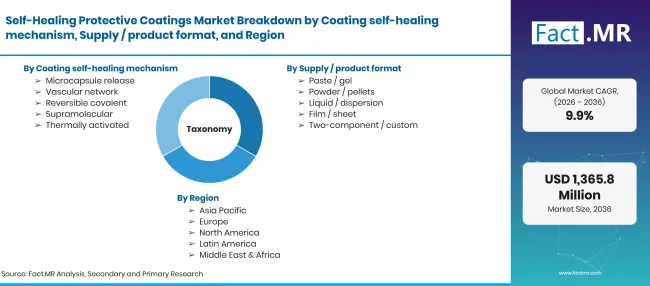
Self Healing Protective Coatings Taxonomy | Source: Fact.MR
| Items | Values |
|---|---|
| Quantitative Units (2026) | USD 531.4 Million |
| Coating Self-Healing Mechanism | Microcapsule Release, Vascular Network, Reversible Covalent, Supramolecular, Thermally Activated |
| Supply / Product Format | Paste / Gel, Powder / Pellets, Liquid / Dispersion, Film / Sheet, Two-Component / Custom |
| Manufacturing / Cure Process | Moisture / Ambient, UV / Radiation, Thermal, Melt Processing, Hybrid / Specialty |
| Industrial End Use | Automotive, Electronics, Construction, Industrial Equipment, Packaging / Infrastructure |
| Regions Covered | North America, Latin America, Europe, East Asia, South Asia and Pacific, Middle East & Africa |
| Countries Covered | United States, China, Germany, Japan, India, and other countries |
| Key Companies Profiled | NEI Corporation, Autonomic Materials, Inc., FEYNLAB Inc., 3M Company, Nippon Paint Holdings Co., Ltd., AkzoNobel N.V. |
| Additional Attributes | Dollar revenue in the Self-Healing Protective Coatings Market is segmented by self-healing mechanism, product format, cure process, industrial end use (automotive, electronics, construction, industrial equipment, packaging/infrastructure) and region. |
Source: Fact.MR analysis. Updated Nov 16, 2026
Self-Healing Protective Coatings Market by Segments
-
Coating Self-Healing Mechanism
- Microcapsule Release
- Vascular Network
- Reversible Covalent
- Supramolecular
- Thermally Activated
-
Supply / Product Format
- Paste / Gel
- Powder / Pellets
- Liquid / Dispersion
- Film / Sheet
- Two-Component / Custom
-
Manufacturing / Cure Process
- Moisture / Ambient
- UV / Radiation
- Thermal
- Melt Processing
- Hybrid / Specialty
-
Industrial End Use
- Automotive
- Electronics
- Construction
- Industrial Equipment
- Packaging / Infrastructure
-
Region:
- North America
- United States
- Canada
- Mexico
- Europe
- Germany
- United Kingdom
- France
- Italy
- Spain
- Rest of Europe
- Asia Pacific
- China
- India
- Japan
- South Korea
- Australia
- Rest of Asia Pacific
- Latin America
- Brazil
- Mexico
- Argentina
- Rest of Latin America
- Middle East & Africa
- GCC Countries
- South Africa
- Rest of Middle East & Africa
- North America
Frequently Asked Questions
How big is the global Self-Healing Protective Coatings Market in 2026?
What will be the size of the Self-Healing Protective Coatings Market by 2036?
How fast will the Self-Healing Protective Coatings Market grow during the forecast period?
Which coating self-healing mechanism segment holds the largest share of the Self-Healing Protective Coatings Market?
Who worked on this report


Preview the report firsthand - request a free sample
Free SampleGet the brochure for pricing and purchase details
Download PDF