- Market Value (2025): USD 533.4 Mn
- Estimated Value (2026): USD 614.3 Mn
- Forecast Value (2036): USD 2520.0 Mn
- CAGR (2026-2036): 15.2%
What is the Multiwall Carbon Nanotube Market forecast to be worth by 2036?
USD 614.3 million in 2026 to USD 2,520.0 million by 2036 at a 15.2% CAGR.
- As per Fact.MR analysis, the MWCNT market was valued at USD 533.4 million in 2025.
- Demand is projected to increase from USD 614.3 million in 2026 to USD 2,520.0 million by 2036.
- The forecast represents a 15.2% CAGR from 2026 to 2036, supported by increasing use of conductive additives in batteries, electronics and engineered materials.
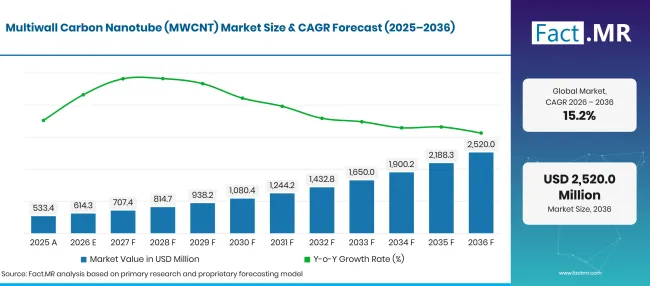
Multiwall Carbon Nanotube Mwcnt Market Forecast Global | Source: Fact.MR
| Year | Basis | Market Value (USD million) |
|---|---|---|
| 2025 | Actual | 533.4 |
| 2026 | Estimate | 614.3 |
| 2036 | Forecast | 2,520.0 |
| CAGR 2026 to 2036 | Forecast period | 15.2% |
Source: Fact.MR analysis. Updated Nov 3, 2026
What are the defining numbers behind Multiwall Carbon Nanotube Market growth?
USD 1,905.7 million absolute opportunity between 2026 and 2036.
- Demand Drivers in the Market
- Battery manufacturers are increasing their use of conductive additives to support electrical performance in lithium-ion cells. The International Energy Agency reported that global electric vehicle battery deployment reached 1.2 TWh in 2025, an increase of almost 30% from 2024 [1].
- Electronics manufacturers require materials that provide conductivity and electrostatic dissipation in components and polymer systems. Arkema's Graphistrength MWCNT range is designed for conductive and mechanical reinforcement applications in polymer matrices and coatings [2].
- Battery and electronics material suppliers are developing ready-to-use CNT dispersions and masterbatches to simplify processing. Birla Carbon's Nanocyl portfolio includes industrial MWCNT powder, polymer masterbatches and liquid dispersions for energy storage, electronics and industrial applications [3].
- Key Segments Analyzed
- By Product Type: Chemical Vapor Deposition is projected to account for 61.3% of the market in 2026. CVD-based production is commercially established for industrial MWCNT manufacturing.
- By Application: Electronics is set to hold 30.0% share in 2026, reflecting the use of conductive nanotubes in electronic materials and components.
- By End-User Industry: Electronics and Semiconductors are estimated to account for 30.0% of the market in 2026, supported by demand for conductive and antistatic materials.
- Analyst Opinion at Fact.MR
- Shambhu Nath Jha, Principal Consultant at Fact.MR, states, “MWCNT adoption will depend on how effectively suppliers translate nanotube performance into consistent industrial formulations. Battery and electronics customers need reliable dispersion, repeatable conductivity and a supply format that can be integrated into existing production processes.”
- Strategic Implications
- Manufacturers should demonstrate batch consistency and provide technical data on purity, diameter, surface area and dispersion behaviour.
- Suppliers need to develop application-ready dispersions and masterbatches to reduce processing complexity for battery and electronics customers.
- Battery producers can assess MWCNT formulations through electrode performance, conductivity and process compatibility testing.
- Electronics material companies must validate electrostatic dissipation and mechanical performance in the final polymer or coating system.
Germany is set to record a 12.8% CAGR through 2036. Brazil is projected to post 16.3%, followed by the USA at 18.5%. The UK is estimated to advance at 14.9%, while Japan is forecast to register 19.3%.
How does the Multiwall Carbon Nanotube Market break down by segment?
Fact.MR finds that Chemical Vapor Deposition leads Product Type at 61.3%; Electronics leads Application at 30.0%; and Electronics and Semiconductors lead End-User Industry at 30.0%.
Which Product Type dominates?
Chemical Vapor Deposition is set to hold 61.3% share in 2026.
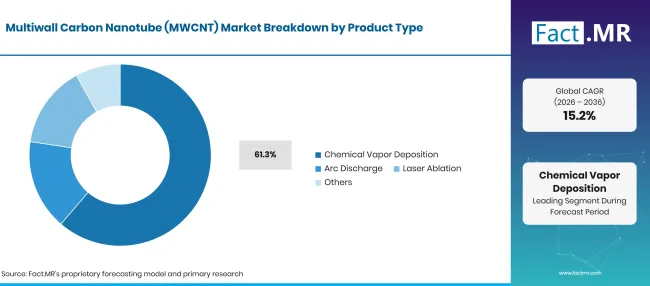
Multiwall Carbon Nanotube Mwcnt Market Breakdown Product Type | Source: Fact.MR
| Product Type | Share (2026) |
|---|---|
| Chemical Vapor Deposition (Leading segment) | 61.3% |
| Other segments combined | 38.7%* |
| Total | 100.0% |
Source: Fact.MR analysis. Updated Nov 3, 2026
Chemical vapor deposition is widely used to produce industrial carbon nanotubes because it can support controlled growth and scalable manufacturing. Arkema identifies its Graphistrength C100 MWCNT powder as being produced through catalytic chemical vapor deposition. Arc discharge and laser ablation are other production routes, while the remaining methods serve different research and manufacturing requirements.
What leads the Application segment?
Electronics is set to represent 30.0% share in 2026.
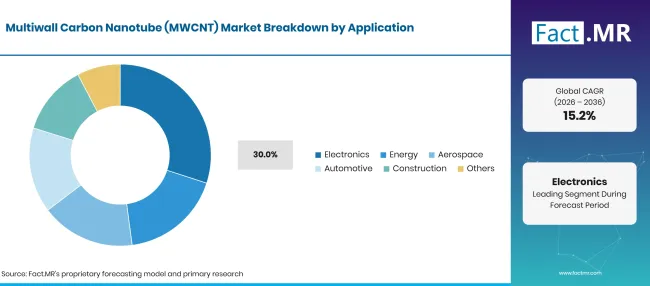
Multiwall Carbon Nanotube Mwcnt Market Breakdown Application | Source: Fact.MR
| Application | Share (2026) |
|---|---|
| Electronics (Leading segment) | 30.0% |
| Other segments combined | 70.0%* |
| Total | 100.0% |
Source: Fact.MR analysis. Updated Nov 3, 2026
Electronics applications use MWCNTs to improve electrical conductivity and electrostatic dissipation in selected materials. Nanotubes can be incorporated into conductive coatings, polymer compounds and electronic packaging materials. Energy storage is another important application, where MWCNTs can serve as conductive additives in lithium-ion battery electrodes. Aerospace and automotive applications use nanotubes in selected lightweight composite and antistatic material formulations.
Which End-User Industry accounts for the largest share?
Electronics and Semiconductors are likely to account for 30.0% share in 2026.
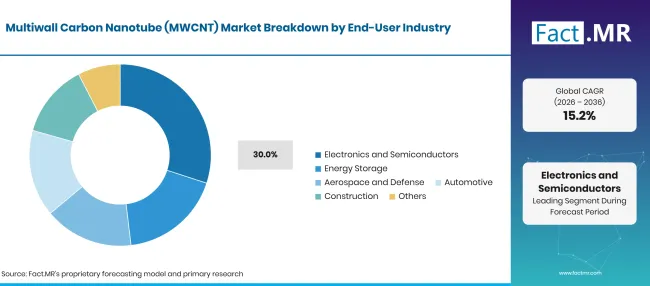
Multiwall Carbon Nanotube Mwcnt Market Breakdown End User Industry | Source: Fact.MR
| End-User Industry | Share (2026) |
|---|---|
| Electronics and Semiconductors (Leading segment) | 30.0% |
| Other segments combined | 70.0%* |
| Total | 100.0% |
Source: Fact.MR analysis. Updated Nov 3, 2026
Electronics and semiconductor manufacturers use conductive materials in components, coatings and polymer systems where electrical or antistatic properties are required. MWCNTs can be incorporated into materials used for electronic packaging and electrostatic discharge protection. Energy storage companies represent another important customer group because nanotubes can improve conductive networks within battery electrodes. Automotive, aerospace and construction buyers use MWCNT-modified materials in more specialized applications.
What is accelerating Multiwall Carbon Nanotube Market adoption, and what is holding it back?
Battery deployment and demand for conductive materials support MWCNT adoption, while dispersion challenges, handling requirements and production economics can constrain wider use.
Drivers Impact Analysis
| DRIVER | (~) % IMPACT ON CAGR | GEOGRAPHIC RELEVANCE | IMPACT TIMELINE |
|---|---|---|---|
| Expansion of lithium-ion battery production | +1.2% | Asia, Europe, Americas | Medium term (2–4 years) |
| Demand for conductive electronics materials | +0.9% | Global | Medium term (2–4 years) |
| Use of antistatic polymer compounds | +0.8% | Global | Short term (≤ 2 years) |
| Development of high-performance composites | +0.7% | Europe, Asia | Long term (≥ 4 years) |
| Greater availability of MWCNT dispersions | +0.6% | Global | Medium term (2–4 years) |
Source: Fact.MR analysis. Updated Nov 3, 2026
Opportunity Impact Analysis
| OPPORTUNITY | (~) % IMPACT ON CAGR | GEOGRAPHIC RELEVANCE | IMPACT TIMELINE |
|---|---|---|---|
| Conductive additives for EV batteries | +1.1% | Asia, Europe, Americas | Medium term (2–4 years) |
| Application-ready polymer masterbatches | +0.8% | Global | Short term (≤ 2 years) |
| High-performance electronic packaging | +0.7% | Asia, North America | Long term (≥ 4 years) |
| Improved dispersion and formulation technologies | +0.6% | Global | Medium term (2–4 years) |
Source: Fact.MR analysis. Updated Nov 3, 2026
Restraints Impact Analysis
| RESTRAINT | (~) % IMPACT ON CAGR | GEOGRAPHIC RELEVANCE | IMPACT TIMELINE |
|---|---|---|---|
| High cost of specialized production and processing | -0.9% | Global | Short term (≤ 2 years) |
| Difficulty achieving uniform dispersion | -0.8% | Global | Medium term (2–4 years) |
| Occupational exposure and handling requirements | -0.6% | Global | Short term (≤ 2 years) |
| Qualification requirements for battery applications | -0.5% | Asia, Europe, Americas | Medium term (2–4 years) |
Source: Fact.MR analysis. Updated Nov 3, 2026
Which countries are scaling the Multiwall Carbon Nanotube Market through 2036?
| Country | CAGR (2026–2036) |
|---|---|
| Germany | 12.8% |
| Brazil | 16.3% |
| USA | 18.5% |
| UK | 14.9% |
| Japan | 19.3% |
Source: Fact.MR analysis. Updated Nov 3, 2026
What supports Germany adoption?
12.8% CAGR, supported by demand for advanced battery materials and conductive industrial compounds.
Germany is emerging as an important growth market for multiwall carbon nanotubes due to its strong automotive manufacturing base and expanding electric mobility ecosystem. The country produced approximately 1.67 million electric vehicles in 2025, representing a 23% annual increase. Battery storage capacity also reached 27.8 GWh in the first quarter of 2026, increasing by 38% year on year. These developments are creating opportunities for MWCNT applications in battery electrodes, conductive additives and lightweight automotive composites. Germany's research and development expenditure reached €137.1 billion in 2024, equivalent to 3.17% of GDP, further supporting innovation in advanced materials and nanotechnology. [7] [8] [9]
How is Brazil developing MWCNT adoption?
16.3% CAGR, shaped by opportunities in battery materials, automotive production and advanced industrial applications.
Brazil's automotive and industrial sectors provide potential markets for conductive additives and reinforced polymer materials. Growth in electric mobility can create opportunities for battery-related MWCNT formulations. Commercial adoption will depend on local customer qualification, access to imported or domestic materials and the availability of technical support.
What supports United States adoption?
18.5% CAGR, supported by battery material development and demand for advanced electronic and conductive products.
The United States has an expanding battery manufacturing and materials ecosystem. The IEA's 2026 outlook identifies continued investment in battery manufacturing and supply-chain diversification as important industry developments. CHASM Advanced Materials offers its NTeC-E multiwall carbon nanotube product family for battery applications in powder and dispersion formats [4]. This demonstrates active product development for the battery market.
How is the United Kingdom building adoption?
14.9% CAGR, backed by demand for advanced materials, battery technologies and specialist electronics applications.
The UK's battery and advanced materials sectors create opportunities for conductive nanotube formulations. MWCNT-based materials can support battery electrodes, antistatic polymers and selected composite applications. Suppliers need to provide application data and demonstrate consistent performance to support qualification by industrial customers.
What supports Japan adoption?
19.3% CAGR, led by advanced electronics, automotive materials and battery manufacturing.
Japan's electronics and automotive industries provide a strong potential customer base for conductive nanotube materials. LG Chem's MWCNT product portfolio identifies conductive additives for lithium-ion batteries and conductive plastics [5]. Japan-based buyers can also evaluate MWCNT materials for electronics packaging and engineered polymer applications where electrical performance is important.
Who leads the Multiwall Carbon Nanotube Market?
Fact.MR identifies LG Chem Ltd., Arkema S.A., Birla Carbon (Nanocyl brand) and CHASM Advanced Materials Inc. as companies with current product-specific evidence for multiwall carbon nanotubes.
LG Chem is a directly verified MWCNT producer. Its official CNT portfolio states that it exclusively produces MWCNTs and lists battery conductive additives and conductive plastics grades. The company also reports operating CNT capacity of 2,900 tonnes across its Yeosu facilities.
Arkema markets Graphistrength multiwall carbon nanotubes in powder and masterbatch forms. Its official product information identifies catalytic chemical vapor deposition as the production route for Graphistrength C100 and describes applications in composites, coatings, adhesives, batteries and automotive materials.
Birla Carbon owns Nanocyl and markets its MWCNT portfolio under the Nanocyl brand. Its NC7000 product is identified as an industrial MWCNT, while its wider portfolio includes polymer masterbatches and liquid dispersions. Nanocyl should therefore be treated as a Birla Carbon brand rather than as a separate independent company [6].
CHASM Advanced Materials offers NTeC-E, a multiwall carbon nanotube product family developed for battery applications. The company lists powder and dispersion formats and describes its materials as suitable for lithium-ion battery applications.
Which companies are the key providers?
Key companies with current, product-specific MWCNT evidence include:
- LG Chem Ltd.
- Arkema S.A.
- Birla Carbon (Nanocyl brand)
- CHASM Advanced Materials Inc.
Bibliography
- [1] International Energy Agency. (2026, May 20). Global EV Outlook 2026
- [2] Arkema. (n.d.). Graphistrength® multiwall carbon nanotubes
- [3] Birla Carbon. (n.d.). NC7000™: Industrial multiwall carbon nanotubes
- [4] CHASM Advanced Materials. (n.d.). NTeC for battery materials.
- [5] LG Chem. (n.d.). CNT
- [6] Birla Carbon. (n.d.). Nanocyl FAQ
- [7] Germany Trade & Invest. (2026, February 17). Germany is world’s second-largest EV maker
- [8] Statistisches Bundesamt (Destatis). (2026, March 27). 3,8 % mehr Ausgaben für Forschung und Entwicklung im Jahr 2024
- [9] Deutscher Bundestag. (2026, June 8). Bundesbericht Forschung und Innovation 2026
This Report Answers
- The report describes how MWCNT materials are produced and supplied across the specified production methods.
- Application analysis examines electronics, energy, aerospace, automotive and construction uses.
- End-user analysis compares demand from electronics and semiconductor companies, energy storage manufacturers and other industrial customers.
- Country analysis discusses Germany, Brazil, USA, UK and Japan alongside their respective market growth estimates.
- The competitive overview profiles companies with current product-specific evidence for MWCNT materials.
What does the Multiwall Carbon Nanotube Market cover?
The market covers multiwall carbon nanotubes as industrial powders, dispersions and formulated products. MWCNTs are used as conductive additives and reinforcement materials in batteries, electronics, polymer compounds, coatings and composites. Market demand depends on nanotube quality, conductivity, dispersion characteristics, production consistency and compatibility with downstream manufacturing processes.
What is included in the scope?
Included products comprise MWCNT powders, liquid dispersions, polymer masterbatches and other formulated products containing multiwall carbon nanotubes. The scope covers materials produced through chemical vapor deposition, arc discharge, laser ablation and other stated production methods. Applications include electronics, energy storage, automotive, aerospace, construction and related industrial uses.
What is excluded from the scope?
The analysis excludes single-wall carbon nanotubes (SWCNTs) sold as a separate product category. Graphene, carbon black, carbon nanofibers and conventional conductive additives are also excluded unless they are part of a formulated product whose relevant MWCNT content is included in the market boundary. Finished batteries, electronic devices, automotive components and composite structures are excluded. Equipment used for CNT production is also outside the scope.
How Was the Analysis Built?
The analysis draws on 120+ sources, 35+ company portfolios, 25+ countries, and more than 20 industry interviews.
- Primary Research: Primary research includes discussions with CNT manufacturers, battery material suppliers, electronics companies, polymer compounders, distributors and subject-matter experts. These conversations examine purchasing priorities, product specifications, dispersion requirements, application qualification and competitive positioning.
- Desk Research: Desk research covers company product portfolios, technical data sheets, corporate publications, government statistics, battery industry reports, technical studies, standards and other authoritative sources. Every source used in the analysis is documented in the bibliography.
- Market Sizing and Forecasting: Market estimates combine historical performance, demand indicators, pricing and volume trends, segment shares, company participation, country-level growth, application patterns and barriers to market expansion.
- Data Validation and Update Cycle: Findings are validated by comparing primary interviews with public data, company product activity, production capacity disclosures, technical specifications and developments in battery and electronics manufacturing. Regular updates review product launches, capacity changes, partnerships and shifts in commercial adoption.
Segmentation
What is the report’s scope and coverage?
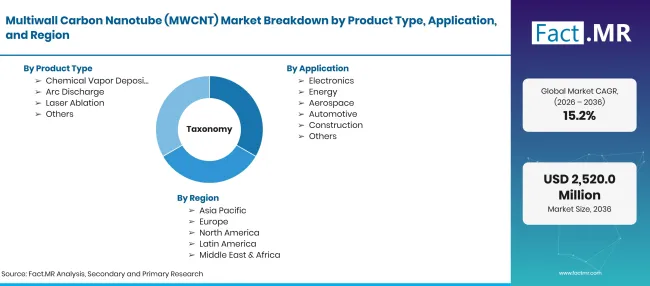
Factmr Multiwall Carbon Nanotube Mwcnt Market Taxonomy | Source: Fact.MR
| Attribute | Details |
|---|---|
| Quantitative Units | USD billion |
| Market Definition | The multiwall carbon nanotube market comprises commercially supplied carbon nanotubes made of multiple concentric graphene cylinders. It covers powders, dispersions and polymer masterbatches used to enhance electrical conductivity and mechanical strength. |
| Product Type | Chemical Vapor Deposition; Arc Discharge; Laser Ablation; Others |
| Application | Electronics; Energy; Aerospace; Automotive; Construction; Others |
| End-User Industry | Electronics and Semiconductors; Energy Storage; Aerospace and Defense; Automotive; Construction; Others |
| Regions Covered | North America; Latin America; Western Europe; Eastern Europe; East Asia; South Asia & Pacific; Middle East & Africa |
| Countries Covered | Germany; Brazil; USA; UK; Japan |
| Companies Profiled | LG Chem Ltd.; Arkema S.A.; Birla Carbon (Nanocyl brand); CHASM Advanced Materials Inc. |
| Forecast Period | 2026 to 2036 |
| Approach | Market segmentation and scenario-based analysis supported by company product portfolios and battery industry indicators |
Source: Fact.MR analysis. Updated Nov 3, 2026
How is the market segmented?
-
By Product Type
- Chemical Vapor Deposition
- Arc Discharge
- Laser Ablation
- Others
-
By Application
- Electronics
- Energy
- Aerospace
- Automotive
- Construction
- Others
-
By End-User Industry
- Electronics and Semiconductors
- Energy Storage
- Aerospace and Defense
- Automotive
- Construction
- Others
-
By Region
- North America
- Latin America
- Western Europe
- Eastern Europe
- East Asia
- South Asia & Pacific
- Middle East & Africa
Frequently Asked Questions
How big is the Multiwall Carbon Nanotube Market in 2026?
What is the CAGR from 2026 to 2036?
Which Product Type has the largest share?
Which Application leads?
Which End-User Industry accounts for the largest share?
Which companies are covered?
Who worked on this report


Preview the report firsthand - request a free sample
Free SampleGet the brochure for pricing and purchase details
Download PDF