- Market Value (2025): USD 968.0 Bn
- Estimated Value (2026): USD 1064.8 Bn
- Forecast Value (2036): USD 2761.8 Bn
- CAGR (2026-2036): 10.0%
What is the Wellness Tourism Market forecast to be worth by 2036?
USD 1,064.8 billion in 2026 to USD 2761.8 billion by 2036 at a 10.0% CAGR.
- The Wellness Tourism Market reached USD 968.0 billion in 2025.
- Demand is projected to increase from USD 1064.8 billion in 2026 to USD 2761.8 billion by 2036.
- The market is projected to expand at a 10.0% CAGR from 2026 to 2036.
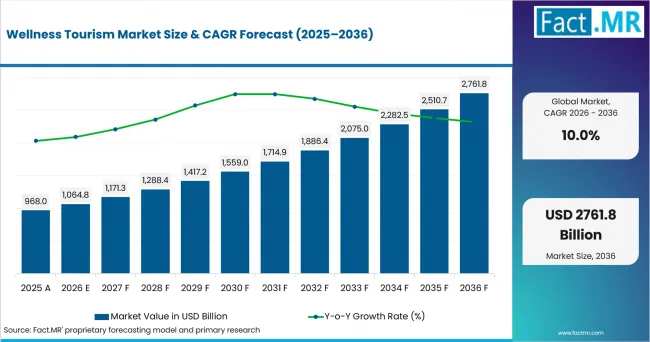
Wellness Tourism Market Value Analysis | Source: Fact.MR
What are the defining numbers behind Wellness Tourism Market growth?
An absolute opportunity of USD 1697.0 billion is expected between 2026 and 2036.
- Demand Drivers in the Market
- Wellness-oriented travel has moved above its pre-pandemic spending base. The Global Wellness Institute reported wellness tourism expenditure of USD 894.0 billion in 2024, while wellness-tourism trips and spending were both above 2019 levels. A larger installed base of wellness trips increases demand for structured retreats, spa stays, preventive health programs and destination-based recovery services.
- Preventive health concerns are widening the addressable traveler base. The World Health Organization reports that physical inactivity contributes to noncommunicable disease risk and that regular activity supports physical and mental wellbeing. This creates a practical use case for fitness retreats, nutrition programs and preventive medical wellness services that combine travel with guided behaviour change.
- International tourism has recovered enough to support cross-border wellness packages again. UN Tourism reported 1.4 billion international tourist arrivals in 2024 and a further 5% increase in the first quarter of 2025. This expands the pool of travelers who can add medical tourism or wellness services to an overseas trip.
- Digital monitoring is making wellness programs more measurable before, during and after travel. WHO extended its Global Strategy on Digital Health through 2027, reflecting continued investment in digital health systems. Wearables, remote monitoring and app-based follow-up allow providers to connect a destination stay with ongoing activity, sleep or recovery tracking.
- Hotels and destination operators are turning wellness into a bookable service layer rather than a general amenity. Accor has highlighted active, nature-based and science-informed wellbeing programs, while Marriott distributes spa stays across multiple hotel brands. This supports spending on spa services and retreat packages alongside ordinary lodging.
- Key Segments Analyzed
- Medical Wellness Programs account for 54.3% of Product in 2026 because they combine preventive health, screening and structured lifestyle support within a defined travel program.
- Preventive Healthcare Tourism holds 41.8% of Application in 2026 as travelers can purchase health-oriented stays before a diagnosed condition requires treatment.
- Individual Travelers represent 47.6% of End Use in 2026 because wellness trips are commonly self-directed and selected around personal health, recovery or lifestyle goals.
- Digital Health Monitoring Systems account for 36.9% of Technology in 2026 by linking wearable and remote-monitoring data with program delivery and follow-up.
- Preventive Wellness Formulations hold 58.2% of Formulation in 2026 as nutrition and wellness products are routinely incorporated into preventive programs and guided retreats.
- Direct Wellness Providers account for 44.5% of Distribution Channel in 2026 because clinics, resorts and specialist providers can control the complete itinerary and service experience.
- Analyst Opinion at Fact.MR
- Shambhu Nath Jha, Principal Consultant at Fact.MR, states, “Wellness tourism purchases are becoming more program-led. Travelers increasingly compare the purpose of a stay, professional support, measurable activities and continuity after the trip. Providers that connect accommodation with structured preventive, recovery or lifestyle programs can capture more spending than businesses selling relaxation as an isolated amenity.”
- Strategic Implications
- Wellness providers should package services around a defined traveler objective such as stress recovery, preventive health, mobility, sleep or lifestyle improvement. A clear program makes it easier for customers to compare outcomes and duration before booking.
- Hotels can raise wellness revenue per guest by connecting rooms with consultations, guided activity and treatment schedules. Dedicated spa market offerings are more defensible when the stay includes a structured sequence instead of one-off treatments.
- Digital monitoring should support the service rather than replace it. Wearable data and remote follow-up are most useful when a coach or clinician can use the information to adjust activity, recovery or nutrition recommendations.
- Mental wellbeing and sleep can support differentiated travel packages because travelers can understand the goal before arrival and continue routines after departure. This creates adjacency with sleep tourism where hotels and wellness resorts package rest support into the stay.
How does the Wellness Tourism Market break down by segment?
The market is segmented by Product, Application, End Use, Technology, Formulation and Distribution Channel.
Why do Medical Wellness Programs lead Product?
Medical Wellness Programs are projected to account for a 54.3% share in 2026.
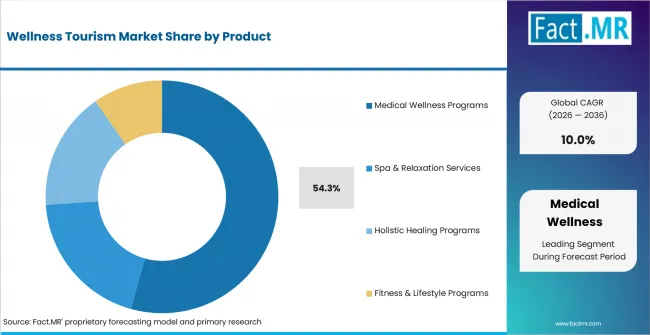
Wellness Tourism Market Analysis By Product | Source: Fact.MR
The segment leads because it gives travelers a structured reason to buy a multi-day wellness stay. Programs can combine preventive assessment, supervised activity, nutrition support and recovery services within one itinerary, increasing spend per trip compared with an unstructured relaxation break.
The operating advantage is coordination. A provider can schedule consultations, activity and follow-up in a defined sequence, which helps buyers understand what is included and makes the program easier to price. WHO identifies screening, prevention and lifestyle risk reduction as important parts of the response to noncommunicable diseases, supporting demand for preventive rather than purely recreational offerings.
Why does Preventive Healthcare Tourism lead Application?
Preventive Healthcare Tourism is projected to account for a 41.8% share in 2026.
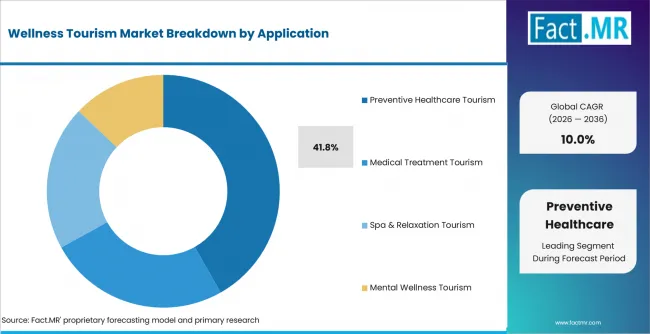
Wellness Tourism Market Analysis By Application | Source: Fact.MR
Preventive travel has a broader eligible customer base than treatment-led travel because participation does not depend on a specific procedure. Health screening, lifestyle improvement and guided activity can be purchased before a condition requires clinical intervention.
This also lowers planning complexity for many travelers. Treatment tourism may involve medical records, insurer approval and procedure-specific recovery, while preventive programs can be booked around annual leave or leisure travel. WHO guidance on physical activity supports the preventive value of movement for both physical and mental wellbeing.
Why do Individual Travelers lead End Use?
Individual Travelers are projected to account for a 47.6% share in 2026.
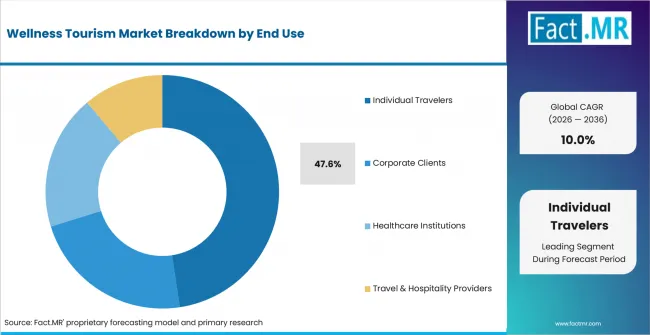
Wellness Tourism Market Analysis By End Use | Source: Fact.MR
Individual travelers lead because the decision to take a wellness trip is commonly tied to personal stress, sleep, fitness, nutrition or recovery goals. The traveler chooses the destination, duration and intensity of the program, making direct consumer demand central to the category.
Self-funded demand also allows providers to create tiered packages around accommodation and service intensity. GWI data show wellness-tourism trips and expenditure exceeded 2019 levels in 2024, indicating that individual consumers have returned to wellness-oriented travel at scale.
Why do Digital Health Monitoring Systems lead Technology?
Digital Health Monitoring Systems are projected to account for a 36.9% share in 2026.
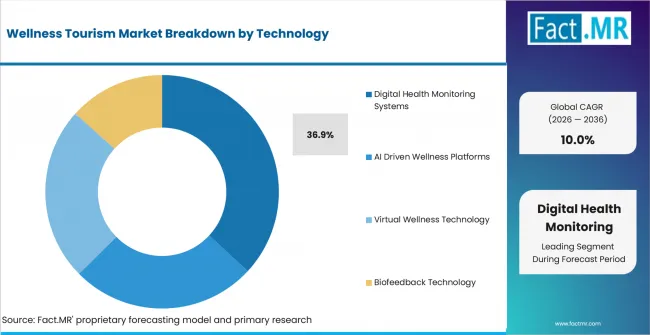
Wellness Tourism Market Analysis By Technology | Source: Fact.MR
Monitoring systems lead because they can translate a wellness program into measurable daily activity. Wearables and remote devices can track movement, sleep or other health indicators during the stay and support follow-up after the traveler returns home.
The buyer value is continuity. Without monitoring, a short retreat can end when the traveler leaves the property. Digital records allow providers to extend coaching or program review beyond the destination. WHO’s digital-health strategy emphasizes coordinated use of technology to support people-centred health services.
Why do Preventive Wellness Formulations lead Formulation?
Preventive Wellness Formulations are projected to account for a 58.2% share in 2026.
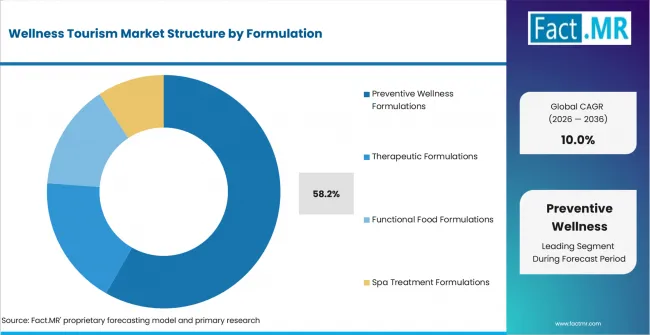
Wellness Tourism Market Analysis By Formulation | Source: Fact.MR
Preventive formulations lead because nutrition, hydration and non-prescription wellness products can be incorporated into a broad range of retreats without the procedure-specific constraints associated with therapeutic treatment. They fit fitness, lifestyle and preventive health programs and can be used throughout the stay.
Providers can also connect formulations with meals, coaching or activity schedules. The commercial value comes from integration with a guided program rather than from selling standalone products. Claims and product selection still require appropriate regulatory and professional controls in each market.
Why do Direct Wellness Providers lead Distribution Channel?
Direct Wellness Providers are projected to account for a 44.5% share in 2026.
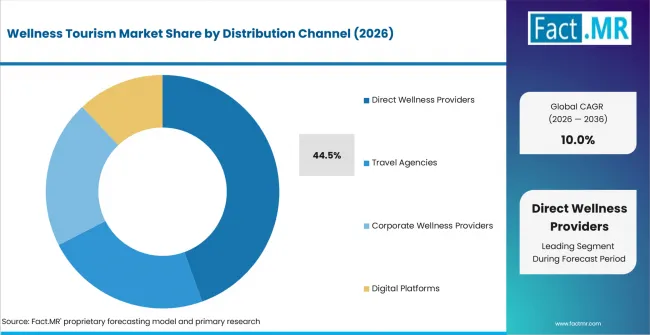
Wellness Tourism Market Analysis By Distribution Channel | Source: Fact.MR
Direct providers lead because they control the program design and the customer experience. Resorts, clinics and specialist wellness operators can coordinate booking, assessment, treatment schedules, accommodation and follow-up without transferring responsibility across several intermediaries.
This matters when buyers are purchasing an outcome-oriented stay. Direct communication allows the provider to explain suitability, program intensity and preparation before arrival. Travel agencies and digital platforms remain relevant for discovery, but the service provider often needs the final customer relationship for higher-complexity wellness programs.
What is accelerating Wellness Tourism Market adoption, and what is holding it back?
Demand is being accelerated by preventive-health travel, structured wellness programs and digital follow-up, while affordability, quality variation and cross-border health-service complexity can restrict conversion.
Drivers Impact Analysis
| Factor | (~) % Impact on CAGR | Geographic Relevance | Impact Timeline |
|---|---|---|---|
| Preventive health-oriented travel | +1.8% | Global | Short term (<= 2 years) |
| Wellness integration in hotels and resorts | +1.5% | Germany; Brazil; USA | Short term (<= 2 years) |
| Digital health monitoring in travel programs | +1.1% | USA; UK; Japan | Medium term (2-4 years) |
| Corporate wellness travel programs | +0.8% | USA; Germany; UK | Medium term (2-4 years) |
| Nature and thermal wellness destination development | +0.6% | Germany; Brazil; Japan | Long term (>= 4 years) |
Opportunity Impact Analysis
| Factor | (~) % Impact on CAGR | Geographic Relevance | Impact Timeline |
|---|---|---|---|
| Sleep and mental wellness programs | +1.0% | USA; UK; Japan | Medium term (2-4 years) |
| Thermal and nature-based wellness stays | +0.8% | Germany; Brazil; Japan | Medium term (2-4 years) |
| AI-personalized wellness packages | +0.7% | USA; UK; Japan | Long term (>= 4 years) |
| Corporate and insurer partnerships | +0.5% | USA; Germany; UK | Long term (>= 4 years) |
Restraints Impact Analysis
| Factor | (~) % Impact on CAGR | Geographic Relevance | Impact Timeline |
|---|---|---|---|
| High trip and program cost | -1.2% | Global | Short term (<= 2 years) |
| Uneven quality and clinical oversight | -0.9% | Global | Short term (<= 2 years) |
| Travel disruption and visa or insurance limitations | -0.7% | Cross-border markets | Medium term (2-4 years) |
| Health-data privacy and device integration | -0.5% | USA; UK; Germany; Japan | Long term (>= 4 years) |
Which countries are scaling the Wellness Tourism Market through 2036?
- Germany: A dense network of health spas and health resorts supports preventive and rehabilitation-oriented travel. The German Spa Association identifies more than 350 health spas and resorts, giving wellness travelers a broad base of established destinations and qualified therapeutic offerings.
- Brazil: The Ministry of Tourism’s 2026 trends publication identifies health and wellbeing travel as a central tourism theme, with spas, thermal waters, outdoor activity, yoga and mindfulness forming part of the offer. This supports nature-led and holistic wellness packages.
- USA: A deep domestic travel market and broad resort network support destination wellness, spa and lifestyle programs. Specialist operators can serve self-funded travelers while hotel groups add wellness to conventional leisure stays.
- UK: Strong inbound and domestic travel flows support short wellness breaks, spa stays and mental-recovery packages. Hotels can attach wellness services to city, countryside and resort trips without requiring a separate medical travel itinerary.
- Japan: High inbound travel volumes combine with established hot-spring and hospitality traditions. Wellness providers can position relaxation, recovery and preventive programs alongside cultural and leisure itineraries.
Country CAGR (2026-2036)
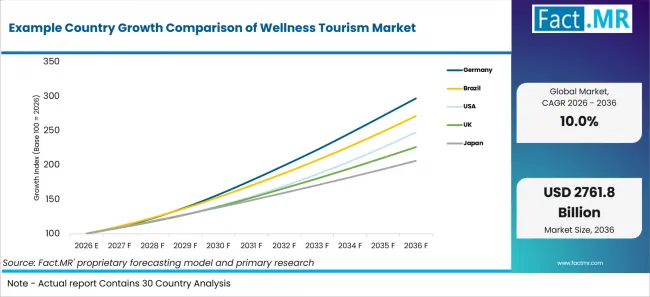
Example Country Growth Comparison Of Wellness Tourism Market | Source: Fact.MR
| Country | CAGR, 2026-2036 |
|---|---|
| Germany | 11.5% |
| Brazil | 10.5% |
| USA | 9.5% |
| UK | 8.5% |
| Japan | 7.5% |
What is driving Germany's growth through 2036?
Germany is forecast to expand at an 11.5% CAGR from 2026 to 2036.
Germany combines a mature health-resort system with a substantial domestic travel base. Destatis reported 169 million multi-day domestic trips in 2025, up 3.9% from 2024. This gives spa towns and preventive-health destinations a large pool of travelers who can purchase wellness services without relying only on international arrivals.
The country also has a long-established network of health resorts that integrates natural therapeutic resources with prevention, rehabilitation and wellness-oriented stays. This supports higher-value programs that extend beyond ordinary hotel accommodation.
What is driving Brazil's growth through 2036?
Brazil is forecast to expand at a 10.5% CAGR from 2026 to 2036.
Brazil is broadening its wellness proposition around nature, thermal water, spas and holistic experiences. The Ministry of Tourism’s 2026 trends work specifically identifies health and wellbeing travel as a major theme, including physical activity, mindfulness and nature-led recovery.
International tourism is also expanding the addressable visitor base. Brazil passed 8 million international tourists before the end of 2025, creating more opportunities for destinations to attach wellness experiences to longer leisure itineraries.
What is driving the USA's growth through 2036?
The USA is forecast to expand at a 9.5% CAGR from 2026 to 2036.
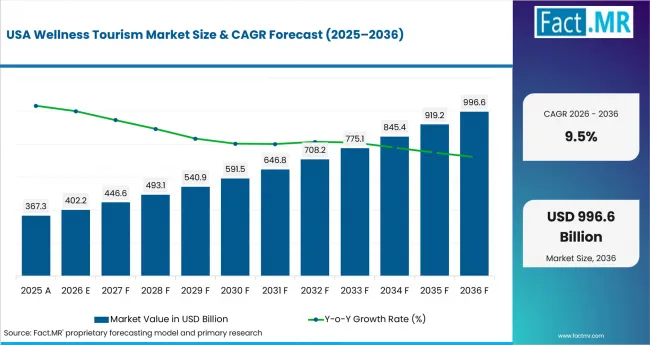
Wellness Tourism Market Country Value Analysis | Source: Fact.MR
The USA benefits from a broad resort, spa and preventive-wellness provider base and from continued recovery in international visitation. The National Travel and Tourism Office projected 85.0 million international arrivals in 2026, above the 72.4 million recorded in 2024.
This volume supports destination wellness at several price points, from specialist retreats to wellness services attached to conventional hotel stays. Digital health and remote follow-up can further extend programs after travelers return home.
What is driving the UK's growth through 2036?
The UK is forecast to expand at an 8.5% CAGR from 2026 to 2036.
VisitBritain estimates 43.6 million inbound visits in 2025 and forecasts 45.5 million in 2026. A growing visitor base supports wellness spending through spa hotels, countryside retreats and mental-recovery packages that can be added to leisure travel.
The market can also benefit from shorter program formats. Travelers do not need a long medical itinerary to purchase sleep, stress-recovery or spa services, which allows providers to package wellness into weekend and short-break travel.
What is driving Japan's growth through 2036?
Japan is forecast to expand at a 7.5% CAGR from 2026 to 2036.
Japan received 42.7 million international visitors in 2025, up 15.8% from 2024 according to the Japan National Tourism Organization. This gives hotels, resorts and regional destinations a wider base for wellness experiences linked to relaxation, recovery and local bathing traditions.
The opportunity is strongest where wellness is integrated with the broader itinerary. Providers can combine spa services, mindful activity and digital support with cultural or nature-based travel rather than depending on a standalone clinical trip.
Who Leads the Wellness Tourism Market?
Marriott, Accor, Allergan, Galderma, Canyon Ranch, and Pravassa are key providers in the Wellness Tourism Market.
Marriott competes through a broad hotel and resort portfolio that can attach spa and wellness services to existing leisure travel. Its current Bonvoy platform distributes spa resorts and spa hotels across several brands, giving the company a direct route to travelers who want wellness within a conventional hotel booking.
Accor competes through a similarly broad hospitality platform and reports more than 950 spas and more than 2,000 hotels with spa or fitness facilities as of June 2025. Canyon Ranch, Rancho La Puerta and Pravassa compete through more specialized wellness positioning, while KPJ Healthcare adds a healthcare-provider channel. Galderma and Ipsen participate closer to therapeutic and medical-wellness adjacencies.
Starwood, Allergan and Miraval now sit within larger corporate groups. Marriott acquired Starwood Hotels & Resorts in 2016, so Starwood is no longer a separate current competitor. AbbVie completed its acquisition of Allergan in 2020. Hyatt acquired Miraval Group in 2017, with Miraval continuing as a wellness brand within Hyatt.
Competition depends on program credibility, destination appeal, clinical or professional capability where relevant, and the ability to connect lodging with repeatable wellness services. Hospitality groups benefit from distribution and loyalty programs, while specialist resorts compete through deeper program design and a more focused wellness proposition.
Which companies are the key providers?
Key companies include Marriott; Accor; Allergan; Galderma; Canyon Ranch; Pravassa; Ipsen; KPJ Healthcare; Miraval Resort & Spa; Omni Hotels Management; Rancho La Puerta; Shangri-La; and Starwood.
- Marriott
- Accor
- Allergan
- Galderma
- Canyon Ranch
- Pravassa
- Ipsen
- KPJ Healthcare
- Miraval Resort & Spa
- Omni Hotels Management
- Rancho La Puerta
- Shangri-La
- Starwood
Bibliography
- Global Wellness Institute. (2025). Global Wellness Economy Monitor 2025. Global Wellness Institute.
- UN Tourism. (2025). International Tourism Recovers Pre-Pandemic Levels in 2024. United Nations Tourism.
- UN Tourism. (2025). International Tourist Arrivals Grew 5% in Q1 2025. United Nations Tourism.
- World Health Organization. (2025). Global Strategy on Digital Health 2020-2027. World Health Organization.
- World Health Organization. (2024). Physical Activity. World Health Organization.
- World Health Organization. (2025). Noncommunicable Diseases. World Health Organization.
- Deutscher Heilbäderverband. (2026). Health Spas and Health Resorts in Germany. German Spa Association.
- Deutscher Heilbäderverband. (2026). Facts and Figures. German Spa Association.
- Federal Statistical Office of Germany. (2026). Multi-Day Domestic and International Travel in 2025. Destatis.
- Ministry of Tourism, Brazil. (2026). Tourism Trends 2026: Health and Wellbeing in Travel. Government of Brazil.
- Ministry of Tourism, Brazil. (2025). Brazil Reaches 8 Million International Tourists. Government of Brazil.
- National Travel and Tourism Office. (2025). International Visitor Forecast. U.S. Department of Commerce.
- VisitBritain. (2026). Inbound Tourism Forecast. British Tourist Authority.
- Japan National Tourism Organization. (2026). Visitor Arrivals to Japan, December and Full Year 2025. JNTO.
- Marriott International. (2026). Spa Resorts and Spa Hotels. Marriott Bonvoy.
- Marriott International. (2026). Our Story: 2016 Starwood Acquisition. Marriott International.
- Accor. (2026). Premium, Midscale & Economy Global Development Presentation. Accor Group.
- Accor. (2024). Wellness Trends 2025. Accor Group.
- AbbVie. (2020). AbbVie Completes Acquisition of Allergan plc. AbbVie Inc.
- Hyatt Hotels Corporation. (2017). Hyatt Acquires Miraval Group. Hyatt Hotels Corporation.
This Report Answers
- How wellness tourism demand is distributed across the covered products, applications and buyer groups.
- Why preventive healthcare and medical wellness programs occupy central positions within wellness-oriented travel.
- How digital monitoring, AI and virtual wellness tools are being integrated into travel programs and provider workflows.
- How Germany, Brazil, the USA, the UK and Japan differ in the mechanisms supporting market expansion.
- How hospitality groups, specialist wellness resorts, healthcare providers and therapeutic companies compete across the market.
What does the Wellness Tourism Market cover?
The Wellness Tourism Market covers travel spending and provider revenue generated by wellness-oriented programs, preventive healthcare tourism, spa and relaxation travel, mental wellness travel and related lifestyle services across Product, Application, End Use, Technology, Formulation and Distribution Channel. Technology and formulation revenue is included where those products are integrated into wellness-travel programs or sold through wellness providers serving travelers.
The market therefore spans destination-based wellness programs alongside the digital and product components that support assessment, monitoring, nutrition, recovery or treatment during a wellness trip.
What is included in the scope?
The scope includes medical wellness, spa and relaxation, holistic healing, fitness and lifestyle programs. Application coverage includes preventive healthcare tourism, medical treatment tourism, spa and relaxation tourism and mental wellness tourism.
Buyer coverage includes individual travelers, corporate clients, healthcare institutions and travel or hospitality providers. Technology coverage includes digital health monitoring, AI-driven platforms, virtual wellness technology and biofeedback. Formulation coverage includes preventive, therapeutic, functional food and spa-treatment categories. Distribution includes direct providers, travel agencies, corporate wellness providers and digital platforms.
What is excluded from the scope?
The scope excludes ordinary leisure travel with no wellness component and standalone hospital care that does not involve travel. General hotel revenue is excluded when a stay does not include a wellness-related service or program.
Standalone consumer supplements, digital health applications and therapeutic products are outside the market when they are sold independently of wellness-travel programs or provider workflows. Conventional business travel and unrelated recreation are also excluded.
How Was the Analysis Built?
The analysis combines primary market interviews with desk research across tourism, wellness, healthcare, hospitality and digital-health sources.
- Primary Research: Interviews focus on wellness-resort operators, hotel groups, travel agencies, healthcare providers, corporate wellness buyers and technology suppliers. Discussions examine package design, traveler motivations, program duration, distribution and purchasing criteria.
- Desk Research: The review covers tourism statistics, health and prevention guidance, digital-health policy, destination promotion, company portfolios and hospitality wellness offerings. Government agencies, multilateral organizations and industry bodies provide the principal external evidence.
- Market Sizing and Forecasting: Market sizing uses wellness-trip volume, traveler expenditure, program mix, accommodation and wellness-service attachment, technology and formulation revenue, and country travel activity. Segment shares and country growth are applied across the market structure.
- Data Validation and Update Cycle: Findings are cross-checked against tourism volumes, wellness-provider activity, corporate developments and changes in digital-health or travel conditions. Updates account for destination demand, program launches, ownership changes and shifts in traveler spending.
What is the report's scope and coverage?
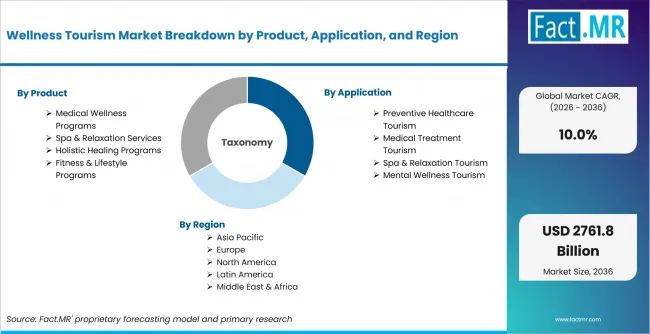
Wellness Tourism Market Breakdown By Product, Application, And Region | Source: Fact.MR
| Attribute | Details |
|---|---|
| Quantitative Units | USD billion |
| Market Definition | Wellness-oriented travel programs and associated services, technologies and formulations across Product, Application, End Use, Technology, Formulation and Distribution Channel |
| Segments Covered | Product; Application; End Use; Technology; Formulation; Distribution Channel |
| Regions Covered | North America; Latin America; Europe; East Asia; South Asia and Pacific; Middle East and Africa |
| Countries Covered | Germany; Brazil; USA; UK; Japan |
| Key Companies Profiled | Marriott; Accor; Allergan; Galderma; Canyon Ranch; Pravassa; Ipsen; KPJ Healthcare; Miraval Resort & Spa; Omni Hotels Management; Rancho La Puerta; Shangri-La; Starwood |
| Forecast Period | 2026 to 2036 |
| Base Year | 2026 |
| Market Value, 2026 | USD 1,064.8 billion |
| Market Value, 2036 | USD 2,761.8 billion |
| CAGR, 2026-2036 | 10.0% |
| Absolute Opportunity | USD 1,697.0 billion |
| Approach | Hybrid top-down and bottom-up approach using wellness-trip volume, traveler expenditure, program mix, service attachment, technology and formulation revenue, and country travel activity |
How is the market segmented?
-
By Product:
- Medical Wellness Programs
- Preventive Health Programs
- Clinical Wellness Programs
- Spa & Relaxation Services
- Therapeutic Spa Services
- Luxury Spa Experiences
- Holistic Healing Programs
- Alternative Medicine Programs
- Energy Healing Systems
- Fitness & Lifestyle Programs
- Physical Fitness Retreats
- Lifestyle Coaching Programs
- Medical Wellness Programs
-
By Application:
- Preventive Healthcare Tourism
- Health Screening Travel
- Lifestyle Disease Prevention Travel
- Medical Treatment Tourism
- Elective Medical Procedures
- Rehabilitation Travel Programs
- Spa & Relaxation Tourism
- Luxury Wellness Travel
- Urban Wellness Stays
- Mental Wellness Tourism
- Stress Recovery Travel
- Mindfulness Travel Programs
- Preventive Healthcare Tourism
-
By End Use:
- Individual Travelers
- High Net Worth Individuals
- General Wellness Tourists
- Corporate Clients
- Employee Wellness Programs
- Insurance Supported Clients
- Healthcare Institutions
- Hospitals Offering Wellness Packages
- Specialty Wellness Clinics
- Travel & Hospitality Providers
- Wellness Resort Operators
- Travel Agencies
- Individual Travelers
-
By Technology:
- Digital Health Monitoring Systems
- Wearable Health Devices
- Remote Patient Monitoring Systems
- AI Driven Wellness Platforms
- Predictive Health Analytics
- Recommendation Systems
- Virtual Wellness Technology
- VR Meditation Systems
- Digital Therapy Platforms
- Biofeedback Technology
- Stress Monitoring Systems
- Neurofeedback Systems
- Digital Health Monitoring Systems
-
By Formulation:
- Preventive Wellness Formulations
- Nutraceutical Formulations
- Herbal Formulations
- Therapeutic Formulations
- Detox Formulations
- Immune Support Formulations
- Functional Food Formulations
- Diet Based Formulations
- Hydration Based Formulations
- Spa Treatment Formulations
- Essential Oil Blends
- Thermal Therapy Products
- Preventive Wellness Formulations
-
By Distribution Channel:
- Direct Wellness Providers
- Hospitals & Clinics
- Wellness Resorts
- Travel Agencies
- Medical Tourism Agencies
- Online Travel Platforms
- Corporate Wellness Providers
- Employee Wellness Platforms
- HR Wellness Vendors
- Digital Platforms
- Telehealth Platforms
- Wellness Mobile Apps
- Direct Wellness Providers
-
By Region:
- North America
- Latin America
- Western Europe
- Eastern Europe
- East Asia
- South Asia and Pacific
- Middle East & Africa