- Market Value (2025): USD 121.1 Bn
- Estimated Value (2026): USD 127.6 Bn
- Forecast Value (2036): USD 215.9 Bn
- CAGR (2026-2036): 5.4%
What is the Professional Spa Services Market forecast to be worth by 2036?
USD 215.9 billion by 2036, at a 5.4% CAGR.
- The market reached approximately USD 121.1 billion in 2025.
- The Professional Spa Services Market is valued at USD 127.6 billion in 2026 and is projected to reach USD 215.9 billion by 2036.
- Beauty and Grooming holds 36.2% share of Services in 2026, while Day And Salon Spa accounts for 45.0% share of segment Type.
- Male customers represent 66.9% of the Customer Orientation split in 2026.
- Germany records high CAGR 5.9% through 2036
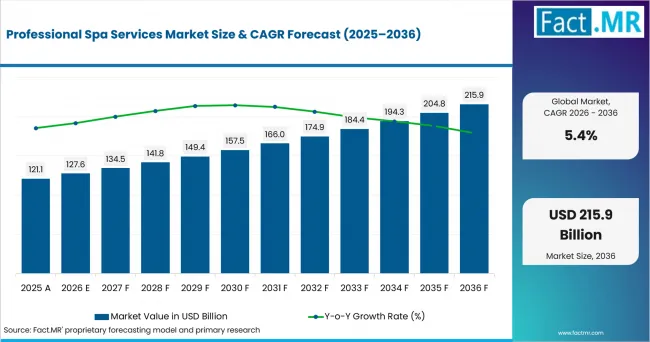
Professional Spa Services Market Value Analysis | Source: Fact.MR
What are the defining numbers behind Professional Spa Services Market growth?
The Professional Spa Services Market is projected to generate an absolute opportunity of USD 88.3 billion between 2026 and 2036.
- Demand Drivers in the Professional Spa Services Market
- Wellness spending has moved beyond occasional indulgence toward a repeat service category. Global Wellness Institute data show that spa facilities recovered strongly.
- The U.S. Bureau of Labor Statistics projects massage therapist employment to rise 15% from 2025 to 2035, while skincare specialists and manicurists and pedicurists are each projected to grow 9%.
- Hospitality groups are extending wellness beyond overnight guests. Hilton expanded its ResortPass partnership in July 2026 to scale day access across properties in the Americas, showing how pools, spas and wellness amenities can be monetized in shorter, locally driven visits rather than only through room stays.
- Key Segments Analyzed
- By Services: Beauty And Grooming leads with 36.2% share in 2026.
- By Type: Day And Salon Spa leads with 45.0% share in 2026.
- By Customer Orientation: Male leads with 66.9% share in 2026.
- Analyst Opinion at Fact.MR
- Shambhu Nath Jha, Principal Consultant, Fact.MR says, "Spa demand is becoming less about a single treatment and more about a service routine that fits time, travel, grooming, recovery, and wellbeing goals. Operators that can make that routine easy to book, safe to repeat, and consistent across therapists and locations will protect pricing far better than those competing only on ambience."
- Strategic Implications
- Day and salon operators should design repeatable service bundles around visit frequency. Memberships, prepaid packages, and cross-service credits can improve utilization when they are simple to understand.
- Hotel and resort spas need to treat local residents as a separate demand pool. Day access and wellness packages can improve asset productivity without depending entirely on room occupancy.
- Beauty and grooming providers should separate high-frequency services from high-complexity services so protocols match the economics of each treatment.
- Spa groups expanding across borders need local licensing and safety checks built into the operating model.
How does the Professional Spa Services Market break down by segment?
The market is segmented by Services, Type, Customer Orientation, and Region. Services include Beauty and Grooming, Massage, Physical Fitness, and Others. Type covers Day and Salon Spa, Destination And Health Resorts, Hotel And Resort Spas, Medical Spas, Thermal And Mineral Springs Spas, and other formats. Customer Orientation is split between Male and Female customers.
Why does Beauty and Grooming lead the Services segment?
Beauty and Grooming is projected to account for 36.2% share in 2026.
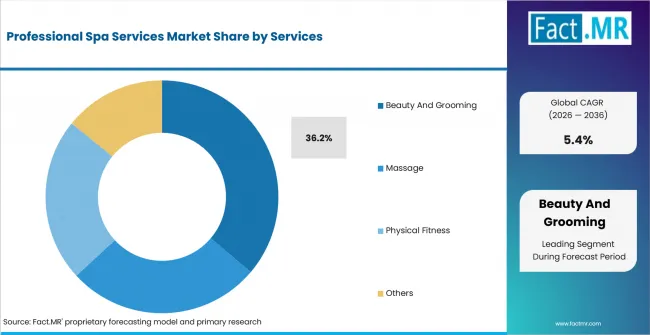
Professional Spa Services Market Analysis By Services | Source: Fact.MR
The segment benefits from visit frequency. Hair care, facial treatments, nail care, and adjacent grooming services can be purchased on shorter cycles than destination wellness programs, creating a steadier base of repeat appointments. Official labor and enterprise data in the USA and UK show durable economic activity around skincare and beauty treatment.
What keeps Day and Salon Spa at the front of the Type segment?
Day and Salon Spa is projected to account for 45.0% share in 2026.
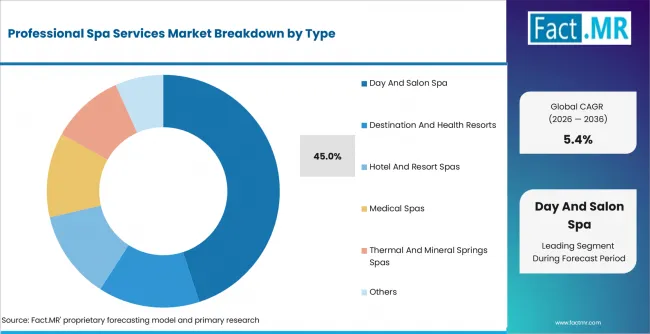
Professional Spa Services Market Analysis By Type | Source: Fact.MR
The format is convenient for local, appointment-based demand because a customer can purchase massage related wellness services without an overnight stay. Global Wellness Institute defines day, club and salon spas around trained-professional services offered on a day-use basis, which closely matches the operating logic of this segment.
Why does Male lead Customer Orientation in the 2026?
Male customers are projected to account for 66.9% share in 2026.
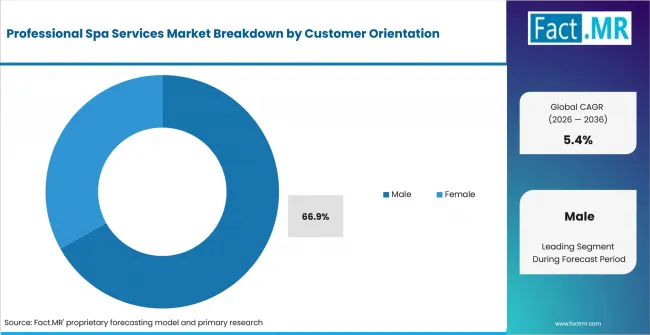
Professional Spa Services Market Analysis By Customer Orientation | Source: Fact.MR
The U.S. Bureau of Labor Statistics has specifically identified a broader customer base including more men as one factor supporting personal-care-service demand. Operators serving this segment increasingly combine grooming and lower-friction booking rather than positioning every visit as a traditional luxury spa occasion.
What is accelerating Professional Spa Services Market adoption, and what is holding it back?
Growth is supported by repeat wellness visits, expanding hotel and resort spa offerings, and wider use of professional services for grooming, recovery and stress management. Expansion is constrained by labor intensity, practitioner availability and differing licensing and safety requirements across markets.
Drivers Impact Analysis
| Factor | (~) % Impact on CAGR | Geographic Relevance | Impact Timeline |
|---|---|---|---|
| Repeat wellness and grooming visits | +1.6% | Global | Short term (≤ 2 years) |
| Expansion of hotel and resort wellness services | +1.4% | Global | Short term (≤ 2 years) |
| Growing demand for massage and personal-care services | +1.1% | USA, Europe and Brazil | Medium term (2–4 years) |
| Wider access through memberships and day-use spa services | +0.9% | Global | Medium term (2–4 years) |
| Integration of wellness into travel and hospitality | +0.6% | Global | Long term (≥ 4 years) |
Source: Fact.MR analysis. Updated Sep 4, 2026
Opportunity Impact Analysis
| Factor | (~) % Impact on CAGR | Geographic Relevance | Impact Timeline |
|---|---|---|---|
| Local-resident access to hotel spa capacity | +1.0% | Global | Medium term (2–4 years) |
| Membership and bundled service models | +0.8% | USA, UK and Germany | Medium term (2–4 years) |
| Culturally specific wellness services | +0.7% | Germany, Japan and Brazil | Long term (≥ 4 years) |
| Expansion of integrated wellness programs | +0.5% | Global | Long term (≥ 4 years) |
Source: Fact.MR analysis. Updated Sep 4, 2026
Restraints Impact Analysis
| Factor | (~) % Impact on CAGR | Geographic Relevance | Impact Timeline |
|---|---|---|---|
| Labor intensity and practitioner shortages | -1.1% | Global | Short term (≤ 2 years) |
| Licensing and safety requirements | -0.9% | UK, Brazil and other regulated markets | Short term (≤ 2 years) |
| Limited therapist treatment capacity | -0.7% | Global | Medium term (2–4 years) |
| Higher operating and compliance costs | -0.5% | Global | Long term (≥ 4 years) |
Source: Fact.MR analysis. Updated Sep 4, 2026
Which countries are scaling the Professional Spa Services Market through 2036?
- Germany: A well-developed network of health spas and resorts supports demand across thermal, mineral-spring and destination wellness services. The German National Tourist Board identifies more than 350 health spas and resorts across the country. (German National Tourist Board, 2026)
- Brazil: Demand is supported by a broad beauty and aesthetics service base alongside established health-and-wellbeing tourism. Regulatory oversight of beauty salons and aesthetic centers is also increasing the importance of professionally managed services. (ANVISA, 2026; Brazil Ministry of Tourism, 2010)
- USA: Growth is supported by rising demand for massage and personal-care services alongside wider use of hotel wellness facilities by local customers. U.S. BLS projects massage therapist employment to increase 15% from 2025 to 2035. (U.S. BLS, 2026; Hilton, 2026)
- U.K.: A developed beauty-services sector and formal licensing requirements for massage and special-treatment premises support demand for compliant professional operators. (ONS, 2026; GOV.UK, 2026)
- Japan: The country’s established onsen culture supports thermal and mineral-spring spas, ryokan wellness services and hotel-based spa treatments linked to domestic and international travel. (Ministry of the Environment Japan, 2026; JNTO, 2026)
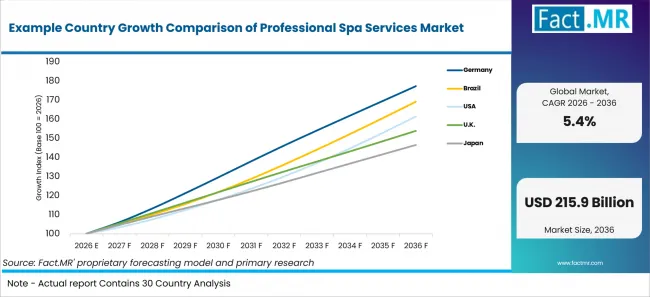
Example Country Growth Comparison Of Professional Spa Services Market | Source: Fact.MR
Country CAGR (2026-2036)
| Country | CAGR (2026-2036) |
|---|---|
| Germany | 5.9% |
| Brazil | 5.4% |
| USA | 4.9% |
| U.K. | 4.4% |
| Japan | 3.9% |
Source: Fact.MR analysis. Updated Sep 4, 2026
What is driving Germany’s growth through 2036?
Germany is forecast to expand at a 5.9% CAGR from 2026 to 2036.
Growth is supported by the country’s established health-resort infrastructure and domestic tourism activity. The German National Tourist Board identifies more than 350 health spas and resorts, including mineral and thermal springs, Kneipp resorts and therapeutic-climate destinations.
Destatis recorded 497.5 million guest overnight stays in Germany in 2025, supporting demand for destination wellness and spa services linked to domestic travel. (German National Tourist Board, 2026; Destatis, 2026)
What is driving Brazil’s growth through 2036?
Brazil is forecast to expand at a 5.4% CAGR from 2026 to 2036.
Growth is supported by the country’s established beauty and aesthetics service base and its health-and-wellbeing tourism sector. Spas, hydrothermal resorts and wellness centers form part of this tourism offering.
ANVISA oversight of beauty salons and aesthetic centers is also increasing the importance of sanitary controls and professional operating standards. (ANVISA, 2026; Brazil Ministry of Tourism, 2010)
What is driving USA’s growth through 2036?
The USA is forecast to expand at a 4.9% CAGR from 2026 to 2036.
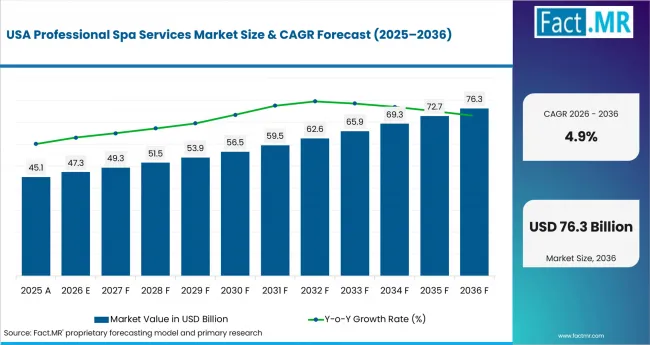
Professional Spa Services Market Country Value Analysis | Source: Fact.MR
Demand is supported by continued growth in occupations that deliver core spa services. The U.S. Bureau of Labor Statistics projects massage therapist employment to rise 15% from 2025 to 2035, while employment for skincare specialists and manicurists and pedicurists is projected to increase 9%.
Hotel operators are also widening access to spa and wellness amenities beyond overnight guests, creating additional demand from local customers. (U.S. BLS, 2026; Hilton, 2026)
What is driving the U.K.’s growth through 2036?
The U.K. is forecast to expand at a 4.4% CAGR from 2026 to 2036.
Growth is supported by an established beauty-services business base and formal licensing requirements for many massage and special-treatment premises.
Local licensing and inspection requirements increase the value of operators that can maintain consistent treatment and safety standards while serving repeat customers. (ONS, 2026; GOV.UK, 2026)
What is driving Japan’s growth through 2036?
Japan is forecast to expand at a 3.9% CAGR from 2026 to 2036.
Growth is supported by the country’s established hot-spring and onsen culture. Thermal bathing forms part of domestic tourism and is also promoted to international visitors.
This supports demand across thermal and mineral-spring spas, ryokan wellness services and hotel spa treatments associated with travel. (Ministry of the Environment Japan, 2026; JNTO, 2026)
Who Leads the Professional Spa Services Market?
Key players in the Professional Spa Services Market include Hilton Hotels & Resorts, Four Seasons Hotels Limited, Hyatt Hotels Corporation, Six Senses Hotels Resorts Spas, Clarins Group, Planet Beach, Woodhouse Spa, Lanserhof and other professional spa operators.
Competition is fragmented across hotel and resort spas, destination wellness operators, day-spa networks and beauty-led service providers. Competitive positioning depends on service consistency, practitioner quality and the ability to keep treatment capacity utilized across different customer groups.
Hotel groups compete by integrating spa and wellness services into the broader guest experience while also extending access to local customers. Hilton expanded its ResortPass partnership in July 2026, increasing day access to participating properties across the Americas. Hyatt opened Miraval The Red Sea in June 2026 with a 40,000-square-foot spa and 39 treatment rooms, supporting its destination-wellness presence. (Hilton, 2026; Hyatt, 2026)
Day-spa and specialist operators compete through repeat visit models such as memberships, prepaid treatments and bundled services. Providers also need consistent hygiene standards and practitioner training, particularly as treatment menus extend into aesthetic and higher-technology services.
Geographic expansion requires operators to adapt to local wellness traditions and regulatory requirements. Germany’s health-resort network, Japan’s onsen sector and Brazil’s regulated aesthetics market create different operating requirements for providers seeking to scale across countries. (German National Tourist Board, 2026; JNTO, 2026; ANVISA, 2026)
Which companies are the key providers?
Key players in the Professional Spa Services Market include Hilton Hotels & Resorts, China Liangtse Wellness Spa, Clarins Group, Four Seasons Hotels Limited, Gaia Retreat & Spa, Grand America Hotels & Resorts, Hot Springs Resort & Spa, Hyatt Hotels Corporation, Jade Mountain, Lanserhof, Planet Beach, Rancho La Puerta, Rosewood Hotels, Six Senses Hotels Resorts Spas, Woodhouse Spa, Zimi Home Spa test, and Kempinski Hotels S.A.
- Hilton Hotels & Resorts
- China Liangtse Wellness Spa
- Clarins Group
- Four Seasons Hotels Limited
- Gaia Retreat & Spa
- Grand America Hotels & Resorts
- Hot Springs Resort & Spa
- Hyatt Hotels Corporation
- Jade Mountain
- Lanserhof
- Planet Beach
- Rancho La Puerta
- Rosewood Hotels
- Six Senses Hotels Resorts Spas
- Woodhouse Spa
- Zimi Home Spa
- Kempinski Hotels S.A.
Bibliography
- Global Wellness Institute. (2025). 2025 Global Wellness Economy Monitor. Global Wellness Institute.
- Global Wellness Institute. (2026). Spa Industry Definitions and Sector Overview. Global Wellness Institute.
- German National Tourist Board. (2026). Health Spas and Health Resorts. German National Tourist Board.
- Federal Statistical Office of Germany. (2026). Tourism in Germany in 2025: Record Guest Overnight Stays. Destatis.
- Federal Statistical Office of Germany. (2026). Tourism by Municipality Groups Including Mineral, Climate and Kneipp Health Resorts. Destatis GENESIS-Online.
- ANVISA. (2026). Services of Interest to Health: Beauty Salons and Aesthetic Centers. Government of Brazil.
- ANVISA. (2026). Anvisa Discusses Regulatory Aspects of Aesthetics Professionals. Government of Brazil.
- Ministry of Tourism, Brazil. (2010). Health Tourism: Basic Guidelines. Government of Brazil.
- U.S. Bureau of Labor Statistics. (2026). Massage Therapists, Occupational Outlook Handbook. U.S. Department of Labor.
- U.S. Bureau of Labor Statistics. (2026). Skincare Specialists, Occupational Outlook Handbook. U.S. Department of Labor.
- U.S. Bureau of Labor Statistics. (2026). Manicurists and Pedicurists, Occupational Outlook Handbook. U.S. Department of Labor.
- U.S. Bureau of Labor Statistics. (2022). Recovering from the Pandemic: A Bright Outlook for the Personal Care Service Industry. U.S. Department of Labor.
- Office for National Statistics. (2026). The Beauty Industry 2025. Government of the United Kingdom.
- GOV.UK. (2026). Massage and Special Treatment Premises Licensing. Government of the United Kingdom.
- Ministry of the Environment, Japan. (2026). Hot Spring Use Data. Government of Japan.
- Japan National Tourism Organization. (2026). How to Best Enjoy Japan's Onsen. Japan National Tourism Organization.
- Hilton. (2026). Hilton and ResortPass Expand Partnership as Wellness and Day Experiences Grow. Hilton.
- Hyatt. (2026). Miraval The Red Sea Opens in Saudi Arabia. Hyatt Hotels Corporation.
- Six Senses Hotels Resorts Spas. (2026). Press Releases and 2026 Openings. Six Senses Hotels Resorts Spas.
This Report Addresses
- Global market value from 2025 through 2036 and the 2026 to 2036 forecast CAGR.
- Demand drivers, labor constraints, licensing and safety issues, hospitality integration, and monetization opportunities shaping professional spa services.
- Segment shares across Services, Type, and Customer Orientation, including Beauty And Grooming, Day And Salon Spa, and Male customers.
- Country growth outlook for Germany, Brazil, USA, U.K., and Japan, with each CAGR separated from its public evidence lens.
- Competitive positioning of Hilton Hotels & Resorts and the wider companies
- Research methodology, evidence boundaries, recent company developments, and links to adjacent Fact.MR beauty, spa, wellness, tourism and hospitality studies.
What does the Professional Spa Services Market cover?
The Professional Spa Services Market covers commercial revenue from professionally delivered beauty and grooming, massage, physical fitness, hydrotherapy, wellness and related spa services. Revenue includes treatments and wellness services delivered through day and salon spas, destination and health resorts, hotel and resort spas, medical spas, thermal and mineral spring spas and other professional spa settings.
Coverage includes Beauty And Grooming, Massage, Physical Fitness and other professional spa services, together with the applicable spa types, customer orientation and regional markets.
What is included in the scope?
Services include Beauty And Grooming, Massage, Physical Fitness and Others. Type includes Day And Salon Spa, Destination And Health Resorts, Hotel And Resort Spas, Medical Spas, Thermal And Mineral Springs Spas and other professional spa formats.
Customer Orientation includes Male and Female customers. The market includes professionally delivered spa services purchased by local customers, travelers and wellness users across North America, Latin America, Europe, East Asia, South Asia and Pacific, and the Middle East and Africa.
What is excluded from the scope?
The scope excludes stand-alone beauty products, cosmetics, personal-care products and spa equipment when they are sold without an associated professional spa service. It also excludes general hotel, resort or fitness revenue that is not attributable to the defined spa-service offering.
Independent medical procedures that fall outside the covered medical-spa service boundary are excluded. Home-use wellness devices, self-administered treatments and unrelated healthcare services are outside the market unless they form part of the defined professional spa service transaction.
How Was the Analysis Built?
The analysis draws on more than 120 public and industry sources, over 35 company and service portfolios and more than 20 industry interviews across at least 25 countries.
- Primary Research: Interviews with spa operators, hotel and resort wellness managers, day-spa owners, beauty and grooming service providers, massage professionals, wellness-center managers and industry specialists examine visit frequency, treatment mix, practitioner utilization, pricing, memberships, repeat booking and capacity constraints.
- Desk Research: The review covers tourism statistics, labor-market data, licensing requirements, sanitary guidance, wellness-industry research, government publications and current company information relevant to professional spa services.
- Market Sizing and Forecasting: Estimates combine service volumes with average treatment spending, visit frequency, spa-type mix, customer orientation, practitioner capacity, hotel and resort utilization and country-level demand conditions.
- Data Validation and Update Cycle: Findings are cross-checked against tourism activity, labor indicators, licensing developments, company expansion and changes in professional spa operating models. Updates account for shifts in service mix, treatment access, wellness travel and practitioner capacity.
Segmentation
What is the report's scope and coverage?
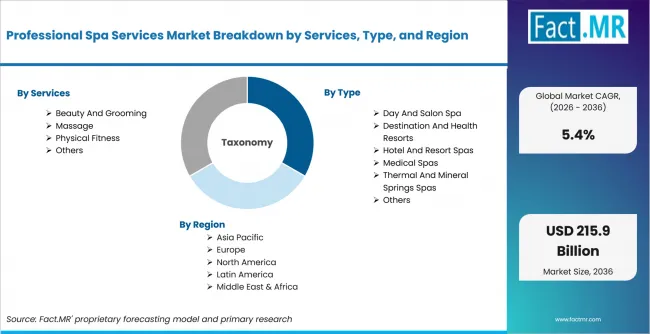
Professional Spa Services Market Breakdown By Services, Type, And Region | Source: Fact.MR
| Attribute | Details |
|---|---|
| Quantitative Units | USD billion; shares and CAGR in percent |
| Market Definition | Professionally delivered beauty and grooming, massage, fitness, hydrotherapy, wellness and related spa services across professional spa settings |
| Segments Covered | Services; Type; Customer Orientation |
| Regions Covered | North America; Latin America; Europe; East Asia; South Asia and Pacific; Middle East and Africa |
| Countries Covered | Germany; Brazil; USA; U.K.; Japan |
| Key Companies Profiled | Hilton Hotels & Resorts; China Liangtse Wellness Spa; Clarins Group; Four Seasons Hotels Limited; Gaia Retreat & Spa; Grand America Hotels & Resorts; Hot Springs Resort & Spa; Hyatt Hotels Corporation; Jade Mountain; Lanserhof; Planet Beach; Rancho La Puerta; Rosewood Hotels; Six Senses Hotels Resorts Spas; Woodhouse Spa; Zimi Home Spa test; Kempinski Hotels S.A. |
| Forecast Period | 2026 to 2036 |
| Base Year | 2025 |
| Market Value, 2026 | USD 127.6 billion |
| Market Value, 2036 | USD 215.9 billion |
| CAGR, 2026-2036 | 5.4% |
| Absolute Opportunity | USD 88.3 billion |
| Approach | Hybrid top-down and bottom-up assessment using service volumes, treatment mix, visit frequency, spa type, customer orientation, pricing, practitioner capacity and country-level demand conditions |
Source: Fact.MR analysis. Updated Sep 4, 2026
How is the market segmented?
-
By Services
- Beauty And Grooming
- Massage
- Physical Fitness
- Others
-
By Type
- Day And Salon Spa
- Destination And Health Resorts
- Hotel And Resort Spas
- Medical Spas
- Thermal And Mineral Springs Spas
- Others
-
By Customer Orientation
- Male
- Female
Frequently Asked Questions
How large is the Professional Spa Services Market in 2026?
What will the Professional Spa Services Market be worth by 2036?
What is the forecast CAGR?
Which Services segment leads in 2026?
Which Type segment leads?
Which country is likely to grow a notable CAGR?
What is the absolute opportunity from 2026 to 2036?
Who worked on this report


Preview the report firsthand - request a free sample
Free SampleGet the brochure for pricing and purchase details
Download PDF