- Market Value (2025): USD 0.5 Bn
- Estimated Value (2026): USD 0.6 Bn
- Forecast Value (2036): USD 2.0 Bn
- CAGR (2026-2036): 13.0%
What is the Eye-Illuminating Gadgets Market forecast to be worth by 2036?
USD 0.6 billion in 2026 to USD 2.0 billion by 2036 at a 13.0% CAGR.
- The Eye-Illuminating Gadgets Market reached USD 0.5 billion in 2025.
- Demand is projected to increase from USD 0.6 billion in 2026 to USD 2.0 billion by 2036.
- The market is projected to expand at a 13.0% CAGR from 2026 to 2036.
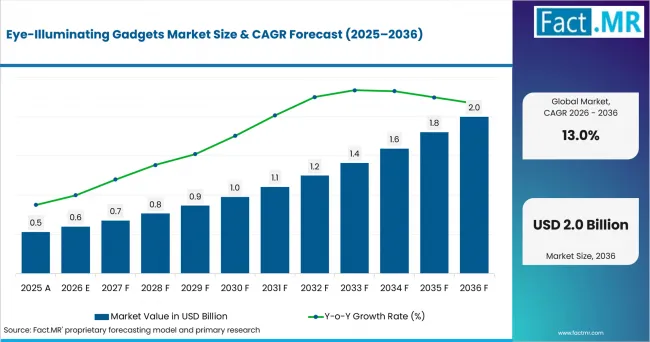
Eye Illuminating Gadgets Market Value Analysis | Source: Fact.MR
What are the defining numbers behind Eye-Illuminating Gadgets Market growth?
An absolute opportunity of USD 1.4 billion is expected between 2026 and 2036.
- Demand Drivers in the Market
- Clinical interest in low-level light is extending into dry-eye and meibomian-gland care. A peer-reviewed review describes photobiomodulation as an emerging in-office approach for meibomian gland dysfunction and dry eye, and a 2025 randomized paired-eye trial evaluated low-level light therapy alone against a combined light protocol. This expands the addressable use case beyond cosmetic appearance and connects the category with red light therapy systems used under controlled treatment conditions.
- Regulatory activity is making the consumer LED segment more concrete. In 2026, the U.S. Food and Drug Administration cleared multiple over-the-counter light-based wrinkle-reduction devices, including LED masks and the Ulike Reglow Light Therapy Device. A visible clearance pathway encourages suppliers to document wavelength, dose, intended use and safety controls, which can improve buyer confidence when devices are used close to the eyes and alongside wearable healthcare products.
- Wearable and hands-free designs are reducing the friction of repeat sessions. Philips introduced ReAura in August 2026 with a flexible LED mask that can treat the eye area independently, while FOREO continues to sell the IRIS 2 eye massager as a compact at-home device. These product architectures show how eye-area gadgets are shifting toward short, repeatable routines that fit consumer beauty and wellness behavior and overlap with beauty wearables.
- Healthcare buyers remain important because periocular light has to be separated from general illumination and used with appropriate controls. The National Eye Institute identifies age 50 and above as a risk factor for dry eye, while the European medical-device framework and the UK safety guidance for lasers, intense light sources and LEDs place emphasis on performance, clinical evidence and safe optical use. This supports a professional channel for devices used in ophthalmic devices workflows and specialty eye clinics.
- Key Segments Analyzed
- LED Eye-Illuminating Devices account for 46.8% of Product in 2026 because diffuse LED arrays can cover the eye contour with repeatable exposure while fitting masks, flexible wearables and compact handheld designs without the beam-management complexity of laser systems.
- Cosmetic Eye Care Applications account for 62.4% of Application in 2026 as periocular wrinkles, dark circles and anti-aging routines support frequent at-home and professional use, with clinical photobiomodulation research giving light-based skincare a clearer evidence base.
- Healthcare Facilities account for 53.6% of End Use in 2026 because hospitals and specialty eye clinics can manage patient selection, ocular protection and treatment protocols when light-based systems are used for dry-eye, recovery or other medical ophthalmic applications.
- LED Light Therapy Technology accounts for 57.9% of Technology in 2026 because LED arrays enable broad, low-profile illumination, flexible mask integration and wavelength-specific designs that are easier to adapt to consumer and professional products than tightly focused laser architectures.
- Wearable Device Formulations account for 41.2% of Formulation in 2026 because flexible masks and ergonomic eye-area systems hold the emitter geometry in a repeatable position while keeping users hands-free during short treatment sessions.
- Online Retail Platforms account for 66.7% of Distribution Channel in 2026 because compact eye-care devices are easy to demonstrate digitally, compare by wavelength and features, and ship directly, while brand websites and marketplaces provide access to specialized models beyond local retail assortments.
- Analyst Opinion at Fact.MR
- Shambhu Nath Jha, Principal Consultant, Fact.MR, comments: "The category is moving from loosely defined eye-care gadgets toward controlled optical systems with clearer use cases. Suppliers that combine comfortable eye-area design, credible dose control and transparent safety positioning will be better placed to convert consumer interest into repeat use across home, clinic and wellness settings."
- Strategic Implications
- Design around optical safety first. Eye-area products need emitter placement, shielding, exposure limits and instructions that prevent direct hazardous exposure, especially for laser and UV configurations.
- Separate cosmetic and medical claims. Suppliers should align product labeling, evidence and distribution with the intended use rather than presenting one device as interchangeable across beauty, wellness and clinical treatment.
- Build repeat-use convenience into hardware. Flexible masks, short session times, app timers and ergonomic eye contours can matter as much as peak light output because adherence determines whether a device becomes part of a routine.
- Use online channels for education, not only conversion. Product pages should make wavelength, intended application, contraindications and protective features easy to compare because buyers cannot rely on in-store demonstrations for most specialized devices.
- Treat blue-light and UV claims cautiously. Evidence for blue-light-filtering benefits remains limited, and optical safety concerns rise as energy and wavelength move toward higher-risk configurations.
How does the Eye-Illuminating Gadgets Market break down by segment?
The market is segmented by Product, Application, End Use, Technology, Formulation and Distribution Channel.
Why do LED Eye-Illuminating Devices lead Product?
LED Eye-Illuminating Devices are projected to account for a 46.8% share of Product in 2026.
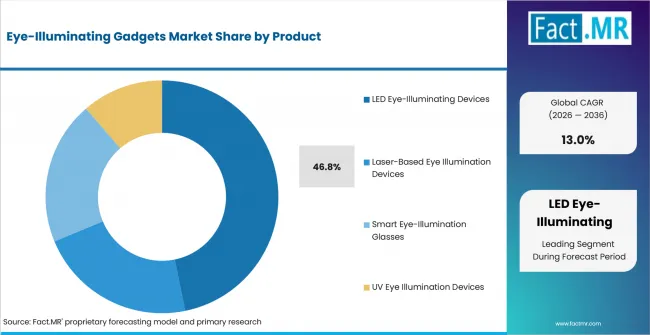
Eye Illuminating Gadgets Market Analysis By Product | Source: Fact.MR
LEDs can be arranged across a flexible or rigid surface to illuminate the eye contour more evenly than a narrow beam. That helps manufacturers control distance, session duration and treated area without requiring the user to manually track a small spot across delicate periocular skin.
The commercial pathway is also becoming more visible. The FDA cleared several over-the-counter light-based wrinkle-reduction devices in 2026, including full-face LED masks, while Philips launched ReAura with an eye-area treatment configuration. These examples support continued migration toward mask and handheld LED designs that can be used repeatedly at home.
Why do Cosmetic Eye Care Applications lead Application?
Cosmetic Eye Care Applications are projected to account for a 62.4% share of Application in 2026.
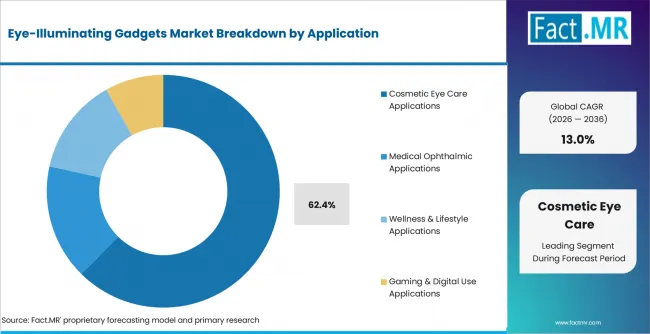
Eye Illuminating Gadgets Market Analysis By Application | Source: Fact.MR
The eye contour concentrates several high-frequency beauty concerns in a small area, including fine lines, under-eye appearance and visible signs of fatigue. A device that can be used for a few minutes without a clinic visit fits the broader movement toward home-based beauty routines and makes the application commercially suitable for repeat sessions.
Clinical research adds credibility to the use case. The randomized periocular photobiomodulation trial published in 2023 reported reductions in wrinkle volume with red and amber LED protocols. ISAPS also reported close to 38 million aesthetic procedures globally in 2024, including substantial volumes of non-surgical facial rejuvenation, indicating a large consumer and professional audience already familiar with technology-assisted aesthetic care.
Why do Healthcare Facilities lead End Use?
Healthcare Facilities are projected to account for a 53.6% share of End Use in 2026.
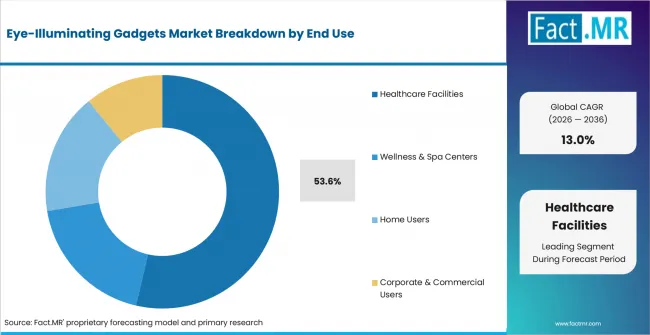
Eye Illuminating Gadgets Market Analysis By End Use | Source: Fact.MR
Hospitals and specialty eye clinics are better positioned to manage the clinical side of light-based eye care because staff can evaluate ocular conditions, select treatment parameters and monitor response. This matters where the application moves beyond appearance into dry-eye treatment, post-surgical recovery or other ophthalmic uses that should not be treated as ordinary consumer electronics.
The research base for low-level light therapy in meibomian gland dysfunction and dry eye has been developing through reviews and controlled trials, but the evidence is still indication-specific. Professional settings therefore remain important for protocols that need tighter dose control, patient selection and follow-up than a general wellness device can provide.
Why does LED Light Therapy Technology lead Technology?
LED Light Therapy Technology is projected to account for a 57.9% share of Technology in 2026.
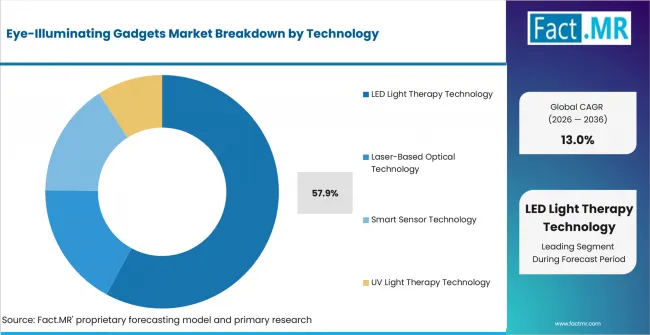
Eye Illuminating Gadgets Market Analysis By Technology | Source: Fact.MR
LED systems give designers a practical balance between spectral control and product flexibility. Multiple emitters can be distributed around the eye contour, integrated into silicone or textile structures and driven at relatively low power, allowing broad-area exposure without the focusing optics and beam hazards associated with many laser systems.
Regulatory activity also supports the technology. U.S. clearances for light-based over-the-counter wrinkle-reduction devices increasingly include LED masks, and the UK government has explicitly identified LED therapy delivered by masks, lamps or handheld devices within its non-surgical cosmetic-procedure framework. That creates a clearer commercial route for LED products with defined intended uses.
Why do Wearable Device Formulations lead Formulation?
Wearable Device Formulations are projected to account for a 41.2% share of Formulation in 2026.
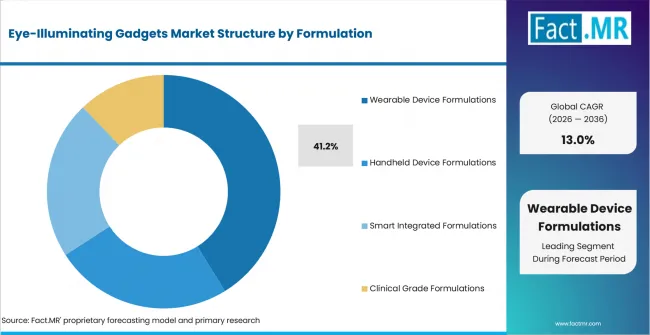
Eye Illuminating Gadgets Market Analysis By Formulation | Source: Fact.MR
Wearable designs stabilize the distance and angle between the emitter and the treated area, which makes repeated sessions easier to reproduce. Flexible materials can also distribute pressure around the orbit and leave the hands free, supporting short routines while users rest, prepare for work or complete other low-motion activities.
The format is now visible in commercial product development. Philips ReAura uses a flexible LED mask with a configuration that can target the eye area, while the wider beauty-wearable category is increasingly organized around masks, connected devices and app-supported routines. The advantage is less about novelty than about making treatment geometry and session adherence easier to control.
Why do Online Retail Platforms lead Distribution Channel?
Online Retail Platforms are projected to account for a 66.7% share of Distribution Channel in 2026.
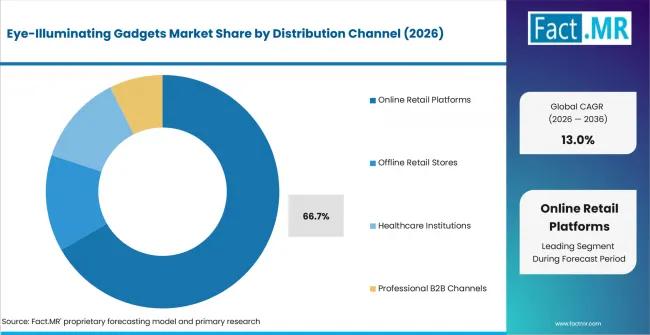
Eye Illuminating Gadgets Market Analysis By Distribution Channel | Source: Fact.MR
Eye-care gadgets are compact, feature-rich products that benefit from digital comparison. Buyers can review wavelength, session time, fit, warranty and intended use before purchase, while brands can demonstrate how masks or handheld systems are positioned around the eye without requiring physical shelf space for every model.
The channel environment is supportive. U.S. retail e-commerce represented 17.1% of total retail sales in the second quarter of 2026, and online sales remained a material share of Great Britain retail spending in 2026. The same channel creates a safety burden, however, because the FDA warns that some laser products sold online may fail to meet federal safety requirements. Credible sellers therefore gain from clear labeling, authorization status and device-specific instructions.
What is accelerating Eye-Illuminating Gadgets Market adoption, and what is holding it back?
Adoption is being accelerated by clinical photobiomodulation research, a growing pipeline of cleared LED wrinkle-reduction devices, consumer familiarity with wearable beauty technology, aging populations and the convenience of direct online sales. Growth is constrained by the sensitivity of the eye to optical radiation, regulatory differences between cosmetic and medical claims, uncertainty around some blue-light-control benefits, product-price dispersion and the risk that poorly documented online devices weaken trust in the category.
Drivers Impact Analysis
| Factor | (~) % Impact on CAGR | Geographic Relevance | Impact Timeline |
|---|---|---|---|
| Clinical evidence for periocular photobiomodulation and dry-eye light therapy | +1.8% | USA, UK, Germany and Japan | Medium term (2-4 years) |
| Expansion of cleared and compliant consumer LED light devices | +1.5% | USA and Europe | Short term (2 years or less) |
| Wearable eye-area formats that improve repeat-session convenience | +1.2% | Global | Medium term (2-4 years) |
| Aging populations increasing eye-care and appearance-related demand | +1.0% | Germany, USA, UK and Japan | Long term (4 years or more) |
| Online retail access to specialized beauty and wellness electronics | +0.8% | USA, UK and Brazil | Short term (2 years or less) |
Source: Fact.MR analysis. Updated Aug 28, 2026
Opportunity Impact Analysis
| Factor | (~) % Impact on CAGR | Geographic Relevance | Impact Timeline |
|---|---|---|---|
| Dedicated eye-area modules within flexible LED masks | +1.0% | USA, Germany, UK and Japan | Short term (2 years or less) |
| Clinic-grade low-level light systems for dry-eye support | +0.9% | USA, Germany and Japan | Medium term (2-4 years) |
| Smart sensor and app-connected control of light dose and session timing | +0.8% | USA, Germany, UK and Japan | Medium term (2-4 years) |
| Professional wellness and aesthetic programs using documented light protocols | +0.7% | Brazil, UK and Germany | Medium term (2-4 years) |
| Safer low-irradiance alternatives to poorly controlled laser or UV products | +0.6% | Global | Long term (4 years or more) |
Source: Fact.MR analysis. Updated Aug 28, 2026
Restraints Impact Analysis
| Factor | (~) % Impact on CAGR | Geographic Relevance | Impact Timeline |
|---|---|---|---|
| Eye-safety risk from direct laser, UV or excessive optical exposure | -1.3% | Global | Long term (4 years or more) |
| Regulatory complexity across cosmetic, wellness and medical intended uses | -1.0% | USA, Europe, Brazil and Japan | Medium term (2-4 years) |
| Weak evidence for some blue-light-control and digital-fatigue claims | -0.8% | Global | Medium term (2-4 years) |
| High prices for premium wearable and professional systems | -0.7% | Brazil, USA and Europe | Short term (2 years or less) |
| Unverified online products reducing trust in light-based eye gadgets | -0.6% | Global | Short term (2 years or less) |
Source: Fact.MR analysis. Updated Aug 28, 2026
Which countries are scaling the Eye-Illuminating Gadgets Market through 2036?
- Germany: Population aging raises the need for eye-care and appearance-related solutions, while the EU medical-device framework rewards suppliers that can document optical safety, performance and intended use for medical and certain non-medical light systems.
- Brazil: A growing older population and a deep aesthetic-treatment culture create demand across cosmetic and professional settings, while Anvisa requires medical and aesthetic equipment to follow formal device-regularization pathways before commercialization.
- USA: Active FDA clearances for over-the-counter light-based wrinkle-reduction devices are expanding the regulated product base, while dry-eye risk among older adults and a mature e-commerce channel support both clinical and home-use purchasing.
- UK: Government policy work explicitly recognizes LED masks, lamps and handheld light therapy within non-surgical cosmetic procedures, and high online retail participation makes direct-to-consumer distribution practical for specialized eye-area devices.
- Japan: A highly aged population, established beauty-electronics capabilities and a formal PMDA medical-device framework support demand for carefully designed eye-care systems across home and professional settings.
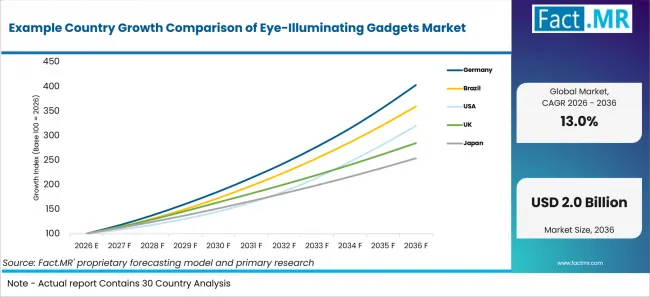
Example Country Growth Comparison Of Eye Illuminating Gadgets Market | Source: Fact.MR
| Country | CAGR (2026-2036) |
|---|---|
| Germany | 15.0% |
| Brazil | 13.7% |
| USA | 12.4% |
| UK | 11.1% |
| Japan | 9.8% |
Source: Fact.MR analysis. Updated Aug 28, 2026
What is driving Germany's growth through 2036?
Germany is forecast to expand at a 15.0% CAGR from 2026 to 2036.
Destatis projects that one person in four in Germany will be aged 67 or older by 2035, compared with about one in five in 2024. The expanding older population increases the addressable base for dry-eye management, periocular skin care and wellness devices that are designed for frequent, low-burden use rather than invasive intervention.
Germany also operates within the EU medical-device framework, which places stronger requirements on clinical evidence, transparency and conformity for medical devices and certain products without an intended medical purpose that have comparable risk profiles. For suppliers, this raises the cost of weakly documented products but favors devices with controlled light output, clear intended use and traceable safety documentation.
What is driving Brazil's growth through 2036?
Brazil is forecast to expand at a 13.7% CAGR from 2026 to 2036.
IBGE population data show a continuing shift toward older age groups, expanding the population exposed to age-related eye discomfort and visible periocular changes. At the same time, Brazil has a well-developed aesthetic-treatment culture: the ISAPS 2024 global survey placed Brazil among the countries with very high volumes of surgical and non-surgical aesthetic procedures.
What is driving USA's growth through 2036?
The USA is forecast to expand at a 12.4% CAGR from 2026 to 2036.
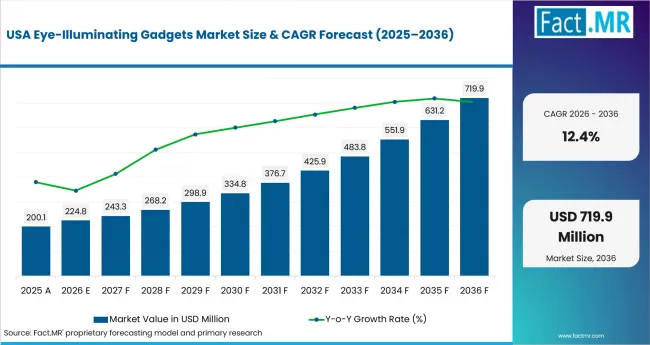
Eye Illuminating Gadgets Market Country Value Analysis | Source: Fact.MR
The U.S. market is receiving a steady stream of regulated light-based consumer devices. During 2026, the FDA cleared multiple products under the light-based over-the-counter wrinkle-reduction classification, including several LED masks and the Ulike Reglow Light Therapy Device. This gives manufacturers concrete predicates and encourages more disciplined specifications for light dose and intended use.
Eye-care demand also has a demographic base. The National Eye Institute states that people aged 50 and older are more likely to develop dry eye, while U.S. research has found dry-eye prevalence rising with age. These conditions do not make every consumer light device a treatment, but they increase interest in eye-area comfort, clinic-based care and non-invasive technologies that can be incorporated into broader management routines.
Distribution is favorable to connected and wearable gadgets. The U.S. Census Bureau reported USD 340.2 billion in seasonally adjusted e-commerce sales in the second quarter of 2026, equal to 17.1% of retail sales. The same online reach increases the importance of verification because the FDA also warns that some laser products sold on the internet may not meet federal safety requirements.
What is driving the UK's growth through 2036?
The UK is forecast to expand at an 11.1% CAGR from 2026 to 2036.
The UK government’s consultation on licensing non-surgical cosmetic procedures explicitly identifies LED light therapy delivered through masks, lamps and handheld devices and also includes photo rejuvenation using laser technologies. This policy attention gives the category a clearer place within professional aesthetic practice while keeping training and safety requirements visible.
Consumer access is supported by a highly developed online channel. Office for National Statistics data show that online sales remained above one-quarter of Great Britain retail spending through 2026, making direct brand websites and specialist marketplaces effective routes for compact light-based beauty devices and replacement accessories.
What is driving Japan's growth through 2036?
Japan is forecast to expand at a 9.8% CAGR from 2026 to 2036.
Japan has one of the most aged consumer populations in the world. The Statistics Bureau reported that 36.24 million people, or 29.3% of the population, were aged 65 and over in 2024. This supports continued demand for products aimed at eye comfort, dry-eye support and age-related periocular care, particularly when the devices are compact enough for home use.
The market also benefits from a strong domestic beauty-electronics culture. Panasonic continues to commercialize facial-care devices with dedicated eye-care modes and introduced an LED-equipped eyebrow-care device in 2026, showing ongoing investment in compact light-assisted personal-care hardware around the eye area.
Who Leads the Eye-Illuminating Gadgets Market?
Key players in the Eye-Illuminating Gadgets Market include KONINKLIJKE PHILIPS N.V., FOREO IRIS, PANASONIC CORPORATION, LUMENIS LTD, HOME SKINOVATIONS LTD, THE PROCTER & GAMBLE COMPANY, SYNERON MEDICAL LTD., ILUMINAGE BEAUTY INC. and CAROL COLE COMPANY, alongside other prominent players.
Competition is shaped by wavelength selection, emitter uniformity, eye shielding, session control, wearable comfort, clinical documentation, regulatory status and the ability to distribute a compact device through online and professional channels. Consumer beauty products compete on ease of use and repeatability, while clinic-oriented systems compete more heavily on protocol control, service and safety assurance.
KONINKLIJKE PHILIPS N.V. strengthened its position in light-based beauty technology in August 2026 with ReAura, a flexible LED mask that can target the eye area independently. FOREO IRIS is a product line rather than a separate corporate entity; FOREO continues to sell IRIS 2 as a dedicated eye massager. PANASONIC CORPORATION also maintains a broad facial-care portfolio with eye-area modes and compact personal-care electronics.
Which companies are the key providers?
KONINKLIJKE PHILIPS N.V., FOREO IRIS, PANASONIC CORPORATION, LUMENIS LTD, HOME SKINOVATIONS LTD, THE PROCTER & GAMBLE COMPANY, SYNERON MEDICAL LTD., ILUMINAGE BEAUTY INC. and CAROL COLE COMPANY, along with other prominent players.
- Koninklijke Philips N.V.
- Foreo Iris
- Panasonic Corporation
- Lumenis Ltd.
- Home Skinovations Ltd.
- The Procter & Gamble Company
- Syneron Medical Ltd.
- Iluminage Beauty Inc.
- Carol Cole Company
Bibliography
- Agencia Nacional de Vigilancia Sanitaria. (2025). Manual for Regularization of Medical Equipment and Software as a Medical Device, Version 1.3. Anvisa.
- Agencia Nacional de Vigilancia Sanitaria. (2024). Consultation of Regularized Health Products. Anvisa.
- Candela. (2026). About Candela: Company History and Aesthetic Laser Innovation. Candela Medical.
- Cochrane. (2023). Blue-light Filtering Spectacle Lenses for Visual Performance, Sleep, and Macular Health in Adults. Cochrane Database of Systematic Reviews.
- Department of Health and Social Care. (2025). The Licensing of Non-surgical Cosmetic Procedures in England: Consultation Document. UK Government.
- European Commission. (2026). Getting Ready for the New Medical Device Regulations. Directorate-General for Health and Food Safety.
- European Commission. (2026). Manufacturers of Devices without an Intended Medical Purpose. Directorate-General for Health and Food Safety.
- Federal Statistical Office of Germany. (2025). By 2035, One Quarter of Germany’s Population Will Be Aged 67 or Over. Destatis.
- FOREO. (2026). IRIS 2 Rejuvenating Eye Massager. FOREO.
- International Society of Aesthetic Plastic Surgery. (2025). ISAPS Global Survey 2024. ISAPS.
- Mota, L. R., et al. (2023). Photobiomodulation Reduces Periocular Wrinkle Volume by 30%: A Randomized Controlled Trial. Photobiomodulation, Photomedicine, and Laser Surgery.
- Medicines and Healthcare products Regulatory Agency. (2015). Lasers, Intense Light Source Systems and LEDs: Guidance for Safe Use in Medical, Surgical, Dental and Aesthetic Practices. UK Government.
- National Eye Institute. (2024). Causes of Dry Eye. National Institutes of Health.
- Office for National Statistics. (2026). Retail Sales, Great Britain: July 2026. UK Statistics Authority.
- Office for National Statistics. (2026). 2024-based National Population Projections. UK Statistics Authority.
- Panasonic Corporation. (2026). Launch of Eyebrow Smooth Pick ES-EF10 with LED Light. Panasonic Newsroom Japan.
- Pharmaceuticals and Medical Devices Agency. (2026). Medical Devices: Regulations and Notifications. PMDA.
- Philips. (2026). Philips Launches ReAura, a New LED Skincare Mask and Beauty Ritual for Younger-looking Skin. Koninklijke Philips N.V.
- Statistics Bureau of Japan. (2025). Statistical Handbook of Japan 2025. Ministry of Internal Affairs and Communications.
- U.S. Census Bureau. (2026). Quarterly Retail E-Commerce Sales, Second Quarter 2026. U.S. Department of Commerce.
- U.S. Food and Drug Administration. (2026). 510(k) Premarket Notification K261851: LED Light Therapy Mask. U.S. Department of Health and Human Services.
- U.S. Food and Drug Administration. (2026). 510(k) Premarket Notification K260511: Ulike Reglow Light Therapy Device (UM10). U.S. Department of Health and Human Services.
- U.S. Food and Drug Administration. (2022). Consumer Safety Alert: Internet Sales of Laser Products. U.S. Department of Health and Human Services.
- U.S. Food and Drug Administration. (2021). Frequently Asked Questions About Lasers. U.S. Department of Health and Human Services.
- Brazilian Institute of Geography and Statistics. (2024). Population Projections for Brazil and Federation Units: 2000-2070. IBGE.
- Chiang, J., et al. (2025). Low-level Light Therapy Alone versus Combination Therapy with Intense Pulsed Light in Dry Eye Disease with Meibomian Gland Dysfunction: A Randomised Paired-eye Trial. Ocular Surface.
- Craig, J. P., et al. (2021). Photobiomodulation (Low-level Light Therapy) and Dry Eye Disease. Clinical and Experimental Optometry.
This Report Answers
- How large is the Eye-Illuminating Gadgets Market in 2026 and what value is expected by 2036?
- Which Product, Application, End Use, Technology, Formulation and Distribution Channel categories lead in 2026?
- What demand drivers, opportunities and restraints are shaping light-based eye-area devices?
- How are Germany, Brazil, USA, UK and Japan developing through 2036?
- Which companies and product architectures are influencing competition?
- How do optical safety, regulatory positioning, wearable design and online distribution affect adoption?
What does the Eye-Illuminating Gadgets Market cover?
The market covers revenue from finished eye-area light and optical-management devices sold for cosmetic, medical ophthalmic, wellness, lifestyle and digital-use applications. Products include LED eye-illuminating devices, laser-based eye illumination devices, smart eye-illumination glasses and UV or hybrid optical systems when the device has a defined eye-area or ophthalmic use.
Revenue is counted at the commercial device level across home-use wearables, handheld systems, clinic-grade equipment and relevant smart integrated devices. The assessment considers the primary intended function, device configuration, buyer type, technology and sales channel rather than treating all illuminated eyewear or all facial beauty electronics as part of the market.
What is included in the scope?
- Wearable LED eye masks and handheld LED eye devices designed for periocular treatment or care.
- Low-level and pulsed laser systems intended for defined eye-area or ophthalmic applications.
- Smart eye-illumination glasses using active light management, adaptive lighting or biometric feedback.
- UV therapy eye systems and hybrid UV-LED systems where commercial sale is tied to a defined application and appropriate safety controls.
- Consumer, professional and clinical devices used in hospitals, specialty eye clinics, beauty clinics, wellness spas, homes and workplace programs.
- Sales through online marketplaces, direct brand websites, offline stores, healthcare institutions and professional B2B channels.
What is excluded from the scope?
The scope excludes conventional passive spectacles, ordinary sunglasses and non-electronic blue-light lenses when they do not contain an active illumination or smart light-management function. It also excludes general room lighting, wake-up lamps, standard display panels, standalone light bulbs and decorative eyewear that is not sold for eye care, wellness or ophthalmic use.
Topical eye creams, serums, cosmetics, artificial tears, medicines and contact lenses are excluded as standalone products. Ophthalmic diagnostic instruments, surgical lasers and general facial aesthetic systems are excluded when eye-area use is not a separately identifiable commercial function. General laser pointers and non-compliant UV products are also outside the market.
How Was the Analysis Built?
The study framework draws on information obtained from more than 4,800 qualified participants across 16 countries, with at least 120 beauty-device, ophthalmic, healthcare, wellness, retail and optical-technology professionals represented in each country-level market, and validation against more than 120 independent information sources.
- Primary Research: Interviews with beauty-device manufacturers, ophthalmic equipment suppliers, dermatology and eye-care professionals, hospital procurement teams, wellness operators, online retailers, electronics distributors and end users examine device pricing, wavelength choices, treatment frequency, wearability, safety features, regulatory positioning, replacement behavior and channel preferences.
- Desk Research: The review covers photobiomodulation studies, dry-eye research, medical-device and radiation-safety rules, non-surgical aesthetic procedure activity, population aging, online retail trends, product launches and current company status. External sources used in the article are recorded in the bibliography.
- Market Sizing and Forecasting: The analysis integrates unit sales, average selling prices, product mix, application and end-use intensity, technology mix, wearable versus handheld configurations, clinic versus home deployment, online-channel penetration and the effect of regulatory qualification on the addressable product base.
- Data Validation and Update Cycle: Findings are cross-checked against regulator databases, peer-reviewed evidence, official demographic and retail statistics, current product portfolios and company-status changes. Updates reflect new light-device clearances, clinical evidence, safety requirements, product launches and channel shifts.
Segmentation
What is the report's scope and coverage?
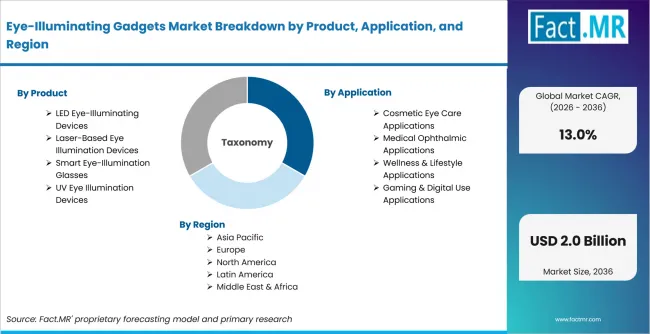
Eye Illuminating Gadgets Market Breakdown By Product, Application, And Region | Source: Fact.MR
| Scope Attribute | Coverage |
|---|---|
| Quantitative Units | USD billion |
| Market Definition | Finished devices that deliver controlled light, laser or light-management functions to the eye contour, periocular area or ophthalmic workflow |
| Segments Covered | Product; Application; End Use; Technology; Formulation; Distribution Channel |
| Regions Covered | North America; Latin America; Europe; East Asia |
| Countries Covered | Germany; Brazil; USA; UK; Japan |
| Key Companies Profiled | KONINKLIJKE PHILIPS N.V.; FOREO IRIS; PANASONIC CORPORATION; LUMENIS LTD; HOME SKINOVATIONS LTD; THE PROCTER & GAMBLE COMPANY; SYNERON MEDICAL LTD.; ILUMINAGE BEAUTY INC.; CAROL COLE COMPANY; other prominent players |
| Forecast Period | 2026 to 2036 |
| Base Year | 2025 |
| 2026 Market Value | USD 0.6 billion |
| 2036 Market Value | USD 2.0 billion |
| Forecast CAGR | 13.0% |
| Absolute Opportunity | USD 1.4 billion |
| Approach | Hybrid top-down and bottom-up assessment based on device shipments, pricing, product and application mix, clinical and home-use intensity, optical technology, form factor, regulation, distribution and safety-related substitution |
Source: Fact.MR analysis. Updated Aug 28, 2026
How is the market segmented?
-
By Product:
- LED Eye-Illuminating Devices
- Wearable LED Eye Masks
- Handheld LED Eye Devices
- Laser-Based Eye Illumination Devices
- Low-Level Laser Therapy Devices
- Pulsed Laser Eye Devices
- Smart Eye-Illumination Glasses
- AR Integrated Light Glasses
- Blue Light Control Glasses
- UV Eye Illumination Devices
- UV Therapy Eye Systems
- Hybrid UV-LED Systems
- LED Eye-Illuminating Devices
-
By Application:
- Cosmetic Eye Care Applications
- Dark Circle Reduction
- Anti Aging Eye Treatments
- Medical Ophthalmic Applications
- Dry Eye Treatment
- Post Surgical Eye Recovery
- Wellness & Lifestyle Applications
- Sleep Improvement Devices
- Stress Relief Applications
- Gaming & Digital Use Applications
- Screen Fatigue Management
- Professional Digital Use
- Cosmetic Eye Care Applications
-
By End Use:
- Healthcare Facilities
- Hospitals
- Specialty Eye Clinics
- Wellness & Spa Centers
- Beauty Clinics
- Wellness Spas
- Home Users
- Personal Care Users
- Lifestyle Consumers
- Corporate & Commercial Users
- Workplace Wellness Programs
- Gaming & Media Industry Users
- Healthcare Facilities
-
By Technology:
- LED Light Therapy Technology
- Red Light Therapy Systems
- Blue Light Control Systems
- Laser-Based Optical Technology
- Low Level Laser Systems
- Pulsed Laser Technology
- Smart Sensor Technology
- AI Based Adaptive Lighting
- Biometric Feedback Systems
- UV Light Therapy Technology
- Controlled UV Emission Systems
- Hybrid UV Optical Systems
- LED Light Therapy Technology
-
By Formulation:
- Wearable Device Formulations
- Flexible Material Systems
- Ergonomic Design Systems
- Handheld Device Formulations
- Portable Optical Systems
- Precision Targeted Systems
- Smart Integrated Formulations
- App Connected Devices
- AI Driven Systems
- Clinical Grade Formulations
- Medical Standard Devices
- Sterile Application Devices
- Wearable Device Formulations
-
By Distribution Channel:
- Online Retail Platforms
- E-commerce Marketplaces
- Direct Brand Websites
- Offline Retail Stores
- Pharmacies & Drug Stores
- Specialty Wellness Stores
- Healthcare Institutions
- Hospital Supply Channels
- Clinic Based Distribution
- Professional B2B Channels
- Corporate Wellness Providers
- Medical Distributors
- Online Retail Platforms
Frequently Asked Questions
What is the Eye-Illuminating Gadgets Market value in 2026?
At what CAGR is the market projected to grow?
What is the projected market value by 2036?
Which Product segment leads the market?
Which Application segment leads the market?
Which End Use segment leads the market?
Which Technology segment leads the market?
Which Formulation segment leads the market?
Which Distribution Channel segment leads the market?
What CAGR is projected for Germany?
Which companies are included in the market assessment?
Who worked on this report


Preview the report firsthand - request a free sample
Free SampleGet the brochure for pricing and purchase details
Download PDF