- Base Value(2024): 2659 Mn
- Forecast Value (2035): 9540 Mn
- CAGR (2035): 12.2%
Beauty Wearables Market Outlook 2025 to 2035
The global beauty wearables market is expected to reach USD 9,540 Million by 2035, up from estimated value of USD 2,964 Million in 2025. During the forecast period 2025 to 2035, the industry is projected to expand at a CAGR of 12.4%.
The beauty wearables industry is witnessing accelerated growth, propelled by rising consumer preference for personalized skincare solutions, the integration of AI and IoT technologies delivering real-time insights, heightened emphasis on wellness and preventive health, and the widespread adoption of portable, non-invasive devices. These dynamics are collectively redefining market trajectories and shaping strategic opportunities for stakeholders.
Quick Stats for Beauty Wearables Market
- Industry Value (2025): USD 2,964 Million
- Projected Value (2035): USD 9,540 Million
- Forecast CAGR (2025 to 2035): 12.4%
- Leading Segment (2025): Smart Skin Analyzers (28% Market Share)
- Growing Country (2025-2035): South Korea (13.8% CAGR)
- Top Key Players:L’Oréal, Johnson & Johnson, Amorepacific, Omnilux, CurrentBody Skin, Therabody, YA-MAN, LG Electronics, and Dr. Dennis Gross Skincare
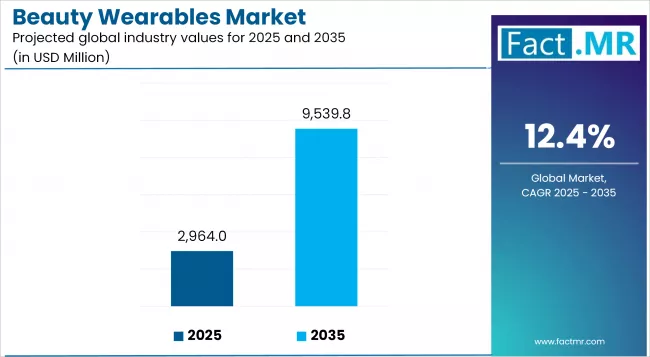
Beauty Wearables Market Industry Value Analysis | Source: Fact.MR
What are the key factors driving growth in the Beauty Wearables Market?
Adoption is being fueled by consumer demand for non-invasive, home-based solutions that replicate clinic-grade outcomes, supported by standardized claims, structured treatment protocols, and dermatologist-backed certifications that enhance credibility and trust in product efficacy. Increasing knowledge of photopharmacology and microcurrent advantages drives experimentation.
The ubiquity of smartphones and enhanced connectivity make onboarding, tracking, and behavioral nudges easier. Elimination of the self-care, ageing, and screen-exposed lifestyles contribute to the increase of the interest in UV coaching, firming and recovery. Repeat business through consumable, pad changes and software subscriptions reinforce business cases.
The collaboration of retail and clinics incorporates devices with procedures and topical regimes that enhance the results and loyalty. The availability of wellness devices in the market, accompanied by decreasing regulatory barriers, maturing supply chains, and ODM platforms, only deepens commercialization and access.
What are the key trends driving growth in the Beauty Wearables market?
The predominant trends focus on flexible, face-conforming LEDs; targeted eye, lip, scalp, and jawline form factors; and closed-loop sensing which adjusts dosing in real time. Hybrid devices integrate diagnostics and treatment and allow condition-based protocols and evidence recording. Sleep, stress, and UV data are interoperable and are combined to contextualize the routines.
Design changes to modular shells, replaceable pads and cordless charging. Recycled polymers, less packaging and refurbishment programs are promoted in sustainability efforts. The co-creation of pre/post-care bundles is done by clinics, and retailers develop experiential areas where coaching and trials take place.
Claim substantiation, biocompatibility, thermal controls and durability standards are given a greater regulatory focus, strengthening quality, safety and trust across brands internationally.
What factors hinder the growth of the Beauty Wearables market?
Market expansion is constrained by challenges related to device comfort, inconsistencies in fit across diverse users, and perceived complexity during the initial onboarding and usage process. Irregular dosing due to improper contact or light leakage will destroy results and contentment. There is still doubt over exaggerated claims, lack of clinical evidence, and a lack of transparency regarding wavelengths, current and protocols.
The regulations on privacy of data, cybersecurity, and cross-border storage create an obstacle to the connected products. Ownership costs can be swelled by replacement-pad expenses and decreasing battery performance. Specialty LEDs, sensors, and medical-grade elastomers are impacted by supply-chain volatility.
Disjointed standards make it hard to be interoperable and repaired. Safety, thermal and biocompatibility are becoming the subject of regulatory scrutiny, and investment in testing, quality systems, and effective post-market monitoring and continuous education is necessary.
What are the key regional trends driving the Beauty Wearables Market growth?
North America
High adoption of app-linked skincare wearables, LED masks, and at-home diagnostics. Luxury boundaries, supported by dermatology tie-ups and retailer coalition. FDA clearance and data privacy shape design. Powerful DTC subscriptions and bundle serums drive stickiness.
East Asia
China, South Korean and Japan are on the anchors of demand. Innovation centers around microcurrent masks, smart patches, and AI skin analyzers. The launches are accelerated by social commerce; coverage is expanded by middle-income pricing in China. Regulatory focus on battery safety and data management; influencer partnership and localization is at the heart of this.
Western Europe
The demand was headed by Germany, U.K, France. Consumers favor LED therapy which has been clinically proven and hair-health equipment. CE-marked devices, GDPR-compliant apps, and eco-friendly materials influence choices. Pharmacies and dermo-cosmetic chains gain significance and the number of spa partnerships grows. The second-hand gadgets and the bundle value are pushed by inflation.
Country-wise Outlook
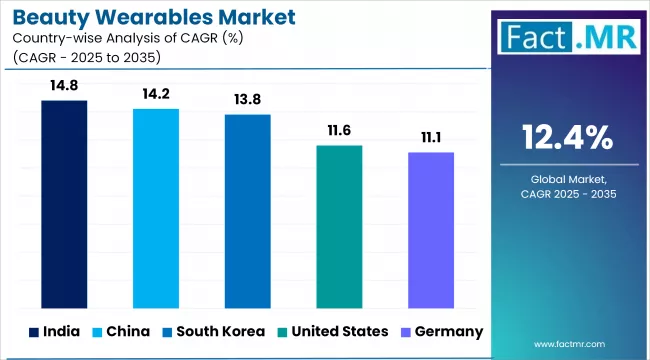
Beauty Wearables Market Cagr Analysis By Country | Source: Fact.MR
Clinical Endorsements and At-Home Innovation Drive U.S. Beauty Wearables Market
The U.S. beauty wearables market is being shaped by rising consumer demand for at-home skincare devices, reinforced by clinical research validating their effectiveness. Consumers are shifting towards LED masks, microcurrent tools, and skin rejuvenation wearables as a way to achieve professional level results.
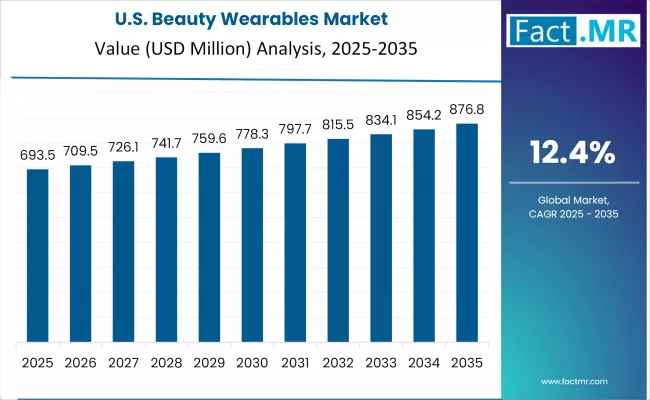
Beauty Wearables Market Country Value Analysis | Source: Fact.MR
Dermatologists and med-spas support this growth through co-branded devices and tech-enabled services. FDA-clearance and clinical validation increase consumer confidence, whereas wellness-tech convergence and influencer marketing drive long-term growth in the retail and the clinical distribution markets.
Tech-Savvy Consumers and Social Commerce Propel Market Expansion
China’s beauty wearables market is underpinned by swift technological uptake, widespread integration of AI-driven solutions, and the strong influence of dynamic social commerce ecosystems. The consumers prefer a versatile gadget such as smart masks, RF skin-tightening devices, and waterproofing trackers. Innovation is dominated by domestic brands, and they frequently join the trends of combining IoT capabilities and cosmetic results. Beauty-tech fusion with health monitoring positions China as a frontrunner in multifunctional beauty wearables.
Aesthetic Innovation and Clinic Networks Drive South Korea’s Beauty Wearables Market
The beauty wearables market in South Korea is propelled by a strong cultural emphasis on cosmetic precision and advanced beauty innovation. Popular in the clinics and used at home are LED therapy masks, microcurrent face sculpting devices, and portable toning devices. The high-tech image and the high concentration of aesthetic clinics in K-beauty make R&D and first mover advantage easier. Brands have a tendency to work with dermatologists and influencers, which increases trust. South Korea has government-supported incentives of biotech and export that help the country to be recognized as the beauty technology hub across the globe.
Category-Wise Market Outlook
Smart Skin Analyzers Lead Growth with Personalized Skincare Demand
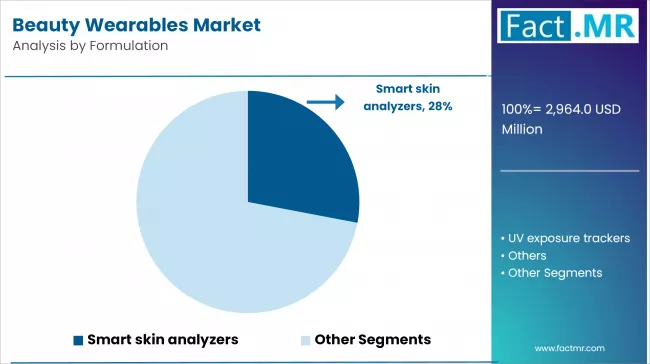
Beauty Wearables Market Analysis By Formulation | Source: Fact.MR
Smart skin analyzers represent the fastest-growing category of devices, offering personalized skin assessments powered by advanced AI algorithms and sensor-based technology. They enable the use of data in skincare decisions and suggest the appropriate products or treatments to the user. Their usage is on the rise by both skincare brands and at-home users making them a necessity in the current beauty regimen. They have been growing especially in Asia where precision skincare and app-based diagnostic is popular.
Patches/Adhesive Sensors Dominate Due to Comfort and Targeted Use
Patches and adhesive sensors continue to lead the form factor segment, driven by their lightweight, skin-adhering design and ability to deliver targeted treatments effectively. Suitable in issues such as acne and hydration, these wearables are subtle, easy to apply and fit perfectly in everyday lives. Clinical endorsement and consumer favor using technology-enhanced, minimally visible skincare support their emergence. The younger consumers are attracted by convenience and hygiene particularly in urban markets that are interested in convenience in their routines.
LED/Photobiomodulation Surges with Broad Use and Safety Profile
LED/Photobiomodulation technology is experiencing strong growth, offering non-invasive light-based treatments for acne management, anti-aging benefits, and enhanced skin healing. Red, blue, or near-infrared light devices are becoming more popular because of their established effectiveness and non-invasive nature of use. This technology is commonly used in facial masks and patches, which attracts those who want to find an at-home alternative to a medical procedure. Its flexibility and legal acceptance in various places also speed up the development of the market.
Competitive Analysis
Competitive Outlook: Beauty Wearables Market
Beauty wearables market continues to evolve fast due to the introduction of regenerative medicine to dermatology and aesthetics. The justification of efficacy of PDRN in tissue repair and inflammation prevention is a growth factor because it will be crucial in the post-procedure and anti-aging products. Firms such as Hugel, Humedix, Merz Pharma and Mastelli S.r.l. have successfully incorporated PDRN into clinical regimens and cosmetic portfolios, but have reinforced this by having strong portfolios. Shiseido, in its turn, specializes in the high end cosmetic market utilising its brand equity and wide international presence.
HTL Biotechnology introduces sterile biologic know-how into hospital corridors, which is credible and scalable. In the meantime, local competitors such as Ruijiming Biological, BR PHARM and Dermat India experience cost-effective local growth but cannot compete in the global arena. This market is succession-based on differentiated clinical trials, regulatory strength, and robust distribution. Nanotechnology-based delivery systems are considered one of the enablers, enhancing stability and skin penetration of ingredients in upcoming generations of beauty devices.
Key players in the Beauty Wearables market are L’Oréal, Johnson & Johnson, Amorepacific, Omnilux, CurrentBody Skin, Therabody, YA-MAN, LG Electronics, Dr. Dennis Gross Skincare, FAQ Swiss, CELLRETURN, Theradome, Capillus, iRestore, Kiierr, HairMax, HigherDOSE, Skin Gym, MZ Skin, and Déesse Pro.
Recent Development:
- In January 2025, Japan’s YA-MAN secured FDA 510(k) clearance (K244048) for its Medi Lift wearable EMS facial mask, marking a regulatory milestone that paves the way for broader U.S. commercialization.
- In November 2024, Amorepacific announced commercialization of a face-conforming FSLED mask (with KAIST & Fronics), citing clinical data showing 340% improvement in deep skin elasticity versus conventional masks—signaling a new generation of flexible LED wearables.
Fact.MR has provided detailed information about the price points of key manufacturers of Beauty Wearables market positioned across regions, sales growth, production capacity, and speculative technological expansion, in the recently published report.
Methodology and Industry Tracking Approach
It is an International evaluation of Beauty Wearables Market in this Fact.MR report. It history reviews the evolution of devices, sensor-form factor and commercialisation of the products in dermatology, medical aesthetics, cosmeceuticals and therapeutic skincare in an ecosystem led by innovation. Constructed with the biggest pool of crowd-sourced data - over 8, 000 stakeholders in 38 nations and more than 350 tested contacts in all countries - the study provides unparalleled insight into the current state of science of devices, AI-friendly protocol design, sustainable materials engineering, and manufacturing scale-up paths that get innovations to the market early.
The trends observed in the market maturing include: high-resilience LED arrays and microcurrent/RF platforms, closed-loop sensing capacities with calibrated dosimetry, and increasing demand of eco-designed and recyclable wearable shells and fabrics. Skin modeling and digital-twin testing is advancing efficacy, compliance, and long reliability through AI.
In a multidimensional perspective of the world moving to sustainable, high-performance beauty tech, based on 225 opinion makers (dermatologists, R&D and innovation leaders, supply-chain experts, regulators, investors, policy advisors), the 2024-2025 benchmark follows progress in device engineering, charging/pack systems, and accelerated dermatological validation (stability, tolerance, wearability/fatigue). The report, with 250+ curated, validated data sets and detailed modeling, establishes a new standard in consolidating device innovation and business opportunity across the entire global skincare economy.
Segmentation
Segmentation of Beauty Wearables Market Research
-
By Formulation :
- UV exposure trackers
- Smart skin analyzers
- IPL hair-removal wearables
- RF facial tightening wearables
- Ultrasound facial devices
- Blue/red light acne wearables
- Smart makeup applicators
- Post-procedure recovery wearables
-
By Form Factor :
- Skin/LED masks
- Microcurrent toning wearables
- Patches/adhesive sensors
- Bands/watches/rings
- Helmets/caps
- Eye/neck/jawline wearables
- Handheld wearables
- Others
-
By Technology :
- LED/photobiomodulation
- Microcurrent/EMS
- IPL/laser
- Radiofrequency
- Ultrasound
- Thermal/cryotherapy
- Multi-sensor (UV, temp, EDA)
- Connectivity (Bluetooth/NFC/Wi-Fi)
-
By Application :
- Skincare monitoring
- Anti-aging & firming
- Hair removal
- Hair growth/scalp therapy
- Makeup support/skin prep
- UV/photoprotection & wellness
- Acne care
- Sensitive-skin/derma recovery
-
By End Use :
- At-home consumers
- Professional clinics/spas
- Prosumer/enthusiasts
- Dermatologists/aestheticians
-
By Price Tier :
- Mass
- Premium
- Luxury/professional
-
By Distribution Channel :
- Online marketplaces
- Brand D2C
- Beauty specialty retail
- Pharmacies/drugstores
- Consumer electronics stores
- Clinics/salons
-
By Region :
- North America
- Latin America
- Western Europe
- Eastern Europe
- East Asia
- South Asia & Pacific
- Middle East & Africa
Frequently Asked Questions
What was the Global Beauty Wearables Market Size Reported by Fact.MR for 2024?
Who are the Major Players Operating in the Beauty Wearables Market?
What is the Estimated Valuation of the Beauty Wearables Market in 2035?
What Value CAGR did the Beauty Wearables Market Exhibit Over the Last Five Years?
Who worked on this report


Preview the report firsthand - request a free sample
Free SampleGet the brochure for pricing and purchase details
Download PDF