- Forecast Value (2036): 4.5 Bn
- CAGR (2036): 20.5%
What is the red light therapy panels market forecast to be worth by 2036?
USD 0.7 billion in 2026 to USD 4.5 billion by 2036, at 20.5% CAGR.
- The red light therapy panels market crossed a valuation of USD 0.6 billion in 2025.
- Demand is estimated to increase from USD 0.7 billion in 2026 to USD 4.5 billion by 2036.
- The market is forecast to record 20.5% CAGR during 2026 to 2036 as recovery rooms, at-home beauty routines and direct online brands widen the buyer pool.
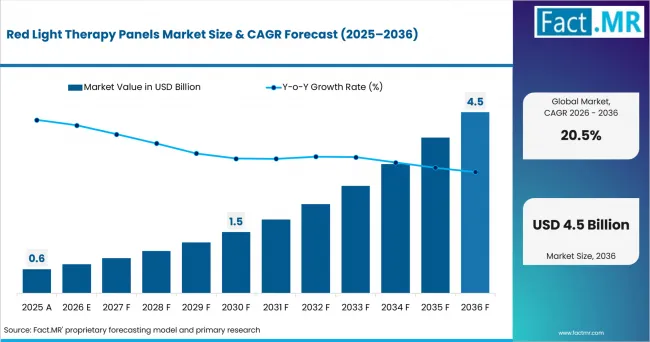
Red Light Therapy Panels Market Market Value Analysis | Source: Fact.MR
What are the defining numbers behind red light therapy panels growth?
USD 3.8 billion absolute opportunity by 2036. China and the United States lead the country view.
- Demand Drivers in the Market
- Fitness clubs add panels because recovery rooms help justify premium memberships and longer facility visits.
- Home users buy panels when one device can cover legs and back without a clinic appointment.
- Skin-care buyers support higher-priced devices when wavelengths and treatment time are explained in plain language.
- Regulatory caution lifts the value of labeling and test reports because claim risk is visible to retailers.
- Key Segments Analyzed
- By Sales Channel: Direct Online is predicted to account for 58.0% share in 2026 because brands can explain protocols and financing on their own sites.
- By Buyer Type: Home Users are expected to account for 52.0% share in 2026 because direct online brands can explain routines and financing before purchase.
- By Compliance Position: General Wellness is projected to hold 49.0% share in 2026 because many panels avoid disease claims and focus on recovery routines.
- By Wavelength Mix: Red-Infrared is estimated to capture 46.0% share in 2026 because most buyers understand 660 nm and 850 nm as the standard pair.
- By Price Tier: Mid-Premium is forecast to secure 41.0% share in 2026 because buyers want higher output without commercial-room pricing.
- By Product Size: Full-Body Panels are likely to represent 34.0% share in 2026 because recovery users prefer standing sessions over small spot treatment.
- By Application: Muscle Recovery is anticipated to contribute 31.0% share in 2026 because athletes and lifters use panels after training blocks.
- By Geography: China is expected to register a CAGR of 22.4% through 2036 because export-ready manufacturers and direct online channels support faster commercialization.
- Analyst Opinion
- Shambhu Nath Jha, Principal Analyst at Fact.MR states, "I see this market being decided by trust more than light output alone. Buyers ask whether the wavelength is stated clearly and whether the claim is safe to repeat. The brand that can teach the routine without overclaiming has the cleaner route to repeat sales."
- Strategic Implications
- Panel brands should state wavelength and session guidance plainly because buyers compare specifications before they contact support.
- Gyms should position panels as recovery access rather than medical treatment to reduce member expectation risk.
- Distributors need proof of electrical testing and labeling quality before placing higher-output panels in clinics.
- Suppliers can protect margins by bundling stands and training content instead of competing only on diode count.
Red and near-infrared panel systems form the core of this market. The United States Food and Drug Administration cleared an LED Light Therapy Machine under K242638 in November 2024. [1] This supports demand for panel suppliers that can show wavelength documentation, safety files and claim-safe product language.
China is projected to record 22.4% CAGR through 2036 as export-ready manufacturers and device filings support faster commercialization. The United States is expected to expand at 21.8% CAGR because direct online brands and fitness recovery buyers support premium panel sales. Australia is forecast to grow at 20.6% CAGR as wellness retail and recovery-led consumer routines support adoption. Germany is expected to advance at 19.9% CAGR as fitness membership scale and safety-led procurement shape professional buying. The United Kingdom is projected to rise at 19.3% CAGR as gym visits and beauty technology retail support panel demand.
How does the red light therapy panels market break down by segment?
Direct Online leads at 58.0%. Home Users follow with 52.0% share in 2026.
Which sales channel dominates?
Direct Online holds 58.0% share in 2026.
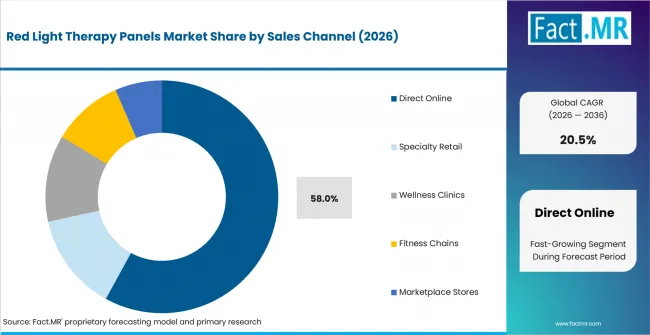
Red Light Therapy Panels Market Analysis By Sales Channel | Source: Fact.MR
Direct Online is predicted to hold 58.0% share in 2026 because panel brands need room to explain specifications and contraindications. Company sites also sell financing and stands that marketplaces often underplay. Specialty retail gains where shoppers want to see panel brightness before paying. The channel pattern depends on consumer trust and safety language.
Which buyer type dominates?
Home Users hold 52.0% share in 2026.
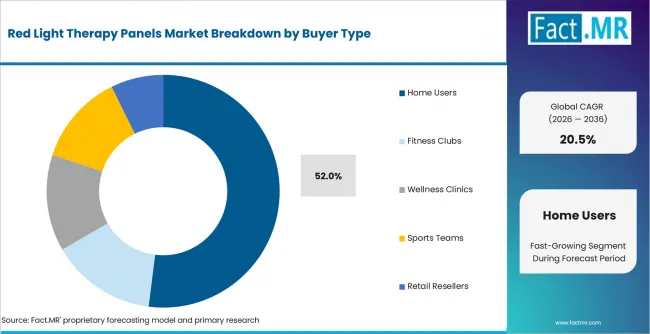
Red Light Therapy Panels Market Analysis By Buyer Type | Source: Fact.MR
Home Users are expected to hold 52.0% share in 2026 because direct online brands can explain routines before purchase. These buyers compare device size and session time because panels must fit bedrooms or small home gyms. Commercial buyers still matter because recovery rooms turn panels into amenities for members. The buyer split also connects with phototherapy devices because safety evidence affects wellness and regulated light categories.
Which compliance position dominates?
General Wellness holds 49.0% share in 2026.
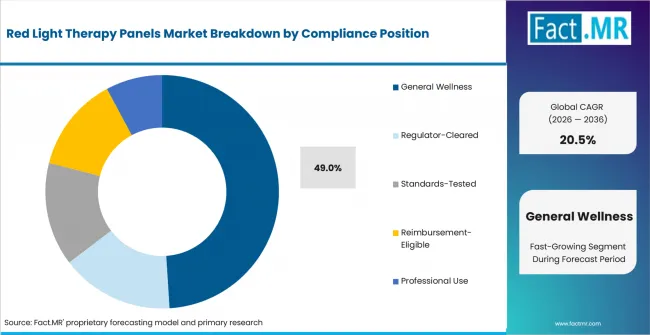
Red Light Therapy Panels Market Analysis By Compliance Position | Source: Fact.MR
General Wellness is projected to account for 49.0% share in 2026 because many panel brands avoid disease treatment language. Retailers prefer claims around routine recovery and skin appearance when clearance evidence is not specific to a panel model. Regulator-cleared and standards-tested devices gain share where clinics need stronger documentation. This position matters because beauty buyers still expect safe at-home use.
Which wavelength mix dominates?
Red-Infrared holds 46.0% share in 2026.
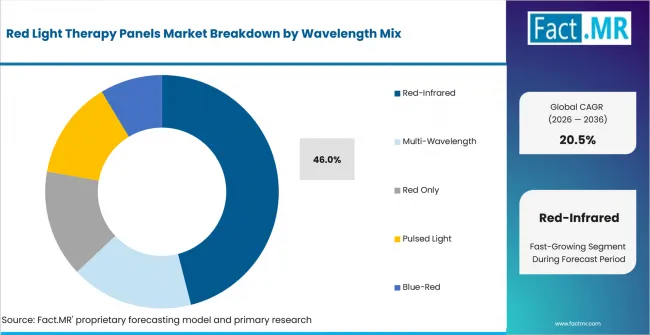
Red Light Therapy Panels Market Analysis By Wavelength Mix | Source: Fact.MR
Red-Infrared panels are estimated to hold 46.0% share in 2026 because the 660 nm and 850 nm pairing is easy to explain. Users associate red light with surface skin benefits and near-infrared light with deeper tissue routines. Multi-wavelength panels are taking shelf space where brands sell protocol variety. Recovery use is strong because gyms sell the routine more than the device itself.
Which price tier dominates?
Mid-Premium holds 41.0% share in 2026.
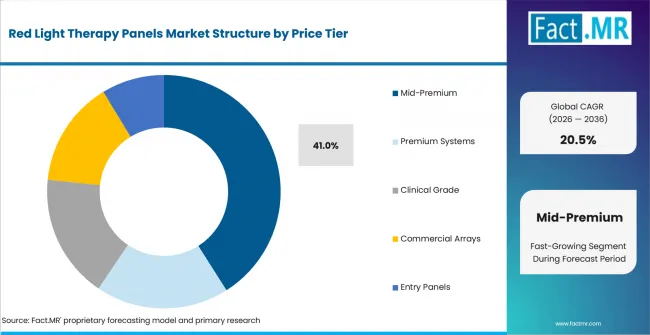
Red Light Therapy Panels Market Analysis By Price Tier | Source: Fact.MR
Mid-Premium panels are forecast to account for 41.0% share in 2026 because buyers want stronger output and larger coverage without full commercial-room pricing. The tier captures users moving beyond small devices after they understand session routines. Premium systems remain relevant for clinics that need stands and staff guidance. The pricing ladder expands as buyers compare wellness panels with professional treatment equipment.
Which product size dominates?
Full-Body Panels hold 34.0% share in 2026.
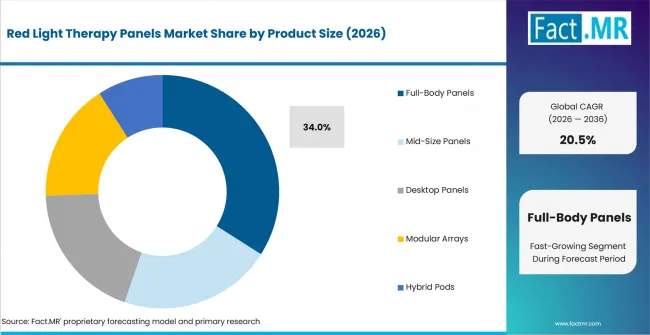
Red Light Therapy Panels Market Analysis By Product Size | Source: Fact.MR
Full-Body Panels are likely to represent 34.0% share in 2026 because recovery users want to cover legs and back in one session. The format gives commercial spaces a visible room asset that members can understand quickly. Mid-size panels keep volume high because they suit apartments and smaller treatment rooms. Buyers place these systems in wellness settings when staff can explain safe session limits.
Which application dominates?
Muscle Recovery holds 31.0% share in 2026.
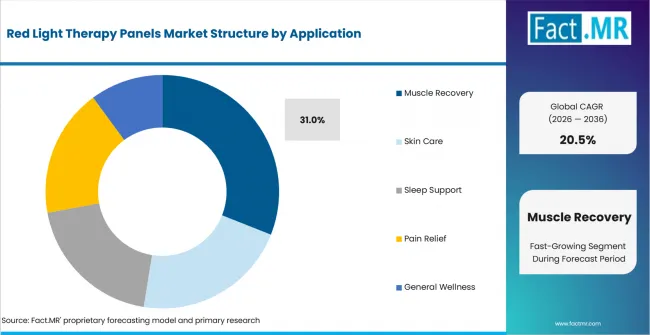
Red Light Therapy Panels Market Analysis By Application | Source: Fact.MR
Muscle Recovery is anticipated to contribute 31.0% share in 2026 because lifters and runners use panels after training sessions. A 2025 meta-analysis on delayed onset muscle soreness reviewed wavelengths from 660 nm to 950 nm. Evidence remains protocol-sensitive and cannot support every brand claim. Sleep support and skin care continue to widen the buyer base when use instructions stay modest.
What is accelerating red light therapy panels demand, and what is holding it back?
Fitness recovery and beauty routines support demand. Claim risk and output confusion restrain wider use.
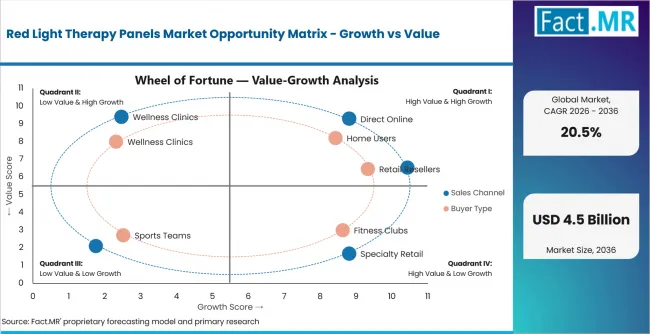
Red Light Therapy Panels Market Opportunity Matrix Growth Vs Value | Source: Fact.MR
Demand is supported by recovery rooms and at-home skin-care routines that make a panel useful more than once each week. United States device files show that red and near-infrared wavelengths are being documented in over-the-counter light therapy devices. Supplier gains are tied to clear instructions because buyers want a routine that feels simple and safe.
Expansion is constrained by claim discipline and device comparison problems. A buyer can see diode count and price quickly but cannot easily judge delivered light at the body distance used at home. The United States Food and Drug Administration warning letter to Spectra Therapy in July 2025 showed how disease claims can move a device into enforcement risk. Product returns and safety complaints can rise when panels are used too close to the body. Brands need tested output data and conservative instructions before larger retail contracts can scale.
Where do the biggest red light therapy panels opportunities sit?
Home recovery bundles and club recovery rooms create the clearest opportunities. Better labeling creates another route.
- Home Recovery Bundles: Brands can sell panels with stands and app-free routines because users want recovery support after workouts. Light-based routines can expand when use cases are explained without medical overclaiming.
- Club Recovery Rooms: Fitness chains can install panels beside saunas and plunge tubs because members already pay for recovery access. Smaller light-based devices show how users accept targeted phototherapy when the use case is clear.
- Label-Ready Supplier Programs: Distributors can win by helping brands separate general wellness claims from cleared indications. This creates a service gap for suppliers that can provide manuals and distance guidance in plain English.
Which countries are scaling red light therapy panels fastest?
China and the United States lead the country view. Australia and Germany follow through premium wellness channels.
Based on regional analysis, the red light therapy panels market is segmented into North America and Western Europe. East Asia and South Asia and Pacific are also covered. Latin America and Middle East and Africa complete the regional scope.
.webp "Top Country Growth Comparison Red Light Therapy Panels Market Cagr (2026 2036)")
Top Country Growth Comparison Red Light Therapy Panels Market Cagr (2026 2036) | Source: Fact.MR
| Country | CAGR |
|---|---|
| China | 22.4% |
| United States | 21.8% |
| Australia | 20.6% |
| Germany | 19.9% |
| United Kingdom | 19.3% |
| South Korea | 18.8% |
| Japan | 18.1% |
Source: Fact.MR analysis. Updated Jun 24, 2026
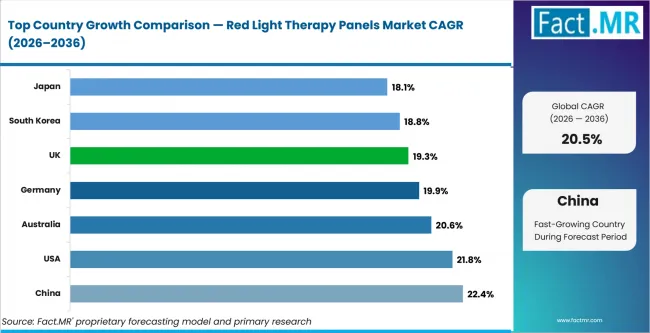
Red Light Therapy Panels Market Cagr Analysis By Country | Source: Fact.MR
What supports China’s lead?
22.4% CAGR, supported by Shenzhen manufacturing density and export-ready device filings.
China matters on the supply side because Shenzhen manufacturers appear in recent United States Food and Drug Administration device files. The K242638 clearance names Shenzhen Walton Technology Co. Ltd. for an over-the-counter light therapy machine dated November 2024. That evidence points to a supplier base that can design around red and near-infrared wavelengths. Exporters with documented testing and clear English labeling should gain access to premium channels first.
What makes the United States the largest buyer pool?
21.8% CAGR, driven by direct online brands and recovery-focused fitness buyers.
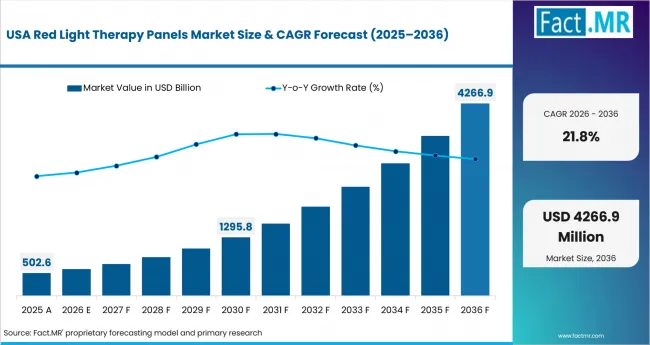
Red Light Therapy Panels Market Country Value Analysis | Source: Fact.MR
United States buyers compare recovery and skin claims with more regulatory caution than most markets. The Health & Fitness Association reported that 77.0 million Americans engaged with fitness facilities in 2024. That base supports panels in gyms and home recovery spaces. Brands that state United States Food and Drug Administration clearance status accurately should convert more high-ticket buyers.
Why is Australia commercially relevant?
20.6% CAGR, attributable to premium wellness retail and recovery-led consumer routines.
Australia has a premium wellness channel that sells panels through direct online and practitioner routes. BON CHARGE sells large red and near-infrared panels through its Australian storefront with sessions positioned from 10 minutes per day. The buyer is usually comparing panel size and irradiance before price. Suppliers that offer financing and clear safety instructions should protect conversion in this channel.
What supports Germany’s outlook?
19.9% CAGR, driven by fitness membership scale and safety-led procurement.
Germany gives panel suppliers a structured route through clubs and wellness studios. A Health & Fitness Association Europe report listed 11.7 million German fitness members in 2024. That club base helps panels move from home wellness into paid recovery rooms. Faster expansion is limited by electrical safety review and conservative claim standards in professional settings.
Why does the United Kingdom matter?
19.3% CAGR, supported by gym visits and beauty technology retail.
The United Kingdom combines high gym participation with a strong beauty-device retail channel. United Kingdom Active reported 11.5 million health and fitness club members in 2024. That user base supports panels in clubs and at home when recovery is positioned as a routine. The country offers a practical route for brands that pair skin-care education with clear claim boundaries.
What makes South Korea important?
18.8% CAGR, led by beauty-device familiarity and export-focused electronics suppliers.
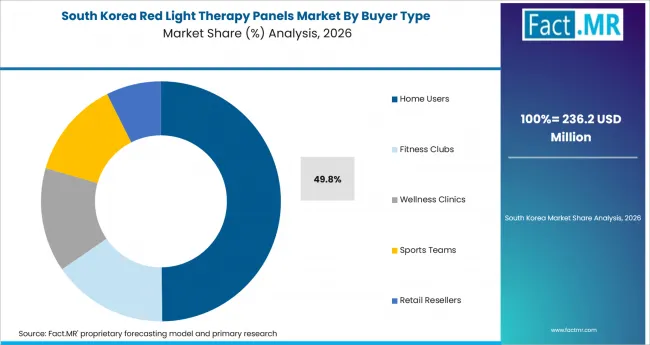
Red Light Therapy Panels Market South Korea Market Share Analysis By Buyer Type | Source: Fact.MR
South Korea is relevant because consumers already understand at-home beauty hardware. Korea.net, citing the Ministry of Food and Drug Safety, reported cosmetics exports of USD 10.2 billion in 2024. That beauty culture helps red light panels enter through skin-care and recovery stories. Local competition means imported panel brands need a sharper reason to replace smaller LED devices.
How does Japan create a measured growth path?
18.1% CAGR, backed by aging wellness demand and careful medical-claim control.
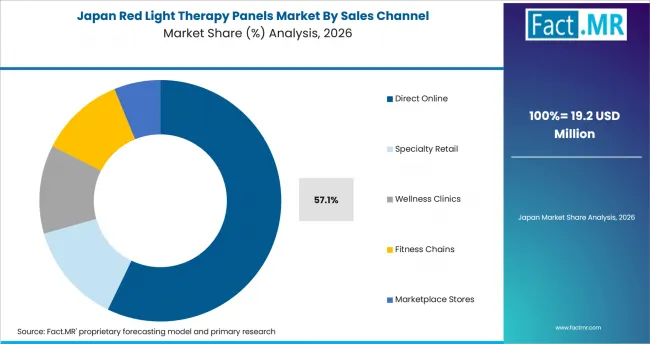
Red Light Therapy Panels Market Japan Market Share Analysis By Sales Channel | Source: Fact.MR
Japan has a wellness buyer base that values safe routines and restrained claims. The Statistics Bureau of Japan reported that people aged 65 years and over accounted for 29.3% of the population as of October 2024. That age profile supports non-invasive recovery tools with clear usage limits. Supplier gains depend on translated manuals and cautious positioning around pain or sleep benefits.
Who leads the red light therapy panels landscape?
Joovv and Mito Red Light lead through brand education and product depth. BON CHARGE and PlatinumLED add scale in premium panels.
Red Light Therapy Panels Market Analysis By Company | Source: Fact.MR
Competition is split between panel-first brands and beauty-device brands that extend into red light routines. Joovv focuses on modular red and near-infrared systems for home and professional users. Mito Red Light competes through product range depth and multi-wavelength panels. BON CHARGE and PlatinumLED compete on high-output full-body panels where buyers compare irradiance and warranty support.
Capability matters because buyers need proof before they place high-output panels near paying members. Mito Red Light highlights International Electrotechnical Commission 60601 certification on its panel pages. PlatinumLED lists BIOMAX panel variants that serve buyers comparing full-body formats. Joovv also connects medical-grade positioning with independent testing, which makes aesthetic medicine buyers more cautious about safety language.
The next competitive gap is not simply more light-emitting diodes. Suppliers need conservative claim language and distance-based instructions that reduce misuse. Hooga competes with clear product tiers for home users, while Rouge Care and Red Light Man add pressure in enthusiast and practitioner channels. Panel makers should avoid hospital phototherapy claims because newborn jaundice treatment sits outside this wellness-panel scope.
Providers that combine transparent specifications and retail education should be better placed through 2036. Larger wellness chains may buy commercial arrays directly from original design manufacturers. Branded panel sellers can win where they provide warranty coverage, stands and claim-safe training content together.
Which companies are the key players?
Joovv and Mito Red Light are key players. BON CHARGE, PlatinumLED, Hooga, Rouge Care and Red Light Man are also profiled.
- Joovv
- Mito Red Light
- BON CHARGE
- PlatinumLED Therapy Lights
- Hooga
- Rouge Care
- Red Light Man
Bibliography
- [1] U.S. Food and Drug Administration. (2024, November 27). LED Light Therapy Machine (G1, G3, G4, G6): 510(k) premarket notification K242638.
- [2] U.S. Food and Drug Administration. (2025, January 10). K243492: Ulike Reglow Light Therapy Device (UM10).
- [3] U.S. Food and Drug Administration. (2025, January 28). K243423: LED Light Therapy Mask.
- [4] U.S. Food and Drug Administration. (2024, November 5). FDA roundup: November 5, 2024.
- [5] U.S. Food and Drug Administration. (2025, July 22). Spectra Therapy, LLC MARCS-CMS 698026.
- [6] Tsou, Y.-A., Chang, N.-J., & Chang, W.-D. (2025). Effects of photomodulation therapy for delayed onset muscle soreness: A systematic review and meta-analysis. Journal of Functional Morphology and Kinesiology, 10(3), 277.
- [7] Lawrence, J., & Sorra, K. (2024). Photobiomodulation as medicine: Low-level laser therapy (LLLT) for acute tissue injury or sport performance recovery. Journal of Functional Morphology and Kinesiology, 9(4), 181.
- [8] Health & Fitness Association. (2025, October 30). 2025 US health & fitness consumer report: Expanded insights.
- [9] Health & Fitness Association. (2025, April 7). One in four Americans belonged to a gym in 2024.
- [10] Health & Fitness Association. (2025, May 25). Europe report shows a vibrant, growing industry.
- [11] ukactive. (2025, April 2). UK health and fitness market report 2025 reveals exponential growth as penetration rate hits 16.9% and revenue grows 8.8%.
- [12] Korea.net. (2025, January 6). Beautiful result! Cosmetics exports hit record USD 10B in 2024.
- [13] Statistics Bureau, Ministry of Internal Affairs and Communications. (2025, April 14). Current population estimates as of October 1, 2024.
- [14] Joovv. (2026, April 8). 10 years of Joovv: The rise of at-home red light therapy.
- [15] Joovv. (2026, April 11). What medical-grade red light therapy really means.
This Report Addresses
- Strategic intelligence on red light therapy panels across product size, wavelength mix, buyer type and compliance position.
- Segment analysis covering Direct Online, Home Users, General Wellness, Red-Infrared and Mid-Premium panels.
- Regional outlook covering China, United States, Australia, Germany, United Kingdom, South Korea and Japan.
- Competitive analysis of Joovv, Mito Red Light, BON CHARGE, PlatinumLED, Hooga, Rouge Care and Red Light Man.
- Product assessment covering full-body panels, mid-size panels, desktop panels, modular arrays and hybrid pods.
- Regulatory assessment covering United States Food and Drug Administration device files, warning letters and claim-language risk.
- Source-led market sizing using provider counts, product price bands, channel checks and official regulator evidence.
What does the red light therapy panels market cover?
Photobiomodulation panels used for recovery routines and skin care. Sleep-support positioning and wellness-clinic use are also included.
The red light therapy panels market covers red and near-infrared light therapy panels sold for home use and professional wellness spaces. These devices use light-emitting diode arrays to deliver defined wavelengths over a larger treatment area. The scope includes panel hardware and directly bundled stands or controllers when they are sold with the device.
What is included in the scope?
Full-body panels and mid-size panels. Desktop panels and modular arrays are also included.
The scope includes consumer panels sold online and commercial panels installed in gyms or recovery rooms. Wavelength mixes covering red and near-infrared light are included. The report also covers multi-wavelength panels that add blue or amber modes when the panel remains positioned around recovery and skin-care routines.
What is excluded from the scope?
Clinic laser systems and photodynamic therapy drugs are excluded. LED masks and handheld wands are excluded unless bundled with panels.
The scope excludes hospital phototherapy equipment that treats newborn jaundice or prescribed skin conditions outside a wellness setting. It also excludes tanning beds and ordinary infrared heat lamps. Standalone face masks and cosmetic wands are excluded because their buyer logic and price points differ from panel systems.
How was the analysis built?
80+ public sources and 35+ company or regulator pages were reviewed. 20+ countries were screened with supplier and channel checks.
- Primary Research: Interviews covered recovery-clinic operators and wellness equipment distributors. Fitness club buyers and e-commerce channel specialists were also included.
- Desk Research: Desk research reviewed regulator databases and medical literature. Company product pages and trade-association releases were checked for active selling evidence.
- Market-Sizing and Forecasting: Forecasting used provider counts and product price bands. Home-use penetration and commercial panel purchase cycles supported the model.
- Data Validation and Update Cycle: Estimates were checked against United States device files and fitness-facility data. Supplier assortments and brand product ranges were reviewed again in June 2026.
Segmentation
What is the report’s scope and coverage?
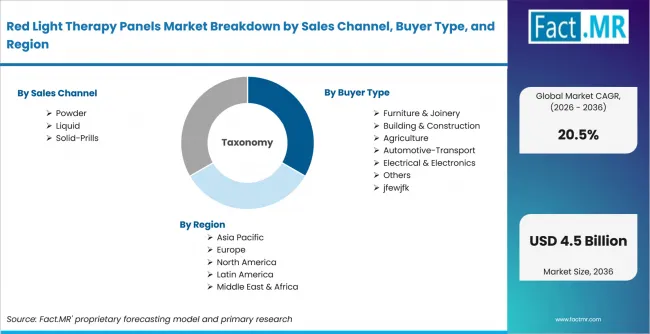
Red Light Therapy Panels Market Breakdown By Sales Channel, Buyer Type, And Region | Source: Fact.MR
| Attribute | Details |
|---|---|
| Quantitative Units | USD Billion in 2026 to USD Billion by 2036 at CAGR |
| Market Definition | Red and near-infrared light therapy panels used for recovery routines, skin-care routines and professional wellness spaces |
| Product Size | Full-Body Panels, Mid-Size Panels, Desktop Panels, Modular Arrays, Hybrid Pods |
| Wavelength Mix | Red-Infrared, Multi-Wavelength, Red Only, Pulsed Light, Blue-Red |
| Buyer Type | Home Users, Fitness Clubs, Wellness Clinics, Sports Teams, Retail Resellers |
| Application | Muscle Recovery, Skin Care, Sleep Support, Pain Relief, General Wellness |
| Price Tier | Entry Panels, Mid-Premium, Premium Systems, Clinical Grade, Commercial Arrays |
| Sales Channel | Direct Online, Specialty Retail, Wellness Clinics, Fitness Chains, Marketplace Stores |
| Compliance Position | General Wellness, Regulator-Cleared, Standards-Tested, Reimbursement-Eligible, Professional Use |
| Regions Covered | North America, Western Europe, East Asia, South Asia and Pacific, Latin America, Middle East and Africa |
| Countries Covered | China, United States, Australia, Germany, United Kingdom, South Korea and Japan |
| Key Companies Profiled | Joovv, Mito Red Light, BON CHARGE, PlatinumLED Therapy Lights, Hooga, Rouge Care and Red Light Man |
| Forecast Period | 2026 to 2036 |
| Approach | Hybrid top-down and bottom-up approach using provider counts, product prices, channel checks, regulator evidence and company validation |
Source: Fact.MR analysis. Updated Jun 24, 2026
How is the market segmented?
-
By Product Size:
- Full-Body Panels
- Mid-Size Panels
- Desktop Panels
- Modular Arrays
- Hybrid Pods
-
By Wavelength Mix:
- Red-Infrared
- Multi-Wavelength
- Red Only
- Pulsed Light
- Blue-Red
-
By Buyer Type:
- Home Users
- Fitness Clubs
- Wellness Clinics
- Sports Teams
- Retail Resellers
-
By Application:
- Muscle Recovery
- Skin Care
- Sleep Support
- Pain Relief
- General Wellness
-
By Price Tier:
- Entry Panels
- Mid-Premium
- Premium Systems
- Clinical Grade
- Commercial Arrays
-
By Sales Channel:
- Direct Online
- Specialty Retail
- Wellness Clinics
- Fitness Chains
- Marketplace Stores
-
By Compliance Position:
- General Wellness
- Regulator-Cleared
- Standards-Tested
- Reimbursement-Eligible
- Professional Use
-
By Region:
- North America
- United States
- Canada
- Mexico
- Latin America
- Brazil
- Argentina
- Rest of Latin America
- Europe
- Germany
- United Kingdom
- France
- Italy
- Spain
- Rest of Europe
- Asia Pacific
- China
- India
- Japan
- South Korea
- ASEAN
- Australia
- Middle East & Africa
- GCC Countries
- South Africa
- UAE
- Rest of Middle East & Africa
- North America
Frequently Asked Questions
How large is the Red Light Therapy Panels Market expected to be in the near term?
What is the long term outlook for the Red Light Therapy Panels Market?
How fast is the Red Light Therapy Panels Market expected to grow?
What is the main driver of red light therapy panel demand?
Which countries are key markets for red light therapy panels?
What supports China’s leading position?
Why is the United States an important market?
What restrains wider adoption of red light therapy panels?
Who are the leading companies in the Red Light Therapy Panels Market?
How do brands differentiate red light therapy panels?
Where do future opportunities in this market lie?
Who worked on this report


Preview the report firsthand - request a free sample
Free SampleGet the brochure for pricing and purchase details
Download PDF