- Base Value(2025): 20.6 Bn
- Estimated Value(2026): 21.8 Bn
- Forecast Value (2036): 38.3 Bn
- CAGR (2026 - 2036): 5.8%
Pneumatic Components Market Analysis and Forecast by Fact.MR
- The global pneumatic components market is estimated at USD 21.79 billion in 2026 and is forecast to expand at a CAGR of 5.8% to reach USD 38.30 billion by 2036.
- Pneumatic components encompass actuators, valves, air preparation units, fittings, tubing, sensors, and grippers that convert compressed air into controlled mechanical motion for industrial automation, manufacturing, food processing, automotive assembly, and healthcare applications.
- The market is driven by increasing factory automation adoption, Industry 4.0 integration, growing demand for energy-efficient compressed air systems, expansion of food and pharmaceutical packaging automation, and the development of smart pneumatic platforms with IoT-enabled monitoring and predictive maintenance capabilities.

Pneumatic Components Market Market Value Analysis | Source: Fact.MR
Summary of Pneumatic Components Market
- Market Snapshot
- In 2025, the global Pneumatic Components Market was valued at approximately USD 20.6 billion.
- The market is estimated to reach USD 21.79 billion in 2026 and is projected to attain USD 38.30 billion by 2036.
- The pneumatic components market is likely to expand at a CAGR of 5.8% during the forecast period.
- The market is anticipated to create an absolute dollar opportunity of USD 16.51 billion between 2026 and 2036.
- Control components account for 40% of component type share in 2026.
- China (6.8%) and India (6.5%) are the key growth markets during the forecast period.
- Demand and Growth Drivers
- Growing factory automation adoption across automotive, electronics, food processing, and packaging industries is increasing demand for pneumatic actuators, valves, and control systems.
- Industry 4.0 integration is driving adoption of smart pneumatic components with IoT-enabled sensors, fieldbus connectivity, and predictive maintenance capabilities.
- Food and pharmaceutical packaging automation requirements are creating demand for hygienic, clean-room compatible pneumatic systems with precise motion control.
- Energy efficiency mandates and compressed air cost optimization are driving specification of low-consumption valves, energy-saving circuits, and air leak detection systems.
- Expansion of manufacturing capacity in India, China, Southeast Asia, and Mexico is generating large-scale procurement of pneumatic infrastructure for new factory installations.
- Product and Segment View
- Actuators account for 30% of the product type segment in 2026, driven by demand for linear and rotary pneumatic cylinders serving pick-and-place, clamping, pressing, and positioning applications across manufacturing.
- Control components hold 40% of the component type segment in 2026, reflecting the critical role of directional valves, pressure sensors, and position sensors in pneumatic system operation.
- Automatic operation accounts for 45% of the operation type segment, sustained by fully automated and smart pneumatic systems integrated with robotic platforms and PLC-controlled manufacturing lines.
- Key segmentation includes:
- Product Type: Actuators (linear, rotary), Valves (directional, pressure, flow), Air preparation units, Fittings and tubing
- Component Type: Control components, Execution components, Support components
- Operation Type: Automatic, Semi-automatic, Manual operation
- Application: Industrial automation, Manufacturing, Food and beverage, Automotive, Healthcare
- End Use Industry: Manufacturing, Automotive, Food and beverage, Healthcare, Energy and utilities
- Pressure Range: Low, Medium, High pressure systems
- These systems enable:
- Reliable, cost-effective motion control for high-speed, repetitive manufacturing operations including pick-and-place, clamping, and positioning
- Clean, dry operation suitable for food processing, pharmaceutical packaging, and cleanroom manufacturing environments
- Simple system architecture with lower maintenance requirements compared to hydraulic alternatives in medium-force applications
- Geography and Competitive Outlook
- Asia Pacific leads growth through China and India, driven by manufacturing capacity expansion, factory automation adoption, and industrial modernization programs.
- Europe sustains demand through Germany, supported by automotive manufacturing automation, precision engineering, and Industry 4.0 technology leadership.
- North America maintains demand through the USA, driven by manufacturing reshoring, packaging automation, and healthcare industry requirements.
- China (6.8%) and India (6.5%) lead growth, while the USA (5.9%), Germany (5.6%), South Korea (5.4%), Japan (4.9%), and France (4.3%) sustain demand.
- Major players include SMC Corporation, Festo SE & Co. KG, Parker Hannifin Corporation, Emerson Electric Co., and Bosch Rexroth AG.
- Analyst Opinion
- Shambhu Nath Jha, Principal Consultant at Fact.MR, says 'The pneumatic components market is being reshaped by the convergence of traditional compressed air motion control with digital intelligence. SMC Corporation's investment of 40 billion yen to implement round-the-clock development operations and its plan to expand overseas engineering to over 2,000 engineers by 2026 signal the scale of commitment required to maintain technology leadership. The competitive divide is forming between vendors offering integrated smart pneumatic platforms with IoT connectivity, energy monitoring, and predictive maintenance, and those selling commodity components without digital differentiation. Energy efficiency is emerging as the decisive specification criterion, with low-consumption valve designs and compressed air leak detection creating measurable cost savings that justify premium pricing.'
Key Growth Drivers, Constraints, and Opportunities
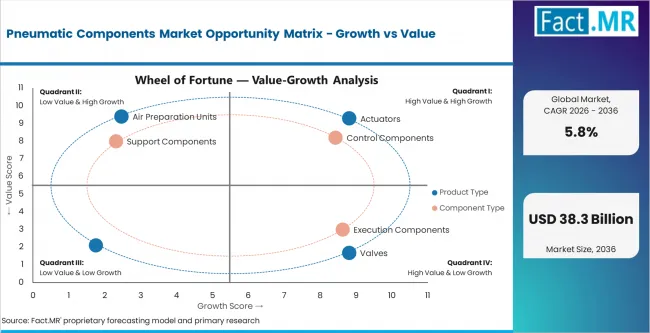
Pneumatic Components Market Opportunity Matrix Growth Vs Value | Source: Fact.MR
Key Factors Driving Growth
- Growing factory automation investment in automotive, electronics, and packaging is creating sustained demand for pneumatic actuators, valves, and control systems.
- Industry 4.0 adoption is driving specification of smart pneumatic components with IoT sensors, fieldbus integration, and energy monitoring.
- Manufacturing capacity expansion in India, China, and Southeast Asia is generating large-scale pneumatic infrastructure procurement for new factory installations.
Key Market Constraints
- Competition from electric actuators in precision and energy-sensitive applications is constraining pneumatic component growth in specific motion control segments.
- Compressed air energy costs, which represent 20 to 30% of industrial facility electricity consumption, create ongoing pressure to reduce air consumption and improve system efficiency.
- Commoditization of standard pneumatic components, particularly valves and fittings, creates margin pressure for manufacturers competing in price-sensitive segments.
Key Opportunity Areas
- Smart pneumatic platforms with IoT connectivity, energy monitoring, and predictive maintenance are creating premium product segments with recurring service revenue.
- Food and pharmaceutical automation growth is creating demand for hygienic, clean-room compatible pneumatic systems with specialized material and surface treatment requirements.
- Emerging market industrialization in India, Southeast Asia, and Latin America is expanding the addressable market for both standard and advanced pneumatic components.
Segment-wise Analysis of the Pneumatic Components Market
- Actuators hold 30% of the product type segment in 2026, driven by demand for pneumatic cylinders, grippers, and rotary actuators across assembly, packaging, and material handling applications.
- Industrial automation accounts for 35% of the application segment in 2026, reflecting the core demand for pneumatic motion control in assembly lines and packaging systems.
- Manufacturing accounts for 35% of the end use industry segment, encompassing discrete and process manufacturing operations that rely on pneumatic actuation and control.
The market is segmented by product type, component type, operation type, application, end use industry, pressure range, and region. Actuators lead by product type. Control components dominate by component type. Automatic operation leads by operation type, and industrial automation leads by application.
Which Product Type Segment Dominates the Pneumatic Components Market?
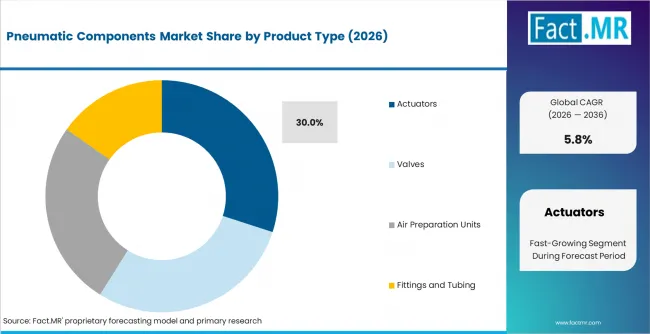
Pneumatic Components Market Analysis By Product Type | Source: Fact.MR
Actuators account for 30% of the product type segment in 2026. Linear actuators, including single-acting and double-acting pneumatic cylinders, serve the largest range of motion control applications including pick-and-place, clamping, pressing, and positioning. Rotary actuators serve indexing, turning, and angular positioning applications across assembly and packaging automation.
Valves represent the second-largest product type, with directional control valves, pressure regulators, and flow control valves forming the control backbone of pneumatic systems. Air preparation units (filters, regulators, lubricators) are essential support components, while fittings and tubing provide the physical interconnection infrastructure.
Which Application Segment Dominates the Pneumatic Components Market?
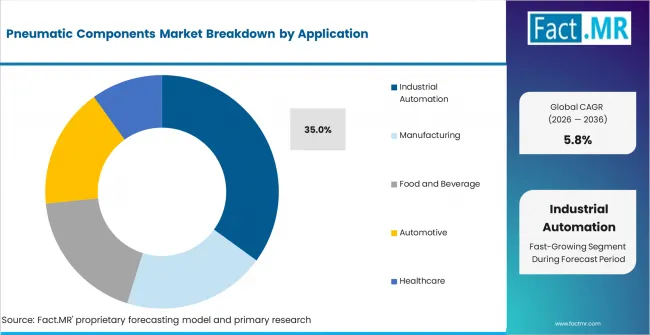
Pneumatic Components Market Analysis By Application | Source: Fact.MR
Industrial automation accounts for 35% of the application segment in 2026. Assembly line pick-and-place operations, packaging system actuation, and material handling automation represent the core demand drivers. Pneumatic systems remain preferred in these applications for their simplicity, speed, reliability, and clean operation in food and pharmaceutical environments.
Manufacturing and automotive applications are the second and third largest segments respectively, with food and beverage and healthcare representing the fastest-growing application areas as packaging automation and cleanroom requirements expand.
Which Operation Type Segment Dominates the Pneumatic Components Market?
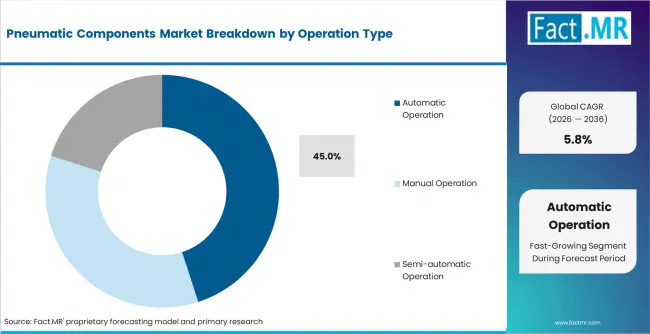
Pneumatic Components Market Analysis By Operation Type | Source: Fact.MR
Automatic operation accounts for 45% of the operation type segment in 2026. Fully automated pneumatic systems integrated with robotic platforms, PLC controls, and manufacturing execution systems serve the majority of high-volume production environments. Smart pneumatics with IoT-enabled monitoring and fieldbus connectivity are the fastest-growing sub-segment within automatic operation.
Semi-automatic systems serve medium-complexity applications where electro-pneumatic control provides flexibility without full automation investment. Manual operation serves basic applications, maintenance tasks, and low-volume production where simplicity and low cost are primary criteria.
Which Product Trend is Shaping the Next Phase of Growth in the Pneumatic Components Market?
Smart pneumatic components with integrated IoT sensors and energy monitoring are the defining product trend. In April 2025, SMC Corporation introduced a modular 3-port solenoid valve and residual pressure release valve designed to reduce installation space and simplify piping, reflecting the industry's shift toward compact, intelligent component designs. SMC's investment of 40 billion yen to implement round-the-clock development operations and expand its overseas engineering workforce to over 2,000 engineers by 2026 demonstrates the scale of R&D commitment driving this trend.
The convergence of pneumatic components with digital control platforms is creating a new category of energy-aware motion control. Smart valves and actuators with embedded sensors can monitor air consumption, detect leaks, predict maintenance requirements, and report operating status to factory-level IoT platforms. This digital layer transforms pneumatic systems from passive mechanical devices into intelligent automation assets, creating differentiation opportunities for vendors like SMC, Festo, and Parker Hannifin that invest in integrated hardware-software platforms.
Regional Outlook Across Key Markets
.webp "Top Country Growth Comparison Pneumatic Components Market Cagr (2026 2036)")
Top Country Growth Comparison Pneumatic Components Market Cagr (2026 2036) | Source: Fact.MR
| Country | CAGR (%) |
|---|---|
| China | 6.8% |
| India | 6.5% |
| USA | 5.9% |
| Germany | 5.6% |
| South Korea | 5.4% |
| Japan | 4.9% |
| France | 4.3% |
- China leads growth at 6.8%, driven by manufacturing expansion, factory automation investment, and the world's largest installed base of industrial pneumatic systems.
- India follows at 6.5%, supported by Make in India manufacturing programs, automotive sector growth, and expanding factory automation adoption.
- The USA grows at 5.9%, driven by manufacturing reshoring, packaging automation, and healthcare industry pneumatic requirements.
- Germany sustains growth at 5.6%, supported by automotive automation leadership, precision engineering, and Industry 4.0 technology integration.
Source: Fact MR (FMR) analysis, based on proprietary forecasting model and primary research.
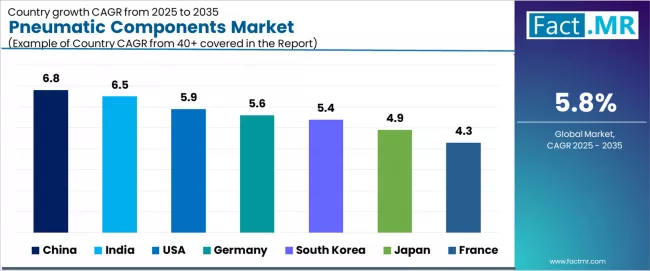
Pneumatic Components Market Cagr Analysis By Country | Source: Fact.MR
Market Outlook for Pneumatic Components in China
The China pneumatic components market is projected to grow at a CAGR of 6.8% through 2036. Demand is driven by manufacturing expansion, factory automation investment, domestic and export production, and growing adoption of smart pneumatic technologies.
- Manufacturing expansion drives large-scale pneumatic system procurement.
- Factory automation investment creates demand for advanced control components.
- Domestic manufacturers like Airtac and Fangda compete with global leaders.
Pneumatic Components Demand Trends in India
The India market is projected to grow at a CAGR of 6.5% through 2036. Growth is supported by Make in India manufacturing programs, automotive sector expansion, packaging automation growth, and factory modernization investment.
- Make in India programs drive manufacturing capacity and pneumatic demand.
- Automotive sector expansion creates assembly line pneumatic requirements.
- Packaging automation growth expands food and pharmaceutical applications.
United States Pneumatic Components Market Growth Assessment
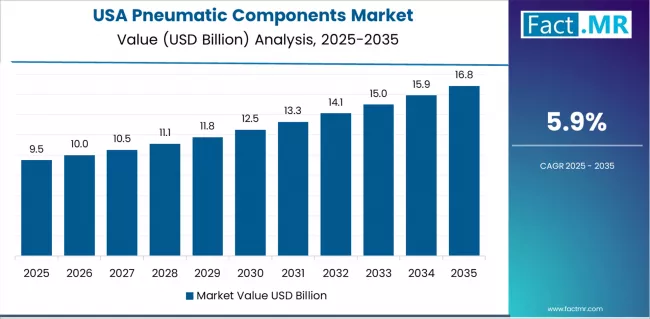
Pneumatic Components Market Country Value Analysis | Source: Fact.MR
The U.S. market is projected to grow at a CAGR of 5.9% through 2036. Demand is driven by manufacturing reshoring, packaging automation, healthcare industry requirements, and energy efficiency optimization in compressed air systems.
- Manufacturing reshoring creates new pneumatic infrastructure procurement.
- Packaging automation drives actuator and valve system demand.
- Energy efficiency focus supports specification of low-consumption components.
Germany Pneumatic Components Market Demand Analysis
The Germany market is projected to grow at a CAGR of 5.6% through 2036. Demand is shaped by automotive automation leadership, precision engineering requirements, Industry 4.0 integration, and Festo's home market technology development.
- Automotive automation sustains demand for high-specification pneumatic systems.
- Precision engineering drives demand for advanced actuators and control valves.
- Industry 4.0 integration supports smart pneumatic platform adoption.
South Korea Pneumatic Components Market Opportunity Outlook
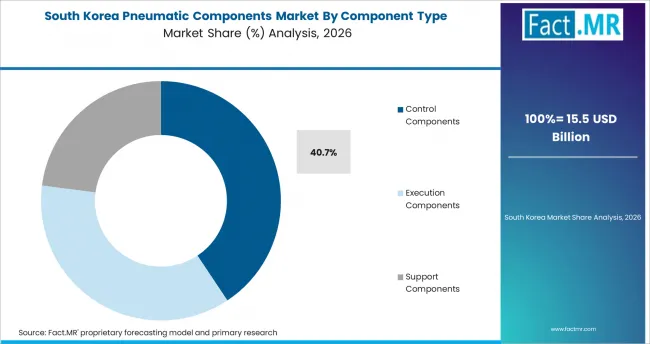
Pneumatic Components Market South Korea Market Share Analysis By Component Type | Source: Fact.MR
The South Korea market is projected to grow at a CAGR of 5.4% through 2036. Demand is supported by semiconductor and electronics manufacturing automation, automotive production, and shipbuilding industry pneumatic requirements.
- Electronics manufacturing automation drives precision pneumatic demand.
- Automotive production sustains assembly line pneumatic system procurement.
- Shipbuilding industry creates specialized pneumatic component requirements.
Competitive Benchmarking and Company Positioning
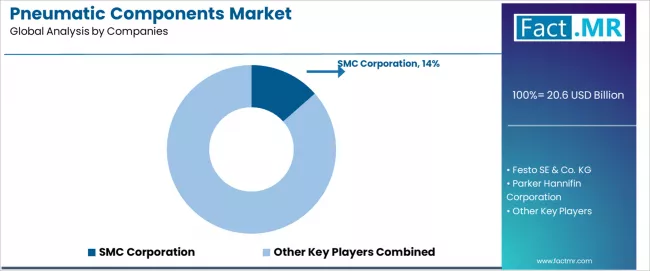
Pneumatic Components Market Analysis By Company | Source: Fact.MR
Pneumatic Components Market Analysis By Company
- SMC Corporation dominates with approximately 14% market share (30% in the pneumatic-specific segment) through the world's broadest product catalog, global manufacturing, and energy efficiency leadership.
- Festo SE & Co. KG and Parker Hannifin Corporation compete through technology innovation, digital platform integration, and strong positions in precision automation.
- Product catalog breadth, energy efficiency performance, digital platform capability, and global distribution are primary differentiators.
The competitive landscape is moderately concentrated, with SMC Corporation holding approximately 14% of the broader market and an estimated 30% of the pneumatic-specific segment. SMC offers the industry's broadest catalog with approximately 30,000 products, operates manufacturing in Japan, China, the U.S., and Europe, and is investing 40 billion yen to halve product development time through round-the-clock global engineering operations.
Festo SE & Co. KG maintains a strong position through technology innovation, digital learning systems, and its focus on smart factory automation. Festo launched the ELGD series axes in March 2024 with high load capacity and compact design, and continues to invest in Industry 4.0 platform integration. Parker Hannifin competes through its broad automation portfolio and sustainability-focused product development.
Emerson Electric, Bosch Rexroth, and Norgren (IMI) serve specific segments through valve technology, heavy industrial applications, and precision engineering. Airtac International Group and Zhaoqing Fangda serve the Asian market with competitive pricing and expanding product ranges. Camozzi Group serves European and global niche applications.
Strategic priorities include expanding IoT-enabled smart pneumatic capabilities, improving energy efficiency across valve and actuator product lines, developing hygienic solutions for food and pharma, and building localized manufacturing in high-growth markets.
Key Companies in the Pneumatic Components Market
- SMC Corporation is the dominant player, supported by the world's broadest product catalog, global manufacturing, and energy efficiency technology leadership.
- Festo SE & Co. KG and Parker Hannifin Corporation hold strong positions through technology innovation, digital platform capabilities, and precision automation expertise.
- Emerson Electric, Bosch Rexroth, Norgren, Airtac International Group, JELPC, Zhaoqing Fangda, and Camozzi Group compete through regional strength, application specialization, and competitive pricing.
Recent Industry Developments
- SMC Corporation - Product Launch / Modular 3-Port Solenoid Valve and Residual Pressure Release Valve (April 2025)
- SMC Corporation introduced a modular 3-port solenoid valve and residual pressure release valve designed to reduce installation space and simplify piping requirements, reflecting the industry's shift toward compact, energy-efficient component designs.
- SMC Corporation - R&D Investment / 40 Billion Yen Development Acceleration Program (2025-2026)
- SMC invested 40 billion yen to implement round-the-clock development operations at global technical centers, targeting a 50% reduction in product development time and expanding its overseas engineering workforce to over 2,000 engineers by 2026.
- SMC Corporation - Manufacturing Expansion / Southeast Asia Capacity Increase (2025)
- SMC Corporation expanded its manufacturing facility in Southeast Asia, increasing production capacity by 25% to meet rising demand for pneumatic components in the automotive and electronics sectors across the region.
Leading Companies Shaping the Pneumatic Components Market
- SMC Corporation
- Festo SE & Co. KG
- Parker Hannifin Corporation
- Emerson Electric Co.
- Norgren, Inc. (IMI, PIC)
- Bosch Rexroth AG
- Airtac International Group
- JELPC
- Zhaoqing Fangda Pneumatic Co. Ltd
- Camozzi Group
Sources and Research References
- SMC Corporation. Modular valve launch, 40 billion yen R&D investment, and Southeast Asia expansion documentation.
- Festo SE & Co. KG. ELGD series axes launch and Industry 4.0 platform documentation.
- Parker Hannifin Corporation. Automation technology acquisition and sustainability strategy.
- Manufacturing output databases, factory automation investment statistics, and compressed air energy analysis.
- Primary interviews with component manufacturers, system integrators, OEMs, and end users.
This bibliography is provided for reader reference and is not exhaustive. The full report contains the complete reference list and detailed citations.
Key Questions This Report Addresses
- What is the current and future size of the Pneumatic Components market?
- How fast is the market expected to grow between 2026 and 2036?
- Which product type leads in 2026?
- Which application holds highest share?
- What drives demand?
- How is Industry 4.0 influencing the market?
- Why is China the fastest-growing market?
- How are smart pneumatic platforms shaping demand?
- Which countries show fastest growth?
- Who are the key companies?
- How does Fact.MR validate the forecast?
Pneumatic Components Market Definition
The pneumatic components market covers actuators, valves, air preparation units, fittings, sensors, and grippers that convert compressed air into controlled mechanical motion for industrial automation, manufacturing, and processing applications.
Pneumatic Components Market Inclusions
- The scope covers global and regional market size and forecasts for 2026 to 2036 across product type, component type, operation type, application, end use industry, pressure range, and region.
- It includes analysis of factory automation investment, manufacturing capacity expansion, Industry 4.0 adoption rates, and compressed air energy efficiency trends.
- The report covers pricing and cost analysis across component categories, including energy consumption economics and total system cost of ownership.
- It covers technology trends, market drivers, and competitive landscape including product portfolios and digital capabilities of leading manufacturers.
Pneumatic Components Market Exclusions
- The scope excludes hydraulic components, electric actuators, and servo-driven motion control systems not classified as pneumatic.
- It excludes air compressors, compressed air dryers, and compressed air distribution piping sold as facility infrastructure.
- The report excludes pneumatic tools (impact wrenches, grinders, nailers) classified under power tools rather than industrial components.
- It also excludes custom-engineered pneumatic systems for aerospace, defense, and marine applications.
Pneumatic Components Market Research Methodology
- The methodology combines secondary research, primary interviews, and forecast modelling.
- It draws on 80+ secondary sources and benchmarks 30+ manufacturer product portfolios.
- Market sizing covers 25+ countries through a demand-side model, supported by top-down validation.
- Key inputs include manufacturing output indices, factory automation investment, automotive production volumes, and compressed air energy consumption data.
- The model cross-checks demand with component production capacity, distribution volumes, and pricing data.
- Primary validation includes 20+ interviews across component manufacturers, system integrators, OEMs, and end users.
- Final estimates go through production-capacity checks, distribution-volume review, and sensitivity testing.
Segmentation
Scope of Analysis
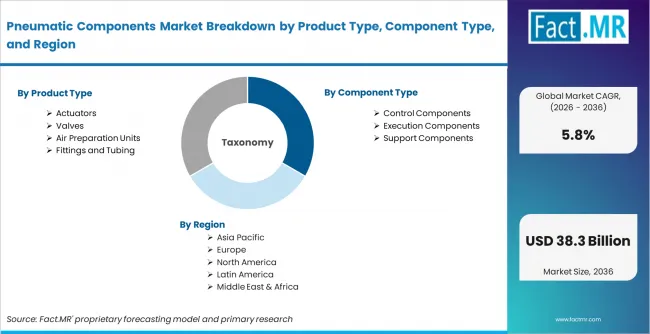
Pneumatic Components Market Breakdown By Product Type, Component Type, And Region | Source: Fact.MR
| Parameter | Details |
|---|---|
| Quantitative Units | USD 21.79 billion to USD 38.30 billion, at a CAGR of 5.8% |
| Market Definition | The pneumatic components market covers actuators, valves, air preparation units, fittings, sensors, and grippers for compressed air-based motion control in industrial automation and manufacturing. |
| Regions Covered | North America, Latin America, Europe, East Asia, South Asia and Pacific, Middle East and Africa |
| Countries Covered | China, India, USA, Germany, South Korea, Japan, France, 25 plus countries |
| Key Companies | SMC Corporation, Festo, Parker Hannifin, Emerson Electric, Norgren, Bosch Rexroth, Airtac, JELPC, Zhaoqing Fangda, Camozzi |
| Forecast Period | 2026 to 2036 |
| Approach | Hybrid demand-side and top-down methodology built on manufacturing output, factory automation investment, automotive production, and primary interviews across component manufacturers, integrators, and end users |
Pneumatic Components Market Segmentation
-
Pneumatic Components Market Segmented by Product Type:
- Actuators
- Linear Actuators
- Single-acting Cylinders
- Double-acting Cylinders
- Rotary Actuators
- Vane Type
- Rack and Pinion Type
- Linear Actuators
- Valves
- Directional Control Valves
- 2/2 Way Valves
- 3/2 and 5/2 Way Valves
- Pressure Control Valves
- Regulators
- Relief Valves
- Flow Control Valves
- Throttle Valves
- Flow Regulators
- Directional Control Valves
- Air Preparation Units
- Filters
- Particulate Filters
- Coalescing Filters
- Regulators
- Pressure Regulators
- Precision Regulators
- Lubricators
- Oil Mist Lubricators
- Micro Fog Lubricators
- Filters
- Fittings and Tubing
- Fittings
- Push-in Fittings
- Compression Fittings
- Tubing
- Polyurethane Tubes
- Nylon Tubes
- Fittings
- Actuators
-
Pneumatic Components Market Segmented by Component Type:
- Control Components
- Valves
- Directional Valves
- Pressure Valves
- Sensors
- Pressure Sensors
- Position Sensors
- Valves
- Execution Components
- Cylinders
- Pneumatic Cylinders
- Compact Cylinders
- Grippers
- Parallel Grippers
- Angular Grippers
- Cylinders
- Support Components
- FRL Units
- Filter-Regulator-Lubricator
- Air Preparation
- Accessories
- Silencers
- Manifolds
- FRL Units
- Control Components
-
Pneumatic Components Market Segmented by Operation Type:
- Automatic Operation
- Fully Automated Systems
- Robotic Integration
- Industrial Automation
- Smart Pneumatics
- IoT-enabled Systems
- Remote Monitoring
- Fully Automated Systems
- Manual Operation
- Hand-operated Valves
- Lever Valves
- Push Button Valves
- Foot-operated Valves
- Pedal Valves
- Safety Controls
- Hand-operated Valves
- Semi-automatic Operation
- Pneumatic Control
- Pilot-operated Valves
- Timed Control
- Electro-pneumatic Systems
- Solenoid Valves
- PLC Integration
- Pneumatic Control
- Automatic Operation
-
Pneumatic Components Market Segmented by Application:
- Industrial Automation
- Assembly Lines
- Pick and Place
- Material Handling
- Packaging Automation
- Filling Systems
- Sealing Machines
- Assembly Lines
- Manufacturing
- Machine Tools
- Cutting
- Forming
- Fabrication
- Welding
- Pressing
- Machine Tools
- Food and Beverage
- Processing
- Sorting
- Mixing
- Packaging
- Bottling
- Labeling
- Processing
- Automotive
- Assembly
- Engine Assembly
- Body Shop
- Paint Shop
- Coating
- Drying
- Assembly
- Healthcare
- Medical Devices
- Ventilators
- Diagnostic Equipment
- Laboratory Automation
- Sample Handling
- Fluid Control
- Medical Devices
- Industrial Automation
-
Pneumatic Components Market Segmented by End Use Industry:
- Manufacturing Industry
- Discrete Manufacturing
- Electronics
- Machinery
- Process Manufacturing
- Chemicals
- Food Processing
- Discrete Manufacturing
- Automotive Industry
- Vehicle Production
- Assembly Lines
- Robotics
- Component Manufacturing
- Parts Production
- Subassemblies
- Vehicle Production
- Food and Beverage Industry
- Food Processing
- Dairy
- Meat
- Beverage Production
- Soft Drinks
- Alcoholic Beverages
- Food Processing
- Healthcare Industry
- Pharmaceuticals
- Drug Manufacturing
- Packaging
- Medical Equipment
- Devices
- Diagnostics
- Pharmaceuticals
- Energy and Utilities
- Oil and Gas
- Refineries
- Pipelines
- Power Plants
- Thermal
- Renewable
- Oil and Gas
- Manufacturing Industry
-
Pneumatic Components Market Segmented by Pressure Range:
- Medium Pressure
- 10–20 bar
- Manufacturing
- Machine Tools
- 20–30 bar
- Heavy-duty Applications
- Industrial Equipment
- 10–20 bar
- Low Pressure
- Below 5 bar
- Light-duty Applications
- Packaging
- 5–10 bar
- General Industrial Use
- Automation
- Below 5 bar
- High Pressure
- Above 30 bar
- Specialty Applications
- Process Industry
- Ultra-high Pressure
- Advanced Systems
- Critical Operations
- Above 30 bar
- Medium Pressure
-
Pneumatic Components Market by Region:
- North America
- USA
- Canada
- Mexico
- Latin America
- Brazil
- Chile
- Rest of Latin America
- Western Europe
- Germany
- UK
- Italy
- Spain
- France
- Nordic
- BENELUX
- Rest of Western Europe
- Eastern Europe
- Russia
- Poland
- Hungary
- Balkan & Baltic
- Rest of Eastern Europe
- East Asia
- China
- Japan
- South Korea
- South Asia and Pacific
- India
- ASEAN
- Australia & New Zealand
- Rest of South Asia and Pacific
- Middle East & Africa
- Kingdom of Saudi Arabia
- Other GCC Countries
- Turkiye
- South Africa
- Other African Union
- Rest of Middle East & Africa
- North America
Frequently Asked Questions
How big is the pneumatic components market in 2025?
What will be the size in 2036?
What are the key product types in the Insulated Packaging Market?
Which application holds the highest share in the Insulated Packaging Market in 2026?
Which are the fastest-growing countries in the Insulated Packaging Market?
Which are the fastest-growing countries?
Who worked on this report


Preview the report firsthand - request a free sample
Free SampleGet the brochure for pricing and purchase details
Download PDF