- Base Value(2025): 3.89 Bn
- Estimated Value(2026): 4.52 Bn
- Forecast Value (2036): 19.96 Bn
- CAGR (2026 - 2036): 16.0%
Electric Car Battery Charger Market Size, Market Forecast and Outlook By Fact.MR
The global electric car battery charger market was valued at USD 3.89 billion in 2025, projected to reach USD 4.52 billion in 2026, and is forecast to expand to USD 19.96 billion by 2036 at a 16.0% CAGR. This positions the electric car battery charger market among the fastest-growing segments within the broader automotive ecosystem, directly tied to the pace of electric vehicle fleet expansion across major economies. Plug-in charging accounts for 91.4% of charging mode share, reflecting the current infrastructure reality where conductive charging networks are substantially more developed than wireless alternatives. Level 2 AC charging holds 48.6% of charging level share, representing the dominant configuration for workplace, residential, and destination charging deployments where three to eight hour dwell times make 7 to 22 kW charging speeds commercially viable.
The absolute dollar expansion of USD 15.44 billion over the forecast period reflects a structural demand acceleration tied to government fleet electrification mandates, corporate sustainability commitments requiring employee charging infrastructure, and public charging network deployment programs funded through national clean energy legislation. Commercial end-use commands 54.8% of market share, driven by fleet operators, parking facility operators, and highway corridor charging network developers whose infrastructure investments generate recurring utilization revenue. Residential charging installations sustain the remaining 45.2%, anchored by single-family homeowner EV adoption where overnight Level 2 home charging covers the majority of daily driving requirements.
India leads country growth at the highest CAGR of 19.4% through 2036, driven by the national EV30@30 campaign targeting 30% electric vehicle sales penetration by 2030 and substantial public charging network investment programs under the FAME II scheme successor framework. China follows at 17.4% CAGR, where domestic EV production volumes sustain the world's largest absolute charger deployment pipeline. Germany advances at 15.4% CAGR, supported by EU Alternative Fuels Infrastructure Regulation mandates requiring minimum charging point deployment densities along Trans-European Transport Network corridors. The United States registers 9.4% CAGR, reflecting the National Electric Vehicle Infrastructure program funding and utility-scale managed charging deployments accompanying fleet electrification across government and commercial operators.
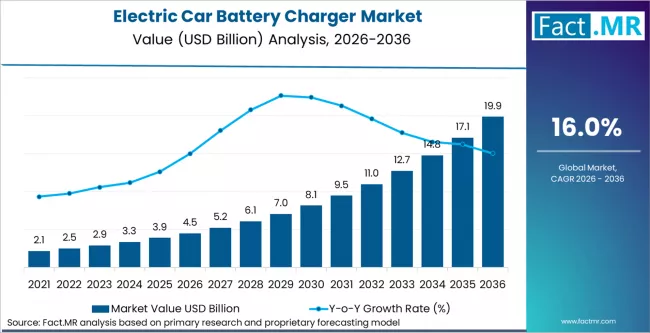
Electric Car Battery Charger Market Market Value Analysis | Source: Fact.MR
Electric Car Battery Charger Market Key Takeaways
| Metric | Details |
|---|---|
| Industry Size (2026) | USD 4.52 Billion |
| Industry Value (2036) | USD 19.96 Billion |
| CAGR (2026-2036) | 16.0% |
Electric Car Battery Charger Market Definition
The electric car battery charger market encompasses stationary and portable charging equipment designed to transfer electrical energy from grid infrastructure to the battery systems of battery electric vehicles and plug-in hybrid electric vehicles. The defined scope includes AC charging units, DC fast charging stations, wireless charging systems, and associated charging management software platforms sold through commercial, fleet, and residential deployment channels.
Electric Car Battery Charger Market Inclusions
Market scope includes Level 1 portable charging cables, Level 2 AC wall-box and pedestal chargers, Level 3 DC fast charging stations, bi-directional vehicle-to-grid capable chargers, and wireless inductive charging pads for passenger electric vehicles. Geographic analysis covers North America, Latin America, Europe, East Asia, South Asia, Oceania, and Middle East and Africa. Forecast scope spans 2026 to 2036 with segment breakdowns by type, charging level, charging mode, end-use, and region.
Electric Car Battery Charger Market Exclusions
Industrial electric vehicle chargers for forklifts, mining equipment, and non-road machinery are excluded from this scope. Battery swap station infrastructure, onboard vehicle charger units integrated into the vehicle powertrain, and charging network software platforms sold independently of physical hardware installations are also excluded. Two-wheeler and three-wheeler electric vehicle chargers operating below 3.3 kW capacity fall outside the defined scope.
Electric Car Battery Charger Market Research Methodology
- Primary Research: Fact.MR analysts conducted interviews with charging network operators, fleet electrification program managers at major logistics companies, utility grid integration engineers, and EV charging hardware procurement directors to validate deployment timelines, pricing structures, and regulatory compliance requirements across commercial and residential installation channels.
- Desk Research: Secondary research aggregated EV registration data from national transport agencies, public charging infrastructure deployment statistics from government energy ministries, Alternative Fuels Infrastructure Regulation compliance schedules from the European Commission, and corporate investment disclosures from listed charging network operators.
- Market-Sizing and Forecasting: Baseline market values derive from a bottom-up aggregation of charger unit installations by charging level and deployment channel, weighted by average hardware and installation prices. EV fleet size projections and charger-to-vehicle ratio targets from national infrastructure plans were applied as demand drivers in the forward model.
- Data Validation and Update Cycle: Segment forecasts are cross-validated against publicly disclosed network deployment milestones from listed charging operators and EV production forecasts from automotive industry bodies. Quarterly model reviews incorporate updated EV sales actuals and infrastructure funding disbursement data from government energy programs.
Summary of Electric Car Battery Charger Market
- Electric Car Battery Charger Market Definition
- The electric car battery charger market covers stationary and portable AC and DC charging equipment for battery electric and plug-in hybrid vehicles, supplied through commercial network, fleet, and residential deployment channels across global EV infrastructure development programs.
- Demand Drivers in the Market
- Government EV Infrastructure Mandates: The EU Alternative Fuels Infrastructure Regulation and the US National Electric Vehicle Infrastructure program are requiring minimum public charging point deployment densities and corridor coverage standards that translate directly into contracted hardware procurement volumes for charging equipment manufacturers across major economies.
- Corporate Fleet Electrification Programs: Large logistics operators, public transit authorities, and corporate vehicle fleet managers are executing multi-year electrification programs requiring workplace and depot charging infrastructure investments, generating bulk procurement orders for Level 2 and DC fast charging systems that establish predictable revenue pipelines for equipment suppliers.
- Residential EV Adoption in Homeowner Markets: Rising passenger EV ownership rates in North America and Europe are driving Level 2 home charger installations, supported by utility rebate programs and building code amendments in several jurisdictions requiring EV-ready electrical infrastructure in new residential construction.
- Key Segments Analyzed in the Fact.MR Report
- AC Chargers Type: Holds 42.7% share in 2026, serving the dominant residential and workplace charging use cases where overnight or workday dwell times make slower AC charging rates commercially practical and installation cost efficiency is the primary procurement criterion.
- Level 2 Charging Level: Commands 48.6% share in 2026, representing the standard configuration for destination, workplace, and public parking charging deployments that balance installation cost with charging speed requirements for daily driving patterns across most passenger EV segments.
- Commercial End-Use: Accounts for 54.8% of 2026 market value, driven by public charging network operators, fleet charging depot developers, and parking facility operators whose infrastructure investments are supported by government co-funding mechanisms and utility-scale grid connection agreements.
- Analyst Opinion at Fact.MR
- Fact.MR analysis indicates that the electric car battery charger market is transitioning from a hardware-led deployment phase to a software and services competition, where network reliability, payment interoperability, and energy management optimization are becoming the primary competitive variables differentiating charging operators. Hardware commoditization is progressing rapidly in Level 2 AC charger categories, compressing margins for equipment-only suppliers and creating pressure to bundle hardware with network software, dynamic load management, and energy procurement services. The bi-directional vehicle-to-grid charger segment represents the next structural growth catalyst, as utility integration programs in Germany, the Netherlands, and California are establishing commercial frameworks that enable EV batteries to function as grid-responsive distributed storage assets. Companies that establish utility partnership agreements and grid service revenue streams before 2028 are positioned to capture premium pricing in a segment that the commodity AC charger market cannot access.
- Strategic Implications / Executive Takeaways
- Software Platform Development Priority: Charging equipment manufacturers must invest in proprietary network management and energy optimization software to defend margins against hardware commoditization, as fleet and commercial customers increasingly evaluate total cost of network operation rather than upfront hardware price in procurement decisions.
- Vehicle-to-Grid Infrastructure Positioning: Suppliers should accelerate bi-directional charger certification and utility interconnection agreement development in Germany, the Netherlands, and California, where grid service revenue frameworks are establishing early commercial precedents that will influence regulatory adoption timelines across wider European and North American markets.
- India and China Market Entry Acceleration: Equipment manufacturers without established distribution in India and China face a narrowing window to negotiate channel partnerships, as both markets are deploying public charging infrastructure at rates that are establishing hardware supplier relationships with multi-year contract duration ahead of broader market maturation.
What are the Drivers of the Electric Car Battery Charger Market?
The global transition toward sustainable transportation is a primary driver for the electric car battery charger market. Policy incentives, laws, regulations, and strategic investments in charging infrastructure are being utilized by nations striving for net-zero emissions to encourage the adoption of electric vehicles. As a result, there is a constant demand for battery chargers everywhere. Large-scale infrastructure for charging buildouts is required by comprehensive EV roadmaps that major economies like the U.S., Germany, China, and Japan have established.
The quick development of battery charging system technology is another important factor. Advancements such as wireless charging systems, ultra-fast DC charging, and AI-enabled smart chargers are improving efficiency and user experience. These enhancements ensure safety and compatibility with various EV brands while reducing charging time. Such innovation not only encourages individual ownership of EVs but also supports the development of commercial fleets and public transport electrification.
Furthermore, the shift in consumer preference toward private mobility solutions post-pandemic has led to increased EV adoption. Growing urbanization and the need for pollution control are prompting municipal authorities to deploy public EV chargers across cities. The market for electric car battery chargers is poised for long-term growth, particularly in conjunction with developments in smart cities and their integration with renewable energy sources.
Regional Trends for the Electric Car Battery Charger Market
The market for electric car battery chargers is dominated by Asia Pacific, driven by South Korea, Japan, and China's rapid EV adoption. With the help of significant subsidies, robust manufacturing capabilities, and national charging station installation programs, China continues to be the world's largest EV market. By 2024, more than 1.8 million public battery chargers are expected to be installed, driven by the government's "New Energy Vehicle" (NEV) policy. Additionally, South Korea and Japan provide tax credits and specialized infrastructure funding for EV charging stations in homes and businesses.
Significant charger deployment is being encouraged in Europe by regulatory mandates. Member states are being pressured to invest in clean transportation and e-mobility by the EU's Fit for 55 package and Green Deal. Strong networks of charging stations are being constructed across highways, cities, and residential areas in nations like Germany, France, and the Netherlands. Furthermore, European players have been able to create scalable and effective EV ecosystems due to grid modernization and charging system interoperability.
North America, particularly the U.S. and Canada, is emerging as a major growth region. Billions of dollars have been set aside for national EV charging networks under the Bipartisan Infrastructure Law and the U.S. Inflation Reduction Act. By 2030, more than 500,000 chargers are expected to be available nationwide, thanks to the National Electric Vehicle Infrastructure (NEVI) program. In the meantime, Canada's Zero-Emission Vehicle Infrastructure Program (ZEVIP) is encouraging the development of charging stations that run on clean energy.
Although charger adoption is still in its infancy, Latin America as well as the Middle East are showing encouraging growth. Brazil and the United Arab Emirates are investing in international partnerships and public charging initiatives. These emerging markets will play a more significant role in long-term market expansion.
What are Challenges and Restraining Factors of the Electric Car Battery Charger Market?
A major challenge in the electric car battery charger market is the high initial cost of fast-charging infrastructure. The installation of DC fast chargers, especially those with 150 kW or higher, requires advanced power supply systems, cooling units, and electrical upgrades, which makes them costly for municipalities and private enterprises.
The absence of a common charging standard is another significant limitation. Usability may be restricted by charger and EV model incompatibilities. Multiple interfaces continue to exist across international markets, making infrastructure planning more challenging, despite efforts to align standards through CHAdeMO and CCS (Combined Charging System).
Concerns are also raised by grid capacity and power reliability. The grid may become overloaded if EV chargers are added quickly, particularly in urban areas with limited capacity. To effectively manage demand loads, integration with smart grids and renewable energy sources is required. Additionally, some areas lack sufficient rural, as well as highway-based, charging stations, which contributes to range anxiety and consumer reluctance.
Country-wise Outlook
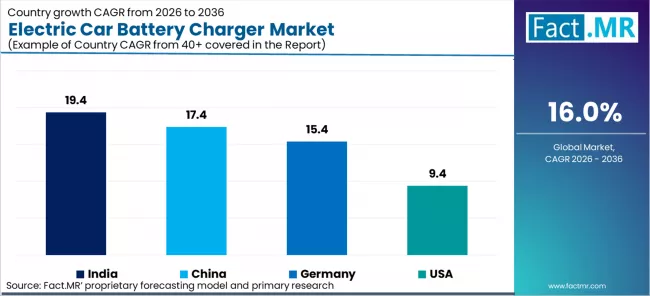
Electric Car Battery Charger Market Cagr Analysis By Country | Source: Fact.MR
US: Growth Is Driven by Infrastructure Investments
The electric car battery charger market in the U.S. is expanding rapidly, driven by federal and state initiatives aimed at decarbonizing the transportation sector. By 2025, there will be more than 2.5 million EVs on the road, which will increase demand for quick and easily accessible chargers. The construction of high-speed EV corridors using Level 3 DC fast chargers through interstate highways is being financed by government-backed initiatives such as NEVI.
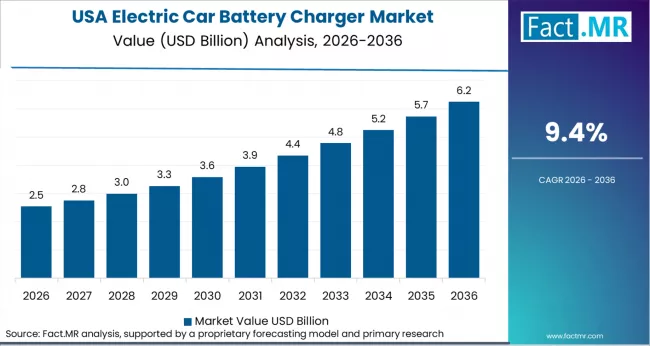
Electric Car Battery Charger Market Country Value Analysis | Source: Fact.MR
With businesses like ChargePoint, Tesla, and Electrify America making investments in extensive charging infrastructure, private sector involvement has increased. Recent announcements confirm that Tesla's Supercharger network is now partially open to other EV brands, and it continues to be a benchmark for ultra-fast charging. The residential segment is further driven by the increase in home charging installations, particularly in suburban households. The U.S. is leading the way in charger innovation by focusing on grid-balancing infrastructure, vehicle-to-grid (V2G) solutions, and bi-directional charging.
China: Urbanization and Government Policy Quicken Growth
With more than half of all EV chargers installed worldwide, China is the leader in this field. China has become a center for electric mobility due to its aggressive NEV policies, investments in EV manufacturing, and urban planning initiatives. With the help of a robust charging network, cities like Beijing and Shenzhen have almost completely switched to electric fleets for their public buses and taxis.
The government has mandated that new commercial and residential structures be equipped with chargers and set strict goals for the number of charging stations per person. The infrastructure rollout is being led by major players, including State Grid Corporation, Star Charge, and TGOOD, with public-private partnerships being encouraged. China's demand for high-power DC chargers is increasing due to the growing popularity of electric logistics vans and commercial vehicles.
Germany: A Pioneer in EV Interoperability and Standardization
Germany's industrial synergy and regulatory leadership are driving the expansion of the charger market in Europe. With the help of energy companies, city councils, and automakers, the nation hopes to have more than one million public charging stations by 2030. The government provides grants and subsidies for the installation of both AC and DC chargers through initiatives such as the "Master Plan Charging Infrastructure."
Drivers can use any public charger, regardless of their EV brand or utility provider, due to Germany's commitment to interoperability and open-access charging. Germany's charging network is expanding due to companies like Siemens, EnBW, and Ionity. Grid balancing, dynamic pricing, and smart meter integration are becoming increasingly essential components of the German charging infrastructure.
Category-wise Analysis
DC Fast Chargers to Exhibit Leading by Type
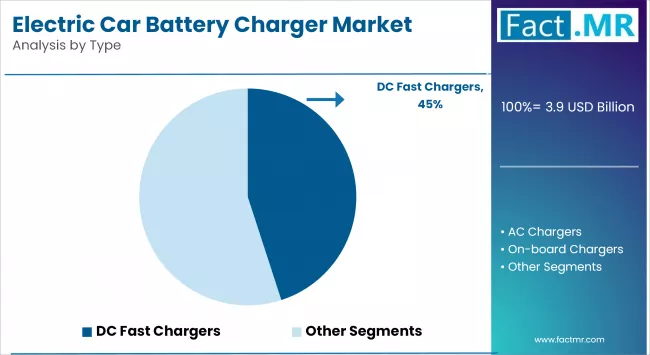
Electric Car Battery Charger Market Analysis By Type | Source: Fact.MR
DC fast chargers are expected to drive market growth, as they can charge electric vehicles significantly faster than AC chargers. These chargers, which are intended for high-traffic areas like highways, shopping centers, and fleet depots, can fully recharge the majority of EVs in 30 to 45 minutes. They are therefore perfect for public infrastructure projects, commercial fleets, and logistics vehicles.
Governments and individuals are giving DC fast charging stations priority due to the growing popularity of long-range EVs and rising convenience expectations. The 350 kW chargers from Electrify America and Tesla's Supercharger V3 are prime examples of state-of-the-art charging speeds in the U.S. High-capacity public DC charging stations are supported by China's national grid, while Ionity, based in Europe, is installing ultra-fast chargers along its highways.
Level Two to Exhibit Leading by Charging Level
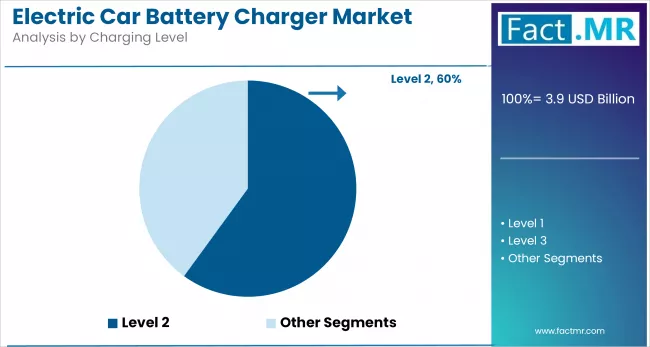
Electric Car Battery Charger Market Analysis By Charging Level | Source: Fact.MR
Level 2 chargers are frequently used for charging at home and work because they strike a balance between price and speed. These chargers are suitable for both daytime charging at offices and overnight charging at home, as they operate at 240V and can typically deliver 10 to 20 miles of range per hour.
The growing popularity of EVs and corporate sustainability initiatives is linked to their increasing adoption. As a green benefit that increases employee retention and satisfaction, many employers now provide workplace charging. Major players, including Siemens, Blink Charging, and Wallbox, are offering compact, smart-connected Level 2 battery chargers that feature planning, energy tracking, and mobile app integration.
Portable and On-Board to Exhibit leading by Charging Mode
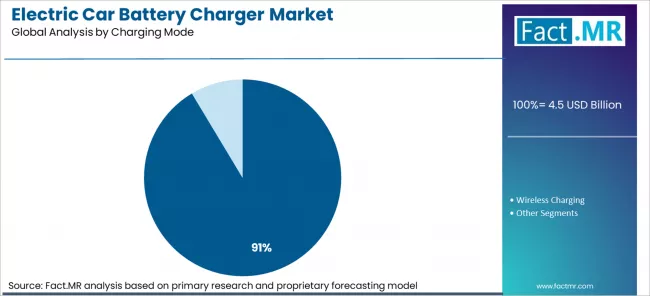
Electric Car Battery Charger Market Analysis By Charging Mode | Source: Fact.MR
Energy flow from external chargers to the battery is controlled by onboard chargers, which are integrated into the car. When attached to AC chargers, they play a critical role in determining charging speed. EVs can be charged more effectively from household or public outlets due to higher capacity onboard chargers.
For EV owners without designated parking spaces, portable chargers provide convenience and mobility. These portable, plug-in gadgets can be charged in an emergency or on occasion using regular wall outlets. In underdeveloped or rural markets where public infrastructure is scarce, their adaptability is particularly advantageous.
Smart and Connected to Exhibit Leading by End-Use
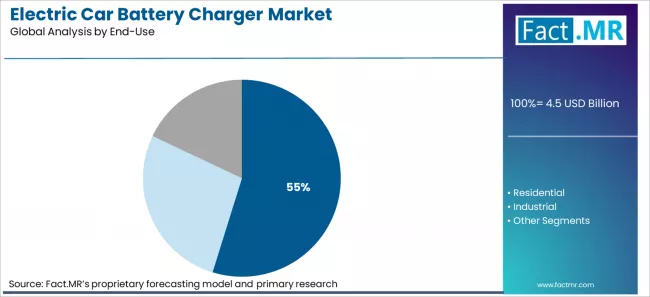
Electric Car Battery Charger Market Analysis By End Use | Source: Fact.MR
Intelligent charging systems are becoming increasingly common as IoT and smart grid technologies continue to grow. Smart chargers provide dynamic pricing, remote control through mobile apps, real-time monitoring, and even solar integration. Demand-response management, energy cost optimization, and grid overload reduction all depend on these characteristics.
An emerging business model called charging-as-a-service (CaaS) enables customers to pay for each charge separately, rather than owning chargers. This is becoming more popular in fleet applications, rental properties, and multi-unit housing. Businesses like ABB, ChargePoint, and EVBox are aggressively pushing for smart infrastructure that incorporates renewable energy sources.
Competitive Analysis
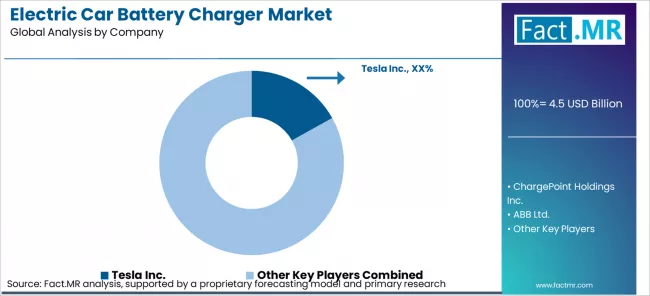
Electric Car Battery Charger Market Analysis By Company | Source: Fact.MR
The electric car battery charger market is becoming increasingly with major players emphasizing on speed, convenience, interoperability, and compatibility with renewable energy sources. In order to increase their market shares, they are also growing through government contracts, strategic alliances, and mergers.
With its exclusive network of superchargers, which provides some of the fastest and most dependable chargers available, Tesla continues to lead the industry. Under government-sponsored interoperability programs, it has begun to open this network to non-Tesla EVs in the U.S. and Europe.
The major oil and gas companies making the shift to EV infrastructure are Shell Recharge, BP Pulse, and TotalEnergies. By deploying EV chargers through their refueling networks, these companies guarantee geographic reach and built-in customer trust.
ChargePoint is well-known for its extensive network and subscription-based business models that offer a variety of charging choices. One of the leading manufacturers of electrical equipment, ABB, provides scalable charging options for highway and urban applications. Other significant contributors, particularly in North America and Europe, include Siemens, EVBox, Blink Charging, and Wallbox.
Key players in the electric car battery charger market are Tesla Inc., ChargePoint Holdings Inc., ABB Ltd., Siemens AG, Blink Charging Co., EVBox Group, Wallbox NV, Delta Electronics Inc., Shell Recharge, BP Pulse, TotalEnergies SE, and Schneider Electric.
Recent Developments (2024 to 2025)
- In March 2025, Tesla announced a 30% expansion of its Supercharger network across North America and Europe. This strategic move aims to support the rapidly growing electric vehicle (EV) market and enhance accessibility to charging infrastructure for all EV users.
Bibliography
- 1. European Commission, Directorate-General for Mobility and Transport. (2024, June). Alternative Fuels Infrastructure Regulation (AFIR): Implementation Progress Report 2024. European Commission.
- 2. International Energy Agency. (2024, April). Global EV Outlook 2024: Charging Infrastructure and Grid Integration. IEA.
- 3. Government of India, Ministry of Heavy Industries. (2024, March). FAME India Scheme Phase II: Public Charging Infrastructure Deployment Status Report. Government of India.
- 4. United States Department of Energy, Office of Energy Efficiency and Renewable Energy. (2024, July). National Electric Vehicle Infrastructure (NEVI) Formula Program: Deployment Update. U.S. DOE.
- 5. International Organization for Standardization. (2023). IEC 61851 Series: Electric Vehicle Conductive Charging System Standards. IEC.
- 6. World Bank Group. (2024, February). Electric Mobility Financing in Emerging Markets: Public Charging Infrastructure Investment Frameworks. World Bank.
This bibliography is provided for reader reference. The full Fact.MR report contains the complete reference list with primary research documentation.
This Report Addresses
- Market sizing and quantitative forecast metrics: detailing precise revenue projections, absolute dollar growth, and compound annual growth rates across major industry segments and geographies through 2036.
- Segmentation analysis: mapping the adoption velocity of leading product, technology, and end-use categories and evaluating structural factors driving segment share transitions over the forecast period.
- Regional deployment intelligence: comparing growth dynamics in high-momentum Asia Pacific and emerging markets against the mature replacement and upgrade demand patterns prevalent in European and North American industry hubs.
- Regulatory compliance assessment: analyzing how evolving product safety standards, environmental directives, and sector-specific mandates are reshaping procurement decisions, material specifications, and supplier qualification criteria.
- Competitive posture evaluation: tracking consolidation trends, platform integration strategies, technology differentiation investments, and the resulting competitive dynamics among established market players and emerging challengers.
- Capital project strategic guidance: defining the procurement specifications, investment thresholds, and performance benchmarks required to support next-generation product adoption and facility modernization programs.
- Supply chain vulnerability analysis: identifying sourcing concentration risks, logistics bottlenecks, raw material price dependencies, and geographic exposure scenarios that affect market participant cost structures.
- Custom data delivery formats: encompassing interactive dashboards, raw Excel datasets, and comprehensive PDF narrative reports tailored for executive decision-making and analyst reference applications.
Scope of the Report
| Metric | Value |
|---|---|
| Quantitative Units | USD 4.52 billion to USD 19.96 billion, at a CAGR of 16.0% |
| Market Definition | Stationary and portable AC and DC charging equipment for battery electric and plug-in hybrid vehicles, supplied through commercial network, fleet, and residential deployment channels. |
| Type Segmentation | AC Chargers, DC Chargers, Others |
| Charging Level Segmentation | Level 1, Level 2, Level 3/DC Fast Charging |
| Charging Mode Segmentation | Plug-in Charging, Wireless Charging |
| End-Use Segmentation | Commercial (Public Charging Stations, Fleet Charging, Parking Garages), Residential |
| Regions Covered | North America, Latin America, Europe, East Asia, South Asia, Oceania, Middle East and Africa |
| Countries Covered | USA, China, India, Germany, and 40 plus countries |
| Key Companies Profiled | Tesla Inc., ChargePoint Holdings Inc., ABB Ltd., Siemens AG, Blink Charging Co., EVBox Group, Wallbox NV, Delta Electronics Inc., Shell Recharge, BP Pulse, TotalEnergies SE, Schneider Electric |
| Forecast Period | 2026 to 2036 |
| Approach | Bottom-up aggregation of charger installations by charging level and deployment channel with EV fleet size and charger-to-vehicle ratio modeling |
Segmentation of Electric Car Battery Charger Market
-
By Type :
- AC Chargers
- DC Fast Chargers
- On-board Chargers
- Portable Chargers
-
By Charging Level :
- Level 1
- Level 2
- Level 3
-
By Charging Mode :
- Plug-in Charging
- Wireless Charging
-
By End-Use :
- Residential
- Commercial (Public Charging Stations, Fleet Charging, Parking Garages)
- Industrial
-
By Region :
- North America
- Latin America
- Western Europe
- Eastern Europe
- East Asia
- South Asia & Pacific
- Middle East & Africa