- Base Value(2025): 3.6 Bn
- Estimated Value(2026): 3.8 Bn
- Forecast Value (2036): 6.2 Bn
- CAGR (2026 - 2036): 5.0%
Ostomy Care Market Analysis and Forecast by Fact.MR
The global market for ostomy care is estimated to be around USD 3.8 billion in 2026 and has been forecast to expand at a CAGR of 5.0% to end up at USD 6.2 billion by 2036. The Ostomy Care segment is led by Ostomy Bags, which is anticipated to account for 58.0% of the product segment in 2026, while Colostomy Care is expected to remain the leading application with around 46.0% share. The market was valued at USD 3.6 billion in 2025 and is poised for steady growth driven by evolving industry dynamics and regional demand patterns.
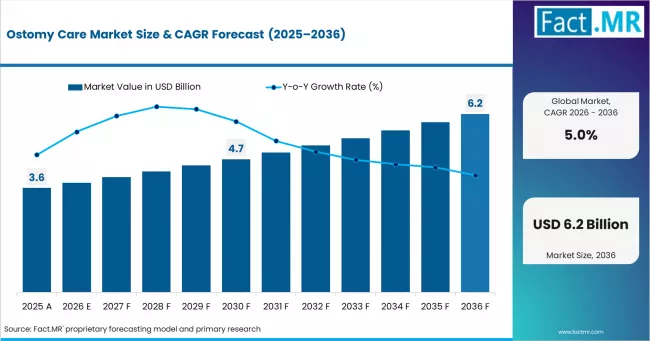
Ostomy Care Market Value Analysis | Source: Fact.MR
Summary of Ostomy Care Market
- Market Snapshot
- In 2025, the global Ostomy Care Market was valued at approximately USD 3.6 billion.
- The market is estimated to reach USD 3.8 billion in 2026 and is projected to attain USD 6.2 billion by 2036
- The ostomy care market is likely to expand at a CAGR of 5.0% during the forecast period.
- The market is anticipated to create an absolute dollar opportunity of USD 2.4 billion between 2026 and 2036.
- Ostomy Bags account for 58.0% of market share in 2026.
- China (6.8%) and India (6.3%) are the key growth markets during the forecast period
- Demand and Growth Drivers
- Rising colorectal cancer incidence and inflammatory bowel disease prevalence are increasing the patient population requiring ostomy surgery and long-term ostomy care products.
- Aging demographics in developed markets are increasing the number of patients with conditions requiring ostomy creation, including cancer, diverticular disease, and bowel obstruction.
- Product innovation in adhesive technology, odor control, and pouch design is improving patient quality of life and driving adoption of premium ostomy care products.
- Product and Segment View
- Ostomy bags account for 58% of the product segment in 2026, reflecting the recurring consumption of pouch systems by the growing global ostomate population.
- Colostomy care applications represent 46% in 2026, with colostomy being the most common ostomy type created during colorectal surgery.
- Home care settings hold 45% of end-use demand in 2026, with the majority of ostomates managing their care independently with periodic clinical support.
- Geography and Competitive Outlook
- China leads at 6.8% CAGR, driven by increasing colorectal cancer incidence and improving ostomy care awareness and product accessibility.
- Europe remains the largest market, with established reimbursement frameworks and high per-patient product utilization.
- Coloplast holds 29% market share, with competition from Hollister, ConvaTec, and regional ostomy care providers.
- Analyst Opinion
- The ostomy care market is a recurring revenue category where demand is directly linked to the growing global ostomate population. Each new ostomy surgery creates a patient who requires daily pouching products for months to years, establishing predictable consumption patterns. Growth is shaped by colorectal cancer incidence trends, aging population demographics, and gradual improvement in ostomy care access in emerging markets. The competitive advantage lies in adhesive technology, skin barrier performance, and patient comfort, as product switching is low once patients find a system that works for them. Premium product adoption is increasing as manufacturers develop thinner, more discreet pouch systems with improved odor control.
Why is the Ostomy Care Market Growing?
- Colorectal cancer incidence growth globally is increasing the number of patients requiring ostomy creation and long-term ostomy care product consumption.
- Aging population demographics increase the prevalence of conditions requiring ostomy surgery, including cancer, diverticular disease, and bowel obstruction.
- Improving ostomy care awareness and product accessibility in emerging markets is bringing previously underserved patients into the managed care system.
The ostomy care market grows through two mechanisms: new patient additions from ostomy surgery and ongoing consumption by the existing ostomate population. Each year, approximately one million new ostomy surgeries are performed globally, with the majority of patients requiring continuous pouching product use for extended periods.
Product technology is evolving to address patient quality-of-life priorities. Thinner pouch materials, improved adhesive formulations, better odor control systems, and more discreet product designs are encouraging patients to adopt premium products and improving compliance with proper ostomy management protocols.
Segment-wise Analysis of the Ostomy Care Market
- Ostomy bags lead at 58% share in 2026, driven by recurring daily consumption requirements across the global ostomate population.
- Colostomy care accounts for 46% of applications in 2026, reflecting its status as the most common ostomy type.
- Advanced adhesive technology holds 52% in 2026, with skin-friendly adhesive formulations reducing peristomal skin complications.
The market is segmented by product type (ostomy bags, accessories, skin barriers), application (colostomy, ileostomy, urostomy care), end use (home care, hospitals and clinics, ambulatory surgical centers), technology (advanced adhesive, drainable pouch systems, odor control), packaging (sterile medical kits, blister packaging, boxed care kits), and distribution channel (pharmacies and retail, online retail, hospital procurement).
Which Product Segment Leads the Ostomy Care Market?
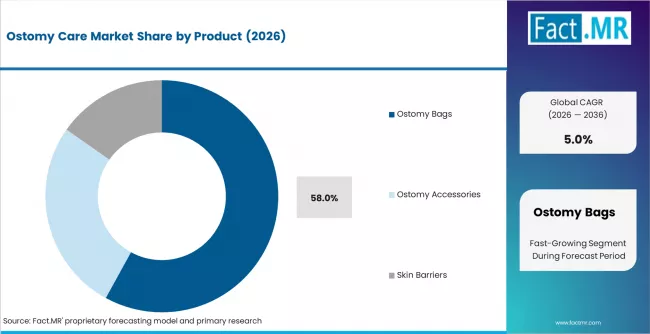
Ostomy Care Market Analysis By Product | Source: Fact.MR
Ostomy bags hold 58% of the product segment in 2026. Pouching systems are the core consumable product in ostomy care, with patients typically using one to three pouches per day depending on ostomy type and output volume. The segment benefits from recurring consumption patterns and the critical importance of pouch performance to patient quality of life.
Which Application Drives the Largest Demand?
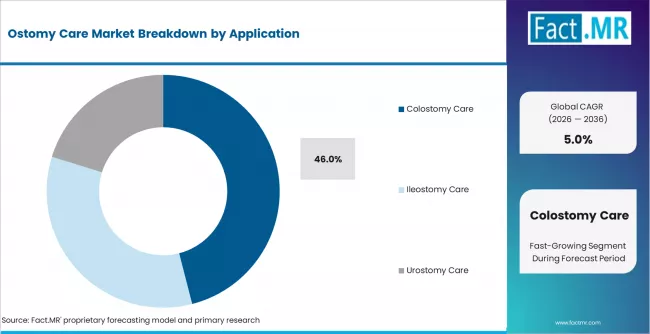
Ostomy Care Market Analysis By Application | Source: Fact.MR
Colostomy care accounts for 46% of applications in 2026. Colostomy is the most frequently created ostomy type, primarily associated with colorectal cancer surgery and diverticular disease. Ileostomy care accounts for the second-largest share, followed by urostomy care, with each application requiring specific pouch configurations and accessories.
Key Growth Drivers, Constraints, and Market Scope
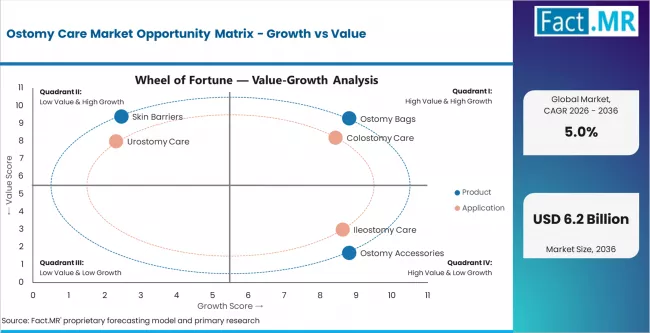
Ostomy Care Market Opportunity Matrix Growth Vs Value | Source: Fact.MR
- Growing ostomate population creates expanding recurring demand for pouching products and accessories.
- Product innovation in adhesive technology and pouch design supports premium product adoption.
- Reimbursement limitations in emerging markets constrain product accessibility for underserved patient populations.
The ostomy care market is shaped by ostomy surgery volume trends, ostomate population growth, product technology development, and reimbursement frameworks governing patient access to care products.
Growth Drivers
Demand is shaped by colorectal cancer incidence growth, aging demographics increasing ostomy surgery rates, and improving product accessibility in emerging markets. Premium product adoption is increasing as adhesive technology and pouch design improvements enhance patient quality of life.
Constraints
Reimbursement limitations in many markets restrict patient access to adequate product supplies. Stigma and awareness gaps in developing regions delay patient entry into managed ostomy care. Price sensitivity constrains premium product penetration in cost-conscious healthcare systems.
Opportunities
Online direct-to-patient delivery services are improving product accessibility and convenience. Emerging market healthcare development is bringing previously underserved ostomate populations into managed care. Smart ostomy monitoring devices represent an emerging technology category that could enhance patient care and create new revenue streams.
Regional Outlook Across Key Markets
.webp "Top Country Growth Comparison Ostomy Care Market Cagr (2026 2036)")
Top Country Growth Comparison Ostomy Care Market Cagr (2026 2036) | Source: Fact.MR
- China leads at 6.8% CAGR, driven by growing colorectal cancer incidence and improving ostomy care awareness.
- India follows at 6.3% CAGR, reflecting expanding surgical capacity and patient care infrastructure.
- Germany records 5.8% CAGR, supported by established reimbursement and high per-patient utilization.
- USA grows at 4.8% CAGR, with mature market dynamics and premium product adoption.
Country CAGR Table
| Country | CAGR (%) |
|---|---|
| China | 6.8% |
| India | 6.3% |
| Germany | 5.8% |
| Brazil | 5.3% |
| USA | 4.8% |
| UK | 4.3% |
| Japan | 3.8% |
Source: Fact.MR analysis. Updated Apr 25, 2026
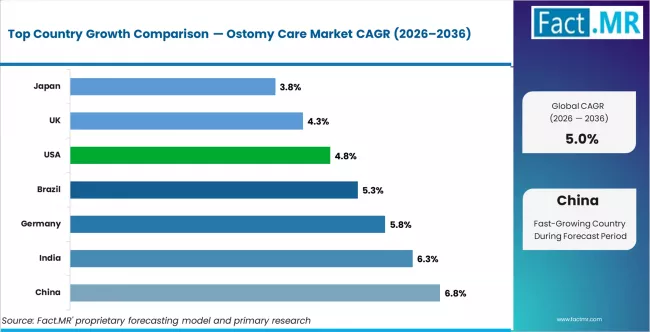
Ostomy Care Market Cagr Analysis By Country | Source: Fact.MR
Regional demand reflects colorectal cancer incidence, ostomy surgery rates, reimbursement coverage, and product distribution infrastructure for ongoing patient supply.
Market Outlook in China
The China ostomy care market is projected to grow at a CAGR of 6.8% through 2036. Demand is driven by increasing colorectal cancer incidence, improving ostomy care awareness, and expanding product distribution through hospital and online channels.
- Colorectal cancer incidence growth expands the ostomate population.
- Ostomy care awareness improvement increases product adoption rates.
- Online distribution channels improve product accessibility.
Demand Trends in India
The India ostomy care market is projected to grow at a CAGR of 6.3% through 2036. Growth reflects expanding surgical capacity, growing awareness of ostomy management, and improving product accessibility through hospital and pharmacy channels.
- Surgical capacity expansion increases ostomy creation volumes.
- Awareness programs improve patient engagement with ostomy care.
- Distribution infrastructure development supports product supply.
Germany Market Growth
The Germany ostomy care market is projected to grow at a CAGR of 5.8% through 2036. Demand is supported by comprehensive reimbursement coverage, established stoma care nursing infrastructure, and high per-patient product utilization.
- Comprehensive reimbursement supports adequate product supply.
- Stoma care nursing infrastructure ensures patient support.
- Premium product adoption reflects quality-focused healthcare standards.
USA Market Outlook
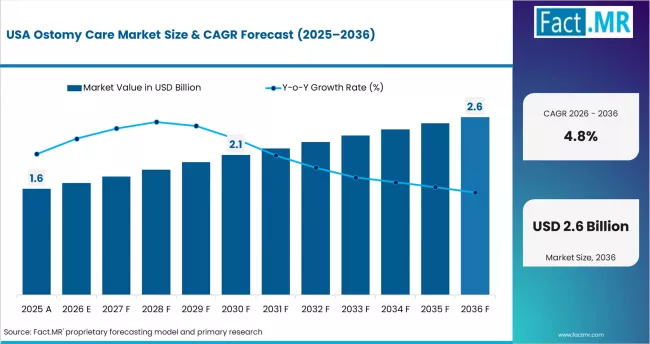
Ostomy Care Market Country Value Analysis | Source: Fact.MR
The USA ostomy care market is projected to grow at a CAGR of 4.8% through 2036. Demand is shaped by stable ostomy surgery volumes, aging demographics, and growing adoption of premium pouch systems and direct-to-patient delivery services.
- Aging demographics increase ostomy surgery rates.
- Premium product adoption supports value growth.
- Direct-to-patient delivery improves convenience and compliance.
Competitive Benchmarking and Company Positioning
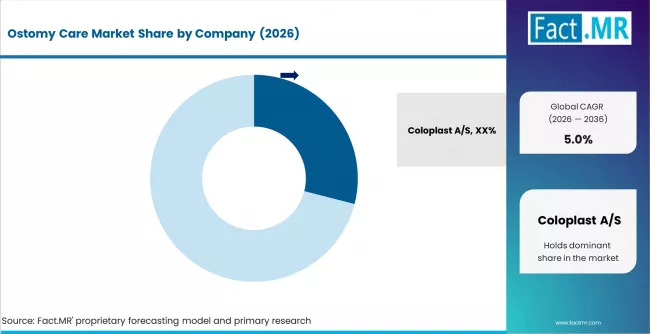
Ostomy Care Market Analysis By Company | Source: Fact.MR
- Coloplast holds 29% market share through its comprehensive ostomy care portfolio including the SenSura and Brava product platforms.
- Hollister and ConvaTec compete through established product portfolios, patient education programs, and distribution network coverage.
- Competition is shaped by adhesive technology, product comfort, patient support programs, and distribution channel coverage.
The competitive landscape is concentrated among three global leaders: Coloplast, Hollister, and ConvaTec, which together control the majority of the global ostomy care market. Competition centers on adhesive technology performance, pouch discretion, patient support programs, and reimbursement navigation services.
Strategic priorities include advancing adhesive and skin barrier technology, developing thinner and more discreet pouch designs, building direct-to-patient delivery infrastructure, and expanding distribution in emerging markets.
Competitive Benchmarking
| Company | Product Portfolio | Patient Support | Distribution | Technology |
|---|---|---|---|---|
| Coloplast | Comprehensive | Extensive | Global | Advanced adhesive |
| Hollister | Comprehensive | Strong | Global | Skin barrier |
| ConvaTec | Comprehensive | Strong | Global | Hydrofiber |
| B. Braun | Regional | Moderate | Europe/Asia | Standard |
| Nu-Hope | Specialty | Niche | Americas | Custom solutions |
Source: Fact.MR analysis. Updated Apr 25, 2026
Recent Industry Developments
- Coloplast launched its next-generation SenSura Mio pouch system in 2025, featuring improved body-close fit technology for enhanced discretion and security.
- ConvaTec expanded its direct-to-patient delivery service in Asia Pacific in early 2026, targeting improved product accessibility for ostomates in underserved markets.
- Hollister invested in smart ostomy monitoring technology in 2025, developing sensor-enabled pouches that alert patients to output levels and potential leakage.
Leading Companies Shaping the Ostomy Care Market
-
Major Players
- Coloplast A/S
- Hollister Incorporated
- ConvaTec Group Plc.
- B. Braun
- ALCARE Co. Ltd.
-
Emerging Players
- Nu-Hope
- Marlen Manufacturing & Development Company
- Welland Medical Limited
- Baohe Ostomy Care
- Flexicare Medical Limited
Sources and Research References
- International Ostomy Association (IOA). Global ostomate population estimates and patient advocacy data.
- World Health Organization (WHO). Colorectal cancer incidence and mortality statistics.
- Coloplast A/S. Annual reports and ostomy care portfolio disclosures.
- United Ostomy Associations of America (UOAA). Patient support and product utilization data.
- European Crohn's and Colitis Organisation (ECCO). IBD epidemiology and surgical intervention data.
- Primary interviews with stoma care nurses, colorectal surgeons, hospital procurement managers, and ostomy product distributors.
This bibliography is provided for reader reference. The full report contains the complete reference list.
Key Questions This Report Addresses
- What is the current and projected size of the ostomy care market through 2036?
- What CAGR is expected for the ostomy care market between 2026 and 2036?
- Which product type holds the largest market share in 2026?
- Which application segment accounts for the highest demand in 2026?
- What factors are shaping demand for ostomy care products globally?
- Which countries are projected to show the fastest growth through 2036?
- How is the competitive landscape structured and who are the leading companies?
- How does Fact.MR estimate and validate the market forecast?
Ostomy Care Market Definition
The ostomy care market covers pouching systems, skin barriers, accessories, and support products used by patients with colostomy, ileostomy, or urostomy for ongoing stoma management. The market spans device manufacturing, distribution through pharmacies and medical suppliers, and direct-to-patient delivery services.
Ostomy Care Market Inclusions
The scope covers global and regional market size and forecasts for 2026 to 2036 across product type, application, end use, technology, packaging, distribution channel, and region. It includes demand analysis based on ostomy surgery volumes, ostomate population estimates, and product utilization patterns.
Ostomy Care Market Exclusions
The scope excludes wound care products not specific to stoma management, continence care products, surgical instruments used during ostomy creation, and ostomy reversal surgical services.
Ostomy Care Market Research Methodology
- Primary research includes interviews with stoma care nurses, colorectal surgeons, hospital procurement managers, and ostomy product distributors.
- Desk research draws on colorectal cancer epidemiology, IBD prevalence data, ostomy surgery statistics, and company financial disclosures.
- Market sizing uses a demand-side model validated through ostomate population estimates, product utilization rates, and pricing benchmarks.
- Data validation involves reconciliation with ostomy association registry data and expert panel review.
Segmentation
Scope of Analysis
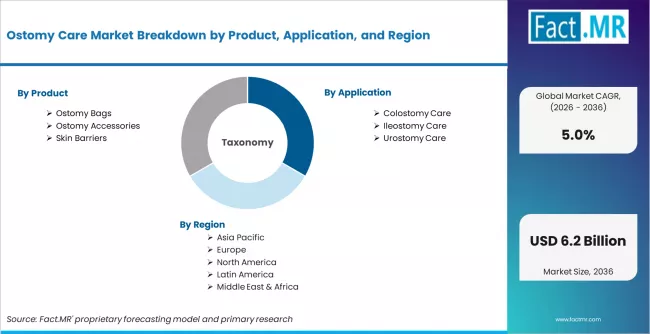
Ostomy Care Market Breakdown By Product, Application, And Region | Source: Fact.MR
| Parameter | Details |
|---|---|
| Quantitative Units | USD 3.8 billion to USD 6.2 billion, at a CAGR of 5.0% |
| Market Definition | Covers pouching systems, skin barriers, accessories, and support products for colostomy, ileostomy, and urostomy patient management. |
| Regions Covered | North America, Latin America, Europe, East Asia, South Asia and Pacific, Middle East and Africa |
| Countries Covered | USA, China, India, Germany, Brazil, UK, Japan, and 30+ countries |
| Key Companies | Coloplast, Hollister, ConvaTec, B. Braun, ALCARE, Nu-Hope, Marlen, Welland Medical, Baohe, Flexicare |
| Forecast Period | 2026 to 2036 |
| Approach | Hybrid demand-side methodology built on ostomy surgery volumes, ostomate population estimates, product utilization rates, and primary interviews across stoma care nurses, surgeons, and distributors. |
Source: Fact.MR analysis. Updated Apr 25, 2026
Analysis by Product Type, Application, End Use, Technology, Packaging, Distribution Channel, and Region
-
Ostomy Care Market Market Segmented by Product:
- Ostomy Bags
- One-Piece Ostomy Bags
- Two-Piece Ostomy Bags
- Drainable Ostomy Bags
- One-Piece Ostomy Bags
- Ostomy Accessories
- Skin Barriers & Seals
- Adhesive Rings & Pouches
- Skin Barriers & Seals
- Skin Barriers
- Protective Barrier Systems
- Leak Prevention Products
- Protective Barrier Systems
- Ostomy Bags
-
Ostomy Care Market Market Segmented by Application:
- Colostomy Care
- Post-Colon Surgery Care
- Colon Cancer Treatment Care
- Post-Colon Surgery Care
- Ileostomy Care
- Intestinal Waste Management
- IBD Related Procedures
- Intestinal Waste Management
- Urostomy Care
- Urinary Diversion Care
- Bladder Cancer Treatment Support
- Urinary Diversion Care
- Colostomy Care
-
Ostomy Care Market Market Segmented by End Use:
- Home Care Settings
- Self-Care Patients
- Long-Term Ostomy Users
- Self-Care Patients
- Hospitals & Clinics
- Post-Surgical Care Units
- Specialized Stoma Care Units
- Post-Surgical Care Units
- Ambulatory Surgical Centers
- Outpatient Procedure Care
- Day Care Recovery Centers
- Outpatient Procedure Care
- Home Care Settings
-
Ostomy Care Market Market Segmented by Technology:
- Advanced Adhesive Technology
- Skin-Friendly Adhesives
- Leak-Resistant Bonding Systems
- Skin-Friendly Adhesives
- Drainable Pouch Systems
- Two-Piece Coupling Systems
- Modular Ostomy Devices
- Two-Piece Coupling Systems
- Odor Control Technology
- Activated Carbon Filters
- Gas Release Systems
- Activated Carbon Filters
- Advanced Adhesive Technology
-
Ostomy Care Market Market Segmented by Packaging:
- Sterile Medical Kits
- Single-Use Ostomy Kits
- Pre-Assembled Bag Systems
- Single-Use Ostomy Kits
- Blister Packaging
- Individual Device Packs
- Hospital Supply Units
- Individual Device Packs
- Boxed Care Kits
- Multi-Pack Patient Kits
- Home Care Supply Boxes
- Multi-Pack Patient Kits
- Sterile Medical Kits
-
Ostomy Care Market Market Segmented by Distribution Channel:
- Pharmacies & Retail Stores
- Hospital Pharmacies
- Medical Supply Stores
- Hospital Pharmacies
- Online Retail
- E-commerce Healthcare Platforms
- Direct Brand Websites
- E-commerce Healthcare Platforms
- Hospital Procurement
- Direct B2B Supply
- Healthcare Distributors
- Direct B2B Supply
- Pharmacies & Retail Stores
-
Ostomy Care Market Market by Region:
- North America
- USA
- Canada
- Mexico
- Latin America
- Brazil
- Chile
- Rest of Latin America
- Western Europe
- Germany
- UK
- Italy
- Spain
- France
- Nordic
- BENELUX
- Rest of Western Europe
- Eastern Europe
- Russia
- Poland
- Hungary
- Balkan & Baltic
- Rest of Eastern Europe
- East Asia
- China
- Japan
- South Korea
- South Asia and Pacific
- India
- ASEAN
- Australia & New Zealand
- Rest of South Asia and Pacific
- Middle East & Africa
- Kingdom of Saudi Arabia
- Other GCC Countries
- Turkiye
- South Africa
- Other African Union
- Rest of Middle East & Africa
- North America
Frequently Asked Questions
What is the size of the ostomy care market in 2026?
What will be the size of the ostomy care market in 2036?
How much will the ostomy care market grow between 2026 and 2036?
What are the key product types in the ostomy care market?
Which application segment will contribute significant share in the ostomy care market in 2026?
Which country is the fastest growing market for ostomy care?
What does the ostomy care market cover?
How does Fact.MR estimate and validate the market forecast?
Who worked on this report


Preview the report firsthand - request a free sample
Free SampleGet the brochure for pricing and purchase details
Download PDF