- Estimated Value(2026): 0.4 Bn
- Forecast Value (2035): 2.8 Bn
- CAGR (2026 - 2035): 4.50%
Froth Flotation Chemicals Market Market Size, Market Forecast and Outlook By Fact.MR
The froth flotation chemicals market was valued at USD Billion 1.80 in 2025, projected to reach USD Billion 1.88 in 2026, and is forecast to expand to USD Billion 2.92 by 2036 at a 4.50% CAGR. Expanding end-use application requirements, tightening performance specifications, and growing adoption across industrial and commercial sectors are driving sustained procurement growth globally.
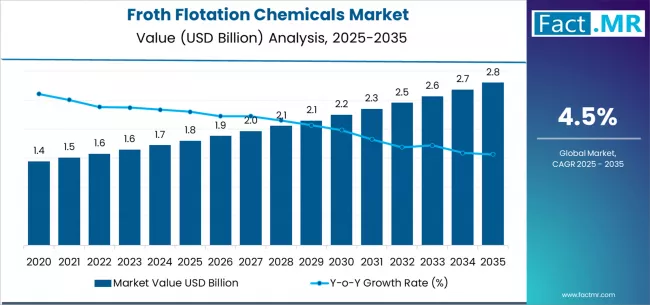
Froth Flotation Chemicals Market Market Value Analysis | Source: Fact.MR
Summary of Froth Flotation Chemicals Market Market
- Market Overview
- The market is valued at USD Billion 1.80 in 2025 and is projected to reach USD Billion 2.92 by 2036.
- The industry is expected to grow at a 4.50% CAGR from 2026 to 2036, creating an incremental opportunity of USD Billion 1.04.
- The market is a performance-driven category where product quality specifications, application-specific qualification, and supply chain reliability define competitive positioning across primary end-use sectors.
- Demand and Growth Drivers
- Demand is sustained by expanding mining application requirements that specify collectors product configurations for performance-critical operations.
- Tightening regulatory and quality standards across major consuming industries are driving specification upgrades toward higher-performance product grades.
- Growing adoption in emerging application segments is creating incremental demand channels beyond traditional end-use categories.
- Supply chain reliability and product consistency requirements are consolidating procurement toward qualified suppliers with demonstrated manufacturing capabilities.
- Product and Segment View
- The froth flotation chemicals market encompasses specialized products serving multiple industrial and commercial end-use applications with differentiated specifications.
- The market is segmented by Product (Collectors, Frothers, Modifiers, Other Products) and End Use (Mining, Pulp & Paper, Industrial Waste & Sewage Treatment, Other End Uses).
- Collectors leads by Product with 38.1% share in 2026.
- Mining leads by End Use with 40.8% share in 2026.
- Scope includes all product variants and grades within the defined market, while excluding raw material feedstock valuations, downstream finished product pricing, and processing equipment.
- Geography and Competitive Outlook
- The global market spans all major manufacturing and consuming regions, with regional dynamics shaped by local regulatory frameworks and end-use industry concentration.
- Competition is shaped by production capability, application expertise, and regulatory compliance, with key players including BASF SE, Clariant AG, Dow Inc., Nasaco International LLC, Nouryon Chemicals Holding B.V., Arkema S.A..
- Supply chain positioning and customer qualification credentials determine procurement allocation across tier-1 and tier-2 supplier categories.
- Analyst Opinion at Fact.MR
- Shambhu Nath Jha , Principal Consultant at Fact.MR, opines: 'In my analysis, I have observed that procurement decisions in the froth flotation chemicals market increasingly depend on application-specific performance documentation and supply chain reliability credentials rather than per-unit pricing alone. Suppliers investing in technical service capabilities and quality consistency documentation hold procurement advantages over commodity-positioned competitors.'
- Strategic Implications / Executive Takeaways
- Manufacturers must invest in application-specific performance testing and qualification data to secure procurement positions with tier-1 end-use customers.
- Procurement teams should evaluate total cost of ownership including product performance benefits and supply reliability rather than unit material pricing alone.
- Companies must monitor regulatory developments across key consuming markets to anticipate specification changes and reformulation requirements.
Froth Flotation Chemicals Market Market Key Takeaways
| Metric | Details |
|---|---|
| Industry Size (2026) | USD Billion 1.88 |
| Industry Value (2036) | USD Billion 2.92 |
| CAGR (2026 to 2036) | 4.50% |
Source: Fact.MR analysis. Updated Apr 1, 2026
The absolute dollar expansion of USD Billion 1.04 between 2026 and 2036 reflects structural demand growth across multiple independent consumption channels. As per Fact.MR, Collectors maintains category leadership at 38.1% share, supported by established performance characteristics and cost-effectiveness advantages across primary application segments.
Fact.MR analysis indicates that Mining applications command 40.8% of end-use demand, driven by specification requirements that favour established product formulations. The competitive landscape features both global multinational suppliers and specialized regional manufacturers competing on technical performance, application expertise, and supply chain reliability.
Why is the Froth Flotation Chemicals Market Growing?
Market expansion is being supported by the exponential increase in mineral commodity demand and the corresponding need for efficient beneficiation technologies in mining applications across global extractive operations. Modern mining operators are increasingly focused on advanced flotation chemical technologies that can improve mineral recovery, enhance concentrate quality, and optimize processing economics while meeting stringent environmental requirements.
The proven efficacy of flotation reagent formulations in various mineral processing applications makes them an essential component of comprehensive beneficiation strategies and mining optimization programs. The growing emphasis on resource efficiency and complex ore processing is driving demand for advanced flotation chemicals that meet stringent performance specifications and environmental requirements for mineral separation applications.
Mining operators' preference for reliable, high-performance reagent solutions that can ensure consistent processing outcomes is creating opportunities for innovative formulation technologies and customized chemical products. The rising influence of environmental regulations and water conservation standards is also contributing to increased adoption of premium-grade flotation chemicals across different mineral categories and processing systems requiring advanced separation technology.
Opportunity Pathways - Froth Flotation Chemicals Market
The froth flotation chemicals market represents a transformative growth opportunity, expanding from USD 1.8 billion in 2025 to USD 2.8 billion by 2035 at a 4.5% CAGR. As mining operators prioritize recovery optimization, processing efficiency enhancement, and environmental compliance in complex mineral beneficiation environments, flotation chemicals have evolved from commodity reagents to essential processing technologies enabling precise mineral separation, comprehensive water management strategies, and multi-mineral recovery operations across base metal platforms and industrial mineral applications.
The convergence of mining production expansion, increasing ore complexity challenges, advanced reagent technology integration, and stringent environmental mandates creates momentum in demand. High-selectivity collector formulations offering superior mineral recovery, cost-effective frother solutions balancing functionality with economics, and specialized products for mining applications will capture market premiums, while geographic expansion into high-growth Asian mining markets and emerging mineral processing economies will drive volume leadership. Mining operator emphasis on recovery efficiency and environmental stewardship provides structural support.
- Pathway A - Collectors Product Dominance: Leading with 38.1% market share, collector applications drive primary demand through sophisticated mineral separation workflows requiring comprehensive surface chemistry capabilities for ore beneficiation optimization. Advanced xanthate and fatty acid formulations enabling improved mineral selectivity, enhanced recovery rates, and superior flotation kinetics command premium pricing from mining operators requiring stringent performance specifications and metallurgical consistency. Expected revenue pool: USD 0.7-1.1 billion.
- Pathway B - Mining End Use Leadership: Dominating with 40.8% market share through optimal balance of production scale and separation requirements, mining applications serve most flotation chemical requirements while meeting diverse ore processing demands. This end-use category addresses both base metal and industrial mineral expectations, making it the preferred segment for mining operators and mineral processors seeking comprehensive beneficiation capabilities. Opportunity: USD 0.7-1.2 billion.
- Pathway C - Asian Market Acceleration: India (5.4% CAGR) and China (5.2% CAGR) lead global growth through mining expansion, coal beneficiation development, and mineral processing infrastructure advancement. Strategic partnerships with local mining operations, reagent localization expertise, and technical service optimization enable the expansion of flotation chemicals in major mining and processing hubs. Geographic expansion upside: USD 0.5-0.8 billion.
- Pathway D - Frothers Product Segment: Frother applications with 28.3% market share serve critical bubble formation requirements for diverse flotation systems. Optimized formulations supporting multiple ore types, water chemistry conditions, and proven flotation effectiveness maintain significant volumes from mining operators and mineral processing facilities. Revenue potential: USD 0.5-0.8 billion.
- Pathway E - Pulp & Paper End Use Growth: Applications serving pulp and paper industry with 26.3% share and companies developing specialized deinking reagents, pitch control formulations, and ink flotation systems gain competitive advantages through consistent process performance and quality delivery. Advanced formulations enabling efficient fiber recovery and contaminant removal capture premium paper manufacturing partnerships. Application premium: USD 0.5-0.7 billion.
- Pathway F - Complex Ore Processing & Selective Separation: Specialized formulations serving polymetallic ore processing, refractory mineral recovery, and selective flotation requirements represent substantial growth opportunities driven by declining ore grades and mineralogical complexity. Companies developing novel collector chemistries, supporting pilot plant testing, and expanding separation applications capture premium positioning in challenging mineral processing operations. Technology opportunity: USD 0.4-0.6 billion.
- Pathway G - Technical Service & Process Optimization: Comprehensive metallurgical support, strategic reagent optimization programs, and reliable technical assistance systems create competitive differentiation in mining markets requiring consistent flotation performance. Companies offering guaranteed recovery performance, on-site technical support, and process improvement consulting gain preferred supplier status with quality-focused mining operations. Service value: USD 0.3-0.5 billion.
Segmental Analysis
The market is segmented by product, end use, and region. By product, the market is divided into collectors, frothers, modifiers, and other products. Based on end use, the market is categorized into mining, pulp & paper, industrial waste & sewage treatment, and other end uses. Regionally, the market is divided into Asia Pacific, North America, Europe, Latin America, and Middle East & Africa.
Which Froth Flotation Chemicals Product Category Dominates?
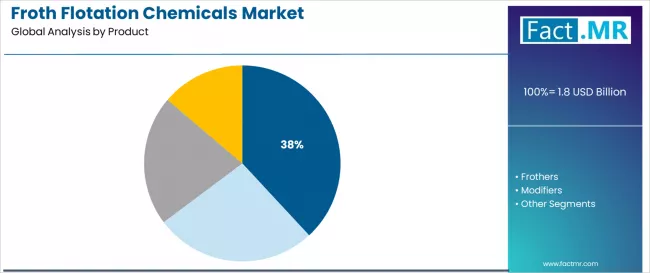
Froth Flotation Chemicals Market Analysis By Product | Source: Fact.MR
Froth flotation chemical collectors are projected to account for 38.1% of the froth flotation chemicals market in 2025, reaffirming its position as the category's dominant product specification. Mining operators increasingly recognize the optimal balance of mineral selectivity and recovery efficiency offered by collector formulations for ore beneficiation applications, particularly in copper, gold, and zinc flotation environments.
This product category addresses both sulfide mineral and oxide mineral requirements while providing consistent separation performance across diverse processing operations. This segment forms the foundation of most mineral beneficiation protocols for base metal and precious metal extraction, as it represents the most technically critical and metallurgically essential product category in the froth flotation chemicals industry.
Performance validation standards and extensive plant application continue to strengthen confidence in collector technologies among metallurgists and process engineers. With increasing recognition of collector chemistry impact on recovery economics and concentrate quality requirements, collector formulations align with both current mineral processing practices and mining industry efficiency goals, making them the central growth driver of comprehensive beneficiation strategies across multiple ore platforms.
The collectors segment benefits from diverse chemistry platforms including xanthate collectors for sulfide mineral flotation offering strong collecting power and cost-effectiveness, fatty acid collectors for non-sulfide minerals providing selective separation, and specialized collectors for complex ores enabling differential flotation. Mining operations prioritize collector selection based on mineralogy, achieving optimal balance between recovery, grade, and selectivity across varied ore types and processing conditions.
Why are Froth Flotation Chemicals Deployed Extensively in the Mining Sector?
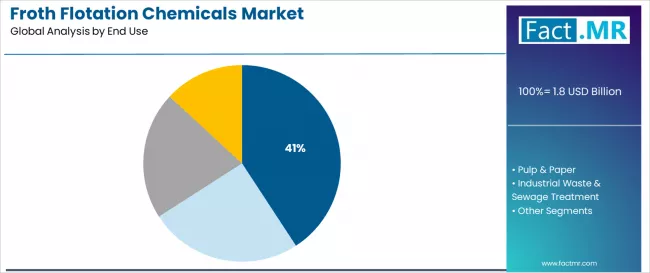
Froth Flotation Chemicals Market Analysis By End Use | Source: Fact.MR
Froth flotation chemicals for mining account for 40.8% of total demand in 2025, underscoring its role as the primary end-use category driving market adoption and reagent technology deployment. Mining operators recognize that mineral processing requirements, including diverse ore types, varied flotation circuits, and comprehensive beneficiation protocols, provide the largest addressable end-use market that other industries cannot match in reagent consumption volume and technical complexity.
Flotation chemicals utilized in mining offer enhanced mineral recovery and processing efficiency essential for serving base metal extraction and industrial mineral production requirements. The segment is supported by the expanding nature of global mining production, requiring chemicals capable of supporting sulfide flotation, oxide mineral separation, and complex ore beneficiation, and the increasing recognition that advanced flotation reagents can improve metallurgical performance and processing economics.
Mining operators are increasingly adopting selective flotation technologies that mandate specialized reagent integration for optimal mineral separation and regulatory compliance. As understanding of flotation chemistry capabilities advances and metallurgical standards become more sophisticated, reagent-enabled beneficiation systems will continue to play a crucial role in comprehensive mineral processing strategies.
The mining segment encompasses diverse applications including copper flotation consuming substantial collector and frother volumes, gold recovery operations requiring specialized reagent programs, coal beneficiation utilizing extensive frother quantities, and iron ore flotation demanding reverse flotation chemistry. Base metal concentrators represent the largest individual market segment, with complex polymetallic ores requiring sophisticated reagent suites for selective mineral separation across multiple flotation stages.
What drives Pulp & Paper End Use Segment Prominence?
The pulp & paper end-use segment is projected to account for 26.3% of the froth flotation chemicals market in 2025, establishing its position as a significant application category. Paper manufacturers increasingly recognize that deinking requirements, encompassing recovered paper processing, ink particle removal, and fiber quality optimization, represent specialized applications requiring effective flotation chemistry due to recycling economics and environmental considerations.
This end-use category addresses both newsprint recycling and office paper reprocessing requirements while delivering critical fiber recovery outcomes across varied paper production platforms. The segment is supported by the continuing nature of paper recycling growth in both developed and emerging markets, driven by environmental regulations, fiber cost economics, and wastepaper availability requiring efficient processing.
Paper manufacturers are increasingly focusing on flotation deinking processes that enhance fiber brightness and contaminant removal while maintaining production efficiency standards. As paper recycling capabilities expand and quality requirements grow, flotation chemical applications will continue to serve a crucial role in ensuring fiber quality and processing efficiency within the global paper manufacturing market.
Pulp & paper applications represent substantial froth flotation chemical consumption through deinking flotation operations requiring specialized collectors for ink particle attachment, frothers for bubble generation, and modifiers for pH control. The economics of recovered fiber utilization compared to virgin pulp production creates favorable conditions for flotation technology adoption, with deinking flotation representing the primary chemical consumption driver within paper recycling operations.
What are the Drivers, Restraints, and Key Trends of the Froth Flotation Chemicals Market?
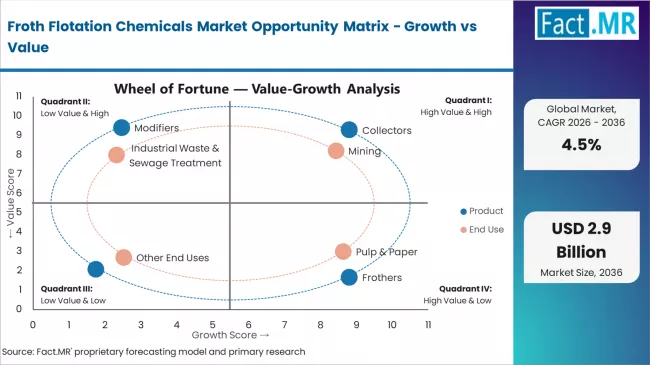
Froth Flotation Chemicals Market Opportunity Matrix Growth Vs Value | Source: Fact.MR
The froth flotation chemicals market is advancing rapidly due to increasing recognition of beneficiation technology importance and growing demand for efficient mineral separation solutions across the mining sector.
The market faces challenges, including ore grade decline requiring higher reagent consumption, water chemistry variability affecting flotation performance, and environmental concerns regarding reagent toxicity. Innovation in collector chemistry and bio-based reagent development continues to influence product development and market expansion patterns.
Proliferation of Complex Ore Processing and Declining Ore Grades
The accelerating challenge of ore grade decline is enabling the development of more sophisticated flotation applications and reagent strategies that can meet stringent recovery and selectivity requirements.
Mining operators demand comprehensive flotation solutions for complex ores, including high-selectivity collector formulations and optimized reagent dosing protocols that are particularly important for achieving acceptable recovery requirements in low-grade ore processing applications.
Advanced flotation chemical technologies provide access to selective mineral separation that can optimize metallurgical performance strategies and enhance processing economics while maintaining operational viability for diverse ore body characteristics.
Integration of Environmental Stewardship and Water Management Practices
Modern mining organizations are incorporating advanced approaches such as reagent biodegradability assessment, water recycling system compatibility, and environmental impact minimization to enhance processing operations and regulatory compliance.
These initiatives improve environmental performance, enable better integration between flotation circuits and tailings management, and provide superior alignment between mineral processing and environmental requirements throughout the mining lifecycle.
Advanced environmental capabilities also enable reduced reagent discharge and enhanced water quality management in tailings facilities or processing water circuits, supporting proactive environmental stewardship and improved mining sustainability outcomes.
Analysis of the Froth Flotation Chemicals Market by Key Countries
.webp "Top Country Growth Comparison Froth Flotation Chemicals Market Cagr (2026 2036)")
Top Country Growth Comparison Froth Flotation Chemicals Market Cagr (2026 2036) | Source: Fact.MR
| Country | CAGR (2026 to 2036) |
|---|---|
| India | 5.4% |
| China | 5.2% |
| Brazil | 4.9% |
| USA | 4.5% |
| Germany | 4.3% |
| South Africa | 4.0% |
| Japan | 3.7% |
Source: Fact.MR analysis. Updated Apr 1, 2026
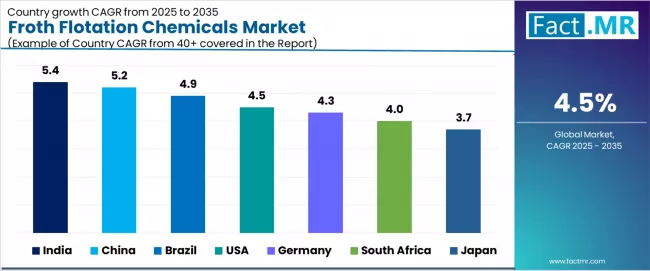
Froth Flotation Chemicals Market Cagr Analysis By Country | Source: Fact.MR
The froth flotation chemicals market is experiencing exceptional growth globally, with India leading at a 5.4% CAGR through 2036, driven by coal beneficiation expansion, substantial iron ore upgrading requirements, and comprehensive flotation capacity development across major mining regions. China follows at 5.2%, supported by heavy metal ore mining scale, extensive phosphate processing operations, and massive reagent utilization infrastructure. Brazil records 4.9% growth, benefiting from copper and gold mining development and demand for specialty collector formulations.
USA demonstrates 4.5% growth, emphasizing existing mining operations combined with growing recycling applications and industrial wastewater treatment adoption. Germany shows 4.3% growth with lithium-ion battery recycling initiatives and EU material recovery mandates. South Africa records 4.0% growth, representing gold and platinum group metals flotation and chemical optimization programs, while Japan shows 3.7% growth, representing rare metal recycling advancement and improved flotation selectivity technologies.
How does India Demonstrate Exceptional Market Potential with Coal Beneficiation Expansion?
The market for froth frotation chemicals in India is projected to exhibit exceptional growth with a CAGR of 5.4% through 2036, driven by substantial coal beneficiation capacity expansion and increasing recognition of ore upgrading as an essential component for resource efficiency and export quality enhancement.
The country's massive coal production and growing iron ore beneficiation requirements are creating significant opportunities for flotation chemical deployment across both coal washing and metallic mineral processing segments.
Major international reagent suppliers and domestic manufacturers are establishing comprehensive distribution networks to serve the expanding population of mining operations and processing plants requiring advanced flotation chemicals across coal fields, iron ore mines, and base metal projects throughout India's diverse mining regions.
The Indian government's strategic emphasis on domestic mineral processing and beneficiation capacity development is driving substantial investments in flotation technology adoption and reagent supply infrastructure.
This policy support, combined with the country's enormous mineral production and growing processing sophistication, creates a favorable environment for flotation chemicals market development. Indian mining operators are increasingly focusing on beneficiation efficiency to improve product quality, with advanced flotation reagents representing a key component in this metallurgical enhancement strategy.
- Government initiatives supporting domestic mineral processing and beneficiation capacity expansion are driving demand for flotation chemicals across coal and metallic mineral segments
- Mining capacity expansion and processing technology advancement are supporting appropriate utilization of flotation reagents among mining operators and processing facilities nationwide
- Mining operators and metallurgists are increasingly recognizing beneficiation importance in product quality, creating new reagent demand capabilities
- Rising mineral processing investment and growing awareness of flotation efficiency benefits are accelerating flotation chemical adoption across mineral categories
What makes China Demonstrate Market Leadership with Heavy Metal Ore Mining Scale?
The market for froth frotation chemicals in China is expanding at a CAGR of 5.2%, supported by the world's largest non-ferrous metal mining capacity, extensive phosphate processing operations, and massive flotation reagent consumption infrastructure across the country's developing mining corridors.
The country's dominant mineral processing capacity and increasing sophistication of flotation technologies are driving demand for specialized reagent solutions in both base metal and industrial mineral applications. International chemical companies and domestic manufacturers are maintaining production capacity to serve the substantial demand for flotation chemicals while supporting the country's position as a leading mineral processing market.
China's mining sector continues to benefit from ongoing production expansion, developing environmental standards, and growing emphasis on processing efficiency. The country's focus on maximizing domestic mineral resources is driving investments in critical beneficiation technologies including advanced flotation systems. This development is particularly important for flotation chemicals applications, as processors seek reliable reagent solutions to enhance recovery efficiency and meet increasingly stringent environmental requirements in large-scale mineral processing environments.
- Expanding mineral production and improving flotation technology capabilities are creating opportunities for advanced flotation chemical solutions
- Growing base metal mining and phosphate processing expansion are supporting increased deployment of specialized flotation reagents across mineral categories
- Advancing processing technology and emerging efficiency standards are driving innovative applications of flotation chemicals in complex ore and industrial mineral applications
- Processing capacity advancement is enabling utilization of sophisticated reagent platforms, supporting market growth and improving metallurgical performance standards
Why does Brazil Maintain Copper and Gold Mining Leadership?
The market for froth flotation chemicals in Brazil is projected to exhibit strong growth with a CAGR of 4.9% through 2036, driven by substantial copper and gold mining development and growing demand for specialty collector formulations. The country's position as a significant mineral producer and expanding mining sector sophistication are creating significant opportunities for flotation chemical integration across both established operations and greenfield projects.
Brazilian mining operators are leveraging geological advantages to serve the growing demand for efficient beneficiation solutions while supporting the country's position as a major mining production economy. The market benefits from strong mining infrastructure supporting flotation technology adoption, enabling optimized reagent deployment and comprehensive metallurgical integration. This development is particularly important for flotation chemicals applications, as operators seek advanced reagent solutions that maximize recovery while ensuring environmental compliance in large-scale mining and competitive global commodity environments.
Strategic Market Considerations:
- Copper and gold mining segments leading growth with focus on recovery optimization and specialty reagent applications
- Mining economics and global competitiveness are driving sophisticated flotation chemical portfolios from conventional reagents to specialty formulations
- Mining expertise and geological resource advantages supporting competitive positioning in Latin American mineral markets
- Environmental regulations and processing efficiency requirements influencing reagent specifications and flotation chemical adoption patterns
How does USA Maintain Existing Mining and Growing Recycling Leadership?
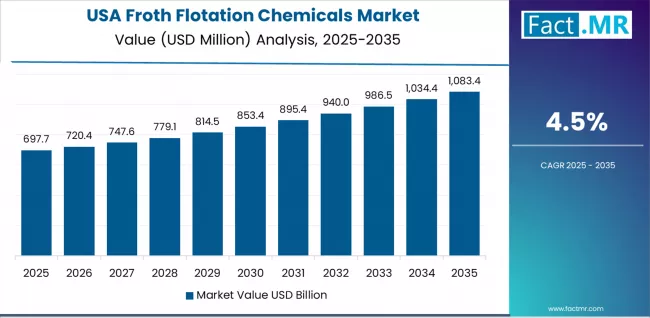
Froth Flotation Chemicals Market Country Value Analysis | Source: Fact.MR
The USA's mature froth flotation chemicals market demonstrates sophisticated mineral processing integration with documented effectiveness in established mining operations and emerging recycling applications through integration with environmental technologies and industrial wastewater treatment protocols.
The country leverages mining technology expertise and comprehensive environmental infrastructure to maintain a 4.5% CAGR through 2036. Established mining operations, including major copper and gold facilities and expanding industrial mineral processors, showcase sophisticated flotation implementations where proven reagent programs integrate with comprehensive metallurgical optimization and ongoing efficiency initiatives to maximize mineral recovery and processing performance.
American mining operators prioritize reagent efficiency and environmental compliance in flotation operations, creating sustained demand for high-performance flotation chemicals with advanced characteristics, including biodegradable formulations and integration with water recycling systems. The market benefits from established technical service infrastructure and commitment to processing optimization that drives continuous reagent technology advancement.
Strategic Market Considerations:
- Established mining operations and industrial wastewater applications leading growth with focus on efficiency optimization and environmental compliance
- Environmental regulations and water management priorities are driving sophisticated flotation chemical portfolios from conventional reagents to environmentally-optimized formulations
- Metallurgical expertise and technical service excellence supporting competitive positioning in North American mineral markets
- Processing optimization and sustainability emphasis ensuring continuous flotation performance improvement and environmental impact reduction
What drives Germany’s Market Growth with Lithium-ion Battery Recycling?
Germany's expanding froth flotation chemicals market demonstrates accelerating recycling application adoption with a 4.3% CAGR through 2036, driven by lithium-ion battery recycling infrastructure development, comprehensive EU material recovery mandates, and advanced separation technology requirements across major industrial regions.
The country's leadership in circular economy initiatives and sophisticated recycling technologies are creating substantial demand for specialized flotation chemicals across diverse battery material recovery and industrial waste processing platforms. German recycling operators and waste treatment facilities are increasingly prioritizing advanced separation technologies that incorporate flotation chemistry for optimal material recovery and environmental compliance enhancement.
Market dynamics focus on selective flotation chemicals that balance separation efficiency with environmental considerations important to German recycling standards and EU regulatory requirements. Growing battery recycling capacity creates opportunities for novel reagent applications and specialized flotation chemistry development.
Strategic Market Considerations:
- Battery recycling and industrial waste treatment segments leading growth with focus on selective separation and material recovery applications
- Circular economy mandates and environmental regulations are driving sophisticated flotation chemical portfolios from mining-focused reagents to recycling-specific formulations
- Recycling technology excellence and environmental leadership supporting competitive positioning in European waste processing markets
- EU recovery targets and sustainability objectives emphasizing separation technology optimization and material circularity advancement
How does South Africa Demonstrate Gold and PGMs Flotation Leadership?
South Africa's expanding froth flotation chemicals market demonstrates established precious metals processing with a 4.0% CAGR through 2036, driven by extensive gold mining operations, substantial platinum group metals production, and comprehensive flotation chemical optimization programs across major mining regions.
The country's position as a leading precious metals producer and sophisticated metallurgical capabilities are creating sustained demand for flotation reagents supporting both primary ore processing and tailings reprocessing applications.
Market dynamics focus on optimized flotation chemicals that balance recovery efficiency with cost considerations important to South African mining economics and long-term operational sustainability. Established precious metals mining creates opportunities for reagent optimization programs and continuous metallurgical improvement initiatives.
Strategic Market Considerations:
- Gold and PGMs mining segments leading demand with focus on recovery optimization and metallurgical efficiency applications
- Mining economics and depth challenges are driving chemical optimization programs and reagent efficiency enhancement
- Metallurgical expertise and precious metals specialization supporting competitive positioning in African mining markets
- Processing optimization and cost management influencing flotation chemical specifications and reagent consumption patterns
What drives Japan’s Market Growth with Rare Metal Recycling?
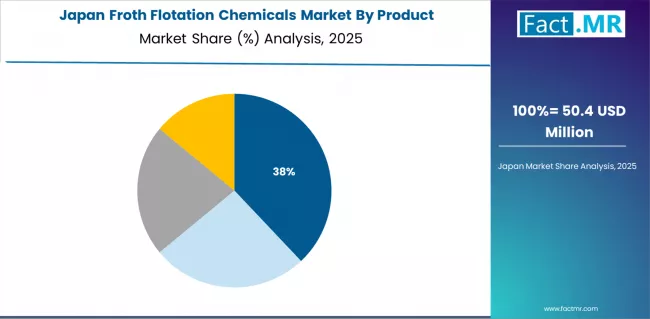
Froth Flotation Chemicals Market Japan Market Share Analysis By Product | Source: Fact.MR
Japan's expanding froth flotation chemicals market demonstrates advancing recycling technology adoption with a 3.7% CAGR through 2036, driven by rare metal recovery initiatives, improved flotation selectivity requirements, and comprehensive material recycling programs across major industrial centers.
The country's emphasis on resource security and sophisticated separation technologies is creating opportunities for specialized flotation chemical applications supporting both electronic waste processing and industrial material recovery operations.
Market dynamics focus on high-selectivity flotation chemicals that balance separation precision with process efficiency considerations important to Japanese recycling standards and resource recovery objectives. Growing rare metal recycling emphasis creates opportunities for advanced reagent development and specialized flotation chemistry applications.
Strategic Market Considerations:
- Rare metal recycling and industrial waste processing segments demonstrating focused growth with emphasis on selective separation and resource recovery
- Resource security priorities and environmental standards driving specialized flotation chemical development and application optimization
- Recycling technology expertise and separation science capabilities supporting competitive positioning in Asian resource recovery markets
- Material circularity objectives and selectivity requirements influencing flotation chemical specifications and advanced reagent adoption
Europe Market Split by Country
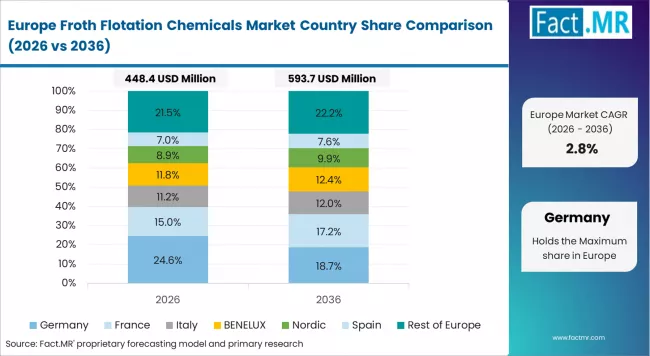
Froth Flotation Chemicals Market Europe Country Market Share Analysis, 2026 & 2036 | Source: Fact.MR
The froth flotation chemicals market in Europe is projected to grow from USD 0.4 billion in 2026 to USD 0.6 billion by 2036, registering a CAGR of 4.2% over the forecast period. Germany is expected to maintain its leadership position with a 32.4% market share in 2026, rising to 33.2% by 2036, supported by its comprehensive recycling infrastructure, advanced waste processing capabilities, and lithium-ion battery recovery technologies throughout major industrial centers and material processing facilities.
Poland follows with a 21.8% share in 2026, projected to reach 22.3% by 2036, driven by substantial coal mining operations, copper production activities, and comprehensive mineral processing infrastructure serving both domestic and European markets. Sweden holds a 16.7% share in 2026, expected to increase to 17.1% by 2036, supported by base metal mining excellence and advanced metallurgical processing. Spain commands a 14.3% share in 2026, projected to reach 13.9% by 2036, while Finland accounts for 10.6% in 2026, expected to reach 10.2% by 2036.
The rest of Europe, including Eastern European emerging mining markets, smaller Western European mineral processors, and specialized recycling facilities, is anticipated to hold 4.2% in 2026, declining slightly to 3.3% by 2036, attributed to market consolidation toward larger core markets with established mineral processing infrastructure and flotation technology expertise.
Competitive Landscape of the Froth Flotation Chemicals Market
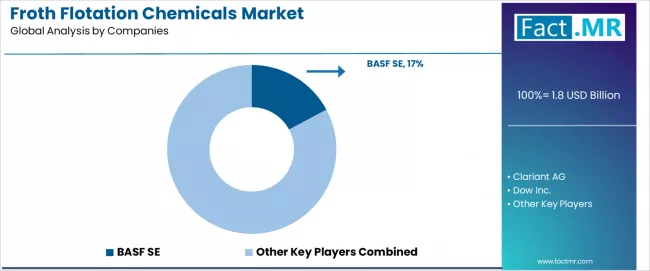
Froth Flotation Chemicals Market Analysis By Company | Source: Fact.MR
The froth flotation chemicals market is characterized by intense competition among established chemical manufacturers, specialized mining reagent suppliers, and comprehensive mineral processing service organizations focused on delivering high-performance, reliable, and metallurgically effective flotation chemical solutions.
Companies are investing in reagent formulation innovation, technical service capacity expansion, strategic mining operation partnerships, and comprehensive metallurgical support initiatives to deliver effective, consistent, and process-optimized flotation chemicals that meet stringent performance standards and mining operator metallurgical expectations. Product innovation, technical support emphasis, and metallurgical service strategies are central to strengthening product portfolios and market presence.
BASF SE leads the market with a 17.2% market share, offering comprehensive flotation chemical solutions with a focus on global mining service expertise and advanced reagent formulation capabilities for diverse mineral processing applications. Clariant AG provides specialized mining chemicals with emphasis on collector innovation and comprehensive technical support across international mining markets.
Dow Inc. focuses on frother technology and diversified reagent solutions serving global mineral processors. NASACO delivers regional mining chemical expertise and specialized flotation reagent portfolios.
Nouryon Chemicals Holding B.V. operates with a focus on specialty chemical production and flotation reagent innovation. Arkema specializes in surface chemistry expertise and advanced flotation formulations. Chevron Phillips Chemical Co. provides hydrocarbon-based reagent production and mining chemical solutions.
Kemira Oyj delivers water chemistry expertise and comprehensive process chemical portfolios. Solvay S.A., Ecolab Inc., and Quadra Chemicals Ltd. focus on mining chemicals innovation and regional market development, emphasizing metallurgical performance and comprehensive technical support through dedicated flotation reagent strategies.
Key Players in the Froth Flotation Chemicals Market
- BASF SE
- Clariant AG
- Dow Inc.
- Nasaco International LLC
- Nouryon Chemicals Holding B.V.
- Arkema S.A.
- Chevron Phillips Chemical Company LLC
- Kemira Oyj
- Solvay S.A.
- Ecolab Inc.
- Quadra Chemicals Ltd.
Bibliography
- Relevant industry regulatory authority. (2025). Industry guidance and standards documentation.
- International trade association. (2025). Market statistics and industry annual report.
- International standards organization. (2025). Product specification and testing standards.
- Leading industry participant. (2025). Annual report and public filings.
- Government statistical agency. (2025). Production and trade statistics database.
This bibliography is provided for reader reference. The full Fact.MR report contains the complete reference list with primary research documentation.
This Report Addresses
- Market sizing and quantitative forecast metrics detailing consumption across product and end use segments globally through 2036.
- Product analysis comparing adoption rates and evaluating performance differentials across product categories.
- End Use intelligence evaluating demand trajectories across leading application segments.
- Regulatory compliance assessment analyzing specification standard impacts on procurement decisions.
- Competitive posture evaluation tracking manufacturer capability investments and market positioning strategies.
- Supply chain intelligence identifying sourcing dynamics and pricing trends across major consuming regions.
- Custom data delivery formats encompassing interactive dashboards, raw Excel datasets, and comprehensive PDF narrative reports.
Froth Flotation Chemicals Market Market Definition
The froth flotation chemicals market encompasses the production, distribution, and consumption of specialized products serving defined industrial, commercial, and consumer applications globally. Products within this category are manufactured to specific quality, purity, and performance standards required by downstream end-use specifications.
Froth Flotation Chemicals Market Market Inclusions
Market scope includes all product types and grades within the froth flotation chemicals market consumed across defined end-use applications globally. Forecast coverage spans 2026 to 2036 across product and end use segments.
Froth Flotation Chemicals Market Market Exclusions
The scope excludes raw material feedstock valuations prior to processing, downstream finished end-use product pricing, and manufacturing equipment used in production processes.
Froth Flotation Chemicals Market Market Research Methodology
- Primary Research: Analysts conducted interviews with end-use manufacturers, procurement directors, and product development managers across key consuming industries.
- Desk Research: Data collection aggregated regulatory databases, trade association statistics, and publicly filed company annual reports from major market participants.
- Market-Sizing and Forecasting: Baseline values derive from a bottom-up aggregation of product shipment volumes by type and application, applying end-use consumption growth rates and market penetration projections.
- Data Validation and Update Cycle: Projections are cross-validated against industry production statistics, trade flow data, and quarterly pricing benchmarks from recognized industry sources.
Segmentation
Scope of the Report
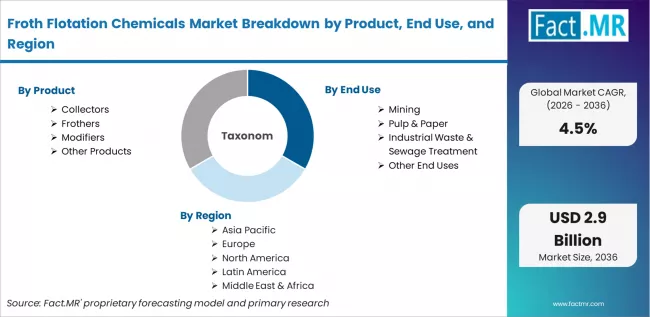
Froth Flotation Chemicals Market Breakdown By Product, End Use, And Region | Source: Fact.MR
| Metric | Value |
|---|---|
| Quantitative Units | USD Billion 1.88 to USD Billion 2.92, at a CAGR of 4.50% |
| Market Definition | The Froth Flotation Chemicals Market encompasses all defined product types and grades across end-use applications globally. |
| Product Segmentation | Collectors, Frothers, Modifiers, Other Products |
| End Use Segmentation | Mining, Pulp & Paper, Industrial Waste & Sewage Treatment, Other End Uses |
| Regions Covered | North America, Latin America, Europe, East Asia, South Asia, Oceania, Middle East & Africa |
| Key Companies Profiled | BASF SE, Clariant AG, Dow Inc., Nasaco International LLC, Nouryon Chemicals Holding B.V., Arkema S.A., Chevron Phillips Chemical Company LLC, Kemira Oyj |
| Forecast Period | 2026 to 2036 |
| Approach | Forecasting models apply a bottom-up methodology starting from product consumption volumes, projecting growth based on end-use demand trends, regulatory conversion timelines, and market penetration rates. |
Source: Fact.MR analysis. Updated Apr 1, 2026
Froth Flotation Chemicals Market by Segments
-
Product :
- Collectors
- Frothers
- Modifiers
- Other Products
-
End Use :
- Mining
- Pulp & Paper
- Industrial Waste & Sewage Treatment
- Other End Uses
-
Region :
- Asia Pacific
- China
- India
- Japan
- South Korea
- ASEAN
- Australia & New Zealand
- Rest of Asia Pacific
- North America
- United States
- Canada
- Mexico
- Europe
- Germany
- France
- United Kingdom
- Italy
- Spain
- Nordic
- BENELUX
- Rest of Europe
- Latin America
- Brazil
- Argentina
- Chile
- Rest of Latin America
- Middle East & Africa
- Kingdom of Saudi Arabia
- Other GCC Countries
- Turkey
- South Africa
- Other African Countries
- Rest of Middle East & Africa
- Asia Pacific
Frequently Asked Questions
How large is the froth flotation chemicals market in 2026?
What will be the market size by 2036?
What is the expected CAGR between 2026 and 2036?
Which product is poised to lead in 2026?
Which end use leads in 2026?
What is driving market growth?
What is the froth flotation chemicals market?
Who worked on this report


Preview the report firsthand - request a free sample
Free SampleGet the brochure for pricing and purchase details
Download PDF