- Base Value(2025): 135.4 Mn
- Estimated Value(2026): 147.5 Mn
- Forecast Value (2036): 345.9 Mn
- CAGR (2026 - 2036): 8.9%
Electromagnetic Navigation Bronchoscopy Market Analysis and Forecast by Fact.MR
The global market for electromagnetic navigation bronchoscopy is estimated to be around USD 147.5 million in 2026 and has been forecast to expand at a CAGR of 8.9% to end up at USD 345.9 million by 2036. The Electromagnetic Navigation Bronchoscopy segment is led by ENB Navigation Systems, which is anticipated to account for 52.0% of the product segment in 2026, while Lung Cancer Diagnosis is expected to remain the leading application with around 58.0% share. The market was valued at USD 135.4 million in 2025 and is poised for steady growth driven by evolving industry dynamics and regional demand patterns.
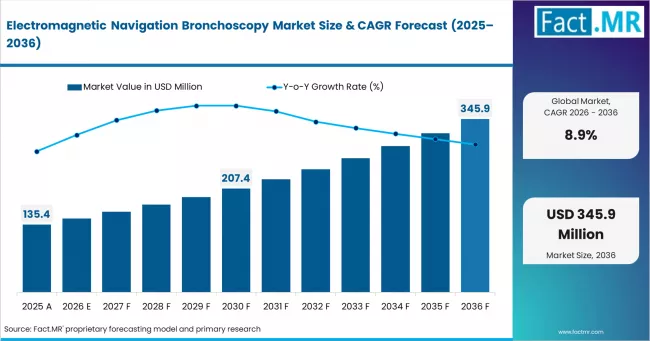
Electromagnetic Navigation Bronchoscopy Market Market Value Analysis | Source: Fact.MR
Summary of Electromagnetic Navigation Bronchoscopy Market
- Market Snapshot
- In 2025, the global Electromagnetic Navigation Bronchoscopy Market was valued at approximately USD 135.4 million.
- The market is estimated to reach USD 147.5 million in 2026 and is projected to attain USD 345.9 million by 2036
- The electromagnetic navigation bronchoscopy market is likely to expand at a CAGR of 8.9% during the forecast period.
- The market is anticipated to create an absolute dollar opportunity of USD 198.4 million between 2026 and 2036.
- ENB Navigation Systems account for 52.0% of market share in 2026.
- China (12.0%) and India (11.1%) are the key growth markets during the forecast period
- Demand and Growth Drivers
- Rising lung cancer screening adoption through low-dose CT programs is identifying more peripheral lung nodules that require tissue diagnosis, expanding the clinical need for guided bronchoscopic biopsy.
- Growing preference for minimally invasive diagnostic procedures over surgical biopsy is positioning ENB as a preferred approach for accessing peripheral lung lesions.
- Technology advancement in navigation accuracy, imaging integration, and catheter design is improving diagnostic yield and expanding clinical adoption across pulmonology programs.
- Product and Segment View
- ENB navigation systems account for 52% of the product segment in 2026, reflecting the capital equipment base that enables guided bronchoscopic procedures.
- Lung cancer diagnosis applications represent 58% in 2026, with peripheral nodule biopsy as the primary clinical use case.
- Hospitals hold 64% of end-use demand in 2026, with pulmonology departments and thoracic surgery programs as primary adopters.
- Geography and Competitive Outlook
- China leads at 12.0% CAGR, driven by lung cancer screening expansion and hospital investment in advanced bronchoscopy capabilities.
- North America remains the largest market by value, with established ENB procedure volumes and clinical adoption.
- Medtronic holds 36% market share through its superDimension navigation platform and integrated bronchoscopy ecosystem.
- Analyst Opinion
- The electromagnetic navigation bronchoscopy market is entering a growth phase linked to lung cancer screening program expansion. As low-dose CT screening identifies increasing numbers of peripheral lung nodules, the clinical demand for minimally invasive tissue diagnosis is growing. ENB addresses this need by enabling guided access to peripheral lesions that conventional bronchoscopy cannot reach. Medtronic's dominant position reflects first-mover advantage with the superDimension platform, but emerging competitors offering robotic-assisted and alternative navigation approaches are beginning to challenge this position. The critical competitive factor is diagnostic yield, as clinicians evaluate navigation platforms based on their ability to reliably reach and sample peripheral lesions.
Why is the Electromagnetic Navigation Bronchoscopy Market Growing?
- Lung cancer screening program expansion is identifying more peripheral nodules that require tissue diagnosis through guided bronchoscopic biopsy.
- Clinical preference for minimally invasive diagnostic approaches over surgical biopsy is increasing ENB procedure adoption.
- Technology improvements in navigation accuracy and imaging integration are enhancing diagnostic yield and supporting broader clinical adoption.
The market is directly linked to lung cancer screening adoption. Low-dose CT screening programs are expanding globally, identifying peripheral lung nodules at earlier stages. Many of these nodules require tissue sampling for diagnosis, and ENB provides a minimally invasive alternative to CT-guided percutaneous biopsy or surgical biopsy.
Diagnostic yield improvement is the critical technology driver. Earlier ENB systems achieved diagnostic yields of 60-70%, but advances in navigation accuracy, real-time imaging integration, and catheter design are pushing yields above 80% in experienced centers. This performance improvement is expanding adoption beyond early-adopter academic centers into community hospital pulmonology programs.
Segment-wise Analysis of the Electromagnetic Navigation Bronchoscopy Market
- ENB navigation systems lead at 52% share in 2026, representing the capital equipment foundation for guided bronchoscopy procedures.
- Lung cancer diagnosis accounts for 58% of applications in 2026, with peripheral nodule biopsy as the dominant clinical indication.
- Electromagnetic navigation technology holds 57% in 2026, with sensor-guided catheter navigation as the established approach.
The market is segmented by product type (ENB navigation systems, disposable catheter systems, software and imaging systems, accessories and sensors), application (lung cancer diagnosis, diagnostic bronchoscopy, therapeutic procedures), end use (hospitals, ambulatory surgical centers, specialty clinics, research institutes), technology (electromagnetic navigation, virtual bronchoscopic navigation, imaging integration), distribution channel (direct B2B sales, specialty medical suppliers, online procurement), and packaging (sterile procedure kits, medical device packaging, system packaging).
Which Product Segment Leads the ENB Market?
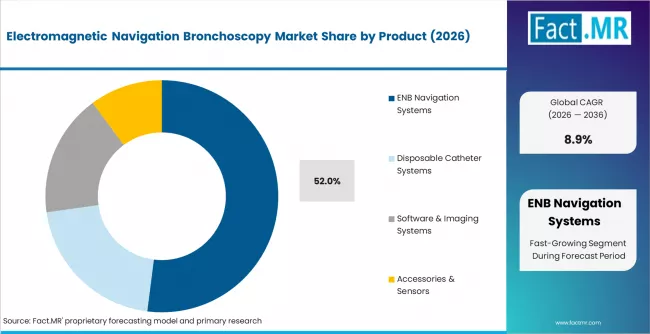
Electromagnetic Navigation Bronchoscopy Market Analysis By Product | Source: Fact.MR
ENB navigation systems hold 52% of the product segment in 2026. The navigation system represents the capital equipment investment that enables guided bronchoscopy procedures. Disposable catheter systems account for the largest recurring revenue component, with each procedure requiring single-use navigation catheters, extended working channels, and biopsy accessories.
Which Application Drives the Largest Demand?
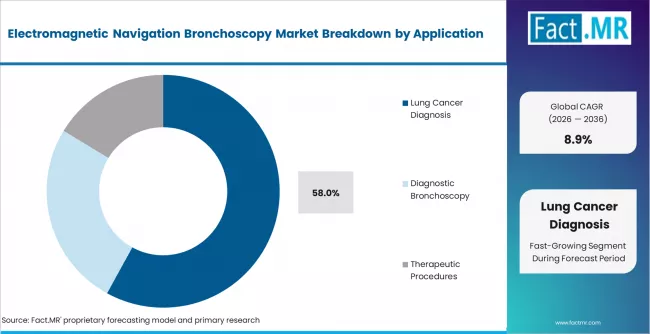
Electromagnetic Navigation Bronchoscopy Market Analysis By Application | Source: Fact.MR
Lung cancer diagnosis accounts for 58% of applications in 2026. Peripheral lung nodule biopsy following CT screening detection represents the primary clinical use case. Diagnostic bronchoscopy for other pulmonary conditions and therapeutic applications including fiducial marker placement for radiation therapy contribute the remaining procedural volumes.
Key Growth Drivers, Constraints, and Market Scope
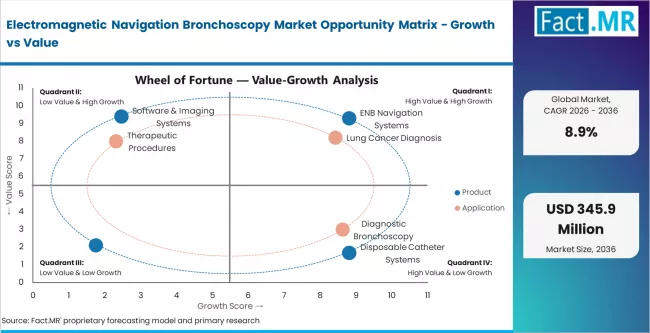
Electromagnetic Navigation Bronchoscopy Market Opportunity Matrix Growth Vs Value | Source: Fact.MR
- Lung cancer screening expansion increases the volume of peripheral nodules requiring tissue diagnosis.
- Minimally invasive diagnostic preference positions ENB as an alternative to surgical biopsy.
- Capital equipment cost and procedural learning curves limit adoption in smaller hospital settings.
The electromagnetic navigation bronchoscopy market is shaped by lung cancer epidemiology, screening program adoption, interventional pulmonology development, and navigation technology advancement.
Growth Drivers
Demand is shaped by lung cancer screening program expansion, growing clinical preference for minimally invasive diagnosis, and technology improvements increasing diagnostic yield. Increasing lung cancer incidence in Asia Pacific creates structural demand growth.
Constraints
Capital equipment costs limit system placement in smaller hospitals. Procedural learning curves require physician training investment. Competition from robotic bronchoscopy and CT-guided percutaneous biopsy limits market share within the peripheral nodule diagnostic space.
Opportunities
Expansion into therapeutic applications including fiducial placement and ablation guidance creates procedural volume growth beyond diagnostics. Hospital ENB program development in Asia Pacific represents the largest installation base expansion opportunity. Integration with augmented reality and AI-assisted navigation could further improve diagnostic yield.
Regional Outlook Across Key Markets
.webp "Top Country Growth Comparison Electromagnetic Navigation Bronchoscopy Market Cagr (2026 2036)")
Top Country Growth Comparison Electromagnetic Navigation Bronchoscopy Market Cagr (2026 2036) | Source: Fact.MR
- China leads at 12.0% CAGR, driven by lung cancer screening expansion and hospital investment in advanced bronchoscopy.
- India follows at 11.1% CAGR, reflecting growing interventional pulmonology capacity and cancer diagnosis infrastructure.
- Germany records 10.2% CAGR, supported by established lung cancer screening and advanced pulmonology programs.
- USA grows at 8.5% CAGR, with mature ENB adoption and procedure volume stability.
Country CAGR Table
| Country | CAGR (%) |
|---|---|
| China | 12.0% |
| India | 11.1% |
| Germany | 10.2% |
| Brazil | 9.4% |
| USA | 8.5% |
| UK | 7.6% |
| Japan | 6.7% |
Source: Fact.MR analysis. Updated Apr 27, 2026
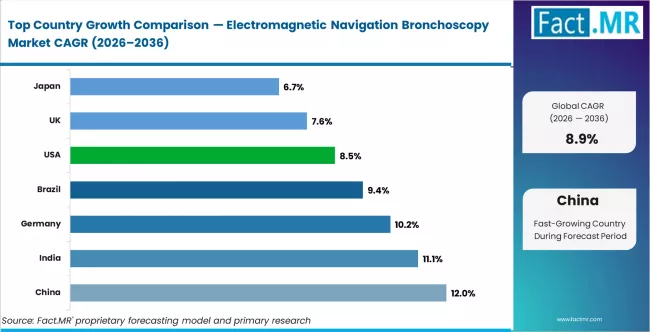
Electromagnetic Navigation Bronchoscopy Market Cagr Analysis By Country | Source: Fact.MR
Regional demand reflects lung cancer incidence, screening program maturity, interventional pulmonology development, and hospital capital equipment procurement capacity.
Market Outlook in China
The China ENB market is projected to grow at a CAGR of 12.0% through 2036. Demand is driven by lung cancer screening program expansion, hospital investment in advanced bronchoscopy equipment, and growing interventional pulmonology training programs.
- Lung cancer screening expansion increases peripheral nodule detection.
- Hospital investment in bronchoscopy suites broadens equipment access.
- Interventional pulmonology training programs support procedure adoption.
Demand Trends in India
The India ENB market is projected to grow at a CAGR of 11.1% through 2036. Growth reflects expanding cancer diagnosis infrastructure, growing tertiary hospital capabilities, and increasing awareness of minimally invasive diagnostic approaches.
- Cancer diagnosis infrastructure expansion supports ENB adoption.
- Tertiary hospital capability development enables advanced procedures.
- Physician training programs build procedural expertise.
USA Market Outlook
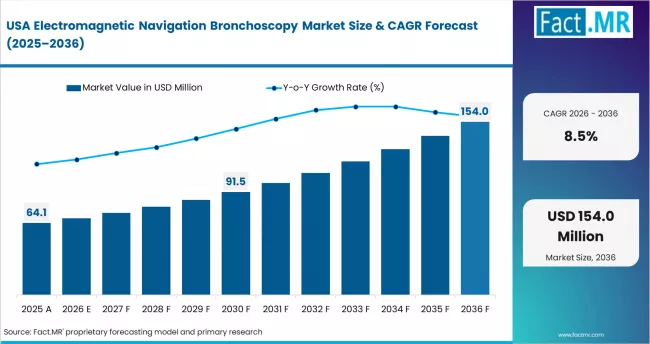
Electromagnetic Navigation Bronchoscopy Market Country Value Analysis | Source: Fact.MR
The USA ENB market is projected to grow at a CAGR of 8.5% through 2036. Demand is shaped by established ENB adoption in academic and community hospitals, growing lung cancer screening volumes, and procedure technology advancement.
- Established adoption sustains procedure volume growth.
- Lung cancer screening expansion increases biopsy demand.
- Technology advancement improves diagnostic yield and expands indications.
Germany Market Assessment
The Germany ENB market is projected to grow at a CAGR of 10.2% through 2036. Demand reflects advanced pulmonology infrastructure, established lung cancer screening programs, and clinical adoption of image-guided bronchoscopy.
- Advanced pulmonology programs support ENB procedure volumes.
- Lung cancer screening sustains peripheral nodule detection.
- Clinical evidence adoption drives guideline integration.
Competitive Benchmarking and Company Positioning
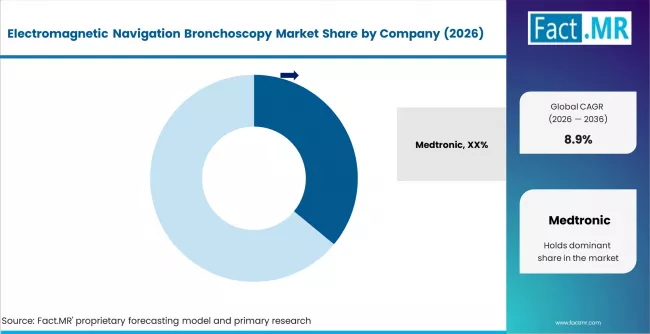
Electromagnetic Navigation Bronchoscopy Market Analysis By Company | Source: Fact.MR
- Medtronic holds 36% market share through its superDimension electromagnetic navigation platform and integrated bronchoscopy ecosystem.
- Olympus and Body Vision Medical compete through alternative navigation approaches and imaging integration capabilities.
- Competition is shaped by navigation accuracy, diagnostic yield, disposable catheter design, and physician training and support programs.
The competitive landscape is dominated by Medtronic's superDimension platform, which holds first-mover advantage and the largest installed base globally. Olympus competes through its bronchoscopy portfolio integration. Body Vision Medical and Veran Medical Technologies offer alternative navigation technologies targeting improved diagnostic yield.
Strategic priorities include improving diagnostic yield through imaging integration, expanding therapeutic procedure capabilities, building training programs to reduce physician learning curves, and developing cost-effective system configurations for emerging market hospitals.
Competitive Benchmarking
| Company | Navigation Platform | Installed Base | Diagnostic Yield | Geographic Reach |
|---|---|---|---|---|
| Medtronic | superDimension | Largest | Established | Global |
| Olympus | Integrated | Growing | Developing | Global |
| Body Vision Medical | LungVision | Emerging | Competitive | Americas/Europe |
| Veran Medical | SPiN System | Niche | Competitive | Americas |
| Boston Scientific | Partnership | Growing | Developing | Global |
Source: Fact.MR analysis. Updated Apr 27, 2026
Recent Industry Developments
- Medtronic launched an updated superDimension navigation software with improved imaging integration in 2025, targeting diagnostic yield improvement for peripheral lung lesion access.
- Body Vision Medical expanded its LungVision platform distribution in Europe in early 2026, targeting hospitals seeking alternative navigation technology.
- LungCare announced clinical adoption milestones for its bronchoscopic navigation platform in China in 2025, supported by local lung cancer screening program expansion.
Leading Companies Shaping the Electromagnetic Navigation Bronchoscopy Market
-
Major Players
- Medtronic
- Olympus
- Body Vision Medical
- Boston Scientific Corporation
- Veran Medical Technologies
-
Emerging Players
- LungCare
Scope of Analysis
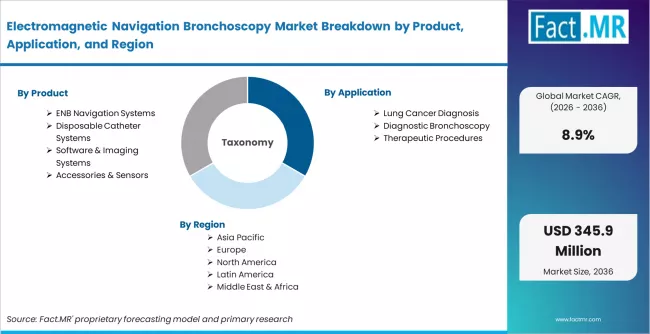
Electromagnetic Navigation Bronchoscopy Market Breakdown By Product, Application, And Region | Source: Fact.MR
| Parameter | Details |
|---|---|
| Quantitative Units | USD 147.5 million to USD 345.9 million, at a CAGR of 8.9% |
| Market Definition | Covers image-guided navigation systems, disposable catheters, and software for guided bronchoscopic procedures in peripheral lung lesion diagnosis and therapy. |
| Regions Covered | North America, Latin America, Europe, East Asia, South Asia and Pacific, Middle East and Africa |
| Countries Covered | USA, China, India, Germany, Brazil, UK, Japan, and 30+ countries |
| Key Companies | Medtronic, Olympus, Body Vision Medical, Boston Scientific, Veran Medical, LungCare |
| Forecast Period | 2026 to 2036 |
| Approach | Hybrid demand-side methodology built on lung cancer epidemiology, screening volumes, procedure data, and primary interviews across interventional pulmonologists and hospital procurement teams. |
Source: Fact.MR analysis. Updated Apr 27, 2026
Analysis by Product Type, Application, End Use, Technology, Packaging, Distribution Channel, and Region
-
Electromagnetic Navigation Bronchoscopy Market Market Segmented by Product:
- ENB Navigation Systems
- Electromagnetic Tracking Systems
- Real-Time Navigation Platforms
- Electromagnetic Tracking Systems
- Disposable Catheter Systems
- Locatable Guide Catheters
- Steerable Bronchoscopy Catheters
- Locatable Guide Catheters
- Software & Imaging Systems
- 3D CT Reconstruction Software
- Virtual Bronchoscopic Navigation Tools
- 3D CT Reconstruction Software
- Accessories & Sensors
- Tracking Sensors
- Disposable Working Channels
- Tracking Sensors
- ENB Navigation Systems
-
Electromagnetic Navigation Bronchoscopy Market Market Segmented by Application:
- Lung Cancer Diagnosis
- Peripheral Lung Lesion Biopsy
- Early Tumor Detection Procedures
- Peripheral Lung Lesion Biopsy
- Diagnostic Bronchoscopy
- Lung Nodule Evaluation
- Image-Guided Biopsy
- Lung Nodule Evaluation
- Therapeutic Procedures
- Endobronchial Interventions
- Minimally Invasive Treatments
- Endobronchial Interventions
- Lung Cancer Diagnosis
-
Electromagnetic Navigation Bronchoscopy Market Market Segmented by End Use:
- Hospitals
- Tertiary Care Hospitals
- Advanced Pulmonology Units
- Tertiary Care Hospitals
- Ambulatory Surgical Centers
- Day Care Surgical Units
- Outpatient Bronchoscopy Clinics
- Day Care Surgical Units
- Specialty Clinics
- Pulmonology Clinics
- Respiratory Diagnostic Centers
- Pulmonology Clinics
- Research & Academic Institutes
- Medical Training Hospitals
- Clinical Research Centers
- Medical Training Hospitals
- Hospitals
-
Electromagnetic Navigation Bronchoscopy Market Market Segmented by Technology:
- Electromagnetic Navigation Technology
- Magnetic Field Tracking Systems
- Real-Time Sensor Guidance
- Magnetic Field Tracking Systems
- Virtual Bronchoscopic Navigation
- 3D Airway Mapping Systems
- CT-Based Reconstruction Tools
- 3D Airway Mapping Systems
- Imaging Integration Technology
- Fusion Imaging Platforms
- AI-Assisted Navigation Systems
- Fusion Imaging Platforms
- Electromagnetic Navigation Technology
-
Electromagnetic Navigation Bronchoscopy Market Market Segmented by Packaging:
- Sterile Procedure Kits
- Disposable ENB Kits
- Catheter & Sensor Packs
- Disposable ENB Kits
- Medical Device Packaging
- Sterile Barrier Packs
- Hospital Use Kits
- Sterile Barrier Packs
- System Packaging Units
- ENB Platform Boxes
- Installation & Setup Kits
- ENB Platform Boxes
- Sterile Procedure Kits
-
Electromagnetic Navigation Bronchoscopy Market Market Segmented by Distribution Channel:
- Direct B2B Sales
- Hospital Procurement Contracts
- Medical Device Distributors
- Hospital Procurement Contracts
- Specialty Medical Suppliers
- Pulmonology Equipment Vendors
- Regional Healthcare Distributors
- Pulmonology Equipment Vendors
- Online Medical Procurement
- Digital Healthcare Platforms
- Institutional Ordering Systems
- Digital Healthcare Platforms
- Direct B2B Sales
-
Electromagnetic Navigation Bronchoscopy Market Market by Region:
- North America
- USA
- Canada
- Mexico
- Latin America
- Brazil
- Chile
- Rest of Latin America
- Western Europe
- Germany
- UK
- Italy
- Spain
- France
- Nordic
- BENELUX
- Rest of Western Europe
- Eastern Europe
- Russia
- Poland
- Hungary
- Balkan & Baltic
- Rest of Eastern Europe
- East Asia
- China
- Japan
- South Korea
- South Asia and Pacific
- India
- ASEAN
- Australia & New Zealand
- Rest of South Asia and Pacific
- Middle East & Africa
- Kingdom of Saudi Arabia
- Other GCC Countries
- Turkiye
- South Africa
- Other African Union
- Rest of Middle East & Africa
- North America
Sources and Research References
- World Health Organization (WHO). Lung cancer incidence and mortality data.
- American College of Chest Physicians (ACCP). Lung cancer screening and bronchoscopy guidelines.
- Medtronic Plc. Annual reports and bronchoscopy portfolio disclosures.
- European Respiratory Society (ERS). Interventional pulmonology clinical standards.
- United States Preventive Services Task Force (USPSTF). Lung cancer screening recommendations.
- Primary interviews with interventional pulmonologists, thoracic surgeons, and hospital procurement teams.
This bibliography is provided for reader reference. The full report contains the complete reference list.
Key Questions This Report Addresses
- What is the current and projected size of the electromagnetic navigation bronchoscopy market through 2036?
- What CAGR is expected for the ENB market between 2026 and 2036?
- Which product type holds the largest market share in 2026?
- Which application segment accounts for the highest demand in 2026?
- What factors are shaping demand for ENB systems globally?
- Which countries are projected to show the fastest growth through 2036?
- How is the competitive landscape structured and who are the leading companies?
- How does Fact.MR estimate and validate the market forecast?
Electromagnetic Navigation Bronchoscopy Market Definition
The electromagnetic navigation bronchoscopy market covers image-guided navigation systems, disposable catheter components, software platforms, and accessories used to perform guided bronchoscopic procedures for peripheral lung lesion diagnosis and therapeutic intervention. The market spans capital equipment, disposable components, and associated software and training services.
Electromagnetic Navigation Bronchoscopy Market Inclusions
The scope covers global and regional market size and forecasts for 2026 to 2036 across product type, application, end use, technology, packaging, distribution channel, and region. It includes demand analysis based on lung cancer incidence, screening program adoption, and bronchoscopy procedure volumes.
Electromagnetic Navigation Bronchoscopy Market Exclusions
The scope excludes conventional bronchoscopes without navigation capability, robotic bronchoscopy platforms classified as separate device categories, thoracic surgical instruments, and standalone imaging systems not integrated with bronchoscopic navigation.
Electromagnetic Navigation Bronchoscopy Market Research Methodology
- Primary research includes interviews with interventional pulmonologists, thoracic surgeons, hospital procurement teams, and device distributors.
- Desk research draws on lung cancer epidemiology data, screening program statistics, device regulatory databases, and company financial disclosures.
- Market sizing uses a demand-side model validated through procedure volume cross-checks, device utilization rates, and pricing benchmarks.
- Data validation involves reconciliation with clinical registry data and expert panel review.
Frequently Asked Questions
What is the size of the electromagnetic navigation bronchoscopy market in 2026?
What will be the size of the ENB market in 2036?
How much will the ENB market grow between 2026 and 2036?
What are the key product types in the ENB market?
Which application segment will contribute significant share in 2026?
Which country is the fastest growing market for ENB?
What does the electromagnetic navigation bronchoscopy market cover?
How does Fact.MR estimate and validate the market forecast?
Who worked on this report


Preview the report firsthand - request a free sample
Free SampleGet the brochure for pricing and purchase details
Download PDF