- Market Value (2025): USD 562.5 Mn
- Estimated Value (2026): USD 596.2 Mn
- Forecast Value (2036): USD 1230.5 Mn
- CAGR (2026-2036): 6.0%
What is the Acacia Honey Market forecast to be worth by 2036?
USD 596.2 million in 2026 to USD 1230.5 million by 2036 at a 6.0% CAGR.
- The acacia honey market reached USD 562.5 million in 2025.
- Demand is projected to increase from USD 596.2 million in 2026 to USD 1230.5 million by 2036.
- The market is forecast to record a 6.0% CAGR from 2026 to 2036 and create an absolute opportunity of USD 634.3 million.
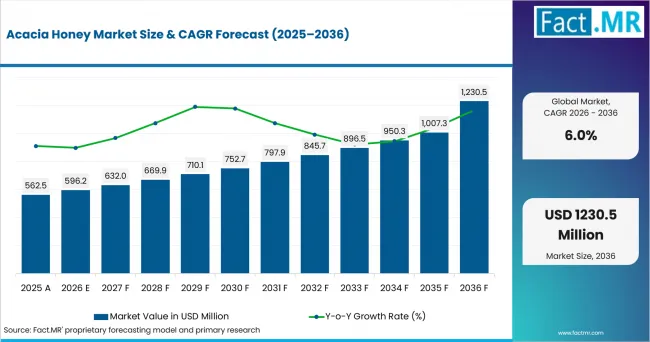
Acacia Honey Market Value Analysis | Source: Fact.MR
What are the defining numbers behind Acacia Honey Market growth?
An absolute opportunity of USD 634.3 million is expected between 2026 and 2036.
- Demand Drivers in the Market
- Acacia honey demand is expected to benefit from flavor clarity and light color. Slow crystallization supports use in recipes that need easy pouring.
- Food and beverage processors are anticipated to use acacia honey when a mild sweet profile must not hide the base product.
- Retail and online channels are projected to improve access for customers comparing botanical origin and premium honey formats.
- Sourcing discipline is expected to affect repeat buying as brands review batch consistency and label proof before expanding listings.
- Key Segments Analyzed
- By Type: Organic Acacia Honey is the leading type and accounts for 32.9% share in 2026.
- By Application: Food and Beverage leads with 30.2% share in 2026.
- Analyst Opinion at Fact.MR
- Shambhu Nath Jha, Principal Consultant at Fact.MR, states, “Acacia honey companies need to show how the product fits each use case. Organic positioning supports premium retail demand, but repeat sales are expected to depend on consistent flavor and clear labeling. Reliable supply is expected to decide repeat sales more than broad natural sweetener claims.”
- Strategic Implications
- Brand owners should position acacia honey by application fit instead of presenting it as a generic natural sweetener.
- Honey companies can strengthen account retention by documenting origin and certification status in simple customer materials.
- Distributors should plan pack sizes around retail gifting and online replenishment. Foodservice use needs a separate volume plan.
The UK records the highest country CAGR at 8.4%. Australia follows at 7.3% and the USA is projected at 6.8%. Canada advances at 6.6% and Germany is forecast to expand at 6.3% by 2036.
How does the Acacia Honey Market break down by segment?
Organic Acacia Honey leads Type with 32.9% share in 2026. Food and Beverage leads Application with 30.2% share in 2026.
Why does Organic Acacia Honey lead Type?
Organic Acacia Honey is projected to account for 32.9% share in 2026.
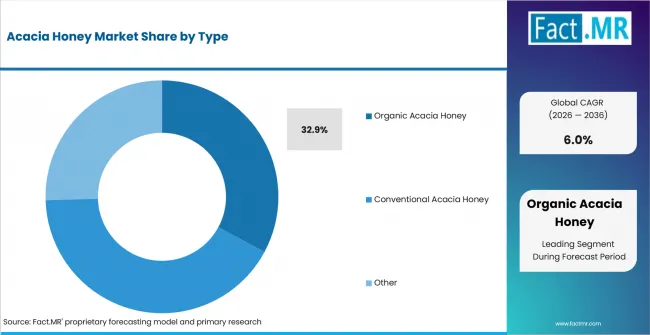
Acacia Honey Market Analysis By Type | Source: Fact.MR
Organic Acacia Honey represents the largest recorded type in the assessed market. Its position reflects customer interest in certified and traceable sweeteners. The segment benefits from a premium food image that fits organic honey shelves. Conventional Acacia Honey continues to serve buyers that give price and availability more weight than certification.
Why does Food and Beverage lead Application?
Food and Beverage holds 30.2% share in 2026.
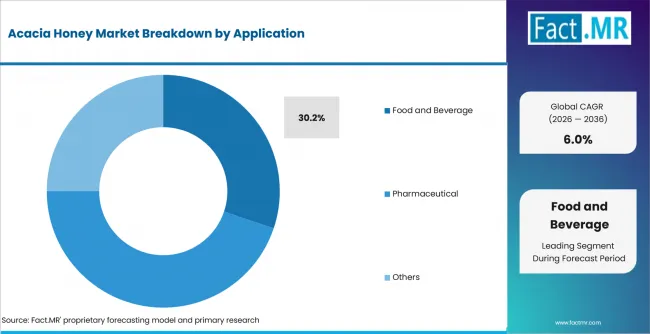
Acacia Honey Market Analysis By Application | Source: Fact.MR
Food and Beverage accounts for the largest share because acacia honey suits drinks and bakery products that need a mild sweet note. Its low tendency to crystallize is expected to support liquid formats. Pharmaceutical and other uses are part of the market. Their demand is narrower and often depends on product positioning.
What is accelerating Acacia Honey Market adoption, and what is holding it back?
Demand is expected to rise with wider use in products and retail. Growth may be limited by quality issues and high prices.
Drivers Impact Analysis
| DRIVER | (~) % IMPACT ON CAGR | GEOGRAPHIC RELEVANCE | IMPACT TIMELINE |
|---|---|---|---|
| Organic and traceable honey positioning | +1.6% | UK; USA; Germany | Short term (<= 2 years) |
| Food and beverage formulation fit | +1.4% | USA; Canada; Australia | Short term (<= 2 years) |
| Retail and online access | +1.1% | UK; Australia; Canada | Medium term (2-4 years) |
| Premium botanical-origin labeling | +0.9% | Europe and North America | Medium term (2-4 years) |
| Foodservice and gifting use | +0.6% | Tourism and specialty retail markets | Long term (>= 4 years) |
Source: Fact.MR analysis. Updated Aug 4, 2026
- Organic and traceable honey positioning: Certification proof is expected to support premium pricing when customers compare acacia honey with standard honey types.
- Food and beverage formulation fit: Mild taste and liquid handling are anticipated to keep acacia honey useful in beverage and bakery applications.
- Retail and online access: E-commerce is projected to improve discovery for imported botanical honey. Specialty stores are expected to support premium trial.
Opportunity Impact Analysis
| OPPORTUNITY | (~) % IMPACT ON CAGR | GEOGRAPHIC RELEVANCE | IMPACT TIMELINE |
|---|---|---|---|
| Single-origin brand positioning | +1.0% | UK and Germany | Medium term (2-4 years) |
| Premium pack-size development | +0.8% | USA and Canada | Medium term (2-4 years) |
| Clean-label beverage use | +0.7% | Australia and USA | Long term (>= 4 years) |
| Online subscription and gifting | +0.5% | UK; Canada; Australia | Long term (>= 4 years) |
Source: Fact.MR analysis. Updated Aug 4, 2026
- Single-origin brand positioning: Country and floral-origin storytelling is expected to help companies explain price differences with concrete product information.
- Premium pack-size development: Smaller jars and gift-ready formats are anticipated to improve trial among customers who compare quality before repeat orders.
- Clean-label beverage use: Formulators are expected to test acacia honey as natural sweetener blends receive more attention in beverage trials.
Restraints Impact Analysis
| RESTRAINT | (~) % IMPACT ON CAGR | GEOGRAPHIC RELEVANCE | IMPACT TIMELINE |
|---|---|---|---|
| Harvest variability and price exposure | -1.1% | Global sourcing routes | Short term (<= 2 years) |
| Certification and labeling checks | -0.9% | UK; USA; Germany | Short term (<= 2 years) |
| Adulteration and authenticity concerns | -0.7% | Import-dependent markets | Medium term (2-4 years) |
| Substitution by lower-cost sweeteners | -0.5% | Food processing channels | Long term (>= 4 years) |
Source: Fact.MR analysis. Updated Aug 4, 2026
- Harvest variability and price exposure: Weather and floral availability are expected to affect supply planning before customer contracts are finalized.
- Certification and labeling checks: Organic and origin claims are expected to need careful proof before products enter premium retail channels.
- Substitution by lower-cost sweeteners: Some processors are expected to choose cheaper alternatives when honey flavor is not central to the final product.
Which countries are scaling the Acacia Honey Market fastest?
- The country comparison spans 2.1 percentage points between the fastest market and the slowest market during the forecast period.
- The UK is forecast to grow 1.1 percentage points faster than Australia as premium retail and organic honey positioning support pricing.
- Australia records a 0.5 percentage point advantage over the USA as specialty food and gifting formats support premium demand.
- The USA is projected to stay 0.2 percentage point above Canada through wider food and beverage application depth.
- Canada is expected to record a 0.3 percentage point advantage over Germany as specialty imports support selective demand.
Comparable CAGRs can create different entry conditions due to taste preference and sourcing routes. Full report coverage includes North America; Latin America; Europe; East Asia; South Asia and Pacific; Middle East and Africa.
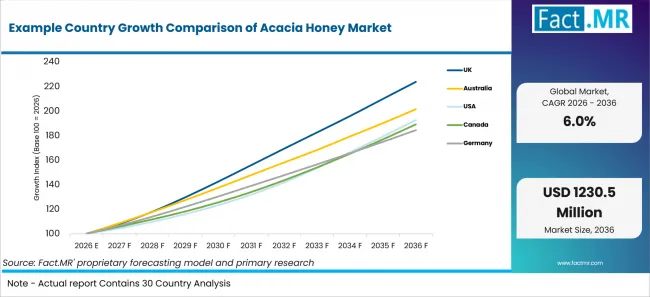
Example Country Growth Comparison Of Acacia Honey Market | Source: Fact.MR
| Country | CAGR (2026-2036) |
|---|---|
| UK | 8.4% |
| Australia | 7.3% |
| USA | 6.8% |
| Canada | 6.6% |
| Germany | 6.3% |
Source: Fact.MR analysis. Updated Aug 4, 2026
What is driving the UK’s growth through 2036?
8.4% CAGR, supported by premium grocery demand and certified specialty foods.
The UK’s growth reflects strong demand for premium and certified food products. Organic acacia honey appeals to shoppers who compare botanical origin and label credibility before paying a higher price. Brands with clear origin proof and reliable shelf availability are expected to gain stronger demand.
What supports Australia’s growth?
7.3% CAGR, led by specialty retail and premium gifting demand.
Australia’s growth reflects rising interest in mild botanical honey across specialty stores and gifting channels. Imported acacia honey must justify its freight cost and premium shelf price. Brands are expected to gain stronger traction by offering smaller pack sizes and positioning the product for premium pantry use.
How does the USA scale demand?
6.8% CAGR, driven by food and beverage applications and healthy retail channels.
The USA’s growth is supported by broad food and beverage uses that suit acacia honey’s light taste. Processors can include it in better-for-you recipes and premium drinks without strongly changing the flavor profile. Wider visibility across health-focused retail channels is expected to encourage trial among consumers comparing natural sweeteners.
What is driving Canada’s growth?
6.6% CAGR, backed by urban specialty stores and online product discovery.
Canada’s growth is shaped by demand from urban specialty retailers and online shoppers. Acacia honey can attract consumers already interested in premium pantry products and health-focused foods. However, exchange-rate changes and freight costs may raise prices and limit expansion for smaller brands.
How does Germany perform?
6.3% CAGR, led by organic retail demand and strict product documentation.
Germany’s growth reflects strong interest in organic products and clear ingredient claims. Acacia honey fits premium retail shelves when suppliers provide reliable origin records and certification. Strict listing requirements may slow market entry, but they also favor brands that offer consistent quality and complete documentation.
Who leads the Acacia Honey Market?
The named company set includes Savannah Bee Company. ARD Dynamic Enterprise Sdn. Bhd. (Ardeen Madu), Bee Seasonal add variety across origin-based and specialty honey positioning.
The wider list includes Apicoltura Gabannini; Mileeven Fine Foods; Littleover Apiaries; CD S.A.; Bulgarian Nuts Ltd. (Bulgarian Bee); Bionectar Mézfeldolgozó és Kereskedelmi Kft..
Competition is expected to depend on proof of origin and certification status. Companies that explain taste, clarity and application fit are likely to earn stronger attention from buyers comparing acacia honey with natural and organic flavor choices.
Which companies are the key providers?
Key companies include Savannah Bee Company; ARD Dynamic Enterprise Sdn. Bhd. (Ardeen Madu); Bee Seasonal; Apicoltura Gabannini; Mileeven Fine Foods; Littleover Apiaries; CD S.A.; Bulgarian Nuts Ltd. (Bulgarian Bee); Bionectar Mézfeldolgozó és Kereskedelmi Kft.
- Savannah Bee Company
- ARD Dynamic Enterprise Sdn. Bhd. (Ardeen Madu)
- Bee Seasonal
- Apicoltura Gabannini
- Mileeven Fine Foods
- Littleover Apiaries
- CD S.A.
- Bulgarian Nuts Ltd. (Bulgarian Bee)
- Bionectar Mézfeldolgozó és Kereskedelmi Kft.
Bibliography
- National Agricultural Statistics Service. (2026, March 13). Honey. United States Department of Agriculture.
- Agricultural Marketing Service. (2025, January 29). National honey report. U.S. Department of Agriculture.
- National Agricultural Statistics Service. (2025, March 14). Honey. U.S. Department of Agriculture.
- Department for Environment, Food & Rural Affairs. (2025, February 13). ‘From the Hives’ honey authenticity survey: Methodological review. GOV.UK.
This Report Answers
- The report provides strategic intelligence on the Acacia Honey Market across Type and Application choices that shape product positioning.
- Segment analysis covers Organic Acacia Honey and Food and Beverage as the share leaders within the 2026 market.
- Country outlook evaluates the UK and Australia alongside the USA. Canada and Germany complete the forecast comparison.
- Competitive analysis profiles Savannah Bee Company alongside ARD Dynamic Enterprise Sdn. Bhd. (Ardeen Madu), Bee Seasonal.
- Application assessment covers Food and Beverage and Pharmaceutical use. Other uses complete the view with attention to channel access and product fit.
What does the Acacia Honey Market cover?
Acacia honey products are sold by botanical origin for food, beverage and selected specialty uses.
The Acacia Honey Market covers honey products identified by acacia floral origin and sold in organic or conventional formats. Coverage includes packaged products for retail and foodservice use. It includes food and beverage applications that need mild taste and light color. Pharmaceutical and other uses are included when the product is sold as acacia honey and not as a general sweetener.
What is included in the scope?
Acacia honey is assessed across Type, Application and Region with company coverage tied to named providers.
The scope includes Type, Application and Region. Coverage spans Organic Acacia Honey and Conventional Acacia Honey. Food and Beverage leads application coverage. Pharmaceutical and Others complete the assessed application base. The country view includes the UK; Australia; USA; Canada and Germany. Company coverage includes the named providers listed in the competitive section.
What is excluded from the scope?
General sweeteners and honey products without acacia origin are outside this market.
The scope excludes honey products that do not identify acacia origin. General sweeteners and sugar substitutes are outside the scope unless sold as acacia honey. Blended syrups are excluded. Pollination services and beekeeping equipment are outside the scope. Honey-based cosmetics and medical products are excluded unless revenue depends directly on acacia honey product use.
How Was the Analysis Built?
The analysis draws on 120+ sources and 35+ company portfolios. It covers 25+ countries and more than 20 industry interviews.
- Primary Research: Primary research includes discussions with manufacturers and service providers. It covers distributors, end users and subject-matter experts. These conversations examine purchasing priorities and channel requirements. They review certification needs and wider market acceptance factors.
- Desk Research: Desk research covers official statistics and regulatory publications. It reviews company literature, trade data and standards. Every source used in the analysis is documented in the bibliography.
- Market Sizing and Forecasting: Market estimates combine historical performance with demand indicators. The model reviews pricing trends, segment shares and country-level growth. Barriers to market expansion are tested before the forecast is finalized.
- Data Validation and Update Cycle: Findings are validated by comparing interviews with public data and company activity. Regular updates review launches, sourcing shifts and changes in customer adoption.
Segmentation
What is the report’s scope and coverage?
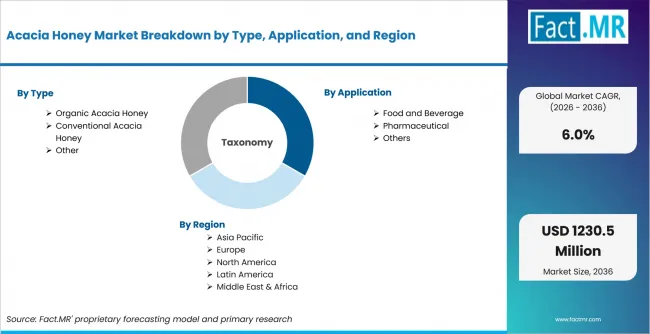
Acacia Honey Market Breakdown By Type, Application, And Region | Source: Fact.MR
| Attribute | Details |
|---|---|
| Quantitative Units | USD million in 2026 to USD million by 2036 at a CAGR |
| Market Definition | Acacia honey sold across organic and conventional formats for food and beverage uses alongside pharmaceutical and other end uses |
| Type | Organic Acacia Honey; Conventional Acacia Honey |
| Application | Food and Beverage; Pharmaceutical; Others |
| Regions Covered | North America; Latin America; Europe; East Asia; South Asia and Pacific; Middle East and Africa |
| Countries Covered | UK; Australia; USA; Canada; Germany |
| Key Companies Profiled | Savannah Bee Company; ARD Dynamic Enterprise Sdn. Bhd. (Ardeen Madu); Bee Seasonal; Apicoltura Gabannini; and others |
| Forecast Period | 2026 to 2036 |
| Approach | Hybrid top-down and bottom-up approach using application demand; type share; country growth; channel visibility; product positioning; sourcing conditions; certification needs; and company portfolio review |
Source: Fact.MR analysis. Updated Aug 4, 2026
How is the market segmented?
-
By Type:
- Organic Acacia Honey
- Conventional Acacia Honey
-
By Application:
- Food and Beverage
- Pharmaceutical
- Others
-
By Region:
- North America
- USA
- Canada
- Europe
- Germany
- UK
- South Asia and Oceania
- Australia
- North America
Frequently Asked Questions
Which type leads the Acacia Honey Market?
Which application leads the market?
Which country records the highest listed CAGR?
What is the primary driver in this market?
What is the main restraint?
Which companies are included in the market assessment?
Who worked on this report


Preview the report firsthand - request a free sample
Free SampleGet the brochure for pricing and purchase details
Download PDF