- Base Value(2025): 25.1 Bn
- Estimated Value(2026): 28.0 Bn
- Forecast Value (2036): 88.5 Bn
- CAGR (2026 - 2036): 12.2%
Accountable Care Solutions Market Size, Market Forecast and Outlook by Fact.MR
- The accountable care solutions market was valued at USD 25.1 billion in 2025. Demand is set to rise from USD 28.0 billion in 2026 to USD 88.5 billion by 2036.
- The market is forecast to record 12.2% CAGR from 2026 to 2036 as value-based care contracts and payer-provider data sharing expand across healthcare systems.
- Accountable care solutions demand is becoming more program-driven. NAACOS stated in 2025 that ACOs lowered spending by more than USD 28.0 billion over the last decade and outperformed non-value-based payment models on quality measures, including preventive care.
- Providers need platforms that can help close care gaps and manage downside risk. This supports demand for technology that helps accountable care groups track performance.
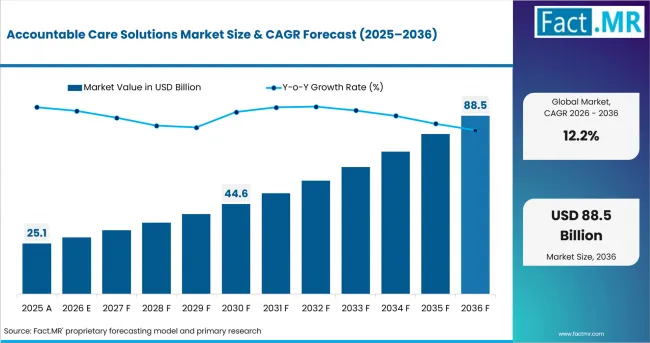
Accountable Care Solutions Market Value Analysis | Source: Fact.MR
Summary of Accountable Care Solutions Market
- Demand Drivers in the Market
- ACO Growth: Providers need accountable care tools as Medicare and commercial value-based contracts expand.
- Data Integration: Healthcare organizations need claims and clinical data combined for better risk tracking.
- Cost Control: Payers use analytics to identify utilization patterns and avoidable spending.
- Key Segments Analyzed
- By Solution Type: Population health management is expected to hold 32.0% share in 2026 because ACOs need patient registries and care gap tracking.
- By Deployment: Cloud-based deployment is likely to account for 58.0% share in 2026 since healthcare organizations need scalable analytics access across distributed care networks.
- By End User: Healthcare providers are projected to hold 44.0% share in 2026 because hospital and physician groups manage frontline care performance.
- By Application: Care coordination is anticipated to capture 29.0% share in 2026 as accountable care models require follow-up and chronic disease management.
- By Sales Channel: Direct enterprise sales are expected to hold 47.0% share in 2026 because large healthcare systems need customized implementation support.
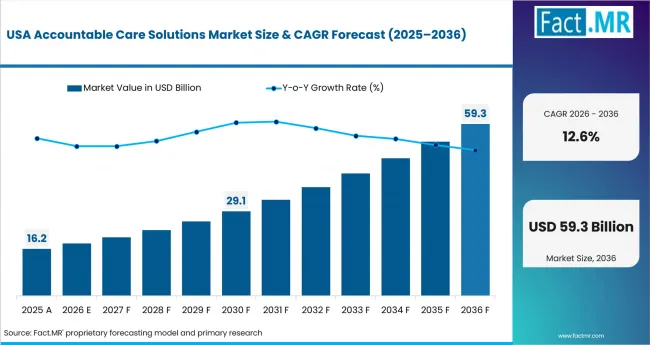
- By Geography: The United States is projected to record 12.6% CAGR through 2036 as Medicare ACOs and commercial value-based contracts expand.
- Analyst Opinion at Fact.MR
- Shambhu Nath Jha, Principal Consultant at Fact.MR, states, “Accountable care solutions are becoming core tools for value-based contracts. Providers need cleaner data, better risk visibility, and simpler physician workflows. Vendors that connect analytics with care actions will strengthen enterprise relationships.”
- Strategic Implications
- Data Readiness: Providers need clean claims and clinical data before scaling accountable care programs.
- Workflow Design: Care teams should use dashboards that trigger outreach rather than passive reporting.
- Contract Control: Payers need analytics that show risk and quality movement together.
The United States is projected to record 12.6% CAGR from 2026 to 2036 as Medicare ACOs and commercial value-based contracts expand. India is likely to post 14.8% CAGR through 2036 as digital health platforms and private hospital networks adopt care coordination tools. China is expected to register 13.9% CAGR by 2036 as hospital digitalization and payer reform support analytics adoption. Germany is forecast to advance at 10.8% CAGR from 2026 to 2036 because integrated care and regulated digital health programs support adoption. The United Kingdom is set to record 10.2% CAGR by 2036 as NHS-linked population health and integrated care models sustain demand.
Segmental Analysis
Accountable Care Solutions Market Analysis by Solution Type
Population health management is expected to hold 32.0% share in 2026 because ACOs need patient registries and care gap tracking. These platforms help care staff find high-risk patients and prioritize outreach. Care management tools support chronic disease follow-up and care after discharge. Risk and contract management tools help organizations track shared savings and benchmark exposure. Quality reporting and performance analytics support measure submission and improvement planning. Patient engagement tools support reminders and preventive care outreach. Aledade said it added more than 500 primary care practices for 2025 and expanded its network to more than 2,400 organizations.
- Population Health: Registry tools help care teams identify patients needing preventive services and chronic care follow-up.
- Contract Tracking: Risk tools help organizations understand savings exposure and contract performance by population.
- Engagement Layer: Outreach systems support reminders and care gap closure across patient groups.
Accountable Care Solutions Market Analysis by Deployment
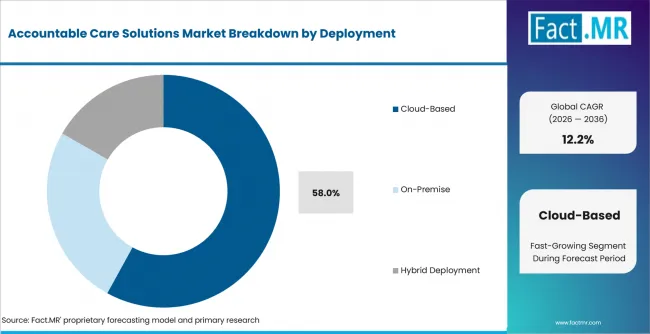
Accountable Care Solutions Market Analysis By Deployment | Source: Fact.MR
Cloud-based deployment leads with 58.0% share in 2026 because healthcare organizations need scalable analytics across distributed care networks. Provider groups and ACOs often work across many sites and data systems. Cloud tools support faster updates and easier user access. On-premise systems remain important for organizations with strict internal data policies. Hybrid deployment supports health systems that need some local control.
- Cloud Scale: Cloud deployment supports faster analytics rollout across multi-site provider and payer organizations.
- Local Control: On-premise systems serve organizations with strict internal security and data hosting rules.
- Hybrid Use: Hybrid deployment helps health systems balance data control with scalable application access.
Accountable Care Solutions Market Analysis by End User
Healthcare providers are projected to hold 44.0% share in 2026 because hospitals and physician groups manage frontline care performance. Providers need tools that help clinicians close care gaps and manage chronic disease outreach. Payers use accountable care solutions for contract design and member risk management. ACOs need tools for quality reporting and savings performance. Employer health plans use analytics to manage workforce health costs. Government programs use accountable care models to improve outcomes and control spending.
- Provider Use: Hospitals and physician groups need tools that make risk-based care easier for clinicians.
- Payer Analytics: Health plans use cost and quality data to manage contract performance and member risk.
- ACO Operations: ACOs need aligned reporting and savings analytics across participating practices.
Accountable Care Solutions Market Analysis by Application
Care coordination leads as accountable care models require follow-up and chronic disease management. CMS stated in 2026 that the ACO PC Flex Model can support proactive care management, patient navigation, preventive care, chronic disease management, and improved care coordination. Care coordinators use these tools to manage discharge follow-up and reduce missed preventive care. The segment is anticipated to capture 29.0% share in 2026 because daily accountable care work depends on patient-level action. Clinical quality management supports measure tracking and reporting. Cost and utilization management identifies avoidable spending.
- Care Coordination: Patient-level workflows help care teams manage follow-up and chronic condition outreach.
- Quality Tracking: Measure dashboards help organizations prioritize gaps that affect performance scores and payment outcomes.
- Utilization Review: Cost analytics highlight avoidable emergency visits and high-variance service use.
Accountable Care Solutions Market Analysis by Sales Channel
Direct enterprise sales are expected to hold 47.0% share in 2026 because large healthcare systems need customized implementation support. Accountable care platforms often require data mapping and contract setup. System integrator sales support organizations that need multi-vendor technology setup. Consulting-led implementation helps providers redesign workflows for value-based care. Channel partner sales serve smaller practices and regional networks. Managed service contracts support organizations that need ongoing analytics and care management operations. Sales channel success will come from implementation quality and measurable performance gains.
- Enterprise Sales: Direct vendor engagement supports complex data integration and multi-contract setup for large systems.
- Consulting Route: Advisory-led implementation helps providers redesign workflows around risk and quality performance.
- Managed Services: Outsourced support helps smaller organizations operate accountable care programs with limited internal staff.
Accountable Care Solutions Market Drivers, Restraints, and Opportunities
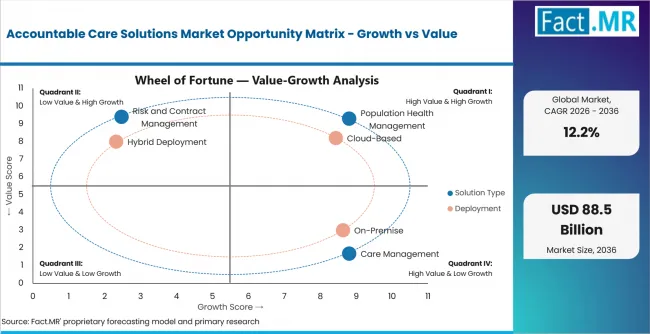
Accountable Care Solutions Market Opportunity Matrix Growth Vs Value | Source: Fact.MR
Value-based care expansion and payer-provider data sharing are the main drivers for accountable care solutions. CMS stated in 2026 that the ACO REACH Model helps providers work together through accountable care organizations to improve care quality and manage costs. CMS also said it shares quality and financial performance information for REACH ACOs through transparency reporting. This supports demand for platforms that manage aligned care and risk arrangements.
Data fragmentation can slow adoption. Providers often manage EHR data and payer reports across separate systems. Poor data quality can weaken risk scoring and care gap tracking. Smaller practices may lack staff to manage complex contracts. Implementation cost can delay adoption because accountable care platforms require workflow change and integration support.
Opportunities in the Accountable Care Solutions Market
- Risk Analytics: Vendors can help providers understand contract exposure and identify high-cost patient groups before losses affect shared savings targets.
- Primary Care Enablement: ACO platforms can support independent practices entering value-based care with performance dashboards and payer reporting tools.
- AI Care Workflows: Suppliers can automate patient outreach and documentation support with careful governance, helping care coordinators reduce manual follow-up work.
Regional Analysis
Based on regional analysis, the accountable care solutions market is segmented into North America, Latin America, Western Europe, Eastern Europe, East Asia, South Asia and Pacific, and Middle East and Africa.
| Country | CAGR (2026 to 2036) |
|---|---|
| India | 14.8% |
| China | 13.9% |
| United States | 12.6% |
| Germany | 10.8% |
| United Kingdom | 10.2% |
Source: Fact.MR analysis. Updated Jun 10, 2026
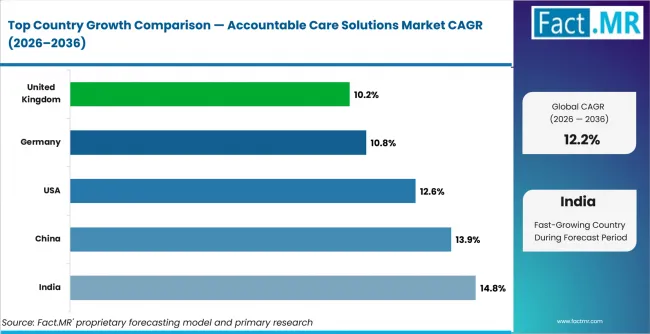
Accountable Care Solutions Market Cagr Analysis By Country | Source: Fact.MR
North America Accountable Care Solutions Market Analysis
Accountable Care Solutions Market Country Value Analysis | Source: Fact.MR
North America demand is led by the United States because Medicare ACOs and payer-provider analytics are well established. Healthcare systems use accountable care tools to improve care coordination and manage shared savings exposure. Aledade reported that its ACOs saved Medicare more than USD 1.0 billion in 2024.
- United States: The United States is projected to record 12.6% CAGR through 2036 as Medicare ACOs and commercial value-based contracts expand. Provider groups need care coordination and claims analytics to manage performance. Payers use accountable care tools to track utilization and risk. Independent practices need support before joining shared savings models.
South Asia and East Asia Accountable Care Solutions Market Analysis
South Asia and East Asia demand comes from hospital digitalization and rising chronic disease management needs. India leads the outlook because private hospitals and health technology firms are expanding digital care tools. China has larger hospital networks and stronger public health digitization activity.
- India: India is likely to post 14.8% CAGR from 2026 to 2036 as digital health platforms and private hospital networks adopt care coordination tools. Hospitals need patient engagement and chronic care management. Insurers are starting to use analytics for cost and utilization review. Fragmented provider systems can slow integration. Smaller clinics may need cloud-based tools with lower setup cost.
- China: China is expected to register 13.9% CAGR by 2036 as hospital digitalization and payer reform support analytics use. Large hospitals need tools to manage patient pathways and performance reporting. Regional health platforms can use data to support chronic disease programs. Payers need utilization tracking as medical spending rises. Data governance and system integration will shape adoption speed.
Western Europe Accountable Care Solutions Market Analysis
Western Europe demand comes from integrated care programs and payer-provider coordination. Germany and the United Kingdom lead the regional view because healthcare systems are investing in digital care coordination and performance monitoring.
- Germany: Germany is forecast to advance at 10.8% CAGR from 2026 to 2036 because integrated care and regulated digital health programs support adoption. Providers need tools that coordinate chronic disease care across hospitals and outpatient groups. Payers can use analytics to manage utilization and outcomes. Strict privacy rules require strong data governance. Implementation may move more slowly than in the United States. Vendors with secure hosting and interoperability support will be better positioned.
- United Kingdom: The United Kingdom is set to record 10.2% CAGR through 2036 as NHS-linked population health and integrated care models support demand. Integrated care systems need tools that connect patient risk and care coordination. Public providers must manage waiting lists and chronic disease pressure. Analytics can support targeted outreach and community care planning. Approval cycles may slow vendor onboarding.
Competitive Aligners for Market Suppliers
Accountable Care Solutions Market Analysis By Company | Source: Fact.MR
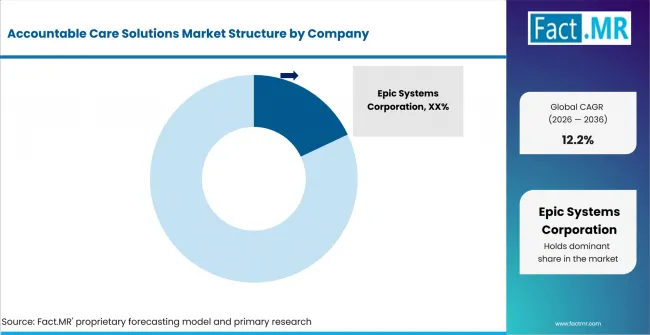
Accountable care solutions are moving closer to daily clinical and financial decisions. Epic Systems Corporation and Oracle Health / Oracle Corporation compete through EHR-connected workflows that help providers manage records and care activity. Their strength comes from deep placement inside health systems and routine clinical processes.
Innovaccer Inc. and Health Catalyst, Inc. support the market through data activation and analytics platforms. These tools help healthcare organizations identify risk and track care quality. Aledade, Inc. and Privia Health Group, Inc. compete through physician-focused value-based care models that support practice groups with coordination and contract performance.
Through 2036, competition will be driven by contract performance proof and ease of daily use. Healthcare organizations need tools that help clinicians act sooner and report quality metrics with less friction. Vendors that connect clinical workflows with payer-facing performance needs will improve enterprise relationships.
Key Companies in Accountable Care Solutions Market
- Epic Systems Corporation
- Oracle Health / Oracle Corporation
- Innovaccer Inc.
- Health Catalyst, Inc.
- Aledade, Inc.
- Privia Health Group, Inc.
Bibliography
- National Association of ACOs. (2025, April 22). Letter to CMS Administrator Mehmet Oz: Advancing accountable care. National Association of ACOs.
- Aledade, Inc. (2025, February 11). Aledade expands value-based care network, adding more than 500 practices for 2025. Aledade, Inc.
- Centers for Medicare & Medicaid Services. (2026, June 17). ACO PC Flex (ACO Primary Care Flex) Model. Centers for Medicare & Medicaid Services.
- Centers for Medicare & Medicaid Services. (2026, May 20). ACO REACH Model. Centers for Medicare & Medicaid Services.
- Aledade, Inc. (2025, September 2). Aledade ACOs save over $1 billion in 2024. Aledade, Inc.
This Report Addresses
- Strategic intelligence on accountable care solution demand across solution type, deployment, end user, application, and sales channel.
- Segment analysis covering population health management, cloud deployment, healthcare providers, care coordination, and direct enterprise sales.
- Regional outlook covering India, China, the United States, Germany, and the United Kingdom.
- Competitive analysis of Epic Systems Corporation, Oracle Health / Oracle Corporation, Innovaccer Inc., Health Catalyst, Inc., Aledade, Inc., Privia Health Group, Inc.
- Solution assessment covering population health, care management, risk and contract analytics, quality reporting, and patient engagement.
- Application assessment covering quality management, cost management, risk adjustment, care coordination, and claims analytics.
- Primary interviews, supplier checks, official source reviews, and accountable care workflow validation support the forecast.
Accountable Care Solutions Market Definition
The accountable care solutions market covers software and analytics platforms used to manage value-based care contracts and accountable care organizations. These solutions help healthcare providers coordinate care and measure contract performance. The market differs from basic hospital IT because it connects clinical and population-level data for accountability-based payment models.
Accountable Care Solutions Market Inclusions
The scope includes population health management and payer-provider analytics platforms. It includes cloud-based and on-premise solutions used by providers and government health programs.
Accountable Care Solutions Market Exclusions
The scope excludes general electronic health records when they are not used for accountable care workflows. Standalone billing software is excluded unless tied to value-based payment or contract analytics. Basic patient portals are outside scope unless they support care gap closure or risk-based care management. General telehealth tools are excluded unless integrated with accountable care programs.
Accountable Care Solutions Market Research Methodology
- Primary Research
- Primary research includes interviews with value-based care leaders and ACO operations managers. It includes input from payer analytics heads and healthcare technology implementation partners.
- Desk Research
- Desk research reviews CMS program updates and official company materials. It covers accountable care participation and payer-provider workflow documentation.
- Market-Sizing and Forecasting
- Forecasting uses solution type demand and deployment movement. End-user adoption and sales channel structure support the market assessment.
- Data Validation and Update Cycle
- Forecasts are validated through supplier checks and healthcare organization feedback. ACO participation signals and value-based contract activity help confirm market direction.
Segmentation
Scope of the Report
| Attribute | Details |
|---|---|
| Quantitative Units |
USD Billion in 2026 to USD Billion by 2036 at CAGR |
| Market Definition | Software, services, and analytics platforms used to manage value-based care contracts and accountable care organizations |
| Solution Type | Population Health Management, Care Management, Risk and Contract Management, Quality Reporting and Performance Analytics, Patient Engagement Solutions |
| Deployment | Cloud-Based, On-Premise, Hybrid Deployment |
| End User | Healthcare Providers, Payers, Accountable Care Organizations, Employer Health Plans, Government Health Programs |
| Application | Clinical Quality Management, Cost and Utilization Management, Risk Adjustment, Care Coordination, Claims and Contract Analytics |
| Sales Channel | Direct Enterprise Sales, System Integrator Sales, Consulting-Led Implementation, Channel Partner Sales, Managed Service Contracts |
| Regions Covered | North America, Latin America, Western Europe, Eastern Europe, East Asia, South Asia and Pacific, Middle East and Africa |
| Countries Covered | India, China, United States, Germany, United Kingdom |
| Key Companies Profiled | Epic Systems Corporation, Oracle Health / Oracle Corporation, Innovaccer Inc., Health Catalyst, Inc., Aledade, Inc., Privia Health Group, Inc. |
| Forecast Period | 2026 to 2036 |
| Approach | Hybrid top-down and bottom-up approach using solution type demand, deployment mix, end-user adoption, application movement, sales channel structure, and regional validation |
Source: Fact.MR analysis. Updated Jun 10, 2026
Accountable Care Solutions Market Analysis by Segments
-
By Solution Type:
- Population Health Management
- Care Management
- Risk and Contract Management
- Quality Reporting and Performance Analytics
- Patient Engagement Solutions
-
By Deployment:
- Cloud-Based
- On-Premise
- Hybrid Deployment
-
By End User:
- Healthcare Providers
- Payers
- Accountable Care Organizations
- Employer Health Plans
- Government Health Programs
-
By Application:
- Clinical Quality Management
- Cost and Utilization Management
- Risk Adjustment
- Care Coordination
- Claims and Contract Analytics
-
By Sales Channel:
- Direct Enterprise Sales
- System Integrator Sales
- Consulting-Led Implementation
- Channel Partner Sales
- Managed Service Contracts
-
Region:
- North America
- United States
- Canada
- Europe
- Germany
- United Kingdom
- France
- Italy
- Spain
- Asia Pacific
- China
- Japan
- South Korea
- Taiwan
- Singapore
- Latin America
- Brazil
- Mexico
- Argentina
- Middle East & Africa
- GCC Countries
- South Africa
- Israel
- North America
Frequently Asked Questions
Which solution type leads the Accountable Care Solutions Market?
Which country is expected to grow fastest in the accountable care solutions market?
How does China perform in the Accountable Care Solutions Market?
How does the United States perform in the Accountable Care Solutions Market?
What is the primary driver in the Accountable Care Solutions Market?
What is the main restraint in the Accountable Care Solutions Market?
Why is population health management important in this market?
Why is cloud deployment important in the Accountable Care Solutions Market?
Who worked on this report


Preview the report firsthand - request a free sample
Free SampleGet the brochure for pricing and purchase details
Download PDF