- Base Value(2025): 251.7 Mn
- Estimated Value(2025): 251.7 Mn
- Forecast Value (2035): 428.7 Mn
- CAGR (2025 - 2035): 5.5%
Malic Acid Market Forecast and Outlook 2025 to 2035
The global malic acid market is projected to reach USD 428.7 million by 2035, recording an absolute increase of USD 177.0 million over the forecast period. The market is valued at USD 251.7 million in 2025 and is set to rise at a CAGR of 5.5% during the assessment period.
The market is expected to grow by approximately 1.7 times during the same period, supported by increasing demand for natural acidulants in food and beverage applications and expanding clean label product formulations across consumer goods categories worldwide, driving adoption for specialized flavor enhancement solutions and increasing investments in fermentation-based production technologies with improved purity standards across beverage acidification and pharmaceutical excipient applications globally.
Quick Stats for Malic Acid Market
- Malic Acid Market Value (2025): USD 251.7 million
- Malic Acid Market Forecast Value (2035): USD 428.7 million
- Malic Acid Market Forecast CAGR: 5.5%
- Leading Product Type in Malic Acid Market: L-Malic Acid (53.5%)
- Key Growth Regions in Malic Acid Market: Asia Pacific, North America, and Europe
- Top Players in Malic Acid Market: Bartek Ingredients Inc., Fuso Chemical Co., Ltd., ISEGEN South Africa (Pty) Ltd., Anhui Sealong Biotechnology Co., Ltd., Thirumalai Chemicals, Yongsan Chemicals, Polynt S.p.A., Lonza, Prinova Group LLC, Nacalai Tesque, Inc.
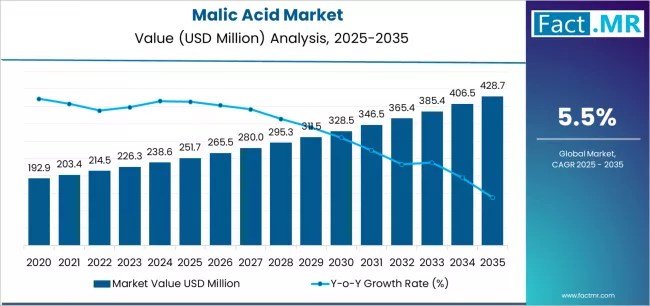
Malic Acid Market Market Value Analysis | Source: Fact.MR
Food and beverage manufacturers face mounting pressure to replace synthetic additives and meet consumer preferences for natural ingredients while addressing flavor optimization requirements and product stability concerns, with modern malic acid formulations providing documented functional benefits including superior tartness profiles, enhanced flavor masking capabilities, and improved solubility characteristics compared to conventional acidulants alone.
Rising awareness about natural food ingredients and expanding applications in personal care formulations enabling moisturization and pH adjustment create substantial opportunities for manufacturers and downstream partners. However, limited production capacity from natural fermentation routes and price competition from citric acid alternatives may pose obstacles to accelerated market expansion.
The L-malic acid segment dominates market activity, driven by extensive food safety approvals supporting its role as the naturally occurring stereoisomer with superior taste characteristics and clean label positioning across diverse application categories worldwide. Food manufacturers increasingly recognize the functional advantages of L-malic acid, with typical product offerings providing effective acidification and flavor enhancement at competitive price points through established chemical distribution networks.
The food and beverage segment demonstrates robust market presence, supported by widespread adoption in beverage formulations and confectionery applications addressing tartness requirements and flavor modulation in modern product development approaches.
L-malic acid emerges as the dominant product form, reflecting industry preference for the naturally occurring isomer and regulatory acceptance in food contact applications. Food and beverage manufacturers represent the leading end use category, driven by comprehensive application scope across carbonated beverages, fruit preparations, and confectionery systems enabling multifunctional ingredient performance.
Regional dynamics show North America maintaining market leadership, supported by established food ingredient consumption patterns and advanced beverage formulation capabilities across processed food categories.
Asia Pacific demonstrates the fastest growth trajectory driven by expanding food processing industries and rising consumer packaged goods production, while Europe emphasizes natural ingredient preferences and organic food market development for clean label compliance.
China leads country-level growth through extensive beverage manufacturing infrastructure and expanding domestic consumption, followed by India supported by pharmaceutical manufacturing growth and food industry modernization.
The competitive landscape features moderate concentration with Bartek Ingredients Inc. maintaining market leadership position, while specialized players including Fuso Chemical Co., Ltd., ISEGEN South Africa (Pty) Ltd., and Anhui Sealong Biotechnology Co., Ltd. compete through production capacity expansion and regional distribution strategies across diverse application segments.
Malic Acid Market Year-over-Year Forecast 2025 to 2035
Between 2025 and 2029, the malic acid market is projected to expand from USD 251.7 million to USD 310.7 million, resulting in a value increase of USD 59.0 million, which represents 33.3% of the total forecast growth for the period. This phase of development will be shaped by rising demand for natural acidulants and clean label ingredient formulations addressing consumer preferences, product innovation in fermentation-derived L-malic acid with enhanced purity profiles and improved cost competitiveness, as well as expanding integration with beverage reformulation initiatives and confectionery applications. Companies are establishing competitive positions through investment in biotechnology production platforms, capacity expansion projects, and strategic market penetration across food ingredient distribution, specialty chemical channels, and direct manufacturer supply models.
From 2029 to 2035, the market is forecast to grow from USD 310.7 million to USD 428.7 million, adding another USD 118.0 million, which constitutes 66.7% of the overall expansion. This period is expected to be characterized by the expansion of specialized product applications, including pharmaceutical excipients and personal care formulations tailored for specific functional requirements, strategic collaborations between malic acid producers and food technology companies, and an enhanced focus on fermentation technology advancement and production sustainability standards. The growing emphasis on natural preservative systems and rising preference for multifunctional acidulants addressing flavor, preservation, and chelation requirements will drive demand for comprehensive ingredient solutions across diverse industrial applications.
Malic Acid Market Key Takeaways
| Metric | Value |
|---|---|
| Market Value (2025) | USD 251.7 million |
| Market Forecast Value (2035) | USD 428.7 million |
| Forecast CAGR (2025-2035) | 5.5% |
Source: Fact.MR analysis. Updated Dec 2, 2025
Why is the Malic Acid Market Growing?
The malic acid market grows by enabling food and beverage manufacturers to optimize product formulations while addressing clean label requirements and natural ingredient preferences without exclusive reliance on synthetic acidulant alternatives.
Food formulators face mounting pressure to enhance tartness profiles and achieve flavor balance while managing pH control, microbial stability, and metal chelation requirements, with modern malic acid formulations typically providing targeted functional benefits including superior sourness intensity, smoother taste characteristics, and enhanced solubility compared to citric acid alternatives alone, making natural acidulants essential for comprehensive product development.
The food ingredient industry's need for versatile and consumer-acceptable acidifying agents creates demand for specialized malic acid solutions that can provide flavor optimization, improve product stability, and support clean label positioning without compromising functional performance or causing formulation limitations.
Food technologist adoption and functional validation supporting malic acid efficacy drive implementation in beverage development, confectionery manufacturing, and pharmaceutical formulation settings, where ingredient performance has direct impact on product quality and consumer acceptance rates.
The increasing consumer preference for natural ingredients globally, affecting diverse product categories across food and personal care markets, creates expanding formulation requirements seeking clean label acidulant approaches. Rising awareness about the functional advantages and natural origin of L-malic acid enables informed ingredient selection and adherence to clean label protocols.
However, production cost differentials between fermentation-derived and petrochemical synthesis routes and competition from established citric acid supply chains may limit complete market substitution and optimal adoption rates among price-sensitive applications with acceptable synthetic ingredient profiles.
Segmental Analysis
The market is segmented by product, end use, and region. By product, the market is divided into L-malic acid, DL-malic acid, and D-malic acid. Based on end use, the market is categorized into food & beverage, personal care & cosmetics, pharmaceuticals, textiles, metals, and others. Regionally, the market is divided into Asia Pacific, Europe, North America, Latin America, and Middle East & Africa.
By Product, Which Segment Accounts for the Dominant Market Share?
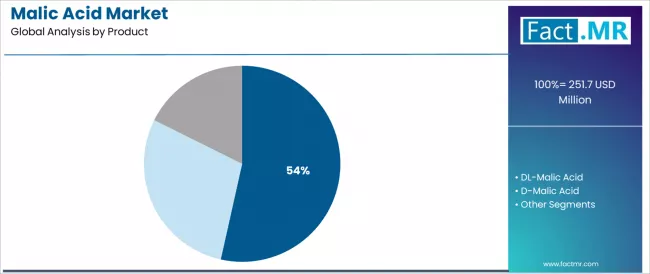
Malic Acid Market Analysis By Product | Source: Fact.MR
The L-malic acid segment represents the dominant force in the malic acid market, capturing 53.5% of total market share in 2025. This established product category encompasses solutions featuring naturally occurring stereoisomer characteristics and superior organoleptic properties, including advanced fermentation-derived formulations combining high purity standards and bioavailability optimization that enable superior functional performance and consumer acceptance across food ingredient and pharmaceutical applications worldwide.
The L-malic acid segment's market leadership stems from its superior regulatory acceptance profile, with solutions capable of addressing core formulation requirements including natural ingredient positioning, clean label compliance, and optimal taste characteristics while maintaining excellent safety records and toxicological standards across diverse application portfolios.
The DL-malic acid segment maintains a substantial market share in the 27.0% range, serving cost-sensitive applications that require effective acidification without specific stereochemical requirements including industrial pH adjustment, metal cleaning formulations, and textile processing operations where racemic mixtures provide sufficient technical functionality.
These solutions offer economic advantages for manufacturers managing large-volume applications while providing adequate performance to support operational requirements. The DL-malic acid segment demonstrates steady presence, driven by established production infrastructure and price competitiveness in non-food industrial applications.
Within the product category, D-malic acid including synthetic variants demonstrates specialized adoption, driven by specific technical applications requiring the unnatural isomer and niche pharmaceutical intermediates. This sub-segment benefits from targeted production capabilities and specialized customer requirements.
Key functional advantages driving the L-malic acid segment include:
- Advanced taste profile characteristics with clinically demonstrated smoother sourness perception and reduced astringency compared to synthetic acidulant alternatives across food applications
- Established clean label positioning allowing natural ingredient declarations and consumer-preferred labeling without extensive regulatory complexity
- Enhanced solubility features enabling superior dissolution rates and formulation flexibility while maintaining ingredient integrity and functional consistency
- Superior regulatory acceptance providing optimal market access for food, pharmaceutical, and cosmetic applications across various jurisdictional frameworks
By End Use, Which Segment Accounts for the Largest Market Share?
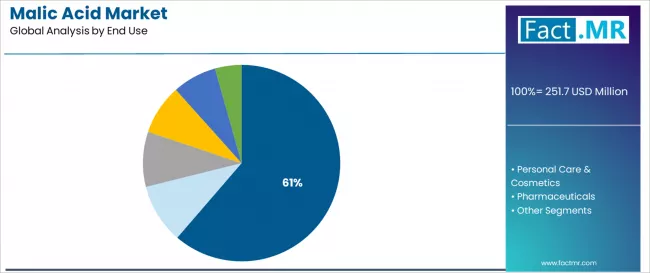
Malic Acid Market Analysis By End Use | Source: Fact.MR
Food and beverage dominates the malic acid end use landscape with a 61.3% market share in 2025, reflecting the critical role of acidulants in supporting flavor optimization, pH control, and product preservation protocols across food manufacturing operations worldwide.
The food and beverage segment's market leadership is reinforced by formulator preferences for versatile acidification solutions, established efficacy in diverse food matrices, and compatibility with multiple processing conditions that characterize comprehensive food ingredient applications.
Within this segment, beverage applications represent the preferred category for many manufacturers, driven by malic acid's ability to enhance fruit flavors, provide tartness modulation, and support microbial stability in carbonated and still beverage formulations. This sub-segment benefits from established formulation precedents and consumer acceptance of natural acidulant positioning.
The personal care and cosmetics segment represents a growing application category, demonstrating expansion through specialized requirements for alpha hydroxy acid functionality, skin pH optimization, and moisturization benefits in cosmetic formulations. This segment benefits from clean beauty movement adoption patterns that prioritize natural-origin functional ingredients.
The pharmaceuticals segment maintains meaningful presence through excipient applications and active pharmaceutical ingredient synthesis, while the textiles category serves specific dyeing and finishing operations requiring chelating agent performance.
Key market dynamics supporting end use growth include:
- Food and beverage application expansion driven by clean label reformulation trends and natural flavor enhancement, requiring extensive technical support and application development
- Personal care format modernization trends require specialized formulation expertise for stability optimization and skin compatibility assurance
- Integration of multifunctional ingredient approaches enabling single-source solutions for acidification, flavoring, and preservation across product categories
- Growing emphasis on fermentation-derived natural ingredients driving formulator preference without synthetic alternative limitations
What are the Drivers, Restraints, and Key Trends of the Malic Acid Market?
The market is driven by three concrete demand factors tied to food industry dynamics. First, accelerating clean label movement and consumer preference for natural ingredients create expanding reformulation requirements seeking naturally derived acidulants, with malic acid representing a critical natural alternative to synthetic additives in comprehensive product development programs, requiring widespread ingredient availability. Second, growing beverage industry innovation drives functional acidulant adoption, with numerous product launches demonstrating significant improvements in flavor profiles and consumer acceptance through targeted malic acid applications enabling differentiated taste experiences by 2030. Third, increasing pharmaceutical industry growth and excipient demand enable more comprehensive formulation approaches that improve drug stability while supporting controlled release mechanisms and enhanced bioavailability performance.
Market restraints include production capacity limitations from fermentation-based manufacturing routes that can challenge supply availability and pricing stability, particularly in regions where biotechnology infrastructure remains underdeveloped and capital-intensive fermentation facilities prove limited. Cost competitiveness challenges versus established citric acid supply chains pose another significant obstacle, as food manufacturers depend on economical ingredient sourcing and price-sensitive formulation decisions, potentially affecting adoption rates and market penetration. Raw material sourcing constraints for fermentation substrates and quality control requirements create additional barriers for production scaling, demanding extensive supplier development and process optimization initiatives.
Key trends indicate accelerated fermentation technology adoption in developed markets, particularly North America and Europe, where producers demonstrate willingness to invest in biotechnology platforms enabling natural L-malic acid production with improved sustainability profiles and reduced environmental footprints. Application diversification trends toward personal care and pharmaceutical markets with specialized functionality requirements and premium pricing opportunities that optimize producer margins and market positioning. However, the market thesis could face disruption if significant advances in synthetic production economics or regulatory changes affecting natural ingredient definitions reduce preference for fermentation-derived malic acid products.
Analysis of the Malic Acid Market by Key Countries
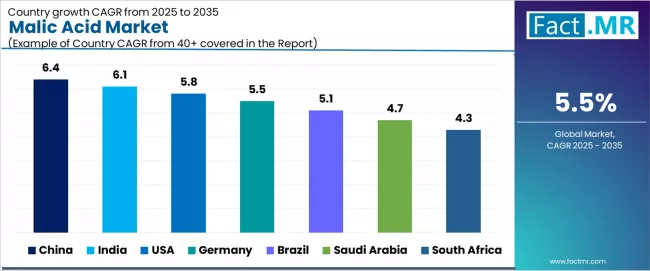
Malic Acid Market Cagr Analysis By Country | Source: Fact.MR
| Country | CAGR (2025 to 2035) |
|---|---|
| China | 6.4% |
| India | 6.1% |
| USA | 5.8% |
| Germany | 5.5% |
| Brazil | 5.1% |
| Saudi Arabia | 4.7% |
| South Africa | 4.3% |
Source: Fact.MR analysis. Updated Dec 2, 2025
The global malic acid market is expanding steadily, with China leading at a 6.4% CAGR through 2035, driven by extensive food processing infrastructure, beverage manufacturing growth, and expanding pharmaceutical production. India follows at 6.1%, supported by food industry modernization, pharmaceutical sector expansion, and rising processed food consumption. USA records 5.8%, reflecting an established landscape with continuous clean label innovation and beverage reformulation emphasis.
Germany advances at 5.5%, leveraging natural ingredient preferences and food quality standards. Brazil posts 5.1%, focusing on expanding beverage production and food processing development, while Saudi Arabia grows steadily at 4.7%, emphasizing food import substitution and domestic manufacturing. South Africa demonstrates 4.3% growth, anchored by regional food processing leadership and chemical industry presence.
How is China Leading Global Market Expansion?
China demonstrates the strongest growth potential in the malic acid market with a CAGR of 6.4% through 2035. The country's leadership position stems from extensive food and beverage manufacturing infrastructure, expanding pharmaceutical production capabilities, and growing domestic consumption patterns driving adoption of food acidulants.
Growth is concentrated in major industrial regions and manufacturing hubs, including Jiangsu, Shandong, Guangdong, and Zhejiang provinces, where manufacturers are increasingly implementing quality ingredient sourcing and natural additive formulations beyond conventional synthetic approaches.
Distribution channels through food ingredient trading companies, pharmaceutical intermediary suppliers, and direct manufacturer relationships expand product accessibility across food processor populations and pharmaceutical companies.
The country's established chemical manufacturing base combined with expanding fermentation biotechnology provides strong momentum for malic acid production, including comprehensive adoption across beverage formulations and pharmaceutical excipient applications.
Key market factors:
- Food processing concentrations in eastern coastal provinces and major metropolitan areas with advanced manufacturing capabilities
- Production growth through domestic malic acid manufacturers including Anhui Sealong Biotechnology and regional chemical producers enabling competitive supply
- Comprehensive pharmaceutical manufacturing ecosystem, including active pharmaceutical ingredient production with proven chemical intermediate capabilities
- Export-oriented production presence featuring Chinese suppliers offering globally competitive pricing and expanding international market access
Why is India Emerging as a High-Growth Market?
In major industrial centers including Maharashtra, Gujarat, Tamil Nadu, and Karnataka, the adoption of malic acid solutions is accelerating across pharmaceutical manufacturing and food processing sectors, driven by expanding generic drug production and growing packaged food consumption. The market demonstrates strong growth momentum with a CAGR of 6.1% through 2035, linked to comprehensive pharmaceutical industry expansion trends and increasing focus on food ingredient quality improvement across manufacturing operations.
Indian manufacturers are implementing advanced ingredient specifications and purchasing quality-assured acidulant products to enhance formulation performance while meeting growing regulatory expectations in pharmaceutical environments. The country's expanding middle class creates ongoing demand for processed food and beverage products, while increasing pharmaceutical export focus drives adoption of high-purity malic acid for international quality standards.
Key development areas:
- Pharmaceutical manufacturers leading malic acid adoption with emphasis on excipient quality and controlled release formulations
- Distribution expansion through both chemical trading networks and pharmaceutical ingredient distributors
- Local production development enabling competitive pricing and reducing import dependency
- Growing preference for natural food ingredients alongside domestic fermentation technology advancement
What drives USA’s Market Resilience?
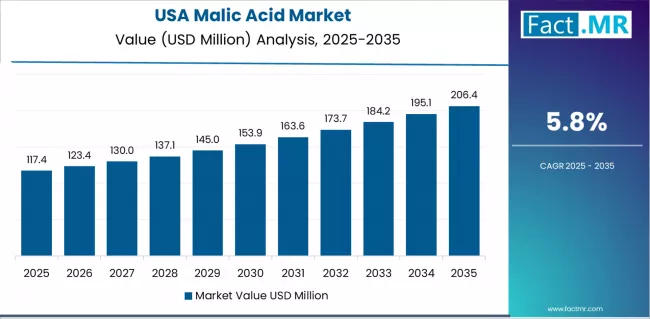
Malic Acid Market Country Value Analysis | Source: Fact.MR
USA’s market expansion is driven by diverse application requirements, including clean label beverage formulations in health-conscious markets and pharmaceutical excipient solutions across research-intensive segments. The country demonstrates steady growth potential with a CAGR of 5.8% through 2035, supported by continuous product innovation from beverage manufacturers and specialized food ingredient applications.
American formulators face implementation challenges related to cost considerations and citric acid competition, requiring malic acid suppliers to demonstrate clear functional advantages and taste profile benefits. Established natural ingredient preferences and high formulation sophistication create stable baseline demand for malic acid, particularly among beverage developers and confectionery manufacturers where superior tartness characteristics drive primary ingredient decisions.
Market characteristics:
- Beverage and confectionery sectors showing robust demand with substantial annual consumption across formulation applications
- Regional preferences varying between premium natural positioning in coastal markets and cost-effective formulation focus in value segments
- Future projections indicate continued clean label emphasis with natural acidulant preference and fermentation-derived ingredient adoption
- Growing emphasis on sustainable production methods and traceability requirements supporting differentiated supplier positioning
How does Germany Demonstrate Quality Leadership?
The market in Germany leads in quality-assured malic acid adoption based on integration with food quality frameworks and pharmaceutical-grade ingredient standards for enhanced formulation reliability. The country shows strong potential with a CAGR of 5.5% through 2035, driven by strict food safety oversight and preference for natural ingredient positioning in major markets, including Bavaria, North Rhine-Westphalia, Baden-Württemberg, and Hesse.
German food manufacturers are adopting malic acid through formulation optimization programs and ingredient quality consultants for comprehensive product development, particularly in organic food sectors and professionally guided reformulation protocols demanding rigorous ingredient credentials. Distribution channels through specialty chemical distributors and food ingredient suppliers expand coverage across food manufacturing centers and quality-conscious formulator communities.
Leading market segments:
- Natural ingredient adoption in food manufacturing centers implementing comprehensive clean label requirements
- Food technologist partnerships with ingredient suppliers achieving high formulation success rates
- Strategic collaborations between acidulant producers and beverage companies achieving application-specific validation
- Focus on organic certification and natural origin verification programs addressing clean label requirements
What positions Brazil for Regional Manufacturing Leadership?
In São Paulo, Rio de Janeiro, Minas Gerais, and other major industrial states, food manufacturers are implementing malic acid solutions through beverage formulation programs and confectionery applications, with documented case studies showing substantial flavor improvements through professionally developed protocols. The market shows steady growth potential with a CAGR of 5.1% through 2035, linked to ongoing food processing expansion, beverage industry modernization, and emerging natural ingredient adoption in major regions.
Manufacturers are adopting natural acidulants with technical support to enhance product competitiveness while maintaining standards demanded by quality-focused consumer segments. The country's expanding beverage production infrastructure creates ongoing opportunities for acidulant applications that differentiate through functional performance and natural positioning.
Market development factors:
- Beverage manufacturers leading adoption of natural acidulants across Brazil
- Food ingredient distribution services providing growth opportunities in manufacturing centers
- Strategic partnerships between international suppliers and local distributors expanding market access
- Emphasis on cost-competitive natural ingredients and technical application support across formulation applications
How Does Saudi Arabia Show Food Security Leadership?
Saudi Arabia's malic acid market demonstrates strategic focus on food manufacturing development and import substitution objectives, with documented integration of local ingredient sourcing achieving substantial progress in domestic production capacity across food processing applications.
The country maintains steady growth momentum with a CAGR of 4.7% through 2035, driven by government food security initiatives emphasizing local manufacturing development and food industry diversification methodologies that align with Vision 2030 economic objectives applied to food ingredient sectors.
Major industrial cities, including Riyadh, Jeddah, and Dammam, showcase expanding adoption of ingredient manufacturing protocols where food-grade chemical production integrates seamlessly with national industrial development programs and comprehensive food security strategies.
Key market characteristics:
- Food processing development driving demand for ingredient localization with emphasis on import reduction
- Government partnerships enabling domestic production investment with comprehensive infrastructure support programs
- Technology collaboration between international chemical producers and Saudi industrial entities expanding local capabilities
- Emphasis on halal certification and food safety compliance addressing regional market requirements
What Characterizes South Africa's Market Position?
In major economic centers including Gauteng, Western Cape, and KwaZulu-Natal, the adoption of malic acid solutions is expanding across food processing and chemical industries, driven by regional manufacturing leadership and established chemical production infrastructure. The market demonstrates solid growth potential with a CAGR of 4.3% through 2035, linked to comprehensive food industry modernization and increasing focus on ingredient quality improvement in manufacturing operations.
South African producers are implementing quality-assured manufacturing practices and supplying regional markets to enhance competitive positioning while meeting growing demand expectations in African food processing environments. The country's established chemical industry base creates ongoing opportunities for malic acid production, while regional export markets drive adoption of quality-controlled ingredient manufacturing.
Key development areas:
- Chemical industry presence supporting malic acid production with established manufacturing expertise
- Distribution expansion through regional trading networks providing accessible product availability across African markets
- Local production capabilities featuring companies like ISEGEN South Africa offering competitive regional supply
- Integration of food industry development programs and quality improvement initiatives supporting market growth
Europe Market Split by Country
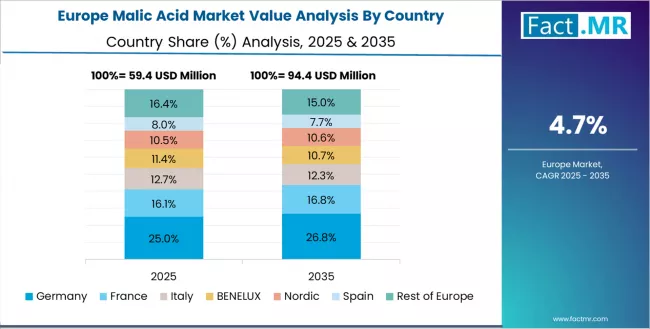
Malic Acid Market Europe Country Market Share Analysis, 2025 & 2035 | Source: Fact.MR
The malic acid market in Europe is projected to grow from USD 68.5 million in 2025 to USD 116.3 million by 2035, registering a CAGR of 5.5% over the forecast period. Germany is expected to maintain its leadership position with a 31.2% market share in 2025, adjusting to 30.8% by 2035, supported by its extensive food processing infrastructure, pharmaceutical manufacturing capabilities, and comprehensive natural ingredient adoption serving major European markets.
France follows with a 22.5% share in 2025, projected to reach 22.8% by 2035, driven by comprehensive beverage industry presence and organic food market development in major regions implementing clean label formulation protocols. UK holds a 19.8% share in 2025, expected to maintain 20.1% by 2035 through ongoing development of natural food ingredient applications and confectionery manufacturing. Italy commands a 14.7% share, while Spain accounts for 8.9% in 2025.
The rest of Europe region is anticipated to gain momentum, expanding its collective share from 2.9% to 3.1% by 2035, attributed to increasing natural ingredient adoption in Nordic countries and emerging Eastern European food processing markets implementing quality ingredient standards.
How does Quality Define Malic Acid Adoption in Germany?
The malic acid market in Germany demonstrates a mature and quality-focused landscape, characterized by sophisticated integration of natural ingredient specifications with food safety technologies across beverage applications, pharmaceutical formulations, and organic food manufacturing. Germany's emphasis on ingredient excellence and comprehensive regulatory compliance drives demand for pharmaceutical-grade malic acid solutions that support holistic clean label initiatives and product quality requirements in daily food manufacturing operations.
The market benefits from strong partnerships between international acidulant producers and domestic food ingredient distributors, including established chemical trading companies and specialty ingredient suppliers, creating comprehensive supply ecosystems that prioritize product quality and technical application support programs. Food manufacturing segments showcase advanced ingredient implementations where natural acidulant capabilities achieve performance improvements through integrated formulation optimization approaches and comprehensive quality assurance programs.
What drives Natural Ingredient Emphasis in France's Market?
The malic acid market in France is characterized by strong natural ingredient presence, with companies like international food ingredient suppliers and regional specialty distributors maintaining significant positions through comprehensive product portfolios and organic-certified formulations for beverage acidification and confectionery applications.
The market is demonstrating a growing emphasis on organic certification and clean label positioning, as French food manufacturers increasingly demand natural acidulants that combine functional performance with consumer-preferred ingredient declarations deployed across quality-focused product segments and organic food categories.
Local formulation innovation and specialty beverage launches are gaining market share through strategic emphasis on natural tartness enhancement, offering specialized capabilities including organic-certified variants and non-GMO verified solutions for comprehensive clean label support. The competitive landscape shows increasing collaboration between acidulant producers and premium food manufacturers, creating integrated supply models that combine technical expertise with organic certification capabilities and sustainable sourcing emphasis.
Competitive Landscape of the Malic Acid Market
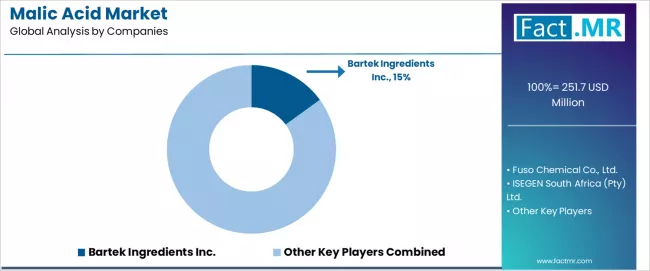
Malic Acid Market Analysis By Company | Source: Fact.MR
The malic acid market features approximately 15-20 meaningful players with moderate concentration, where the top three companies control roughly 35-45% of global market share through established production capacity, integrated supply chains, and multi-regional distribution networks. Competition centers on production efficiency, product purity, and technical service capabilities rather than price competition alone.
Market leaders include Bartek Ingredients Inc., Fuso Chemical Co., Ltd., and ISEGEN South Africa (Pty) Ltd., which maintain competitive advantages through comprehensive production capabilities, established quality assurance systems, and deep expertise in food-grade acidulant manufacturing, creating high customer trust among food manufacturers and pharmaceutical companies seeking reliable ingredient supply. These companies leverage production scale and ongoing process optimization to defend market positions while expanding into adjacent categories including specialty organic acids and fermentation-derived ingredients.
Challengers encompass Asian producers including Anhui Sealong Biotechnology Co., Ltd. and Thirumalai Chemicals, which compete through competitive pricing and expanding production capacity serving regional food processing and pharmaceutical markets through direct manufacturer relationships and trading company partnerships. Specialty chemical producers, including Yongsan Chemicals, Polynt S.p.A., and Lonza, focus on high-purity pharmaceutical grades and specialized applications, offering differentiated capabilities in custom synthesis, analytical support, and regulatory documentation services.
Emerging fermentation technology companies and biotechnology manufacturers create competitive pressure through sustainable production platforms and natural positioning advantages, particularly in high-growth markets including China and India, where biotechnology adoption provides opportunities in clean label ingredient supply and environmentally conscious manufacturing approaches.
Market dynamics favor companies that combine production reliability with technical application support that addresses the complete formulation workflow from ingredient selection through final product optimization. Strategic emphasis on fermentation technology development, capacity expansion projects, and sustainability certification enables differentiation in increasingly competitive food ingredient and pharmaceutical excipient segments across developed and emerging markets.
Global Malic Acid Market - Stakeholder Contribution Framework
Malic acid represents a critical food ingredient category that enables food and beverage manufacturers to optimize product formulations while addressing clean label requirements and natural ingredient preferences without exclusive synthetic acidulant dependency, typically providing functional performance including superior tartness characteristics, enhanced flavor profiles, and improved solubility compared to alternative acidulants alone while ensuring optimal product quality and comprehensive formulation outcomes.
With the market projected to grow from USD 251.7 million in 2025 to USD 428.7 million by 2035 at a 5.5% CAGR, these solutions offer compelling advantages for beverage formulation applications, pharmaceutical excipient uses, and diverse food manufacturing populations seeking natural functional ingredients. Scaling market penetration and application expansion requires coordinated action across food safety policy, production technology standards, ingredient manufacturers, food technologists, and formulation development initiatives.
How Could Governments Spur Local Development and Adoption?
- Food Industry Programs: Include natural ingredient promotion in food policy frameworks, providing targeted support for clean label initiatives in food processing sectors and supporting research institutions through development grants and fermentation technology funding.
- Tax Policy & Investment Support: Implement reduced tax rates for natural food ingredient production, provide tax incentives for companies investing in fermentation biotechnology and quality manufacturing practices, and establish favorable import duty structures that encourage biotechnology substrate procurement over conventional chemical synthesis approaches.
- Regulatory Framework Development: Create streamlined approval processes for new food ingredient applications across beverage and pharmaceutical uses, establish clear identity standards and purity specifications for consumer protection, and develop international harmonization protocols that facilitate cross-border regulatory recognition.
- Food Safety Integration & Standards: Fund integration of natural ingredient standards in food safety frameworks, invest in analytical method development that ensures product quality verification, and establish food contact regulations supporting natural acidulant applications.
- Research & Innovation Support: Establish public-private partnerships for fermentation technology research, support academic-industry collaborations investigating production optimization and application development, and create regulatory environments that encourage innovation in biotechnology manufacturing approaches.
How Could Industry Bodies Support Market Development?
- Quality Standards & Specifications: Define standardized purity specifications for malic acid products across food-grade, pharmaceutical-grade, and technical-grade classifications, establish universal analytical methods and quality control protocols, and create specification databases that formulators can rely on for ingredient selection.
- Market Education & Best Practices: Lead messaging that demonstrates malic acid benefits, emphasizing functional advantages with application-specific guidance, natural positioning opportunities, and realistic performance expectations compared to alternative acidulants.
- Quality Assurance Standards: Develop guidelines for production processes, lot consistency requirements, stability specifications, and label accuracy, ensuring user safety across manufacturing and distribution operations.
- Professional Development: Run training programs for food technologists, formulation scientists, and quality assurance professionals on optimizing malic acid applications, ingredient interactions, and regulatory compliance requirements in diverse formulation settings.
How Could Manufacturers and Technology Players Strengthen the Ecosystem?
- Advanced Product Development: Develop next-generation malic acid products with enhanced purity profiles, optimized particle sizes, and application-specific characteristics that enhance functional effectiveness while reducing formulation complexity and improving process efficiency.
- Production Technology Programs: Provide comprehensive fermentation technology advancement, process optimization studies, and sustainability impact assessments that support production efficiency and informed manufacturing decisions.
- Technical Support Initiatives: Offer comprehensive information about application development, formulation optimization techniques, and performance benchmarking that help customers implement effective solutions aligned with product quality priorities and functional requirements.
- Research & Development Networks: Build comprehensive R&D capabilities, collaborative application development programs, and analytical testing systems that ensure malic acid products maintain high purity standards and consistent quality across diverse application portfolios.
How Could Food Technologists and Formulators Navigate the Market?
- Application-Based Protocol Integration: Incorporate validated malic acid applications into product development workflows, with particular focus on beverage acidification, confectionery tartness enhancement, and pharmaceutical excipient optimization for comprehensive formulation performance.
- Formulation Excellence: Establish comprehensive development programs addressing ingredient selection, solubility optimization, and stability assessment through optimized testing frameworks and performance validation protocols.
- Multidisciplinary Development Models: Implement integrated teams combining food scientists, sensory experts, quality professionals, and regulatory specialists that provide comprehensive product development addressing technical, sensory, and compliance aspects.
- Performance Monitoring Systems: Develop standardized shelf-life testing, sensory evaluation protocols, and quality assessment frameworks that enable continuous formulation optimization and product excellence.
How Could Investors and Financial Enablers Unlock Value?
- Production Capacity Financing: Provide growth capital for established companies like Bartek Ingredients Inc., FUSO CHEMICAL CO., LTD., and emerging producers to fund capacity expansion and fermentation technology initiatives that support market supply.
- Technology Innovation Investment: Back companies developing advanced fermentation platforms, biotechnology optimization systems, and sustainable production technologies that enhance manufacturing efficiency and environmental performance.
- Market Expansion Funding: Finance distribution strategies for acidulant manufacturers establishing operations in high-growth regions including China and India, supporting localization initiatives that address regional requirements while maintaining quality standards.
- Application Development Integration: Support companies developing technical service capabilities, application laboratories, and customer collaboration platforms that enhance formulation support and market penetration through technology-enabled customer engagement.
Key Players in the Malic Acid Market
- Bartek Ingredients Inc.
- Fuso Chemical Co., Ltd.
- ISEGEN South Africa (Pty) Ltd.
- Anhui Sealong Biotechnology Co., Ltd.
- Thirumalai Chemicals Ltd.
- Yongsan Chemicals, Inc.
- Polynt S.p.A.
- Lonza Group Ltd.
- Prinova Group LLC
- Nacalai Tesque, Inc.
Segmentation
Scope of the Report
| Items | Values |
|---|---|
| Quantitative Units | USD 251.7 Million |
| Product | L-Malic Acid, DL-Malic Acid, D-Malic Acid |
| End Use | Food & Beverage, Personal Care & Cosmetics, Pharmaceuticals, Textiles, Metals, Others |
| Regions Covered | Asia Pacific, Europe, North America, Latin America, Middle East & Africa |
| Country Covered | China, India, USA, Germany, Brazil, Saudi Arabia, South Africa, and 40+ countries |
| Key Companies Profiled | Bartek Ingredients Inc., FUSO CHEMICAL CO., LTD., ISEGEN South Africa (Pty) Ltd., Anhui Sealong Biotechnology Co., Ltd., Thirumalai Chemicals, Yongsan Chemicals, Polynt S.p.A., Lonza, Prinova Group LLC, Nacalai Tesque, Inc. |
| Additional Attributes | Dollar sales by product and end use categories, regional adoption trends across Asia Pacific, North America, and Europe, competitive landscape with acidulant producers and specialty chemical manufacturers, product specifications and purity requirements, integration with food formulation programs and pharmaceutical applications, innovations in fermentation technology and natural production methods, and development of specialized applications with clean label positioning and multifunctional ingredient capabilities. |
Source: Fact.MR analysis. Updated Dec 2, 2025
Malic Acid Market by Segments
-
Product :
- L-Malic Acid
- DL-Malic Acid
- D-Malic Acid
-
End Use :
- Food & Beverage
- Personal Care & Cosmetics
- Pharmaceuticals
- Textiles
- Metals
- Others
-
Region :
- Asia Pacific
- China
- Japan
- South Korea
- India
- Australia
- Thailand
- Rest of Asia Pacific
- Europe
- Germany
- UK
- France
- Italy
- Spain
- Denmark
- Sweden
- Norway
- Rest of Europe
- North America
- USA
- Canada
- Mexico
- Latin America
- Brazil
- Argentina
- Rest of Latin America
- Middle East & Africa
- South Africa
- Saudi Arabia
- UAE
- Kuwait
- Rest of Middle East & Africa
- Asia Pacific
Frequently Asked Questions
How big is the malic acid market in 2025?
What will be the size of malic acid market in 2035?
How much will be the malic acid market growth between 2025 and 2035?
What are the key product types in the malic acid market?
Which end use segment to contribute significant share in the malic acid market in 2025?
Who worked on this report


Preview the report firsthand - request a free sample
Free SampleGet the brochure for pricing and purchase details
Download PDF