- Base Value(2025): 0.6 Bn
- Estimated Value(2026): 0.7 Bn
- Forecast Value (2036): 3.4 Bn
- CAGR (2026 - 2036): 17.0%
Butyric Acid Market Forecast and Outlook By Fact.MR
- In 2025, the butyric acid market was valued at USD 0.6 billion.
- Based on Fact.MR analysis, demand for butyric acid is estimated to grow to USD 0.7 billion in 2026 and USD 3.4 billion by 2036.
- FACT.MR projects a CAGR of 17.0% during the forecast period.
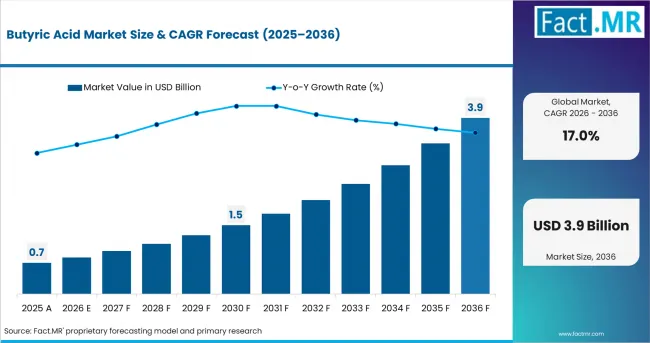
Butyric Acid Market Market Value Analysis | Source: Fact.MR
| Metric | Value |
|---|---|
| Estimated Value in 2026 | USD 0.7 billion |
| Forecast Value in 2036 | USD 3.4 billion |
| Forecast CAGR (2026 to 2036) | 17.0% |
Source: Fact.MR analysis. Updated May 26, 2026
Summary of Butyric Acid Market
- Market Definition
- The market includes both synthetic and renewable butyric acid, along with butyrate salt derivatives, used across animal feed supplementation, food flavouring, pharmaceutical ingredient production, and chemical intermediate manufacturing. These applications span global agriculture, food processing, and life sciences industries.
- Demand Drivers
- Global poultry and swine sector expansion drove record encapsulated butyrate procurement in 2024, as feed manufacturers in Asia and Latin America adopted gut-health additives to reduce antibiotic usage under national antimicrobial resistance reduction mandates.
- EFSA’s 2024 re-evaluation of short-chain fatty acids in animal feed confirmed the safety and efficacy of butyrate supplementation, directly accelerating regulatory approvals and commercial adoption across EU livestock markets.
- Perstorp Holding AB expanded its ButiPEARL encapsulated butyrate production capacity in 2025, targeting pharmaceutical-grade and premium feed-grade butyrate supply to European and North American customers facing tightening quality standards.
- Key Segments Analyzed
- By Type: Synthetic butyric acid leads with approximately 60% share in 2026, driven by lower production cost and large-scale availability across animal feed and chemical applications.
- By Application: Animal feed dominates with approximately 45% share in 2026, driven by widespread butyrate adoption as a gut-health additive in poultry, swine, and dairy feed globally.
- By Form: Liquid form leads with approximately 70% share in 2026, preferred for ease of handling and mixing in large-scale feed processing and industrial applications.
- By End-Use Industry: Agriculture & livestock dominates with approximately 50% share in 2026, driven by rising global demand for feed additives and animal health nutrition.
- By Distribution Channel: Direct sales lead with approximately 60% share in 2026, as large feed manufacturers and chemical buyers prefer bulk procurement for supply reliability and cost efficiency.
- By Geography: India leads at 19.0% CAGR through 2036, driven by rapid poultry and dairy sector growth and rising feed additive adoption across commercial livestock farms.
- Analyst Opinion at FACT.MR
- Shambhu Nath Jha, Principal Analyst at Fact.MR, opines, ‘CXOs will notice a clear split in how value is being created within the butyric acid market. Higher margins are increasingly concentrated in premium, encapsulated butyrate products used in pharmaceutical applications and advanced animal nutrition, where performance and purity are critical.’
- Strategic Implications
- Invest in encapsulated and protected-release butyrate formulation capabilities to capture premium pricing from pharmaceutical and high-performance animal nutrition customers where bioavailability differentiation drives procurement decisions.
- Expand commercial partnerships with feed manufacturers in India and China during the 2026–2029 accelerated livestock sector growth phase to secure long-term supply agreements before competitive capacity tightens in these high-CAGR markets.
- Develop renewable and fermentation-derived butyric acid capacity ahead of anticipated regulatory tightening on synthetic chemical routes in Europe and North America, positioning early entrants to command regulatory-compliance premiums.
- Methodology
- Market sizing based on butyric acid producer revenues and feed additive procurement data, validated with 2024–2025 FAO livestock production statistics and EFSA feed safety opinion records.
- Analysis uses Perstorp, Eastman Chemical, Oxea GmbH, Dow Inc., and Blue Marble Biomaterials public disclosures alongside China livestock industry data and EU animal nutrition regulatory databases.
- Forecasts incorporate livestock sector expansion pipelines, pharmaceutical-grade butyrate adoption trends, renewable chemistry cost trajectories, and expert inputs from feed formulation chemists and chemical procurement managers.
The market is set to generate an absolute opportunity of USD 2.7 billion between 2026 and 2036. Growth is structurally supported by rising animal feed additive demand, pharmaceutical-grade butyrate adoption, and expanding renewable production capacity. Expansion is partially constrained by feedstock price volatility for synthetic routes and limited fermentation-scale infrastructure in emerging markets.
Procurement dynamics are shifting toward encapsulated and protected butyrate formulations offering superior intestinal delivery. Large-scale feed manufacturers and specialty chemical buyers are consolidating procurement from vertically integrated producers. Perstorp Holding AB and Eastman Chemical Company are embedding customised butyrate blends into long-term supply agreements to reduce substitution risk and strengthen customer retention.
India leads with an estimated CAGR of 19.0% through 2036, driven by rapid poultry and dairy sector expansion and rising feed additive adoption across large-scale livestock farms. China follows at 18.5%, anchored by the world’s largest livestock industry and a growing domestic synthetic butyric acid production base. The United States records 17.0%, driven by mature animal nutrition markets and increasing pharmaceutical-grade butyrate demand. Germany records 16.8%, reflecting strong regulatory emphasis on animal health and pharmaceutical-quality chemical standards. Brazil records 15.7%, driven by its globally significant meat export industry and expanding commercial livestock operations. Mature European and North American markets generate upgrade and premiumisation demand rather than volume growth, with regulatory compliance costs constraining faster uptake of renewable grades.
Segmental Analysis
Butyric Acid Market Analysis by Type
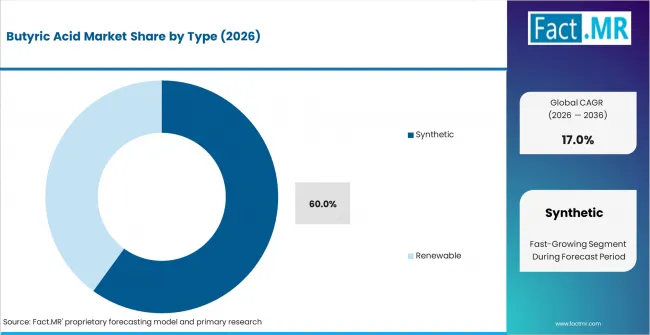
Butyric Acid Market Analysis By Type | Source: Fact.MR
Based on FACT.MR’s butyric acid market report, consumption of synthetic butyric acid is estimated to hold approximately 60% share in 2026. Synthetic grades dominate because established chemical synthesis routes deliver lower per-unit cost and consistent large-scale supply.
- Eastman Chemical Capacity: Eastman Chemical Company disclosed ongoing capacity optimisation for its butyric acid and butyrate ester production lines in Texas in its Q2 2024 earnings release, targeting improved cost positioning for large-volume animal feed and chemical intermediates customers in North America and export markets. [1]
- Blue Marble Biomaterials Renewable Development: Blue Marble Biomaterials expanded fermentation-derived butyric acid production at its Montana facility in 2024, targeting pharmaceutical and food-grade customers requiring non-petrochemical-sourced butyrate with full traceability documentation. [2]
- Renewable Adoption Trend: The European Bioeconomy Strategy progress report published by the European Commission in 2024 highlighted short-chain fatty acid fermentation as a priority bio-based chemical sector, signalling increased policy support and investment in renewable butyric acid capacity across EU member states. [3]
Butyric Acid Market Analysis by Application
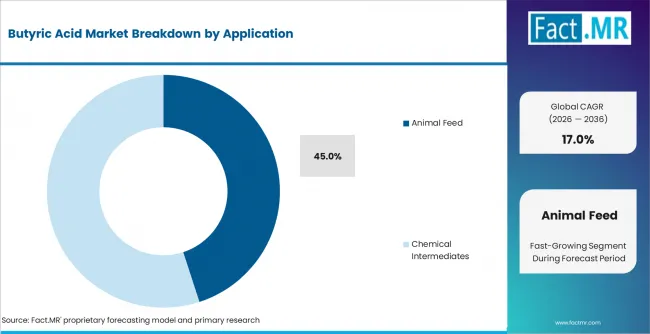
Butyric Acid Market Analysis By Application | Source: Fact.MR
Based on FACT.MR’s butyric acid market report, animal feed is estimated to hold approximately 45% share in 2026. Animal feed leads because butyric acid and encapsulated butyrate salts address gut-health, intestinal integrity, and antimicrobial resistance challenges.
- Perstorp ButiPEARL Expansion: Perstorp Holding AB announced expanded manufacturing capacity for its ButiPEARL encapsulated sodium butyrate product line in Q1 2025, citing rising demand from European and North American feed manufacturers adopting protected butyrate formulations under stricter antibiotic reduction programmes. [4]
- Pharmaceutical-Grade Development: Tokyo Chemical Industry Co., Ltd. expanded its high-purity butyric acid and sodium butyrate reagent catalogue in 2024, targeting pharmaceutical and nutraceutical researchers developing butyrate-based gastrointestinal health and oncology applications requiring certified-grade supply. [5]
- Food & Flavors Application Trend: The Flavour and Fragrance Industry Association Europe reported stable growth in butyrate ester demand for dairy and confectionery flavouring applications in its 2024 annual market assessment, driven by premium food product launches requiring authentic short-chain fatty acid flavour profiles. [6]
Butyric Acid Market Analysis by Form
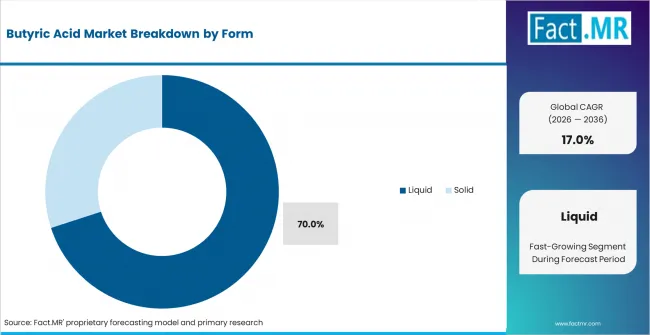
Butyric Acid Market Analysis By Form | Source: Fact.MR
Based on FACT.MR’s butyric acid market report, liquid butyric acid is estimated to hold approximately 70% share in 2026. Liquid form dominates because it integrates directly into existing feed mixing, chemical reactor, and flavour blending operations without additional dissolution steps, reducing handling complexity at industrial processing scale.
- Oxea Liquid Supply Network: Oxea GmbH, a subsidiary of Oman Oil Company, maintained its position as a leading European supplier of liquid butyric acid through its Oberhausen, Germany and Bay City, Texas facilities, serving feed and chemical intermediates customers with bulk liquid tanker supply agreements renewed in 2024. [7]
- Solid Encapsulated Grade Growth: Perstorp Holding AB’s Q1 2025 capacity expansion for ButiPEARL encapsulated sodium butyrate underscored the structural shift toward solid protected-release formats in premium animal nutrition, where encapsulation ensures intestinal delivery efficiency and reduces feed palatability issues associated with raw liquid butyric acid. [4]
- Handling and Logistics Trend: CEFIC, the European Chemical Industry Council, highlighted in its 2024 logistics sustainability report that liquid short-chain fatty acid bulk shipments by ISO tank containers remained the dominant cost-efficient mode for large feed and chemical buyers across Europe and Asia, reinforcing liquid form’s commercial advantage at scale. [8]
Butyric Acid Market Analysis by End-Use Industry
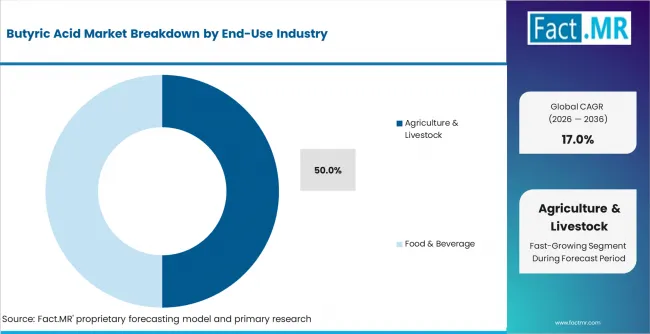
Butyric Acid Market Analysis By End Use Industry | Source: Fact.MR
Based on FACT.MR’s butyric acid market report, agriculture & livestock is estimated to hold approximately 50% share in 2026. This end-use dominates because feed additive demand from poultry, swine, and dairy sectors globally creates the highest-volume, most consistent procurement base for butyric acid and butyrate salt derivatives.
- Feed Manufacturer Procurement: India’s National Action Plan for Antimicrobial Containment progress review in 2024 documented accelerating adoption of butyrate-based gut-health additives among commercial poultry integrators in Maharashtra and Andhra Pradesh, with major integrators including Venky’s India Ltd. expanding certified feed additive procurement programmes. [9]
- Pharmaceutical Sector Development: Dow Inc. reported increased enquiries for pharmaceutical-intermediates-grade butyrate derivatives from API manufacturers in its Q3 2024 investor update, reflecting growing pharmaceutical industry interest in butyric acid’s role as a histone deacetylase inhibitor in oncology and gastrointestinal therapeutic development. [10]
- Chemical Industry End-Use Trend: ICIS Chemical Business 2024 annual review noted stable demand growth for butyric acid as a chemical intermediate in cellulose acetate butyrate, plasticiser, and fragrance ester synthesis, with demand anchored by packaging, coatings, and personal care sector consumption across Europe and North America. [11]
Butyric Acid Market Analysis by Distribution Channel
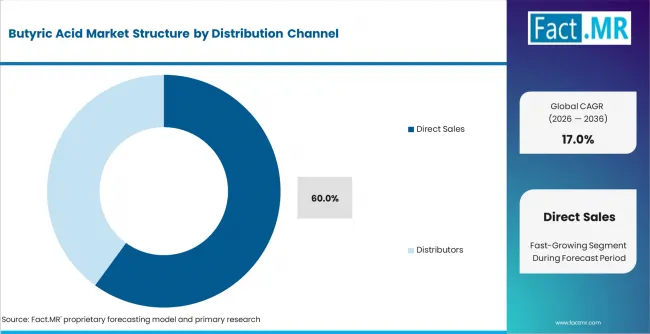
Butyric Acid Market Analysis By Distribution Channel | Source: Fact.MR
Based on FACT.MR’s butyric acid market report, direct sales are estimated to hold approximately 60% share in 2026. Direct sales lead because large feed manufacturers and chemical companies managing multi-tonne annual volumes require guaranteed supply continuity, customised logistics, and negotiated long-term pricing that only direct producer relationships deliver.
- Perstorp Direct Customer Programme: Perstorp Holding AB’s 2024 annual sustainability report disclosed that more than 70% of its butyrate product revenues were generated through direct long-term supply contracts with feed manufacturers and chemical distributors, reflecting the company’s strategy of building direct customer relationships to reduce intermediary margin erosion. [4]
- Distributor Network Expansion: Brenntag SE, a global chemical distributor, expanded its animal nutrition specialty additive portfolio across Southeast Asian markets in 2024, adding encapsulated butyrate products from European producers to its regional distribution offering in Indonesia, Vietnam, and Thailand. [12]
- Online Channel Emergence Trend: Tokyo Chemical Industry Co., Ltd.’s 2024 catalogue expansion included enhanced e-commerce ordering capabilities for research-grade butyric acid and sodium butyrate, reflecting growing demand from pharmaceutical and biotech research buyers preferring direct online procurement of small-volume certified-grade reagents. [5]
Butyric Acid Market Analysis by Distribution Channel
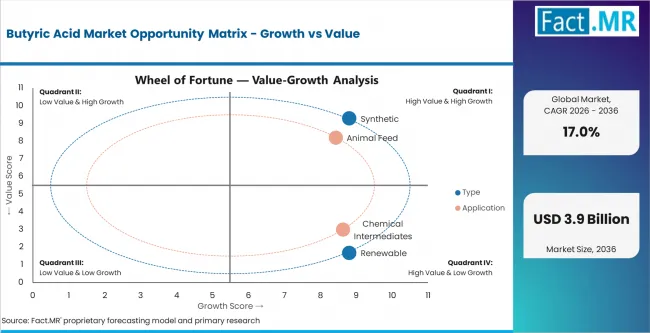
Butyric Acid Market Opportunity Matrix Growth Vs Value | Source: Fact.MR
Based on FACT.MR’s butyric acid market report, direct sales are estimated to hold approximately 60% share in 2026. Direct sales lead because large feed manufacturers and chemical companies managing multi-tonne annual volumes require guaranteed supply continuity, customised logistics, and negotiated long-term pricing that only direct producer relationships deliver.
- Perstorp Direct Customer Programme: Perstorp Holding AB’s 2024 annual sustainability report disclosed that more than 70% of its butyrate product revenues were generated through direct long-term supply contracts with feed manufacturers and chemical distributors, reflecting the company’s strategy of building direct customer relationships to reduce intermediary margin erosion. [4]
- Distributor Network Expansion: Brenntag SE, a global chemical distributor, expanded its animal nutrition specialty additive portfolio across Southeast Asian markets in 2024, adding encapsulated butyrate products from European producers to its regional distribution offering in Indonesia, Vietnam, and Thailand. [12]
- Online Channel Emergence Trend: Tokyo Chemical Industry Co., Ltd.’s 2024 catalogue expansion included enhanced e-commerce ordering capabilities for research-grade butyric acid and sodium butyrate, reflecting growing demand from pharmaceutical and biotech research buyers preferring direct online procurement of small-volume certified-grade reagents. [5]
Regional Analysis
The butyric acid market is assessed across North America, Europe, Asia Pacific, Latin America, and Middle East and Africa, covering 40+ countries with distinct demand profiles shaped by livestock sector scale, antibiotic reduction regulation, pharmaceutical industry development, and feed additive adoption rates. The full report offers market attractiveness analysis by region and country.
.webp "Top Country Growth Comparison Butyric Acid Market Cagr (2026 2036)")
Top Country Growth Comparison Butyric Acid Market Cagr (2026 2036) | Source: Fact.MR
| Country | CAGR (2026 to 2036) |
|---|---|
| India | 19.0% |
| China | 18.5% |
| United States | 17.0% |
| Germany | 16.8% |
| Brazil | 15.7% |
Source: Fact.MR analysis. Updated May 26, 2026
Source: Fact.MR (FACT.MR) analysis, based on proprietary forecasting model and primary research
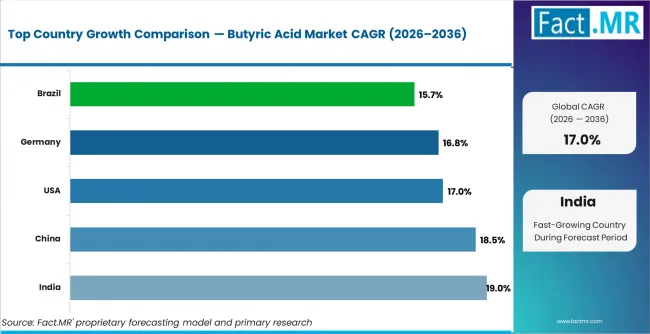
Butyric Acid Market Cagr Analysis By Country | Source: Fact.MR
Asia Pacific Butyric Acid Market Analysis
Asia Pacific is the fastest-growing region for butyric acid, defined by massive livestock sector scale and regulatory-driven antibiotic replacement demand. Key regional producers include domestic Chinese synthetic acid manufacturers and Indian feed additive formulators. Imported encapsulated butyrate from Perstorp and Eastman Chemical competes with growing local production.
- India: India is emerging as one of the fastest-expanding markets, supported by regulatory-led feed additive adoption and rapid livestock sector formalisation, with growth estimated at around 19.0% CAGR through 2036. The 2024 update to the National Action Plan for Antimicrobial Containment incentivised certified feed additive usage across poultry and dairy operations, creating a strong demand base for butyrates. The National Fisheries Development Board’s aquaculture expansion programme is further contributing to demand through aquafeed supplementation.
- China: Demand for butyric acid in China is projected to rise at 18.5% CAGR through 2036. China’s 14th Five-Year Plan livestock modernisation programme continued to support commercial farm scale-up through 2025, driving systemic feed additive adoption across the world’s largest poultry and swine production base. The Ministry of Agriculture and Rural Affairs’ 2024 updated animal feed additive approval list confirmed butyrate salts for commercial use, removing procurement barriers for large integrators.
North America Butyric Acid Market Analysis
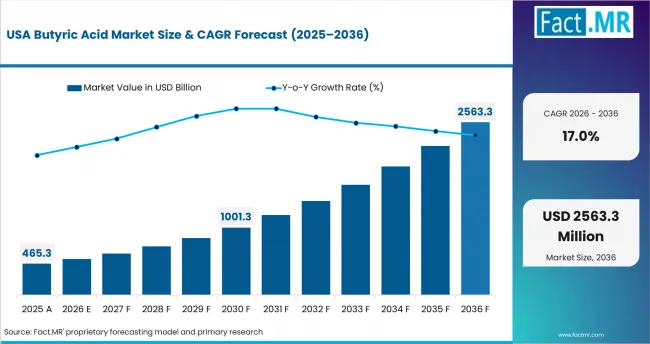
Butyric Acid Market Country Value Analysis | Source: Fact.MR
North America reflects a mature, high-value market for speciality and pharmaceutical-grade butyric acid. Demand is anchored in sophisticated animal nutrition and growing clinical-grade butyrate applications. Eastman Chemical and Dow Inc. are key domestic producers serving both feed and pharmaceutical customers.
- United States: The United States market is characterised by strong regulatory clarity and expanding use across both feed and clinical applications, advancing at an estimated 17.0% CAGR through 2036. Continued GRAS status recognition by the FDA supports stable use in food and pharmaceutical formulations, while antibiotic reduction programmes are driving feed-grade adoption. The USDA’s 2024 updates to the National Organic Program have increased demand for non-synthetic butyrate in organic poultry production.
Fact.MR analysis for North America includes the United States and other regional markets, with insights on regulatory approvals, feed additive usage, and pharmaceutical demand trends.
Europe Butyric Acid Market Analysis
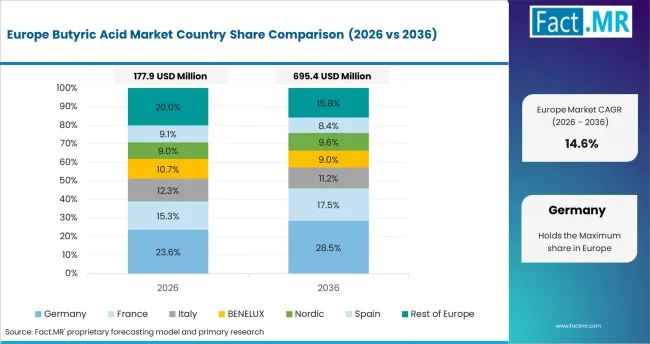
Butyric Acid Market Europe Country Market Share Analysis, 2026 & 2036 | Source: Fact.MR
Europe is the global regulatory benchmark for animal feed additive safety and pharmaceutical chemical standards. Demand is shaped by EU Regulation (EU) 2019/6, EFSA feed safety opinions, and REACH chemical compliance requirements. Perstorp and Oxea GmbH are regionally dominant, serving feed and specialty chemical sectors.
- Germany: Germany’s market is driven by strict regulatory enforcement and high-quality feed production standards, growing at around 16.8% CAGR through 2036. EFSA’s 2024 reconfirmation of butyrate safety has supported increased adoption of premium encapsulated grades among feed manufacturers. The Federal Ministry of Food and Agriculture’s antibiotic reduction initiatives continue to expand certified additive usage in poultry and swine sectors.
Fact.MR analysis for Europe and Latin America includes Germany, Brazil, and other key markets, covering regulatory compliance, feed additive adoption, and pharmaceutical application trends.
Competitive Aligners for Market Players
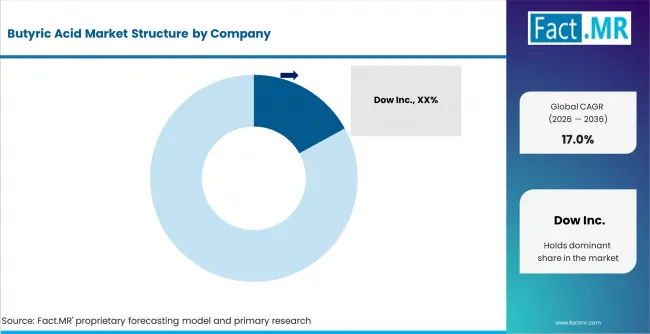
Butyric Acid Market Analysis By Company | Source: Fact.MR
Companies in the butyric acid market are operating in a fast-changing environment. Growth is strong, but competition is becoming more nuanced. It is no longer just about volume. It is about where that volume sits. Synthetic products still dominate the base market. They offer cost advantages and scale. But premium demand is shifting elsewhere. Encapsulated and high-purity butyrates are gaining importance. These products deliver better performance in feed and pharma applications. That is where margins are improving.
Regulation is playing a big role. Antibiotic reduction policies are pushing feed producers toward functional additives. At the same time, pharma buyers are demanding higher purity and consistency. Suppliers that can meet these standards are better positioned. Others may struggle to keep up.
Customer relationships are also evolving. Large feed producers and integrators prefer reliable, long-term partners. They value consistency in supply and quality. This creates an advantage for established players. But it also opens doors for specialists offering differentiated products.
Production strategy matters more than before. Fermentation-based and renewable routes are gaining attention. They align better with sustainability goals and regulatory trends. Companies investing here are building future-ready portfolios. Pricing pressure remains in the commodity segment. This makes innovation even more important. New formulations, better delivery systems, and technical support can help protect margins. Thus, the market is becoming more selective. Success depends on quality, reliability, and the ability to adapt to changing demand.
Key Players
- Dow Inc.
- Eastman Chemical Company
- Oxea GmbH
- Perstorp Holding AB
- Tokyo Chemical Industry Co., Ltd.
- Blue Marble Biomaterials
Bibliography
- [1] Eastman Chemical Company. (Q2 2024). Earnings Release and Investor Update: Butyric Acid and Butyrate Ester Production Capacity Optimisation at Texas Facility. eastman.com/investors
- [2] Blue Marble Biomaterials. (2024). Company Announcement: Expanded Fermentation-Derived Butyric Acid Production Capacity at Montana Facility Targeting Pharmaceutical and Food-Grade Markets. bluemarblebiomaterials.com
- [3] European Commission, Directorate-General for Research and Innovation. (2024). European Bioeconomy Strategy Progress Report 2024: Short-Chain Fatty Acid Fermentation as Priority Bio-Based Chemical Sector. research-and-innovation.ec.europa.eu
- [4] Perstorp Holding AB. (Q1 2025). Product Announcement and Sustainability Report: ButiPEARL Encapsulated Sodium Butyrate Capacity Expansion and Direct Supply Contract Strategy. perstorp.com/news
- [5] Tokyo Chemical Industry Co., Ltd. (2024). Product Catalogue Update: High-Purity Butyric Acid and Sodium Butyrate Reagent Range Expansion and Enhanced E-Commerce Ordering for Research and Pharmaceutical Customers. tcichemicals.com
- [6] Flavour and Fragrance Industry Association Europe. (2024). Annual Market Assessment 2024: Butyrate Ester Demand in Dairy and Confectionery Flavouring Applications. effa.eu
- [7] Oxea GmbH. (2024). Company Overview and Supply Agreement Update: Bulk Liquid Butyric Acid Supply from Oberhausen Germany and Bay City Texas Facilities. oxea-chemicals.com
- [8] CEFIC, European Chemical Industry Council. (2024). Logistics Sustainability Report 2024: ISO Tank Container Shipments for Bulk Liquid Short-Chain Fatty Acids Across Europe and Asia. cefic.org
- [9] Ministry of Agriculture and Farmers Welfare, Government of India. (2024). National Action Plan for Antimicrobial Containment Progress Review 2024: Certified Feed Additive Adoption in Commercial Poultry and Dairy Farms. agriculture.gov.in
- [10] Dow Inc. (Q3 2024). Investor Update: Increased Pharmaceutical Intermediates Enquiries for Butyrate Derivatives Including HDAC Inhibitor Applications in Oncology and Gastrointestinal Therapeutics. dow.com/investors.
This Report Addresses
- Strategic intelligence on butyric acid demand across synthetic and renewable types, animal feed, pharmaceutical, food, and chemical intermediates applications globally.
- Market forecast from USD 0.7 billion in 2026 to USD 3.4 billion by 2036, at a CAGR of 17.0%.
- Opportunity mapping across India and China livestock sector expansion, US pharmaceutical-grade butyrate adoption, Germany premium encapsulated feed additive procurement, and Brazil antibiotic-free export compliance demand.
- Segment analysis by type, application, form, end-use industry, and distribution channel, covering global and regional markets with country-level CAGR forecasts.
- Regional outlook across Asia Pacific, North America, and Europe, with focus on antibiotic reduction regulation, livestock sector modernisation, and pharmaceutical chemical demand.
- Competitive analysis of Perstorp, Eastman Chemical, Oxea GmbH, Dow Inc., Blue Marble Biomaterials, and Tokyo Chemical Industry, covering encapsulation technology, direct supply strategies, and renewable grade development.
- Regulatory analysis covering EU Regulation (EU) 2019/6 antibiotic reduction mandates, EFSA feed additive safety opinions, US FDA GRAS framework, India National Action Plan for Antimicrobial Containment, and Brazil MAPA feed additive standards.
- Report delivered in PDF, Excel datasets, and presentation formats, supported by primary interviews, producer filings, EFSA regulatory records, FAO livestock statistics, and feed additive investment data.
Market Definition
The butyric acid market encompasses synthetic and renewable short-chain fatty acid produced via chemical synthesis or microbial fermentation. It is commercially supplied as liquid or solid butyrate salt derivatives.
Butyric Acid Market Inclusions
Covers global and regional market size forecasts from 2026 to 2036 by type, application, form, end-use industry, and distribution channel. Includes synthetic and renewable butyric acid and derivative butyrate salts used in animal feed, food, pharmaceuticals, and chemical processing across all geographies.
Butyric Acid Market Exclusions
Excludes isobutyric acid and other isomers not commercially interchangeable with n-butyric acid. Omits downstream finished feed formulations and pharmaceutical drug products, focusing strictly on butyric acid and its immediate salt intermediates. Excludes acetic and propionic acids unless present in commercial butyrate blend formats.
Butyric Acid Market Research Methodology
- Primary Research
- Interviews with animal feed additive procurement managers, butyrate formulation chemists, feed mill operators, pharmaceutical chemical sourcing directors, and renewable chemistry process engineers across the United States, Germany, China, India, and Brazil.
- Desk Research
- Analysis of Perstorp, Eastman Chemical, Oxea GmbH, and Dow Inc. public filings, alongside FAO livestock production data, EFSA feed additive opinion records, and 2024–2025 global butyrate market investment disclosures.
- Market-Sizing and Forecasting
- Hybrid model combining top-down revenue estimates from butyric acid producers with bottom-up volume estimates by application, end-use, and form, cross-referenced with average selling prices and encapsulated grade cost benchmarks.
- Data Validation and Update Cycle
- Validated through producer revenue disclosures, FAO livestock output statistics, EFSA regulatory records, and expert interviews with feed additive formulators and chemical distributors. Updated annually.
Segmentation
Scope of the Report
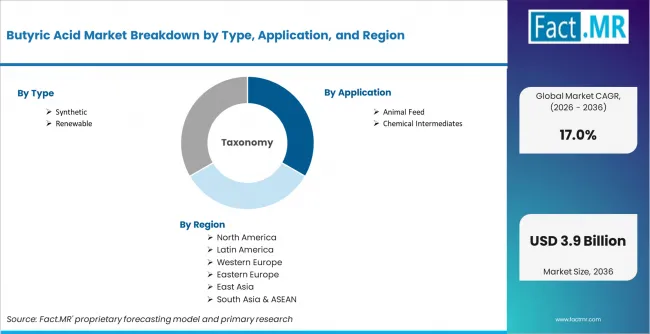
Butyric Acid Market Breakdown By Type, Application, And Region | Source: Fact.MR
| Attribute | Details |
|---|---|
| Quantitative Units | USD 0.7 billion (2026) to USD 3.4 billion (2036), at a CAGR of 17.0% |
| Market Definition | Synthetic and renewable butyric acid and butyrate salt derivatives used in animal feed supplementation, food flavouring, pharmaceutical active ingredient manufacturing, and chemical intermediate production globally. |
| Type Segmentation | Synthetic, Renewable |
| Application Segmentation | Animal Feed, Chemical Intermediates, Food & Flavors, Pharmaceuticals, Other Applications |
| Form Segmentation | Liquid, Solid |
| End-Use Industry Segmentation | Agriculture & Livestock, Food & Beverage, Pharmaceuticals, Chemical Industry |
| Distribution Channel Segmentation | Direct Sales, Distributors, Online Sales |
| Application Coverage | Antibiotic-free poultry and swine feed additive use, pharmaceutical-grade sodium butyrate for API synthesis, dairy and confectionery flavour ester applications, and chemical intermediate synthesis for cellulose acetate butyrate and plasticisers. |
| Regions Covered | North America, Europe, Asia Pacific, Latin America, Middle East and Africa |
| Countries Covered | USA, Canada, Mexico, Germany, UK, France, Italy, Spain, Netherlands, Nordic, BENELUX, China, Japan, South Korea, India, ASEAN, Australia and New Zealand, Brazil, Argentina, Colombia, Saudi Arabia, GCC, Turkey, South Africa, Rest of MEA |
| Key Companies Profiled | Dow Inc., Eastman Chemical Company, Oxea GmbH, Perstorp Holding AB, Tokyo Chemical Industry Co., Ltd., Blue Marble Biomaterials |
| Forecast Period | 2026 to 2036 |
| Approach | Hybrid top-down and bottom-up model using butyric acid producer revenues, feed additive procurement volumes, pharmaceutical-grade butyrate demand data, average selling prices by type and application, and primary interviews with feed formulators and chemical procurement managers. |
Source: Fact.MR analysis. Updated May 26, 2026
Butyric Acid Market By Segment
-
By Type
- Synthetic
- Renewable
-
By Application
- Animal Feed
- Chemical Intermediates
- Food & Flavors
- Pharmaceuticals
- Other Applications
-
By Form
- Liquid
- Solid
-
By End-Use Industry
- Agriculture & Livestock
- Food & Beverage
- Pharmaceuticals
- Chemical Industry
-
By Distribution Channel
- Direct Sales
- Distributors
- Online Sales
-
By Region
- North America
- United States
- Canada
- Mexico
- Latin America
- Brazil
- Argentina
- Colombia
- Rest of Latin America
- Western Europe
- Germany
- United Kingdom
- France
- Italy
- Spain
- Netherlands
- Nordic Countries
- BENELUX
- Rest of Western Europe
- Eastern Europe
- Russia
- Poland
- Hungary
- Balkan and Baltic
- Rest of Eastern Europe
- East Asia
- China
- Japan
- South Korea
- South Asia and Pacific
- India
- ASEAN
- Australia and New Zealand
- Rest of South Asia and Pacific
- Middle East and Africa
- Kingdom of Saudi Arabia
- Other GCC Countries
- Turkey
- South Africa
- Rest of Middle East and Africa
- North America
Frequently Asked Questions
How large is the global butyric acid market in 2025?
What will the market size be in 2026?
What is the projected market size by 2036?
What is the expected CAGR from 2026 to 2036?
Which type segment is poised to lead the market?
Which application segment holds the largest share?
Which end-use industry leads the market?
Which country shows the fastest growth?
Who worked on this report


Preview the report firsthand - request a free sample
Free SampleGet the brochure for pricing and purchase details
Download PDF