- Market Value (2025): USD 161.9 Mn
- Estimated Value (2026): USD 180.0 Mn
- Forecast Value (2036): USD 520.4 Mn
- CAGR (2026-2036): 11.2%
What is the Ellagic Acid Market forecast to be worth by 2036?
USD 180.0 million in 2026 to USD 520.4 million by 2036 at 11.2% CAGR.
- The ellagic acid market reached USD 161.9 million in 2025 as nutraceutical and cosmetic formulators widened their use of plant-derived antioxidant ingredients.
- Demand is projected to increase from USD 180.0 million in 2026 to USD 520.4 million by 2036.
- The market to record 11.2% CAGR from 2026 to 2036.
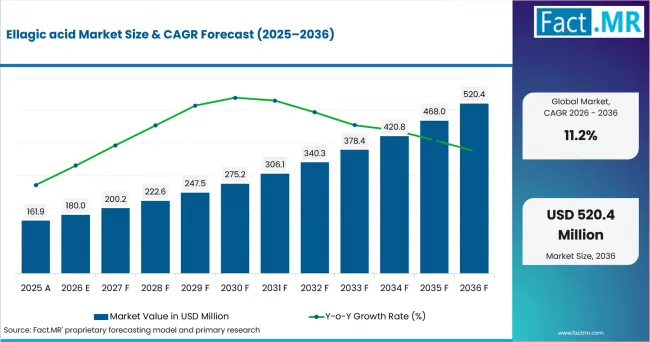
Ellagic Acid Market Value Analysis | Source: Fact.MR
What are the defining numbers behind Ellagic Acid Market growth?
USD 340.4 million absolute opportunity by 2036, led by Natural Ellagic Acid Extracts, Nutraceutical Applications and Direct B2B Sales.
- Demand Drivers in the Market
- Nutraceutical brands need standardized plant extracts because capsule and powder lines depend on repeatable active content across batches.
- Cosmetic formulators value ellagic acid where antioxidant positioning must be backed by ingredient identity and skin-use documentation.
- Food and beverage manufacturers use soluble and powder formats when they need polyphenol claims without changing the base recipe.
- Pharmaceutical research teams test purified material because early anti-inflammatory and anti-cancer studies require consistent analytical grades.
- Key Segments Analyzed
- By Product: Natural Ellagic Acid Extracts are expected to hold 68.4% share in 2026 due to stronger buyer preference for fruit and plant-derived extracts.
- By Application: Nutraceutical Applications are projected to account for 52.9% share in 2026 as supplement brands use polyphenol ingredients in capsules and powders.
- By End Use: Nutraceutical Companies are anticipated to capture 61.7% share in 2026 owing to direct formulation demand and repeat B2B purchasing.
- By Technology: Extraction Technology is estimated to represent 44.6% share in 2026 because natural extract producers need scalable recovery and purification steps.
- By Formulation: Powder Formulations are forecast to hold 58.3% share in 2026 as bulk powder is easier to standardize, ship, and blend.
- By Distribution Channel: Direct B2B Sales are expected to account for 63.9% share in 2026 since formulators require specifications and samples before purchase.
- Analyst Opinion at Fact.MR
- Shambhu Nath Jha, Senior Consultant at Fact.MR, states, “Ellagic acid suppliers are being judged less on catalogue availability and more on proof of source and purity. Residual-solvent control is becoming part of the first buyer review. The next acceptance cycle is expected to favor producers that link extraction chemistry with finished-format stability. Formulators should look for verified botanical origin and repeatable assay data before approving capsule or cosmetic systems.”
- Strategic Implications
- Ingredient producers should publish clear assay ranges and residue controls before negotiating annual supply contracts.
- Supplement brands should qualify both natural extracts and purified forms to reduce reformulation risk.
- Cosmetic formulators should separate antioxidant positioning from unapproved treatment claims in product documentation.
- Distributors should maintain lot-level certificates because direct B2B customers ask for traceability before repeat orders.
Germany is projected to record 12.9% CAGR from 2026 to 2036 due to supplement e-commerce and strict documentation. Brazil is anticipated to post 11.8% CAGR as natural ingredient sourcing and Anvisa regularization shape demand. The USA is forecast to advance at 10.6% CAGR, supported by supplement use and FDA quality oversight. The UK is estimated to hold 9.5% CAGR as food supplement guidance and label trust guide formulations. Japan is expected to register 8.4% CAGR, led by functional food filings and cosmetic quality discipline.
How does the Ellagic Acid Market break down by segment?
Natural Ellagic Acid Extracts lead Product at 68.4%; Nutraceutical Applications lead Application at 52.9%.
Which product dominates?
Natural Ellagic Acid Extracts are projected to account for 68.4% share in 2026.
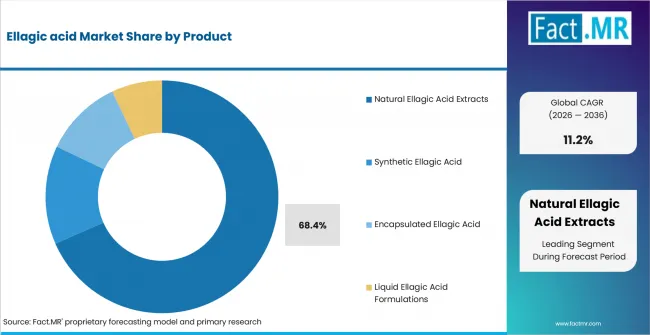
Ellagic Acid Market Analysis By Product | Source: Fact.MR
Natural extracts lead product demand because formulators position ellagic acid as a plant-derived polyphenol. Plant derived extracts suit capsule and powder applications where source identity is central to the label. Synthetic ellagic acid serves research and pharmaceutical development where tight purity carries more weight.
What leads the Application segment?
Nutraceutical Applications are expected to hold 52.9% share in 2026.
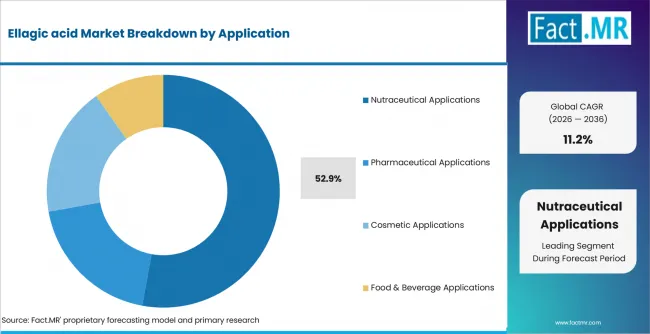
Ellagic Acid Market Analysis By Application | Source: Fact.MR
Nutraceutical applications account for the main commercial route because ellagic acid fits antioxidant supplement formats. Dietary supplement formulations use standardized extracts where brands need active content and batch records. Functional food additives remain smaller but useful in powder blends and fortified concepts.
How does End Use shape demand?
Nutraceutical Companies are anticipated to lead with 61.7% share in 2026.
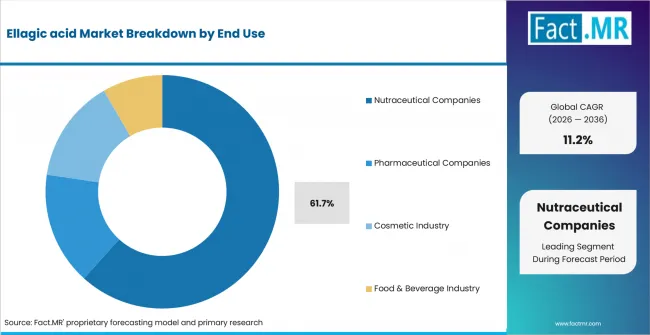
Ellagic Acid Market Analysis By End Use | Source: Fact.MR
Nutraceutical companies form the largest end-use base because they convert raw ellagic acid into supplement formats. Capsules and bulk powder blends account for much of this use. Supplement manufacturers need documentation on source and assay before approving suppliers. Functional food producers use smaller volumes when the ingredient fits taste and stability needs.
What supports Extraction Technology within Technology?
Extraction Technology is estimated to represent 44.6% share in 2026.
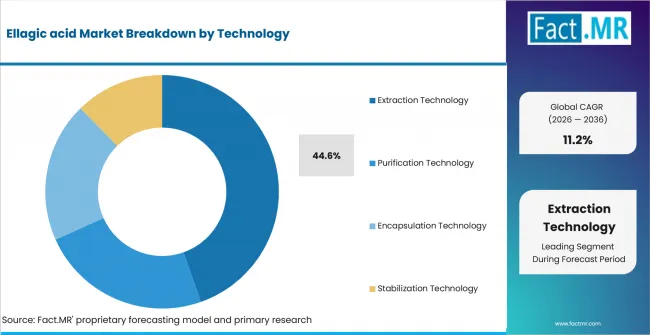
Ellagic Acid Market Analysis By Technology | Source: Fact.MR
Extraction technology leads because natural ellagic acid depends on plant material, hydrolysis control, and downstream purification. Solvent extraction systems remain widely used where cost and yield guide production decisions. Chromatographic separation and membrane filtration support higher purity grades.
Which formulation leads demand?
Powder Formulations are forecast to hold 58.3% share in 2026.
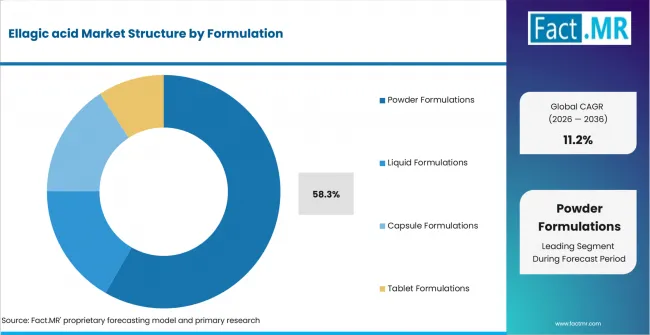
Ellagic Acid Market Analysis By Formulation | Source: Fact.MR
Powder formulations lead because they simplify B2B handling and fit capsules, tablets, and premix systems. Bulk powder extracts are standardized by assay and packed with certificates of analysis. Liquid formulations and emulsified systems serve cosmetics and beverages but face more stability work.
What leads Distribution Channel?
Direct B2B Sales are expected to account for 63.9% share in 2026.
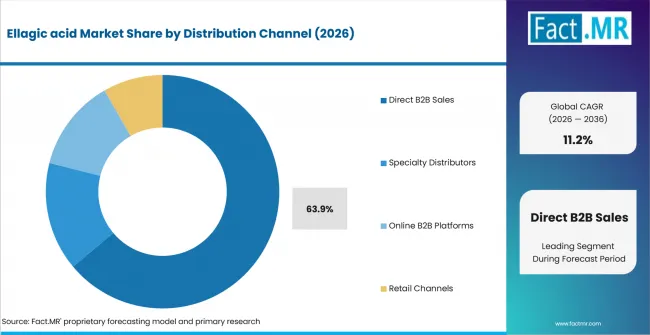
Ellagic Acid Market Analysis By Distribution Channel | Source: Fact.MR
Direct B2B sales lead because ingredient approval depends on samples, technical files, and buyer audits. Pharma supply contracts require tighter documentation and longer qualification. Online B2B platforms help discovery but do not replace direct technical review for regulated formulations.
What is accelerating Ellagic Acid Market adoption, and what is holding it back?
Natural extract demand drives it; safety documentation restrains it.
Drivers Impact Analysis
| DRIVER | (~) % IMPACT ON CAGR | GEOGRAPHIC RELEVANCE | IMPACT TIMELINE |
|---|---|---|---|
| Natural polyphenol positioning | +2.8% | Germany, USA, UK | Short term (<= 2 years) |
| Nutraceutical powder growth | +2.4% | USA, Brazil, Japan | Short term (<= 2 years) |
| Cosmetic antioxidant use | +1.8% | Germany, Japan, UK | Medium term (2-4 years) |
| Direct B2B qualification | +1.5% | Global ingredient hubs | Medium term (2-4 years) |
| Research-grade purification | +1.0% | USA, Germany, Japan | Long term (>= 4 years) |
Source: Fact.MR analysis. Updated Aug 13, 2026
- Natural polyphenol positioning: Brands prefer plant-derived antioxidant inputs tied to pomegranate and berry sources. Destatis reported on March 11, 2025 that 21% of people in Germany aged 16 to 74 said they had bought medicines or dietary supplements online in 2024.
- Nutraceutical powder growth: Powder and capsule formulators need stable ingredients that blend cleanly. NIH's Office of Dietary Supplements states that the dietary-supplement market includes more than 100,000 products.
- Cosmetic antioxidant use: Skin care formulators use ellagic acid in plant-active concepts when claims remain cosmetic and documentation is clear. Commission Regulation (EU) 2025/877 of May 12, 2025 amended EU cosmetic rules for certain CMR-classified substances.
Opportunity Impact Analysis
| OPPORTUNITY | (~) % IMPACT ON CAGR | GEOGRAPHIC RELEVANCE | IMPACT TIMELINE |
|---|---|---|---|
| Standardized extract dossiers | +1.3% | Germany, USA, UK | Short term (<= 2 years) |
| Low-residue extraction claims | +1.1% | Germany, Japan | Medium term (2-4 years) |
| Cosmetic encapsulation systems | +0.9% | Japan, UK, USA | Medium term (2-4 years) |
| Functional beverage trials | +0.6% | Brazil, USA, Japan | Long term (>= 4 years) |
Source: Fact.MR analysis. Updated Aug 13, 2026
- Standardized extract dossiers: Suppliers with assay history and plant-source records are better positioned for technical review. FDA's May 15, 2026 warning letter to Meta Labs cited a December 8-18, 2025 dietary-supplement inspection and serious CGMP violations under 21 CFR Part 111. The warning letter demonstrates FDA enforcement of supplement specification and CGMP requirements; it does not specifically concern ellagic acid.
- Low-residue extraction claims: Suppliers should substantiate residue limits and analytical methods with product-specific documentation before making low-residue claims.
- Functional beverage trials: Liquid and soluble ellagic-acid formats as an opportunity beyond capsules. Commercial trials still depend on taste, color, solubility and stability performance; broad agricultural-production statistics do not directly measure this opportunity.
Restraints Impact Analysis
| RESTRAINT | (~) % IMPACT ON CAGR | GEOGRAPHIC RELEVANCE | IMPACT TIMELINE |
|---|---|---|---|
| Health-claim limits | -1.3% | USA, UK, Germany, Japan | Short term (<= 2 years) |
| Raw-material variability | -1.0% | Brazil, Asia sourcing hubs | Short term (<= 2 years) |
| Residual-solvent review | -0.8% | Germany, USA, Japan | Medium term (2-4 years) |
| Limited clinical proof | -0.6% | Global | Long term (>= 4 years) |
Source: Fact.MR analysis. Updated Aug 13, 2026
- Raw-material variability: Plant extracts can vary by source and processing method, so botanical suppliers need source identity, assay specifications and repeat testing before approval. Broad national grain-production totals do not directly measure the availability or consistency of ellagic-acid source botanicals.
- Residual-solvent review: Solvent extraction remains practical for many suppliers. Buyers are expected to request residue limits and analytical methods before approval, and suppliers should support these controls with solvent-specific standards rather than general cosmetic CMR rules.
Which countries are scaling Ellagic Acid Market fastest?
- The country comparison spans 4.5 percentage points and forms three practical growth bands across the forecast period.
- Germany remains 1.1 percentage points above Brazil because supplement e-commerce and EU cosmetic review increase the value of clean ingredient files.
- Brazil remains 1.2 percentage points above the USA with farm raw-material depth and Anvisa notification rules shaping supplier access.
- The USA remains 1.1 percentage points above the UK as supplement scale supports demand but FDA quality oversight keeps qualification strict.
- The UK remains 1.1 percentage points above Japan where official food supplement guidance and label trust favour cautious product positioning.
Comparable CAGRs create different entry conditions due to channel structure, product-claim rules, and source documentation. Full report coverage includes North America, Latin America, Europe, East Asia, South Asia and Pacific, Middle East and Africa.
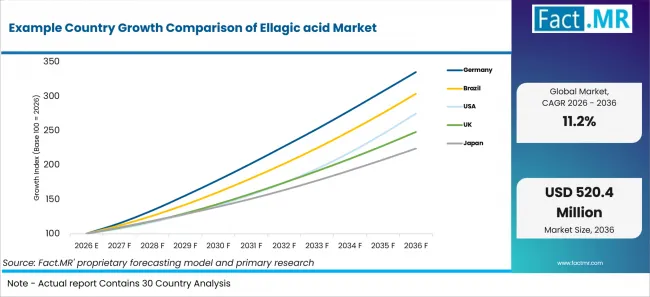
Example Country Growth Comparison Of Ellagic Acid Market | Source: Fact.MR
| Country | CAGR (2026-2036) |
|---|---|
| Germany | 12.9% |
| Brazil | 11.8% |
| USA | 10.6% |
| UK | 9.5% |
| Japan | 8.4% |
Source: Fact.MR analysis. Updated Aug 13, 2026
What supports Germany adoption?
12.9% CAGR, supported by online supplement buying and strict documentation.
German ingredient buyers treat ellagic acid as a regulated botanical input before it reaches supplement or cosmetic shelves. Destatis reported on March 11, 2025 that 21% of people in Germany aged 16 to 74 said they had bought medicines or dietary supplements online during the three months preceding the 2024 survey. This supports supplement-channel context, while suppliers still need assay and residual-solvent documentation before technical approval.
How is Brazil scaling demand?
11.8% CAGR, backed by natural ingredient sourcing and Anvisa regularization.
Brazil's position is shaped by tighter supplement review. The regulatory step to favor suppliers that provide clear source identity, assay and safety documentation for Brazilian buyers.
What supports USA adoption?
10.6% CAGR, supported by supplement scale and FDA quality oversight.
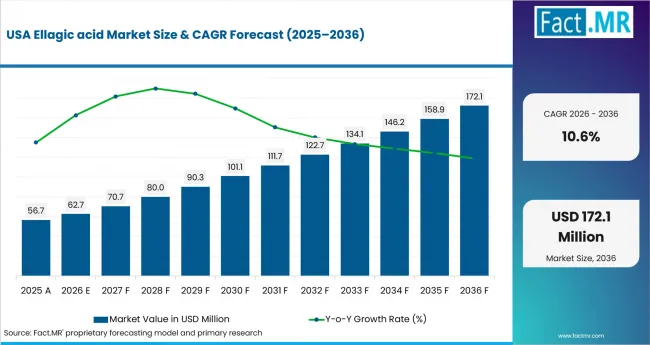
Ellagic Acid Market Country Value Analysis | Source: Fact.MR
The USA offers a large supplement base but gives suppliers little room for weak documentation. NIH's Office of Dietary Supplements states that the U.S. dietary-supplement market includes more than 100,000 products. FDA's May 15, 2026 warning letter to Meta Labs cited a December 8-18, 2025 dietary-supplement inspection and serious CGMP violations under 21 CFR Part 111. These sources support broad supplement scale and quality oversight; neither specifically measures ellagic-acid demand.
How does the UK develop demand?
9.5% CAGR, shaped by food supplement guidance and label trust.
UK demand is tied to cautious supplement positioning and clear consumer-facing labelling. The Food Standards Agency reported that Wave 11 surveyed 5,898 adults aged 16 and over in England, Wales and Northern Ireland between May 19 and August 7, 2025. It found that 86% of respondents were confident that information on food labels is accurate. GOV.UK guidance published on June 25, 2026 states that food supplements should not carry claims to prevent, treat or cure medical conditions. Ellagic acid formulators therefore need evidence-led wording before approval.
What supports Japan’s growth?
8.4% CAGR, led by functional food filings and quality review.
Japan’s market develops through functional food filings and careful review of ingredient evidence. Manufacturers focus on documented safety, functionality and labeling compliance, while structured regulatory processes encourage suppliers to maintain consistent quality standards and strengthen supporting evidence for functional food products.
Which suppliers have verifiable Ellagic Acid offerings?
Aktin Chemicals, Merck KGaA (Sigma-Aldrich), INDOFINE Chemical Company, FUJIFILM Wako, TCI and Sabinsa show relevant supplier positions.
Official supplier sources confirm ellagic-acid participation across the listed company set. Aktin Chemicals lists ellagic acid at a minimum 98% specification; FUJIFILM Wako and Tokyo Chemical Industry list ellagic acid for laboratory or research use; INDOFINE lists ellagic acid in its Natural Products Catalog; and Sabinsa lists pomegranate extracts standardized to 40% and 90% ellagic acid. These sources confirm product participation, not comparative market-share leadership
Which companies are the key providers?
Key companies include Aktin Chemicals, Merck KGaA (Sigma-Aldrich), INDOFINE Chemical Company, FUJIFILM Wako, TCI and Sabinsa.
- Aktin Chemicals, Inc.
- Merck KGaA (Sigma-Aldrich)
- INDOFINE Chemical Company, Inc.
- FUJIFILM Wako Pure Chemical Corporation
- Tokyo Chemical Industry Co., Ltd.
- Sabinsa Corporation
Bibliography
- Agência Nacional de Vigilância Sanitária. (2025, September 22). Produtos irregulares de Cannabis são proibidos.
- Agência Nacional de Vigilância Sanitária. (2025, April 23). Creatinas: Anvisa divulga resultados de análise em suplementos.
- Commission Regulation (EU) 2025/877 of 12 May 2025 amending Regulation (EC) No 1223/2009 of the European Parliament and of the Council as regards the use in cosmetic products of certain substances classified as carcinogenic, mutagenic or toxic for reproduction. (2025). Official Journal of the European Union, L, 2025/877.
- Statistisches Bundesamt (Destatis). (2025, March 11). 21 % der 16- bis 74-Jährigen kaufen Arzneimittel oder Nahrungsergänzungsmittel online [21% of 16- to 74-year-olds buy medicines or dietary supplements online].
- Food Standards Agency. (2026, March 31). Food and You 2 Survey: Wave 11 [Data set].
- Office of Dietary Supplements. (2025). Strategic plan FY 2025–2029: A blueprint for a coordinated dietary supplement research agenda at NIH. National Institutes of Health.
- U.S. Food and Drug Administration. (2026, May 15). Meta Labs Pharmaceuticals, LLC—Warning letter (MARCS-CMS 725130).
This Report Answers
- The report provides strategic intelligence on the Ellagic Acid Market across Product and Application choices that shape natural antioxidant ingredient programs.
- Segment analysis covers Natural Ellagic Acid Extracts and Nutraceutical Applications as the share leaders within the 2026 market.
- Country outlook evaluates Germany and Brazil alongside the USA, UK, and Japan.
- Competitive analysis profiles Aktin Chemicals and Merck KGaA (Sigma-Aldrich) alongside INDOFINE Chemical Company, FUJIFILM Wako, TCI, and Sabinsa.
- Technology assessment covers Extraction Technology and Purification Technology. Encapsulation Technology and Stabilization Technology complete the process view.
What does the Ellagic Acid Market cover?
Ellagic acid is a polyphenol ingredient used in supplements and cosmetics. Food and research-grade pharmaceutical systems are included when ellagic acid is bought as an ingredient input. The market operates near botanical extracts, dietary supplements, nutraceuticals, and herbal supplements because buyers often compare plant-source documents before selecting a supplier.
Coverage includes natural and synthetic ellagic acid where the product is sold as an ingredient input. It also covers adjacent use in pomegranate peel polyphenol, personal care active ingredients, and skin care supplements when demand depends on ellagic acid content or antioxidant positioning.
What is included in the scope?
The scope includes powder and liquid formulations. Capsule and tablet formats are included when ellagic acid is sold as an ingredient input. Coverage also includes direct B2B sales, specialty distributors, and online B2B platforms. It includes related demand from antioxidant-rich skincare and dried fruit extracts where ellagic acid-rich inputs support finished formulations.
The scope includes natural extract production and synthetic supply. Encapsulation, purification, and stabilization are included when they support ellagic acid formulations. Nutraceutical, pharmaceutical, cosmetic, and food companies are included when they buy ellagic acid as a functional input.
What is excluded from the scope?
General fruit juice, whole fruit, and retail pomegranate products remain outside the scope unless the product is sold as an ellagic acid ingredient. Finished consumer supplements are excluded when the analysis cannot separate ellagic acid ingredient demand from brand-level retail sales. Company revenue without a clear connection to ellagic acid sourcing, extraction, formulation, or distribution is also excluded.
How Was the Analysis Built?
The analysis draws on 120+ sources, 35+ company portfolios, 25+ countries and more than 20 industry interviews.
- Primary Research: Primary research includes discussions with ingredient manufacturers, extract suppliers, distributors, and formulators. These conversations examine purchasing priorities, approval requirements, and factors that influence market acceptance.
- Desk Research: Desk research covers government statistics, regulatory publications, company filings and trade data. Industry associations and standards sources are also reviewed. Key public sources cited in this report are documented in the bibliography.
- Market Sizing and Forecasting: Market estimates combine historical performance, demand indicators, and pricing trends. Segment shares, company participation, country-level growth, adoption patterns, and barriers are then reviewed together.
- Data Validation and Update Cycle: Findings are validated by comparing primary interviews with public data and company activity. Regular updates review product activity, partnerships, approvals, and procurement trends.
Segmentation
What is the report’s scope and coverage?
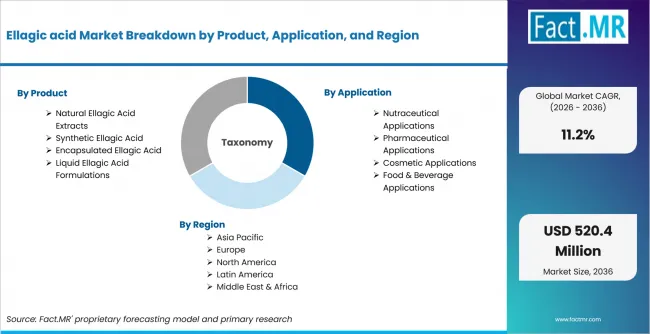
Ellagic Acid Market Breakdown By Product, Application, And Region | Source: Fact.MR
| Attribute | Details |
|---|---|
| Quantitative Units | USD million |
| Market Definition | Purified ellagic acid and ellagic acid-rich extracts used in nutraceutical, food, cosmetic, and pharmaceutical formulations. |
| Product | Natural Ellagic Acid Extracts; Synthetic Ellagic Acid; Encapsulated Ellagic Acid; Liquid Ellagic Acid Formulations |
| Application | Nutraceutical Applications; Pharmaceutical Applications; Cosmetic Applications; Food & Beverage Applications |
| End Use | Nutraceutical Companies; Pharmaceutical Companies; Cosmetic Industry; Food & Beverage Industry |
| Technology | Extraction Technology; Purification Technology; Encapsulation Technology; Stabilization Technology |
| Formulation | Powder Formulations; Liquid Formulations; Capsule Formulations; Tablet Formulations |
| Distribution Channel | Direct B2B Sales; Specialty Distributors; Online B2B Platforms; Retail Channels |
| Regions Covered | North America; Latin America; Europe; East Asia; South Asia and Pacific; Middle East and Africa |
| Countries Covered | Germany; Brazil; USA; UK; Japan |
| Key Companies Profiled | Aktin Chemicals, Inc.; Merck KGaA (Sigma-Aldrich); INDOFINE Chemical Company, Inc.; FUJIFILM Wako Pure Chemical Corporation; Tokyo Chemical Industry Co., Ltd.; Sabinsa Corporation |
| Forecast Period | 2026 to 2036 |
| Approach | Hybrid top-down and bottom-up approach using supplement demand; botanical sourcing; regulatory review; B2B procurement; country adoption; and company portfolio review. |
Source: Fact.MR analysis. Updated Aug 13, 2026
How is the market segmented?
-
By Product
- Natural Ellagic Acid Extracts
- Plant Derived Extracts
- Wood Derived Extracts
- Synthetic Ellagic Acid
- Chemically Synthesized Forms
- Standard Purity Grades
- Encapsulated Ellagic Acid
- Liposomal Formulations
- Powder Based Encapsulation
- Liquid Ellagic Acid Formulations
- Soluble Liquid Extracts
- Suspension Based Formulations
- Natural Ellagic Acid Extracts
-
By Application
- Nutraceutical Applications
- Dietary Supplement Formulations
- Functional Food Additives
- Pharmaceutical Applications
- Anti Cancer Research Applications
- Anti Inflammatory Drug Systems
- Cosmetic Applications
- Skin Care Formulations
- Personal Care Products
- Food & Beverage Applications
- Functional Beverage Industry
- Food Fortification Applications
- Nutraceutical Applications
-
By End Use
- Nutraceutical Companies
- Supplement Manufacturers
- Functional Food Producers
- Pharmaceutical Companies
- Drug Development Firms
- Clinical Research Organizations
- Cosmetic Industry
- Skincare Manufacturers
- Personal Care Brands
- Food & Beverage Industry
- Health Beverage Companies
- Food Processing Companies
- Nutraceutical Companies
-
By Technology
- Extraction Technology
- Solvent Extraction Systems
- Supercritical Fluid Extraction
- Purification Technology
- Chromatographic Separation
- Membrane Filtration Systems
- Encapsulation Technology
- Nano Encapsulation Systems
- Spray Drying Technology
- Stabilization Technology
- Antioxidant Stabilization
- Formulation Stabilizers
- Extraction Technology
-
By Formulation
- Powder Formulations
- Bulk Powder Extracts
- Standardized Powder Forms
- Liquid Formulations
- Concentrated Liquid Extracts
- Emulsified Liquid Systems
- Capsule Formulations
- Hard Capsule Systems
- Soft Gel Capsules
- Tablet Formulations
- Compressed Tablet Systems
- Chewable Tablets
- Powder Formulations
-
By Distribution Channel
- Direct B2B Sales
- Pharma Supply Contracts
- Nutraceutical Supply Chains
- Specialty Distributors
- Health Ingredient Distributors
- Pharmaceutical Distributors
- Online B2B Platforms
- Digital Ingredient Marketplaces
- Manufacturer Direct Portals
- Retail Channels
- Health Stores
- E-commerce Retail
- Direct B2B Sales
-
By Region
- North America
- Latin America
- Western Europe
- Eastern Europe
- East Asia
- South Asia and Pacific
- Middle East & Africa
Frequently Asked Questions
How big is the ellagic acid market in 2026?
What is the CAGR of the ellagic acid market from 2026 to 2036?
Which product leads the ellagic acid market?
Which application leads the ellagic acid market?
Who are the leading companies in the ellagic acid market?
Who worked on this report


Preview the report firsthand - request a free sample
Free SampleGet the brochure for pricing and purchase details
Download PDF