- Market Value (2025): USD 5.48 Bn
- Estimated Value (2026): USD 13.4 Bn
- Forecast Value (2036): USD 5.94 Bn
- CAGR (2026-2036): 8.5%
What is the Wi-Fi Front End Modules Market forecast to be worth by 2036?
USD 5.94 billion in 2026 to USD 13.4 billion by 2036 at an 8.5% CAGR.
- The Wi-Fi front end modules market stood at USD 5.48 billion in 2025, with smartphone and home router programs taking most of the module volume.
- By 2036 the market will reach USD 13.4 billion, up from USD 5.94 billion in 2026, as tri-band Wi-Fi 7 designs push front-end content per device higher.
- An 8.5% CAGR will come from both rising unit counts and richer modules, since each Wi-Fi 7 device carries more amplification and filtering than the Wi-Fi 6 model it replaces.
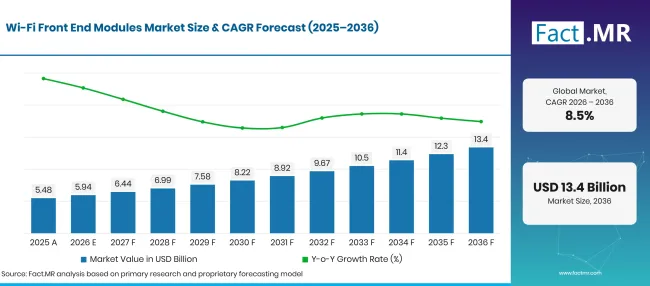
Wi Fi Front End Modules Market Forecast Global | Source: Fact.MR
| Year | Basis | Market Value (USD billion) |
|---|---|---|
| 2025 | Actual | 5.48 |
| 2026 | Estimate | 5.94 |
| 2036 | Forecast | 13.4 |
| CAGR 2026 to 2036 | Forecast period | 8.5% |
Source: Fact.MR analysis. Updated Nov 5, 2026
What are the defining numbers behind Wi-Fi Front End Modules Market growth?
The 2026 to 2036 period adds USD 7.5 billion in new value, led by power amplifier content in smartphones and 6 GHz capable access points.
- Demand Drivers in the Market
- The connected user base keeps widening. About 6 billion people used the internet in 2025, roughly three quarters of the world population [1]. Much of that traffic reaches the final device over Wi-Fi, which keeps phones, laptops and gateways in steady production.
- Regulators are giving Wi-Fi more room at 6 GHz. In January 2026 the US Federal Communications Commission created a geofenced variable power class of unlicensed devices that can run indoors and outdoors at higher power than earlier categories [2]. Higher power and outdoor use call for linear power amplifiers and sharp filters at the front end.
- Wi-Fi 7 portfolios are being refreshed for efficiency. Skyworks introduced second-generation Wi-Fi 7 front-end modules in October 2025 that run from supplies as low as 3.15V [3]. Lower supply voltage cuts heat in compact routers and extends battery life in handsets.
- Device makers want fewer parts on the board. Integrated modules that combine the amplifier, switch and filter in one package shorten design cycles and free space for batteries and antennas.
- Key Segments Analyzed
- By Component: Power Amplifiers will hold 28.3% share in 2026 as they set transmit range and must stay linear across the wide channels used by Wi-Fi 7.
- By Application: Smartphones will capture 35.8% of 2026 value, given the sheer volume of handsets shipped each year with dual-band or tri-band Wi-Fi.
- By Frequency Band: 5 GHz will account for 49.3% of 2026 revenue, since nearly every current router, phone and laptop uses this band for high-throughput traffic.
- By End-User: Consumer Electronics will command 47.6% of 2026 sales, owing to the phones, PCs, TVs and smart home products that carry Wi-Fi as a standard feature.
- Analyst Opinion at Fact.MR
- Shambhu Nath Jha, Principal Consultant at Fact.MR, states, “Every move to a new Wi-Fi generation raises the work done by the front end, and Wi-Fi 7 adds a third band with very strict linearity targets. Handset and router makers will pay for modules that hold signal quality at lower supply voltage, because heat and battery life now limit product design. Suppliers that pair 6 GHz power amplifiers with matching filters in one package will win the platform slots that decide volume through 2036.”
- Strategic Implications
- Module suppliers should qualify 5 GHz and 6 GHz parts as matched sets, since router makers now design tri-band boards around a single vendor reference.
- Semiconductor companies should invest in integrated amplifier, switch and filter packages, which cut board area and simplify RF layout for phone makers.
- Smartphone makers should test front-end efficiency at low supply voltage early in a program, as Wi-Fi power draw affects battery claims and thermal limits.
- Networking equipment developers should plan outdoor and higher-power 6 GHz products for regions where regulators now allow them.
The five countries cover a 3.7-point spread, and regulation explains most of the order. The United States leads at 10.0%, where new 6 GHz device rules open outdoor and higher-power Wi-Fi products. Japan follows at 9.3%, 0.7 points behind, as the government prepares wider 6 GHz access and an electronics base builds modules close to the phone makers. Brazil comes in at 8.4%, a further 0.9 points lower, with near-universal household internet now pulling in more smart devices. The United Kingdom reaches 7.7%, helped by automated frequency coordination for 6 GHz Wi-Fi. Germany trails at 6.3%, 1.4 points under the United Kingdom, because its fibre rollout is still at an early stage and router upgrades follow fibre.
How does the Wi-Fi Front End Modules Market break down by segment?
Power Amplifiers will lead Component at 28.3%; Smartphones will head Application at 35.8%; 5 GHz will hold Frequency Band at 49.3%; Consumer Electronics will top End-User at 47.6% in 2026.
Which Component leads?
Power Amplifiers take 28.3% of 2026 sales.
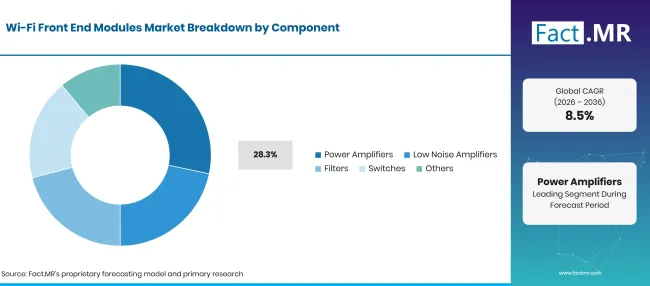
Wi Fi Front End Modules Market Breakdown Component | Source: Fact.MR
| Component | Share (2026) |
|---|---|
| Power Amplifiers (Leading segment) | 28.3% |
| Other segments combined | 71.7%* |
| Total | 100.0% |
Source: Fact.MR analysis. Updated Nov 5, 2026
Transmit power decides how far a Wi-Fi signal travels and how many clients an access point can serve. Wi-Fi 7 uses 320 MHz channels and dense modulation, so the amplifier has to deliver power without distortion that would cut data rates. Designers also want it to run cool at low supply voltage, and vendors with deep RF power amplifier expertise hold an edge here. Low-noise amplifiers improve receive sensitivity at the edge of coverage. Filters keep Wi-Fi apart from cellular bands, and Murata began mass shipments in July 2025 of a filter using XBAR technology for Wi-Fi 7 and Wi-Fi 6E with a passband of 5150 to 7125 MHz [4]. Switches route signals between bands and antennas, and many low-cost designs use CMOS power amplifiers for IoT radios.
What supports Smartphones within Application?
Smartphones account for 35.8% of 2026 revenue.
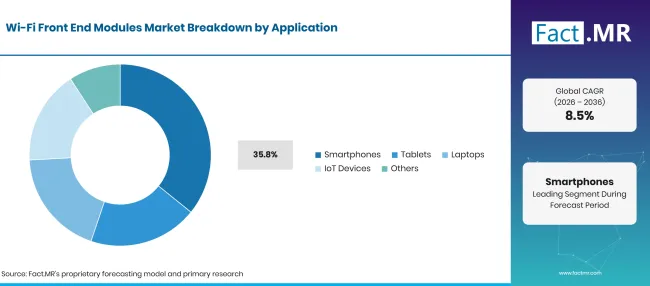
Wi Fi Front End Modules Market Breakdown Application | Source: Fact.MR
| Application | Share (2026) |
|---|---|
| Smartphones (Leading segment) | 35.8% |
| Other segments combined | 64.2%* |
| Total | 100.0% |
Source: Fact.MR analysis. Updated Nov 5, 2026
Handset volumes give this application its weight, and phone ownership is close to saturation in mature markets. In Japan, 91.8% of households owned a smartphone in 2025 [5]. Video calls, streaming and cloud backup move much of that traffic onto home and office Wi-Fi, which keeps a tri-band front end on the bill of materials of most new models. Tablets and laptops follow the same Wi-Fi 7 path with larger antenna space and fewer size limits. IoT devices such as cameras, speakers and sensors need small, low-cost modules, and access points serving the wider Wi-Fi equipment base add higher-power designs.
What leads the Frequency Band segment?
5 GHz represents 49.3% of 2026 value.
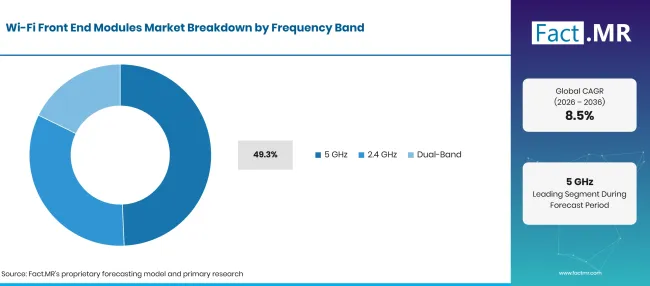
Wi Fi Front End Modules Market Breakdown Frequency Band | Source: Fact.MR
| Frequency Band | Share (2026) |
|---|---|
| 5 GHz (Leading segment) | 49.3% |
| Other segments combined | 50.7%* |
| Total | 100.0% |
Source: Fact.MR analysis. Updated Nov 5, 2026
Routers, phones and laptops sold in the past several years all carry a 5 GHz radio, and most high-throughput traffic still runs there. The band offers far more channels than 2.4 GHz with fewer interference problems in homes and offices. Mature front-end designs keep cost per module low. The 2.4 GHz band stays in use for range and for low-power IoT links. Dual-band modules combine both, and tri-band products add 6 GHz, which requires filters with steep skirts such as radio frequency duplexer designs to protect adjacent services.
How does End-User shape demand?
Consumer Electronics takes 47.6% of 2026 sales.
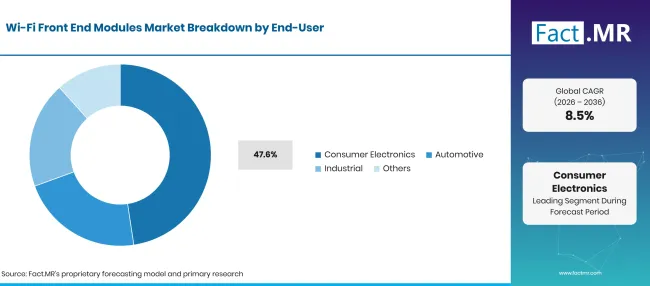
Wi Fi Front End Modules Market Breakdown End User | Source: Fact.MR
| End-User | Share (2026) |
|---|---|
| Consumer Electronics (Leading segment) | 47.6% |
| Other segments combined | 52.4%* |
| Total | 100.0% |
Source: Fact.MR analysis. Updated Nov 5, 2026
Phones, PCs, smart TVs, game consoles and smart speakers all ship with Wi-Fi, and buyers expect each new model to connect faster. Connected home products are spreading as broadband reaches more homes. In Brazil, 15.4 million internet-connected households owned at least one smart device in 2025 [6]. Automotive buyers add Wi-Fi for in-cabin hotspots, software updates and phone mirroring. Industrial users fit Wi-Fi in factory sensors and handheld terminals, and outdoor links for fixed wireless access gateways need rugged front ends.
What is accelerating Wi-Fi Front End Modules Market adoption, and what is holding it back?
The move to Wi-Fi 6E and Wi-Fi 7, wider 6 GHz access and steady device output keep front-end content rising. Murata said in February 2026 that the shift to higher-frequency technologies such as Wi-Fi 7 has moved more slowly than it first planned and that competition from China-based rivals is intensifying in high-frequency devices [7]. Uneven spectrum rules also add certification cost.
Drivers Impact Analysis
| DRIVER | (~) % IMPACT ON CAGR | GEOGRAPHIC RELEVANCE | IMPACT TIMELINE |
|---|---|---|---|
| Wi-Fi 6E and Wi-Fi 7 devices moving into the mainstream | +2.4% | Global | Short term (<=2 years) |
| More smartphones and connected gadgets coming off production lines | +1.8% | Global | Medium term (2-4 years) |
| 6 GHz spectrum opening up for Wi-Fi in more countries | +1.1% | North America, Western Europe, East Asia | Medium term (2-4 years) |
| Demand for smaller RF parts that draw less power | +0.7% | Global | Short term (<=2 years) |
Source: Fact.MR analysis. Updated Nov 5, 2026
Opportunity Impact Analysis
| OPPORTUNITY | (~) % IMPACT ON CAGR | GEOGRAPHIC RELEVANCE | IMPACT TIMELINE |
|---|---|---|---|
| Wi-Fi 7 and multi-band front-end modules combined in a single package | +1.0% | Global | Medium term (2-4 years) |
| Smart speakers, TVs and other home devices adding Wi-Fi | +0.8% | North America, Western Europe, East Asia | Short term (<=2 years) |
| Wi-Fi finding its way into cars | +0.5% | North America, Western Europe, East Asia | Long term (>=4 years) |
| RF front-end designs built to save power | +0.3% | Global | Medium term (2-4 years) |
Source: Fact.MR analysis. Updated Nov 5, 2026
Restraints Impact Analysis
| RESTRAINT | (~) % IMPACT ON CAGR | GEOGRAPHIC RELEVANCE | IMPACT TIMELINE |
|---|---|---|---|
| Costly design and fabrication of advanced RF modules | -1.1% | Global | Medium term (2-4 years) |
| Fitting several frequency bands into one module | -0.8% | Global | Short term (<=2 years) |
| Price competition among semiconductor component manufacturers | -0.5% | Global | Medium term (2-4 years) |
| Spectrum rules and device certification that differ by region | -0.3% | Global | Long term (>=4 years) |
Source: Fact.MR analysis. Updated Nov 5, 2026
Which countries are scaling the Wi-Fi Front End Modules Market through 2036?
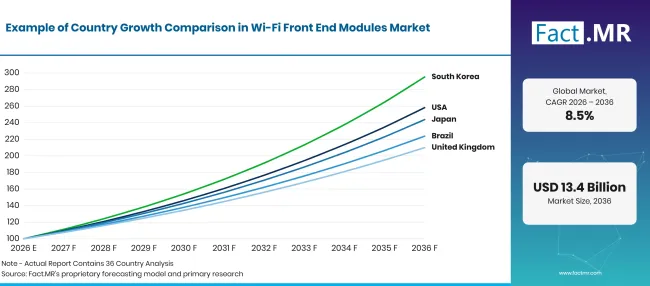
Wi Fi Front End Modules Market Growth Index | Source: Fact.MR
| Country | CAGR (2026 to 2036) |
|---|---|
| United States | 10.0% |
| Japan | 9.3% |
| Brazil | 8.4% |
| United Kingdom | 7.7% |
| Germany | 6.3% |
Source: Fact.MR analysis. Updated Nov 5, 2026
What supports adoption in the United States?
10.0% CAGR, driven by new 6 GHz device rules and Wi-Fi 7 router upgrades.
The Federal Communications Commission voted on 29 January 2026 to let geofenced variable power devices use the U-NII-5 and U-NII-7 portions of the 6 GHz band [2]. These devices may work outdoors and at higher power, provided they avoid exclusion zones that protect licensed users. Headsets, hotspots and automation gear built for this class need a 6 GHz amplifier and filter that meet stricter emission limits.
How is Japan developing demand?
9.3% CAGR, backed by preparation for wider 6 GHz wireless LAN use.
Japan’s Ministry of Internal Affairs and Communications received a council report on 2 July 2026 on technical conditions for expanding 6 GHz wireless LAN and for advanced dynamic frequency selection at 5 GHz [8]. The ministry will now draft the matching regulations. The review studies automated frequency coordination of the kind already used in the United States and Canada. Japanese component makers work closely with handset and PC assemblers, so new band rules move quickly into module orders.
What is supporting Brazil’s adoption?
8.4% CAGR, helped by near-universal household internet access.
Internet was used in 95.0% of Brazilian households in 2025, or about 76.0 million homes [6]. That was 2.7 million more households than a year earlier. Broader access brings more routers, smart TVs and phones into homes, and much of the new hardware ships with dual-band Wi-Fi.
What supports adoption in the United Kingdom?
7.7% CAGR, reflecting full fibre growth and new 6 GHz access rules.
Full fibre reached 78% of UK homes, or 23.7 million, by Ofcom’s November 2025 count, up from 69% a year earlier [9]. Faster lines push households to replace older routers. In January 2026 Ofcom set rules that let licence-exempt Wi-Fi run at higher power in the 6 GHz band under automated frequency coordination [10]. This supports outdoor and fixed wireless uses that need higher-power front ends.
How does Germany perform?
6.3% CAGR, as broadband speed upgrades lift router replacement.
The Bundesnetzagentur counted 23.6 million fixed broadband connections at 100 Mbps or faster in 2025, up from 21.5 million in 2024 [11]. Active fibre connections grew from 5.3 million to 6.4 million over the same period. Faster lines expose the limits of older home routers, which supports Wi-Fi 6 and Wi-Fi 7 replacement. Fibre still forms a small share of active lines, so the upgrade wave builds more gradually than in the other four countries.
Who leads the Wi-Fi Front End Modules Market?
Competition splits into three groups. RF specialists Qorvo and Skyworks Solutions sell stand-alone Wi-Fi 7 front-end modules across 2.4 GHz, 5 GHz and 6 GHz, and they compete on efficiency and linearity. Skyworks added second-generation Wi-Fi 7 modules and full-band 5 GHz and 6 GHz filters in October 2025 [3].
Platform vendors Broadcom and Qualcomm Technologies sell the Wi-Fi radios that set the reference design, and Qualcomm also offers integrated front-end modules for networking gear. Broadcom introduced Wi-Fi 8 chips for routers, enterprise access points and handsets on 14 October 2025 [12]. Murata Manufacturing brings filter and module packaging depth, shown by its XBAR filter for Wi-Fi 7 [4]. RichWave Technology serves cost-focused router and IoT designs with amplifiers, switches and modules. Design wins on chipset reference boards will decide who gains volume.
Which companies are the key providers?
Key companies in the Wi-Fi Front End Modules Market include Qorvo, Skyworks Solutions, Broadcom, Qualcomm Technologies, Murata Manufacturing and RichWave Technology.
- Qorvo
- Skyworks Solutions
- Broadcom
- Qualcomm Technologies
- Murata Manufacturing
- RichWave Technology
Bibliography
- [1] International Telecommunication Union. (2025, November 17). Global number of Internet users increases, but disparities deepen key digital divides.
- [2] Federal Communications Commission. (2026, January 29). FCC Votes to Enable Better, Faster Wi-Fi and Next-Gen Connectivity.
- [3] Skyworks Solutions, Inc. (2025, October 14). Skyworks Introduces Expanded Wi-Fi 7 Portfolio with Next-Generation, High-Efficiency and High-Performance Front-End Modules and Filters.
- [4] Murata Manufacturing Co., Ltd. (2025, July 8). Murata Unveils First High-Frequency XBAR Filter for Next-Gen Networks.
- [5] Ministry of Internal Affairs and Communications. (2026, May 29). Results of the 2025 Communications Usage Trend Survey.
- [6] Brazilian Institute of Geography and Statistics. (2026, July 2). Access to the Internet and television and possession of mobile phones for personal use 2025.
- [7] Murata Manufacturing Co., Ltd. (2026, February 2). Earnings Release Conference, Third Quarter of FY2025.
- [8] Ministry of Internal Affairs and Communications. (2026, July 24). Technical Conditions for Frequency Expansion, etc., of 6 GHz Band Wireless LAN Systems.
- [9] Ofcom. (2025, November 19). Brits devour data at record levels as mobile networks race to improve 5G.
- [10] Ofcom. (2026, January 9). Statement: Enabling automated frequency coordination (AFC) in the 6 GHz band.
- [11] Bundesnetzagentur. (2026, June 5). Telecoms Annual Report 2025.
- [12] Broadcom Inc. (2025, October 14). Broadcom Introduces Industry’s First Wi-Fi 8 Silicon Ecosystem Powering the AI Era
This Report Answers
- How much do power amplifiers, low-noise amplifiers, filters and switches each add to front-end value?
- Why do smartphones, the 5 GHz band and consumer electronics hold the lead in their segments?
- Which spectrum decisions in the United States, Japan and the United Kingdom open new 6 GHz product classes?
- Where do broadband and smart device trends in Brazil and Germany translate into router and module demand?
- Which suppliers compete in Wi-Fi 7 modules, and how do RF specialists differ from chipset platform vendors?
- What cost, integration and certification hurdles slow the move to tri-band designs?
What does the Wi-Fi Front End Modules Market cover?
This study tracks the RF circuits placed between a Wi-Fi radio chip and its antenna. Power amplifiers boost the transmit signal, low-noise amplifiers lift weak incoming signals, filters reject unwanted bands and switches route traffic between transmit, receive and antenna paths.
Values are measured at the module and component level in USD billion, at the price paid by device makers. The analysis spans Wi-Fi 6, Wi-Fi 6E and Wi-Fi 7 designs in phones, tablets, laptops, IoT products, vehicles and industrial equipment.
What is included in the scope?
Dedicated Wi-Fi front-end modules that combine a power amplifier, low-noise amplifier, switch and filtering in one package.
Stand-alone RF amplifiers, switches and filters designed for the Wi-Fi signal chain, including acoustic filters on lithium tantalate crystal substrates.
Single-band, dual-band and tri-band modules for smartphones, tablets, laptops, routers, access points and IoT devices.
Wi-Fi front ends fitted in vehicles and industrial equipment when their main role is Wi-Fi connectivity.
What is excluded from the scope?
Finished phones, laptops, routers and other devices beyond the value of their Wi-Fi front-end parts.
Wi-Fi chipsets, baseband processors, application processors and memory, unless sold as part of a dedicated front-end module.Cellular-only front-end modules and Bluetooth-only modules.Antennas, cables and general-purpose semiconductor parts not built for the Wi-Fi signal chain.
How Was the Analysis Built?
The analysis draws on 120+ sources, 35+ company portfolios, 25+ countries, and more than 20 industry interviews.
- Primary Research: Primary research includes discussions with manufacturers, service providers, technology developers, distributors, end users, and subject-matter experts. These conversations examine purchasing priorities, product adoption, operational challenges, approval requirements, competitive positioning, and the factors that influence wider market acceptance.
- Desk Research: Desk research covers government statistics, regulatory publications, company filings, trade data, technical studies, industry associations, standards, public policy, and other authoritative sources. Every source used in the analysis is documented in the bibliography.
- Market Sizing and Forecasting: Market estimates combine historical performance, demand indicators, pricing and volume trends, segment shares, company participation, country-level growth, adoption patterns, investment activity, and barriers to market expansion.
- Data Validation and Update Cycle: Findings are validated by comparing primary interviews with public data, company activity, regulatory changes, trade patterns, and industry developments. Regular updates review new product launches, capacity changes, partnerships, approvals, and shifts in commercial adoption.
Segmentation
What is the report’s scope and coverage?
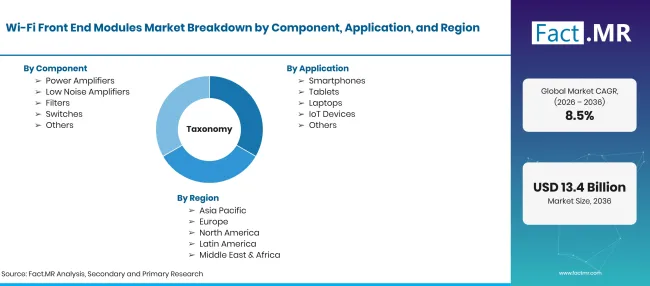
Wi Fi Front End Modules Market Taxonomy | Source: Fact.MR
| Attribute | Details |
|---|---|
| Quantitative Units | USD billion |
| Market Definition | RF front-end modules and integrated components that amplify, receive, filter and switch Wi-Fi signals across the 2.4 GHz, 5 GHz and 6 GHz bands. |
| Component | Power Amplifiers; Low Noise Amplifiers; Filters; Switches; Others |
| Application | Smartphones; Tablets; Laptops; IoT Devices; Others |
| Frequency Band | 5 GHz; 2.4 GHz; Dual-Band |
| End-User | Consumer Electronics; Automotive; Industrial; Others |
| Regions Covered | North America; Latin America; Western Europe; Eastern Europe; East Asia; South Asia & Pacific; Middle East & Africa |
| Countries Covered | United States; Japan; Brazil; United Kingdom; Germany |
| Companies Profiled | Qorvo; Skyworks Solutions; Broadcom; Qualcomm Technologies; Murata Manufacturing; RichWave Technology |
| Forecast Period | 2026 to 2036 |
| Approach | Device shipments by Wi-Fi generation multiplied by front-end content per device, checked against supplier portfolios and spectrum rules in each country. |
Source: Fact.MR analysis. Updated Nov 5, 2026
How is the market segmented?
-
By Component
- Power Amplifiers
- Low Noise Amplifiers
- Filters
- Switches
- Others
-
By Application
- Smartphones
- Tablets
- Laptops
- IoT Devices
- Others
-
By Frequency Band
- 5 GHz
- 2.4 GHz
- Dual-Band
-
By End-User
- Consumer Electronics
- Automotive
- Industrial
- Others
-
By Region
- North America
- Latin America
- Western Europe
- Eastern Europe
- East Asia
- South Asia & Pacific
- Middle East & Africa
Frequently Asked Questions
How large is the Wi-Fi front end modules market in 2026?
What growth rate will the Wi-Fi front end modules market record?
Which component leads?
Which application leads?
Which frequency band leads?
Which end-user leads?
Which country will grow quickest?
Who are the main companies?
What holds the market back?
Who worked on this report


Preview the report firsthand - request a free sample
Free SampleGet the brochure for pricing and purchase details
Download PDF