- Base Value(2025): 300 Mn
- Estimated Value(2026): 340 Mn
- Forecast Value (2036): 549 Mn
- CAGR (2026 - 2036): 4.9%
Aerospace Blind Rivets Market Forecast 2026 to 2036
In 2025, the aerospace blind rivets market was valued at USD 300 million. Based on Fact MR's analysis, demand for aerospace blind rivets is estimated to grow to USD 340 million in 2026 and USD 549 million by 2036. FMR projects a CAGR of 4.9% during the forecast period.
The absolute dollar growth from 2026 to 2036 is USD 209 million. This growth is driven by the increasing demand for lightweight, high-strength fasteners used in aerospace applications, where blind rivets play a crucial role in assembling various components. Despite steady growth, challenges such as material costs and specialized manufacturing processes may limit growth in some regions.
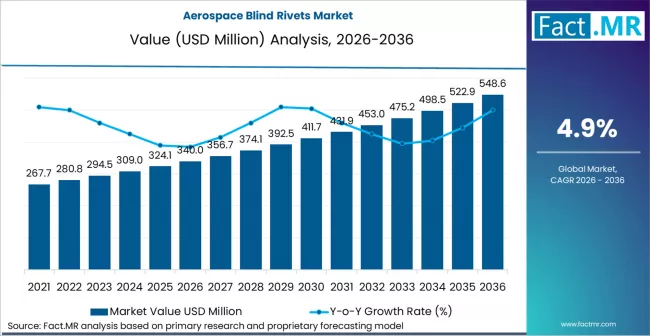
Aerospace Blind Rivets Market Market Value Analysis | Source: Fact.MR
India leads with a CAGR of 6.9%, driven by growing aerospace manufacturing and demand for precision fasteners. China follows with a 6.4% CAGR, supported by the expansion of its aerospace industry and rising demand for durable, high-quality rivets. Brazil grows at 4.6%, fueled by an increasing aerospace sector and industrial demand. The USA shows a 4.2% growth rate, supported by steady aerospace production and aerospace defense needs. France and Germany grow at 3.9% and 3.7%, respectively, as the European aerospace market remains steady. The UK grows at 3.6%, while Japan shows the slowest growth at 3.1%, due to a mature aerospace market.
Aerospace Blind Rivets Market Definition
The aerospace blind rivets market refers to the production and sale of blind rivet fasteners used to join structural components in aerospace assemblies where only one side of a joint is accessible. Blind rivets deform or expand to lock materials together without requiring access behind the panel, offering reliable fastening in tight spaces. Their primary function is to provide secure, lightweight, and fatigue‑resistant joints in aircraft skins, interiors, and systems. Key end uses include commercial aircraft, military platforms, helicopters, business jets, and aerospace maintenance, repair, and overhaul (MRO) operations.
Market Inclusions
This report covers global and regional market sizes for aerospace blind rivets with a defined forecast period. It includes segment breakdowns by product type (countersunk, flush, structural, multi‑grip blind rivets), material (aluminum, steel, titanium, composites compatible), and aerospace application (commercial, military, general aviation). End users such as OEMs and MRO providers are analyzed. Pricing trends, raw material supply dynamics, and trade flow data are included to reflect overall market dynamics.
Market Exclusions
The scope excludes other fastener types such as solid rivets, bolts, screws, and threaded inserts not used as blind rivets. Finished aircraft, complete assemblies, and unrelated hardware such as electrical connectors or hydraulic fittings are not covered. Blind rivets intended solely for non‑aerospace or industrial applications are omitted.
Research Methodology
- Primary Research: Interviews were conducted with aerospace engineers, blind rivet suppliers, OEM procurement specialists, and MRO professionals.
- Desk Research: Data was sourced from industry reports, aerospace manufacturing publications, and trade statistics.
- Market‑Sizing and Forecasting: A hybrid model was used, combining top‑down aerospace demand estimates with bottom‑up shipment and revenue data.
Data Validation and Update Cycle
Findings were validated through expert review and aligned with recent production and trade figures, with periodic updates.
Aerospace Blind Rivets Market Summary
Aerospace Blind Rivets Market Definition
The Aerospace Blind Rivets Market includes fasteners designed to securely join components in aerospace assemblies where access is limited to one side of the joint. These rivets are essential for aircraft construction, as they offer a reliable, lightweight, and vibration-resistant solution for securing airframe structures, interiors, and other critical components. Blind rivets, which include structural, sealed, and pull-type rivets, deform or expand to lock materials together without requiring access behind the panel. The primary materials used in aerospace blind rivets include aluminum, stainless steel, and titanium, all of which provide strength, durability, and corrosion resistance in the demanding aerospace environment.
Demand Drivers in the Market
- Growing Aerospace Manufacturing: The increasing production of commercial, military, and business aircraft continues to drive demand for aerospace blind rivets, which are crucial for assembly in areas with limited access.
- Technological Advancements in Aircraft Design: The development of new aircraft models, particularly those focused on improving fuel efficiency and reducing weight, is driving the need for specialized fastening solutions like aerospace blind rivets.
- Rising Air Travel and Fleet Expansion: The growing demand for air travel and the corresponding expansion of global airline fleets are boosting the need for efficient, cost-effective assembly and repair processes that rely on blind rivets.
- Aerospace MRO Growth: Maintenance, repair, and overhaul (MRO) operations are expanding, increasing the demand for durable, reliable fasteners that meet stringent aerospace standards.
Key Segments Analyzed in the FMR Report
- Rivet Type: Structural blind rivets are expected to dominate the market due to their ability to provide strong, permanent joints in critical aerospace applications, such as airframe and fuselage construction.
- Material: Aluminum is projected to capture the largest market share due to its lightweight, corrosion-resistant properties, making it ideal for use in aerospace applications where weight reduction is crucial.
- Application Area: Fuselage & skins are expected to account for the largest share of the market as they require high-performance fasteners to ensure the structural integrity of the aircraft.
Analyst Opinion at FMR
Fact MR analyst Shambhu Nath Jha predicts that "The aerospace blind rivets market will experience steady growth, driven by the increasing demand for lightweight, reliable fastening solutions in aerospace manufacturing, alongside the expansion of commercial and military aircraft production and MRO activities."
Strategic Implications/Executive Takeaways
- Focus on Lightweight and Durable Fastening Solutions: Manufacturers should prioritize the development of rivets that provide strength while minimizing weight, crucial for meeting the performance standards of modern aircraft.
- Increase MRO Capabilities: The growing demand for MRO services presents an opportunity to expand the supply of aerospace blind rivets that meet the specific requirements of aircraft maintenance and repair.
- Regional Growth Opportunities: Emerging markets in South Asia, particularly India and China, offer significant growth opportunities for aerospace blind rivets due to the expanding aerospace manufacturing and defense sectors.
Methodology
- Primary Research: Interviews with aerospace engineers, rivet suppliers, and procurement specialists provided insights into the demand drivers and technological innovations shaping the market.
- Desk Research: Data from industry reports, aerospace publications, and trade statistics supported the findings from primary research.
- Market Sizing and Forecasting: A hybrid model combining top-down and bottom-up data was used to estimate market size and project future growth, validated through expert reviews and recent production data.
Segmental Analysis
Aerospace Blind Rivets Market Analysis by Rivet Type
Aerospace Blind Rivets Market Analysis By Rivet Type | Source: Fact.MR
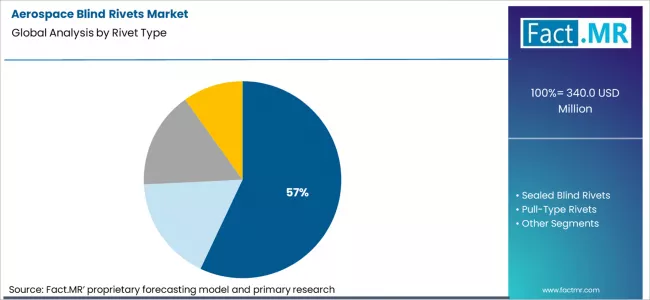
- Market Overview: Structural blind rivets are expected to capture 57% of the aerospace blind rivets market by 2026. Structural blind rivets are commonly used in aerospace applications due to their ability to provide strong, permanent joints without requiring access to both sides of the workpiece. These rivets are essential in the construction of airframes, fuselage, and other critical components.
- Demand Drivers:
- Strength and Durability: Structural blind rivets are preferred in aerospace applications due to their ability to withstand high stress and vibration, ensuring strong, reliable connections in demanding environments. They are especially important for securing airframe components and ensuring the overall integrity of the aircraft.
- Ease of Installation: Blind rivets allow for easy installation in areas with limited access, which is essential in aerospace manufacturing where certain components are hard to reach. This feature makes them an ideal solution for fast and efficient assembly.
- Increasing Aircraft Production: As global demand for commercial and military aircraft continues to rise, the demand for high-performance structural rivets to meet the stringent requirements of aerospace construction grows.
Aerospace Blind Rivets Market Analysis by Material
Aerospace Blind Rivets Market Analysis By Material | Source: Fact.MR
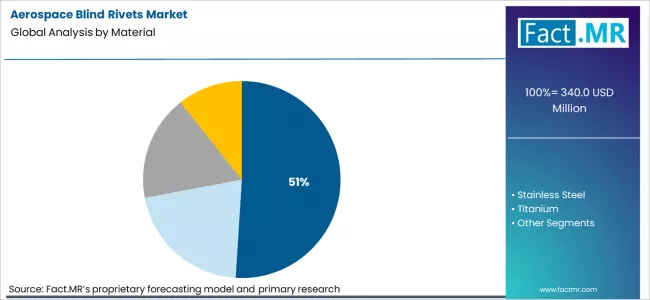
- Market Overview: Aluminum is projected to hold 51% of the aerospace blind rivets market by 2026. Aluminum rivets are commonly used in aerospace applications due to their lightweight, corrosion resistance, and good mechanical properties, which make them suitable for a wide range of structural applications.
- Demand Drivers:
- Lightweight and Corrosion Resistance: Aluminum is a key material in the aerospace industry, particularly for applications where reducing weight is a priority. Aluminum blind rivets help maintain the overall weight efficiency of aircraft while providing sufficient strength and durability.
- Cost-Effectiveness: Compared to materials like titanium or stainless steel, aluminum offers a cost-effective solution while still meeting the required mechanical and safety standards in aerospace applications.
- Widespread Use in Aircraft Manufacturing: Aluminum’s widespread use in aerospace construction and its compatibility with other materials in aircraft manufacturing processes contribute to the high demand for aluminum rivets in structural applications, particularly in airframes and panels.
Aerospace Blind Rivets Market Drivers, Restraints, and Opportunities
FMR analysts observe that the aerospace blind rivets market is a mature, safety‑driven segment rooted in the long‑standing requirement for reliable, one‑side installation fasteners in aircraft structures. Historically, solid rivets dominated assembly, but blind rivets became structurally necessary where access is limited or one‑side installation improves productivity in airframes and secondary structures. The 2026 valuation reflects this reality, where demand is sustained by ongoing aircraft production, retrofit, and MRO cycles, and strict OEM and certification standards anchor blind rivets as essential hardware.
While demand for basic mechanical fasteners persists in some legacy applications, corrosion‑resistant and high‑strength aerospace blind rivets are gaining share due to durability and performance demands. These advanced rivets carry higher per‑unit prices, contributing to net market value growth even as unit volumes move with aircraft build and service rates. The market exists because aerospace assembly and maintenance require fasteners that meet strict vibration, fatigue, and environmental criteria while enabling efficient one‑side installation.
- Efficiency in Assembly: OEMs and MRO providers increasingly specify blind rivets for one‑side installation in hard‑to‑reach areas, improving build and repair efficiency compared with traditional solid rivets.
- Certification and Material Standards: Aviation regulators such as FAA and EASA require blind rivets that meet specific strength, fatigue, and corrosion criteria in certified applications, supporting premium specification levels.
- Regional Aerospace Dynamics: In North America and Europe, large commercial and defense aerospace sectors with rigorous maintenance standards drive higher adoption of advanced blind rivets compared with regions with smaller in‑service fleets.
Regional Analysis
The market analysis covers key global regions, including South Asia and Pacific, East Asia, Latin America, North America, Western Europe, and Germany. It is segmented geographically, with specific market dynamics for each region. The full report provides a detailed market attractiveness analysis.
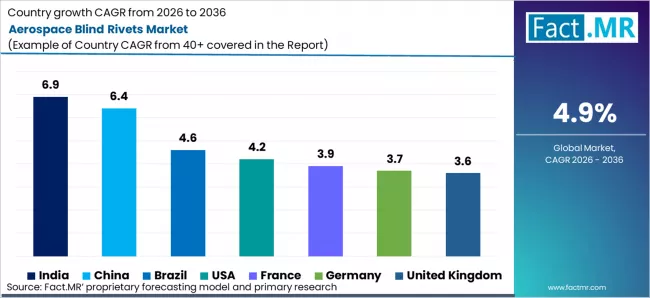
Aerospace Blind Rivets Market Cagr Analysis By Country | Source: Fact.MR
| Country | CAGR (2026-2036) |
|---|---|
| India | 6.9% |
| China | 6.4% |
| Brazil | 4.6% |
| USA | 4.2% |
| France | 3.9% |
| Germany | 3.7% |
| United Kingdom | 3.6% |
| Japan | 3.1% |
Source: Fact.MR analysis. Updated Feb 20, 2026
Source: Fact MR (FMR) analysis, based on proprietary forecasting model and primary research.
South Asia and Pacific:
South Asia and Pacific represent "emerging markets" for aerospace blind rivets, with countries like India leading demand due to the growing aerospace and defense industries.
- India: Demand for aerospace blind rivets in India is projected to rise at 6.9% CAGR through 2036. India’s expanding aerospace sector and the increasing production of military and commercial aircraft drive demand for high-performance fastening solutions like blind rivets.
East Asia:
East Asia, particularly China, remains a "key market" for aerospace blind rivets, with robust growth driven by increased aerospace manufacturing and the demand for durable, lightweight fasteners.
- China: Demand for aerospace blind rivets in China is projected to rise at 6.4% CAGR through 2036. China’s growing aerospace manufacturing industry and its focus on high-quality, cost-effective fastening solutions contribute significantly to market growth.
- Japan: Demand for aerospace blind rivets in Japan is projected to rise at 3.1% CAGR through 2036. Japan’s advanced aerospace technologies and the need for high-quality rivets in the aerospace sector continue to support steady demand.
Latin America:
In Latin America, Brazil is experiencing growing demand for aerospace blind rivets, driven by the country’s aerospace sector expansion and increasing aircraft production.
- Brazil: Demand for aerospace blind rivets in Brazil is projected to rise at 4.6% CAGR through 2036. Brazil’s growing aerospace and defense industry, along with demand for efficient and durable fastening solutions, contribute to steady growth in the market.
North America:
North America, especially the USA, remains a significant market for aerospace blind rivets, supported by the strong aerospace industry and the need for reliable, high-performance fastening solutions.
- USA: Demand for aerospace blind rivets in the U.S. is projected to rise at 4.2% CAGR through 2036. The USA’s established aerospace sector and the increased production of aircraft continue to drive demand for advanced rivets.
Western Europe:
Western Europe, particularly countries like France, Germany, and the UK, remains a "mature market" for aerospace blind rivets, where steady growth is driven by stringent aerospace standards and increased production.
- France: Demand for aerospace blind rivets in France is projected to rise at 3.9% CAGR through 2036. France’s aerospace industry, particularly in aircraft manufacturing, continues to drive demand for precision and durable fastening solutions.
- Germany: Demand for aerospace blind rivets in Germany is projected to rise at 3.7% CAGR through 2036. Germany’s aerospace sector and focus on lightweight, high-strength materials continue to fuel demand for aerospace fasteners.
- United Kingdom: Demand for aerospace blind rivets in the UK is projected to rise at 3.6% CAGR through 2036. The UK’s aerospace industry and focus on high-performance components continue to contribute to the steady demand for blind rivets.
Fact MR's analysis of the aerospace blind rivets market in South Asia and Pacific, East Asia, Latin America, North America, Western Europe, and Germany consists of country-wise assessments that include India, China, Brazil, the USA, France, Germany, the United Kingdom, and Japan. Readers can find detailed trends, regulatory updates, and company-specific investments shaping the market’s growth in these countries.
How Are Key Players Competing in the Aerospace Blind Rivets Market?

Aerospace Blind Rivets Market Analysis By Company | Source: Fact.MR
In the aerospace blind rivets market, competition is driven by precision, reliability, and the ability to meet stringent aerospace standards. Stanley Black & Decker, Inc. and SPS Technologies LLC (Cherry Aerospace) dominate the market with advanced rivet solutions that provide high-strength fastening for aircraft assembly. Howmet Aerospace Inc. and LISI S.A. also hold significant market shares, focusing on manufacturing blind rivets with superior performance in high-vibration environments. SFS Group AG and Precision Castparts Corp. provide specialized rivet technologies with an emphasis on corrosion resistance and durability. TriMas Corporation and Wilhelm Böllhoff GmbH & Co. KG offer innovative solutions that cater to both commercial and military aerospace applications. AVK Holding A/S and National Aerospace Fasteners Corporation further enhance the market with a focus on lightweight, high-performance rivets critical for reducing aircraft weight while maintaining structural integrity.
Recent Industry Developments
- EASA (European Union Aviation Safety Agency) | Safety Directive for Composite Structures | October 2025 EASA published updated certification requirements for "blind" fastening systems used in composite-to-metal joints, specifically mandating new 2026 electrical bonding standards for blind rivets to prevent lightning-induced ignition in fuel tank areas.
- NIST (National Institute of Standards and Technology) | Advanced Fastener Integrity Report | November 2025 NIST released its Sustainable Metals Strategy, which details 2026 testing protocols for "smart" blind rivets that use integrated sensor materials to detect internal shear failure without the need for destructive inspection.
- NASA (National Aeronautics and Space Administration) | SBIR Phase I Award | July 2025 NASA funded a research project to develop high-temperature, nickel-alloy blind rivets for use in hypersonic airframes, aiming to establish public-domain performance benchmarks for fasteners that can withstand temperatures exceeding 1,000°C.
Key Players of the Aerospace Blind Rivets Market
- Stanley Black & Decker, Inc.
- SPS Technologies LLC
- Howmet Aerospace Inc.
- LISI S.A.
- SFS Group AG
- Precision Castparts Corp.
- TriMas Corporation
- Wilhelm Böllhoff GmbH & Co. KG
- AVK Holding A/S
- National Aerospace Fasteners Corporation
Report Scope
| Metric | Value |
|---|---|
| Quantitative Units | USD 340 million (2026) to USD 549 million (2036), at a CAGR of 4.9% |
| Market Definition | The aerospace blind rivets market includes rivets used in aerospace applications for securing components in aircraft, such as fuselages, skins, and interiors, providing a secure and lightweight fastening solution. |
| By Rivet Type | Structural Blind Rivets, Sealed Blind Rivets, Pull-Type Rivets, Other |
| By Material | Aluminum, Stainless Steel, Titanium, Other |
| By Application | Fuselage & Skins, Interiors, MRO Repairs, Other |
| By Sales Channel | OEM/Tier Direct, Distributors, MRO, Other |
| Regions Covered | North America, Latin America, Europe, East Asia, South Asia, Oceania, Middle East and Africa |
| Countries Covered | United States, Canada, Mexico, Brazil, Argentina, Germany, France, United Kingdom, Italy, Spain, China, India, Japan, South Korea, Indonesia, Australia, and 40+ countries |
| Key Companies Profiled | Stanley Black & Decker, Inc., SPS Technologies LLC (doing business as Cherry Aerospace), Howmet Aerospace Inc., LISI S.A., SFS Group AG, Precision Castparts Corp., TriMas Corporation, Wilhelm Böllhoff GmbH & Co. KG, AVK Holding A/S, National Aerospace Fasteners Corporation |
| Forecast Period | 2026 to 2036 |
| Approach | Hybrid top-down and bottom-up market modeling validated through primary interviews with manufacturers and supported by trade data benchmarking and market research. |
Source: Fact.MR analysis. Updated Feb 20, 2026
Bibliographies
- SPS Technologies LLC (Cherry Aerospace). (2025). Blind rivets and structural blind fastening systems for aerospace applications. SPS Technologies LLC (Cherry Aerospace).
- Stanley Engineered Fastening. (2025). Aerospace blind rivet technologies and structural fastening systems. Stanley Black & Decker, Inc.
- Howmet Aerospace Inc. (2025). Aerospace blind fastening solutions. Howmet Aerospace Inc.
- LISI Aerospace. (2025). Precision-engineered aerospace blind rivets. LISI Aerospace.
- SFS Group AG. (2025). Blind rivet systems for aerospace and lightweight structures. SFS Group AG.
Segmentation
Aerospace Blind Rivets Market Key Segments
-
By Rivet Type :
- Structural Blind Rivets
- Sealed Blind Rivets
- Pull-Type Rivets
- Other
-
By Material :
- Aluminum
- Stainless Steel
- Titanium
- Other
-
By Application :
- Fuselage & Skins
- Interiors
- MRO Repairs
- Other
-
By Sales Channel :
- OEM/Tier Direct
- Distributors
- MRO
- Other
-
Region :
- North America
- USA
- Canada
- Mexico
- Europe
- Germany
- UK
- France
- Italy
- Spain
- Nordic Countries
- BENELUX
- Rest of Europe
- Asia Pacific
- China
- Japan
- South Korea
- India
- Australia
- Rest of Asia Pacific
- Latin America
- Brazil
- Argentina
- Rest of Latin America
- Middle East and Africa
- Kingdom of Saudi Arabia
- United Arab Emirates
- South Africa
- Rest of Middle East and Africa
- Other Regions
- Oceania
- Central Asia
- Other Markets
- North America
Frequently Asked Questions
How large is the demand for Aerospace Blind Rivets in the global market in 2026?
What will be the market size of Aerospace Blind Rivets in the global market by 2036?
What is the expected demand growth for Aerospace Blind Rivets in the global market between 2026 and 2036?
Which rivet type is expected to dominate the market?
Which region is expected to show the highest growth rate for Aerospace Blind Rivets?
How significant is the growth outlook for China in this market?
What is the growth outlook for the United States in this report?
What is the growth forecast for Brazil in the Aerospace Blind Rivets market?
Which European market is highlighted in this analysis?
Which company is identified as a leading player in the Aerospace Blind Rivets market?
What are Aerospace Blind Rivets used for?
What does the Aerospace Blind Rivets market include in this report?
How is the market forecast developed in this report?
What is meant by the Aerospace Blind Rivets market in this report?
Who worked on this report


Preview the report firsthand - request a free sample
Free SampleGet the brochure for pricing and purchase details
Download PDF