- Base Value(2025): 600 Mn
- Estimated Value(2026): 610 Mn
- Forecast Value (2036): 956 Mn
- CAGR (2026 - 2036): 4.6%
Corrosion Resistant Aerospace Fasteners Market Forecast 2026 to 2036
In 2025, the corrosion resistant aerospace fasteners market was valued at USD 600 million. Based on Fact MR's analysis, demand for corrosion-resistant aerospace fasteners is estimated to grow to USD 610 million in 2026 and USD 956 million by 2036. FMR projects a CAGR of 4.6% during the forecast period.
The absolute dollar growth from 2026 to 2036 is USD 346 million. This growth is driven by the increasing demand for durable, corrosion-resistant materials in the aerospace industry, where fasteners are crucial for the longevity and safety of aircraft. Despite the steady growth, challenges such as the high cost of production and raw material volatility may impact the market.
India leads with a CAGR of 6.6%, driven by expanding aerospace manufacturing and a rising demand for high-quality fasteners. China follows with a 6.2% CAGR, supported by the growth of its aerospace sector and demand for corrosion-resistant materials. Mexico grows at 4.4%, fueled by increasing aerospace manufacturing activities. The USA grows at 4.0%, driven by steady demand from the aerospace and defense industries. France and Germany show growth rates of 3.7% and 3.5%, respectively, as the European aerospace market remains steady. The UK grows at 3.4%, while Japan experiences the slowest growth at 3.0%, due to a more mature aerospace market.
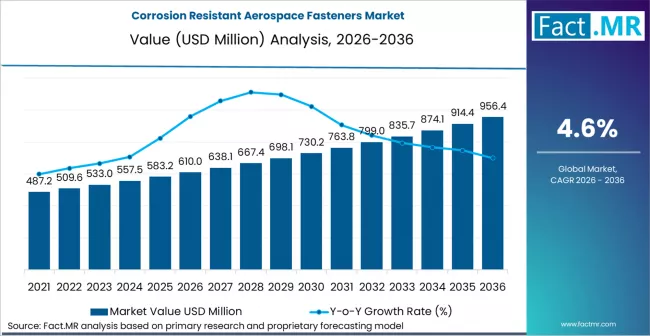
Corrosion Resistant Aerospace Fasteners Market Market Value Analysis | Source: Fact.MR
Corrosion Resistant Aerospace Fasteners Market Definition
The Corrosion Resistant Aerospace Fasteners Market refers to the production and sale of fastening hardware engineered to resist corrosion in aerospace environments. These fasteners include bolts, screws, nuts, rivets, and specialty fasteners made from corrosion‑resistant alloys or surface treatments designed to withstand moisture, salt, chemicals, and temperature extremes. Their primary function is to join aircraft structures and components while maintaining integrity over service life. Key end uses include commercial and military aircraft, helicopters, space vehicles, and maintenance, repair, and overhaul (MRO) operations that require durable, long‑lasting fastening solutions.
Market Inclusions
This report covers global and regional market sizes for corrosion resistant aerospace fasteners with a defined forecast period. It includes segment breakdowns by product type (bolts, screws, nuts, rivets, specialty fasteners), material (stainless steel, titanium, coated alloys), aerospace application (commercial, military, general aviation), and end user (OEMs and MROs). Pricing trends, raw material and alloy supply analysis, and trade flow data are included to reflect overall market dynamics.
Market Exclusions
The scope excludes fasteners made from non‑corrosion‑resistant base materials such as uncoated carbon steel unless used in mixed assemblies above a defined threshold. Finished aircraft, complete assemblies, and unrelated hardware such as electrical connectors or hydraulic fittings are not covered. Niche non‑aerospace fastening products intended for other industries are omitted.
Research Methodology
- Primary Research: Interviews were conducted with aerospace engineers, fastener suppliers, OEM procurement specialists, and MRO professionals.
- Desk Research: Data was sourced from industry reports, aerospace manufacturing publications, and trade statistics.
- Market‑Sizing and Forecasting: A hybrid model was used, combining top‑down aerospace demand estimates with bottom‑up shipment and revenue data.
- Data Validation and Update Cycle: Findings were validated through expert review and aligned with recent production and trade figures, with periodic updates.
Corrosion Resistant Aerospace Fasteners Market Summary
- Corrosion Resistant Aerospace Fasteners Market Definition
- The Corrosion Resistant Aerospace Fasteners Market focuses on the production and sale of fasteners designed to withstand harsh environmental conditions in the aerospace sector. These fasteners, including bolts, screws, nuts, rivets, and specialty fasteners, are made from corrosion-resistant alloys or treated with protective coatings. Their primary function is to securely fasten critical aircraft components, ensuring long-term durability and safety, particularly in areas exposed to moisture, salt, chemicals, and extreme temperatures. Key applications include airframe structures, engines, nacelles, landing gear interfaces, and cabin interiors in both commercial and military aircraft, as well as for maintenance, repair, and overhaul (MRO) operations.
- Demand Drivers in the Market
- Aircraft Longevity and Safety: As the aerospace industry focuses on extending aircraft service life, there is an increasing demand for durable, corrosion-resistant fasteners that ensure the long-term integrity of aircraft components.
- Environmental Exposure: Aircraft components, especially airframe structures, are exposed to extreme conditions like saltwater, humidity, and temperature fluctuations, making corrosion resistance a crucial factor for maintaining aircraft safety and performance.
- Regulatory Standards: Aerospace fasteners must meet stringent safety and durability standards set by aviation authorities such as the FAA and EASA. These regulations drive the demand for corrosion-resistant materials to meet certification requirements.
- Performance and Weight Requirements: Corrosion-resistant fasteners, such as those made from titanium and high-performance alloys, provide the necessary strength and light weight for aerospace applications, contributing to improved fuel efficiency and performance.
- Key Segments Analyzed in the FMR Report
- Protection Approach: Titanium and high-nickel alloys are expected to dominate the market, offering superior corrosion resistance and durability in aerospace applications.
- Application Area: Airframe structures will hold the largest market share, driven by the need for high-strength, corrosion-resistant materials in the primary load-bearing components of aircraft.
- Sales Channel: OEM and Tier-1 suppliers are expected to capture the largest share of the market, providing fasteners directly integrated into new aircraft manufacturing processes.
- Analyst Opinion at FMR
- Fact MR analyst Shambhu Nath Jha predicts, "The corrosion-resistant aerospace fasteners market will see steady growth, driven by increasing demand for durable and high-performance fasteners in the aerospace sector, particularly in commercial and military aircraft production."
- Strategic Implications/Executive Takeaways
- Focus on Advanced Materials: Aerospace manufacturers should prioritize the development of fasteners that combine corrosion resistance with high strength-to-weight ratios to meet the increasing demands for fuel-efficient, durable aircraft.
- Regulatory Compliance is Key: Fastener suppliers must ensure their products meet the stringent regulatory standards for safety, performance, and durability to maintain their competitive edge in the aerospace market.
- Growth in Emerging Markets: India and China offer significant growth opportunities due to their expanding aerospace manufacturing capabilities and increasing demand for high-quality materials in aircraft production.
- Methodology
- Primary Research: Interviews with aerospace engineers, fastener suppliers, OEM procurement specialists, and MRO professionals provided insights into market demands and technological advancements.
- Desk Research: Industry reports, aerospace manufacturing publications, and trade statistics supplemented the primary research data.
- Market Sizing and Forecasting: A hybrid model was used, combining top-down demand projections with bottom-up data on shipments and revenue from key industry players.
Segmental Analysis
Corrosion Resistant Aerospace Fasteners Market Analysis by Application Area
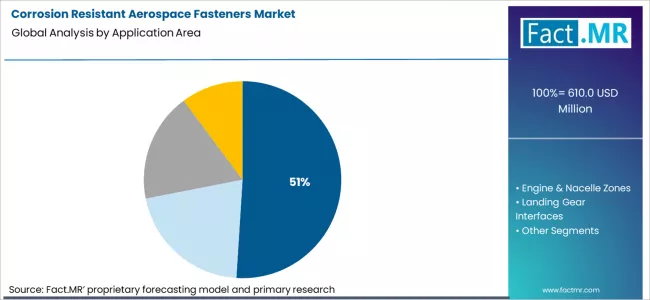
Corrosion Resistant Aerospace Fasteners Market Analysis By Application Area | Source: Fact.MR
- Market Overview: Airframe structures are expected to capture 51% of the corrosion-resistant aerospace fasteners market by 2026. Fasteners used in airframe structures are critical for maintaining the structural integrity of the aircraft. Corrosion-resistant materials, such as titanium, are essential for these fasteners, given the exposure to harsh environmental conditions and the need for long-term durability.
- Demand Drivers:
- Exposure to Harsh Environmental Conditions: Airframe structures are exposed to extreme conditions, including humidity, temperature variations, and de-icing agents, which makes corrosion resistance crucial for maintaining the aircraft’s integrity and safety.
- Emphasis on Aircraft Longevity: As the aerospace industry increasingly focuses on extending the lifespan of aircraft, corrosion-resistant fasteners are in high demand to ensure the longevity and reliability of airframe structures.
- Weight and Strength Requirements: Aerospace fasteners used in airframe structures need to be both lightweight and strong to meet stringent performance standards. Corrosion-resistant materials like titanium and other high-performance alloys provide the necessary balance between strength and weight.
Corrosion Resistant Aerospace Fasteners Market Analysis by Sales Channel
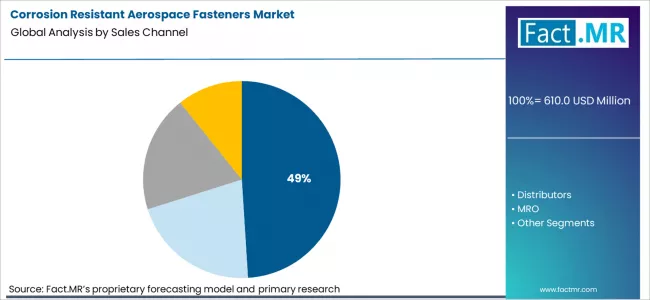
Corrosion Resistant Aerospace Fasteners Market Analysis By Sales Channel | Source: Fact.MR
- Market Overview: OEM/Tier direct sales are expected to capture 49% of the market share by 2026. OEMs (Original Equipment Manufacturers) and Tier-1 suppliers play a key role in supplying corrosion-resistant fasteners directly to the aerospace industry. These fasteners are essential components in new aircraft production, as well as in major systems where long-term durability is critical.
- Demand Drivers:
- Direct Integration in Aircraft Production: The demand for corrosion-resistant fasteners in OEM/Tier direct sales is driven by the integration of these fasteners into the initial manufacturing process of aircraft. OEMs and Tier-1 suppliers ensure that the required standards for performance, durability, and safety are met in the fasteners they provide.
- Cost-Effectiveness and Efficiency: Direct sales from OEMs and Tier-1 suppliers help streamline the supply chain, ensuring that fasteners meet the specific requirements of the aircraft manufacturer while also offering cost-effective solutions for large-scale production.
- Regulatory and Certification Requirements: Fasteners supplied through OEM/Tier direct channels are typically subject to stringent quality control and certification processes to meet the aerospace industry’s rigorous standards for safety and reliability.
Corrosion Resistant Aerospace Fasteners Market Drivers, Restraints, and Opportunities
FMR analysts observe that the corrosion resistant aerospace fasteners market is a mature, safety‑driven segment rooted in long‑standing requirements for durable, high‑integrity joints in airframes, engines, and systems that are exposed to harsh environments. Historically, basic steel and aluminum fasteners were used where corrosion was minimal; as aircraft service life expectations extended and environmental exposure intensified (salt, humidity, chemicals), demand grew for alloys and coatings that resist corrosion without compromising strength. The 2026 valuation reflects this structural reality, where ongoing commercial, military, and MRO (maintenance, repair, overhaul) activity sustains baseline demand tied to performance and longevity standards.
While demand for standard fasteners persists in low‑exposure applications, corrosion resistant materials such as titanium alloys, stainless steels, and specialty coatings are gaining share due to their longer service life and lower lifecycle costs. These advanced fasteners often carry higher per‑unit prices, contributing to net market value growth even as overall unit volumes align with aircraft production and overhaul cycles. The market exists at its current size because aerospace manufacturers and regulators prioritize corrosion performance to meet safety, durability, and certification requirements.
- Longevity and Safety Demand: Extended aircraft service intervals and critical safety expectations drive adoption of corrosion resistant fasteners that outperform basic materials in aggressive environments.
- Regulatory & Certification Standards: Aviation authorities such as FAA and EASA require certified corrosion resistant components that meet specific fatigue and environmental exposure criteria, supporting higher specification levels.
- Regional Fleet Dynamics: In North America and Europe, large in‑service fleets and stringent maintenance standards sustain higher demand for corrosion resistant aerospace fasteners compared with regions with smaller commercial fleets.
Regional Analysis
The market analysis covers key global regions, including South Asia and Pacific, East Asia, Latin America, North America, Western Europe, and Germany. It is segmented geographically, with specific market dynamics for each region. The full report provides a detailed market attractiveness analysis.
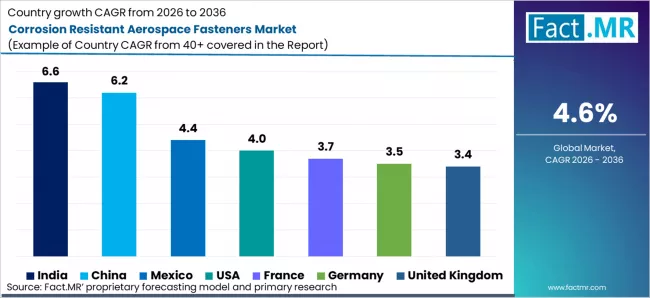
Corrosion Resistant Aerospace Fasteners Market Cagr Analysis By Country | Source: Fact.MR
| Country | CAGR (2026-2036) |
|---|---|
| India | 6.6% |
| China | 6.2% |
| Mexico | 4.4% |
| USA | 4.0% |
| France | 3.7% |
| Germany | 3.5% |
| United Kingdom | 3.4% |
| Japan | 3.0% |
Source: Fact.MR analysis. Updated Feb 20, 2026
Source: Fact MR (FMR) analysis, based on proprietary forecasting model and primary research.
South Asia and Pacific:
South Asia and Pacific are "emerging markets" for corrosion-resistant aerospace fasteners, driven by expanding aerospace industries in countries like India and China, where demand for high-performance materials is growing.
- India: Demand for corrosion-resistant aerospace fasteners in India is projected to rise at 6.6% CAGR through 2036. India’s expanding aerospace sector and growing focus on quality and durability in aerospace components are key drivers of demand.
- China: Demand for corrosion-resistant aerospace fasteners in China is projected to rise at 6.2% CAGR through 2036. China’s rapid growth in aerospace production and focus on high-quality, durable components continue to push market growth.
East Asia:
East Asia, particularly Japan, continues to drive demand for corrosion-resistant aerospace fasteners, supported by advancements in aerospace technologies and the rise in aircraft production.
- Japan: Demand for corrosion-resistant aerospace fasteners in Japan is projected to rise at 3.0% CAGR through 2036. Japan’s aerospace industry and focus on high-performance materials contribute to steady demand in the region.
Latin America:
In Latin America, Mexico is the key market for corrosion-resistant aerospace fasteners, supported by the country’s increasing aerospace manufacturing capacity.
- Mexico: Demand for corrosion-resistant aerospace fasteners in Mexico is projected to rise at 4.4% CAGR through 2036. Mexico’s expanding aerospace industry and increasing demand for durable, high-performance fasteners drive the market.
North America:
In North America, the USA is a significant market for corrosion-resistant aerospace fasteners, driven by growing demand in the aerospace, defense, and commercial aircraft industries.
- USA: Demand for corrosion-resistant aerospace fasteners in the U.S. is projected to rise at 4.0% CAGR through 2036. The expansion of aerospace and defense sectors and increased production of commercial aircraft continue to support demand for corrosion-resistant materials.
Western Europe:
Western Europe, with countries like France, Germany, and the UK, remains a "mature market" for corrosion-resistant aerospace fasteners, driven by established aerospace sectors and stringent regulations on materials used in aircraft construction.
- France: Demand for corrosion-resistant aerospace fasteners in France is projected to rise at 3.7% CAGR through 2036. France’s aerospace and defense industries, coupled with increasing aircraft production, contribute to the steady growth of this market.
- Germany: Demand for corrosion-resistant aerospace fasteners in Germany is projected to rise at 3.5% CAGR through 2036. Germany’s strong aerospace sector and emphasis on high-quality aerospace materials drive the adoption of corrosion-resistant fasteners.
- United Kingdom: Demand for corrosion-resistant aerospace fasteners in the UK is projected to rise at 3.4% CAGR through 2036. The UK’s aerospace industry, along with growing demand for lightweight and durable materials, supports steady growth in the market.
Fact MR's analysis of the Corrosion Resistant Aerospace Fasteners Market in South Asia and Pacific, East Asia, Latin America, North America, Western Europe, and Germany consists of country-wise assessments that include India, China, Mexico, the USA, France, Germany, the United Kingdom, and Japan. Readers can find detailed trends, regulatory updates, and company-specific investments shaping the market’s growth in these countries.
How Are Key Players Competing in the Corrosion Resistant Aerospace Fasteners Market?
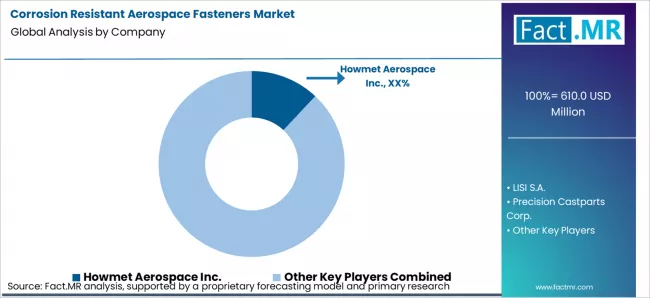
Corrosion Resistant Aerospace Fasteners Market Analysis By Company | Source: Fact.MR
The corrosion-resistant aerospace fasteners market is characterized by significant competition from companies focused on providing high-performance fasteners tailored for the demanding aerospace industry. Howmet Aerospace Inc. leads with a focus on innovative corrosion-resistant coatings and materials designed for both military and commercial aerospace applications. LISI S.A. and Precision Castparts Corp. have developed corrosion-resistant fasteners that meet stringent aerospace standards, strengthening their position in the market. Stanley Black & Decker, Inc. delivers a wide range of fasteners designed to withstand harsh environments, capitalizing on its global footprint. Wilhelm Böllhoff GmbH & Co. KG and EJOT SE & Co. KG focus on precision-engineered corrosion-resistant fasteners for various aerospace sectors, including commercial and military. Bossard Holding AG and Bufab AB (publ) ensure competitiveness by providing high-quality fasteners with excellent corrosion resistance. Initial Publications, Inc. (Fastener Technology International) plays a key role in educating and guiding market players on advancements in corrosion-resistant fastener technology.
Recent Industry Developments
- FAA (Federal Aviation Administration) | Airworthiness Directive (AD) 2025-23-09 | December 2025 The FAA issued a final rule (effective January 2026) mandating new high-frequency eddy current (HFEC) inspections and the replacement of specific structural fasteners on Airbus A320 series aircraft to address discovered corrosion and fatigue cracking in door stop fittings.
- EASA (European Union Aviation Safety Agency) | Special Condition for Composite Fastening | February 2026 EASA published updated certification specifications for the "Decomatic" titanium bolt series used in Dassault Falcon 7X and 8X aircraft, establishing new 2026 safety benchmarks for galvanic corrosion resistance when titanium fasteners are paired with carbon-fiber-reinforced polymer (CFRP) airframes.
- NIST (National Institute of Standards and Technology) | Metals Infrastructure Report | November 2025 NIST released a comprehensive strategy report identifying critical vulnerabilities in the U.S. titanium and superalloy supply chains, specifically calling for new 2026 standards in recycled aerospace-grade metals to ensure corrosion-resistant properties remain consistent in secondary material streams.
Key Players of the Corrosion Resistant Aerospace Fasteners Market
- Howmet Aerospace Inc.
- LISI S.A.
- Precision Castparts Corp.
- Stanley Black & Decker, Inc.
- Wilhelm Böllhoff GmbH & Co. KG
- EJOT SE & Co. KG
- Bossard Holding AG
- Bufab AB (publ)
- Initial Publications, Inc. (Fastener Technology International)
Report Scope
| Metric | Value |
|---|---|
| Quantitative Units | USD 610 million (2026) to USD 956 million (2036), at a CAGR of 4.6% |
| Market Definition | The Corrosion Resistant Aerospace Fasteners Market includes fasteners designed to resist corrosion in aerospace applications, ensuring reliability and longevity in critical systems like airframes and engines. |
| By Protection Approach | Stainless Steel Fasteners, Coated Alloy Steel Fasteners, Titanium/High-Ni Alloys, Other |
| By Application Area | Airframe Structures, Engine & Nacelle Zones, Landing Gear Interfaces, Cabin & Interior |
| By Coating Type | Cadmium Alternatives (Zn-Ni, etc.), Passivation/Anodic Coats, Dry Film Lubricant Coats, Other |
| By Sales Channel | OEM/Tier Direct, Distributors, MRO, Other |
| Regions Covered | North America, Latin America, Europe, East Asia, South Asia, Oceania, Middle East and Africa |
| Countries Covered | United States, Canada, Mexico, Brazil, Argentina, Germany, France, United Kingdom, Italy, Spain, China, India, Japan, South Korea, Indonesia, Australia, and 40+ countries |
| Key Companies Profiled | Howmet Aerospace Inc., LISI S.A., Precision Castparts Corp., Stanley Black & Decker, Inc., Wilhelm Böllhoff GmbH & Co. KG, EJOT SE & Co. KG, Bossard Holding AG, Bufab AB (publ), Initial Publications, Inc. (Fastener Technology International) |
| Forecast Period | 2026 to 2036 |
| Approach | Hybrid top-down and bottom-up market modeling validated through primary interviews with manufacturers and supported by trade data benchmarking and market research. |
Source: Fact.MR analysis. Updated Feb 20, 2026
Bibliographies
- FAA Issues Airworthiness Directive (AD) 2025-23-09:
- FAA. (2025, December). FAA issues Airworthiness Directive (AD) 2025-23-09 for Airbus A320 series aircraft. FAA Dynamic Regulatory System.
- EASA Publishes Special Condition for Composite Fastening:
- EASA. (2026, February). EASA publishes special condition for Decomatic titanium bolts in Dassault Falcon 7X and 8X aircraft. EASA Safety Publications.
- NIST Releases Metals Infrastructure Report:
- NIST. (2025, November). NIST releases strategy report on vulnerabilities in the U.S. titanium and superalloy supply chains. NIST.
- University of Sheffield Advanced Manufacturing Research Centre. (2024). Industry 4.0 smart factory adoption transforms an aerospace company’s production line [Case study]. University of Sheffield AMRC.
- The Manufacturer. (2024, September 20). Partners in production: AMRC and LISI Aerospace industry 4.0 project success [Article]. The Manufacturer.
- High Value Manufacturing Catapult. (2024). Smart production line unlocks more jobs and new contracts [Case study]. High Value Manufacturing Catapult.
Segmentation
Corrosion Resistant Aerospace Fasteners Market Key Segments
-
By Protection Approach
- Stainless Steel Fasteners
- Coated Alloy Steel Fasteners
- Titanium/High-Ni Alloys
- Other
-
By Application Area
- Airframe Structures
- Engine & Nacelle Zones
- Landing Gear Interfaces
- Cabin & Interior
-
By Coating Type
- Cadmium Alternatives (Zn-Ni, etc.)
- Passivation/Anodic Coats
- Dry Film Lubricant Coats
- Other
-
By Sales Channel
- OEM/Tier Direct
- Distributors
- MRO
- Other
-
Region
- North America
- USA
- Canada
- Mexico
- Europe
- Germany
- UK
- France
- Italy
- Spain
- Nordic Countries
- BENELUX
- Rest of Europe
- Asia Pacific
- China
- Japan
- South Korea
- India
- Australia
- Rest of Asia Pacific
- Latin America
- Brazil
- Argentina
- Rest of Latin America
- Middle East and Africa
- Kingdom of Saudi Arabia
- United Arab Emirates
- South Africa
- Rest of Middle East and Africa
- Other Regions
- Oceania
- Central Asia
- Other Markets
- North America
Frequently Asked Questions
How large is the demand for Corrosion Resistant Aerospace Fasteners in the global market in 2026?
What will be the market size of Corrosion Resistant Aerospace Fasteners in the global market by 2036?
What is the expected demand growth for Corrosion Resistant Aerospace Fasteners in the global market between 2026 and 2036?
Which application area is expected to dominate the market?
Which region is expected to show the highest growth rate for Corrosion Resistant Aerospace Fasteners?
How significant is the growth outlook for China in this market?
What is the growth outlook for the United States in this report?
What is the growth forecast for Mexico in the Corrosion Resistant Aerospace Fasteners market?
Which European market is highlighted in this analysis?
Which company is identified as a leading player in the Corrosion Resistant Aerospace Fasteners market?
What are Corrosion Resistant Aerospace Fasteners used for?
What does the Corrosion Resistant Aerospace Fasteners market include in this report?
How is the market forecast developed in this report?
What is meant by the Corrosion Resistant Aerospace Fasteners market in this report?
Who worked on this report


Preview the report firsthand - request a free sample
Free SampleGet the brochure for pricing and purchase details
Download PDF