- Market Value (2025): USD 3.9 Bn
- Estimated Value (2026): USD 4.8 Bn
- Forecast Value (2036): USD 36.2 Bn
- CAGR (2026-2036): 22.4%
What is the Agentic Artificial Intelligence in Energy and Utilities Market forecast to be worth by 2036?
The market is projected to grow from USD 4.8 billion in 2026 to USD 36.2 billion by 2036, registering a CAGR of 22.4%.
- The Agentic Artificial Intelligence in Energy and Utilities market reached USD 3.9 billion in 2025.
- Demand is forecast to increase from USD 4.8 billion in 2026 to USD 36.2 billion by 2036.
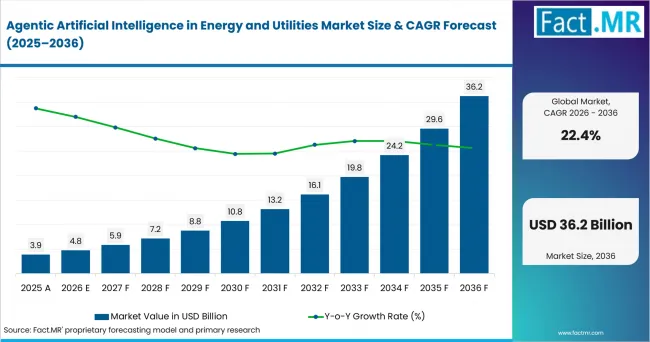
Agentic Artificial Intelligence In Energy And Utilities Market Value Analysis | Source: Fact.MR
What are the defining numbers behind Agentic Artificial Intelligence in Energy and Utilities Market growth?
An absolute dollar opportunity of USD 31.4 billion is expected between 2026 and 2036.
- Demand Drivers in the Market
- The main driver is the widening gap between operating complexity and available human attention. Variable generation and distributed resources increase the number of conditions teams must assess, while electrification, severe weather, and large new loads add further pressure on grid operations.
- Public institutions are actively encouraging AI use in grid planning and operations. The Department of Energy stated in April 2024 that AI can support grid planning, permitting, operations, reliability, and resilience.
- Reliability events carry immediate economic and regulatory consequences, giving utilities a clear business case for agents that interpret network conditions and coordinate bounded responses under human approval.
- Grid and industrial technology suppliers are connecting AI to operational data and digital twins. GE Vernova launched GridOS for Distribution in February 2026 to unify real-time operations and distributed-resource management, and Siemens launched its Eigen Engineering Agent in April 2026.
- Cloud platforms are providing managed agent development and hybrid deployment. AWS expanded Amazon Bedrock AgentCore in April 2026, and Microsoft acquired Osmos in January 2026 to accelerate autonomous data engineering, reducing the effort to bring utility agents to production.
- Multi-agent architecture is proving well suited to utility work, which naturally divides across forecasting, network constraints, asset risk, and cybersecurity. Google Cloud introduced the Agent2Agent protocol and new Vertex AI capabilities in April 2025 for building multi-system agents.
- Key Segments Analyzed
- Autonomous Grid Agents anchor the AI Agent Type segment with a 38.0% share in 2026, as they sit closest to operational value by interpreting network conditions and coordinating bounded responses.
- Grid Operations leads the Utility Function segment, taking 34.0% of demand in 2026, because reliability events create immediate economic and regulatory consequences.
- Electric Utilities is the dominant End-use Sector at 46.0% in 2026, reflecting the scale of investment in generation and network modernization.
- Cloud-based Deployment leads the Deployment Model segment at 58.0% in 2026, since it speeds development and centralizes governance, though safety-critical control paths stay on premises or at the edge.
- Multi-agent Systems lead the Core Technology segment with a 37.0% share in 2026, as utility work naturally divides across specialized agent roles.
- Analyst Opinion at Fact.MR
- Shambhu Nath Jha, Sr. Consultant at Fact.MR, opines: “Agentic AI is moving into the heart of utility operations as grids become more variable and more distributed. The strongest use cases are in grid operations, where agents can interpret network conditions and prepare approved actions for operator review, and the market is concentrated around Autonomous Grid Agents, which already hold 38.0% of the category in 2026. But buyers must validate agent behavior across legacy operational systems and regulated decision boundaries. Vendors that connect human-supervised agents to trusted operational data, digital twins, and hybrid cloud execution, with clear audit trails and authority limits, will capture the largest share of utility spending.”
- Strategic Implications
- Grid and industrial technology suppliers should connect agent layers to operational data, digital twins, and asset context, because domain depth helps operators trust agent recommendations.
- Cloud and agent-platform vendors should support hybrid deployment with private connectivity, identity controls, and data-residency options, since safety-critical control paths must remain on premises or at the edge.
- Vendors should design human-supervised agents that can connect planning, asset, and field workflows while preserving authority limits, audit trails, and human escalation in regulated decision loops.
- Channel and service investment should follow the fastest-growing country markets, including the USA, Germany, and Japan, adapting governance and deployment models to local utility structures.
- Providers should emphasize observability and interoperability with existing grid systems, because the purchase case is strongest when agents integrate with operational systems rather than adding another isolated dashboard.
How does the Agentic Artificial Intelligence in Energy and Utilities Market break down by segment?
The market is segmented by AI Agent Type, Utility Function, End-use Sector, Deployment Model, Core Technology, and Region. AI Agent Type includes Autonomous Grid Agents, Decision Intelligence Agents, Customer Service Agents, and Grid Security Agents. Utility Function covers Grid Operations, Asset Performance Management, Energy Trading, and Cybersecurity Management. End-use analysis covers Electric Utilities, Renewable Energy Providers, Oil & Gas Utilities, and Water Utilities. Deployment Model includes Cloud-based, On-premises, and Hybrid Deployment, while Core Technology covers Multi-agent Systems, Large Language Models, Edge AI Infrastructure, and Explainable AI. The regional analysis spans North America, Latin America, Western Europe, Eastern Europe, East Asia, South Asia and Pacific, and Middle East & Africa.
Why do Autonomous Grid Agents lead AI Agent Type?
Autonomous Grid Agents is projected to account for a 38.0% share in 2026.
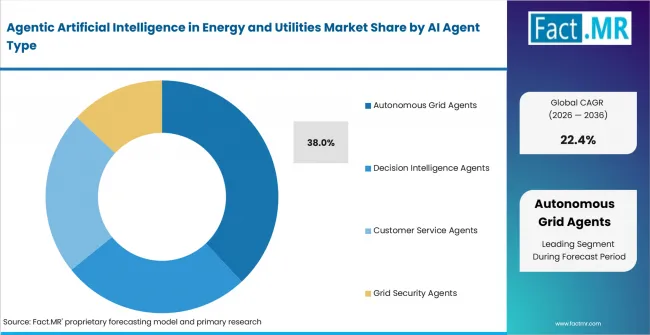
Agentic Artificial Intelligence In Energy And Utilities Market Analysis By Ai Agent Type | Source: Fact.MR
Autonomous Grid Agents sit closest to operational value because they interpret network conditions and coordinate bounded responses. Their role can include contingency analysis, switching recommendations, congestion management, outage triage, and distributed-resource coordination, workflows with measurable reliability effects and clear human owners. These tasks require action sequencing across data feeds and control systems, which raises integration costs but creates a larger recurring software boundary than a standalone assistant. Utilities can tie agent performance to restoration time, operator workload, constraint violations, and deferred interventions, while high-consequence control actions remain under policy limits and human approval. In April 2026, Siemens launched the Eigen Engineering Agent with multi-step reasoning and self-correction for automation-engineering tasks.
Why do Grid Operations lead Utility Function?
Grid Operations is projected to account for a 34.0% share in 2026.
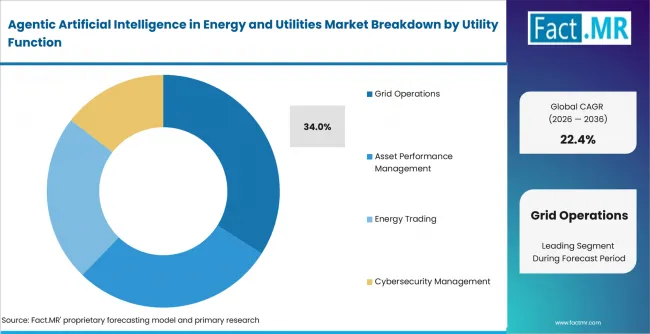
Agentic Artificial Intelligence In Energy And Utilities Market Analysis By Utility Function | Source: Fact.MR
Grid Operations leads because reliability events create immediate economic and regulatory consequences. Operators must reconcile forecasts with topology and equipment status, and they must assess weather, market schedules, and distributed energy resources. Agentic systems can break this work into specialized tasks, return a coordinated recommendation, and prepare approved actions for operator review. Asset management and cybersecurity remain important, but their decisions often operate on longer cycles or narrower teams, so grid operations software attracts earlier cross-functional funding. GE Vernova launched GridOS for Distribution in February 2026 to unify real-time operations and distributed-resource management, connecting field execution with grid analytics within existing operational systems.
Why do Electric Utilities lead End-use Sector?
Electric Utilities is projected to account for a 46.0% share in 2026.
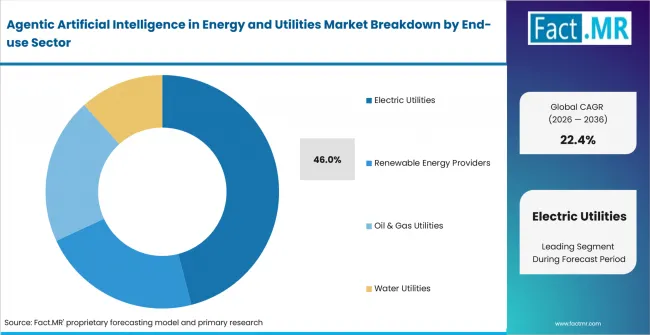
Agentic Artificial Intelligence In Energy And Utilities Market Analysis By End Use Sector | Source: Fact.MR
Electric utilities lead the End-use Sector because they operate the systems where reliability and resilience decisions have the most immediate impact. They manage generation, transmission, and distribution assets that are undergoing rapid electrification and modernization, and they face regulatory expectations for service quality and resilience. Budgets for reliability programs, network modernization, and digital transformation converge on grid software, giving electric utilities the largest addressable base for agentic AI deployment. Their operators need observability, frequent software updates, and integration with field and customer operations, which makes them the earliest and largest buyers of grid-focused agents.
Why does Cloud-based Deployment lead Deployment Model?
Cloud-based Deployment is projected to account for a 58.0% share in 2026.
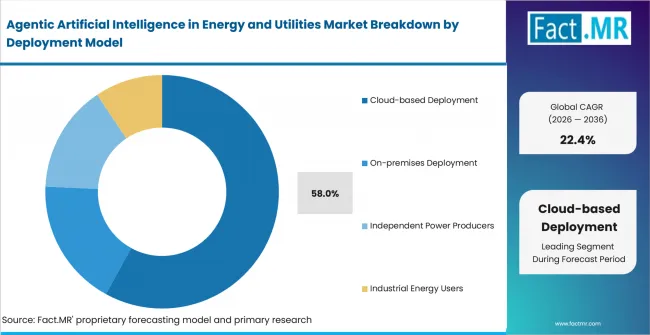
Agentic Artificial Intelligence In Energy And Utilities Market Analysis By Deployment Model | Source: Fact.MR
Cloud deployment leads because utility operations increasingly need observability, frequent software updates, and shared platform services. Utilities can centralize governance and connect business applications without building every component internally. The operating model is rarely cloud-only, as safety-critical control paths often remain on premises or at the edge, so buyers favor cloud services that support private connectivity, identity controls, data-residency choices, and hybrid execution. In April 2026, AWS expanded Amazon Bedrock AgentCore with lifecycle tools for prototyping and managed agent development, with a command-line interface supporting deployment. The adoption threshold is whether the vendor can isolate sensitive operational data and maintain dependable behavior when external connectivity is constrained.
Why do Multi-agent Systems lead Core Technology?
Multi-agent Systems is projected to account for a 37.0% share in 2026.
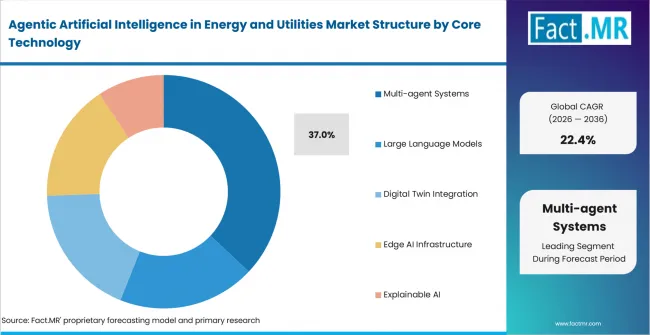
Agentic Artificial Intelligence In Energy And Utilities Market Analysis By Core Technology | Source: Fact.MR
Multi-agent systems lead because utility work is naturally divided across specialized responsibilities. One agent can interpret forecasts while another checks network constraints, a third can assess asset risk or cybersecurity policy, and an orchestrator manages sequence, context, and escalation. This design reduces the need for one model to handle every domain rule and lets utilities set different permissions for each role. Large language models remain important as reasoning and interface components, while digital twins and edge AI supply context and execution environments. In April 2025, Google Cloud introduced the Agent2Agent protocol and new Vertex AI capabilities for building and managing multi-system agents, supporting the multi-agent control layer that connects these technologies to governed business processes.
What is accelerating Agentic Artificial Intelligence in Energy and Utilities Market adoption, and what is holding it back?
Drivers
| Driver | Relative Impact | Geographic Relevance | Impact Timeline |
|---|---|---|---|
| Utilities need faster coordination across grid, asset, and customer workflows as operating complexity rises. | High | Global | Near term |
| Public energy and grid programs are encouraging AI use in planning, operations, and resilience. | Medium | North America, Europe | Mid term |
| Multi-agent architecture fits the divided responsibilities of utility operations. | Medium | Global | Mid term |
| Cloud-managed agent development and hybrid deployment reduce implementation effort. | Medium | North America, Europe, Asia Pacific | Long term |
Source: Fact.MR analysis. Updated Aug 10, 2026
Restraints
| Restraint | Relative Impact | Geographic Relevance | Impact Timeline |
|---|---|---|---|
| Utilities must validate agent behavior across legacy operational systems and regulated decision boundaries. | High | Global | Mid term |
| Legacy integration and fragmented data can extend the path from pilot to production. | High | Global | Mid term |
| Cybersecurity and explainability requirements can delay deployment when human override is unclear. | Medium | North America, Europe | Near term |
Source: Fact.MR analysis. Updated Aug 10, 2026
Which countries are scaling the Agentic Artificial Intelligence in Energy and Utilities Market fastest?
Utilities in the USA, Germany, Japan, the UK, and Canada are the countries shown in the comparative outlook. Their adoption paths differ according to grid modernization, operating structures, and procurement requirements.
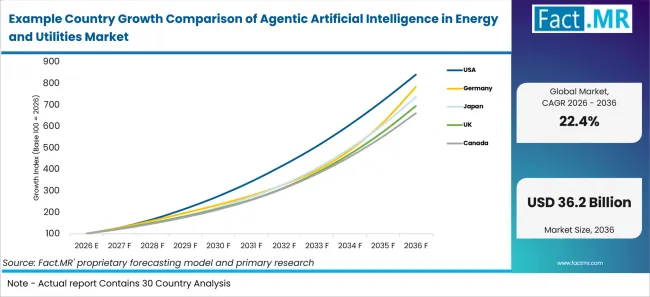
Example Country Growth Comparison Of Agentic Artificial Intelligence In Energy And Utilities Market | Source: Fact.MR
Country-wise CAGR Forecast (2026-2036)
| Country | CAGR |
|---|---|
| USA | 23.8% |
| Germany | 22.9% |
| Japan | 22.1% |
| UK | 21.4% |
| Canada | 20.8% |
| Australia | 19.9% |
| South Korea | 19.2% |
Source: Fact.MR analysis. Updated Aug 10, 2026
What is driving the Agentic Artificial Intelligence in Energy and Utilities Market in the USA?
USA is projected to register a 23.8% CAGR through 2036.
Utilities are assessing agentic AI across reliability, digital-grid, asset, and customer-service workflows. Department of Energy guidance gives buyers a federal reference point for evaluating AI in grid planning, operations, permitting, and resilience.
What is driving the Agentic Artificial Intelligence in Energy and Utilities Market in Germany?
Germany is projected to register a 22.9% CAGR through 2036.
German transmission operators and municipal utilities evaluate digital systems against long service lives and established engineering standards. Network expansion programs create a setting where interoperability and lifecycle support matter in utility technology procurement.
What is driving the Agentic Artificial Intelligence in Energy and Utilities Market in Japan?
Japan is projected to register a 22.1% CAGR through 2036.
Utilities introduce operational AI through controlled trials and staged authority limits. Buyers require documentation that separates advisory tasks from actions that can affect field equipment.
What is driving the Agentic Artificial Intelligence in Energy and Utilities Market in the UK?
The UK is projected to register a 21.4% CAGR through 2036.
Network operators assess digital workflows against reliability, flexibility, and connection outcomes. Procurement teams need clear evidence of how each workflow fits regulated operating responsibilities before wider rollout.
What is driving the Agentic Artificial Intelligence in Energy and Utilities Market in Canada?
Canada is projected to register a 20.8% CAGR through 2036.
Provincial utility structures and differing market conditions shape buyer priorities. Hydro-heavy provinces and competitive markets may emphasize different operating outcomes, integration needs, and procurement cycles.
What is driving the Agentic Artificial Intelligence in Energy and Utilities Market in Australia?
Australia is projected to register a 19.9% CAGR through 2036.
Network businesses operate across long transmission corridors and dispersed assets. Resilient data synchronization remains important where remote sites can lose central connectivity.
What is driving the Agentic Artificial Intelligence in Energy and Utilities Market in South Korea?
South Korea is projected to register a 19.2% CAGR through 2036.
Procurement is concentrated among large utilities, industrial groups, and government-backed energy programs. Domestic technology groups can shape platform-selection requirements.
Who leads the Agentic Artificial Intelligence in Energy and Utilities Market?
Competition is organized around three strategic positions. Cloud and agent-platform providers supply model access, orchestration, security, and developer tooling. Grid and industrial technology suppliers connect AI to operational data and digital twins, providing asset and control context. Enterprise application vendors connect agents to customer, finance, procurement, field service, and asset workflows. Buyers often combine these positions rather than selecting one vendor for the entire architecture.
Microsoft Corporation, Google LLC, Amazon Web Services, Inc., and IBM Corporation compete through agent development, orchestration, hybrid deployment, and governance services. Siemens AG, Schneider Electric SE, ABB Ltd., and General Electric Company compete through grid software, industrial automation, digital twins, and asset context. Oracle Corporation and SAP SE add utility enterprise data and process applications.
Which companies are the key providers?
Key companies profiled in the Agentic Artificial Intelligence in Energy and Utilities market include Microsoft Corporation, Google LLC, Amazon Web Services, Inc., IBM Corporation, Siemens AG, Schneider Electric SE, Oracle Corporation, ABB Ltd., General Electric Company, and SAP SE.
- Microsoft Corporation
- Google LLC
- Amazon Web Services, Inc.
- IBM Corporation
- Siemens AG
- Schneider Electric SE
- ABB Ltd.
- General Electric Company
- Oracle Corporation
- SAP SE
Bibliography
- U.S. Department of Energy. (2024, April 29). AI for Energy.
- U.S. Department of Energy, Office of Cybersecurity, Energy Security, and Emergency Response. (2024, April 29). DOE Delivers Initial Risk Assessment on Artificial Intelligence for Critical Energy Infrastructure.
- Bundesnetzagentur. (2024, December 19). Progress in Network Expansion: Bundesnetzagentur Approves Five Sections.
- Ministry of Economy, Trade and Industry, Japan. (2025, February 18). Cabinet Decision on the Seventh Strategic Energy Plan.
- UK Department for Energy Security and Net Zero. (2024, December 13). Government Sets Out Plan for New Era of Clean Electricity.
- Natural Resources Canada. (2024, December 23). The Canada Electricity Advisory Council.
- Australian Energy Market Operator. (2024, June 26). 2024 Integrated System Plan.
- Republic of Korea Policy Briefing. (2024, December 3). Data Opening Expands the Use of Artificial Intelligence in Energy.
- Microsoft Corporation. (2026, January 5). Microsoft Announces Acquisition of Osmos to Accelerate Autonomous Data Engineering in Fabric.
- Google Cloud. (2025, April 9). Build and Manage Multi-system Agents with Vertex AI.
- Amazon Web Services. (2026, April 22). Amazon Bedrock AgentCore Adds New Features to Help Developers Build Agents Faster.
- Siemens AG. (2026, April 20). Siemens Launches the Eigen Engineering Agent, Bringing Purpose-built AI to Industrial Automation.
- Schneider Electric SE. (2025, May 15). Schneider Electric Announces Multi-year Initiative Building an AI-native Ecosystem for Sustainability and Energy Management.
- Oracle Corporation. (2025, March 3). Oracle Helps Utilities Transform Raw Data into Intelligence.
- GE Vernova. (2026, February 3). GE Vernova Launches GridOS for Distribution.
This Report Answers
- The report examines Agentic Artificial Intelligence in Energy and Utilities Market performance by AI Agent Type, Utility Function, End-use Sector, Deployment Model, Core Technology, and Region.
- Segment analysis identifies Autonomous Grid Agents as the leading AI Agent Type, accounting for a 38.0% share in 2026.
- The country outlook compares the USA, Germany, Japan, the UK, and Canada, with additional coverage of Australia and South Korea.
- Competitive analysis profiles Microsoft Corporation, Google LLC, Amazon Web Services, Inc., IBM Corporation, Siemens AG, Schneider Electric SE, Oracle Corporation, ABB Ltd., General Electric Company, and SAP SE.
- The assessment evaluates market value and share across the defined segment groups.
What does the Agentic Artificial Intelligence in Energy and Utilities Market cover?
The Agentic Artificial Intelligence in Energy and Utilities Market covers software, platforms, and related services used by utility and energy organizations to support monitored agent-based workflows. The scope follows AI Agent Type, Utility Function, End-use Sector, Deployment Model, Core Technology, and Region.
What is included in the scope?
Coverage includes Autonomous Grid Agents, Decision Intelligence Agents, Customer Service Agents, and Grid Security Agents; grid operations, asset performance management, energy trading, and cybersecurity management workflows; and deployments across electric utilities, renewable energy providers, oil and gas utilities, and water utilities. The report also covers cloud-based, on-premises, and hybrid deployment models, the core technologies specified in the segmentation, and the regions profiled in the report.
What is excluded from the scope?
General-purpose AI tools, unrelated enterprise software, commodity infrastructure, and services not configured for the defined energy and utility use cases are outside the scope.
How was the analysis built?
The analysis draws on public company disclosures, product documentation, regulatory and government material, industry publications, and interviews with relevant market participants. These inputs are assessed alongside the report's defined market scope, segment structure, regional coverage, and forecast period.
Segmentation
What is the report’s scope and coverage?
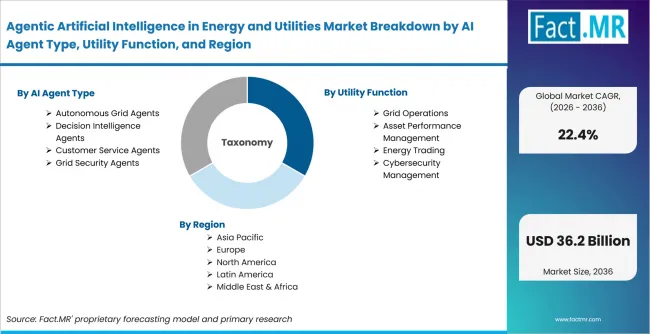
Agentic Artificial Intelligence In Energy And Utilities Market Breakdown By Ai Agent Type, Utility Function, And Region | Source: Fact.MR
| Attribute | Details |
|---|---|
| Forecast Period | 2026-2036 |
| Base Year | 2025 |
| Market Value, 2026 | USD 4.8 billion |
| Market Value, 2036 | USD 36.2 billion |
| CAGR, 2026-2036 | 22.4% |
| Absolute Dollar Opportunity | USD 31.4 billion |
| Key Regions Covered | USA, Germany, Japan, UK, Canada, Australia, South Korea, and more than twenty-five additional countries in the full report |
Source: Fact.MR analysis. Updated Aug 10, 2026
How is the market segmented?
-
AI Agent Type:
- Autonomous Grid Agents
- Distributed Control Agents
- Predictive Maintenance Agents
- Decision Intelligence Agents
- Fault Diagnosis Agents
- Energy Optimization Agents
- Customer Service Agents
- Billing Support Agents
- Virtual Energy Assistants
- Grid Security Agents
- Threat Detection Agents
- Incident Response Agents
- Autonomous Grid Agents
-
Utility Function:
- Grid Operations
- Transmission Monitoring
- Distribution Automation
- Asset Performance Management
- Substation Asset Analytics
- Renewable Energy Optimization
- Energy Trading
- Real-time Power Trading
- Demand Response
- Cybersecurity Management
- Threat Intelligence
- Compliance Monitoring
- Grid Operations
-
End-use Sector:
- Electric Utilities
- Transmission Operators
- Distribution Utilities
- Renewable Energy Providers
- Wind Farm Operators
- Solar Plant Operators
- Oil & Gas Utilities
- Gas Distribution Companies
- District Energy Systems
- Water Utilities
- Wastewater Utilities
- Drinking Water Utilities
- Electric Utilities
-
Deployment Model:
- Cloud-based Deployment
- Public Cloud
- Private Cloud
- On-premises Deployment
- Private Data Centers
- Hybrid Deployment
- Independent Power Producers
- Energy Retailers
- Municipal Utilities
- Industrial Energy Users
- Utility Service Providers
- Government Energy Agencies
- Cloud-based Deployment
-
Core Technology:
- Multi-agent Systems
- Collaborative AI Agents
- Reinforcement Learning Agents
- Large Language Models
- Generative AI Models
- Digital Twin Integration
- Edge AI Infrastructure
- Edge Computing AI
- Stream Analytics
- Explainable AI
- AI Governance Layer
- Model Orchestration
- Multi-agent Systems
-
Region:
- North America
- Latin America
- Western Europe
- Eastern Europe
- East Asia
- South Asia and Pacific
- Middle East & Africa
Frequently Asked Questions
What is the Agentic Artificial Intelligence in Energy and Utilities market size in 2026?
At what CAGR is the Agentic Artificial Intelligence in Energy and Utilities market expected to grow?
What is the projected Agentic Artificial Intelligence in Energy and Utilities market size by 2036?
Which country leads the Agentic Artificial Intelligence in Energy and Utilities market?
Which is the leading segment in the Agentic Artificial Intelligence in Energy and Utilities market?
What is driving growth in the Agentic Artificial Intelligence in Energy and Utilities Market?
Who are the key players in the Agentic Artificial Intelligence in Energy and Utilities Market?
Who worked on this report


Preview the report firsthand - request a free sample
Free SampleGet the brochure for pricing and purchase details
Download PDF