AI Dermatology Imaging Market (2026 - 2036)

AI Dermatology Imaging Market Size and Share Forecast Outlook 2026 to 2036

Core Findings

    AI Dermatology Imaging Market Forecast and Outlook 2026 to 2036

    A 2026 baseline of USD 1.3 billion sets the scale of the AI dermatology imaging market, with the outlook extending to USD 7.1 billion by 2036 at an 18.50% CAGR.

    AI Dermatology Imaging Market Key Takeaways

    • AI Dermatology Imaging Market Value (2026): USD 1.3 billion
    • AI Dermatology Imaging Market Forecast Value (2036): USD 7.1 billion
    • AI Dermatology Imaging Market Forecast CAGR: 18.5%
    • Leading Type in AI Dermatology Imaging Market: AI lesion triage and malignancy risk scoring (SaMD)
    • Key Growth Regions in AI Dermatology Imaging Market: North America, Europe, Asia Pacific, Latin America, Middle East & Africa
    • Top Players in AI Dermatology Imaging Market: Canfield Scientific, FotoFinder Systems, Microsoft (Nuance Communications), Google (Health), MetaOptima Technology (DermEngine)
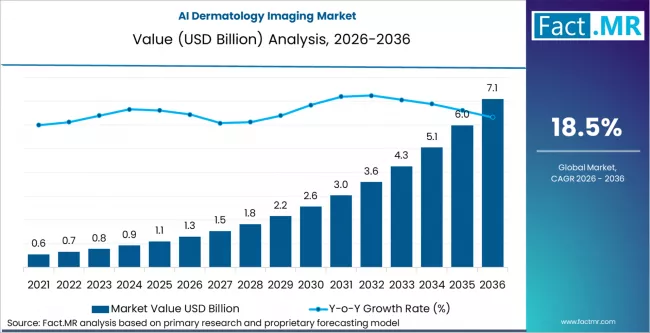
    Ai Dermatology Imaging Market Market Value Analysis

    This field supports clinical workflows where image capture, comparison, and structured assessment are required at scale. Systems are used to standardize documentation, support triage, and improve follow-up consistency across clinics and hospital networks. Deployment decisions focus on image quality, repeatability of analysis, and integration with existing record systems.

    Routine use depends on stable software performance, predictable update cycles, and clear audit trails. Once a platform is embedded into daily practice, replacement is approached cautiously since it affects training, reporting formats, and historical case libraries. Procurement teams evaluate long-term support, data handling standards, and reliability under high case volumes. Expansion follows wider adoption in outpatient settings, growth in screening programs, and broader acceptance of assisted interpretation tools rather than rapid turnover of installed systems.

    AI Dermatology Imaging Market

    Metric Value
    Market Value (2026) USD 1.3 billion
    Forecast Value (2036) USD 7.1 billion
    Forecast CAGR (2026-2036) 18.5%

    Category

    Category Segments
    Solution Types AI lesion triage and malignancy risk scoring (SaMD); Total-body imaging and dermoscopy hardware; Workflow and image management platforms; Tele-dermatology imaging capture kits; Analytics, audit and model monitoring services
    Clinical Use Cases Skin cancer screening and surveillance; Inflammatory dermatoses monitoring (eczema, psoriasis); Acne and pigmentation assessment; Wound or ulcer skin integrity imaging; Cosmetic dermatology assessment
    End User or Channel Dermatology clinics; Hospitals; Telehealth platforms; Primary care networks; Others
    Region North America; Europe; Asia Pacific; Latin America; Middle East & Africa

    AI Dermatology Imaging Market Segmental Analysis

    Which Solution Segment Holds the Leading Share of The AI Dermatology Imaging Market?
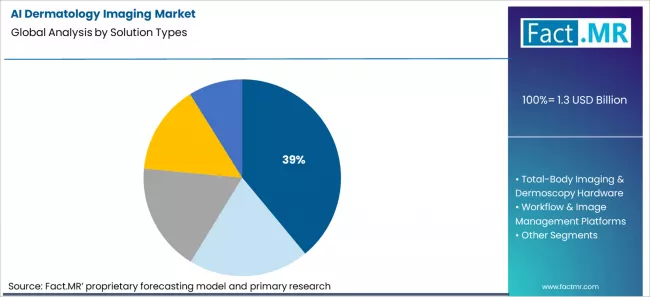
    Ai Dermatology Imaging Market Analysis By Solution Types

    Fact.MR analysis indicates that lesion triage and malignancy risk scoring represents the leading solution-layer share at 39% of total deployment in the AI dermatology imaging market. This position reflects where health systems concentrate control over access and referral flow. The intake boundary of care pathways governs waiting lists, specialist utilisation, and network capacity planning. Budget ownership at this layer sits with system and programme management rather than with individual departments. Spending therefore accumulates where throughput and prioritisation are decided. This segment sits at the point where volume pressure is absorbed and redistributed across the care network. Infrastructure budgets follow this control point, which secures this layer the largest share within the solution stack.

    Which Clinical Use Case Holds the Leading Share of The AI Dermatology Imaging Market?
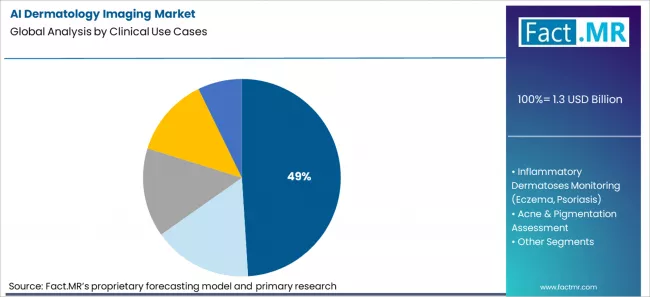
    Ai Dermatology Imaging Market Analysis By Clinical Use Cases

    Fact.MR assessment shows that skin cancer screening and surveillance holds the leading share at 49% of total use-case allocation in the AI dermatology imaging market. This dominance follows the structure of service delivery and funding. Surveillance operates on defined cohorts, scheduled cycles, and long follow-up horizons, which produces recurring, contractable activity. Budget authority typically sits at system, insurer, or public programme level. Documentation continuity, audit requirements, and longitudinal record retention increase institutional dependence on this segment. Once established, these programmes become part of operating architecture rather than discretionary tools, which secures this segment the largest share of overall market activity.

    How Are Clinical Risk, Evidence Standards, and Workflow Integration Shaping AI Dermatology Imaging Adoption?

    • Clinical Logic: Adoption is being driven by the need for consistent lesion measurement, objective change tracking, and triage support in high-volume dermatology and teledermatology settings, where visual judgment alone creates variability.
    • Adoption Friction: Regulatory clearance requirements, concerns about performance across different skin tones, and the need for clinician-level validation slow procurement decisions and limit unsupervised use.
    • Product Direction: Development is concentrating on tools that quantify lesion size, color, and border change over time rather than positioning AI as a standalone diagnostic authority.
    • Deployment Pattern: Most implementations are appearing as decision-support layers inside existing imaging and record systems, not as independent diagnostic endpoints.

    Analysis of the AI Dermatology Imaging Market by Key Country
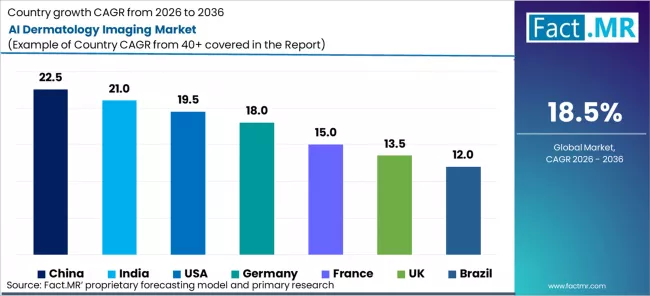
    Ai Dermatology Imaging Market Cagr Analysis By Country

    Country CAGR (2026-2036)
    USA 19.5%
    China 22.5%
    India 21.0%
    Germany 18.0%
    France 15.0%
    UK 13.5%
    Brazil 12.0%

    The report covers an in-depth analysis of 40+ countries; top-performing countries are highlighted below.

    What Defines Clinical Integration Priorities in the AI Dermatology Imaging Market in USA?

    Clinical workflow integration, not experimental use, is determining how the ai dermatology imaging market in USA develops, and that logic explains why expansion is tracking close to 19.5% per year through 2036. Health systems face dermatologist shortages and documentation pressure, so adoption focuses on triage support, follow-up comparison, and report automation. Buying authority sits with enterprise IT and compliance teams rather than departments. Tools must integrate with records and imaging systems before scale becomes possible. Growth therefore comes from productivity gains and earlier screening, not specialist replacement. Expansion speed depends more on interoperability clearance and governance approval than on algorithm novelty.

    Why Does Platform Infrastructure Set the Pace in the AI Dermatology Imaging Market in China?

    Hospital network expansion and digital platform deployment explain why a 22.5% annual trajectory through 2036 is reshaping the AI dermatology imaging market in China. Care delivery relies on high-volume outpatient flows, which makes screening efficiency and standardized reporting more valuable than specialist interpretation. Systems are adopted when they fit provincial deployment models and central procurement rules. Once included in platform stacks, usage scales quickly through mandated workflows. Growth therefore follows infrastructure rollout rather than clinical advocacy. The category expands because new capacity needs triage tools, not because diagnostic philosophy is changing. Long-term positioning will depend on data localization and system-level integration mandates.

    How Do Access Constraints Shape the AI Dermatology Imaging Market in India?

    Uneven specialist distribution explains why a 21% growth path through 2036 is accelerating the AI dermatology imaging market in India. Large parts of the system rely on primary care and diagnostic chains, which makes triage support and referral prioritization the main use cases. Adoption occurs when tools reduce unnecessary travel and waiting rather than when they offer advanced analytics. Purchasing is driven by network operators seeking throughput improvements. Growth therefore comes from first-contact screening and telemedicine expansion. The category scales because access gaps exist, not because workflow sophistication is high. Sustainability will depend on price discipline and operational simplicity across mixed infrastructure environments.

    What Role Does Regulatory Discipline Play in the AI Dermatology Imaging Market in Germany?

    Regulatory caution explains why an 18% trajectory through 2036 is widening acceptance of the AI dermatology imaging market in Germany without accelerating it. Clinical practice requires documented benefit and auditability, so deployment focuses on triage and monitoring rather than diagnosis. Tools enter routine use only after compliance, data protection, and reimbursement conditions align. Procurement follows structured tenders, which slows diffusion but stabilizes standards. Growth therefore comes from guideline integration and screening programs, not from local experimentation. The category expands because institutions absorb it into defined pathways, not because individual physicians seek efficiency tools. Interoperability and documentation remain more decisive than performance claims.

    Why Does Institutional Governance Frame the AI Dermatology Imaging Market in France?

    Centralized healthcare governance explains why a 15% growth rate through 2036 is shaping the AI dermatology imaging market in France in a controlled manner. Adoption depends on national evaluations, not local initiative, so use cases concentrate on referral triage and documentation. Hospitals introduce systems when they fit approved digital roadmaps and data hosting rules. Growth therefore follows policy alignment and outpatient pathway reform. The category expands because system planners need consistency and traceability, not because departments seek productivity tools. Commercial success depends on meeting administrative criteria before clinical enthusiasm matters. Scale arrives through coordinated rollout, not competitive site-by-site adoption across regions and provider groups.

    How Do Capacity Pressures Shape the AI Dermatology Imaging Market in UK?

    Service backlog management explains why a 13.5% annual increase through 2036 is driving the AI dermatology imaging market in UK. The system prioritizes reducing referral queues and standardizing triage decisions, not diagnostic automation. Tools are adopted when they support pathway discipline and documentation consistency. Central procurement and information governance reviews slow adoption but ensure uniformity. Growth therefore follows teledermatology expansion and community hubs rather than hospital-driven innovation. The category scales because capacity constraints require earlier filtering, not because technology strategy has shifted. Long-term uptake will track workforce planning and referral redesign more closely than algorithm improvement or vendor competition dynamics.

    What Constrains Scaling in the AI Dermatology Imaging Market in Brazil?

    Economic variability explains why a 12% trajectory through 2036 is expanding the AI dermatology imaging market in Brazil unevenly. Adoption concentrates in private networks where throughput and cosmetic consultation support justify investment. Public system uptake remains limited by funding cycles and infrastructure gaps. Growth therefore comes from urban teleconsultation and retail health models rather than national programs. The category scales when it supports revenue-generating workflows, not when it promises efficiency. Procurement depends on distributors and financing terms as much as performance. Expansion remains sensitive to credit conditions and investment confidence, making deployment cyclical rather than systematic across regions and care settings nationwide.

    Why AI Dermatology Imaging Is Becoming a Clinical Infrastructure Market Rather Than a Software Market?
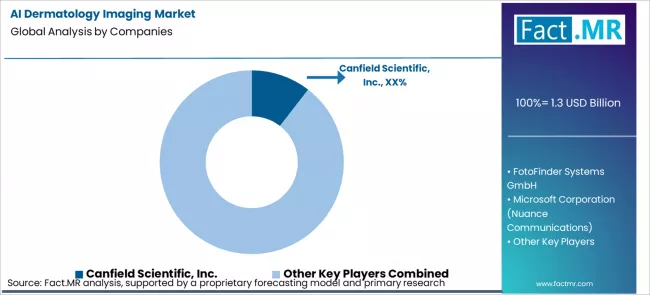
    Ai Dermatology Imaging Market Analysis By Company

    The AI dermatology imaging sector is reorganising around control of clinical infrastructure rather than model performance. Canfield’s deployment of mobile VECTRA systems shows that value now sits in standardising how skin is captured, not merely how it is analysed. FotoFinder’s shift toward wireless acquisition follows the same logic, since frictionless capture expands usable datasets and fixes customers inside hardware defined workflows. MetaOptima’s integration into primary care records signals where monetisation moves next, because clinic capacity is constrained by documentation and triage rather than by detection accuracy. Microsoft and Google accelerate this compression by making high quality interpretation widely available, which removes algorithmic scarcity as a pricing lever. Once accuracy becomes a baseline, operational control becomes the differentiator. The platforms that collapse imaging, reporting, coding, and follow up into a single process gain durable advantage. By 2027, competitive position will be measured by minutes removed from clinical workflows rather than by marginal gains in diagnostic sensitivity. In this structure, regulatory clearance becomes a scaling gate rather than a compliance formality, and systems that control capture and workflow become embedded clinical infrastructure. This forms the basis of Fact.MR’s strategic outlook for the AI dermatology imaging sector over the coming decade.

    Key Players in AI Dermatology Imaging Market

    • Canfield Scientific, Inc.
    • FotoFinder Systems GmbH
    • Microsoft Corporation (Nuance Communications)
    • Google LLC (Health)
    • MetaOptima Technology Inc. (DermEngine)
    • Others

    Scope of the Report

    Items Values
    Quantitative Units (2026) USD billion
    Solution Types AI lesion triage and malignancy risk scoring (SaMD), total-body imaging and dermoscopy hardware, workflow and image management platforms, tele-dermatology imaging capture kits, analytics, audit and model monitoring services
    Clinical Use Cases Skin cancer screening and surveillance, inflammatory dermatoses monitoring (eczema, psoriasis), acne and pigmentation assessment, wound or ulcer skin integrity imaging, cosmetic dermatology assessment
    End User or Channel Dermatology clinics, hospitals, telehealth platforms, primary care networks, others
    Regions Covered Asia Pacific, Europe, North America, Latin America, Middle East & Africa
    Countries Covered United States, Canada, Mexico, Germany, United Kingdom, France, Italy, Spain, China, Japan, South Korea, India, Australia & New Zealand, ASEAN, Brazil, Chile, Saudi Arabia, Turkey, South Africa, and other regional markets
    Key Companies Profiled Canfield Scientific, FotoFinder Systems, Microsoft (Nuance Communications), Google (Health), MetaOptima Technology (DermEngine)
    Additional Attributes Dollar by sales by solution type, clinical use case, and end user; focus on triage integration, workflow standardization, and auditability; demand driven by screening programs, outpatient adoption, and enterprise deployment

    AI Dermatology Imaging Market Segmentation

    • Solution Types :

      • AI Lesion Triage & Malignancy Risk Scoring (SaMD)
      • Total-Body Imaging & Dermoscopy Hardware
      • Workflow & Image Management Platforms
      • Tele-Dermatology Imaging Capture Kits
      • Analytics, Audit & Model Monitoring Services
    • Clinical Use Cases :

      • Skin Cancer Screening & Surveillance
      • Inflammatory Dermatoses Monitoring (Eczema, Psoriasis)
      • Acne & Pigmentation Assessment
      • Wound or Ulcer Skin Integrity Imaging
      • Cosmetic Dermatology Assessment
    • End User or Channel :

      • Dermatology Clinics
      • Hospitals
      • Telehealth Platforms
      • Primary Care Networks
      • Others
    • Region :

      • Asia Pacific
        • China
        • Japan
        • South Korea
        • India
        • Australia & New Zealand
        • ASEAN
        • Rest of Asia Pacific
      • Europe
        • Germany
        • United Kingdom
        • France
        • Italy
        • Spain
        • Nordic
        • BENELUX
        • Rest of Europe
      • North America
        • United States
        • Canada
        • Mexico
      • Latin America
        • Brazil
        • Chile
        • Rest of Latin America
      • Middle East & Africa
        • Kingdom of Saudi Arabia
        • Other GCC Countries
        • Turkey
        • South Africa
        • Other African Union
        • Rest of Middle East & Africa

    References

    • World Health Organization. (2023). Regulatory considerations on artificial intelligence for health. World Health Organization.
    • U.S. Food and Drug Administration. (2024). Artificial Intelligence and Machine Learning in Software as a Medical Device. U.S. FDA.
    • European Commission. (2024). Artificial Intelligence Act (AI Act): Regulatory framework for medical and high-risk AI systems. Official Journal of the European Union.
    • International Organization for Standardization. (2024). ISO/IEC 23894:2024 Information technology - Artificial intelligence - Risk management. ISO.

    Table of Content

    1. Executive Summary
      • Global Market Outlook
      • Demand to side Trends
      • Supply to side Trends
      • Technology Roadmap Analysis
      • Analysis and Recommendations
    2. Market Overview
      • Market Coverage / Taxonomy
      • Market Definition / Scope / Limitations
    3. Research Methodology
      • Chapter Orientation
      • Analytical Lens and Working Hypotheses
        • Market Structure, Signals, and Trend Drivers
        • Benchmarking and Cross-market Comparability
        • Market Sizing, Forecasting, and Opportunity Mapping
      • Research Design and Evidence Framework
        • Desk Research Programme (Secondary Evidence)
          • Company Annual and Sustainability Reports
          • Peer-reviewed Journals and Academic Literature
          • Corporate Websites, Product Literature, and Technical Notes
          • Earnings Decks and Investor Briefings
          • Statutory Filings and Regulatory Disclosures
          • Technical White Papers and Standards Notes
          • Trade Journals, Industry Magazines, and Analyst Briefs
          • Conference Proceedings, Webinars, and Seminar Materials
          • Government Statistics Portals and Public Data Releases
          • Press Releases and Reputable Media Coverage
          • Specialist Newsletters and Curated Briefings
          • Sector Databases and Reference Repositories
          • FMR Internal Proprietary Databases and Historical Market Datasets
          • Subscription Datasets and Paid Sources
          • Social Channels, Communities, and Digital Listening Inputs
          • Additional Desk Sources
        • Expert Input and Fieldwork (Primary Evidence)
          • Primary Modes
            • Qualitative Interviews and Expert Elicitation
            • Quantitative Surveys and Structured Data Capture
            • Blended A8oach
          • Why Primary Evidence is Used
          • Field Techniques
            • Interviews
            • Surveys
            • Focus Groups
            • Observational and In-context Research
            • Social and Community Interactions
          • Stakeholder Universe Engaged
            • C-suite Leaders
            • Board Members
            • Presidents and Vice Presidents
            • R&D and Innovation Heads
            • Technical Specialists
            • Domain Subject-matter Experts
            • Scientists
            • Physicians and Other Healthcare Professionals
          • Governance, Ethics, and Data Stewardship
            • Research Ethics
            • Data Integrity and Handling
        • Tooling, Models, and Reference Databases
      • Data Engineering and Model Build
        • Data Acquisition and Ingestion
        • Cleaning, Normalisation, and Verification
        • Synthesis, Triangulation, and Analysis
      • Quality Assurance and Audit Trail
    4. Market Background
      • Market Dynamics
        • Drivers
        • Restraints
        • Opportunity
        • Trends
      • Scenario Forecast
        • Demand in Optimistic Scenario
        • Demand in Likely Scenario
        • Demand in Conservative Scenario
      • Opportunity Map Analysis
      • Product Life Cycle Analysis
      • Supply Chain Analysis
      • Investment Feasibility Matrix
      • Value Chain Analysis
      • PESTLE and Porter’s Analysis
      • Regulatory Landscape
      • Regional Parent Market Outlook
      • Production and Consumption Statistics
      • Import and Export Statistics
    5. Global Market Analysis 2021 to 2025 and Forecast, 2026 to 2036
      • Historical Market Size Value (USD Million) Analysis, 2021 to 2025
      • Current and Future Market Size Value (USD Million) Projections, 2026 to 2036
        • Y to o to Y Growth Trend Analysis
        • Absolute $ Opportunity Analysis
    6. Global Market Pricing Analysis 2021 to 2025 and Forecast 2026 to 2036
    7. Global Market Analysis 2021 to 2025 and Forecast 2026 to 2036, By Solution Types
      • Introduction / Key Findings
      • Historical Market Size Value (USD Million) Analysis By Solution Types, 2021 to 2025
      • Current and Future Market Size Value (USD Million) Analysis and Forecast By Solution Types, 2026 to 2036
        • AI Lesion Triage & Malignancy Risk Scoring (SaMD)
        • Total-Body Imaging & Dermoscopy Hardware
        • Workflow & Image Management Platforms
        • Tele-Dermatology Imaging Capture Kits
        • Analytics, Audit & Model Monitoring Services
      • Y to o to Y Growth Trend Analysis By Solution Types, 2021 to 2025
      • Absolute $ Opportunity Analysis By Solution Types, 2026 to 2036
    8. Global Market Analysis 2021 to 2025 and Forecast 2026 to 2036, By Clinical Use Cases
      • Introduction / Key Findings
      • Historical Market Size Value (USD Million) Analysis By Clinical Use Cases, 2021 to 2025
      • Current and Future Market Size Value (USD Million) Analysis and Forecast By Clinical Use Cases, 2026 to 2036
        • Skin Cancer Screening & Surveillance
        • Inflammatory Dermatoses Monitoring (Eczema, Psoriasis)
        • Acne & Pigmentation Assessment
        • Wound or Ulcer Skin Integrity Imaging
        • Cosmetic Dermatology Assessment
      • Y to o to Y Growth Trend Analysis By Clinical Use Cases, 2021 to 2025
      • Absolute $ Opportunity Analysis By Clinical Use Cases, 2026 to 2036
    9. Global Market Analysis 2021 to 2025 and Forecast 2026 to 2036, By End User or Channel
      • Introduction / Key Findings
      • Historical Market Size Value (USD Million) Analysis By End User or Channel, 2021 to 2025
      • Current and Future Market Size Value (USD Million) Analysis and Forecast By End User or Channel, 2026 to 2036
        • Dermatology Clinics
        • Hospitals
        • Telehealth Platforms
        • Primary Care Networks
        • Others
      • Y to o to Y Growth Trend Analysis By End User or Channel, 2021 to 2025
      • Absolute $ Opportunity Analysis By End User or Channel, 2026 to 2036
    10. Global Market Analysis 2021 to 2025 and Forecast 2026 to 2036, By Region
      • Introduction
      • Historical Market Size Value (USD Million) Analysis By Region, 2021 to 2025
      • Current Market Size Value (USD Million) Analysis and Forecast By Region, 2026 to 2036
        • North America
        • Latin America
        • Western Europe
        • Eastern Europe
        • East Asia
        • South Asia and Pacific
        • Middle East & Africa
      • Market Attractiveness Analysis By Region
    11. North America Market Analysis 2021 to 2025 and Forecast 2026 to 2036, By Country
      • Historical Market Size Value (USD Million) Trend Analysis By Market Taxonomy, 2021 to 2025
      • Market Size Value (USD Million) Forecast By Market Taxonomy, 2026 to 2036
        • By Country
          • USA
          • Canada
          • Mexico
        • By Solution Types
        • By Clinical Use Cases
        • By End User or Channel
      • Market Attractiveness Analysis
        • By Country
        • By Solution Types
        • By Clinical Use Cases
        • By End User or Channel
      • Key Takeaways
    12. Latin America Market Analysis 2021 to 2025 and Forecast 2026 to 2036, By Country
      • Historical Market Size Value (USD Million) Trend Analysis By Market Taxonomy, 2021 to 2025
      • Market Size Value (USD Million) Forecast By Market Taxonomy, 2026 to 2036
        • By Country
          • Brazil
          • Chile
          • Rest of Latin America
        • By Solution Types
        • By Clinical Use Cases
        • By End User or Channel
      • Market Attractiveness Analysis
        • By Country
        • By Solution Types
        • By Clinical Use Cases
        • By End User or Channel
      • Key Takeaways
    13. Western Europe Market Analysis 2021 to 2025 and Forecast 2026 to 2036, By Country
      • Historical Market Size Value (USD Million) Trend Analysis By Market Taxonomy, 2021 to 2025
      • Market Size Value (USD Million) Forecast By Market Taxonomy, 2026 to 2036
        • By Country
          • Germany
          • UK
          • Italy
          • Spain
          • France
          • Nordic
          • BENELUX
          • Rest of Western Europe
        • By Solution Types
        • By Clinical Use Cases
        • By End User or Channel
      • Market Attractiveness Analysis
        • By Country
        • By Solution Types
        • By Clinical Use Cases
        • By End User or Channel
      • Key Takeaways
    14. Eastern Europe Market Analysis 2021 to 2025 and Forecast 2026 to 2036, By Country
      • Historical Market Size Value (USD Million) Trend Analysis By Market Taxonomy, 2021 to 2025
      • Market Size Value (USD Million) Forecast By Market Taxonomy, 2026 to 2036
        • By Country
          • Russia
          • Poland
          • Hungary
          • Balkan & Baltic
          • Rest of Eastern Europe
        • By Solution Types
        • By Clinical Use Cases
        • By End User or Channel
      • Market Attractiveness Analysis
        • By Country
        • By Solution Types
        • By Clinical Use Cases
        • By End User or Channel
      • Key Takeaways
    15. East Asia Market Analysis 2021 to 2025 and Forecast 2026 to 2036, By Country
      • Historical Market Size Value (USD Million) Trend Analysis By Market Taxonomy, 2021 to 2025
      • Market Size Value (USD Million) Forecast By Market Taxonomy, 2026 to 2036
        • By Country
          • China
          • Japan
          • South Korea
        • By Solution Types
        • By Clinical Use Cases
        • By End User or Channel
      • Market Attractiveness Analysis
        • By Country
        • By Solution Types
        • By Clinical Use Cases
        • By End User or Channel
      • Key Takeaways
    16. South Asia and Pacific Market Analysis 2021 to 2025 and Forecast 2026 to 2036, By Country
      • Historical Market Size Value (USD Million) Trend Analysis By Market Taxonomy, 2021 to 2025
      • Market Size Value (USD Million) Forecast By Market Taxonomy, 2026 to 2036
        • By Country
          • India
          • ASEAN
          • Australia & New Zealand
          • Rest of South Asia and Pacific
        • By Solution Types
        • By Clinical Use Cases
        • By End User or Channel
      • Market Attractiveness Analysis
        • By Country
        • By Solution Types
        • By Clinical Use Cases
        • By End User or Channel
      • Key Takeaways
    17. Middle East & Africa Market Analysis 2021 to 2025 and Forecast 2026 to 2036, By Country
      • Historical Market Size Value (USD Million) Trend Analysis By Market Taxonomy, 2021 to 2025
      • Market Size Value (USD Million) Forecast By Market Taxonomy, 2026 to 2036
        • By Country
          • Kingdom of Saudi Arabia
          • Other GCC Countries
          • Turkiye
          • South Africa
          • Other African Union
          • Rest of Middle East & Africa
        • By Solution Types
        • By Clinical Use Cases
        • By End User or Channel
      • Market Attractiveness Analysis
        • By Country
        • By Solution Types
        • By Clinical Use Cases
        • By End User or Channel
      • Key Takeaways
    18. Key Countries Market Analysis
      • USA
        • Pricing Analysis
        • Market Share Analysis, 2025
          • By Solution Types
          • By Clinical Use Cases
          • By End User or Channel
      • Canada
        • Pricing Analysis
        • Market Share Analysis, 2025
          • By Solution Types
          • By Clinical Use Cases
          • By End User or Channel
      • Mexico
        • Pricing Analysis
        • Market Share Analysis, 2025
          • By Solution Types
          • By Clinical Use Cases
          • By End User or Channel
      • Brazil
        • Pricing Analysis
        • Market Share Analysis, 2025
          • By Solution Types
          • By Clinical Use Cases
          • By End User or Channel
      • Chile
        • Pricing Analysis
        • Market Share Analysis, 2025
          • By Solution Types
          • By Clinical Use Cases
          • By End User or Channel
      • Germany
        • Pricing Analysis
        • Market Share Analysis, 2025
          • By Solution Types
          • By Clinical Use Cases
          • By End User or Channel
      • UK
        • Pricing Analysis
        • Market Share Analysis, 2025
          • By Solution Types
          • By Clinical Use Cases
          • By End User or Channel
      • Italy
        • Pricing Analysis
        • Market Share Analysis, 2025
          • By Solution Types
          • By Clinical Use Cases
          • By End User or Channel
      • Spain
        • Pricing Analysis
        • Market Share Analysis, 2025
          • By Solution Types
          • By Clinical Use Cases
          • By End User or Channel
      • France
        • Pricing Analysis
        • Market Share Analysis, 2025
          • By Solution Types
          • By Clinical Use Cases
          • By End User or Channel
      • India
        • Pricing Analysis
        • Market Share Analysis, 2025
          • By Solution Types
          • By Clinical Use Cases
          • By End User or Channel
      • ASEAN
        • Pricing Analysis
        • Market Share Analysis, 2025
          • By Solution Types
          • By Clinical Use Cases
          • By End User or Channel
      • Australia & New Zealand
        • Pricing Analysis
        • Market Share Analysis, 2025
          • By Solution Types
          • By Clinical Use Cases
          • By End User or Channel
      • China
        • Pricing Analysis
        • Market Share Analysis, 2025
          • By Solution Types
          • By Clinical Use Cases
          • By End User or Channel
      • Japan
        • Pricing Analysis
        • Market Share Analysis, 2025
          • By Solution Types
          • By Clinical Use Cases
          • By End User or Channel
      • South Korea
        • Pricing Analysis
        • Market Share Analysis, 2025
          • By Solution Types
          • By Clinical Use Cases
          • By End User or Channel
      • Russia
        • Pricing Analysis
        • Market Share Analysis, 2025
          • By Solution Types
          • By Clinical Use Cases
          • By End User or Channel
      • Poland
        • Pricing Analysis
        • Market Share Analysis, 2025
          • By Solution Types
          • By Clinical Use Cases
          • By End User or Channel
      • Hungary
        • Pricing Analysis
        • Market Share Analysis, 2025
          • By Solution Types
          • By Clinical Use Cases
          • By End User or Channel
      • Kingdom of Saudi Arabia
        • Pricing Analysis
        • Market Share Analysis, 2025
          • By Solution Types
          • By Clinical Use Cases
          • By End User or Channel
      • Turkiye
        • Pricing Analysis
        • Market Share Analysis, 2025
          • By Solution Types
          • By Clinical Use Cases
          • By End User or Channel
      • South Africa
        • Pricing Analysis
        • Market Share Analysis, 2025
          • By Solution Types
          • By Clinical Use Cases
          • By End User or Channel
    19. Market Structure Analysis
      • Competition Dashboard
      • Competition Benchmarking
      • Market Share Analysis of Top Players
        • By Regional
        • By Solution Types
        • By Clinical Use Cases
        • By End User or Channel
    20. Competition Analysis
      • Competition Deep Dive
        • Canfield Scientific, Inc.
          • Overview
          • Product Portfolio
          • Profitability by Market Segments (Product/Age /Sales Channel/Region)
          • Sales Footprint
          • Strategy Overview
            • Marketing Strategy
            • Product Strategy
            • Channel Strategy
        • FotoFinder Systems GmbH
        • Microsoft Corporation (Nuance Communications)
        • Google LLC (Health)
        • MetaOptima Technology Inc. (DermEngine)
        • Others
    21. Assumptions & Acronyms Used

    List Of Table

    • Table 1: Global Market Value (USD Million) Forecast by Region, 2021 to 2036
    • Table 2: Global Market Value (USD Million) Forecast by Solution Types, 2021 to 2036
    • Table 3: Global Market Value (USD Million) Forecast by Clinical Use Cases, 2021 to 2036
    • Table 4: Global Market Value (USD Million) Forecast by End User or Channel, 2021 to 2036
    • Table 5: North America Market Value (USD Million) Forecast by Country, 2021 to 2036
    • Table 6: North America Market Value (USD Million) Forecast by Solution Types, 2021 to 2036
    • Table 7: North America Market Value (USD Million) Forecast by Clinical Use Cases, 2021 to 2036
    • Table 8: North America Market Value (USD Million) Forecast by End User or Channel, 2021 to 2036
    • Table 9: Latin America Market Value (USD Million) Forecast by Country, 2021 to 2036
    • Table 10: Latin America Market Value (USD Million) Forecast by Solution Types, 2021 to 2036
    • Table 11: Latin America Market Value (USD Million) Forecast by Clinical Use Cases, 2021 to 2036
    • Table 12: Latin America Market Value (USD Million) Forecast by End User or Channel, 2021 to 2036
    • Table 13: Western Europe Market Value (USD Million) Forecast by Country, 2021 to 2036
    • Table 14: Western Europe Market Value (USD Million) Forecast by Solution Types, 2021 to 2036
    • Table 15: Western Europe Market Value (USD Million) Forecast by Clinical Use Cases, 2021 to 2036
    • Table 16: Western Europe Market Value (USD Million) Forecast by End User or Channel, 2021 to 2036
    • Table 17: Eastern Europe Market Value (USD Million) Forecast by Country, 2021 to 2036
    • Table 18: Eastern Europe Market Value (USD Million) Forecast by Solution Types, 2021 to 2036
    • Table 19: Eastern Europe Market Value (USD Million) Forecast by Clinical Use Cases, 2021 to 2036
    • Table 20: Eastern Europe Market Value (USD Million) Forecast by End User or Channel, 2021 to 2036
    • Table 21: East Asia Market Value (USD Million) Forecast by Country, 2021 to 2036
    • Table 22: East Asia Market Value (USD Million) Forecast by Solution Types, 2021 to 2036
    • Table 23: East Asia Market Value (USD Million) Forecast by Clinical Use Cases, 2021 to 2036
    • Table 24: East Asia Market Value (USD Million) Forecast by End User or Channel, 2021 to 2036
    • Table 25: South Asia and Pacific Market Value (USD Million) Forecast by Country, 2021 to 2036
    • Table 26: South Asia and Pacific Market Value (USD Million) Forecast by Solution Types, 2021 to 2036
    • Table 27: South Asia and Pacific Market Value (USD Million) Forecast by Clinical Use Cases, 2021 to 2036
    • Table 28: South Asia and Pacific Market Value (USD Million) Forecast by End User or Channel, 2021 to 2036
    • Table 29: Middle East & Africa Market Value (USD Million) Forecast by Country, 2021 to 2036
    • Table 30: Middle East & Africa Market Value (USD Million) Forecast by Solution Types, 2021 to 2036
    • Table 31: Middle East & Africa Market Value (USD Million) Forecast by Clinical Use Cases, 2021 to 2036
    • Table 32: Middle East & Africa Market Value (USD Million) Forecast by End User or Channel, 2021 to 2036

    List Of Figures

    • Figure 1: Global Market Pricing Analysis
    • Figure 2: Global Market Value (USD Million) Forecast 2021 to 2036
    • Figure 3: Global Market Value Share and BPS Analysis by Solution Types, 2026 and 2036
    • Figure 4: Global Market Y to o to Y Growth Comparison by Solution Types, 2026 to 2036
    • Figure 5: Global Market Attractiveness Analysis by Solution Types
    • Figure 6: Global Market Value Share and BPS Analysis by Clinical Use Cases, 2026 and 2036
    • Figure 7: Global Market Y to o to Y Growth Comparison by Clinical Use Cases, 2026 to 2036
    • Figure 8: Global Market Attractiveness Analysis by Clinical Use Cases
    • Figure 9: Global Market Value Share and BPS Analysis by End User or Channel, 2026 and 2036
    • Figure 10: Global Market Y to o to Y Growth Comparison by End User or Channel, 2026 to 2036
    • Figure 11: Global Market Attractiveness Analysis by End User or Channel
    • Figure 12: Global Market Value (USD Million) Share and BPS Analysis by Region, 2026 and 2036
    • Figure 13: Global Market Y to o to Y Growth Comparison by Region, 2026 to 2036
    • Figure 14: Global Market Attractiveness Analysis by Region
    • Figure 15: North America Market Incremental Dollar Opportunity, 2026 to 2036
    • Figure 16: Latin America Market Incremental Dollar Opportunity, 2026 to 2036
    • Figure 17: Western Europe Market Incremental Dollar Opportunity, 2026 to 2036
    • Figure 18: Eastern Europe Market Incremental Dollar Opportunity, 2026 to 2036
    • Figure 19: East Asia Market Incremental Dollar Opportunity, 2026 to 2036
    • Figure 20: South Asia and Pacific Market Incremental Dollar Opportunity, 2026 to 2036
    • Figure 21: Middle East & Africa Market Incremental Dollar Opportunity, 2026 to 2036
    • Figure 22: North America Market Value Share and BPS Analysis by Country, 2026 and 2036
    • Figure 23: North America Market Value Share and BPS Analysis by Solution Types, 2026 and 2036
    • Figure 24: North America Market Y to o to Y Growth Comparison by Solution Types, 2026 to 2036
    • Figure 25: North America Market Attractiveness Analysis by Solution Types
    • Figure 26: North America Market Value Share and BPS Analysis by Clinical Use Cases, 2026 and 2036
    • Figure 27: North America Market Y to o to Y Growth Comparison by Clinical Use Cases, 2026 to 2036
    • Figure 28: North America Market Attractiveness Analysis by Clinical Use Cases
    • Figure 29: North America Market Value Share and BPS Analysis by End User or Channel, 2026 and 2036
    • Figure 30: North America Market Y to o to Y Growth Comparison by End User or Channel, 2026 to 2036
    • Figure 31: North America Market Attractiveness Analysis by End User or Channel
    • Figure 32: Latin America Market Value Share and BPS Analysis by Country, 2026 and 2036
    • Figure 33: Latin America Market Value Share and BPS Analysis by Solution Types, 2026 and 2036
    • Figure 34: Latin America Market Y to o to Y Growth Comparison by Solution Types, 2026 to 2036
    • Figure 35: Latin America Market Attractiveness Analysis by Solution Types
    • Figure 36: Latin America Market Value Share and BPS Analysis by Clinical Use Cases, 2026 and 2036
    • Figure 37: Latin America Market Y to o to Y Growth Comparison by Clinical Use Cases, 2026 to 2036
    • Figure 38: Latin America Market Attractiveness Analysis by Clinical Use Cases
    • Figure 39: Latin America Market Value Share and BPS Analysis by End User or Channel, 2026 and 2036
    • Figure 40: Latin America Market Y to o to Y Growth Comparison by End User or Channel, 2026 to 2036
    • Figure 41: Latin America Market Attractiveness Analysis by End User or Channel
    • Figure 42: Western Europe Market Value Share and BPS Analysis by Country, 2026 and 2036
    • Figure 43: Western Europe Market Value Share and BPS Analysis by Solution Types, 2026 and 2036
    • Figure 44: Western Europe Market Y to o to Y Growth Comparison by Solution Types, 2026 to 2036
    • Figure 45: Western Europe Market Attractiveness Analysis by Solution Types
    • Figure 46: Western Europe Market Value Share and BPS Analysis by Clinical Use Cases, 2026 and 2036
    • Figure 47: Western Europe Market Y to o to Y Growth Comparison by Clinical Use Cases, 2026 to 2036
    • Figure 48: Western Europe Market Attractiveness Analysis by Clinical Use Cases
    • Figure 49: Western Europe Market Value Share and BPS Analysis by End User or Channel, 2026 and 2036
    • Figure 50: Western Europe Market Y to o to Y Growth Comparison by End User or Channel, 2026 to 2036
    • Figure 51: Western Europe Market Attractiveness Analysis by End User or Channel
    • Figure 52: Eastern Europe Market Value Share and BPS Analysis by Country, 2026 and 2036
    • Figure 53: Eastern Europe Market Value Share and BPS Analysis by Solution Types, 2026 and 2036
    • Figure 54: Eastern Europe Market Y to o to Y Growth Comparison by Solution Types, 2026 to 2036
    • Figure 55: Eastern Europe Market Attractiveness Analysis by Solution Types
    • Figure 56: Eastern Europe Market Value Share and BPS Analysis by Clinical Use Cases, 2026 and 2036
    • Figure 57: Eastern Europe Market Y to o to Y Growth Comparison by Clinical Use Cases, 2026 to 2036
    • Figure 58: Eastern Europe Market Attractiveness Analysis by Clinical Use Cases
    • Figure 59: Eastern Europe Market Value Share and BPS Analysis by End User or Channel, 2026 and 2036
    • Figure 60: Eastern Europe Market Y to o to Y Growth Comparison by End User or Channel, 2026 to 2036
    • Figure 61: Eastern Europe Market Attractiveness Analysis by End User or Channel
    • Figure 62: East Asia Market Value Share and BPS Analysis by Country, 2026 and 2036
    • Figure 63: East Asia Market Value Share and BPS Analysis by Solution Types, 2026 and 2036
    • Figure 64: East Asia Market Y to o to Y Growth Comparison by Solution Types, 2026 to 2036
    • Figure 65: East Asia Market Attractiveness Analysis by Solution Types
    • Figure 66: East Asia Market Value Share and BPS Analysis by Clinical Use Cases, 2026 and 2036
    • Figure 67: East Asia Market Y to o to Y Growth Comparison by Clinical Use Cases, 2026 to 2036
    • Figure 68: East Asia Market Attractiveness Analysis by Clinical Use Cases
    • Figure 69: East Asia Market Value Share and BPS Analysis by End User or Channel, 2026 and 2036
    • Figure 70: East Asia Market Y to o to Y Growth Comparison by End User or Channel, 2026 to 2036
    • Figure 71: East Asia Market Attractiveness Analysis by End User or Channel
    • Figure 72: South Asia and Pacific Market Value Share and BPS Analysis by Country, 2026 and 2036
    • Figure 73: South Asia and Pacific Market Value Share and BPS Analysis by Solution Types, 2026 and 2036
    • Figure 74: South Asia and Pacific Market Y to o to Y Growth Comparison by Solution Types, 2026 to 2036
    • Figure 75: South Asia and Pacific Market Attractiveness Analysis by Solution Types
    • Figure 76: South Asia and Pacific Market Value Share and BPS Analysis by Clinical Use Cases, 2026 and 2036
    • Figure 77: South Asia and Pacific Market Y to o to Y Growth Comparison by Clinical Use Cases, 2026 to 2036
    • Figure 78: South Asia and Pacific Market Attractiveness Analysis by Clinical Use Cases
    • Figure 79: South Asia and Pacific Market Value Share and BPS Analysis by End User or Channel, 2026 and 2036
    • Figure 80: South Asia and Pacific Market Y to o to Y Growth Comparison by End User or Channel, 2026 to 2036
    • Figure 81: South Asia and Pacific Market Attractiveness Analysis by End User or Channel
    • Figure 82: Middle East & Africa Market Value Share and BPS Analysis by Country, 2026 and 2036
    • Figure 83: Middle East & Africa Market Value Share and BPS Analysis by Solution Types, 2026 and 2036
    • Figure 84: Middle East & Africa Market Y to o to Y Growth Comparison by Solution Types, 2026 to 2036
    • Figure 85: Middle East & Africa Market Attractiveness Analysis by Solution Types
    • Figure 86: Middle East & Africa Market Value Share and BPS Analysis by Clinical Use Cases, 2026 and 2036
    • Figure 87: Middle East & Africa Market Y to o to Y Growth Comparison by Clinical Use Cases, 2026 to 2036
    • Figure 88: Middle East & Africa Market Attractiveness Analysis by Clinical Use Cases
    • Figure 89: Middle East & Africa Market Value Share and BPS Analysis by End User or Channel, 2026 and 2036
    • Figure 90: Middle East & Africa Market Y to o to Y Growth Comparison by End User or Channel, 2026 to 2036
    • Figure 91: Middle East & Africa Market Attractiveness Analysis by End User or Channel
    • Figure 92: Global Market - Tier Structure Analysis
    • Figure 93: Global Market - Company Share Analysis

    - FAQs -

    How big is the ai dermatology imaging market in 2026?

    The global ai dermatology imaging market is estimated to be valued at USD 1.3 billion in 2026.

    What will be the size of ai dermatology imaging market in 2036?

    The market size for the ai dermatology imaging market is projected to reach USD 7.1 billion by 2036.

    How much will be the ai dermatology imaging market growth between 2026 and 2036?

    The ai dermatology imaging market is expected to grow at a 18.5% CAGR between 2026 and 2036.

    What are the key product types in the ai dermatology imaging market?

    The key product types in ai dermatology imaging market are ai lesion triage & malignancy risk scoring (samd), total-body imaging & dermoscopy hardware, workflow & image management platforms, tele-dermatology imaging capture kits and analytics, audit & model monitoring services.

    Which clinical use cases segment to contribute significant share in the ai dermatology imaging market in 2026?

    In terms of clinical use cases, skin cancer screening & surveillance segment to command 49.0% share in the ai dermatology imaging market in 2026.

    AI Dermatology Imaging Market