- Base Value(2026): 1.8 Bn
- Estimated Value(2026): 1.8 Bn
- Forecast Value (2036): 6.1 Bn
- CAGR (2026 - 2036): 13.0%
Additive Binder Jets Market Forecast Outlook By Fact.MR
- The additive binder jets market is projected to reach USD 1.8 billion in 2026 and grow to USD 6.1 billion by 2036, reflecting a CAGR of 13%.
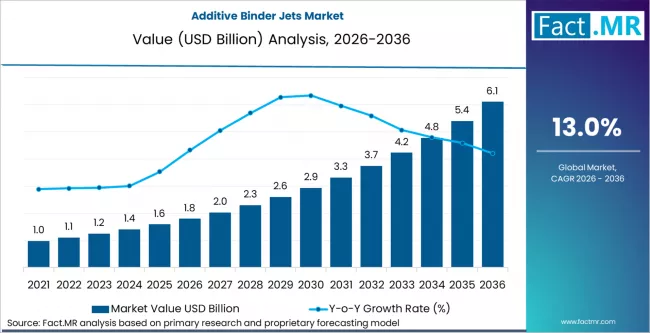
Additive Binder Jets Market Market Value Analysis | Source: Fact.MR
Summary of Additive Binder Jets Market
- Market Snapshot
- Global additive binder jets market revenue stood at USD 1.8 billion in 2026 and is forecast to reach USD 6.1 billion by 2036.
- At a 13.0% CAGR from 2026 to 2036, this market is set to expand ~3.4x in value, adding USD 4.3 billion in absolute opportunity.
- Growth is being driven by increasing adoption of industrial additive manufacturing, rising demand for high-speed production technologies, and expanding use of binder jetting across aerospace and automotive applications.
- Additive binder jets are increasingly adopted to improve manufacturing flexibility while maintaining production efficiency, material optimization, and design freedom for complex components.
- Rising investments in advanced manufacturing technologies, digital production infrastructure, and Industry 4.0 initiatives are reinforcing market expansion globally.
- Demand and Growth Drivers
- Increasing adoption of additive manufacturing across industrial production environments
- Rising demand for rapid prototyping and production-grade additive manufacturing solutions
- Growingutilizationof metal and ceramic binder jetting technologies
- Expansion of digital manufacturing and smart factory ecosystems
- Need for solutions that provide:
- Reduced manufacturing lead times
- Greater design flexibility for complex geometries
- Improved materialutilizationand operational efficiency
- Enhanced scalability for production applications
- Product and Segment View
- Geography and Competitive Outlook
- Asia Pacificemergesas the leading growth region for the additive binder jets market.
- Key growth markets and CAGR: China 14.2%, Brazil 13.8%, USA 12.7%, UK 12.7%, Germany 12.6%, South Korea 12.2%, Japan 11.5%
- Market expansion is closely tied to:
- Increasing adoption of additive manufacturing technologies across industrial sectors
- Rising investments in advanced manufacturing infrastructure and automation
- Growing demand for localized, flexible, and digitally enabled production systems
- Key companies active in this market include HP Inc., Desktop Metal, Inc.,ExOne,voxeljetAG, GE Additive, Digital Metal AB, Ricoh Company, Ltd., Toshiba Corporation, Stratasys Ltd., and 3D Systems Corporation.
Additive Binder Jets Market — At a Glance
| Attribute | Details |
|---|---|
| Market Value 2026 | USD 1.8 billion |
| Market Value 2036 | USD 6.1 billion |
| Absolute Dollar Opportunity 2026–2036 | USD 4.3 billion |
| Total Growth 2026–2036 | 238.9% |
| CAGR 2026–2036 | 13.0% |
| Growth Multiple | ~3.4x |
| Key Demand Theme | Increasing adoption of industrial-scale additive manufacturing and digital production technologies |
| Leading Segment by Sales Channel (2026) | Direct OEM |
| Segment Share (2026) | 57% |
| Key Growth Region | Asia Pacific |
| Country CAGRs | China 14.2%, Brazil 13.8%, USA 12.7%, UK 12.7%, Germany 12.6%, South Korea 12.2%, Japan 11.5% |
| Top Companies | HP Inc., Desktop Metal, Inc.,ExOne,voxeljetAG, GE Additive, Digital Metal AB, Ricoh Company, Ltd., Toshiba Corporation, Stratasys Ltd., 3D Systems Corporation |
| Segmentation by End-use | Industrial, Aerospace, Automotive, Other |
| Segmentation by Material | Metal Powders, Ceramics, Sand, Other |
| Segmentation by Sales Channel | Direct OEM, Distributors, Integrators, Other |
| Segmentation by Machine Size | Medium, Small, Large, Other |
| Segmentation by Region | North America, Europe, Asia Pacific, Latin America, Middle East & Africa |
Source: Fact.MR analysis. Updated Jun 3, 2026
Decision-makers must understand that this market represents a significant shift toward more efficient, scalable manufacturing processes, driven by the growing demand for customized, high-precision production. Economic exposure to this market is considerable, as investments in new technologies and infrastructure are required to capture growth, but timing will be crucial for capitalizing on returns. Prioritization should focus on securing reliable supply chains, optimizing production costs, and ensuring technological integration. While the market is expanding, adoption may be gradual, with buyers and suppliers needing to overcome barriers related to cost, complexity, and required expertise. Thus, decisions around when and how to enter this space should be carefully balanced with understanding the evolving competitive landscape and technological advancements that will define the next decade of growth.
Category
| Category | Segments |
|---|---|
| Material | Metal powders; Ceramics; Sand; Other |
| Machine Size | Medium; Small; Large; Other |
| End Use | Industrial; Aerospace; Automotive; Other |
| Sales Channel | Direct OEM; Distributors; Integrators; Other |
| Region | North America; Europe; Asia Pacific; Latin America; Middle East & Africa |
Source: Fact.MR analysis. Updated Jun 3, 2026
Segmental Analysis
What Is the Impact of Sales Channel on the Additive Binder Jets Market?
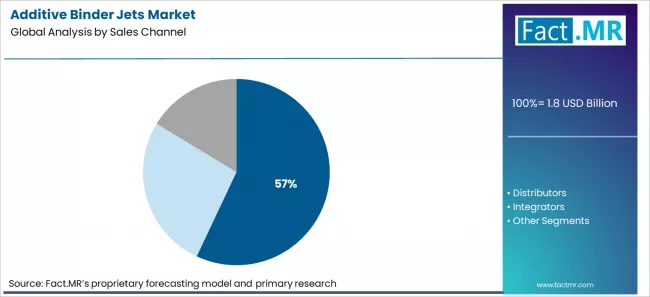
Additive Binder Jets Market Analysis By Sales Channel | Source: Fact.MR
In the additive binder jets market, the sales channel plays a crucial role in determining how binder jetting systems are distributed and accessed by end-users. Direct OEM sales lead the market with a 57% share, as original equipment manufacturers (OEMs) provide customized solutions and direct support to customers in industries such as aerospace, automotive, and healthcare. OEMs play an integral role in ensuring that binder jetting technology meets specific operational requirements and quality standards. As industries increasingly adopt additive manufacturing for high-precision and complex part production, the demand for binder jetting systems through direct OEM channels will continue to drive market growth.
What Is the Impact of Material on the Additive Binder Jets Market?
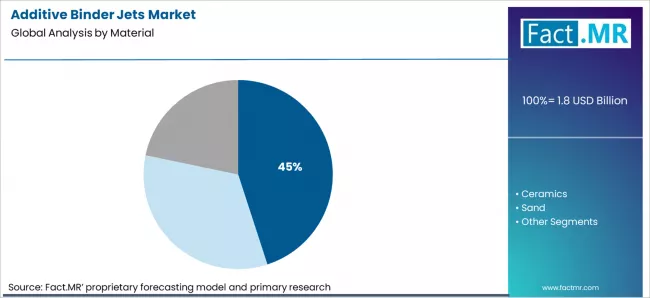
Additive Binder Jets Market Analysis By Material | Source: Fact.MR
Material choice significantly influences the performance and application of binder jetting technology, with metal powders holding a 45% share in the market. Metal powders are widely used in binder jetting due to their ability to produce highly detailed, strong, and durable parts, making them ideal for industries that require high-performance materials, such as aerospace, automotive, and industrial manufacturing. The use of ceramics and sand in binder jetting also sees growth in specific applications, such as prototyping and casting. As industries continue to explore new applications for additive manufacturing, the demand for various materials in binder jetting will expand, driving innovation and market development.
What are the Drivers, Restraints, and Key Trends in the Additive Binder Jets Market?
Demand for additive binder jets has been shaped by industrial requirements to produce complex geometries and near net shape parts across aerospace, automotive, tooling, and mass customized manufacturing. Engineers specify binder jet systems for metals, ceramics, and composites where layer by layer deposition followed by sintering or infiltration delivers high throughput relative to other additive manufacturing methods. Procurement teams and process engineers prioritize suppliers that demonstrate reliable binder deposition accuracy, consistent powder handling, and integration with post processing workflows. Growth in applications such as lightweight structures, lattice components, and rapid prototyping influences capital planning and adoption timelines for binder jet technologies.
Variability in powder quality, binder formulations, and process parameters affects part density, surface finish, and mechanical performance, creating challenges in process qualification and repeatability. Some manufacturers invest in material characterization and process control to reduce defects and improve dimensional stability. High initial investment and requirements for post processing (sintering furnaces, infiltration stations) constrain adoption where budgets or facility space are limited. Work on standardizing binder chemistries, developing closed loop process monitoring, and expanding certified material libraries is progressing. Collaboration among equipment vendors, materials suppliers, and end users aims to expand validated use cases and reduce barriers to industrial binder jet deployment.
Analysis of the Additive Binder Jets Market by Key Country
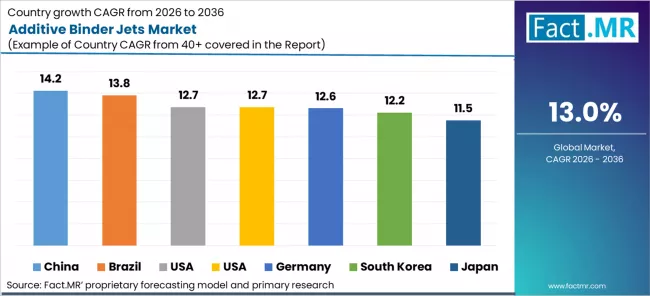
Additive Binder Jets Market Cagr Analysis By Country | Source: Fact.MR
| Country | CAGR 2026 to 2036 |
|---|---|
| USA | 12.7% |
| Japan | 11.5% |
| South Korea | 12.2% |
| Germany | 12.6% |
| China | 14.2% |
| UK | 12.7% |
| Brazil | 13.8% |
Source: Fact.MR analysis. Updated Jun 3, 2026
The report covers an in-depth analysis of 40+ countries; top-performing countries are highlighted below.
What is the Outlook on the Additive Binder Jets Market in the USA?
USA market in additive binder jets is projected to grow at a CAGR of 12.7% from 2026 to 2036. The demand for additive binder jetting technology in the USA is rising as industries such as manufacturing, automotive, and aerospace increasingly adopt 3D printing solutions for precision and efficiency. This technology offers the advantage of producing high-quality parts with complex geometries while reducing material waste. As businesses continue to innovate and seek faster, cost-effective production methods, the market for additive binder jets in the USA is expected to experience robust growth.
What is the Demand for Additive Binder Jets in Japan?
Japan sales of additive binder jets are expected to grow at a CAGR of 11.5% from 2026 to 2036. Japan's demand for additive binder jetting technology is increasing as industries such as automotive, electronics, and manufacturing continue to explore advanced 3D printing technologies. These solutions offer increased design flexibility, faster production times, and lower costs. With Japan’s commitment to technological innovation and its strong industrial base, the market for additive binder jets is expected to continue expanding steadily, supported by both local demand and global advancements in 3D printing.
What is the Sales Outlook on Additive Binder Jets in South Korea?
South Korea demand for additive binder jets is projected to grow at a CAGR of 12.2% from 2026 to 2036. South Korea’s industrial sectors, particularly automotive and electronics, are adopting 3D printing technologies to enhance their manufacturing processes. Additive binder jetting allows for high-speed production of complex parts, which is vital for improving operational efficiency and reducing material costs. As South Korea’s manufacturing industry continues to prioritize innovation and sustainability, the market for additive binder jets is expected to grow steadily, driven by both technological advancements and industrial demand.
What is the Demand for Additive Binder Jets in Germany?
Germany market in additive binder jets is forecast to grow at a CAGR of 12.6% from 2026 to 2036. As Germany remains a leader in industrial manufacturing and technology, the adoption of additive binder jetting is increasing across sectors such as automotive, aerospace, and industrial equipment. The technology offers advantages like rapid prototyping and the ability to manufacture complex parts with high precision, making it highly desirable for industries focused on reducing costs and improving production efficiency. The market for additive binder jets in Germany is expected to experience steady growth, supported by the country's commitment to innovation and sustainability.
What is the Sales Outlook on Additive Binder Jets in China?
China demand for additive binder jets is projected to grow at a CAGR of 14.2% from 2026 to 2036. China’s manufacturing sector, which is one of the largest in the world, is increasingly adopting 3D printing technologies to streamline production processes and enhance product quality. Additive binder jetting offers a cost-effective way to produce complex parts with high precision and low material waste. As China continues to focus on advancing its manufacturing capabilities and innovation in 3D printing, the market for additive binder jets is expected to grow rapidly, driven by both domestic demand and the country's focus on technological development.
What is the Market Expansion Outlook for Additive Binder Jets in the UK?
UK sales of additive binder jets are set to grow at a CAGR of 12.7% from 2026 to 2036. The demand for additive binder jetting in the UK is rising as industries such as aerospace, automotive, and consumer goods manufacturing adopt more advanced production technologies. Additive binder jets are gaining traction for their ability to produce high-quality components quickly and efficiently, which helps businesses meet growing market demands while reducing material waste. The market for additive binder jets in the UK is expected to continue growing, supported by ongoing industrial innovations and a focus on sustainability.
What is the Market Expansion Outlook for Additive Binder Jets in Brazil?
Brazil demand for additive binder jets is projected to grow at a CAGR of 13.8% from 2026 to 2036. As Brazil's manufacturing sector grows, particularly in industries such as automotive and industrial equipment, the need for additive manufacturing solutions like binder jetting is increasing. The technology allows for the fast production of high-quality, complex parts, making it an attractive option for businesses looking to improve operational efficiency and reduce material costs. The market for additive binder jets in Brazil is expected to experience robust growth, supported by the country’s expanding industrial base and increasing investments in 3D printing technologies.
How Are Key Players Competing in the Additive Binder Jets Market?
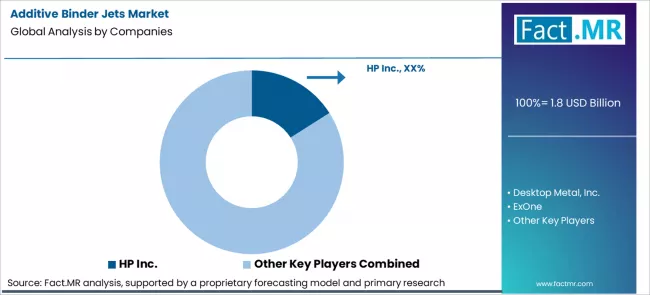
Additive Binder Jets Market Analysis By Company | Source: Fact.MR
Competition in the additive binder jets market is shaped by binder jetting system performance, material compatibility, and post processing workflows. HP Inc. and Desktop Metal, Inc. lead with industrial scale binder jet platforms that support high throughput and diverse material sets. ExOne and voxeljet AG focus on purpose built machines for metals and ceramics, emphasising precision and repeatability. GE Additive and Digital Metal AB compete by integrating binder jet solutions with broader additive portfolios and digital workflows. Ricoh Company, Ltd. and Toshiba Corporation offer compact systems tailored to specialized applications. Stratasys Ltd. and 3D Systems Corporation emphasise ecosystem support, including software, powders, and finishing. Competitive advantage is defined by machine accuracy, process stability, material range, and the ability to meet varied production requirements.
Key Players of the Additive Binder Jets Market
- HP Inc.
- Desktop Metal, Inc.
- ExOne
- voxeljet AG
- GE Additive
- Digital Metal AB
- Ricoh Company, Ltd.
- Toshiba Corporation
- Stratasys Ltd.
- 3D Systems Corporation
Bibliographies
- International Organization for Standardization & ASTM International. (2023). ISO/ASTM 52921: Terminology for powder-bed AM processes.
- ASTM International. (2024). ASTM F3122: Binder jetting of metal parts.
- National Institute of Standards and Technology. (2024). Process control and dimensional accuracy in metal binder jetting.
- Fraunhofer IFAM. (2023). Industrialization of binder jetting for metal components.
- European Commission, Joint Research Centre. (2023). Additive manufacturing technologies for industrial production.
Segmentation
Scope of the Report
| Items | Values |
|---|---|
| Quantitative Units (2026) | USD Billion |
| Material | Metal powders, Ceramics, Sand, Other |
| Machine Size | Small, Medium, Large |
| End Use | Industrial, Aerospace, Automotive, Other |
| Sales Channel | Direct OEM, Distributors, Integrators |
| Regions Covered | North America, Europe, Asia Pacific, Latin America, Middle East & Africa |
| Countries Covered | United States, Canada, Mexico, Brazil, Germany, United Kingdom, France, Italy, Spain, China, Japan, South Korea, India, Australia & New Zealand |
| Key Companies Profiled | HP Inc., Desktop Metal, Inc., ExOne, voxeljet AG, GE Additive, Digital Metal AB, Ricoh Company, Ltd., Toshiba Corporation, Stratasys Ltd., 3D Systems Corporation |
| Additional Attributes | Dollar revenue by material, machine size, end use, and sales channel; regional demand trends, competitive landscape, technological advancements in additive binder jets, and innovations in 3D printing and industrial applications |
Source: Fact.MR analysis. Updated Jun 3, 2026
Additive Binder Jets Market Key Segments
-
Material :
- Metal powders
- Ceramics
- Sand
- Other
-
Machine Size :
- Medium
- Small
- Large
-
End Use :
- Industrial
- Aerospace
- Automotive
- Other
-
Sales Channel :
- Direct OEM
- Distributors
- Integrators
- Other
-
Region :
- North America
- USA
- Canada
- Mexico
- Europe
- Germany
- UK
- France
- Italy
- Spain
- Nordic Countries
- BENELUX
- Rest of Europe
- Asia Pacific
- China
- Japan
- South Korea
- India
- Australia
- Rest of Asia Pacific
- Latin America
- Brazil
- Argentina
- Rest of Latin America
- Middle East and Africa
- Kingdom of Saudi Arabia
- United Arab Emirates
- South Africa
- Rest of Middle East and Africa
- Other Regions
- Oceania
- Central Asia
- Other Markets
- North America
Frequently Asked Questions
How big is the additive binder jets market in 2026?
What will be the size of additive binder jets market in 2036?
How much will be the additive binder jets market growth between 2026 and 2036?
What are the key product types in the additive binder jets market?
Which machine size segment to contribute significant share in the additive binder jets market in 2026?
Who worked on this report


Preview the report firsthand - request a free sample
Free SampleGet the brochure for pricing and purchase details
Download PDF