- Base Value(2026): 1.1 Bn
- Estimated Value(2026): 1.1 Bn
- Forecast Value (2036): 3.5 Bn
- CAGR (2026 - 2036): 12.4%
Airline Amenity Kit Disposable Packaging Market Forecast and Outlook 2026 to 2036
The airline amenity kit disposable packaging market starts 2026 at USD 1.1 billion and reaches USD 3.5 billion by 2036, which represents a 12.40% CAGR.
Airline Amenity Kit Disposable Packaging Market Key Takeaways
- Airline Amenity Kit Disposable Packaging Market Value (2026): USD 1.1 billion
- Airline Amenity Kit Disposable Packaging Market Forecast Value (2036): USD 3.5 billion
- Airline Amenity Kit Disposable Packaging Market Forecast CAGR: 12.4%
- Leading Type in Airline Amenity Kit Disposable Packaging Market: Kit boxes
- Key Growth Regions in Airline Amenity Kit Disposable Packaging Market: North America, Europe, Asia Pacific, Latin America, Middle East & Africa
- Top Players in Airline Amenity Kit Disposable Packaging Market: Berry Global, Avery Dennison, Ranpak, NEFAB, Smurfit Kappa
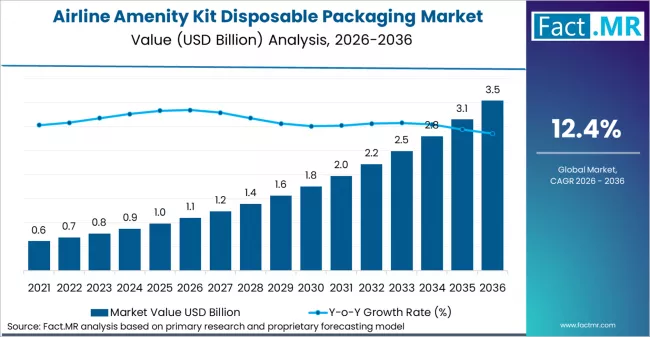
Airline Amenity Kit Disposable Packaging Market Market Value Analysis | Source: Fact.MR
This segment supports kits prepared for short and long haul flights where weight control, space efficiency, and neat presentation all matter. Packs must hold small items securely, stay compact, and tolerate handling during loading and cabin service. Airlines and kit assemblers prefer formats that can be filled at speed, stacked efficiently, and adjusted to different service classes without changing the base structure.
Once a pouch or box format is accepted, it usually remains in place since any change affects packing lines, supplier coordination, and onboard routines. Buyers focus on consistent quality, pack strength, and unit cost stability rather than frequent changes in design. Growth follows higher passenger volumes and wider use of amenity kits rather than repeated changes in packaging formats.
Airline Amenity Kit Disposable Packaging Market
| Metric | Value |
|---|---|
| Market Value (2026) | USD 1.1 billion |
| Forecast Value (2036) | USD 3.5 billion |
| Forecast CAGR 2026 to 2036 | 12.4% |
Category
| Category | Segments |
|---|---|
| End-use | Full-service airlines; European carriers; Asian airlines; Premium airlines |
| Packaging Format | Kit boxes; Fabric pouches; Plastic zip bags; Rigid cases |
| Material | Paperboard; Textile blends; PE films; PP |
| Region | North America; Europe; Asia Pacific; Latin America; Middle East & Africa |
Airline Amenity Kit Disposable Packaging Market Segmental Analysis
Why Do Full-Service Airlines Account for The Largest Share of Amenity Kit Packaging Demand?
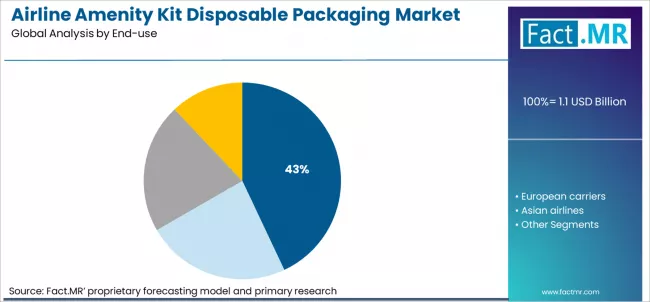
Airline Amenity Kit Disposable Packaging Market Analysis By End Use | Source: Fact.MR
Full-service airlines represent 43% of end-use demand in the airline amenity kit disposable packaging market. These carriers operate long-haul and premium economy cabins where amenity distribution forms part of the standard service flow. Cabin service routines require each passenger seat to be pre-equipped or served with a complete kit, which creates predictable unit volumes per flight. Fleet size and route frequency further multiply this requirement across daily operations. Procurement teams plan packaging orders around scheduled rotations rather than seasonal campaigns. European, Asian, and premium focused carriers contribute additional demand. The scale of wide network operations and consistent service standards keep full-service airlines as the primary driver of amenity kit packaging consumption.
What Keeps Kit Boxes as The Most Common Format for Airline Amenity Distribution?
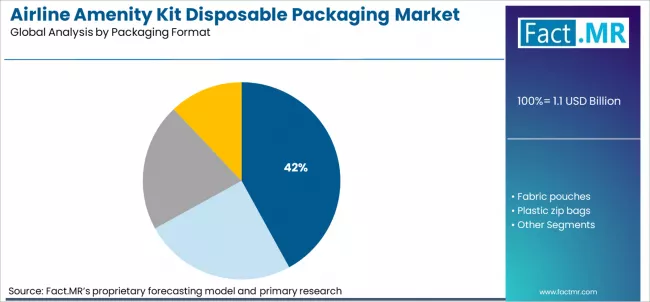
Airline Amenity Kit Disposable Packaging Market Analysis By Packaging Format | Source: Fact.MR
Kit boxes account for 42% of packaging format usage in this market. This format allows multiple items to be organized in a fixed layout that simplifies packing and cabin distribution. Handling during catering and loading remains straightforward since boxes stack and transport easily. Cabin crew can place or hand out these kits without sorting individual components. Printing surfaces also support branding and route specific messaging. Fabric pouches, zip bags, and rigid cases appear in selected classes or premium offerings. Most standard service programs still rely on box formats since they combine organization, protection, and logistics efficiency within a single disposable package.
What are the Drivers, Restraints, and Key Trends of the Airline Amenity Kit Disposable Packaging Market?
- Drivers: Airline specifications that require compact, hygienic, and single-use packaging for amenity kits, along with carrier efforts to enhance passenger experience through well-designed disposables, are shaping selection of packaging formats for onboard distribution.
- Restraint: Must-meet size and weight constraints tied to airline carry allowances, combined with stringent cost targets for high-volume procurement, restrict adoption of heavier or more complex packaging solutions.
- Trend 1: Increased use of modular packaging systems that secure individual components while simplifying kit assembly and disposal after flights.
- Trend 2: Expanded integration of clear usage instructions and regulatory icons on packaging to support quick understanding and reduce in-flight handling time.
Analysis of the Airline Amenity Kit Disposable Packaging Market by Key Country
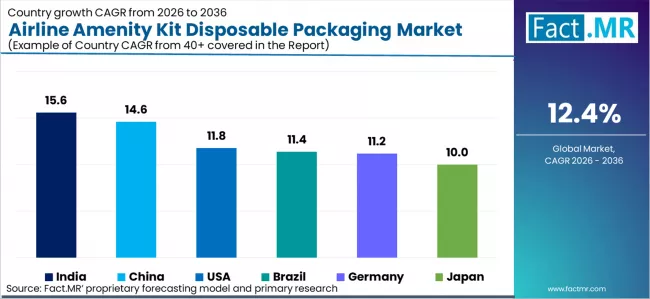
Airline Amenity Kit Disposable Packaging Market Cagr Analysis By Country | Source: Fact.MR
| Country | CAGR 2026 to 2036 |
|---|---|
| USA | 11.8% |
| Germany | 11.2% |
| China | 14.6% |
| Japan | 10.0% |
| India | 15.6% |
| Brazil | 11.4% |
The report covers an in-depth analysis of 40+ countries; top-performing countries are highlighted below.
How Are Fleet Operations and Cabin Standards Shaping This Market in USA?
Airlines in USA treat amenity kits as operational items that must load quickly and comply with cabin rules. The market grows near 11.8% per year through 2036 as premium economy and long haul traffic expand. Demand centers on lightweight cartons, simple closures, and clean opening for crew handling. Buyers focus on pack density, waste volume, and compatibility with kitting lines. Procurement decisions balance unit cost, branding space, and delivery reliability. Volume growth follows route expansion and cabin refits. Market development stays tied to fleet utilization and service standards rather than seasonal promotions or complex structural packaging features in daily operations.
Why Do Governance and Process Control Matter for This Market in Germany?
Airlines and airport caterers in Germany manage amenity packaging through tightly controlled processes. The market advances near 11.2% per year through 2036 as long haul schedules and premium cabins grow. Demand focuses on secure closures, clear labeling, and predictable pack geometry. Buyers emphasize documentation, supplier audits, and repeatable kitting performance. Procurement remains conservative and specification driven. Volume growth follows gradual fleet upgrades and route additions. Market development stays process oriented and tied to operational governance rather than impulse driven design changes or frequent material substitutions across categories across airports and partner catering facilities within the national airline system today broadly.
What Is Driving Scale Oriented Expansion in China?
Network expansion and centralized catering shape how amenity packaging is specified in China. The market expands near 14.6% per year through 2036 as international routes and widebody fleets increase. Demand centers on compact packs, fast kitting cycles, and consistent quality. Buyers prioritize scale, supply continuity, and compatibility with automated lines. Procurement strategies favor large suppliers with integrated converting and assembly. Volume increases follow new route launches and terminal openings. Market development remains tied to infrastructure buildout and passenger growth rather than premium materials or intricate structural designs for onboard programs across multiple hubs and regional gateways nationwide today operations scale.
How Do Service Discipline and Presentation Rules Influence This Market in Japan?
Cabin service in Japan places strong emphasis on order and predictable presentation. The market grows near 10.0% per year through 2036 as outbound travel and premium seating recover. Demand focuses on tidy opening, precise folding, and minimal waste. Buyers stress defect avoidance and consistent appearance. Procurement favors long term partners and stable specifications. Volume growth follows slow fleet updates and route normalization. Market development stays measured and tied to service discipline rather than rapid assortment changes or decorative packaging experiments across airline brands within cabins and ground handling processes used by carriers nationwide today operations standards broadly applied across fleets.
What Is Accelerating Adoption Across Carriers in India?
Route additions and cabin upgrades are expanding demand for amenity packaging in India. The market advances near 15.6% per year through 2036 as international travel and premium economy seats increase. Demand centers on low weight, spill resistance, and simple assembly. Buyers emphasize availability and the ability to scale volumes quickly. Procurement decisions often favor suppliers that support fast kitting expansion. Volume growth follows fleet growth and network expansion. Market development depends more on traffic growth and operational execution than on refined materials or complex structural packaging concepts within growing full service and low cost carrier systems nationwide today operations scale.
How Are Traffic Recovery and Concessions Shaping This Market in Brazil?
Air travel recovery and concession expansion influence amenity packaging demand in Brazil. The market grows near 11.4% per year through 2036 as international services and longer routes return. Demand centers on basic protection, secure closures, and easy disposal. Buyers focus on cost control and reliable supply. Procurement decisions emphasize distributor coverage and consistent kitting quality. Volume growth follows passenger throughput and cabin refresh programs. Market development remains tied to traffic levels and retail partnerships rather than premium materials or intricate packaging structures for onboard service used by major carriers and charter operators across the country today and abroad routes networks.
How Do Cabin Logistics and Assembly Workflows Shape Competition in the Airline Amenity Kit Disposable Packaging Market?
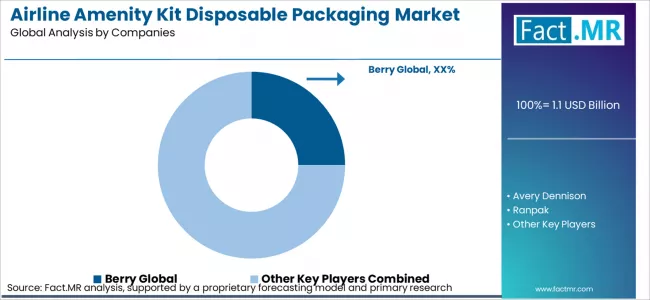
Airline Amenity Kit Disposable Packaging Market Analysis By Company | Source: Fact.MR
Amenity kit programs are designed around packing stations, aircraft galley storage limits, and route specific loading plans rather than around material cost alone. Airlines and kit assemblers first define pack footprint, weight ceilings, and opening sequence before any supplier is shortlisted. Berry Global and Smurfit Kappa compete through flexible and paper based structures that balance protection with low cube usage. Avery Dennison participates where labeling, sealing, and traceability features are integrated into the pack. Ranpak and Nefab support programs that require transit protection and efficient kitting of mixed items. Buyers compare suppliers using assembly speed, damage rates, and pallet density. Once a format is standardized for a fleet or cabin class, volumes track route schedules and seasonal service adjustments. Supplier changes usually follow cabin refresh cycles or shifts in onboard service concepts.
Key Players in Airline Amenity Kit Disposable Packaging Market
- Berry Global
- Avery Dennison
- Ranpak
- NEFAB
- Smurfit Kappa
References
- European Commission. (2024). Proposal for a regulation of the European Parliament and of the Council on packaging and packaging waste and repealing Directive 94/62/EC. European Commission.
- International Civil Aviation Organization. (2024). Eco-Toolkit: Single Use Plastics. ICAO.
- European Commission. (2025). Single-Use Plastics (SUP) policy and legislative framework. European Commission.
- United Nations Environment Programme. (2023). Single-Use Plastic Products (SUPP) and their alternatives: Recommendations from life cycle assessments. United Nations Environment Programme.
Segmentation
Scope of the Report
| Items | Values |
|---|---|
| Quantitative Units (2026) | USD billion |
| End-use | Full-service airlines, European carriers, Asian airlines, premium airlines |
| Packaging Format | Kit boxes, fabric pouches, plastic zip bags, rigid cases |
| Material | Paperboard, textile blends, PE films, PP |
| Regions Covered | Asia Pacific, Europe, North America, Latin America, Middle East & Africa |
| Countries Covered | United States, Canada, Mexico, Germany, United Kingdom, France, Italy, Spain, China, Japan, South Korea, India, Australia & New Zealand, ASEAN, Brazil, Chile, Saudi Arabia, Turkey, South Africa, and other regional markets |
| Key Companies Profiled | Berry Global, Avery Dennison, Ranpak, NEFAB, Smurfit Kappa |
| Additional Attributes | Dollar by sales by end-use, packaging format, and material; focus on pack density, weight control, and kitting efficiency; demand linked to fleet expansion and wider amenity kit adoption |
Airline Amenity Kit Disposable Packaging Market Segmentation
-
End-use :
- Full-service airlines
- European carriers
- Asian airlines
- Premium airlines
-
Packaging Format :
- Kit boxes
- Fabric pouches
- Plastic zip bags
- Rigid cases
-
Material :
- Paperboard
- Textile blends
- PE films
- PP
-
Region :
- Asia Pacific
- China
- Japan
- South Korea
- India
- Australia & New Zealand
- ASEAN
- Rest of Asia Pacific
- Europe
- Germany
- United Kingdom
- France
- Italy
- Spain
- Nordic
- BENELUX
- Rest of Europe
- North America
- United States
- Canada
- Mexico
- Latin America
- Brazil
- Chile
- Rest of Latin America
- Middle East & Africa
- Kingdom of Saudi Arabia
- Other GCC Countries
- Turkey
- South Africa
- Other African Union
- Rest of Middle East & Africa
- Asia Pacific
Frequently Asked Questions
How big is the airline amenity kit disposable packaging market in 2026?
What will be the size of airline amenity kit disposable packaging market in 2036?
How much will be the airline amenity kit disposable packaging market growth between 2026 and 2036?
What are the key product types in the airline amenity kit disposable packaging market?
Which packaging format segment to contribute significant share in the airline amenity kit disposable packaging market in 2026?
Who worked on this report


Preview the report firsthand - request a free sample
Free SampleGet the brochure for pricing and purchase details
Download PDF