Modular Packaging Architecture for Recyclability Market
Modular Packaging Architecture for Recyclability Market Size and Share Forecast Outlook 2026 to 2036
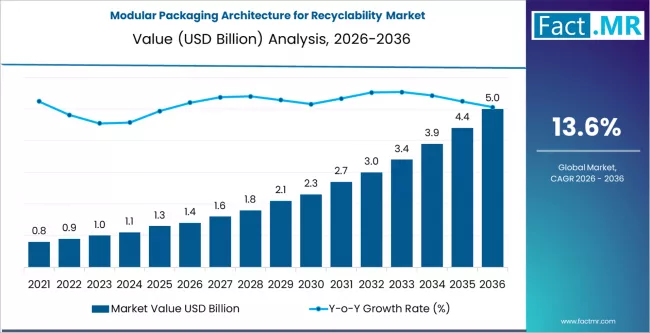
Modular packaging architecture for recyclability market is projected to grow from USD 1.4 billion in 2026 to USD 5.0 billion by 2036, at a CAGR of 13.6%. FMCG and personal care will dominate with a 47.0% market share, while modular bottle-cap-label systems will lead the architecture type segment with a 53.0% share.
Modular Packaging Architecture for Recyclability Market Forecast and Outlook 2026 to 2036
The modular packaging architecture for recyclability market is projected to reach USD 1.4 billion in 2026, growing to USD 5 billion by 2036, with a CAGR of 13.6%. Regulatory oversight is becoming increasingly stringent, with governments implementing stricter recycling mandates and sustainability requirements.
Key Takeaways from Modular Packaging Architecture for Recyclability Market
- Modular Packaging Architecture for Recyclability Market Value (2026): USD 1.4 billion
- Modular Packaging Architecture for Recyclability Market Forecast Value (2036): USD 5 billion
- Modular Packaging Architecture for Recyclability Market Forecast CAGR (2026-2036): 13.6%
- Leading Segment in Modular Packaging Architecture for Recyclability Market: Design-for-disassembly and snap-fit systems (60%)
- Key Growth Region in Modular Packaging Architecture for Recyclability Market: Asia Pacific
- Key Players in Modular Packaging Architecture for Recyclability Market: ALPLA, Berry Global, Zijiang Enterprise, Manjushree Technopack, Greiner Packaging, Plastipak
These regulations drive companies to adapt modular packaging solutions that comply with new standards, though the costs of compliance and certification processes are considerable. Certification complexity adds an additional layer of challenge, as suppliers must navigate a variety of local and global standards. This can result in delays and increased expenses, influencing adoption rates, particularly among smaller players. Larger vendors, with the resources to manage compliance at scale, are better positioned to lead the market. The pressure to meet regulatory demands shapes vendor positioning, as companies that invest in early-stage compliance and modular design innovation stand to benefit from long-term market stability and consumer trust.
Modular Packaging Architecture for Recyclability Market
| Metric | Value |
|---|---|
| Estimated Value in (2026E) | USD 1.4 billion |
| Forecast Value in (2036F) | USD 5 billion |
| Forecast CAGR (2026 to 2036) | 13.6% |
Category
| Category | Segments |
|---|---|
| End-use | FMCG and personal care; Household and food packaging; High-volume FMCG; Dairy and FMCG; Beverage packaging |
| Architecture Type | Modular bottle-cap-label systems; Modular rigid packaging; Interchangeable packaging parts; Reusable or modular bottles; Others |
| Material Strategy | Mono-material PP or PE; PE or PP mono-structures; Polyolefins; PE-based systems; Others |
| Technology | Design-for-disassembly and snap-fit systems; Tooling standardisation; High-speed modular moulding; Cost-optimised modular tooling; Others |
| Region | North America; Europe; Asia Pacific; Latin America; Middle East & Africa |
Segmental Analysis
What Is the Impact of Architecture Type on the Modular Packaging Architecture for Recyclability Market?
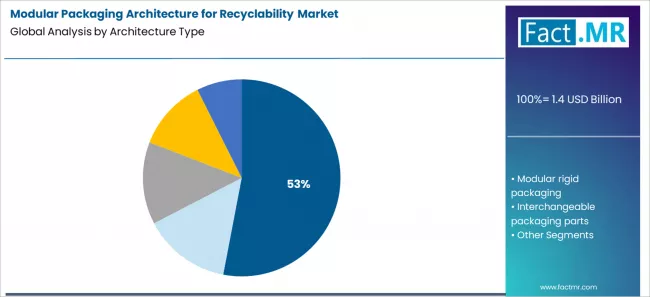
In the modular packaging architecture for recyclability market, architecture type plays a crucial role in determining the effectiveness and sustainability of packaging solutions. Modular bottle-cap-label systems lead the market with a 53% share, offering flexibility in design and facilitating easier recycling. This system allows for easy disassembly and material separation, ensuring that each component can be effectively recycled. As the demand for sustainable packaging increases, modular systems that simplify recycling processes will continue to drive growth, making them a preferred choice for manufacturers looking to meet environmental goals.
How Does Material Strategy Influence the Modular Packaging Architecture for Recyclability Market?
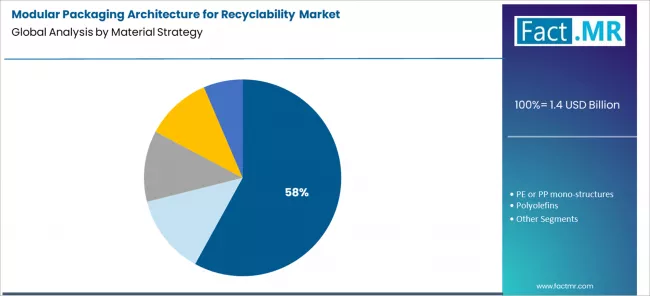
Material strategy is a key factor in ensuring that modular packaging systems are recyclable and environmentally friendly, with mono-material PP or PE leading the market with a 58% share. By using single-material solutions, such as mono-material PP or PE, manufacturers can simplify the recycling process and increase the recyclability of the packaging. This strategy reduces the complexity associated with multi-material packaging and aligns with global trends toward sustainability. As the focus on reducing plastic waste and improving recycling efficiency intensifies, mono-material strategies will remain central to the development of recyclable packaging solutions across industries.
What are the Principal Drivers, Constraints, and Evolving Dynamics of the Modular Packaging Architecture for Recyclability Market?
Demand for modular packaging architecture designed for recyclability has been shaped by requirements to simplify disassembly of multi material packages. Brand owners and converters specify modules that can be separated easily at end of life to support sorting and material recovery. Requirements from extended producer responsibility frameworks and recycled content targets have influenced design criteria that emphasize material uniformity and ease of separation.
Variability in material combinations and performance needs has constrained adoption of modular designs in some formats. Some packaging formats require trade offs between recyclability and barrier performance. Integration of modular components into existing production equipment has required design adjustments. Work focused on defining standard interfaces and material guidelines is under way. Collaboration between packaging designers, resin suppliers, and recycling stakeholders aims to expand modular architectures that balance recyclability and functional requirements.
Analysis of the Modular Packaging Architecture for Recyclability Market by Key Country
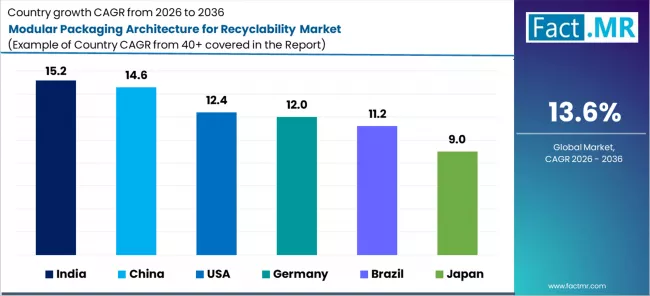
| Country | CAGR 2026 to 2036 |
|---|---|
| Germany | 12% |
| USA | 12.4% |
| China | 14.6% |
| India | 15.2% |
| Brazil | 11.2% |
| Japan | 9% |
The report covers an in-depth analysis of 40+ countries; top-performing countries are highlighted below.
What is the Growth Outlook for Modular Packaging Architecture for Recyclability in Germany?
Germany’s modular packaging architecture for recyclability market is projected to grow at a CAGR of 12% from 2026 to 2036. As Germany continues to lead in sustainable packaging practices, the demand for modular packaging systems that enhance recyclability is rising. Modular packaging solutions enable more efficient recycling processes and improve the reuse of materials. With Germany’s stringent regulations on plastic waste and growing consumer demand for eco-friendly products, the market for recyclable modular packaging architecture is expected to expand steadily.
How is the Modular Packaging Architecture for Recyclability Market Performing in the USA?
The USA’s modular packaging architecture for recyclability market is expected to grow at a CAGR of 12.4% from 2026 to 2036. With a growing focus on sustainability and regulatory pressures to reduce plastic waste, the demand for modular packaging systems that improve recyclability is increasing. These solutions provide flexible and sustainable alternatives for packaging in various industries, including food and beverage. As the USA continues to prioritize environmental responsibility and circular economy principles, the market for recyclable modular packaging architecture is expected to grow steadily.
What is the Market Outlook for Modular Packaging Architecture for Recyclability in China?
China is projected to experience significant growth in the modular packaging architecture for recyclability market, with a projected CAGR of 14.6% from 2026 to 2036. As China’s packaging industry focuses on improving recycling rates and reducing waste, modular packaging systems that enhance recyclability are becoming increasingly important. Government policies promoting recycling and environmental sustainability are key drivers of this market. With China’s large-scale manufacturing and growing consumer demand for sustainable packaging, the market for modular packaging architecture is expected to grow rapidly.
What is the Growth Potential for Modular Packaging Architecture for Recyclability in India?
India’s modular packaging architecture for recyclability market is forecast to grow at a CAGR of 15.2% from 2026 to 2036. As India’s packaging industry expands, the demand for packaging solutions that are both sustainable and recyclable is rising. Modular packaging systems that improve recyclability offer an efficient solution to India’s waste management challenges. Government initiatives to reduce plastic waste, combined with growing consumer awareness of environmental issues, will drive significant growth in the market for modular packaging architecture in India.
What is the Demand for Modular Packaging Architecture for Recyclability in Brazil?
Brazil’s modular packaging architecture for recyclability market is set to grow at a CAGR of 11.2% from 2026 to 2036. With increasing regulatory pressure to improve recycling rates and reduce packaging waste, Brazil’s packaging industry is adopting more sustainable solutions. Modular packaging architecture, which supports recyclability and reduces environmental impact, is gaining traction. As Brazil continues to improve its recycling infrastructure and embraces circular economy principles, the demand for recyclable modular packaging will continue to rise, supporting steady market growth.
What is the Market Expansion Outlook for Modular Packaging Architecture for Recyclability in Japan?
Japan’s modular packaging architecture for recyclability market is projected to grow at a CAGR of 9% from 2026 to 2036. Japan’s focus on sustainability and innovation in packaging makes it an attractive market for modular packaging solutions that improve recyclability. Although the growth rate may be more modest compared to other regions, Japan’s regulatory framework and commitment to reducing waste will continue to drive the adoption of these packaging solutions. As Japan enhances its recycling processes and consumer demand for eco-friendly products grows, the market will experience gradual expansion.
How is Competition Structured in the Modular Packaging Architecture for Recyclability Market?
Competition in this market is defined by design adaptability, recyclability performance, and alignment with existing filling lines. ALPLA and Berry Global offer modular systems with standardized components that support disassembly and material separation. Plastipak and Greiner Packaging compete by integrating interchangeable modules that simplify recycling and reduce mixed material complexity. Zijiang Enterprise and Manjushree Technopack focus on cost effective modular solutions suitable for regional manufacturing scales. Competitive differentiation arises from design engineering support, ease of adoption by brand owners, and documented recyclability outcomes. Buyers assess suppliers based on modularity, compatibility with sustainability targets, and the ability to maintain package integrity across supply chains.
Key Players in the Modular Packaging Architecture for Recyclability Market
- ALPLA
- Berry Global
- Zijiang Enterprise
- Manjushree Technopack
- Greiner Packaging
- Plastipak
Scope of the Report
| Items | Values |
|---|---|
| Quantitative Units (2026) | USD Billion |
| End-use | FMCG and personal care, Household and food packaging, High-volume FMCG, Dairy and FMCG, Beverage packaging |
| Architecture Type | Modular bottle-cap-label systems, Modular rigid packaging, Interchangeable packaging parts, Reusable or modular bottles, Others |
| Material Strategy | Mono-material PP or PE, PE or PP mono-structures, Polyolefins, PE-based systems, Others |
| Technology | Design-for-disassembly and snap-fit systems, Tooling standardisation, High-speed modular moulding, Cost-optimised modular tooling, Others |
| Regions Covered | North America, Europe, Asia Pacific, Latin America, Middle East & Africa |
| Countries Covered | United States, Canada, Mexico, Brazil, Germany, United Kingdom, France, Italy, Spain, China, Japan, South Korea, India, Australia & New Zealand |
| Key Companies Profiled | ALPLA, Berry Global, Zijiang Enterprise, Manjushree Technopack, Greiner Packaging, Plastipak |
| Additional Attributes | Dollar revenue by end-use, architecture type, material strategy, and technology; regional demand trends, competitive landscape, technological advancements in modular packaging systems, and innovations in recyclability-focused packaging design |
Modular Packaging Architecture for Recyclability Market Key Segments
-
End-use :
- FMCG and personal care
- Household and food packaging
- High-volume FMCG
- Dairy and FMCG
- Beverage packaging
-
Architecture Type :
- Modular bottle-cap-label systems
- Modular rigid packaging
- Interchangeable packaging parts
- Reusable or modular bottles
- Others
-
Material Strategy :
- Mono-material PP or PE
- PE or PP mono-structures
- Polyolefins
- PE-based systems
- Others
-
Technology :
- Design-for-disassembly and snap-fit systems
- Tooling standardisation
- High-speed modular moulding
- Cost-optimised modular tooling
- Others
-
Region :
-
North America
- USA
- Canada
- Mexico
-
Europe
- Germany
- UK
- France
- Italy
- Spain
- Nordic Countries
- BENELUX
- Rest of Europe
-
Asia Pacific
- China
- Japan
- South Korea
- India
- Australia
- Rest of Asia Pacific
-
Latin America
- Brazil
- Argentina
- Rest of Latin America
-
Middle East and Africa
- Kingdom of Saudi Arabia
- United Arab Emirates
- South Africa
- Rest of Middle East and Africa
-
Other Regions
- Oceania
- Central Asia
- Other Markets
-
Bibliographies
- European Commission. (2023). Packaging and Packaging Waste Regulation (PPWR): Design requirements for recyclability, modularity, and component separability. Publications Office of the European Union.
- European Commission, Joint Research Centre. (2024). Design for recycling: Modular packaging architectures and material separation performance. JRC Technical Reports.
- Organisation for Economic Co-operation and Development. (2023). Design principles for circular packaging systems and modular product architectures. OECD Publishing.
- United Nations Environment Programme. (2023). System-level design strategies for recyclable and reusable packaging. UNEP.
- WRAP. (2024). Design for recyclability guidance: Modular packaging formats and material compatibility. Waste & Resources Action Programme.
Table of Content
- Executive Summary
- Global Market Outlook
- Demand to side Trends
- Supply to side Trends
- Technology Roadmap Analysis
- Analysis and Recommendations
- Market Overview
- Market Coverage / Taxonomy
- Market Definition / Scope / Limitations
- Market Background
- Market Dynamics
- Drivers
- Restraints
- Opportunity
- Trends
- Scenario Forecast
- Demand in Optimistic Scenario
- Demand in Likely Scenario
- Demand in Conservative Scenario
- Opportunity Map Analysis
- Product Life Cycle Analysis
- Supply Chain Analysis
- Investment Feasibility Matrix
- Value Chain Analysis
- PESTLE and Porter’s Analysis
- Regulatory Landscape
- Regional Parent Market Outlook
- Production and Consumption Statistics
- Import and Export Statistics
- Market Dynamics
- Global Market Analysis 2021 to 2025 and Forecast, 2026 to 2036
- Historical Market Size Value (USD Million) Analysis, 2021 to 2025
- Current and Future Market Size Value (USD Million) Projections, 2026 to 2036
- Y to o to Y Growth Trend Analysis
- Absolute $ Opportunity Analysis
- Global Market Pricing Analysis 2021 to 2025 and Forecast 2026 to 2036
- Global Market Analysis 2021 to 2025 and Forecast 2026 to 2036, By End-use
- Introduction / Key Findings
- Historical Market Size Value (USD Million) Analysis By End-use, 2021 to 2025
- Current and Future Market Size Value (USD Million) Analysis and Forecast By End-use, 2026 to 2036
- FMCG and personal care
- Household and food packaging
- High-volume FMCG
- Dairy and FMCG
- Beverage packaging
- FMCG and personal care
- Y to o to Y Growth Trend Analysis By End-use, 2021 to 2025
- Absolute $ Opportunity Analysis By End-use, 2026 to 2036
- Global Market Analysis 2021 to 2025 and Forecast 2026 to 2036, By Architecture Type
- Introduction / Key Findings
- Historical Market Size Value (USD Million) Analysis By Architecture Type, 2021 to 2025
- Current and Future Market Size Value (USD Million) Analysis and Forecast By Architecture Type, 2026 to 2036
- Modular bottle-cap-label systems
- Modular rigid packaging
- Interchangeable packaging parts
- Reusable or modular bottles
- Others
- Modular bottle-cap-label systems
- Y to o to Y Growth Trend Analysis By Architecture Type, 2021 to 2025
- Absolute $ Opportunity Analysis By Architecture Type, 2026 to 2036
- Global Market Analysis 2021 to 2025 and Forecast 2026 to 2036, By Material Strategy
- Introduction / Key Findings
- Historical Market Size Value (USD Million) Analysis By Material Strategy, 2021 to 2025
- Current and Future Market Size Value (USD Million) Analysis and Forecast By Material Strategy, 2026 to 2036
- Mono-material PP or PE
- PE or PP mono-structures
- Polyolefins
- PE-based systems
- Others
- Mono-material PP or PE
- Y to o to Y Growth Trend Analysis By Material Strategy, 2021 to 2025
- Absolute $ Opportunity Analysis By Material Strategy, 2026 to 2036
- Global Market Analysis 2021 to 2025 and Forecast 2026 to 2036, By Technology
- Introduction / Key Findings
- Historical Market Size Value (USD Million) Analysis By Technology, 2021 to 2025
- Current and Future Market Size Value (USD Million) Analysis and Forecast By Technology, 2026 to 2036
- Design-for-disassembly and snap-fit systems
- Tooling standardisation
- High-speed modular moulding
- Cost-optimised modular tooling
- Others
- Design-for-disassembly and snap-fit systems
- Y to o to Y Growth Trend Analysis By Technology, 2021 to 2025
- Absolute $ Opportunity Analysis By Technology, 2026 to 2036
- Global Market Analysis 2021 to 2025 and Forecast 2026 to 2036, By Region
- Introduction
- Historical Market Size Value (USD Million) Analysis By Region, 2021 to 2025
- Current Market Size Value (USD Million) Analysis and Forecast By Region, 2026 to 2036
- North America
- Latin America
- Western Europe
- Eastern Europe
- East Asia
- South Asia and Pacific
- Middle East & Africa
- Market Attractiveness Analysis By Region
- North America Market Analysis 2021 to 2025 and Forecast 2026 to 2036, By Country
- Historical Market Size Value (USD Million) Trend Analysis By Market Taxonomy, 2021 to 2025
- Market Size Value (USD Million) Forecast By Market Taxonomy, 2026 to 2036
- By Country
- USA
- Canada
- Mexico
- By End-use
- By Architecture Type
- By Material Strategy
- By Technology
- By Country
- Market Attractiveness Analysis
- By Country
- By End-use
- By Architecture Type
- By Material Strategy
- By Technology
- Key Takeaways
- Latin America Market Analysis 2021 to 2025 and Forecast 2026 to 2036, By Country
- Historical Market Size Value (USD Million) Trend Analysis By Market Taxonomy, 2021 to 2025
- Market Size Value (USD Million) Forecast By Market Taxonomy, 2026 to 2036
- By Country
- Brazil
- Chile
- Rest of Latin America
- By End-use
- By Architecture Type
- By Material Strategy
- By Technology
- By Country
- Market Attractiveness Analysis
- By Country
- By End-use
- By Architecture Type
- By Material Strategy
- By Technology
- Key Takeaways
- Western Europe Market Analysis 2021 to 2025 and Forecast 2026 to 2036, By Country
- Historical Market Size Value (USD Million) Trend Analysis By Market Taxonomy, 2021 to 2025
- Market Size Value (USD Million) Forecast By Market Taxonomy, 2026 to 2036
- By Country
- Germany
- UK
- Italy
- Spain
- France
- Nordic
- BENELUX
- Rest of Western Europe
- By End-use
- By Architecture Type
- By Material Strategy
- By Technology
- By Country
- Market Attractiveness Analysis
- By Country
- By End-use
- By Architecture Type
- By Material Strategy
- By Technology
- Key Takeaways
- Eastern Europe Market Analysis 2021 to 2025 and Forecast 2026 to 2036, By Country
- Historical Market Size Value (USD Million) Trend Analysis By Market Taxonomy, 2021 to 2025
- Market Size Value (USD Million) Forecast By Market Taxonomy, 2026 to 2036
- By Country
- Russia
- Poland
- Hungary
- Balkan & Baltic
- Rest of Eastern Europe
- By End-use
- By Architecture Type
- By Material Strategy
- By Technology
- By Country
- Market Attractiveness Analysis
- By Country
- By End-use
- By Architecture Type
- By Material Strategy
- By Technology
- Key Takeaways
- East Asia Market Analysis 2021 to 2025 and Forecast 2026 to 2036, By Country
- Historical Market Size Value (USD Million) Trend Analysis By Market Taxonomy, 2021 to 2025
- Market Size Value (USD Million) Forecast By Market Taxonomy, 2026 to 2036
- By Country
- China
- Japan
- South Korea
- By End-use
- By Architecture Type
- By Material Strategy
- By Technology
- By Country
- Market Attractiveness Analysis
- By Country
- By End-use
- By Architecture Type
- By Material Strategy
- By Technology
- Key Takeaways
- South Asia and Pacific Market Analysis 2021 to 2025 and Forecast 2026 to 2036, By Country
- Historical Market Size Value (USD Million) Trend Analysis By Market Taxonomy, 2021 to 2025
- Market Size Value (USD Million) Forecast By Market Taxonomy, 2026 to 2036
- By Country
- India
- ASEAN
- Australia & New Zealand
- Rest of South Asia and Pacific
- By End-use
- By Architecture Type
- By Material Strategy
- By Technology
- By Country
- Market Attractiveness Analysis
- By Country
- By End-use
- By Architecture Type
- By Material Strategy
- By Technology
- Key Takeaways
- Middle East & Africa Market Analysis 2021 to 2025 and Forecast 2026 to 2036, By Country
- Historical Market Size Value (USD Million) Trend Analysis By Market Taxonomy, 2021 to 2025
- Market Size Value (USD Million) Forecast By Market Taxonomy, 2026 to 2036
- By Country
- Kingdom of Saudi Arabia
- Other GCC Countries
- Turkiye
- South Africa
- Other African Union
- Rest of Middle East & Africa
- By End-use
- By Architecture Type
- By Material Strategy
- By Technology
- By Country
- Market Attractiveness Analysis
- By Country
- By End-use
- By Architecture Type
- By Material Strategy
- By Technology
- Key Takeaways
- Key Countries Market Analysis
- USA
- Pricing Analysis
- Market Share Analysis, 2025
- By End-use
- By Architecture Type
- By Material Strategy
- By Technology
- Canada
- Pricing Analysis
- Market Share Analysis, 2025
- By End-use
- By Architecture Type
- By Material Strategy
- By Technology
- Mexico
- Pricing Analysis
- Market Share Analysis, 2025
- By End-use
- By Architecture Type
- By Material Strategy
- By Technology
- Brazil
- Pricing Analysis
- Market Share Analysis, 2025
- By End-use
- By Architecture Type
- By Material Strategy
- By Technology
- Chile
- Pricing Analysis
- Market Share Analysis, 2025
- By End-use
- By Architecture Type
- By Material Strategy
- By Technology
- Germany
- Pricing Analysis
- Market Share Analysis, 2025
- By End-use
- By Architecture Type
- By Material Strategy
- By Technology
- UK
- Pricing Analysis
- Market Share Analysis, 2025
- By End-use
- By Architecture Type
- By Material Strategy
- By Technology
- Italy
- Pricing Analysis
- Market Share Analysis, 2025
- By End-use
- By Architecture Type
- By Material Strategy
- By Technology
- Spain
- Pricing Analysis
- Market Share Analysis, 2025
- By End-use
- By Architecture Type
- By Material Strategy
- By Technology
- France
- Pricing Analysis
- Market Share Analysis, 2025
- By End-use
- By Architecture Type
- By Material Strategy
- By Technology
- India
- Pricing Analysis
- Market Share Analysis, 2025
- By End-use
- By Architecture Type
- By Material Strategy
- By Technology
- ASEAN
- Pricing Analysis
- Market Share Analysis, 2025
- By End-use
- By Architecture Type
- By Material Strategy
- By Technology
- Australia & New Zealand
- Pricing Analysis
- Market Share Analysis, 2025
- By End-use
- By Architecture Type
- By Material Strategy
- By Technology
- China
- Pricing Analysis
- Market Share Analysis, 2025
- By End-use
- By Architecture Type
- By Material Strategy
- By Technology
- Japan
- Pricing Analysis
- Market Share Analysis, 2025
- By End-use
- By Architecture Type
- By Material Strategy
- By Technology
- South Korea
- Pricing Analysis
- Market Share Analysis, 2025
- By End-use
- By Architecture Type
- By Material Strategy
- By Technology
- Russia
- Pricing Analysis
- Market Share Analysis, 2025
- By End-use
- By Architecture Type
- By Material Strategy
- By Technology
- Poland
- Pricing Analysis
- Market Share Analysis, 2025
- By End-use
- By Architecture Type
- By Material Strategy
- By Technology
- Hungary
- Pricing Analysis
- Market Share Analysis, 2025
- By End-use
- By Architecture Type
- By Material Strategy
- By Technology
- Kingdom of Saudi Arabia
- Pricing Analysis
- Market Share Analysis, 2025
- By End-use
- By Architecture Type
- By Material Strategy
- By Technology
- Turkiye
- Pricing Analysis
- Market Share Analysis, 2025
- By End-use
- By Architecture Type
- By Material Strategy
- By Technology
- South Africa
- Pricing Analysis
- Market Share Analysis, 2025
- By End-use
- By Architecture Type
- By Material Strategy
- By Technology
- USA
- Market Structure Analysis
- Competition Dashboard
- Competition Benchmarking
- Market Share Analysis of Top Players
- By Regional
- By End-use
- By Architecture Type
- By Material Strategy
- By Technology
- Competition Analysis
- Competition Deep Dive
- ALPLA
- Overview
- Product Portfolio
- Profitability by Market Segments (Product/Age /Sales Channel/Region)
- Sales Footprint
- Strategy Overview
- Marketing Strategy
- Product Strategy
- Channel Strategy
- Berry Global
- Zijiang Enterprise
- Manjushree Technopack
- Greiner Packaging
- Plastipak
- ALPLA
- Competition Deep Dive
- Assumptions & Acronyms Used
- Research Methodology
List Of Table
- Table 1: Global Market Value (USD Million) Forecast by Region, 2021 to 2036
- Table 2: Global Market Value (USD Million) Forecast by End-use, 2021 to 2036
- Table 3: Global Market Value (USD Million) Forecast by Architecture Type, 2021 to 2036
- Table 4: Global Market Value (USD Million) Forecast by Material Strategy, 2021 to 2036
- Table 5: Global Market Value (USD Million) Forecast by Technology, 2021 to 2036
- Table 6: North America Market Value (USD Million) Forecast by Country, 2021 to 2036
- Table 7: North America Market Value (USD Million) Forecast by End-use, 2021 to 2036
- Table 8: North America Market Value (USD Million) Forecast by Architecture Type, 2021 to 2036
- Table 9: North America Market Value (USD Million) Forecast by Material Strategy, 2021 to 2036
- Table 10: North America Market Value (USD Million) Forecast by Technology, 2021 to 2036
- Table 11: Latin America Market Value (USD Million) Forecast by Country, 2021 to 2036
- Table 12: Latin America Market Value (USD Million) Forecast by End-use, 2021 to 2036
- Table 13: Latin America Market Value (USD Million) Forecast by Architecture Type, 2021 to 2036
- Table 14: Latin America Market Value (USD Million) Forecast by Material Strategy, 2021 to 2036
- Table 15: Latin America Market Value (USD Million) Forecast by Technology, 2021 to 2036
- Table 16: Western Europe Market Value (USD Million) Forecast by Country, 2021 to 2036
- Table 17: Western Europe Market Value (USD Million) Forecast by End-use, 2021 to 2036
- Table 18: Western Europe Market Value (USD Million) Forecast by Architecture Type, 2021 to 2036
- Table 19: Western Europe Market Value (USD Million) Forecast by Material Strategy, 2021 to 2036
- Table 20: Western Europe Market Value (USD Million) Forecast by Technology, 2021 to 2036
- Table 21: Eastern Europe Market Value (USD Million) Forecast by Country, 2021 to 2036
- Table 22: Eastern Europe Market Value (USD Million) Forecast by End-use, 2021 to 2036
- Table 23: Eastern Europe Market Value (USD Million) Forecast by Architecture Type, 2021 to 2036
- Table 24: Eastern Europe Market Value (USD Million) Forecast by Material Strategy, 2021 to 2036
- Table 25: Eastern Europe Market Value (USD Million) Forecast by Technology, 2021 to 2036
- Table 26: East Asia Market Value (USD Million) Forecast by Country, 2021 to 2036
- Table 27: East Asia Market Value (USD Million) Forecast by End-use, 2021 to 2036
- Table 28: East Asia Market Value (USD Million) Forecast by Architecture Type, 2021 to 2036
- Table 29: East Asia Market Value (USD Million) Forecast by Material Strategy, 2021 to 2036
- Table 30: East Asia Market Value (USD Million) Forecast by Technology, 2021 to 2036
- Table 31: South Asia and Pacific Market Value (USD Million) Forecast by Country, 2021 to 2036
- Table 32: South Asia and Pacific Market Value (USD Million) Forecast by End-use, 2021 to 2036
- Table 33: South Asia and Pacific Market Value (USD Million) Forecast by Architecture Type, 2021 to 2036
- Table 34: South Asia and Pacific Market Value (USD Million) Forecast by Material Strategy, 2021 to 2036
- Table 35: South Asia and Pacific Market Value (USD Million) Forecast by Technology, 2021 to 2036
- Table 36: Middle East & Africa Market Value (USD Million) Forecast by Country, 2021 to 2036
- Table 37: Middle East & Africa Market Value (USD Million) Forecast by End-use, 2021 to 2036
- Table 38: Middle East & Africa Market Value (USD Million) Forecast by Architecture Type, 2021 to 2036
- Table 39: Middle East & Africa Market Value (USD Million) Forecast by Material Strategy, 2021 to 2036
- Table 40: Middle East & Africa Market Value (USD Million) Forecast by Technology, 2021 to 2036
List Of Figures
- Figure 1: Global Market Pricing Analysis
- Figure 2: Global Market Value (USD Million) Forecast 2021 to 2036
- Figure 3: Global Market Value Share and BPS Analysis by End-use, 2026 and 2036
- Figure 4: Global Market Y to o to Y Growth Comparison by End-use, 2026 to 2036
- Figure 5: Global Market Attractiveness Analysis by End-use
- Figure 6: Global Market Value Share and BPS Analysis by Architecture Type, 2026 and 2036
- Figure 7: Global Market Y to o to Y Growth Comparison by Architecture Type, 2026 to 2036
- Figure 8: Global Market Attractiveness Analysis by Architecture Type
- Figure 9: Global Market Value Share and BPS Analysis by Material Strategy, 2026 and 2036
- Figure 10: Global Market Y to o to Y Growth Comparison by Material Strategy, 2026 to 2036
- Figure 11: Global Market Attractiveness Analysis by Material Strategy
- Figure 12: Global Market Value Share and BPS Analysis by Technology, 2026 and 2036
- Figure 13: Global Market Y to o to Y Growth Comparison by Technology, 2026 to 2036
- Figure 14: Global Market Attractiveness Analysis by Technology
- Figure 15: Global Market Value (USD Million) Share and BPS Analysis by Region, 2026 and 2036
- Figure 16: Global Market Y to o to Y Growth Comparison by Region, 2026 to 2036
- Figure 17: Global Market Attractiveness Analysis by Region
- Figure 18: North America Market Incremental Dollar Opportunity, 2026 to 2036
- Figure 19: Latin America Market Incremental Dollar Opportunity, 2026 to 2036
- Figure 20: Western Europe Market Incremental Dollar Opportunity, 2026 to 2036
- Figure 21: Eastern Europe Market Incremental Dollar Opportunity, 2026 to 2036
- Figure 22: East Asia Market Incremental Dollar Opportunity, 2026 to 2036
- Figure 23: South Asia and Pacific Market Incremental Dollar Opportunity, 2026 to 2036
- Figure 24: Middle East & Africa Market Incremental Dollar Opportunity, 2026 to 2036
- Figure 25: North America Market Value Share and BPS Analysis by Country, 2026 and 2036
- Figure 26: North America Market Value Share and BPS Analysis by End-use, 2026 and 2036
- Figure 27: North America Market Y to o to Y Growth Comparison by End-use, 2026 to 2036
- Figure 28: North America Market Attractiveness Analysis by End-use
- Figure 29: North America Market Value Share and BPS Analysis by Architecture Type, 2026 and 2036
- Figure 30: North America Market Y to o to Y Growth Comparison by Architecture Type, 2026 to 2036
- Figure 31: North America Market Attractiveness Analysis by Architecture Type
- Figure 32: North America Market Value Share and BPS Analysis by Material Strategy, 2026 and 2036
- Figure 33: North America Market Y to o to Y Growth Comparison by Material Strategy, 2026 to 2036
- Figure 34: North America Market Attractiveness Analysis by Material Strategy
- Figure 35: North America Market Value Share and BPS Analysis by Technology, 2026 and 2036
- Figure 36: North America Market Y to o to Y Growth Comparison by Technology, 2026 to 2036
- Figure 37: North America Market Attractiveness Analysis by Technology
- Figure 38: Latin America Market Value Share and BPS Analysis by Country, 2026 and 2036
- Figure 39: Latin America Market Value Share and BPS Analysis by End-use, 2026 and 2036
- Figure 40: Latin America Market Y to o to Y Growth Comparison by End-use, 2026 to 2036
- Figure 41: Latin America Market Attractiveness Analysis by End-use
- Figure 42: Latin America Market Value Share and BPS Analysis by Architecture Type, 2026 and 2036
- Figure 43: Latin America Market Y to o to Y Growth Comparison by Architecture Type, 2026 to 2036
- Figure 44: Latin America Market Attractiveness Analysis by Architecture Type
- Figure 45: Latin America Market Value Share and BPS Analysis by Material Strategy, 2026 and 2036
- Figure 46: Latin America Market Y to o to Y Growth Comparison by Material Strategy, 2026 to 2036
- Figure 47: Latin America Market Attractiveness Analysis by Material Strategy
- Figure 48: Latin America Market Value Share and BPS Analysis by Technology, 2026 and 2036
- Figure 49: Latin America Market Y to o to Y Growth Comparison by Technology, 2026 to 2036
- Figure 50: Latin America Market Attractiveness Analysis by Technology
- Figure 51: Western Europe Market Value Share and BPS Analysis by Country, 2026 and 2036
- Figure 52: Western Europe Market Value Share and BPS Analysis by End-use, 2026 and 2036
- Figure 53: Western Europe Market Y to o to Y Growth Comparison by End-use, 2026 to 2036
- Figure 54: Western Europe Market Attractiveness Analysis by End-use
- Figure 55: Western Europe Market Value Share and BPS Analysis by Architecture Type, 2026 and 2036
- Figure 56: Western Europe Market Y to o to Y Growth Comparison by Architecture Type, 2026 to 2036
- Figure 57: Western Europe Market Attractiveness Analysis by Architecture Type
- Figure 58: Western Europe Market Value Share and BPS Analysis by Material Strategy, 2026 and 2036
- Figure 59: Western Europe Market Y to o to Y Growth Comparison by Material Strategy, 2026 to 2036
- Figure 60: Western Europe Market Attractiveness Analysis by Material Strategy
- Figure 61: Western Europe Market Value Share and BPS Analysis by Technology, 2026 and 2036
- Figure 62: Western Europe Market Y to o to Y Growth Comparison by Technology, 2026 to 2036
- Figure 63: Western Europe Market Attractiveness Analysis by Technology
- Figure 64: Eastern Europe Market Value Share and BPS Analysis by Country, 2026 and 2036
- Figure 65: Eastern Europe Market Value Share and BPS Analysis by End-use, 2026 and 2036
- Figure 66: Eastern Europe Market Y to o to Y Growth Comparison by End-use, 2026 to 2036
- Figure 67: Eastern Europe Market Attractiveness Analysis by End-use
- Figure 68: Eastern Europe Market Value Share and BPS Analysis by Architecture Type, 2026 and 2036
- Figure 69: Eastern Europe Market Y to o to Y Growth Comparison by Architecture Type, 2026 to 2036
- Figure 70: Eastern Europe Market Attractiveness Analysis by Architecture Type
- Figure 71: Eastern Europe Market Value Share and BPS Analysis by Material Strategy, 2026 and 2036
- Figure 72: Eastern Europe Market Y to o to Y Growth Comparison by Material Strategy, 2026 to 2036
- Figure 73: Eastern Europe Market Attractiveness Analysis by Material Strategy
- Figure 74: Eastern Europe Market Value Share and BPS Analysis by Technology, 2026 and 2036
- Figure 75: Eastern Europe Market Y to o to Y Growth Comparison by Technology, 2026 to 2036
- Figure 76: Eastern Europe Market Attractiveness Analysis by Technology
- Figure 77: East Asia Market Value Share and BPS Analysis by Country, 2026 and 2036
- Figure 78: East Asia Market Value Share and BPS Analysis by End-use, 2026 and 2036
- Figure 79: East Asia Market Y to o to Y Growth Comparison by End-use, 2026 to 2036
- Figure 80: East Asia Market Attractiveness Analysis by End-use
- Figure 81: East Asia Market Value Share and BPS Analysis by Architecture Type, 2026 and 2036
- Figure 82: East Asia Market Y to o to Y Growth Comparison by Architecture Type, 2026 to 2036
- Figure 83: East Asia Market Attractiveness Analysis by Architecture Type
- Figure 84: East Asia Market Value Share and BPS Analysis by Material Strategy, 2026 and 2036
- Figure 85: East Asia Market Y to o to Y Growth Comparison by Material Strategy, 2026 to 2036
- Figure 86: East Asia Market Attractiveness Analysis by Material Strategy
- Figure 87: East Asia Market Value Share and BPS Analysis by Technology, 2026 and 2036
- Figure 88: East Asia Market Y to o to Y Growth Comparison by Technology, 2026 to 2036
- Figure 89: East Asia Market Attractiveness Analysis by Technology
- Figure 90: South Asia and Pacific Market Value Share and BPS Analysis by Country, 2026 and 2036
- Figure 91: South Asia and Pacific Market Value Share and BPS Analysis by End-use, 2026 and 2036
- Figure 92: South Asia and Pacific Market Y to o to Y Growth Comparison by End-use, 2026 to 2036
- Figure 93: South Asia and Pacific Market Attractiveness Analysis by End-use
- Figure 94: South Asia and Pacific Market Value Share and BPS Analysis by Architecture Type, 2026 and 2036
- Figure 95: South Asia and Pacific Market Y to o to Y Growth Comparison by Architecture Type, 2026 to 2036
- Figure 96: South Asia and Pacific Market Attractiveness Analysis by Architecture Type
- Figure 97: South Asia and Pacific Market Value Share and BPS Analysis by Material Strategy, 2026 and 2036
- Figure 98: South Asia and Pacific Market Y to o to Y Growth Comparison by Material Strategy, 2026 to 2036
- Figure 99: South Asia and Pacific Market Attractiveness Analysis by Material Strategy
- Figure 100: South Asia and Pacific Market Value Share and BPS Analysis by Technology, 2026 and 2036
- Figure 101: South Asia and Pacific Market Y to o to Y Growth Comparison by Technology, 2026 to 2036
- Figure 102: South Asia and Pacific Market Attractiveness Analysis by Technology
- Figure 103: Middle East & Africa Market Value Share and BPS Analysis by Country, 2026 and 2036
- Figure 104: Middle East & Africa Market Value Share and BPS Analysis by End-use, 2026 and 2036
- Figure 105: Middle East & Africa Market Y to o to Y Growth Comparison by End-use, 2026 to 2036
- Figure 106: Middle East & Africa Market Attractiveness Analysis by End-use
- Figure 107: Middle East & Africa Market Value Share and BPS Analysis by Architecture Type, 2026 and 2036
- Figure 108: Middle East & Africa Market Y to o to Y Growth Comparison by Architecture Type, 2026 to 2036
- Figure 109: Middle East & Africa Market Attractiveness Analysis by Architecture Type
- Figure 110: Middle East & Africa Market Value Share and BPS Analysis by Material Strategy, 2026 and 2036
- Figure 111: Middle East & Africa Market Y to o to Y Growth Comparison by Material Strategy, 2026 to 2036
- Figure 112: Middle East & Africa Market Attractiveness Analysis by Material Strategy
- Figure 113: Middle East & Africa Market Value Share and BPS Analysis by Technology, 2026 and 2036
- Figure 114: Middle East & Africa Market Y to o to Y Growth Comparison by Technology, 2026 to 2036
- Figure 115: Middle East & Africa Market Attractiveness Analysis by Technology
- Figure 116: Global Market - Tier Structure Analysis
- Figure 117: Global Market - Company Share Analysis
- FAQs -
How big is the modular packaging architecture for recyclability market in 2026?
The global modular packaging architecture for recyclability market is estimated to be valued at USD 1.4 billion in 2026.
What will be the size of modular packaging architecture for recyclability market in 2036?
The market size for the modular packaging architecture for recyclability market is projected to reach USD 5.0 billion by 2036.
How much will be the modular packaging architecture for recyclability market growth between 2026 and 2036?
The modular packaging architecture for recyclability market is expected to grow at a 13.6% CAGR between 2026 and 2036.
What are the key product types in the modular packaging architecture for recyclability market?
The key product types in modular packaging architecture for recyclability market are fmcg and personal care, household and food packaging, high-volume fmcg, dairy and fmcg and beverage packaging.
Which architecture type segment to contribute significant share in the modular packaging architecture for recyclability market in 2026?
In terms of architecture type, modular bottle-cap-label systems segment to command 53.0% share in the modular packaging architecture for recyclability market in 2026.