- Market Value (2025): USD 22.79 Bn
- Estimated Value (2026): USD 24.0 Bn
- Forecast Value (2036): USD 40.4 Bn
- CAGR (2026-2036): 5.3%
Alkoxylates Market Forecast and Outlook 2026 to 2036
The alkoxylates market is projected to grow from USD 24.0 billion in 2026 to USD 40.4 billion by 2036, a 5.3% CAGR and USD 16.4 billion of added revenue, as detergent makers, industrial cleaners and agrochemical formulators seek reliable ingredients at a low cost per batch.
Adoption of greener grades is gaining pace as regulation tightens. For example, in March 2026, the European Union adopted Regulation (EU) 2026/405, which retains biodegradability requirements for surfactants used in detergents. Suppliers are broadening natural-origin portfolios, and similar rules are projected to drive sales of application-specific grades in Europe, North America and Asia-Pacific.
Key Takeaways from the Alkoxylates Market
- Alkoxylates market revenue stood at USD 22.79 billion in 2025
- Alkoxylates Market Value (2026): USD 24.0 billion
- Alkoxylates Market Forecast Value (2036): USD 40.4 billion
- Alkoxylates Market Forecast CAGR (2026-2036): 5.3%
- Leading Type: Natural (58.6%)
- Key Market Participants: BASF SE, Dow Inc., Huntsman Corporation, Kao Corporation, Evonik Industries AG, Stepan Company, Clariant AG, Croda International Plc., Sasol Limited, Nouryon
- Key Growth Regions: Germany, Brazil, United States, United Kingdom, Japan
Detergents account for 38.2% of 2026 revenue as household, commercial and industrial cleaning keep consumption high. Demand from industrial cleaning, paints, coatings, agrochemicals and personal care adds further volume, and interest in renewable feedstock is increasing opportunities for natural-origin grades. This diversification should support sales of alkoxylates through 2036.
Alkoxylates Market
| Metric | Value |
|---|---|
| Estimated Value in (2026) | USD 24.0 billion |
| Forecast Value in (2036) | USD 40.4 billion |
| Forecast CAGR (2026 to 2036) | 5.3% |
Source: Fact.MR analysis. Updated Nov 18, 2026
Source: Fact.MR analysis
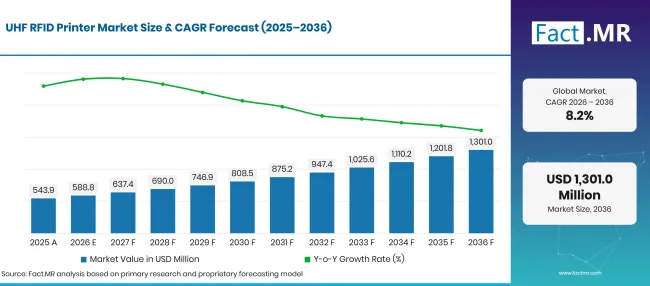
Uhf Rfid Printer Market Forecast Global 1 | Source: Fact.MR
Category
| Category | Segments |
|---|---|
| Type | Natural, Synthetic |
| Application | Detergents, Cleaning Agents, Emulsifying Agents, Dispersing Agents, Wetting Agents |
| Region | Germany; Brazil; United States; United Kingdom; Japan |
Source: Fact.MR analysis. Updated Nov 18, 2026
Source: Fact.MR analysis
Segmental Analysis
Why does the natural type lead demand in the Alkoxylates Market?
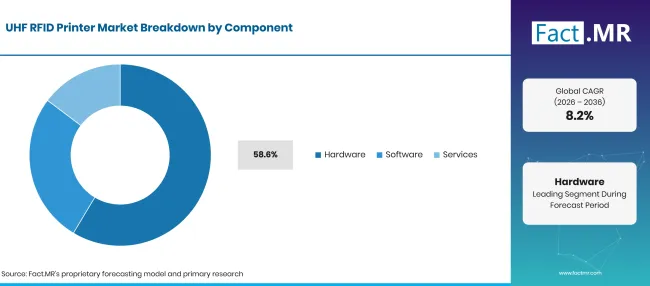
Uhf Rfid Printer Market Breakdown Component | Source: Fact.MR
Demand for natural alkoxylates accounts for 58.6% of 2026 revenue, with synthetic holding 41.4%, as buyers favor renewable feedstocks in formulations. Suppliers are expanding natural-origin portfolios and diversifying feedstock sourcing. Interest in alternative feedstocks is projected to keep natural the leading type through 2036. Suppliers are broadening natural-origin product portfolios because formulators increasingly specify renewable feedstock when they reformulate detergents and specialty products. Synthetic grades remain important where price sensitivity is high, and they hold the remaining share. Opportunities for natural grades are strongest in Europe, North America and Asia-Pacific, where sustainability expectations influence purchasing, and the segment's lead is expected to hold through 2036.
Why do detergents lead application demand in the Alkoxylates Market?
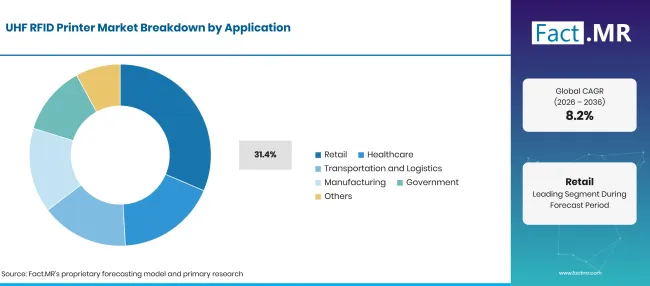
Uhf Rfid Printer Market Breakdown Application 1 | Source: Fact.MR
Sales of alkoxylates to detergents account for 31.4% of 2026 revenue as household, commercial and industrial cleaning consume them routinely. Environmental performance is now weighed alongside cleaning performance; for example, in March 2026, Regulation (EU) 2026/405 retained biodegradability requireaments. Suppliers are developing grades that meet both, and these requirements will continue to shape adoption. Industrial and institutional cleaning, emulsifying, dispersing and wetting uses add further volume beyond detergents, but none matches the breadth of household and commercial cleaning demand. Detergent makers need dependable wetting and emulsification across formulations, so they favor suppliers with consistent product quality and reliable distribution, which supports the segment's position as demand for cleaning products continues to grow.
Alkoxylates Market by Analysis by Key Country
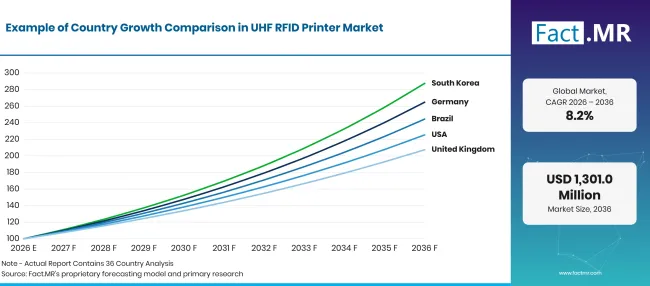
Uhf Rfid Printer Market Growth Index 1 | Source: Fact.MR
| Country | CAGR (2026-2036) |
|---|---|
| Germany | 6.1% |
| Brazil | 5.6% |
| United States | 5.0% |
| United Kingdom | 4.5% |
| Japan | 4.0% |
Source: Fact.MR analysis. Updated Nov 18, 2026
Source: Fact.MR analysis
What is driving alkoxylate demand in Germany?
The market in Germany is projected to grow at 6.1% a year, the highest rate of the five countries, as the specialty chemicals and industrial base requires surfactant ingredients.
For example, in July 2026, the German Chemical Industry Association reviewed first-half conditions, and the ifo index for the chemical industry rose to 5.5 points in September 2026. Growth is tied to higher-value, application-specific grades rather than volume. Producers in Germany are focusing on specialty formulations where quality and application expertise matter more than volume, and this supports the country's position as the highest-growth country of the five despite near-term pressure on the wider chemical sector.
How is cleaning product output supporting alkoxylate sales in Brazil?
The market in Brazil is projected to grow 5.6% a year as household cleaning consumption recovers.
For example, in September 2026, ABIPLA reported 3.5% growth in cleaning product production in the first five months of 2026 and projected 3.9% for the full year. This momentum should drive adoption of ingredients for laundry and surface cleaning. Homecare producers are expanding output of laundry and surface cleaning formulations, and suppliers with local distribution can capture this demand. Industrial activity adds to household use, and the growth outlook of 3.9% for cleaning products in 2026 supports confidence that demand for surfactant ingredients will keep growing through the forecast period.
What is sustaining alkoxylate demand in the United States?
The market in the United States is projected to grow at 5.0% a year as an established detergent industry and institutional cleaning requirements sustain consumption.
Environmental ingredient assessment under the EPA Safer Choice criteria remains relevant to selection alongside cost, and suppliers are aligning grades with it. Laundry care, institutional cleaning and specialty chemical producers all draw on these ingredients, so demand is spread across several end uses rather than relying on a single market. Producers compete on consistency of wetting and emulsification, and customers evaluate suppliers on formulation support as well as price. Established detergent makers and a large industrial cleaning sector keep volumes stable, which explains steady growth below the pace of Germany and Brazil.
How are alternative feedstocks shaping adoption in the United Kingdom?
The market in the United Kingdom is projected to grow at 4.5% as detergent makers and industrial users sustain demand.
For example, in May 2026, the Department for Energy Security and Net Zero published a competition on turning waste carbon dioxide into value for the surfactants industry. Interest in alternative raw material routes is expected to open further opportunities. Industrial users also need surfactants for specialized cleaning processes, and detergent makers continue to rely on wetting and emulsification performance, so demand is supported from several directions. Interest in carbon-based feedstocks suggests that opportunities may emerge for producers able to offer lower-carbon grades over the forecast period.
Why is alkoxylate growth slowest in Japan?
The market in Japan is projected to grow at 4.0% a year, the lowest of the five countries as a mature manufacturing base expands gradually.
For example, in April 2025, Japan published its national plan of action for the Global Framework on Chemicals, outlining its approach to chemicals management. Attention to specialized formulations should sustain demand. Consumer goods and industrial producers require ingredients that meet precise formulation and quality standards, so buyers favor reliable suppliers with strong application expertise. Alkoxylates serve detergent production, emulsification and other specialty uses where consistent performance matters, and the emphasis on sound chemicals management shapes how producers present their products. Growth is gradual rather than rapid, reflecting maturity, but demand for higher-value grades offers steady opportunities.
Competitive Landscape for Alkoxylates Market
Competition in the alkoxylates market is divided between large chemical groups with broad portfolios and specialists in surfactant and cleaning formulations. BASF, Dow, Huntsman and Evonik compete through broad chemical portfolios, Kao and Stepan through surfactant and cleaning positions, and Clariant, Croda, Sasol and Nouryon through specialty ingredient lines.
Position depends on manufacturing capability, product consistency, feedstock sourcing, application expertise and customer relationships. Companies with differentiated formulations and dependable distribution are better placed to serve industrial and consumer demand.
Recent Developments
- In September 2026, ABIPLA projected 3.9% growth in Brazil's cleaning products sector for the full year 2026 after stable output in 2025.
- In July 2026, the German Chemical Industry Association published its first-half 2026 review of the German chemical-pharmaceutical industry.
- In May 2026, the UK Department for Energy Security and Net Zero published the CCUS Innovation 2.0 competition on turning waste carbon dioxide into value for the surfactants industry.
- In March 2026, the European Union adopted Regulation (EU) 2026/405 on detergents and surfactants, retaining biodegradability requirements.
Key Players in Alkoxylates Market
Key companies profiled include BASF SE; Dow Inc.; Huntsman Corporation; Kao Corporation; Evonik Industries AG; Stepan Company; Clariant AG; Croda International Plc.; Sasol Limited; and Nouryon.
- BASF SE
- Dow Inc.
- Huntsman Corporation
- Kao Corporation
- Evonik Industries AG
- Stepan Company
- Clariant AG
- Croda International Plc.
- Sasol Limited
- Nouryon
Bibliography
- Associação Brasileira das Indústrias de Produtos de Higiene, Limpeza e Saneantes de Uso Doméstico e de Uso Profissional. 2026. Setor de produtos de limpeza deve crescer 3,9% em 2026 após estabilidade no ano passado. São Paulo: ABIPLA.
- Department for Energy Security and Net Zero. 2026. CCUS Innovation 2.0 competition: Turning waste carbon dioxide into value for the surfactants industry. London: GOV.UK.
- European Parliament and Council of the European Union. 2026. Regulation (EU) 2026/405 on detergents and surfactants, and repealing Regulation (EC) No 648/2004. Brussels: EUR-Lex.
- German Chemical Industry Association (VCI). 2026. Business situation of the German chemical-pharmaceutical industry: First-half 2026 review. Frankfurt: VCI.
- Ministry of the Environment, Government of Japan. 2025. Publication of the national plan of action for the implementation of the Global Framework on Chemicals. Tokyo: MOE.
- United States Environmental Protection Agency. n.d. Safer Choice criteria for surfactants. Washington, DC: US EPA.
Alkoxylates Market-Drivers, Restraints & Trends
Drivers
Demand for alkoxylates is rising as detergent use and industrial cleaning expand. Fact.MR attributes about +4.0% of CAGR to four forces: household and industrial detergent consumption (+1.6%), industrial cleaning (+1.2%), emulsifying, dispersing and wetting uses (+0.8%) and natural-origin surfactants (+0.4%). Suppliers are widening grades for varied processing requirements, and growth of this kind is projected to drive sales through the forecast period.
Restraints:
Sales of alkoxylates face about -0.9 points of CAGR pressure, led by petrochemical and natural feedstock price volatility (-0.5%), high costs of specialized and natural-origin grades (-0.25%) and competition from alternative surfactants in price-sensitive uses (-0.15%). Suppliers must manage feedstock sourcing to protect margins.
TrendBio-Based and Natural-Origin Grades Opportunities in renewable-feedstock grades are the largest in the impact table at +0.9% of CAGR across Europe, North America and Asia-Pacific. For example, in May 2026, the UK Department for Energy Security and Net Zero published a competition on turning waste carbon dioxide into value for the surfactants industry. Programs of this kind are projected to drive adoption.
Trend
Application-Specific Formulations Demand for grades tailored to industrial and institutional cleaning (+0.7%) and specialized emulsification and dispersion (+0.6%) is rising, bringing opportunity impact to about +2.2%. Suppliers are developing application-focused products, and customization is expected to increase sales across industries.
Segmentation
Scope of Report
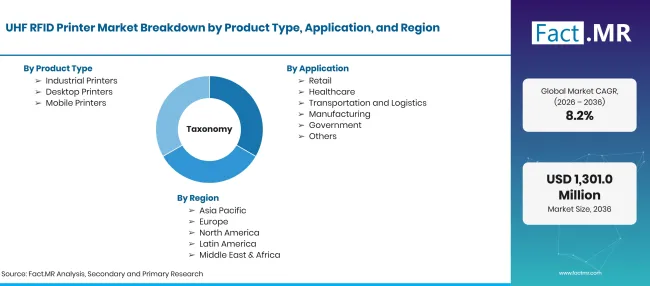
Uhf Rfid Printer Market Taxonomy 2 | Source: Fact.MR
| Items | Values |
|---|---|
| Quantitative Units (2026) | USD 24.0 Billion |
| Market Definition | Surfactant-related chemical ingredients produced by adding alkylene oxides to suitable starting materials, used in detergents, cleaning, emulsifying, dispersing and wetting agents across industrial and consumer applications. |
| Type | Natural, Synthetic |
| Application | Detergents, Cleaning Agents, Emulsifying Agents, Dispersing Agents, Wetting Agents |
| Regions Covered | North America, Latin America, Western Europe, Eastern Europe, East Asia, South Asia & Pacific, Middle East & Africa |
| Countries Covered | Germany, Brazil, United States, United Kingdom, Japan |
| Key Companies Profiled | BASF SE, Dow Inc., Huntsman Corporation, Kao Corporation, Evonik Industries AG, Stepan Company, Clariant AG, Croda International Plc., Sasol Limited, Nouryon |
| Additional Attributes | Hybrid top-down and bottom-up estimate using production and consumption patterns, product mix, application demand and country growth indicators. Alkoxylation equipment, standalone alkylene oxide feedstocks and finished detergents or cosmetics are excluded. |
Source: Fact.MR analysis. Updated Nov 18, 2026
Alkoxylates Market by Segments
-
Type
- Natural
- Synthetic
-
Application
- Detergents
- Cleaning Agents
- Emulsifying Agents
- Dispersing Agents
- Wetting Agents
-
Region:
- North America
- United States
- Canada
- Mexico
- Europe
- Germany
- United Kingdom
- France
- Italy
- Spain
- Rest of Europe
- Asia Pacific
- China
- India
- Japan
- South Korea
- Australia
- Rest of Asia Pacific
- Latin America
- Brazil
- Mexico
- Argentina
- Rest of Latin America
- Middle East & Africa
- GCC Countries
- South Africa
- Rest of Middle East & Africa
- North America
Frequently Asked Questions
What revenue does the forecast show for alkoxylates in 2036?
What compound annual growth rate does the forecast show?
Is natural or synthetic the bigger type?
Who are the profiled producers?
Who worked on this report


Preview the report firsthand - request a free sample
Free SampleGet the brochure for pricing and purchase details
Download PDF