- Market Value (2025): USD 362.2 Mn
- Estimated Value (2026): USD 381.6 Mn
- Forecast Value (2036): USD 642.6 Mn
- CAGR (2026-2036): 5.4%
Binocular Zoom Stereo Microscopes Market Forecast and Outlook 2026 to 2036
Opportunities in binocular zoom stereo microscopes are growing with laboratory modernization and research activity, with sales projected to grow from USD 381.6 million in 2026 to USD 642.6 million by 2036, a 5.4% CAGR that adds USD 261.0 million.
Adoption is supported by public research funding. For example, in April 2026, Japan's Ministry of Education, Culture, Sports, Science and Technology opened the call for its Advanced Research Infrastructure Renewal Project (EPOCH) to modernize university research facilities. Suppliers are targeting institutions that are renewing equipment, and funding programs of this kind are projected to drive sales across research institutions in Asia, Europe and Latin America.
Key Takeaways from the Binocular Zoom Stereo Microscopes Market
- The binocular zoom stereo microscopes market was valued at USD 362.2 million in 2025
- Binocular Zoom Stereo Microscopes Market Value (2026): USD 381.6 million
- Binocular Zoom Stereo Microscopes Market Forecast Value (2036): USD 642.6 million
- Binocular Zoom Stereo Microscopes Market Forecast CAGR (2026-2036): 5.4%
- Leading Product Type: Upright Microscopes (42.3%)
- Key Market Participants: Evident Corporation, Leica Microsystems, Nikon Corporation, ZEISS, Meiji Techno Co., Ltd., Motic, Scienscope, METZER-M
- Key Growth Regions: Germany, Brazil, United States, United Kingdom, Japan
Demand from electronics manufacturers and medical and diagnostic laboratories broadens the base beyond life sciences, and improvements in optics, illumination and ergonomics support replacement purchases. Opportunities are building as emerging research institutions buy microscopy equipment. High equipment prices, maintenance costs and competition from digital inspection technologies are the main constraints.
Binocular Zoom Stereo Microscopes Market
| Metric | Value |
|---|---|
| Estimated Value in (2026) | USD 381.6 million |
| Forecast Value in (2036) | USD 642.6 million |
| Forecast CAGR (2026 to 2036) | 5.4% |
Source: Fact.MR analysis. Updated Nov 18, 2026
Source: Fact.MR analysis
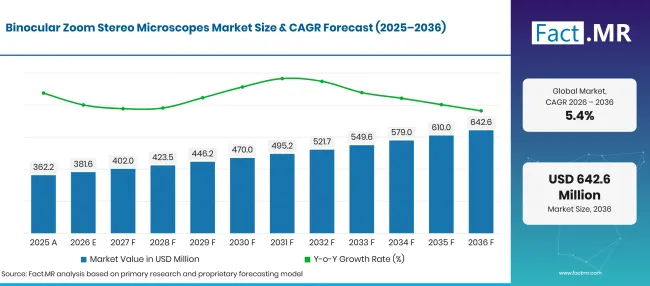
Binocular Zoom Stereo Microscopes Market Forecast Global | Source: Fact.MR
Category
| Category | Segments |
|---|---|
| Product Type | Upright Microscopes, Inverted Microscopes, Others |
| Application | Biological Research, Industrial Inspection, Medical Diagnostics, Educational Use, Others |
| End-User | Research Institutes, Hospitals and Clinics, Academic Institutions, Industrial Laboratories, Others |
| Region | Germany; Brazil; United States; United Kingdom; Japan |
Source: Fact.MR analysis. Updated Nov 18, 2026
Segmental Analysis
Why do upright models lead demand in the Binocular Zoom Stereo Microscopes Market?
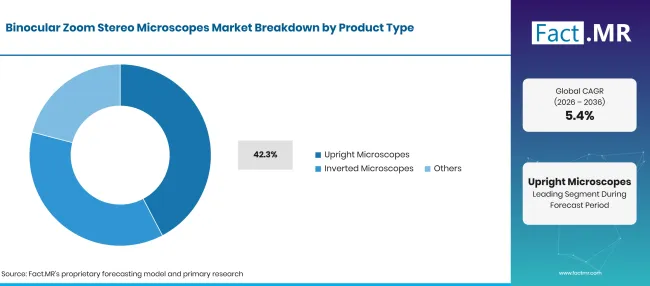
Binocular Zoom Stereo Microscopes Market Breakdown Product Type | Source: Fact.MR
Demand for upright microscopes accounts for 42.3% of 2026 revenue as buyers use them across biological research and industrial inspection. For example, in May 2026, Motic introduced its SM12 and SM16 research-grade stereo microscopes for laboratory and industrial use, and Meiji Techno's 2025 to 2026 catalogue includes IVF-focused configurations. Launches of this kind should keep upright models the leading type. Distributors also support the segment by offering demonstrations, calibration assistance and responsive after-sales service, which matters for buyers comparing configurations against specimen characteristics and magnification needs. Inverted and other configurations serve narrower workflows, so upright models keep the broader application reach that sustains their lead through 2036.
Why does biological research lead application demand?
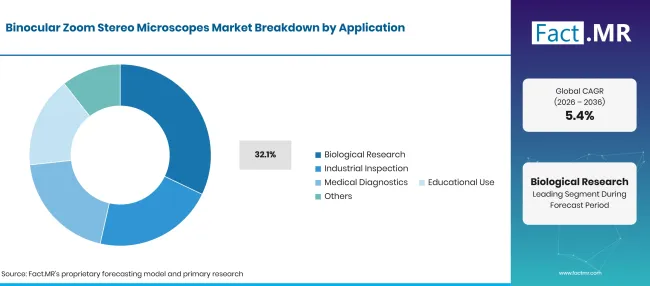
Binocular Zoom Stereo Microscopes Market Breakdown Application | Source: Fact.MR
Sales to biological research account for 32.1% of 2026 revenue as laboratories examine plant tissue and small organisms routinely. For example, in July 2026, IISER Pune hosted the India BioImaging Western Chapter microscopy and image analysis course. Suppliers are supporting training and demonstrations, and this activity is projected to sustain adoption. Medical and diagnostic laboratories, educational use and industrial inspection add to demand, but biological research remains the largest group because the work is continuous and specimen driven. Universities and research institutes are increasing laboratory activity, and this creates demand for optical equipment used in experiments and sample preparation, supporting the segment's 32.1% share.
Why do research institutes lead end-user demand?
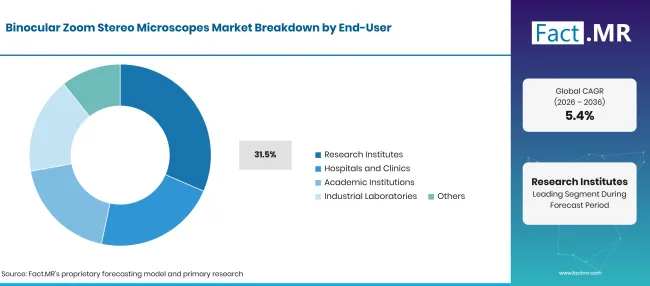
Binocular Zoom Stereo Microscopes Market Breakdown End User | Source: Fact.MR
Demand from research institutes accounts for 31.5% of 2026 revenue as continuous experiments sustain equipment purchases. For example, in February 2026, the National Forensic Sciences University invited bids for a 3D stereo microscope at its Goa campus. Institutional tenders of this kind are projected to drive sales. Hospitals and clinics, academic institutions and industrial laboratories form the other end-user groups, each buying for its own purposes. Research institutes lead because they run experiments continuously and plan equipment budgets around long-term programs. Emerging research institutions in Latin America, Asia-Pacific and the Middle East and Africa are expected to add purchases, widening the base of buyers over the forecast period.
Binocular Zoom Stereo Microscopes Market-Drivers, Restraints & Trends
Drivers
Demand for stereo microscopes is rising as research and inspection needs grow. Fact.MR attributes about +4.5% of CAGR to biological research use (+1.5%), precision inspection in electronics and manufacturing (+1.2%), laboratory investment and modernization (+1.0%) and improvements in optics and ergonomics (+0.8%). Growth in these areas is projected to drive sales through the forecast period.
Restraints
Sales face pressure from high initial costs of advanced systems (about -0.3% on the CAGR), competition from digital microscopes and alternative inspection technologies (-0.2%) and maintenance and support requirements in emerging markets (-0.1%). Variations in laboratory budgets also influence purchase timing.
Trend
Advanced Optics and Wider Zoom Ranges Opportunities in higher-resolution models with wider zoom ranges are the largest at +0.7% of CAGR over the long term. For example, in May 2026, Motic launched the SM12 and SM16. Launches of this kind are projected to drive replacement purchases.
Trend
Digital Imaging and Emerging-Institution Purchasing Adoption of camera-compatible and digitally integrated systems adds +0.4% of CAGR, while rising purchases at emerging research institutions in Latin America, Asia-Pacific and the Middle East and Africa add +0.5%. This activity is expected to increase sales.
Binocular Zoom Stereo Microscopes Market by Analysis by Key Country
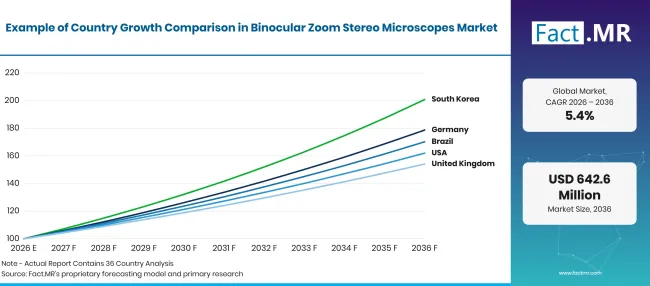
Binocular Zoom Stereo Microscopes Market Growth Index | Source: Fact.MR
| Country | CAGR (2026-2036) |
|---|---|
| Germany | 6.0% |
| Brazil | 5.5% |
| United States | 4.9% |
| United Kingdom | 4.4% |
| Japan | 3.9% |
Source: Fact.MR analysis. Updated Nov 18, 2026
Source: Fact.MR analysis
What is driving stereo microscope demand in Germany?
The market in Germany is projected to grow at 6.0% a year, the highest of the five countries, as an established research network invests in microscopy infrastructure.
For example, in February 2026, the German Research Foundation's NFDI4BIOIMAGE progress report documented a broad network of participating institutions. Universities, research centers and industrial laboratories are the buyers, and continued investment should sustain sales. Industrial laboratories also use the instruments for component inspection, so demand is supported by manufacturing as well as science. Distributors offering demonstrations and training strengthen customer engagement, and suppliers that deliver sharper optics and imaging compatibility are well placed in a market where research and production requirements are becoming more precise.
How is public research funding supporting sales in Brazil?
The market in Brazil is projected to grow 5.5% a year as public research funding rises.
For example, in July 2025, the Ministry of Science, Technology and Innovation reported that the National Fund for Scientific and Technological Development allocated BRL 10 billion in 2023 and BRL 12.7 billion in 2024, with BRL 14.7 billion indicated for 2025. Universities and research laboratories use the instruments for biological investigations and teaching, while manufacturers apply stereo microscopy to product examination and quality assessment. Rising funding supports institutional purchases, and emerging research institutions are a key opportunity for suppliers able to provide training, calibration help and service in the region across the forecast period.
What is sustaining stereo microscope demand in the United States?
The market in the United States is projected to grow at 4.9% a year.
For example, in May 2025, the National Science Foundation's FY2026 budget request identified research infrastructure as a distinct funding area. Universities, biomedical laboratories and electronics manufacturers are the main buyers. Federal attention to scientific capabilities contributes to the operating environment for laboratory equipment demand. Universities and biomedical laboratories prepare and examine specimens, and electronics manufacturers rely on precision observation when assessing miniature components and production quality. Suppliers able to combine strong optics with imaging compatibility and responsive after-sales service are best placed to serve this mix of research and manufacturing buyers.
How are infrastructure investments shaping adoption in the United Kingdom?
The market in the United Kingdom is projected to grow at 4.4% a year. For example, in June 2025, King's College London announced GBP 1.8 million from UKRI-BBSRC and UKRI-MRC to widen access to biological imaging, and UKRI reported about GBP 1.138 billion of research and innovation infrastructure investment in 2024 to 2025.
Biomedical research centers and universities use optical equipment for specimen observation and experimental work, and the funding covered World Class Labs, the Infrastructure Fund and digital research infrastructure. Investment in life sciences and biological imaging facilities supports institutional purchasing, so demand is expected to keep growing steadily even though the pace is below that of Germany and Brazil.
Why is stereo microscope growth slowest in Japan?
The market in Japan is projected to grow at 3.9%, the lowest of the five countries, as an already well-equipped research base expands gradually.
For example, in April 2026, the EPOCH program emphasized shared infrastructure and equipment development at universities. Electronics manufacturers and universities remain the main buyers. Electronics manufacturers and scientific institutions use the instruments for component inspection and material examination, and universities employ them in biological investigations and laboratory training. The emphasis on shared infrastructure creates a favorable environment for specialized microscopy technologies, while optical manufacturing expertise keeps domestic competition strong. Growth is gradual because the research base is already well equipped, but modernization funding sustains replacement purchases through 2036.
Competitive Landscape for Binocular Zoom Stereo Microscopes Market
Competition in the binocular zoom stereo microscopes market is divided between established players and new microscopy players. Evident, Leica Microsystems, Nikon and ZEISS compete through broad stereo ranges with imaging and illumination, Meiji Techno and Motic through laboratory and research ranges, Scienscope through electronics and industrial inspection, and METZER-M through binocular and trinocular configurations.
Competition centers on optical clarity, zoom consistency, working distance and illumination, with camera integration and ergonomics separating suppliers in research and inspection.
Recent Developments
- In July 2026, IISER Pune hosted the India BioImaging Western Chapter microscopy and image analysis training course, including three-dimensional reconstruction and hands-on instrument training.
- In May 2026, Motic introduced its SM12 and SM16 research-grade stereo microscopes with enhanced optical performance for laboratory and industrial use.
- In April 2026, Japan's Ministry of Education, Culture, Sports, Science and Technology opened the call for the Advanced Research Infrastructure Renewal Project (EPOCH).
- In February 2026, the National Forensic Sciences University invited tenders for a 3D stereo microscope at its Goa campus.
Key Players in Binocular Zoom Stereo Microscopes Market
Key companies profiled include Evident Corporation; Leica Microsystems; Nikon Corporation; ZEISS; Meiji Techno Co., Ltd.; Motic; Scienscope; and METZER-M.
- Evident Corporation
- Leica Microsystems
- Nikon Corporation
- ZEISS
- Meiji Techno Co., Ltd.
- Motic
- Scienscope
- METZER-M
Bibliography
- German Research Foundation. 2026. National research data infrastructure for microscopy and bioimage analysis: Public progress report part 1. Bonn: DFG.
- Indian Institute of Science Education and Research Pune. 2026. India BioImaging Western Chapter microscopy and image analysis training course. Pune: IISER Pune.
- King's College London. 2025. £1.8M investment to expand access to bioimaging research infrastructure. London: King's College London.
- Meiji Techno America. 2025. 2025-2026 IVF series stereo microscopes. Saratoga, CA: Meiji Techno America.
- Ministério da Ciência, Tecnologia e Inovação. 2025. Na abertura do Cidades Inovadoras, ministra Luciana Santos destaca papel dos municípios na inovação. Brasília: Governo Federal do Brasil.
- Ministry of Education, Culture, Sports, Science and Technology. 2026. Announcement of the call for proposals for the EPOCH advanced research infrastructure renewal project. Tokyo: MEXT.
- Motic America. 2026. The future of precision: Introducing the all-new Motic SM12 and SM16 research-grade stereo microscopes. Motic Microscopes.
- National Forensic Sciences University. 2026. Tenders invited for NFSU, Goa campus: Tender for 3D stereo microscope. Gandhinagar: NFSU.
- National Science Foundation. 2025. Fiscal year 2026 budget request to Congress. Alexandria, VA: NSF.
- UK Research and Innovation. 2025. UKRI annual report and accounts 2024 to 2025. Swindon: UKRI.
Segmentation
Scope of Report
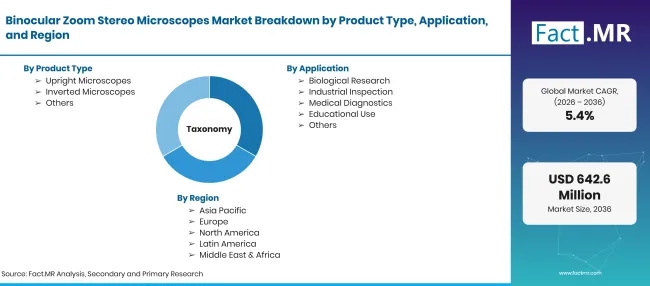
Binocular Zoom Stereo Microscopes Market Taxonomy | Source: Fact.MR
| Items | Values |
|---|---|
| Quantitative Units (2026) | USD 381.6 Million |
| Market Definition | Optical instruments with two viewing paths and adjustable zoom magnification that give three-dimensional observation of specimens and components. |
| Product Type | Upright Microscopes, Inverted Microscopes, Others |
| Application | Biological Research, Industrial Inspection, Medical Diagnostics, Educational Use, Others |
| End-User | Research Institutes, Hospitals and Clinics, Academic Institutions, Industrial Laboratories, Others |
| Regions Covered | North America, Latin America, Western Europe, Eastern Europe, East Asia, South Asia & Pacific, Middle East & Africa |
| Countries Covered | Germany, Brazil, United States, United Kingdom, Japan |
| Key Companies Profiled | Evident Corporation, Leica Microsystems, Nikon Corporation, ZEISS, Meiji Techno Co., Ltd., Motic, Scienscope, METZER-M |
| Additional Attributes | Hybrid top-down and bottom-up estimate drawing on shipments and revenue, product mix, application demand, end-user purchasing and country research investment. Digital microscopes, compound microscopes, electron microscopes and separately sold accessories or software are excluded. |
Source: Fact.MR analysis. Updated Nov 18, 2026
Binocular Zoom Stereo Microscopes Market by Segments
-
Product Type
- Upright Microscopes
- Inverted Microscopes
- Others
-
Application
- Biological Research
- Industrial Inspection
- Medical Diagnostics
- Educational Use
- Others
-
End-User
- Research Institutes
- Hospitals and Clinics
- Academic Institutions
- Industrial Laboratories
- Others
-
Region:
- North America
- United States
- Canada
- Mexico
- Europe
- Germany
- United Kingdom
- France
- Italy
- Spain
- Rest of Europe
- Asia Pacific
- China
- India
- Japan
- South Korea
- Australia
- Rest of Asia Pacific
- Latin America
- Brazil
- Mexico
- Argentina
- Rest of Latin America
- Middle East & Africa
- GCC Countries
- South Africa
- Rest of Middle East & Africa
- North America
Frequently Asked Questions
What is the estimated size of the Binocular Zoom Stereo Microscopes Market in 2026?
How much could the market reach by 2036?
What annual growth should buyers and suppliers expect?
Who are the largest buyers?
Who worked on this report


Preview the report firsthand - request a free sample
Free SampleGet the brochure for pricing and purchase details
Download PDF