- Market Value (2025): USD 737.9 Mn
- Estimated Value (2026): USD 823.0 Mn
- Forecast Value (2036): USD 2453.0 Mn
- CAGR (2026-2036): 11.5%
Thermally Conductive Filler Systems Market Forecast and Outlook 2026 to 2036
According to the Fact.MR analysis, the thermally conductive filler systems market was valued at USD 737.9 million in 2025 and is projected to grow from USD 823.0 million in 2026 to USD 2,453.0 million by 2036. Sales are expected to increase at a CAGR of 11.5% over the forecast period.
Demand is supported by the growing need to manage heat in high-power electronics, electric vehicle components and industrial equipment. As electronic assemblies become more compact and power densities increase, manufacturers are adopting thermally conductive materials to transfer heat away from sensitive components while maintaining electrical insulation where required. Boron nitride and aluminum nitride are important material choices for applications requiring thermal performance alongside electrical properties. Demand is also expanding across paste and gel formulations, films and sheets, and engineered powder systems that can be incorporated into different production processes.
Key Takeaways from the Thermally Conductive Filler Systems Market
- Thermally Conductive Filler Systems Market value (2025): USD 737.9 million
- Thermally Conductive Filler Systems Market value (2026): USD 823.0 million
- Thermally Conductive Filler Systems Market Forecast value (2036): USD 2,453.0 million
- Thermally Conductive Filler Systems Market Forecast CAGR (2026–2036): 11.5%
- Leading thermal filler chemistry: Boron nitride (32.1%)
- Key market participants: 3M, Saint-Gobain, Tokuyama Corporation, Evonik.
- Key Growth Regions: India, China, United States, Germany, and Japan
On September 10, 2026, Tokuyama Corporation announced plans for a new aluminum nitride powder facility in Yanai, Japan, that will raise production capacity by approximately 30%, with commercial operations scheduled for April 2028. The company cited growing demand from semiconductor manufacturing and AI-related investments. Aluminum nitride is used in semiconductor equipment components and as a heat-dissipation filler in thermally conductive materials. Tokuyama also offers engineered aluminum nitride and boron nitride filler grades for heat-dissipation resin systems. This investment reflects increasing demand for high-performance ceramic fillers that provide thermal conductivity while maintaining electrical insulation. Manufacturers of power electronics, semiconductor equipment and advanced electronic assemblies are expected to require more specialized filler materials to manage heat generation. Similar capacity investments and product developments are projected to support sales of thermally conductive filler systems across Asia, North America and Europe through 2036.
Thermally Conductive Filler Systems Market
| Metric | Value |
|---|---|
| Estimated value (2026) | USD 823.0 million |
| Forecast value (2036) | USD 2,453.0 million |
| Forecast CAGR (2026–2036) | 11.5% |
Source: Fact.MR analysis. Updated Nov 18, 2026
Source: Fact.MR analysis.
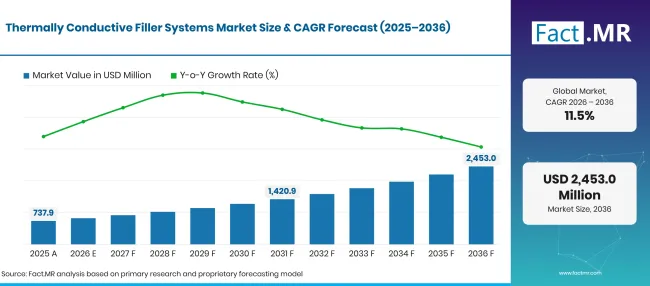
Thermally Conductive Filler Systems Forecast Global | Source: Fact.MR
Category and Segment Coverage
| Category | Segments |
|---|---|
| Thermal filler chemistry | Boron nitride, Aluminum nitride, Alumina, Graphite / graphene, Hybrid ceramic-carbon |
| Supply / product format | Paste / gel, Powder / pellets, Liquid / dispersion, Film / sheet, Two-component / custom |
| Manufacturing / cure process | Hybrid / specialty, UV / radiation, Moisture / ambient, Melt processing, Thermal |
| Industrial end use | Electronics, Automotive, Construction, Industrial equipment, Packaging / infrastructure |
| Countries covered | China, United States, Germany, Japan, India |
Source: Fact.MR analysis. Updated Nov 18, 2026
Source: Fact.MR analysis.
Segmental Analysis
Why does boron nitride lead the thermal filler chemistry segment?
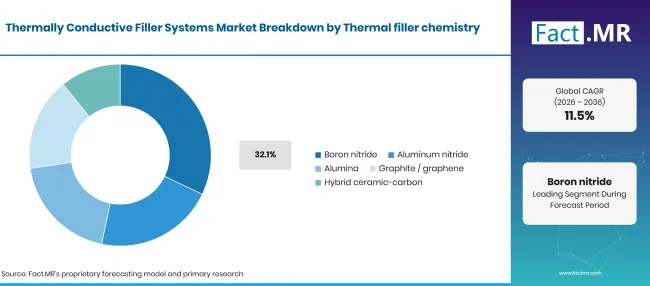
Thermally Conductive Filler Systems Breakdown Thermal Filler Chemistry | Source: Fact.MR
Boron nitride accounts for 32.1% of thermal filler chemistry revenue in 2026, about USD 264.2 million. Demand for boron nitride is supported by its ability to improve heat transfer while retaining electrical insulation, making it suitable for electronic components and power systems where conductive fillers could create electrical risks. Manufacturers are incorporating boron nitride into polymer compounds, adhesives, thermal interface materials and thermally conductive plastics. For example, 3M offers its Boron Nitride Cooling Fillers for thermoplastics, elastomers, thermoset resins and adhesives. Its product portfolio includes platelet and agglomerate forms that enable compounders to adjust in-plane and through-plane heat dissipation. Saint-Gobain also offers boron nitride powder grades designed for dielectric thermal filler applications and thermally conductive plastics. These product developments demonstrate how particle morphology and electrical insulation characteristics influence material selection across end-use industries. Demand for boron nitride is expected to increase as manufacturers seek higher thermal performance in compact electronics and power-dense applications. Its combination of heat dissipation and dielectric properties is projected to sustain its leading position through 2036.
How is aluminum nitride supporting demand for thermally conductive filler systems?
On September 10, 2026, Tokuyama Corporation announced plans to raise aluminum nitride powder production capacity by approximately 30% through a new facility in Yanai, Japan, citing semiconductor-related applications and increased AI investment. This expansion reflects growing commercial interest in high-performance aluminum nitride materials. In 2026, aluminum nitride is projected to account for 24.1% of thermal filler chemistry revenue, about USD 198.3 million. Its high thermal conductivity, electrical insulation and coefficient of thermal expansion close to silicon make it suitable for semiconductor-related applications, power electronics and high-power LED systems. Tokuyama offers high-purity aluminum nitride fillers in different particle sizes and morphologies, including pseudo-spherical, polyhedral and spherical grades, designed to support higher filler loading and improved thermal performance in resin systems. The company also offers boron nitride fillers for heat-dissipation applications. Growing demand for high-power semiconductor devices and advanced electronic assemblies is expected to support further adoption of aluminum nitride-based filler systems.
Why do paste and gel formats account for the largest supply-format share?
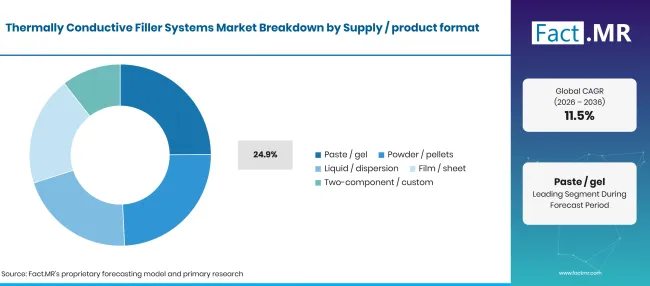
Thermally Conductive Filler Systems Breakdown Supply Product Format | Source: Fact.MR
Paste and gel formats segment to lead with 24.9% of supply-format revenue in 2026, about USD 204.9 million. Demand is supported by their ability to fill small gaps between heat-generating components and heat sinks while accommodating surface irregularities. Their conformability helps maintain contact across uneven assembly surfaces, improving heat transfer in electronic systems. Manufacturers are increasingly selecting paste and gel systems that can be dispensed through automated production equipment. Consistent viscosity, controlled flow and predictable curing behavior are important purchasing considerations because they influence material placement, assembly speed and finished-component reliability. These requirements are expected to support paste and gel sales through 2036.
How are powder and pellet formats supporting market demand?
Tokuyama Corporation's aluminum nitride and boron nitride portfolios demonstrate how particle size, morphology and surface treatment influence the selection of powder-based thermal fillers. In 2026, powder and pellet formats represent 22.1% of supply-format revenue, about USD 181.9 million. These materials are widely used by compounders and manufacturers incorporating thermal fillers into thermoplastics, elastomers and thermoset resins. Their adoption is supported by the need for uniform filler distribution and consistent material properties during compounding and molding. Tokuyama offers aluminum nitride powders and engineered filler grades designed to improve resin compatibility and thermal performance, while 3M provides boron nitride platelet and agglomerate formats that allow compounders to adjust heat-transfer characteristics to component requirements. Demand for powder-based fillers is expected to increase as manufacturers expand the use of thermally conductive polymer components in lightweight electronic housings, automotive power systems and industrial equipment.
Why are hybrid and specialty processes leading manufacturing and curing demand?
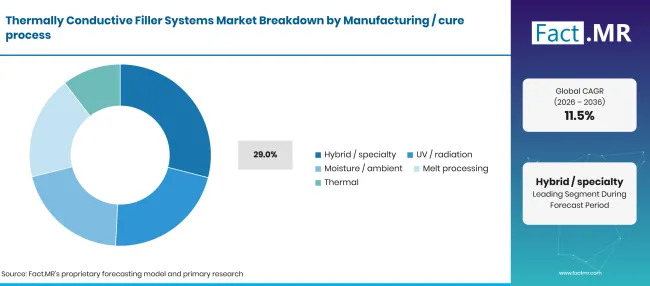
Thermally Conductive Filler Systems Breakdown Manufacturing Cure Process | Source: Fact.MR
Demand for hybrid and specialty manufacturing processes is increasing as manufacturers seek thermal filler systems that balance heat transfer with adhesion, flexibility, mechanical stability and processing efficiency. In 2026, this segment accounts for 29.0% of manufacturing and cure process revenue, about USD 238.7 million. According to the Ministry of Heavy Industries, as of March 2026, 40 GWh of the targeted 50 GWh domestic Advanced Chemistry Cell battery-manufacturing capacity had been awarded to four companies, with 1 GWh installed under the PLI scheme. This expansion of domestic battery manufacturing is expected to create opportunities for customized thermal management materials used in battery-pack assembly. Sales are supported by growing requirements for formulations tailored to different substrates, component geometries and operating temperatures. Adoption of specialty formulations is gaining momentum because individual filler chemistries and curing methods may not meet the requirements of every application. Formulators are therefore combining different filler types, particle sizes and polymer systems to achieve the required balance of thermal performance and processability.
Why does electronics lead industrial end-use demand?
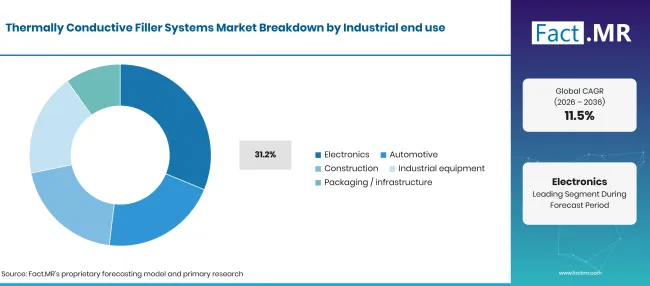
Thermally Conductive Filler Systems Breakdown Industrial End Use | Source: Fact.MR
According to the Ministry of Electronics and Information Technology, India's electronics production increased by 15.8% year-on-year to ₹13.11 lakh crore in FY 2025–26, reflecting the expansion of domestic electronics manufacturing. This growth is expected to support demand for thermal management materials used in increasingly compact and power-dense electronic assemblies. In 2026, electronics holds 31.2% of industrial end-use revenue, about USD 256.8 million. 3M's boron nitride cooling fillers are designed for thermally conductive and electrically insulating polymers. Tokuyama also offers aluminum nitride fillers for heat-dissipation resin systems and semiconductor-related components. Rising component density across power modules, semiconductor devices and telecommunications infrastructure is increasing the need for thermal interface materials that transfer heat from sensitive components to cooling structures. As electronic devices become more powerful and compact, manufacturers are expected to expand the use of thermally conductive fillers in encapsulation, bonding, component housings and thermal interface applications. This is projected to maintain electronics as the largest end-use segment through 2036.
Thermally Conductive Filler Systems Market – Drivers, Restraints and Trends
Driver
Increasing demand for thermal management in power-dense electronics: Demand for thermally conductive filler systems is rising as manufacturers address heat generation in semiconductors, power electronics, telecommunications equipment and electric vehicle components. Higher component density and increased operating power are creating a need for materials that transfer heat efficiently while maintaining electrical insulation. For example, India's Semicon 2.0 program, approved in July 2026 with an outlay of ₹1,27,500 crore, includes semiconductor equipment, materials, fabrication and advanced packaging among its strategic priorities. The program is expected to strengthen India's semiconductor ecosystem and encourage investment across the supporting materials value chain.
Restraint
High formulation costs and processing complexity: Sales and adoption of advanced thermally conductive filler systems can be constrained by high raw-material costs and formulation complexity. High-performance ceramic fillers such as boron nitride and aluminum nitride may increase material costs, particularly when applications require high filler loading, specialized particle morphology or surface treatment. Excessive filler loading can also affect viscosity, flexibility, adhesion and mechanical strength. Manufacturers must evaluate thermal conductivity alongside dispersion stability, processability and compatibility with the selected polymer matrix.
Opportunity
Thermal management for electric vehicle batteries and power electronics: Government of India data highlights the expansion of the electric mobility ecosystem. In October 2026, the Ministry of Heavy Industries reported that the PM E-DRIVE scheme had enabled 26.59 lakh electric vehicle sales as of June 2026. The government had also earmarked ₹2,000 crore for public EV charging infrastructure, with ₹851 crore approved for deploying 8,147 chargers as of September 28, 2026. Separately, the Ministry reported 52,718 public EV charging stations across India in July 2026, including 16,561 equipped with fast chargers for cars. This expansion in EV adoption and charging infrastructure is expected to increase demand for thermal management systems used in battery modules, inverters, converters and electronic control units. These applications require effective heat transfer while maintaining mechanical stability and electrical safety. Demand is increasing for gap fillers and thermally conductive adhesives that accommodate component tolerances and maintain reliable contact between heat-generating assemblies and cooling structures.
Trend
Development of engineered ceramic and hybrid filler systems: Material development is shifting toward engineered filler structures that improve heat transfer without compromising electrical insulation or polymer processability. Manufacturers are evaluating particle size, morphology, surface treatment and filler combinations to improve dispersion and create more effective thermal conduction pathways. Tokuyama's aluminum nitride and boron nitride portfolios demonstrate the use of engineered particle morphologies to improve filling properties and thermal performance. 3M's platelet and agglomerate boron nitride grades are designed to support different heat-transfer directions within polymer compounds. Saint-Gobain's boron nitride powder portfolio includes platelet and agglomerate forms for dielectric thermal fillers and thermally conductive plastics.
Thermally Conductive Filler Systems Market by Key Country
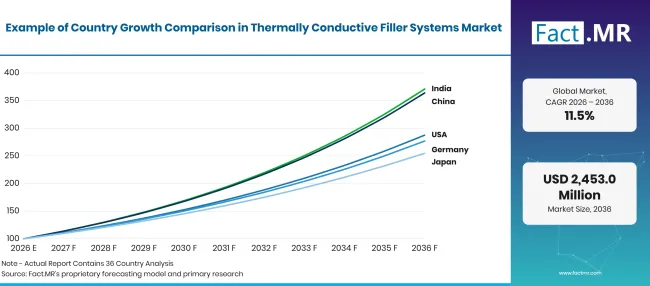
Thermally Conductive Filler Systems Growth Index | Source: Fact.MR
| Country | CAGR (2026–2036) |
|---|---|
| India | 14.0% |
| China | 13.8% |
| United States | 11.1% |
| Germany | 10.7% |
| Japan | 9.8% |
Source: Fact.MR analysis. Updated Nov 18, 2026
Source: Fact.MR analysis.
What is driving thermally conductive filler systems demand in India?
In July 2026, the Government of India approved Semicon 2.0 with a total outlay of ₹1,27,500 crore, extending support beyond semiconductor fabrication to include machinery, materials, research and advanced packaging. This initiative is expected to strengthen India's semiconductor manufacturing ecosystem and create opportunities for materials used in heat dissipation, component protection and thermal interface applications. Demand for thermally conductive filler systems in India is estimated to grow at a 14.0% CAGR, the fastest among the five key countries. Government initiatives supporting semiconductor manufacturing, electronics production and advanced packaging are expected to drive market expansion. Manufacturers are likely to require thermally conductive adhesives, ceramic fillers and polymer compounds for power modules and electronic assemblies.
How is electronics and manufacturing expansion supporting demand in China?
Sales of thermally conductive filler systems in China to represent a 13.8% CAGR through 2036. Demand is supported by the country's extensive electronics manufacturing base and continued investment in electric vehicles, batteries, telecommunications equipment and industrial automation. These industries require materials that can manage heat in compact electronic assemblies and high-power components. The expansion of domestic battery and power electronics production is expected to support the use of thermally conductive gap fillers, adhesives and ceramic-based polymer compounds. Demand is also expected to benefit from the use of boron nitride and aluminum nitride in applications requiring high thermal conductivity alongside electrical insulation. Increasing adoption of advanced thermal management materials is projected to drive sales in China over the forecast period.
What is supporting thermally conductive filler systems sales in the United States?
Demand for thermally conductive filler systems in the United States is projected to increase at an 11.1% CAGR. Growth is supported by demand for advanced electronic components, electric vehicle systems, data center infrastructure and industrial power equipment. Higher computing loads and increasing power density in electronic systems are encouraging manufacturers to adopt more efficient heat-dissipation materials. The availability of specialized products from companies such as 3M supports the development of thermally conductive polymer compounds and gap-filling materials for electronics and automotive applications. 3M's boron nitride fillers provide thermal conductivity while maintaining electrical insulation. As manufacturers focus on improving component reliability and reducing thermal stress, demand for engineered filler systems is expected to increase across U.S. electronics and automotive production.
Why is Germany maintaining strong demand for thermally conductive filler systems?
Sales of thermally conductive filler systems in Germany are estimated to hold 10.7% CAGR. Demand is supported by the country's automotive manufacturing base and the transition toward electric mobility. Battery systems, power electronics and vehicle control units require effective thermal management to maintain operating reliability and component performance. Thermally conductive adhesives and gap fillers are gaining importance in battery assembly because they help transfer heat between battery modules and cooling plates.
How is Japan supporting demand for thermally conductive filler systems?
In October 2026, Japan's Ministry of Foreign Affairs announced a Japan–U.S. semiconductor manufacturing initiative to strengthen the semiconductor supply chain, with Japanese companies expressing interest in supplying manufacturing equipment and materials for the project. This highlights the importance of Japan's advanced ceramic materials industry in supplying high-performance thermal management materials. Demand for thermally conductive filler systems in Japan is projected to increase at a 9.8% CAGR through 2036. Growth is supported by the country's established semiconductor materials industry and manufacturers specializing in advanced ceramic powders. Semiconductor manufacturing equipment, power devices and high-performance electronics require materials that dissipate heat while maintaining electrical insulation and dimensional stability. Tokuyama offers aluminum nitride and boron nitride fillers for heat-dissipation resin materials. Japan's established advanced-materials ecosystem and continued investment in semiconductor-related technologies are expected to sustain demand for high-purity ceramic fillers through 2036.
Competitive Landscape for Thermally Conductive Filler Systems Market
Competition in the thermally conductive filler systems market is shaped by material performance, filler chemistry, particle morphology and compatibility with customer formulations. Companies compete through ceramic powders, engineered filler grades, polymer-based compounds and formulated thermal interface materials. Product differentiation depends on the ability to improve heat transfer while preserving electrical insulation, mechanical integrity and manufacturing efficiency. 3M and Saint-Gobain have established positions in boron nitride-based filler materials. 3M's Boron Nitride Cooling Fillers are designed for thermally conductive polymers and adhesives, with platelet and agglomerate grades that support different heat-transfer requirements. Saint-Gobain's boron nitride powder portfolio serves dielectric thermal filler and thermally conductive plastic applications.
Tokuyama Corporation competes through high-purity aluminum nitride and boron nitride filler products. Its portfolio includes engineered particle sizes and morphologies designed to improve resin filling properties and thermal performance. The company's announced capacity expansion for aluminum nitride powder in September 2026 reflects its focus on growing demand from semiconductor and thermal management applications. Evonik has relevant technical development in thermally conductive filler treatment. Its published patent work describes surface treatment of boron nitride powders using dry mixing with fumed silica or metal oxides. This provides evidence of technical activity in the field, although a current commercial thermally conductive filler product portfolio was not established from the reviewed sources. Buyers evaluate filler systems based on thermal conductivity and electrical resistivity alongside particle size distribution, viscosity and compatibility with existing manufacturing processes. Companies offering application-specific grades with technical formulation support are better positioned to strengthen their market presence.
Recent Developments
- On March 12, 2026, Eaton completed its approximately USD 9.5 billion acquisition of Boyd Corporation’s Thermal business, expanding its liquid-cooling and thermal-management operations. This transaction concerns the wider thermal-management sector and does not directly establish sales growth for thermally conductive fillers.
Key Players in the Thermally Conductive Filler Systems Market
Key companies profiled include 3M; Saint-Gobain; Tokuyama Corporation; and Evonik.
- 3M
- Saint-Gobain
- Tokuyama Corporation
- Evonik
Bibliography
- Boyd Corporation. (2026, March 12). Boyd completes the sale of its Thermal business to Eaton for $9.5 billion.
- Government of India, Press Information Bureau. (2026, September 17). India building semiconductor future: Emerging capabilities across design, manufacturing, packaging, materials and talent.
- Ministry of Foreign Affairs of Japan. (2026, October 15). Semiconductor manufacturing project to be implemented under the Japan-U.S. Strategic Investment Initiative.
- Ministry of Heavy Industries. (2026, February 13). Promotion of domestic battery manufacturing capacity. Press Information Bureau, Government of India.
- Ministry of Heavy Industries. (2026, March 27). ACC battery production-linked incentive (PLI) scheme. Press Information Bureau, Government of India.
- Ministry of Heavy Industries. (2026, July 21). Charging stations for electric vehicles (EVs). Press Information Bureau, Government of India.
- Press Information Bureau, Government of India. (2026, August 14). Manufacturing momentum: Building a self-reliant India.
- Press Information Bureau, Government of India. (2026, October 1). PM E-DRIVE scheme: A step towards a sustainable future.
- Saint-Gobain. (2025, January 1). Saint-Gobain Boron Nitride Powder Solutions [Safety data sheet].
- Saint-Gobain. (2025, March). Powder Solutions, Grade MCFP [Technical data sheet].
- Tokuyama Corporation. (2025). Presentation for FY25 business briefing: Thermal management materials business.
- Tokuyama Corporation. (2026, March 12). Aluminum nitride powder and resin composition (U.S. Patent Application Publication No. US20260071110A1).
- Tokuyama Corporation. (2026, September 10). Notice concerning expansion of aluminum nitride powder production capacity by 30%—New production facility to be built at the Center for Commercialization of Advanced Technology.
- Tokuyama Corporation. (2026, October 29). Notice concerning expansion of aluminum nitride granule production capacity by approximately 50%.
Segmentation
Scope of Report
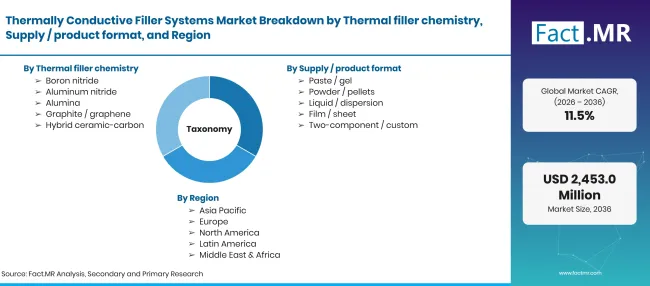
Thermally Conductive Filler Systems Taxonomy | Source: Fact.MR
| Items | Values |
|---|---|
| Quantitative units (2026) | USD 823.0 million |
| Thermal filler chemistry | Boron nitride, Aluminum nitride, Alumina, Graphite / graphene, Hybrid ceramic-carbon |
| Supply / product format | Paste / gel, Powder / pellets, Liquid / dispersion, Film / sheet, Two-component / custom |
| Manufacturing / cure process | Hybrid / specialty, UV / radiation, Moisture / ambient, Melt processing, Thermal |
| Industrial end use | Electronics, Automotive, Construction, Industrial equipment, Packaging / infrastructure |
| Countries covered | China, United States, Germany, Japan, India |
| Key companies profiled | 3M, Saint-Gobain, Tokuyama Corporation, Evonik |
| Additional attributes | Dollar revenue in the thermally conductive filler systems market is segmented by thermal filler chemistry, supply and product format, manufacturing and curing process, industrial end use and country. |
Source: Fact.MR analysis. Updated Nov 18, 2026
Thermally Conductive Filler Systems Market by Segments
-
Thermal Filler Chemistry
- Boron nitride
- Aluminum nitride
- Alumina
- Graphite / graphene
- Hybrid ceramic-carbon
-
Supply / Product Format
- Paste / gel
- Powder / pellets
- Liquid / dispersion
- Film / sheet
- Two-component / custom
-
Manufacturing / Cure Process
- Hybrid / specialty
- UV / radiation
- Moisture / ambient
- Melt processing
- Thermal
-
Industrial End Use
- Electronics
- Automotive
- Construction
- Industrial equipment
- Packaging / infrastructure
-
Region
- North America
- United States
- Canada
- Mexico
- Europe
- Germany
- United Kingdom
- France
- Italy
- Rest of Europe
- Asia Pacific
- China
- Japan
- India
- South Korea
- Taiwan
- Rest of Asia Pacific
- Latin America
- Brazil
- Mexico
- Argentina
- Rest of Latin America
- Middle East & Africa
- GCC Countries
- South Africa
- Rest of Middle East & Africa
- North America
Frequently Asked Questions
How big is the global thermally conductive filler systems market in 2026?
What will be the size of the thermally conductive filler systems market by 2036?
How fast will the thermally conductive filler systems market grow during the forecast period?
Which thermal filler chemistry holds the largest market share?
Which supply format leads the thermally conductive filler systems market?
Which manufacturing and cure process holds the largest share?
Which industrial end use accounts for the largest market share?
Which country is expected to record the fastest growth?
Who are the key companies operating in the thermally conductive filler systems market?
Who worked on this report


Preview the report firsthand - request a free sample
Free SampleGet the brochure for pricing and purchase details
Download PDF