- Market Value (2025): USD 508.4 Mn
- Estimated Value (2026): USD 532.3 Mn
- Forecast Value (2036): USD 854.1 Mn
- CAGR (2026-2036): 4.7%
What is the Amaretto Liqueur Market forecast to be worth by 2036?
USD 532.3 million in 2026 to USD 854.1 million by 2036 at 4.7% CAGR.
- The amaretto liqueur market reached USD 508.4 million in 2025 as beverage use and recipe-based consumption supported the category.
- Demand is projected to increase from USD 532.3 million in 2026 to USD 854.1 million by 2036.
- The market is forecast to record 4.7% CAGR from 2026 to 2036.
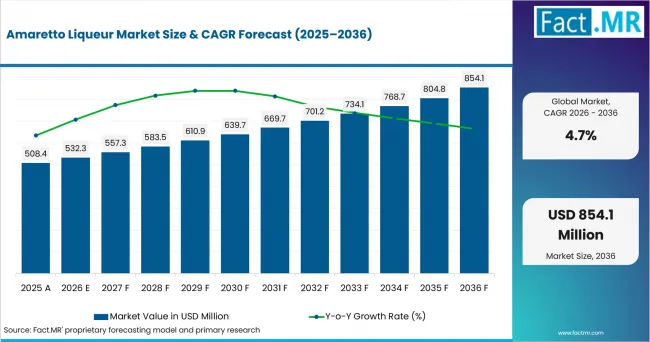
Amaretto Liqueur Market Value Analysis | Source: Fact.MR
What are the defining numbers behind Amaretto Liqueur Market growth?
USD 321.9 million absolute opportunity is expected by 2036.
- Demand Drivers in the Market
- Familiar almond flavor helps buyers understand amaretto quickly across classic drinks and dessert occasions.
- Beverage use is expected to protect repeat orders because bars and households can use the product in simple cocktails.
- Bottle size and pack design are projected to shape listings across retail and foodservice channels.
- Ingredient use is anticipated to support demand as bakeries and food brands need a recognizable liqueur note.
- Key Segments Analyzed
- By Type: 28% ABV is expected to hold 29.5% share in 2026. It balances flavor strength with broad beverage use.
- By Application: Beverage is projected to account for 52.8% share in 2026. Cocktail and direct-serving occasions support volume.
- Analyst Opinion at Fact.MR
- Shambhu Nath Jha, Principal Consultant at Fact.MR, states, “Amaretto liqueur companies need to protect flavor consistency while giving customers a clear reason to choose one bottle. Product acceptance is expected to depend on ABV fit and beverage use. Channel support matters more than sweetness alone.”
- Strategic Implications
- Brand owners can position 28% ABV products around cocktail and direct-serving occasions that need balanced flavor and strength.
- Distributors need separate plans for beverage and ingredient demand because each route favors different bottle sizes and product messaging.
- Retail teams must pair flavor claims with simple serving guidance so customers understand common drink and dessert uses.
The UK leads at 6.6% CAGR through home mixing, specialty retail and giftable formats. Australia follows at 7.2% as premium drink and dessert occasions support demand. The USA reaches 6.1% through broad spirits retail and cocktail use. Canada records 6.4% through provincial channel planning, while Germany posts 5.3% as mature spirits preferences keep expansion measured.
How does the Amaretto Liqueur Market break down by segment?
28% ABV is expected to lead Type with 29.5% share in 2026. Beverage is projected to lead Application with 52.8% share in 2026.
Why does 28% ABV lead Type?
28% ABV is projected to account for 29.5% share in 2026.
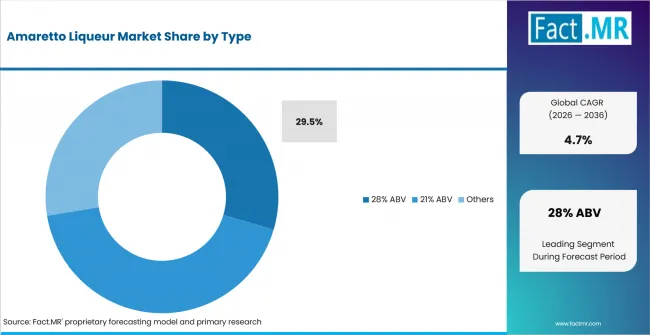
Amaretto Liqueur Market Analysis By Type | Source: Fact.MR
The 28% ABV format has the clearest commercial role because it gives beverage users enough strength without moving away from common serving patterns. It works in cocktails and after-dinner occasions. The 21% ABV segment serves lighter uses. Other ABV levels are expected to cover local recipes and defined strength needs. Brands can use this split to avoid overloading one strength point with every occasion.
Why does Beverage lead Application?
Beverage is projected to account for 52.8% share in 2026.
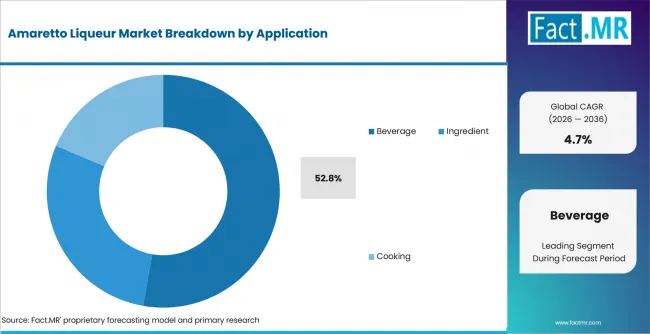
Amaretto Liqueur Market Analysis By Application | Source: Fact.MR
Amaretto is most often selected as a drink ingredient or served directly over ice. This gives beverage use more repeat occasions than cooking alone. Ingredient demand is expected to come from bakery and dessert use. Cooking demand depends on recipes that need a clear almond liqueur note. Ingredient buyers compare amaretto with flavors and fragrances only when aroma stability affects the final recipe.
What is accelerating Amaretto Liqueur Market adoption, and what is holding it back?
Demand is expected to rise through beverage use and format choice. Growth may be limited by input cost changes and label requirements.
Drivers Impact Analysis
| DRIVER | (~) % IMPACT ON CAGR | GEOGRAPHIC RELEVANCE | IMPACT TIMELINE |
|---|---|---|---|
| Beverage application depth | +1.1% | UK plus USA and Canada | Short term (<= 2 years) |
| 28% ABV format fit | +0.9% | UK plus Australia and USA | Short term (<= 2 years) |
| Simple cocktail use | +0.7% | Developed beverage markets | Medium term (2-4 years) |
| Ingredient and cooking use | +0.5% | Europe plus North America | Medium term (2-4 years) |
| Online and specialty retail access | +0.3% | USA plus UK and Australia | Long term (>= 4 years) |
Source: Fact.MR analysis. Updated Aug 4, 2026
- Beverage application depth: Cocktail and direct-serving use is expected to create repeat occasions beyond seasonal gifting.
- 28% ABV format fit: This strength point is anticipated to support broad use since it balances sweetness with alcohol presence.
- Simple cocktail use: Bar menus and home mixing are expected to help first-time customers try the product.
Opportunity Impact Analysis
| OPPORTUNITY | (~) % IMPACT ON CAGR | GEOGRAPHIC RELEVANCE | IMPACT TIMELINE |
|---|---|---|---|
| Serving guidance | +0.8% | USA plus UK and Canada | Short term (<= 2 years) |
| Gift packaging | +0.6% | UK and Australia | Medium term (2-4 years) |
| Food and dessert pairings | +0.4% | Europe plus North America | Medium term (2-4 years) |
| Specialty retail education | +0.3% | Premium beverage markets | Long term (>= 4 years) |
Source: Fact.MR analysis. Updated Aug 4, 2026
- Serving guidance: Simple drink instructions are expected to help customers understand how amaretto fits at home.
- Gift packaging: Better bottle design is projected to support seasonal sales when shoppers compare shelf appeal. This fits alcoholic drinks packaging analysis when format affects gifting.
- Food pairings: Recipe guidance is anticipated to create more space for amaretto in confectionery and liquor confectionery.
Restraints Impact Analysis
| RESTRAINT | (~) % IMPACT ON CAGR | GEOGRAPHIC RELEVANCE | IMPACT TIMELINE |
|---|---|---|---|
| Input price variability | -0.6% | Global | Short term (<= 2 years) |
| Label rule differences | -0.5% | USA plus UK and Europe | Short term (<= 2 years) |
| Brand loyalty in core accounts | -0.4% | Bars and specialty retail | Medium term (2-4 years) |
| Low-alcohol trial shift | -0.3% | Developed beverage markets | Long term (>= 4 years) |
Source: Fact.MR analysis. Updated Aug 4, 2026
- Input price variability: Almond flavor materials and glass costs are expected to keep margin planning tight.
- Label rule differences: Bottlers must meet local alcohol and product claim rules before entering new markets.
- Brand loyalty in core accounts: Established listings are expected to slow switching at bars and retailers.
Which countries are scaling Amaretto Liqueur Market fastest?
- The country comparison spans 2.1 percentage points and forms a narrow growth range across the forecast period.
- The UK grows 0.3 percentage point faster than Australia as cocktail use and specialty retail improve listing chances.
- Australia stays 0.4 percentage point above the USA as premium drink occasions help bottle selection.
- The USA tracks 0.3 percentage point above Canada through larger beverage channels and broader cocktail use.
- Canada stays 1.1 percentage points above Germany as provincial route planning supports steady demand.
- Germany closes the displayed range because mature spirits habits make switching more gradual.
Comparable CAGRs can create different entry conditions because retail rules and brand familiarity differ by market. Full report coverage includes North America and Latin America. Europe and East Asia are included. South Asia and Pacific plus Middle East and Africa complete the coverage.
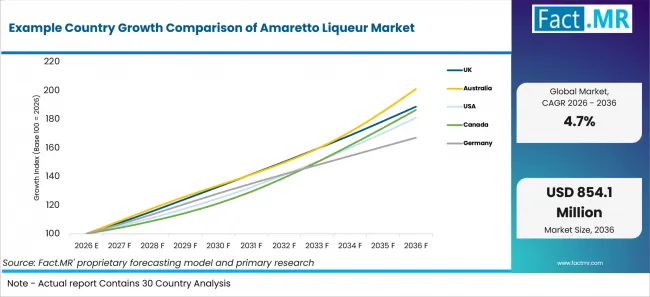
Example Country Growth Comparison Of Amaretto Liqueur Market | Source: Fact.MR
| Country | CAGR (2026-2036) |
|---|---|
| UK | 6.6% |
| Australia | 7.2% |
| USA | 6.1% |
| Canada | 6.4% |
| Germany | 5.3% |
Source: Fact.MR analysis. Updated Aug 4, 2026
What supports UK adoption?
6.6% CAGR, supported by home mixing and specialty retail discovery.
The UK’s growth reflects clear use of amaretto in simple home-mixed drinks. Specialty retailers support product discovery through giftable bottle formats and serving ideas. Smaller brands may still face slower entry because alcohol rules and label checks can add complexity before wider distribution.
How is Australia scaling demand?
7.2% CAGR, driven by premium drink occasions and dessert use.
Australia’s growth is supported by consumers who use flavored spirits across casual drinks and dessert recipes. Importers are expected to favor products with clear brand stories and distinct positioning. Freight costs and limited shelf space may restrict expansion for smaller labels.
What is driving USA growth from 2026 to 2036?
6.1% CAGR, backed by broad spirits retail and beverage use.
The USA’s growth reflects wide access through large spirits retail channels and established cocktail occasions. Clear labeling and simple serving guidance are expected to support product acceptance. Strong competition from established brands may increase the cost of gaining shelf visibility.
How is Canada developing demand?
6.4% CAGR, supported by provincial channel planning and stable sweet liqueur use.
Canada’s growth is shaped by provincial retail systems that control how brands reach shoppers. Companies need careful listing plans because each province follows a different route to market. Limited assortment windows may slow wider rollout across the country.
How does Germany perform?
5.3% CAGR, led by beverage use and mature spirits preferences.
Germany’s growth reflects steady demand from beverage service and selected food applications. Category switching is expected to remain limited because consumers already have established spirits preferences. Careful retail assortment planning may therefore keep expansion slower than in the faster-growing markets.
Who leads the Amaretto Liqueur Market?
ILLVA Saronno and Girolamo Luxardo show the direct relevance, while Lucas Bols strengthens the wider branded liqueur landscape.
ILLVA Saronno supports the market through Disaronno Originale, one of the most recognized amaretto brands. Girolamo Luxardo adds established Italian liqueur expertise. Lucas Bols contributes through its Bols and Galliano portfolios. Distillerie Camel expands the premium field through Bepi Tosolini and Salizà. Gabriello Santoni supports regional positioning through Amaretto di Toscana. De Kuyper Royal Distillers and Paolo Lazzaroni & Figli broaden the European supplier base, while Sazerac and Bellaventura extend the market through Mr. Boston and Amaretto ADRIATICO.
Which companies are the key providers?
Key companies include Distillerie Camel S.p.A. (Bepi Tosolini – Salizà); Girolamo Luxardo S.p.A.; Gabriello Santoni S.r.l. (Amaretto di Toscana); Lucas Bols B.V. (Bols and Galliano); ILLVA Saronno S.p.A. (Disaronno Originale); De Kuyper Royal Distillers B.V.; Paolo Lazzaroni & Figli S.p.A.; Sazerac Company, Inc. (Mr. Boston); Bellaventura S.A. (Amaretto ADRIATICO).
- Distillerie Camel S.p.A. (Bepi Tosolini – Salizà)
- Girolamo Luxardo S.p.A.
- Gabriello Santoni S.r.l. (Amaretto di Toscana)
- Lucas Bols B.V. (Bols and Galliano)
- ILLVA Saronno S.p.A. (Disaronno Originale)
- De Kuyper Royal Distillers B.V.
- Paolo Lazzaroni & Figli S.p.A.
- Sazerac Company, Inc. (Mr. Boston)
- Bellaventura S.A. (Amaretto ADRIATICO)
Bibliography
- World Health Organization. (2025, May 13). Total alcohol per capita (>= 15 years of age) consumption (litres of pure alcohol) [Indicator].
- Statistics Canada. (2025, March 7). Control and sale of alcoholic beverages and cannabis, April 1, 2023 to March 31, 2024.
- Alcohol and Tobacco Tax and Trade Bureau. (2025). Distilled spirits labeling. U.S. Department of the Treasury.
This Report Answers
- The report provides strategic intelligence on the Amaretto Liqueur Market across Type and Application choices that shape demand.
- Segment analysis covers 28% ABV and Beverage as the share leaders within the 2026 market.
- Country outlook evaluates the UK and Australia alongside the USA and Canada. Germany completes the growth comparison across the profiled markets.
- Competitive analysis profiles Distillerie Camel S.p.A. (Bepi Tosolini – Salizà) and Girolamo Luxardo S.p.A. alongside Gabriello Santoni S.r.l. (Amaretto di Toscana) and Lucas Bols B.V. (Bols and Galliano). ILLVA Saronno S.p.A. (Disaronno Originale) and De Kuyper Royal Distillers B.V. complete the wider provider view.
What does the Amaretto Liqueur Market cover?
Amaretto liqueur products are almond-flavored cordials used in beverages and food applications.
The market covers 28% ABV and 21% ABV formats. Other strength levels are included when they serve beverage or recipe needs. Coverage includes beverage use and ingredient use. Cooking applications are included when amaretto provides flavor value.
What is included in the scope?
The scope includes amaretto liqueur products sold through retail and foodservice routes.
Coverage includes Type and Application alongside Region. The scope spans 28% ABV and 21% ABV products. Other listed formats are included. Beverage leads the application view. Ingredient and cooking uses are included when demand depends on amaretto flavor.
What is excluded from the scope?
Products outside the defined amaretto liqueur category remain outside the scope of this market.
The scope excludes unrelated spirits that do not use amaretto positioning. General almond flavorings without liqueur identity are excluded. Non-beverage food products are excluded unless amaretto is used as a flavor input.
How Was the Analysis Built?
The analysis draws on 120+ sources, 35+ company portfolios, 25+ countries, and more than 20 industry interviews.
- Primary Research: Primary research includes discussions with manufacturers, service providers, technology developers, distributors, investors, procurement managers, and regulatory specialists. These discussions help validate demand patterns, pricing movement, competitive positioning, and adoption barriers.
- Desk Research: Desk research covers government statistics, regulatory publications, company filings, trade data, technical papers, patent records, industry associations, and public policy documents. Every secondary input is checked for date, source authority, and relevance before use.
- Market Sizing and Forecasting: Market estimates combine historical performance, demand indicators, pricing and volume trends, segment shares, company participation, country-level growth, adoption patterns, and barriers to market expansion. Forecasts are tested through top-down and bottom-up checks.
- Data Validation and Update Cycle: Findings are validated by comparing primary interviews with public data, company activity, regulatory changes, trade patterns, and industry developments. Regular updates review new launches, partnerships, approvals, capacity changes, and shifts in commercial adoption.
Segmentation
What is the report’s scope and coverage?
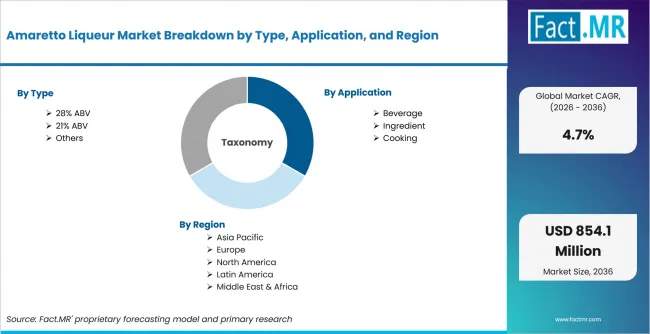
Amaretto Liqueur Market Breakdown By Type, Application, And Region | Source: Fact.MR
| Attribute | Details |
|---|---|
| Quantitative Units | USD million in 2026 to USD million by 2036 at CAGR |
| Market Definition | Almond-flavored cordial and liqueur products used in beverage service and food flavoring, where flavor consistency, alcohol strength, serving fit and distribution access influence product acceptance |
| Type | 28% ABV; 21% ABV; Others |
| Application | Beverage; Ingredient; Cooking |
| Serving Occasion | Cocktails; Direct serving; After-dinner drinks; Dessert recipes; Food flavoring |
| Distribution Channel | Spirits retail; Specialty retail; Online retail; Foodservice; Bars and restaurants |
| Packaging Consideration | Bottle size; Gift packaging; Label design; Serving guidance |
| Regions Covered | North America; Latin America; Europe; East Asia; South Asia and Pacific; Middle East and Africa |
| Countries Covered | UK; Australia; USA; Canada; Germany |
| Key Companies Profiled | Distillerie Camel S.p.A. (Bepi Tosolini – Salizà); Girolamo Luxardo S.p.A.; Gabriello Santoni S.r.l. (Amaretto di Toscana); Lucas Bols B.V. (Bols and Galliano); ILLVA Saronno S.p.A. (Disaronno Originale); De Kuyper Royal Distillers B.V.; Paolo Lazzaroni & Figli S.p.A.; Sazerac Company, Inc. (Mr. Boston); Bellaventura S.A. (Amaretto ADRIATICO) |
| Forecast Period | 2026 to 2036 |
| Approach | Hybrid top-down and bottom-up approach using beverage demand; ABV format fit; cocktail and direct-serving occasions; ingredient and cooking use; bottle and packaging requirements; alcohol labeling rules; retail and foodservice access; country growth patterns; pricing trends; company participation and portfolio review |
Source: Fact.MR analysis. Updated Aug 4, 2026
How is the market segmented?
-
By Type:
- 28% ABV
- 21% ABV
- Others
-
By Application:
- Beverage
- Ingredient
- Cooking
-
By Region:
- North America
- Latin America
- Europe
- East Asia
- South Asia and Oceania
- Middle East and Africa
Frequently Asked Questions
Which type leads the market?
Which application leads the market?
Which country records the highest listed CAGR?
What is the primary driver in this market?
What is the main restraint?
Why does Beverage lead demand?
Who worked on this report


Preview the report firsthand - request a free sample
Free SampleGet the brochure for pricing and purchase details
Download PDF