- Base Value(2025): 55.8 Bn
- Estimated Value(2026): 59.2 Bn
- Forecast Value (2036): 100.9 Bn
- CAGR (2026 - 2036): 5.5%
Alcoholic Drinks Packaging Market Forecast 2026 to 2036
In 2025, the Alcoholic Drinks Packaging market was valued at USD 55.8 billion. Based on Future Market Insights' analysis, demand for alcoholic drinks packaging is estimated to grow to USD 59.2 billion in 2026 and USD 100.9 billion by 2036. FMI projects a CAGR of 5.5% during the forecast period.
The absolute dollar growth from 2026 to 2036 is USD 41.7 billion. This growth is driven by increasing demand for alcoholic beverages globally, with packaging playing a crucial role in enhancing product visibility, safety, and sustainability. Innovations in packaging materials, such as eco-friendly options, are also fueling market expansion. However, challenges such as fluctuating raw material costs and stringent regulatory requirements could affect growth in certain regions.
As Jennifer English, Global Brand Director of Johnnie Walker at Diageo, noted regarding sustainable packaging innovation in alcoholic drinks packaging, ‘We are constantly pushing the boundaries of innovation to not only deliver premium quality and iconic design but also to reflect our sustainability ambitions.’
China leads with a CAGR of 7.6%, driven by the growing alcoholic drinks market and increasing demand for modern, sustainable packaging solutions. India follows with a 7.0% CAGR, supported by rising disposable incomes and shifting consumer preferences for packaged alcoholic drinks. Germany grows at 6.4%, reflecting strong demand for packaging in the European alcoholic beverages sector. France shows growth at 5.8%, benefiting from the demand for premium packaging in wine and spirits. The USA grows at 4.7%, driven by innovation in packaging and the expansion of craft and premium alcoholic drinks.
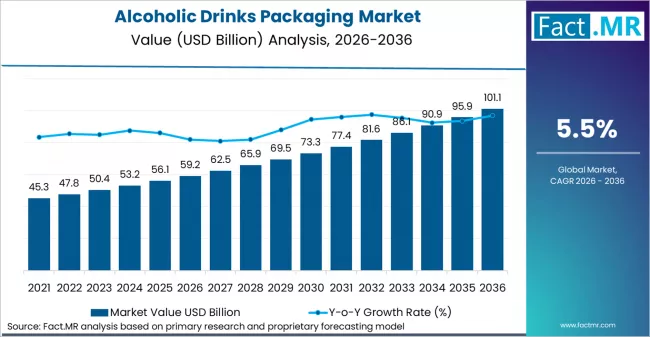
Alcoholic Drinks Packaging Market Market Value Analysis | Source: Fact.MR
Alcoholic Drinks Packaging Market
| Metric | Value |
|---|---|
| Estimated Value in (2026E) | USD 59.2 billion |
| Forecast Value in (2036F) | USD 100.9 billion |
| Forecast CAGR (2026 to 2036) | 5.5% |
Source: Fact.MR analysis. Updated Mar 4, 2026
Alcoholic Drinks Packaging Market Definition
The Alcoholic Drinks Packaging Market involves the production and sale of packaging materials and solutions (such as bottles, cans, cartons, closures, labels, and secondary packaging) specifically designed for alcoholic beverages to protect, preserve, and present products from production to consumer.
Market Inclusions
This report covers global and regional market sizes for alcoholic drinks packaging over a defined forecast period, including material types (glass, aluminum, PET, paperboard), packaging formats (bottles, cans, kegs), beverage categories (beer, wine, spirits), and distribution channels.
Market Exclusions
The scope excludes alcoholic beverages themselves, packaging for non‑alcoholic drinks, and general packaging machinery not specific to alcoholic beverage formats.
Research Methodology
- Primary Research: Interviews were conducted with packaging designers, material suppliers, and beverage producers.
- Desk Research: Data was sourced from industry reports, trade statistics, and packaging association publications.
- Market‑Sizing and Forecasting: A hybrid model combining top‑down beverage packaging demand forecasts with bottom‑up shipment and revenue data was used.
- Data Validation and Update Cycle: Findings were validated through expert review and aligned with recent production, adoption, and trade figures.
Summary of the Alcoholic Drinks Packaging Market
- Market Definition
- The Alcoholic Drinks Packaging Market involves the production and sale of packaging materials and solutions (such as bottles, cans, cartons, closures, labels, and secondary packaging) specifically designed for alcoholic beverages to protect, preserve, and present products from production to consumer. The market is essential for ensuring the safety, quality, and appeal of alcoholic drinks, including beer, wine, and spirits.
- Demand Drivers
- Sustainability Focus: Growing consumer and regulatory demand for eco-friendly and recyclable packaging is driving innovation in materials and packaging solutions, with glass, aluminum, and sustainable plastics leading the charge.
- Premiumization: The increasing consumer preference for premium alcoholic beverages is fueling demand for high-quality packaging materials that can enhance product presentation and align with consumer expectations.
- Rising Alcohol Consumption: With global demand for alcoholic beverages rising, the need for innovative and sustainable packaging solutions is increasing, particularly in emerging markets.
- Key Segments Analyzed
- Product: Bottles and growlers are expected to capture 41.8% of the market share by 2026. Glass bottles, in particular, are highly preferred for their ability to preserve the taste and quality of alcoholic beverages.
- Material: Glass is projected to dominate the material segment, holding 47.5% of the market share in 2026, due to its non-reactive properties and ability to preserve the flavor and aroma of alcoholic drinks.
- Geography: China leads with a CAGR of 7.6%, supported by rising disposable income, an expanding alcoholic drinks market, and increasing demand for premium packaging solutions.
- Analyst Opinion at Fact MR
- Shambhu Nath Jha, Principal Consultant at Fact MR, highlighted the importance of sustainability in the packaging industry, stating, "With growing environmental concerns and a shift toward premium alcoholic beverages, packaging innovations that emphasize sustainability will play a critical role in the growth of the market."
- Strategic Implications/Executive Takeaways
- Focus on Sustainability: Companies should prioritize the development of recyclable and eco-friendly packaging materials to meet growing consumer and regulatory demands.
- Invest in Premium Solutions: As consumers continue to seek premium alcoholic beverages, focusing on high-quality packaging can enhance product appeal and support market growth.
- Innovation in Materials: Exploring innovations in materials such as lightweight glass, biodegradable plastics, and smart packaging will be essential for staying competitive in the market.
- Methodology
- Primary Research: Interviews with packaging designers, material suppliers, and beverage producers.
- Desk Research: Data sourced from industry reports, trade statistics, and packaging association publications.
- Market Sizing & Forecasting: A hybrid model combining top-down beverage packaging demand forecasts with bottom-up shipment and revenue data was used to estimate market growth.
Segmental Analysis
Alcoholic Drinks Packaging Market Analysis by Product
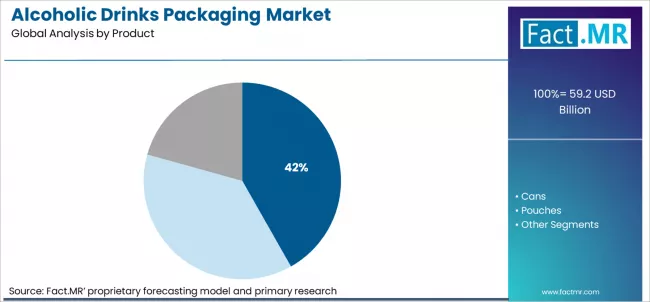
Alcoholic Drinks Packaging Market Analysis By Product | Source: Fact.MR
- Market Overview: Bottles and growlers are expected to capture 41.8% of the market share by 2026. Bottles, particularly glass bottles, are the most common packaging for alcoholic beverages, including beer, wine, and spirits, due to their ability to preserve the quality and taste of the product.
- Demand Drivers:
- Preservation of Quality and Taste: Glass bottles are highly effective in protecting the integrity of alcoholic beverages by offering an airtight seal and minimizing exposure to light and air. This helps preserve the flavor and quality of the drinks, particularly for high-end wines and spirits, making them the preferred choice.
- Premium Appeal: Bottles, especially glass, have a premium and sophisticated look that appeals to consumers, particularly in the wine and spirits sectors. The packaging not only protects the product but also enhances the perceived value, contributing to the continued demand for bottles and growlers.
- Consumer Preference for Reusable Packaging: Growlers, which are often used for craft beer, provide a sustainable and reusable option for consumers. This eco-friendly aspect is gaining traction in markets where sustainability is a growing concern.
Alcoholic Drinks Packaging Market Analysis by Material
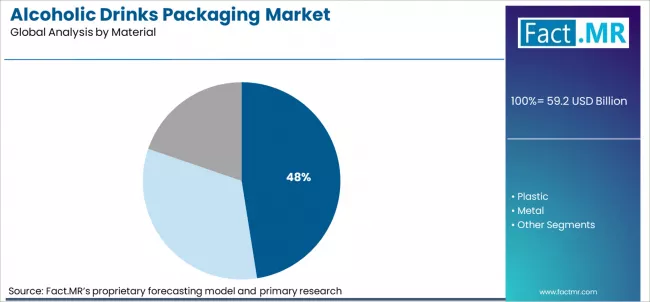
Alcoholic Drinks Packaging Market Analysis By Material | Source: Fact.MR
-
Market Overview: Glass is projected to hold 47.5% of the market share by 2026. Glass remains the most popular material for alcoholic drink packaging due to its premium appeal, non-reactive properties, and ability to preserve the product's quality over time.
- Demand Drivers:
- Preservation of Product Quality: Glass is non-porous and inert, meaning it does not interact with the beverage, preserving its original taste and aroma. This is particularly important for alcoholic beverages like wine, whiskey, and beer, where packaging plays a critical role in maintaining the product’s integrity.
- Sustainability and Recycling: Glass is 100% recyclable and can be reused multiple times without losing quality, making it an environmentally friendly option. The increasing focus on sustainability in consumer products is driving the demand for glass packaging in the alcoholic drinks sector.
- Consumer Perception and Brand Image: Glass packaging is often associated with premium products and is favored by consumers for its aesthetic appeal and traditional association with high-quality alcoholic beverages. This drives its adoption in sectors where branding and presentation are essential.
Alcoholic Drinks Packaging Market Drivers, Restraints, and Opportunities
FMR analysts observe that the alcoholic drinks packaging market is a mature, consumer‑driven segment where packaging serves both functional and branding purposes. The 2026 market valuation reflects steady demand, driven by established consumption patterns and product innovation in materials and designs.
While traditional glass bottles and cans dominate due to cost, there is growing demand for premium, sustainable packaging solutions such as lightweight glass, eco‑friendly materials, and specialty closures. These options often carry higher costs, contributing to market value growth despite moderate volume growth.
- Premiumization Demand: Brands increasingly adopt premium packaging to stand out in competitive markets, raising price points and customer perception.
- Sustainability & Regulation: Rising environmental concerns and packaging regulations push adoption of eco‑friendly solutions and recyclable materials.
- Regional Dynamics: In North America and Europe, strong demand for premium and eco‑friendly packaging boosts market growth, while Asia‑Pacific shows rising demand with increasing disposable incomes.
Regional Analysis
The market analysis covers key global regions, including East Asia, South Asia, Western Europe, and North America. It is segmented geographically, with specific market dynamics for each region. The full report provides a detailed market attractiveness analysis.
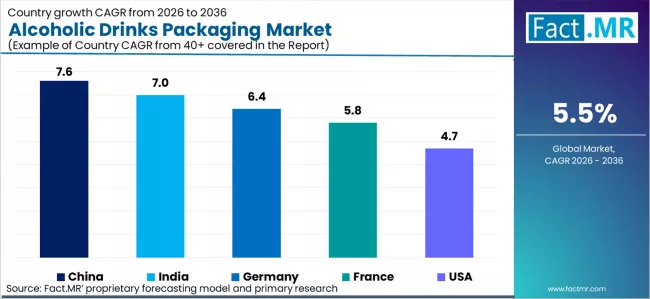
Alcoholic Drinks Packaging Market Cagr Analysis By Country | Source: Fact.MR
| Country | CAGR (2026-2036) |
|---|---|
| China | 7.6% |
| India | 7.0% |
| Germany | 6.4% |
| France | 5.8% |
| USA | 4.7% |
Source: Fact.MR analysis. Updated Mar 4, 2026
Source: Fact MR (FMR) analysis, based on proprietary forecasting model and primary research.
East Asia:
In East Asia, China leads the demand for alcoholic drinks packaging, supported by the country's large alcoholic beverage market, growing consumer demand for packaged alcoholic drinks, and strong manufacturing capabilities.
- China: Demand for alcoholic drinks packaging in China is projected to rise at 7.6% CAGR through 2036. China’s growing alcoholic beverage market, increased demand for packaging in the wine, beer, and spirits sectors, and expanding e-commerce platforms continue to fuel market growth.
South Asia:
In South Asia, India is a key market for alcoholic drinks packaging, driven by the increasing demand for packaged alcoholic drinks, growing disposable income, and expanding middle class.
- India: Demand for alcoholic drinks packaging in India is projected to rise at 7.0% CAGR through 2036. India’s expanding alcoholic beverage consumption, growing demand for branded packaging, and rising consumer preference for convenience continue to support steady market growth.
Western Europe:
In Western Europe, Germany and France are important markets for alcoholic drinks packaging, supported by strong consumer demand for premium alcoholic beverages, growing trends in sustainability, and innovative packaging solutions.
- Germany: Demand for alcoholic drinks packaging in Germany is projected to rise at 6.4% CAGR through 2036. Germany’s established alcoholic beverage market, demand for eco-friendly packaging solutions, and growing focus on sustainable packaging continue to drive market growth.
- France: Demand for alcoholic drinks packaging in France is projected to rise at 5.8% CAGR through 2036. France’s demand for premium wines and spirits and increasing focus on packaging innovation and sustainability contribute to the market's growth.
North America:
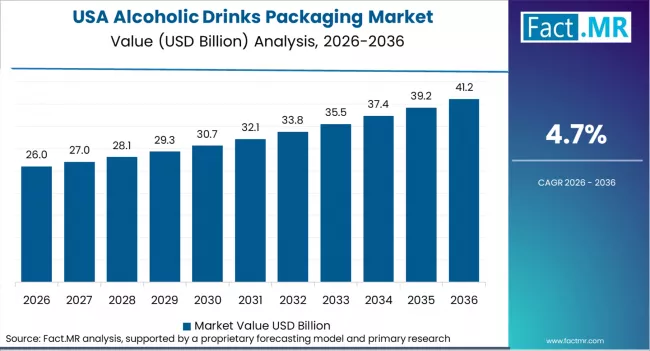
Alcoholic Drinks Packaging Market Country Value Analysis | Source: Fact.MR
In North America, the USA remains a significant market for alcoholic drinks packaging, driven by increasing demand for packaged alcoholic drinks, premium packaging, and innovations in packaging design.
- USA: Demand for alcoholic drinks packaging in the U.S. is projected to rise at 4.7% CAGR through 2036. The USA’s strong demand for packaged alcoholic beverages, growing focus on premium packaging for wines and spirits, and increasing demand for sustainable packaging continue to support steady market growth.
Fact MR's analysis of the Alcoholic Drinks Packaging Market in East Asia, South Asia, Western Europe, North America consists of country-wise assessments that include China, India, Germany, France, and the USA. Readers can find detailed trends, regulatory updates, and company-specific investments shaping the market’s growth in these countries.
Competitive Landscape
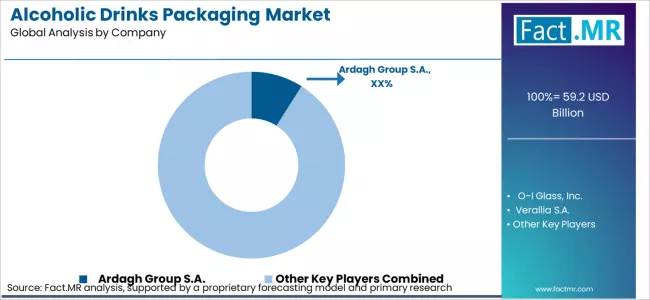
Alcoholic Drinks Packaging Market Analysis By Company | Source: Fact.MR
The Alcoholic Drinks Packaging Market is characterized by key players like Ardagh Group S.A., O-I Glass, Inc., and Verallia S.A., who are major suppliers of glass packaging for alcoholic beverages. Ball Corporation and Crown Holdings, Inc. dominate the market with their aluminum cans and closures, catering to a wide range of alcoholic products. Amcor plc and Berry Global Group, Inc. provide sustainable packaging solutions with innovations in flexible materials. Tetra Pak International S.A. and SIG Combibloc Group AG focus on aseptic and carton packaging for non-carbonated alcoholic beverages. Companies like Smurfit Kappa Group plc, Mondi plc, and WestRock Company lead the corrugated packaging sector, ensuring safe transport and distribution. The market also includes specialized packaging providers such as TricorBraun, Inc. and Saxco International, LLC, which offer tailored solutions for premium alcoholic drinks. The demand for eco-friendly and cost-effective packaging is driving continuous innovation across these segments.
Recent Industry Developments
- Lightweighting and Decarbonized Glass Production: Glass remains the dominant material, holding a 42.5% market share in 2026. To meet sustainability mandates, manufacturers are transitioning to electric and hydrogen-powered furnaces and aggressively "lightweighting" bottles to reduce transport emissions.
- India’s Mandatory Labeling Extension (July 2026): The Food Safety and Standards Authority of India (FSSAI) has extended the deadline for new alcoholic beverage labeling to July 1, 2026. This regulation introduces standardized drink definitions and mandates clear disclosures of alcohol content to improve consumer transparency.
- The Rise of "Paper Bottles" and Bio-Based Formats: Major players like Diageo are scaling up trials for paper-based bottles, such as the Baileys paper bottle, to reduce reliance on traditional glass and plastic. These formats are specifically targeting the "eco-conscious" consumer and are expected to move from limited trials to wider commercial availability throughout 2026.
Key Players of the Alcoholic Drinks Packaging Market
- Ardagh Group S.A.
- O-I Glass, Inc.
- Verallia S.A.
- Ball Corporation
- Crown Holdings, Inc.
- Amcor plc
- Berry Global Group, Inc.
- Tetra Pak International S.A.
- SIG Combibloc Group AG
- Smurfit Kappa Group plc
- DS Smith plc
- Mondi plc
- WestRock Company
- TricorBraun, Inc.
- Saxco International, LLC
- Graham Packaging Company, L.P.
- Encore Glass, Inc.
- Glassworks International, Inc.
- Vetreria Etrusca S.r.l.
- AGI Greenpac Ltd.
- Big Sky Packaging, Inc.
- Golden West Packaging Group, LLC
- Orora Limited
- PT Packaging, Inc.
- Sealed Air Corporation
Report Scope
| Metric | Value |
|---|---|
| Quantitative Units | USD 59.2 billion (2026) to USD 100.9 billion (2036), at a CAGR of 5.5% |
| Market Definition | The Alcoholic Drinks Packaging Market involves packaging solutions for alcoholic beverages such as beer, wine, and spirits, utilizing materials like glass, plastic, metal, and wood. |
| By Product | Bottles and Growlers, Cans, Pouches, Barrels, Others (Cartons, Bag-in-Box) |
| By Material | Glass, Plastic, Metal, Wood |
| By End-Use | Beer, Wine, Spirit, Other |
| Regions Covered | North America, Latin America, Europe, East Asia, South Asia, Oceania, Middle East and Africa |
| Countries Covered | United States, Canada, Mexico, Brazil, Argentina, Germany, France, United Kingdom, Italy, Spain, China, India, Japan, South Korea, Indonesia, Australia, and 40+ countries |
| Key Companies Profiled | Ardagh Group S.A., O-I Glass, Inc., Verallia S.A., Ball Corporation, Crown Holdings, Inc., Amcor plc, Berry Global Group, Inc., Tetra Pak International S.A., SIG Combibloc Group AG, Smurfit Kappa Group plc, DS Smith plc, Mondi plc, WestRock Company, TricorBraun, Inc., Saxco International, LLC, Graham Packaging Company, L.P., Encore Glass, Inc., Glassworks International, Inc., Vetreria Etrusca S.r.l., AGI Greenpac Ltd., Big Sky Packaging, Inc., Golden West Packaging Group, LLC, Orora Limited, PT Packaging, Inc., Sealed Air Corporation |
| Forecast Period | 2026 to 2036 |
| Approach | Hybrid top-down and bottom-up market modeling validated through primary interviews with manufacturers and supported by trade data benchmarking and market research. |
Source: Fact.MR analysis. Updated Mar 4, 2026
Bibliographies
- Amcor plc. (2023). Sustainable packaging innovations for alcoholic beverage applications. Amcor plc.
- Ardagh Group S.A. (2023). Sustainable glass and metal packaging solutions for alcoholic drinks. Ardagh Group S.A.
- Ball Corporation. (2023). Aluminum beverage packaging solutions for premium and sustainable alcoholic brands. Ball Corporation.
- Crown Holdings, Inc. (2023). Global metal packaging systems for alcoholic beverage markets. Crown Holdings, Inc.
- O-I Glass, Inc. (2023). Innovations in glass packaging for premium alcoholic beverages. O-I Glass, Inc.
- Diageo plc. (2026). Grain-to-glass sustainability initiatives and development of paper-based bottle formats. Diageo plc.
- Morningstar. (2026, February). Global alcoholic drinks packaging market forecast to 2036 [Industry analysis]. Morningstar.
- myFSSAI (Food Safety and Standards Authority of India). (2026, February). Extension of labelling compliance deadline for alcoholic beverages to July 2026. FSSAI.
This report addresses:
- Market intelligence enabling comprehensive assessment of leading countries and product segments across the Alcoholic Drinks Packaging Market globally.
- Market volume (sales units) estimates and 10-year revenue forecasts from 2026 to 2036, validated through manufacturer shipment data, channel partner surveys, and country-level demand modeling.
- Growth opportunity mapping across product types (Bottles and Growlers, Cans, Pouches, Barrels, Others (Cartons, Bag-in-Box)), materials (Glass, Plastic, Metal, Wood), and end-use sectors (Beer, Wine, Spirits, Others).
- Segment and regional revenue forecasts by product type, material, end-use industry, and geography across 40+ countries.
- Competition strategy analysis covering dealer network structure, recent developments, product portfolio, USPs, and market share analysis.
- Product and regulatory compliance tracking aligned with sustainability standards, health and safety regulations, and packaging certifications.
- Regulatory impact analysis addressing environmental regulations, recyclability standards, and material compliance across key markets.
- Report delivery in PDF, Excel, PowerPoint, and interactive dashboard formats for executive, procurement, and operational planning use.
Segmentation
Alcoholic Drinks Packaging Market Analysis by Segments
-
Product :
- Bottles and Growlers
- Glass Bottles
- Plastic Bottles
- Growlers (Refillable)
- Cans
- Aluminum Cans
- Steel Cans
- Pouches
- Stand-up Pouches
- Flexible Pouches
- Barrels
- Wood Barrels
- Metal Barrels
- Others (Cartons, Bag-in-Box)
- Bottles and Growlers
-
Material :
- Glass
- Flint/Colorless
- Amber/Brown
- Green
- Specialty Colors
- Plastic
- PET
- HDPE
- Other Polymers
- Metal
- Aluminum
- Tinplate/Steel
- Wood
- Glass
-
End Use :
- Beer
- Lager
- Ale/Craft Beer
- Non-Alcoholic Beer
- Wine
- Still Wine
- Sparkling Wine/Champagne
- Fortified Wine
- Spirit
- Whisky/Whiskey
- Vodka
- Rum
- Gin
- Tequila/Mezcal
- Baijiu
- Soju
- Other Spirits
- Other
- Cider
- Ready-to-Drink Cocktails
- Hard Seltzer
- Beer
-
Region :
- North America
- United States
- Canada
- Mexico
- Latin America
- Brazil
- Argentina
- Chile
- Colombia
- Rest of Latin America
- Europe
- Germany
- France
- United Kingdom
- Italy
- Spain
- Russia
- Nordic
- Benelux
- Rest of Europe
- East Asia
- China
- Japan
- South Korea
- South Asia & Pacific
- India
- Thailand
- Vietnam
- Indonesia
- Malaysia
- Philippines
- Australia & New Zealand
- Rest of South Asia & Pacific
- Middle East & Africa
- Saudi Arabia
- UAE
- Turkey
- South Africa
- Rest of Middle East & Africa
- North America
Frequently Asked Questions
How large is the demand for Alcoholic Drinks Packaging in the global market in 2026?
What will be the market size of Alcoholic Drinks Packaging in the global market by 2036?
What is the expected demand growth for Alcoholic Drinks Packaging in the global market between 2026 and 2036?
Which material is expected to dominate the market?
Which region is expected to show the highest growth rate for Alcoholic Drinks Packaging?
How significant is the growth outlook for India in this market?
What is the growth outlook for Germany in the Alcoholic Drinks Packaging market?
What is the growth forecast for France in the Alcoholic Drinks Packaging market?
What is the growth forecast for the United States in the Alcoholic Drinks Packaging market?
Which company is identified as a leading player in the Alcoholic Drinks Packaging market?
What is the role of Glass in Alcoholic Drinks Packaging?
What does the Alcoholic Drinks Packaging market include in this report?
How is the market forecast developed in this report?
What is meant by the Alcoholic Drinks Packaging market in this report?
Who worked on this report


Preview the report firsthand - request a free sample
Free SampleGet the brochure for pricing and purchase details
Download PDF