- Market Value (2025): USD 148.6 Mn
- Estimated Value (2026): USD 157.2 Mn
- Forecast Value (2036): USD 276.9 Mn
- CAGR (2026-2036): 5.8%
What is the Animal Necropsy Tables Market forecast to be worth by 2036?
USD 157.3 million in 2026 to USD 276.9 million by 2036 at a 5.8% CAGR.
- In 2025, buyers spent USD 148.6 million on animal necropsy tables, with veterinary practices and diagnostic laboratories placing the bulk of orders.
- Revenue will expand from USD 157.2 million in 2026 to USD 276.9 million by 2036, as clinics, universities and surveillance laboratories replace aging benches with purpose-built tables.
- A 5.8% CAGR reflects steady facility investment in animal disease investigation, paired with long equipment lives that slow replacement in mature markets.
| Year | Basis | Market Value (USD million) |
|---|---|---|
| 2025 | Actual | 148.6 |
| 2026 | Estimate | 157.2 |
| 2036 | Forecast | 276.9 |
| CAGR 2026 to 2036 | Forecast period | 5.8% |
Source: Fact.MR analysis. Updated Nov 12, 2026
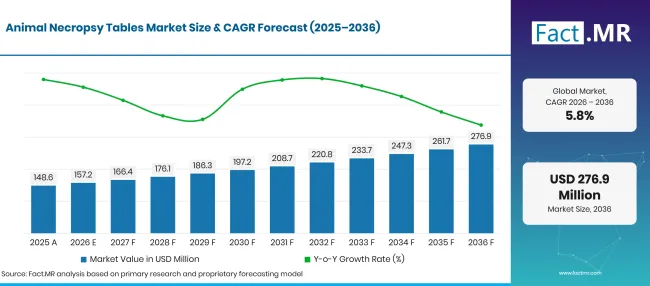
Animal Necropsy Tables Market Forecast Global | Source: Fact.MR
What are the defining numbers behind Animal Necropsy Tables Market growth?
The 2026 to 2036 period will add USD 119.7 million in new value, led by adjustable stainless steel tables bought for clinics and diagnostic laboratories.
- Demand Drivers in the Market
- Government surveillance networks depend on post-mortem work. In Great Britain, the Animal and Plant Health Agency runs six Veterinary Investigation Centres and works with eight surveillance pathology partners that offer subsidised post-mortem examinations. Each of these sites needs tables rated for large carcasses, with drainage and easy cleaning between cases.
- Research use is shrinking in volume but tightening in standards. Germany recorded 1.95 million animals used or killed for scientific purposes in 2024, down 8.2% from the previous year. Fewer animals per study push facilities toward better tissue recovery per case, which favors ventilated tables with integrated sinks and specimen trays.
- Veterinary education is expanding in several countries. Brazil had about 580 authorized in-person veterinary medicine courses and 87.4 thousand annual places as of January 2025. Each new course needs a pathology teaching room with tables that can stand up to daily student use.
- Scientific procedure counts remain large even as they decline. Great Britain carried out 2.54 million procedures on living animals in 2025, against 2.64 million in 2024. Animal facilities that support this work keep buying necropsy stations sized for rodents and small mammals, often with downdraft extraction to limit formalin exposure.
- Key Segments Analyzed
- By Product Type: Adjustable Necropsy Tables will hold 41.2% share in 2026 because a single height-adjustable unit can serve dogs, sheep and calves without forcing staff into awkward postures.
- By Material: Stainless Steel will command 62.4% of 2026 revenue, given its resistance to corrosion from blood, formalin and repeated disinfectant cycles.
- By End-User: Veterinary Clinics will account for 38.4% of 2026 value, since practices investigating unexplained deaths and herd losses need an in-house post-mortem station.
- Analyst Opinion at Fact.MR
- Shambhu Nath Jha, Principal Consultant at Fact.MR, states, “Necropsy rooms are being rebuilt around worker safety, with height control and downdraft ventilation now written into most tenders for clinics and laboratories. Suppliers will win repeat business when they pair heavy-gauge stainless steel with fast service and spare parts, because a table out of action stops disease investigations. Surveillance budgets and new veterinary schools will set the pace of orders through 2036, so vendors that track public funding cycles will see demand earlier than those that wait for tenders.”
- Strategic Implications
- Manufacturers should build modular frames that take hydraulic lifts, sinks and downdraft modules as options, so one platform covers clinic, laboratory and teaching orders.
- Distributors should keep demonstration units and installation crews close to veterinary schools and government laboratories, where buying decisions follow site visits.
- Clinic and laboratory buyers should check load rating, drain position, floor footprint and ventilation needs before ordering, since plumbing changes can cost more than the table.
- Investors should watch public surveillance budgets and veterinary course approvals, which signal order flow two to three years ahead.
Germany leads the five profiled countries at 6.7%, as federal disease reference work and laboratory refits favor ventilated tables. Brazil follows at 6.1%, where a wide clinic base and a growing number of veterinary courses widen the buyer pool. The United States, at 5.5%, grows from a large installed base, so replacement and upgrades carry more weight than new rooms. The United Kingdom reaches 4.9%, held back by mature practice networks yet lifted by surveillance pathology sites. Japan closes the group at 4.4%, since compact facilities and slow facility turnover cap volume even as standards rise.
How does the Animal Necropsy Tables Market break down by segment?
Adjustable Necropsy Tables will lead Product Type at 41.2%; Stainless Steel will head Material at 62.4%; Veterinary Clinics will hold End-User at 38.4% in 2026.
Which Product Type leads?
Adjustable Necropsy Tables take 41.2% of 2026 sales.
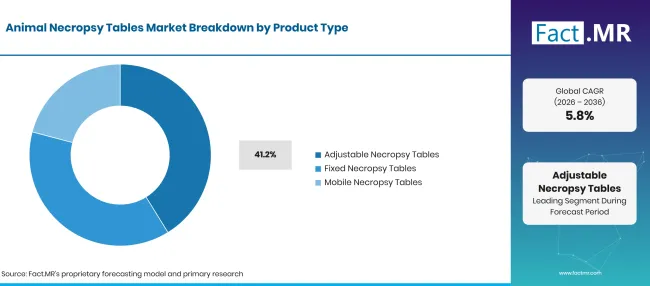
Animal Necropsy Tables Market Breakdown Product Type | Source: Fact.MR
| Product Type | Share (2026) |
|---|---|
| Adjustable Necropsy Tables (Leading segment) | 41.2% |
| Other segments combined | 58.8%* |
| Total | 100.0% |
Source: Fact.MR analysis. Updated Nov 12, 2026
Pathologists and technicians handle animals that range from a cat to a foal in the same week, and a fixed working height suits only part of that caseload. Hydraulic and electric lifts let staff raise or lower the surface to elbow height, which cuts back strain and improves access to body cavities. Tilt functions also move fluids toward the drain. These tables share buyers with the wider human autopsy tables segment, where height control has become a standard tender item. Fixed tables keep a place in high-throughput rooms with standard caseloads, where a pedestal design with built-in plumbing offers lower cost per unit. Mobile tables on locking casters serve shared laboratories and farm-animal units that need to move a carcass from a cold room to the examination area. C-shaped and rectangular large-animal designs fill the specialist end of the range.
What supports Stainless Steel within Material?
Stainless Steel represents 62.4% of 2026 revenue.
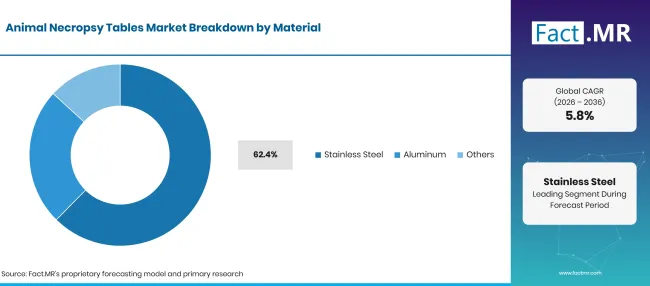
Animal Necropsy Tables Market Breakdown Material | Source: Fact.MR
| Material | Share (2026) |
|---|---|
| Stainless Steel (Leading segment) | 62.4% |
| Other segments combined | 37.6%* |
| Total | 100.0% |
Source: Fact.MR analysis. Updated Nov 12, 2026
Wet necropsy work exposes surfaces to blood, body fluids, formalin and chlorine-based disinfectants many times a day. Type 304 and 316 stainless steel resists pitting under these conditions and shows no porous seams where pathogens could survive cleaning. Welded, coved corners and seamless tops let staff hose down the table after each case, which suits rooms handling notifiable disease suspects. The same grade appears across autopsy saw stands and instrument trays in the room. Aluminum tables weigh less and suit mobile units, field necropsy and rooms with weak floors, though they need coatings to cope with harsh chemicals. Other materials, including polymer worktops and composite trays, appear on small-animal stations and teaching benches where low weight and price guide the purchase.
How does End-User shape demand?
Veterinary Clinics account for 38.4% of 2026 value.
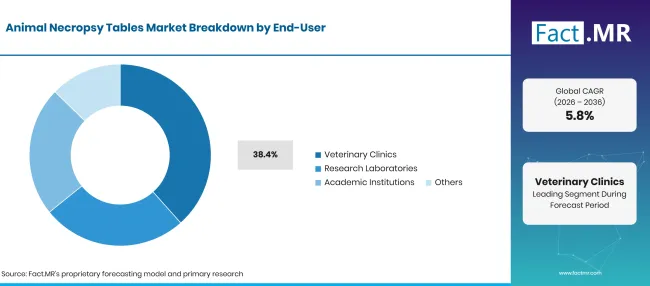
Animal Necropsy Tables Market Breakdown End User | Source: Fact.MR
| End-User | Share (2026) |
|---|---|
| Veterinary Clinics (Leading segment) | 38.4% |
| Other segments combined | 61.6%* |
| Total | 100.0% |
Source: Fact.MR analysis. Updated Nov 12, 2026
Practices that treat farm animals and pets often perform their own post-mortems to explain sudden deaths, guide herd treatment or answer owner questions. A dedicated table keeps this work away from surgical areas and helps the clinic meet hygiene rules. Larger referral hospitals add ventilated stations as caseloads grow, often alongside equipment bought for veterinary hospital expansions. Research laboratories buy small-animal stations with downdraft extraction for rodent and fish studies. Academic institutions furnish teaching rooms where groups of students watch or take part in dissections. In the United States, the National Animal Health Laboratory Network links state and university diagnostic laboratories that receive carcasses for disease testing. Other end-users include zoos, wildlife agencies and abattoir inspection units.
What is accelerating Animal Necropsy Tables Market adoption, and what is holding it back?
Public surveillance networks, new veterinary schools and tighter worker safety rules keep orders coming for adjustable, ventilated stainless steel tables. Against this, a complete installation can need new drains, extraction ducts and reinforced floors, which raises project cost well above the table price. Long service lives of 15 years or more also slow replacement, and smaller clinics often lack room for a dedicated post-mortem area.
Drivers Impact Analysis
| DRIVER | (~) % IMPACT ON CAGR | GEOGRAPHIC RELEVANCE | IMPACT TIMELINE |
|---|---|---|---|
| Expansion of veterinary diagnostic and surveillance facilities | +0.9% | Global | Medium term (2-4 years) |
| Investment in animal disease surveillance networks | +0.8% | Europe, Americas | Medium term (2-4 years) |
| Demand for adjustable and ergonomic workstations | +0.7% | Global | Short term (<=2 years) |
| Research and academic laboratory upgrades | +0.6% | Europe, Asia | Long term (>=4 years) |
| Preference for stainless steel equipment | +0.4% | Global | Short term (<=2 years) |
Source: Fact.MR analysis. Updated Nov 12, 2026
Opportunity Impact Analysis
| OPPORTUNITY | (~) % IMPACT ON CAGR | GEOGRAPHIC RELEVANCE | IMPACT TIMELINE |
|---|---|---|---|
| Integrated ventilation and extraction systems | +0.8% | Europe, North America | Medium term (2-4 years) |
| Custom tables for large-animal necropsy | +0.7% | Americas, Europe | Long term (>=4 years) |
| Mobile and height-adjustable configurations | +0.6% | Global | Medium term (2-4 years) |
| Modular drainage and waste-handling systems | +0.5% | Global | Short term (<=2 years) |
| Laboratory modernization in emerging markets | +0.4% | Asia, Latin America | Long term (>=4 years) |
Source: Fact.MR analysis. Updated Nov 12, 2026
Restraints Impact Analysis
| RESTRAINT | (~) % IMPACT ON CAGR | GEOGRAPHIC RELEVANCE | IMPACT TIMELINE |
|---|---|---|---|
| High upfront equipment and installation costs | -0.8% | Global | Short term (<=2 years) |
| Limited space in smaller veterinary facilities | -0.6% | Global | Medium term (2-4 years) |
| Ventilation and plumbing infrastructure requirements | -0.5% | Emerging markets | Medium term (2-4 years) |
| Long replacement cycles for durable equipment | -0.4% | North America, Europe | Long term (>=4 years) |
| Budget limits in academic and public laboratories | -0.4% | Global | Short term (<=2 years) |
Source: Fact.MR analysis. Updated Nov 12, 2026
Which countries are scaling the Animal Necropsy Tables Market through 2036?
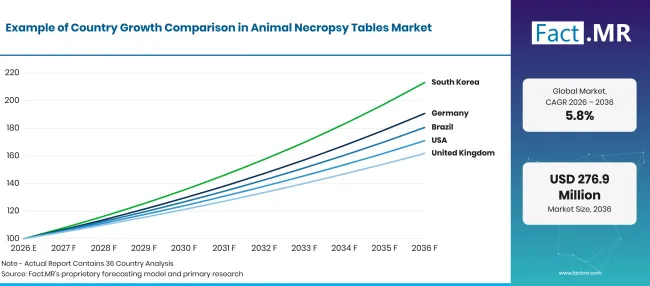
Animal Necropsy Tables Market Growth Index | Source: Fact.MR
| Country | CAGR (2026 to 2036) |
|---|---|
| Germany | 6.7% |
| Brazil | 6.1% |
| United States | 5.5% |
| United Kingdom | 4.9% |
| Japan | 4.4% |
Source: Fact.MR analysis. Updated Nov 12, 2026
What is driving Germany’s market growth?
6.7% CAGR, backed by federal disease reference work and research facility refits.
The Friedrich-Loeffler-Institut holds national reference laboratory duties for more than 75 notifiable animal diseases, which keeps a steady flow of post-mortem and sampling work in federal and state laboratories. Research use is falling: Germany used or killed 1.95 million animals for science in 2024. Laboratories are using that shift to refit dissection rooms with ventilated tables that protect staff and raise sample quality, so value per order rises even as animal numbers drop.
How is Brazil developing animal necropsy table adoption?
6.1% CAGR, helped by a wide clinic network and growing veterinary schools.
The Federal Council of Veterinary Medicine inspected 1,127 veterinary clinics and hospitals in its 2026 national operation and found irregularities in 21.9% of them, including 258 structural nonconformities. Enforcement of this kind pushes clinics to upgrade rooms and equipment. Brazil also counts 0.77 veterinary professionals per 1,000 inhabitants, the densest ratio among the countries the council compared. Durable mid-priced tables with simple drainage will find the widest buyer base here.
What is supporting United States adoption?
5.5% CAGR, reflecting a large practice workforce and an established diagnostic laboratory network.
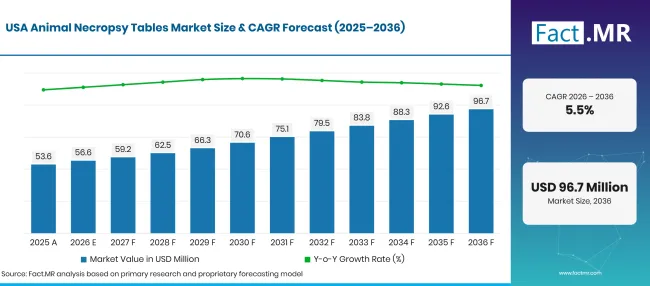
Animal Necropsy Tables Market Forecast Usa | Source: Fact.MR
Veterinarians held about 91,100 jobs in 2025, and 83% of them worked in veterinary services, according to the Bureau of Labor Statistics. The same source sees employment rising 9% from 2025 to 2035, which points to more clinics and referral hospitals. State diagnostic laboratories and university teaching hospitals add steady demand for large-animal tables with hydraulic lifts, while upgrades to existing rooms account for much of the spend.
How is the United Kingdom building adoption?
4.9% CAGR, as surveillance pathology sites and research facilities update their rooms.
The Competition and Markets Authority counted 4,417 small-animal first-opinion practices in the UK as of May 2025, owned by 1,198 businesses. Only part of this network carries out post-mortems, so the core buyers are referral centers, university pathology departments and the APHA surveillance network. Research facilities also need small-animal stations with downdraft extraction to meet exposure limits. Replacement of older fixed tables will carry most UK orders.
What supports Japan’s adoption?
4.4% CAGR, owing to a broad registered clinic base and university pathology demand.
Japan had 17,200 registered veterinary treatment facilities at the end of 2025, of which 4,154 served industrial animals and 13,046 served small animals and others, according to the Ministry of Agriculture, Forestry and Fisheries. Livestock facilities and prefectural animal hygiene service centers handle most farm-animal post-mortems. Space is tight in many urban buildings, so compact, mobile tables with built-in extraction will suit Japanese buyers best.
Who leads the Animal Necropsy Tables Market?
Competition splits into three groups. Broad pathology suppliers such as Mopec and LEEC sell necropsy tables as part of full room fit-outs, which lets them win large tenders that bundle tables with ventilation, cold storage and instruments.
Mopec added a laboratory consumables distribution center in Troy, Michigan, in February 2026 as part of a plan to bring more work into its Michigan base, and it launched Cortex Systems in May 2026 to connect pathology workflows. Its anatomy lab project with LSU Health Shreveport, reported in April 2026, shows how teaching sites buy complete stations. A second group, including AFOS and KUGEL medical, focuses on ventilated dissection and large-animal tables built to order for European schools and institutes. Shank’s Veterinary Equipment serves large-animal veterinary users with C-shaped and rectangular tables. Thermo Fisher Scientific reaches laboratories through its Fisher Scientific catalog. Service reach, spare parts and custom sizing will decide future wins.
Which companies are the key providers?
Key companies in the Animal Necropsy Tables Market include Mopec, Thermo Fisher Scientific, LEEC Limited, AFOS Group, KUGEL medical and Shank’s Veterinary Equipment.
- Mopec
- Thermo Fisher Scientific
- LEEC Limited
- AFOS Group
- KUGEL medical
- Shank’s Veterinary Equipment
Bibliography
- Animal and Plant Health Agency. (2026, October 16). APHA Veterinary Investigation Centres and surveillance pathology partners.
- Animal and Plant Health Inspection Service. (2026, March 12). National Animal Health Laboratory Network.
- Competition and Markets Authority. (2025, October 15). Veterinary services for household pets: Provisional decision report, Part A.
- Conselho Federal de Medicina Veterinária. (2025, September 24). CNP Rio de Janeiro: CFMV apresenta diagnóstico inédito do ensino de Medicina Veterinária no Brasil.
- Conselho Federal de Medicina Veterinária. (2026, June 26). Fiscalização nacional identifica ausência de médico-veterinário em plantões e aponta irregularidades em 21,9% dos estabelecimentos vistoriados.
- Friedrich-Loeffler-Institut. (2026, March 4). National Reference Laboratories.
- German Federal Institute for Risk Assessment. (2025, December 9). Less than two million laboratory animals for the first time.
- Home Office. (2026, July 9). Annual statistics of scientific procedures on living animals, Great Britain 2025.
- Ministry of Agriculture, Forestry and Fisheries. (2026, March 6). 飼育動物診療施設の開設届出状況(診療施設数): Number of registered veterinary treatment facilities, 2025.
- Mopec Group. (2026, February 27). Mopec Group Opens New Distribution Center as Part of Strategic Expansion of Michigan Manufacturing Operations.
- Mopec Group. (2026, April 2). Mopec Group Partners with LSU Health Shreveport to Deliver a Next-Generation Anatomy Education Lab.
- Mopec Group. (2026, May 11). Mopec Group Introduces Cortex Systems to Advance Connected Pathology Workflows.
- U.S. Bureau of Labor Statistics. (2026, October 29). Veterinarians: Occupational Outlook Handbook
This Report Answers
- How much will veterinary clinics, research laboratories and teaching schools spend on necropsy tables from 2026 to 2036?
- Why do adjustable tables lead product demand, and where do fixed and mobile designs still win orders?
- What keeps stainless steel ahead of aluminum and other materials in wet post-mortem rooms?
- Which of Germany, Brazil, the United States, the United Kingdom and Japan will add demand quickest, and for what reasons?
- How do broad pathology suppliers compare with specialist veterinary table makers?
- Which installation, space and budget limits slow purchases in smaller facilities?
What does the Animal Necropsy Tables Market cover?
This study measures revenue from tables and workstations designed for animal post-mortem examination. It spans small-animal, companion-animal and large-animal designs used in clinics, diagnostic laboratories, research facilities and teaching rooms.
Values are stated in USD million at the manufacturer selling price, including built-in features such as lifts, sinks, drainage and downdraft extraction when sold as part of the table.
What is included in the scope?
Height-adjustable tables with hydraulic or electric lifts, fixed pedestal tables and mobile tables on casters built for necropsy.
Ventilated and downdraft necropsy stations, including units with integrated sinks, spray hoses and specimen trays.
Large-animal tables, C-shaped and rectangular designs, and tables sold with hoists for cattle and horse post-mortems.
Tables sold to clinics, research laboratories, universities and public surveillance sites, used alongside pathology instruments in the same room.
What is excluded from the scope?
General operating and examination tables that are not designed or sold for necropsy, including tables covered under veterinary surgical instruments and surgery suites.
Human mortuary furniture, cold storage cabinets, body lifts and laboratory benches sold separately.
Diagnostic tests and analyzers, including those counted under veterinary infectious disease diagnostics.
Consumables, pathology testing services and building works such as drains, ducts and floor reinforcement.
How Was the Analysis Built?
The analysis draws on 120+ sources, 35+ company portfolios, 25+ countries, and more than 20 industry interviews.
- Primary Research: Primary research includes discussions with manufacturers, service providers, technology developers, distributors, end users, and subject-matter experts. These conversations examine purchasing priorities, product adoption, operational challenges, approval requirements, competitive positioning, and the factors that influence wider market acceptance.
- Desk Research: Desk research covers government statistics, regulatory publications, company filings, trade data, technical studies, industry associations, standards, public policy, and other authoritative sources. Every source used in the analysis is documented in the bibliography.
- Market Sizing and Forecasting: Market estimates combine historical performance, demand indicators, pricing and volume trends, segment shares, company participation, country-level growth, adoption patterns, investment activity, and barriers to market expansion.
- Data Validation and Update Cycle: Findings are validated by comparing primary interviews with public data, company activity, regulatory changes, trade patterns, and industry developments. Regular updates review new product launches, capacity changes, partnerships, approvals, and shifts in commercial adoption.
Segmentation
What is the report’s scope and coverage?
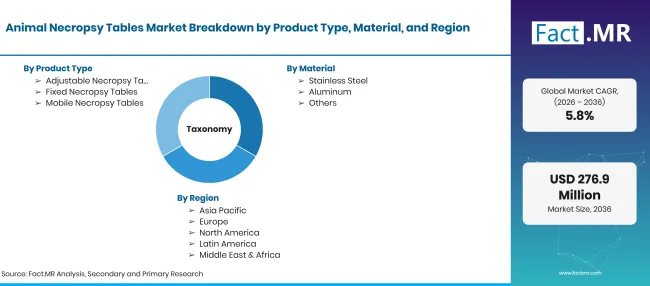
Animal Necropsy Tables Market Taxonomy | Source: Fact.MR
| Attribute | Details |
|---|---|
| Quantitative Units | USD million |
| Market Definition | Purpose-built tables and workstations used for animal post-mortem examination, dissection, tissue sampling and veterinary pathology, with features such as drainage, height adjustment and ventilation. |
| Product Type | Adjustable Necropsy Tables; Fixed Necropsy Tables; Mobile Necropsy Tables |
| Material | Stainless Steel; Aluminum; Others |
| End-User | Veterinary Clinics; Research Laboratories; Academic Institutions; Others |
| Regions Covered | North America; Latin America; Western Europe; Eastern Europe; East Asia; South Asia & Pacific; Middle East & Africa |
| Countries Covered | Germany; Brazil; United States; United Kingdom; Japan |
| Companies Profiled | Mopec; Thermo Fisher Scientific; LEEC Limited; AFOS Group; KUGEL medical; Shank’s Veterinary Equipment |
| Forecast Period | 2026 to 2036 |
| Approach | Facility counts, surveillance network data and supplier product ranges were combined with interviews to size table demand by segment and country. |
Source: Fact.MR analysis. Updated Nov 12, 2026
How is the market segmented?
-
By Product Type
- Adjustable Necropsy Tables
- Fixed Necropsy Tables
- Mobile Necropsy Tables
-
By Material
- Stainless Steel
- Aluminum
- Others
-
By End-User
- Veterinary Clinics
- Research Laboratories
- Academic Institutions
- Others
-
By Region
- North America
- Latin America
- Western Europe
- Eastern Europe
- East Asia
- South Asia & Pacific
- Middle East & Africa
Frequently Asked Questions
How large is the animal necropsy tables market in 2026?
What growth rate will the animal necropsy tables market record?
Which product type leads?
Which material leads?
Which end-user leads?
Which country will grow quickest?
Who are the main companies?
What holds the market back?
Who worked on this report


Preview the report firsthand - request a free sample
Free SampleGet the brochure for pricing and purchase details
Download PDF