- Market Value (2025): USD 10.8 Bn
- Estimated Value (2026): USD 11.5 Bn
- Forecast Value (2036): USD 21.0 Bn
- CAGR (2026-2036): 6.2%
What is the Antiarrhythmic Drugs Market forecast to be worth by 2036?
USD 11.5 billion in 2026 to USD 21.0 billion by 2036 at a 6.2% CAGR.
- Demand for antiarrhythmic drugs was worth USD 10.8 billion in 2025, with Class III medicines accounting for the most prescriptions of prescriptions in hospital and community care.
- Market value will grow from USD 11.5 billion in 2026 to USD 21.0 billion by 2036 as more patients with atrial fibrillation are diagnosed and kept on long-term rhythm control.
- A 6.2% CAGR over 2026 to 2036 reflects steady prescription volume for established generics, joined by newer agents for episodic arrhythmias.
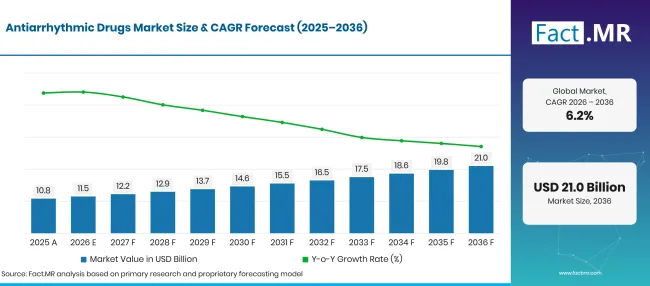
Antiarrhythmic Drugs Market Forecast Global | Source: Fact.MR
| Year | Basis | Market Value (USD billion) |
|---|---|---|
| 2025 | Actual | 10.8 |
| 2026 | Estimate | 11.5 |
| 2036 | Forecast | 21.0 |
| CAGR 2026 to 2036 | Forecast period | 6.2% |
Source: Fact.MR analysis. Updated Nov 2, 2026
What are the defining numbers behind Antiarrhythmic Drugs Market growth?
The 2026 to 2036 period adds USD 9.5 billion in new value, most of it tied to atrial fibrillation care delivered through hospitals.
- Demand Drivers in the Market
- Cardiovascular disease keeps the patient pool wide. The World Health Organization’s July 2025 fact sheet estimates that 19.8 million people died from cardiovascular diseases in 2022, about 32% of all global deaths [1]. Rhythm disorders often accompany heart failure and coronary disease, so this burden feeds steady demand for rhythm-control and rate-control medicines.
- Poorly controlled blood pressure raises the risk of atrial fibrillation over time. WHO’s September 2025 hypertension fact sheet counts about 1.4 billion adults aged 30 to 79 living with hypertension in 2024, and only about 23% have it under control [2]. Many of these adults will reach cardiology clinics with new rhythm problems over the forecast period.
- New approvals are widening the treatment toolkit. The FDA’s list of novel drug approvals for 2025 includes Cardamyst (etripamil), cleared on December 12, 2025 to treat episodes of paroxysmal supraventricular tachycardia [3]. A self-administered nasal spray gives patients an option outside the emergency room.
- Label updates for established injectables keep hospital demand active. The July 2025 FDA prescribing information for intravenous sotalol covers life-threatening ventricular arrhythmias and maintenance of sinus rhythm in highly symptomatic atrial fibrillation or flutter, with QTc checks every 15 minutes during the loading infusion [4]. Such monitoring ties sotalol initiation to hospital settings.
- Key Segments Analyzed
- By Drug Type: Class III will hold 34.7% share in 2026, as amiodarone, sotalol and dofetilide treat both atrial and ventricular rhythm disorders.
- By Application: Atrial Fibrillation will account for 52.3% of 2026 value, given the recurring nature of episodes and the long treatment courses patients need.
- By Distribution Channel: Hospital Pharmacies will capture 44.1% in 2026 since injectable antiarrhythmics and monitored oral starts are dispensed inside institutions.
- By End-User: Hospitals will represent 57.3% of 2026 revenue, owing to emergency cardiac care, telemetry beds and specialist electrophysiology teams.
- Analyst Opinion at Fact.MR
- Shambhu Nath Jha, Principal Consultant at Fact.MR, states, “Atrial fibrillation will keep antiarrhythmic prescribing busy over the next decade even as ablation takes a larger share of rhythm-control decisions. Suppliers that pair reliable generic amiodarone and sotalol supply with clear safety labelling will hold their place in hospital formularies. Agents that move treatment out of the emergency room, such as patient-administered therapies for episodic tachycardia, will open the most new value through 2036.”
- Strategic Implications
- Manufacturers should keep oral and injectable presentations of the same molecule in stock together, since hospitals start many patients on intravenous therapy and move them to tablets before discharge.
- Hospital pharmacists should build dosing and QTc monitoring protocols into order sets for sotalol, dofetilide and amiodarone, which cuts dosing errors and supports faster discharge.
- Prescribers and payers should weigh drug therapy and catheter ablation case by case, because many patients continue antiarrhythmic tablets after an ablation procedure.
- Investors should look at companies with episodic or self-administered therapies, where label expansions and new indications can still add revenue to a largely generic class.
Germany leads the five-country comparison at 7.1%, helped by a high atrial fibrillation death toll and dense hospital cardiology networks. Brazil follows at 6.5% as primary care programmes find more hypertensive patients who later need rhythm care. The United States grows at 5.9% on a large installed base where new agents and label expansions add value. The United Kingdom trails at 5.3%, since national anticoagulation targets draw much of the AF budget. Japan closes the set at 4.7%, where an aged population keeps volumes steady but generic pricing limits value growth.
How does the Antiarrhythmic Drugs Market break down by segment?
Class III will lead Drug Type at 34.7%; Atrial Fibrillation will head Application at 52.3%; Hospital Pharmacies will top Distribution Channel at 44.1%; Hospitals will hold End-User at 57.3% in 2026.
Which Drug Type leads?
Class III holds 34.7% of 2026 sales.
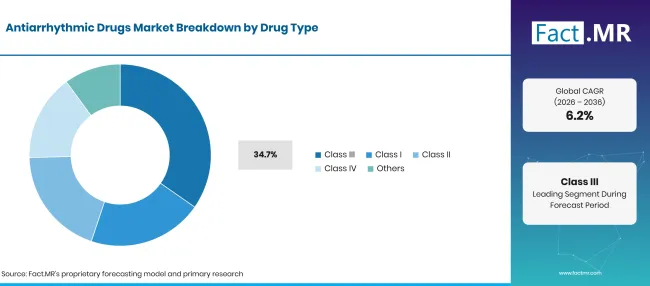
Antiarrhythmic Drugs Market Breakdown Drug Type | Source: Fact.MR
| Drug Type | Share (2026) |
|---|---|
| Class III (Leading segment) | 34.7% |
| Other segments combined | 65.3%* |
| Total | 100.0% |
Source: Fact.MR analysis. Updated Nov 2, 2026
Clinicians reach for Class III agents when they need one drug that works on both the atria and the ventricles. Amiodarone, sotalol and dofetilide prolong repolarisation, which suits patients with structural heart disease where Class I drugs carry more risk. Hikma’s 2025 US injectable catalog lists amiodarone injection among its products, a reminder of how much of this class moves through hospital supply contracts [5]. Class I drugs such as flecainide and propafenone serve patients with structurally normal hearts. Class II beta blockers and Class IV calcium channel blockers act mainly on rate control, and newer agents for supraventricular tachycardia add to Class IV. Other drugs, including digoxin and adenosine, cover niche or acute uses. Many patients also take medicines from the anticoagulants category alongside their rhythm drug.
What supports Atrial Fibrillation within Application?
Atrial Fibrillation takes 52.3% of 2026 revenue.
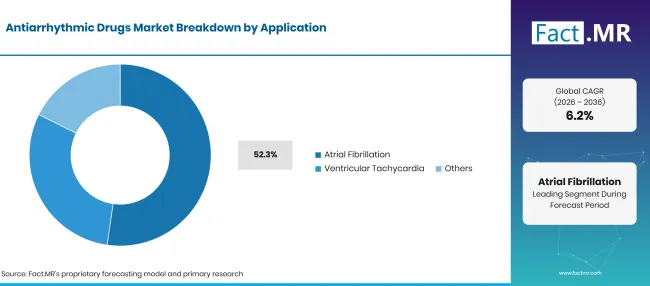
Antiarrhythmic Drugs Market Breakdown Application | Source: Fact.MR
| Application | Share (2026) |
|---|---|
| Atrial Fibrillation (Leading segment) | 52.3% |
| Other segments combined | 47.7%* |
| Total | 100.0% |
Source: Fact.MR analysis. Updated Nov 2, 2026
Episodes return in many patients, so rhythm-control treatment often lasts for years. NHS England’s 2025/26 Quality and Outcomes Framework guidance describes atrial fibrillation as the most common heart rhythm disorder, affecting about 2% of adults [6]. The wider atrial fibrillation treatment space includes drugs, ablation and stroke prevention, and antiarrhythmics cover the medical share of rhythm control. Ventricular tachycardia needs fewer patients but more intensive care, often with intravenous amiodarone or sotalol and an implanted defibrillator as backup. Other applications include supraventricular tachycardia and atrial flutter. Drug choice in each case depends on ejection fraction, kidney function and the risk of QT prolongation.
How does Distribution Channel shape demand?
Hospital Pharmacies capture 44.1% of 2026 value.
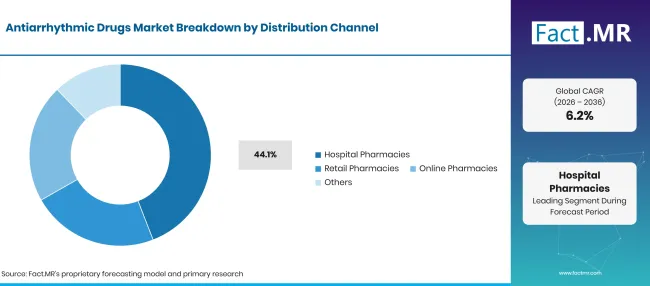
Antiarrhythmic Drugs Market Breakdown Distribution Channel | Source: Fact.MR
| Distribution Channel | Share (2026) |
|---|---|
| Hospital Pharmacies (Leading segment) | 44.1% |
| Other segments combined | 55.9%* |
| Total | 100.0% |
Source: Fact.MR analysis. Updated Nov 2, 2026
Many antiarrhythmic starts happen on a monitored ward, and the hospital pharmacy controls that first supply. Intravenous amiodarone, sotalol and adenosine are stocked for emergency use. Pharmacists also check renal function and electrolytes before oral dofetilide or sotalol is released, which keeps the first doses inside the institution. Retail pharmacies take over once the patient is stable and on maintenance tablets. Online pharmacies serve repeat prescriptions for generic flecainide, amiodarone and beta blockers. Other channels include specialty distributors and government tender supply in public health systems.
How does End-User shape demand?
Hospitals account for 57.3% of 2026 revenue.
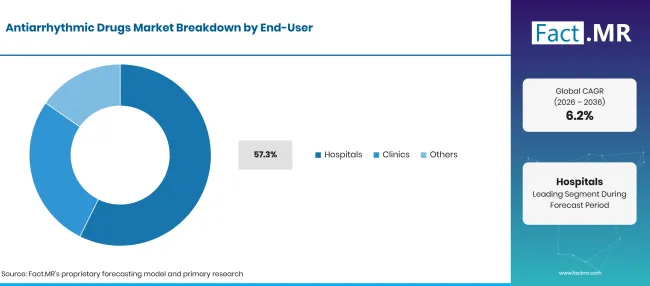
Antiarrhythmic Drugs Market Breakdown End User | Source: Fact.MR
| End-User | Share (2026) |
|---|---|
| Hospitals (Leading segment) | 57.3% |
| Other segments combined | 42.7%* |
| Total | 100.0% |
Source: Fact.MR analysis. Updated Nov 2, 2026
Cardiology departments, emergency units and electrophysiology labs share one building in a hospital, so most acute rhythm cases land there. Teams there run electrophysiology devices for mapping and use antiarrhythmics before and after procedures to hold sinus rhythm. Telemetry beds allow safe loading of drugs that need ECG checks. Clinics handle outpatient follow-up, dose reviews and ECG checks for patients on long-term therapy. Other end-users include specialist cardiac centres and ambulatory surgical sites. Their purchasing depends on patient volume and on whether they can monitor QT intervals on site.
What is accelerating Antiarrhythmic Drugs Market adoption, and what is holding it back?
More diagnosed atrial fibrillation, ageing populations and new agents for episodic tachycardia keep prescriptions rising across hospitals and clinics. Proarrhythmia risk and the cost of ECG and lab monitoring check growth. Wider use of catheter ablation also reduces long-term drug need for some patients. Generic pricing also caps the value of high-volume molecules such as amiodarone.
Drivers Impact Analysis
| DRIVER | (~) % IMPACT ON CAGR | GEOGRAPHIC RELEVANCE | IMPACT TIMELINE |
|---|---|---|---|
| Rising diagnosis of atrial fibrillation in ageing populations | +1.5% | Global | Short term (<= 2 years) |
| Continued use of antiarrhythmics in ventricular arrhythmia care | +1.0% | North America, Western Europe, East Asia | Medium term (2-4 years) |
| Wider access to cardiac diagnosis and specialist treatment | +0.8% | Latin America, South Asia & Pacific | Medium term (2-4 years) |
| Steady demand for generic oral and injectable formulations | +0.6% | Global | Long term (>= 4 years) |
Source: Fact.MR analysis. Updated Nov 2, 2026
Opportunity Impact Analysis
| OPPORTUNITY | (~) % IMPACT ON CAGR | GEOGRAPHIC RELEVANCE | IMPACT TIMELINE |
|---|---|---|---|
| Patient-administered therapies for episodic tachycardia | +0.8% | North America | Short term (<= 2 years) |
| Expansion of cardiac care infrastructure in emerging economies | +0.6% | Latin America, South Asia & Pacific | Medium term (2-4 years) |
| Label expansions into pediatric arrhythmia care | +0.5% | North America, Western Europe | Medium term (2-4 years) |
| Ready-to-use injectable presentations for hospitals | +0.4% | Global | Long term (>= 4 years) |
Source: Fact.MR analysis. Updated Nov 2, 2026
Restraints Impact Analysis
| RESTRAINT | (~) % IMPACT ON CAGR | GEOGRAPHIC RELEVANCE | IMPACT TIMELINE |
|---|---|---|---|
| Proarrhythmia and organ toxicity risks | -0.6% | Global | Short term (<= 2 years) |
| ECG, renal function and electrolyte monitoring needs | -0.4% | Global | Short term (<= 2 years) |
| Competition from catheter ablation procedures | -0.3% | North America, Western Europe, East Asia | Medium term (2-4 years) |
| Generic pricing pressure | -0.2% | Global | Long term (>= 4 years) |
Source: Fact.MR analysis. Updated Nov 2, 2026
Which countries are scaling the Antiarrhythmic Drugs Market through 2036?
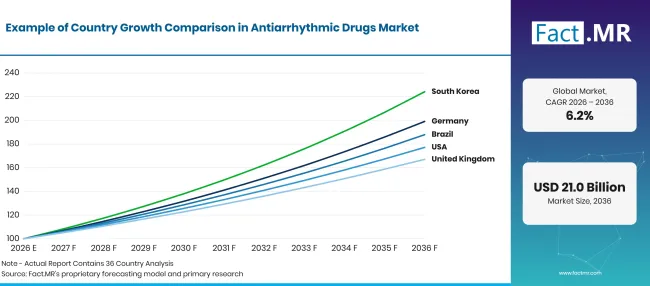
Antiarrhythmic Drugs Market Growth Index | Source: Fact.MR
| Country | CAGR (2026 to 2036) |
|---|---|
| Germany | 7.1% |
| Brazil | 6.5% |
| United States | 5.9% |
| United Kingdom | 5.3% |
| Japan | 4.7% |
Source: Fact.MR analysis. Updated Nov 2, 2026
What gives Germany a strong position in this market?
7.1% CAGR, driven by a heavy atrial fibrillation burden and dense hospital cardiology capacity.
Atrial fibrillation is a visible cause of death in Germany. Federal Statistical Office data for 2025 record 23,514 deaths from atrial fibrillation and flutter, about 7.04% of all deaths from circulatory diseases [7]. Hospitals with electrophysiology units treat many of these patients, and German cardiologists use amiodarone, flecainide and dronedarone across inpatient and outpatient care. Statutory insurance covers both drug therapy and ablation, which keeps total rhythm-care volume high.
How is Brazil developing demand?
6.5% CAGR, backed by primary care programmes that find more patients at cardiac risk.
Brazil’s public health system is putting more effort into cardiovascular risk control. In August 2026 the Pan American Health Organization met with SUS partners on HEARTS 2.0, which aims for at least 80% of primary care units to apply the HEARTS model [8]. A second PAHO meeting the same month advanced HEARTS and wider chronic disease care in São Paulo and Rio de Janeiro [9]. Better detection at primary level will send more patients with rhythm problems to specialist care.
What is supporting United States adoption?
5.9% CAGR, helped by new approvals and label expansions on a large treated base.
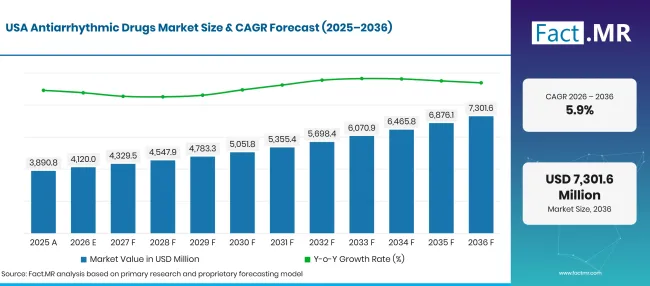
Antiarrhythmic Drugs Market Forecast Usa | Source: Fact.MR
The United States combines a large generic market with active product development. In July 2025, the FDA approved new pediatric indications for AltaThera’s intravenous sotalol, covering life-threatening ventricular arrhythmias and maintenance of sinus rhythm in atrial fibrillation and flutter [10]. The December 2025 approval of etripamil nasal spray added a home-use option for supraventricular tachycardia. Hospitals continue to buy IV amiodarone and sotalol for emergency and telemetry care.
How is the United Kingdom developing demand?
5.3% CAGR, reflecting structured AF care led by primary practice.
NHS England runs atrial fibrillation care through general practice registers and annual reviews. The 2025/26 QOF guidance notes that about 9% of patients with atrial fibrillation at risk of stroke are not on any anticoagulant [6]. That focus on stroke prevention keeps patients under regular review, where rate and rhythm drugs are also adjusted. Specialist centres handle drug loading and ablation referrals.
What supports Japan’s adoption?
4.7% CAGR, as an ageing population keeps treatment volumes steady.
Japan has one of the oldest populations in the world. The Cabinet Office’s FY2025 Annual Report on the Ageing Society records 36.24 million people aged 65 or older as of October 1, 2024, or 29.3% of the population [11]. Atrial fibrillation becomes more common with age, so demand for oral rhythm-control drugs stays firm. Government generic pricing rules limit value growth even as patient numbers hold.
Who leads the Antiarrhythmic Drugs Market?
The market splits into three groups. Originator companies such as Pfizer and Sanofi keep branded oral agents, Tikosyn (dofetilide) and Multaq (dronedarone), in front of cardiologists who treat long-term atrial fibrillation.
Hospital injectable suppliers such as Baxter and Hikma compete on reliable supply and ready-to-use formats. Hikma’s 2025 US injectable catalog lists amiodarone, diltiazem and lidocaine injections [5], while Baxter offers Nexterone premixed amiodarone. Specialist companies form the third group. AltaThera secured FDA approval for new pediatric indications of intravenous sotalol in July 2025 [10] and named a pediatric chief medical officer in March 2026 [12]. Milestone Pharmaceuticals brought Cardamyst (etripamil) nasal spray to the US for episodic tachycardia. Competition through 2036 will turn on safety labelling, hospital supply security and whether new agents can shift care away from the emergency room.
Which companies are the key providers?
Key companies in the Antiarrhythmic Drugs Market include Pfizer Inc., Sanofi, Baxter International Inc., Hikma Pharmaceuticals PLC, AltaThera Pharmaceuticals and Milestone Pharmaceuticals Inc.
- Pfizer Inc.
- Sanofi
- Baxter International Inc.
- Hikma Pharmaceuticals PLC
- AltaThera Pharmaceuticals
- Milestone Pharmaceuticals Inc.
Bibliography
- [1] World Health Organization. (2025, July 31). Cardiovascular diseases (CVDs).
- [2] World Health Organization. (2025, September 25). Hypertension.
- [3] U.S. Food and Drug Administration. (2026, July 8). Novel Drug Approvals for 2025.
- [4] U.S. Food and Drug Administration. (2025, July). Sotalol hydrochloride injection: Prescribing information.
- [5] Hikma Pharmaceuticals USA Inc. (2025, June). 2025 Injectable Product Catalog.
- [6] NHS England. (2025, April 1). Quality and Outcomes Framework guidance for 2025/26.
- [7] Statistisches Bundesamt. (2026, October 9). Häufigste Todesfälle durch Herz-Kreislauf-Erkrankungen 2025.
- [8] Pan American Health Organization. (2026, August 14). HEARTS 2.0 reúne atores do SUS para fortalecer atenção cardiovascular no Brasil.
- [9] Pan American Health Organization. (2026, August 11). OPAS e parceiros avançam na implementação das iniciativas HEARTS e Melhor Atenção às DCNTs no Brasil.
- [10] AltaThera Pharmaceuticals. (2025, July 29). AltaThera Pharmaceuticals’ Sotalol IV receives FDA approval for new pediatric indications.
- [11] Cabinet Office, Government of Japan. (2025, June). Annual Report on the Ageing Society [Summary] FY2025.
- [12] AltaThera Pharmaceuticals. (2026, March 24). AltaThera Pharmaceuticals Names Dr. Jim Perry as Pediatric Chief Medical Officer.
This Report Answers
- How is antiarrhythmic drug revenue divided across drug type, application, distribution channel and end-user?
- Why do Class III agents lead, and where do Class I, II and IV medicines fit in practice?
- What share of demand comes from atrial fibrillation, and how does ventricular tachycardia care differ?
- Where do Germany, Brazil, the United States, the United Kingdom and Japan stand on growth, and what explains the gaps?
- Which originator, injectable and specialist companies compete, and what sets them apart?
- How will safety labelling, generic pricing and catheter ablation affect demand through 2036?
What does the Antiarrhythmic Drugs Market cover?
This study tracks prescription medicines that act on cardiac electrical activity to restore or control heart rhythm. It spans Classes I to IV under the Vaughan Williams system and other agents such as digoxin, adenosine and newer drugs for episodic tachycardia.
Values are measured at manufacturer selling prices in USD billion. Oral and injectable forms are both counted, whether dispensed through hospital, retail or online pharmacies.
What is included in the scope?
Branded and generic antiarrhythmic tablets, capsules and injections used in atrial fibrillation, ventricular tachycardia and other rhythm disorders.
Premixed and ready-to-use intravenous presentations sold to hospitals for acute rhythm control.
Self-administered therapies approved for episodic arrhythmias, such as nasal sprays for supraventricular tachycardia.
Use of these drugs alongside procedures in the electrophysiology ablation field, where they hold rhythm before and after an intervention.
What is excluded from the scope?
Anticoagulants and antiplatelet drugs, even when prescribed to the same patients for stroke prevention.
Pacemakers, implantable defibrillators, ablation catheters and other cardiac devices, such as those in the heart failure treatment devices category.
Diagnostic tests such as ECG services and cardiac biomarker tests used to assess arrhythmia patients.
General antihypertensive medicines that have no approved antiarrhythmic indication.
How Was the Analysis Built?
The analysis draws on 120+ sources, 35+ company portfolios, 25+ countries, and more than 20 industry interviews.
- Primary Research: Primary research includes discussions with manufacturers, service providers, technology developers, distributors, end users, and subject-matter experts. These conversations examine purchasing priorities, product adoption, operational challenges, approval requirements, competitive positioning, and the factors that influence wider market acceptance.
- Desk Research: Desk research covers government statistics, regulatory publications, company filings, trade data, technical studies, industry associations, standards, public policy, and other authoritative sources. Every source used in the analysis is documented in the bibliography.
- Market Sizing and Forecasting: Market estimates combine historical performance, demand indicators, pricing and volume trends, segment shares, company participation, country-level growth, adoption patterns, investment activity, and barriers to market expansion.
- Data Validation and Update Cycle: Findings are validated by comparing primary interviews with public data, company activity, regulatory changes, trade patterns, and industry developments. Regular updates review new product launches, capacity changes, partnerships, approvals, and shifts in commercial adoption.
Segmentation
What is the report’s scope and coverage?
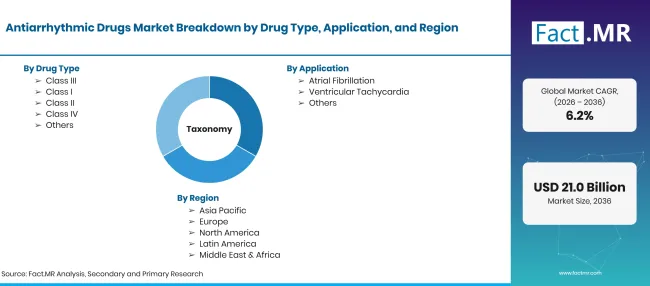
Antiarrhythmic Drugs Market Taxonomy | Source: Fact.MR
| Attribute | Details |
|---|---|
| Quantitative Units | USD billion in 2026 to USD billion by 2036 at CAGR |
| Market Definition | Prescription medicines used to prevent, convert or control abnormal heart rhythms, including atrial fibrillation and ventricular tachycardia, across Vaughan Williams Classes I to IV and other antiarrhythmic agents. |
| Drug Type | Class III; Class I; Class II; Class IV; Others |
| Application | Atrial Fibrillation; Ventricular Tachycardia; Others |
| Distribution Channel | Hospital Pharmacies; Retail Pharmacies; Online Pharmacies; Others |
| End-User | Hospitals; Clinics; Others |
| Regions Covered | North America; Latin America; Western Europe; Eastern Europe; East Asia; South Asia & Pacific; Middle East & Africa |
| Countries Covered | Germany; Brazil; United States; United Kingdom; Japan |
| Companies Profiled | Pfizer Inc.; Sanofi; Baxter International Inc.; Hikma Pharmaceuticals PLC; AltaThera Pharmaceuticals; Milestone Pharmaceuticals Inc. |
| Forecast Period | 2026 to 2036 |
| Approach | Drug class revenue built from prescription volumes, formulation mix and channel pricing, checked against hospital purchasing and cardiology practice. |
Source: Fact.MR analysis. Updated Nov 2, 2026
How is the market segmented?
-
By Drug Type
- Class III
- Class I
- Class II
- Class IV
- Others
-
By Application
- Atrial Fibrillation
- Ventricular Tachycardia
- Others
-
By Distribution Channel
- Hospital Pharmacies
- Retail Pharmacies
- Online Pharmacies
- Others
-
By End-User
- Hospitals
- Clinics
- Others
-
By Region
- North America
- Latin America
- Western Europe
- Eastern Europe
- East Asia
- South Asia & Pacific
- Middle East & Africa
Frequently Asked Questions
How large is the antiarrhythmic drugs market in 2026?
What growth rate will the antiarrhythmic drugs market record?
Which drug type leads?
Which application leads?
Which distribution channel leads?
Which end-user leads?
Which country will grow quickest?
Who are the main companies?
What holds the market back?
Who worked on this report


Preview the report firsthand - request a free sample
Free SampleGet the brochure for pricing and purchase details
Download PDF