- Market Value (2025): USD 19.0 Bn
- Estimated Value (2026): USD 20.6 Bn
- Forecast Value (2036): USD 44.9 Bn
- CAGR (2026-2036): 8.1%
What is the Dementia Drugs Market forecast to be worth by 2036?
USD 20.6 billion in 2026 to USD 44.9 billion by 2036 at an 8.1% CAGR.
- Fact.MR estimates that the dementia drugs market reached USD 19.0 billion in 2025, with oral symptomatic drugs making up most prescriptions.
- By 2036, revenue will rise from USD 20.6 billion in 2026 to USD 44.9 billion as more diagnosed patients start therapy earlier.
- An 8.1% CAGR will carry the market from 2026 to 2036, since antibody treatment adds higher-value courses on top of a large oral base.
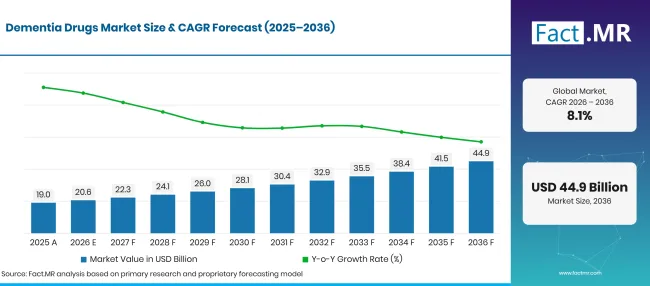
Factmr Dementia Drugs Market Forecast Global | Source: Fact.MR
| Year | Basis | Market Value (USD billion) |
|---|---|---|
| 2025 | Actual | 19.05 |
| 2026 | Estimate | 20.6 |
| 2036 | Forecast | 44.9 |
| CAGR 2026 to 2036 | Forecast period | 8.1% |
Source: Fact.MR analysis. Updated Oct 16, 2026
What are the defining numbers behind Dementia Drugs Market growth?
The 2026 to 2036 period adds USD 24.3 billion in new value, led by early Alzheimer’s treatment.
- Demand Drivers in the Market
- An aging population keeps widening the pool of patients. The World Health Organization reported that 57 million people were living with dementia in 2021, with nearly 10 million new cases each year [1]. Each new diagnosis creates a long treatment course, often lasting several years.
- Anti-amyloid antibodies have moved from the United States into Europe. The European Medicines Agency authorised Leqembi on 15 April 2025 for adults with early Alzheimer’s disease who carry one or no copy of the ApoE ε4 gene [2]. Kisunla followed with EU-wide authorisation on 24 September 2025 [3].
- Blood-based biomarker tests are making diagnosis faster and cheaper. In July 2026, Eli Lilly said it would present data showing that P-tau217 blood tests had rule-in performance comparable to amyloid PET in identifying Alzheimer’s pathology in cognitively unimpaired people [4]. Simpler testing will move more patients from suspicion to a confirmed diagnosis and a prescription.
- Hospital pharmacies and infusion units are building capacity for antibody therapy. Retail pharmacies continue to handle the monthly refills of donepezil, rivastigmine, galantamine and memantine that make up the bulk of prescriptions.
- Key Segments Analyzed
- By Drug Class: Cholinesterase Inhibitors will account for 35.4% share in 2026, as donepezil, rivastigmine and galantamine remain first-line therapy for mild to moderate Alzheimer’s disease.
- By Indication: Alzheimer’s Disease will capture 72.4% share in 2026, given that every approved disease-modifying antibody targets this form of dementia.
- By Distribution Channel: Hospital Pharmacies will hold 45.0% share in 2026 through specialist-led diagnosis, infusion services and the safety monitoring that newer therapies require.
- Analyst Opinion at Fact.MR
- Shambhu Nath Jha, Principal Consultant at Fact.MR, states, “Dementia care now runs on two tracks: oral symptomatic drugs for the broad patient base and antibody therapy for a smaller group with confirmed amyloid pathology. Blood tests and at-home injection formats will decide how fast that second group grows, because infusion chairs and MRI slots are limited. Companies that pair approved therapies with diagnostic support and clear monitoring pathways will capture the most value as treatment rates rise.”
- Strategic Implications
- Drug developers should design trials around biomarker-confirmed patients, since regulators and payers now judge new therapies on outcomes in people with proven amyloid or tau pathology.
- Hospital systems should plan infusion capacity, MRI scheduling and specialist staffing together, given that antibody therapy needs all three during the first months of treatment.
- Retail and online pharmacies should build caregiver support into refill services, as most people on oral dementia drugs rely on a family member to manage doses.
- Payers should agree clear eligibility and monitoring rules early, so that access to costly new therapies is predictable for both clinicians and manufacturers.
Japan will lead the group at 10.0% CAGR, where close to three in ten residents are aged 65 or older and a home-use antibody pen has just been approved. Brazil follows at 9.2% as the public health system widens access to oral Alzheimer’s drugs. Growth in the United Kingdom will reach 8.3%, with high recorded diagnosis rates and an open NICE review of antibody therapy. Germany comes in at 7.3% on the back of an aging population and early EU access to Leqembi. Last in line, the United States will grow at 6.6%, building on a large, established base of symptomatic prescribing.
How does the Dementia Drugs Market break down by segment?
Cholinesterase Inhibitors will lead Drug Class at 35.4%; Alzheimer’s Disease will lead Indication at 72.4%; Hospital Pharmacies will lead Distribution Channel at 45.0%.
Which Drug Class dominates?
Cholinesterase Inhibitors take 35.4% of 2026 sales.
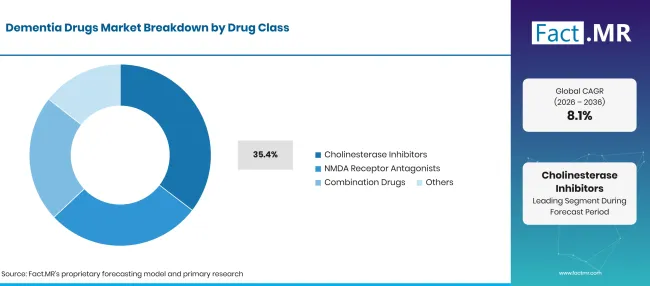
Factmr Dementia Drugs Market Breakdown Drug Class | Source: Fact.MR
| Drug Class | Share (2026) |
|---|---|
| Cholinesterase Inhibitors (Leading segment) | 35.4% |
| Other segments combined | 64.6%* |
| Total | 100.0% |
Source: Fact.MR analysis. Updated Oct 16, 2026
Prescribers reach for donepezil, rivastigmine and galantamine first because these drugs have decades of use, low generic prices and familiar side-effect profiles. Rivastigmine patches help patients who struggle with tablets. Memantine, the main NMDA receptor antagonist, is added for moderate to severe disease, and fixed-dose combinations reduce the pill burden for caregivers. Anti-amyloid antibodies are tracked under Others and will add the most value per patient. Lecanemab had approval in 51 countries and regions by October 2025, including Japan, the United States, Europe and China [5]. Many patients also take drugs for behavioural symptoms, a field covered in Fact.MR’s view of antipsychotic drug demand.
What supports Alzheimer’s Disease within Indication?
Alzheimer’s Disease accounts for 72.4% of 2026 sales.
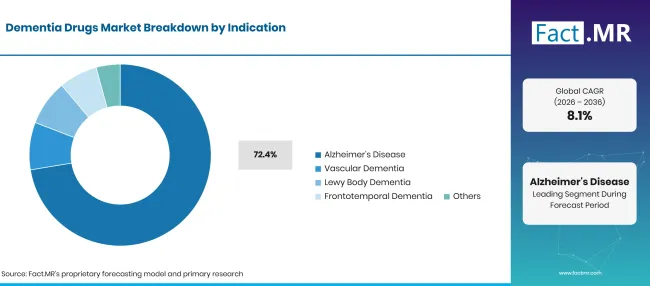
Factmr Dementia Drugs Market Breakdown Indication | Source: Fact.MR
| Indication | Share (2026) |
|---|---|
| Alzheimer’s Disease (Leading segment) | 72.4% |
| Other segments combined | 27.6%* |
| Total | 100.0% |
Source: Fact.MR analysis. Updated Oct 16, 2026
Alzheimer’s disease causes 60% to 70% of all dementia cases, according to the World Health Organization [1]. It is also the only indication with approved disease-modifying drugs, so new launches add revenue here first. Vascular dementia, Lewy body dementia and frontotemporal dementia rely mostly on off-label symptomatic care. Rivastigmine is used in Lewy body disease, and Fact.MR tracks this niche separately in its Lewy body dementia treatment outlook. Frontotemporal dementia still has no approved drug, which leaves room for genetic and protein-targeted candidates.
How does Distribution Channel shape demand?
Hospital Pharmacies represent 45.0% of 2026 sales.
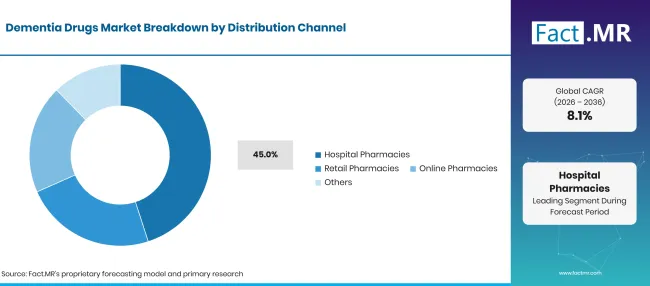
Factmr Dementia Drugs Market Breakdown Distribution Channel | Source: Fact.MR
| Distribution Channel | Share (2026) |
|---|---|
| Hospital Pharmacies (Leading segment) | 45.0% |
| Other segments combined | 55.0%* |
| Total | 100.0% |
Source: Fact.MR analysis. Updated Oct 16, 2026
Memory clinics inside hospitals confirm the diagnosis, start therapy and arrange the MRI scans that antibody treatment needs. Their pharmacies also handle infusion drugs, and staff track infusion reactions with infusion monitoring devices built for the scanner suite. Retail pharmacies dispense the monthly oral refills that most patients need for years. Home injection is opening a new route: the FDA approved LEQEMBI IQLIK as a weekly subcutaneous initiation dose in July 2026, with dispensing through a specialty pharmacy [6]. Online pharmacies serve caregivers who want repeat prescriptions delivered to the home.
What is accelerating Dementia Drugs Market adoption, and what is holding it back?
Earlier diagnosis, new antibody approvals and simpler dosing will widen the treated population through 2036. High prices, payer limits and the need for regular MRI checks will slow uptake, mainly outside high-income markets.
Drivers Impact Analysis
| DRIVER | (~) % IMPACT ON CAGR | GEOGRAPHIC RELEVANCE | IMPACT TIMELINE |
|---|---|---|---|
| Rising dementia prevalence among aging populations | +2.0% | Global | Long term (>= 4 years) |
| Uptake of approved anti-amyloid antibodies | +1.6% | North America, Western Europe, East Asia | Medium term (2-4 years) |
| Wider use of blood biomarker tests and early diagnosis | +1.2% | North America, Western Europe, East Asia | Medium term (2-4 years) |
| Investment in dementia drug research and late-stage pipelines | +0.8% | Global | Long term (>= 4 years) |
Source: Fact.MR analysis. Updated Oct 16, 2026
Opportunity Impact Analysis
| OPPORTUNITY | (~) % IMPACT ON CAGR | GEOGRAPHIC RELEVANCE | IMPACT TIMELINE |
|---|---|---|---|
| Subcutaneous at-home dosing of antibody therapy | +1.2% | North America, East Asia | Medium term (2-4 years) |
| Next-generation antibodies with brain-shuttle delivery | +0.9% | Global | Long term (>= 4 years) |
| Growth in specialist infusion and memory clinic services | +0.6% | North America, Western Europe | Medium term (2-4 years) |
| Public reimbursement of oral drugs in emerging markets | +0.4% | Latin America, South Asia & Pacific | Long term (>= 4 years) |
Source: Fact.MR analysis. Updated Oct 16, 2026
Restraints Impact Analysis
| RESTRAINT | (~) % IMPACT ON CAGR | GEOGRAPHIC RELEVANCE | IMPACT TIMELINE |
|---|---|---|---|
| High treatment costs and reimbursement limits | -0.8% | Global | Short term (<= 2 years) |
| MRI safety monitoring for amyloid-related imaging abnormalities | -0.6% | Global | Medium term (2-4 years) |
| Limited specialist access and diagnostic infrastructure | -0.4% | Latin America, Middle East & Africa | Medium term (2-4 years) |
Source: Fact.MR analysis. Updated Oct 16, 2026
Which countries are scaling the Dementia Drugs Market through 2036?
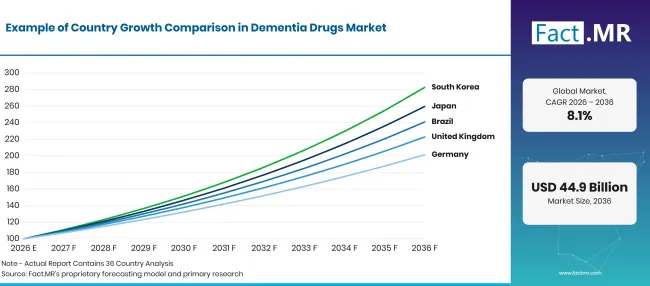
Factmr Dementia Drugs Market Growth Index | Source: Fact.MR
| Country | CAGR (2026–2036) |
|---|---|
| Japan | 10.0% |
| Brazil | 9.2% |
| United Kingdom | 8.3% |
| Germany | 7.3% |
| United States | 6.6% |
Source: Fact.MR analysis. Updated Oct 16, 2026
What supports Japan adoption?
10.0% CAGR, driven by population aging and early access to home-use antibody therapy.
Japan has the oldest population among the listed countries. The Statistics Bureau of Japan reported in September 2025 that 36.19 million people were aged 65 or older, equal to 29.4% of the population [7]. In September 2026, Eisai and Biogen announced Japanese approval of LEQEMBI Pen, a subcutaneous form given as two pens once a week, which a patient or care partner can use at home [8]. Home dosing will ease pressure on hospital infusion units.
How is Brazil scaling demand?
9.2% CAGR, backed by wider public coverage of oral Alzheimer’s drugs.
Brazil’s public health system, the SUS, now covers more stages of Alzheimer’s disease. In May 2025, the Ministry of Health, on the advice of the national health technology commission Conitec, added donepezil to the SUS for patients with severe Alzheimer’s disease, alone or with memantine [9]. Its report estimated 6,411 eligible severe-stage patients in 2025, rising to 10,199 by 2029 [9]. Neurology services remain concentrated in large cities, so regional access will shape uptake.
What supports United Kingdom adoption?
8.3% CAGR, helped by high recorded diagnosis rates in primary care.
The NHS records dementia diagnoses through GP practices, and NHS England reported 516,230 patients with a recorded diagnosis on 30 June 2026 [10]. The estimated diagnosis rate for people aged 65 or older was 66.2% [10]. NICE is still appraising lecanemab, and its project page lists an appeal decision on 20 March 2026 [11]. Wider NHS access to antibody therapy depends on the final appraisal.
How is Germany developing demand?
7.3% CAGR, reflecting an aging population and early EU access to antibody therapy.
Germany’s older population will keep growing. Destatis forecast that one in four residents will be aged 67 or over by 2035, and it counted 6.1 million people aged 80 or over in 2024 [12]. Germany was one of the first EU markets for Leqembi, with launch on 1 September 2025 under a controlled access program that registers each patient centrally [13]. Specialist neurologists start therapy, and statutory insurers fund approved medicines.
How does the United States perform?
6.6% CAGR, on the back of a large, established base of symptomatic prescribing.
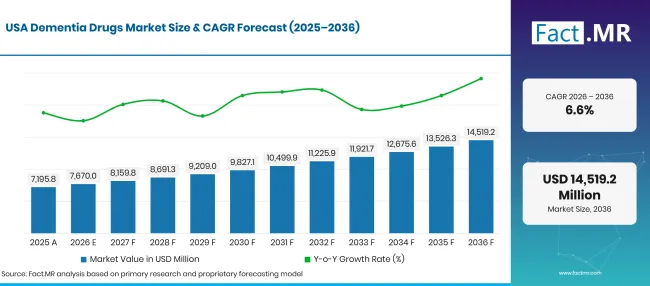
Factmr Dementia Drugs Market Forecast Usa | Source: Fact.MR
Alzheimer’s disease was the sixth leading cause of death in the United States in 2024, with 116,022 deaths, according to the National Center for Health Statistics [14]. Cholinesterase inhibitors and memantine are widely prescribed in generic form, which holds back value growth. New formats will add some momentum, and diagnostic tools from the neurodiagnostic and monitoring devices field will help identify eligible patients.
Who leads the Dementia Drugs Market?
Competition splits into three groups. Antibody developers lead the disease-modifying tier: Eisai and Biogen market Leqembi, and Eli Lilly markets Kisunla.
This group competes on dosing convenience and safety monitoring. Eisai and Biogen won US approval for a subcutaneous initiation dose in July 2026 [6], and Lilly presented P-tau217 blood test data at AAIC 2026 [4]. Roche is the main late-stage challenger, with trontinemab Phase III studies in early Alzheimer’s disease planned to start in 2025 [15], supported by its own Elecsys blood tests. The third group serves symptoms and behaviour. Lundbeck markets memantine, and Otsuka markets Rexulti for agitation linked to Alzheimer’s dementia. These firms compete on long prescriber relationships and broad country registration. Through 2036, the winners will be the companies that make diagnosis, dosing and monitoring easier for clinics with limited capacity.
Which companies are the key providers?
Key companies include Eisai Co., Ltd.; Biogen Inc.; Eli Lilly and Company; F. Hoffmann-La Roche Ltd; H. Lundbeck A/S; and Otsuka Pharmaceutical Co., Ltd.
- Eisai Co., Ltd.
- Biogen Inc.
- Eli Lilly and Company
- F. Hoffmann-La Roche Ltd
- H. Lundbeck A/S
- Otsuka Pharmaceutical Co., Ltd.
Bibliography
- [1] World Health Organization. (2026, July 3). Dementia.
- [2] European Medicines Agency. (2026, August 5). Leqembi.
- [3] European Medicines Agency. (2026, February 26). Kisunla.
- [4] Eli Lilly and Company. (2026, July 9). Lilly to present Alzheimer’s disease diagnostic and therapeutic research at AAIC 2026, including new data on P-tau217 blood tests and amyloid-targeting treatment.
- [5] Biogen Inc. (2025, October 26). Health Canada Grants Authorization for "LEQEMBI" (lecanemab) for the Treatment of Early Alzheimer’s Disease.
- [6] Biogen Inc. (2026, July 13). FDA Approves LEQEMBI IQLIK (lecanemab-irmb) Subcutaneous Injection as an Initiation Dose for Early Alzheimer’s Disease.
- [7] Statistics Bureau of Japan. (2025, September 14). [Statistics on Japan’s elderly] (Statistics Topics No. 146).
- [8] Biogen Inc. (2026, September 16). LEQEMBI Pen (Subcutaneous Formulation of LEQEMBI) Approved in Japan for the Treatment of Early Alzheimer’s Disease.
- [9] Comissão Nacional de Incorporação de Tecnologias no SUS (Conitec), Ministério da Saúde. (2025, May). Relatório de Recomendação nº 976: Donepezila para pacientes com doença de Alzheimer grave [Donepezil for patients with severe Alzheimer’s disease].
- [10] NHS England. (2026, July 30). Primary Care Dementia Data, June 2026.
- [11] National Institute for Health and Care Excellence. (2026, March 20). Lecanemab for treating mild cognitive impairment or mild dementia caused by Alzheimer’s disease [ID4043].
- [12] Statistisches Bundesamt (Destatis). (2025, December 11). By 2035, one quarter of Germany’s population will be aged 67 or over.
- [13] Biogen Inc. (2025, August 25). Austria and Germany to become the first markets in the European Union (EU) to launch LEQEMBI (lecanemab).
- [14] National Center for Health Statistics. (2026, January 29). Mortality in the United States, 2024 (NCHS Data Brief No. 548).
- [15] F. Hoffmann-La Roche Ltd. (2025, July 28). Roche presents new insights in Alzheimer’s disease research across its diagnostics and pharmaceutical portfolios at AAIC.
This Report Answers
- Dementia drug revenue is split by drug class, indication and distribution channel for 2026 to 2036.
- Readers learn which subsegment leads each segment and the clinical reasons behind its 2026 share.
- Aging, diagnosis rates and reimbursement decisions frame the comparison of the five listed countries.
- Profiles group antibody developers, late-stage challengers and symptomatic drug suppliers by how they compete.
- Recent approvals of new dosing formats are traced to show how treatment is moving from infusion chairs to the home.
What does the Dementia Drugs Market cover?
This market brings together pharmaceutical therapies used to manage or treat dementia, including Alzheimer’s disease, vascular dementia, Lewy body dementia and frontotemporal dementia. The established classes are cholinesterase inhibitors such as donepezil, rivastigmine and galantamine, together with the NMDA receptor antagonist memantine.
Combination drugs and newer disease-modifying therapies, including anti-amyloid monoclonal antibodies, are tracked as well. Sales are followed through hospital, retail and online pharmacy channels, and the wider brain medicine field is covered in Fact.MR’s CNS therapeutics study.
What is included in the scope?
Prescription drugs approved to manage or treat dementia are in scope, from oral tablets, capsules and patches to infused or injected antibodies. Fixed-dose products are counted when every active ingredient targets dementia symptoms or disease pathology.
Sales through hospital pharmacies, retail pharmacies and online pharmacies are included at the price paid by the dispensing channel. Specialty pharmacy sales of home-injected antibodies are counted within the matching channel.
What is excluded from the scope?
Supplements, nutraceuticals and brain-health products sold without regulatory approval as dementia therapies are left out. Diagnostic tests, imaging equipment and digital tools from the cognitive assessment and training field are also outside this analysis.
Drugs approved only for other neurological or psychiatric conditions do not count unless dementia is a labeled indication. Non-drug care services, such as nursing homes and day care, are excluded.
How Was the Analysis Built?
The analysis draws on 120+ sources, 35+ company portfolios, 25+ countries, and more than 20 industry interviews.
- Primary Research: Primary research includes discussions with manufacturers, service providers, technology developers, distributors, end users, and subject-matter experts. These conversations examine purchasing priorities, product adoption, operational challenges, approval requirements, competitive positioning, and the factors that influence wider market acceptance.
- Desk Research: Desk research covers government statistics, regulatory publications, company filings, trade data, technical studies, industry associations, standards, public policy, and other authoritative sources. Every source used in the analysis is documented in the bibliography.
- Market Sizing and Forecasting: Market estimates combine historical performance, demand indicators, pricing and volume trends, segment shares, company participation, country-level growth, adoption patterns, investment activity, and barriers to market expansion.
- Data Validation and Update Cycle: Findings are validated by comparing primary interviews with public data, company activity, regulatory changes, trade patterns, and industry developments. Regular updates review new product launches, capacity changes, partnerships, approvals, and shifts in commercial adoption.
Segmentation
What is the report’s scope and coverage?
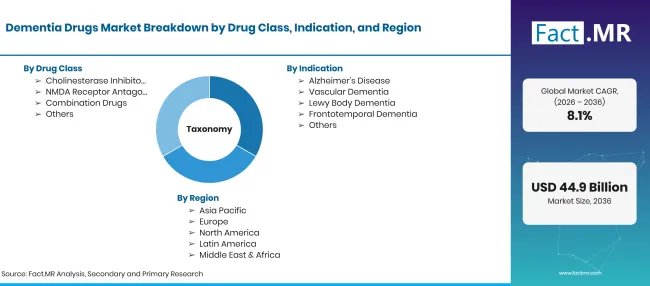
Factmr Dementia Drugs Market Taxonomy | Source: Fact.MR
| Attribute | Details |
|---|---|
| Quantitative Units | USD billion |
| Market Definition | Prescription drugs used to treat dementia and its symptoms, including oral symptomatic therapies and disease-modifying antibodies. Revenue is counted at the point of sale through hospital, retail and online pharmacies. |
| Drug Class | Cholinesterase Inhibitors; NMDA Receptor Antagonists; Combination Drugs; Others |
| Indication | Alzheimer’s Disease; Vascular Dementia; Lewy Body Dementia; Frontotemporal Dementia; Others |
| Distribution Channel | Hospital Pharmacies; Retail Pharmacies; Online Pharmacies; Others |
| Regions Covered | North America; Latin America; Western Europe; Eastern Europe; East Asia; South Asia & Pacific; Middle East & Africa |
| Countries Covered | Japan; Brazil; United Kingdom; Germany; United States |
| Companies Profiled | Eisai Co., Ltd.; Biogen Inc.; Eli Lilly and Company; F. Hoffmann-La Roche Ltd; H. Lundbeck A/S; Otsuka Pharmaceutical Co., Ltd. |
| Forecast Period | 2026 to 2036 |
| Approach | Hybrid top-down and bottom-up approach using diagnosed patient pools; treatment rates by drug class; regulatory approval status by country; channel mix; and pricing of branded and generic therapies. |
Source: Fact.MR analysis. Updated Oct 16, 2026
How is the market segmented?
-
By Drug Class
- Cholinesterase Inhibitors
- NMDA Receptor Antagonists
- Combination Drugs
- Others
-
By Indication
- Alzheimer’s Disease
- Vascular Dementia
- Lewy Body Dementia
- Frontotemporal Dementia
- Others
-
By Distribution Channel
- Hospital Pharmacies
- Retail Pharmacies
- Online Pharmacies
- Others
-
By Region
- North America
- Latin America
- Western Europe
- Eastern Europe
- East Asia
- South Asia & Pacific
- Middle East & Africa
Frequently Asked Questions
How big is the dementia drugs market in 2026?
What is the CAGR of the dementia drugs market from 2026 to 2036?
Which drug class leads the dementia drugs market?
Low generic prices and long clinical use give cholinesterase inhibitors 35.4% of 2026 sales.
Which distribution channel leads the dementia drugs market?
Which country will grow the most in the dementia drugs market?
Who are the main companies in the dementia drugs market?
Who worked on this report


Preview the report firsthand - request a free sample
Free SampleGet the brochure for pricing and purchase details
Download PDF